Loss to follow-up before and after initiation of
antiretroviral therapy in HIV facilities in
Lilongwe, Malawi
Hannock Tweya1,2*, Ikwo Kitefre Oboho3, Salem T. Gugsa2,4, Sam Phiri2,5,6, Ethel Rambiki7, Rebecca Banda2, Johnbosco Mwafilaso2, Chimango Munthali8, Sundeep Gupta9, Moses Bateganya3, Alice Maida9
1 The International Union Against Tuberculosis and Lung Disease, Paris, France, 2 Lighthouse Trust,
Lilongwe, Malawi, 3 Division of Global HIV and Tuberculosis (DGHT), Center for Global Health, Centers for Disease Control and Prevention (CDC), Atlanta, Georgia, United States of America, 4 International Training and Education Center for Health (I-TECH), Lilongwe, Malawi, 5 Department of Public Health, School of Public Health and Family Medicine, College of Medicine, University of Malawi, Lilongwe, Malawi, 6 Department of Medicine, School of Medicine, University of North Carolina Chapel Hill, Chapel Hill, NC, United States of America, 7 Bwaila Hospital, Ministry of Health, Lilongwe, Malawi, 8 Baobab Health Trust, Lilongwe, Malawi,
9 Division of Global HIV and Tuberculosis (DGHT), Center for Global Health, Centers for Disease Control and
Prevention (CDC), Lilongwe, Malawi
Abstract
Introduction
Although several studies have explored factors associated with loss to follow-up (LTFU) from HIV care, there remains a gap in understanding how these factors vary by setting, vol-ume of patient and patients’ demographic and clinical characteristics. We determined rates and factors associated with LTFU in HIV care Lilongwe, Malawi.
Methods
We conducted a retrospective cohort study of HIV-infected individuals aged 15 years or older at the time of registration for HIV care in 12 ART facilities, between April 2012 and March 2013. HIV-positive individuals who had not started ART (pre-ART patients) were clini-cally assessed to determine ART eligibility at registration and during clinic follow-up visits. ART-eligible patients were initiated on triple antiretroviral combination. Study data were abstracted from patients’ cards, facility ART registers or electronic medical record system from the date of registration for HIV care to a maximum follow-up period of 24 months. Descriptive statistics were undertaken to summarize characteristics of the study patients. Separate univariable and multivariable poisson regression models were used to explore fac-tors associated with LTFU in pre-ART and ART care.
Results
A total of 10,812 HIV-infected individuals registered for HIV care. Of these patients, 1,907 (18%) and 8,905 (82%) enrolled in ART and ART care, respectively. Of the 1,907 pre-ART patients, 490 (26%) subsequently initiated pre-ART and were included in both the pre-pre-ART
a1111111111 a1111111111 a1111111111 a1111111111 a1111111111
OPEN ACCESS
Citation: Tweya H, Oboho IK, Gugsa ST, Phiri S,
Rambiki E, Banda R, et al. (2018) Loss to follow-up before and after initiation of antiretroviral therapy in HIV facilities in Lilongwe, Malawi. PLoS ONE 13(1): e0188488.https://doi.org/10.1371/journal. pone.0188488
Editor: Eduard J. Beck, NPMS-HHC CIC / LSH&TM,
UNITED KINGDOM
Received: December 5, 2016
Accepted: November 8, 2017
Published: January 26, 2018
Copyright: This is an open access article, free of all
copyright, and may be freely reproduced, distributed, transmitted, modified, built upon, or otherwise used by anyone for any lawful purpose. The work is made available under theCreative Commons CC0public domain dedication.
Data Availability Statement: The data contain
and ART analyses. The LTFU rates among patients in pre-ART and ART care were 48 and 26 per 100 person-years, respectively. Of the 9,105 ART patients with reasons for starting ART, 2,451 (27%) were initiated on ART because of pregnancy or breastfeeding (Option B+) status. Multivariable analysis showed that being35 years and female were associated with decreased risk of LTFU in the pre-ART and ART phases of HIV care. However, being in WHO clinical stage 3 (adjusted risk ratio (aRR) 1.35, 95% confidence interval (CI): 1.20– 1.51) and stage 4 (aRR 1.87, 95% CI: 1.62–2.18), body mass index18.4 (aRR 1.24, 95% CI: 1.11–1.39) at ART initiation, poor adherence to clinic appointments (aRR 4.55, 95% CI: 4.16–4.97) and receiving HIV care in rural facilities (aRR 2.32, 95% CI: 1.94–2.87) were associated with increased risk of LTFU among ART patients. Being re-initiated on ART once (aRR 0.20, 95% CI: 0.17–0.22), more than once (aRR 0.06, 95% CI: 0.05–0.07), and being enrolled at a low-volume facility (aRR 0.25, 95% CI: 0.20–0.30) were associated with decreased risk of LTFU from ART care.
Conclusion
A sizeable proportion of ART LTFU occurred among women enrolled during pregnancy or breast-feeding. Non- compliance to clinic and receiving ART in a rural facility or high-volume facility were associated with increased risk of LTFU from ART care. Developing effective interventions that target high-risk subgroups and contexts may help reduce LTFU from HIV care.
Introduction
Increased access to antiretroviral therapy (ART) in resource-limited settings is an unprece-dented success story for HIV programs. As of June 2015, 15.8 million people received ART globally, the majority, 10.7 million in sub-Saharan Africa (SSA)[1], a tremendous increase from just over 0.8 million people in 2005 [2]. However, these successes are being challenged by high rates of loss to follow-up (LTFU) [3].
LTFU from HIV care is a major public health concern. LTFU increases the risk of drug resistance and treatment failure in cases where death is not the reason for LTFU. Previous studies showed that patients with treatment interruptions are more likely to develop treatment failure [4,5], viral rebound, and clinically significant drug resistance [4]. At the national pro-gram and clinic levels, not accounting for LTFU may bias retention estimates and misdirect resources when planning and budgeting for HIV care [6].
Factors and reasons for LTFU at patient and system levels include advanced HIV disease, older age, male gender, longer distance to clinics in patients not on ART, unregistered trans-fers out and undocumented deaths in patients on ART [6–9]. Factors associated with LTFU remain complex. Comparing facility characteristics in urban and rural HIV with varying patient volumes may inform the design of intervention that optimize retention.
Effective early patient tracing may reduce LTFU and improve retention. However, tracing all patients who have missed appointments and those LTFU can be resource and time-inten-sive. As such, the Malawi guidelines recommend prioritizing tracing patients that miss ART appointment or those eligible for ART [10]. Despite this guidance, implementation is chal-lenged by health systems constraints including chronic human resource shortages and limited health infrastructure; as a result, facility- and community-level interventions to improve reten-tion differs widely across the country.
individual may email the data manager:
[email protected] access data.
Funding: The United States Centers for Disease
Control and Prevention (CDC) funded the study. The funders had no role in study design, data collection and analysis, decision to publish, or preparation of the manuscript.
Competing interests: The authors have declared
Optimizing retention by mitigating the varying risk factors for LTFU may greatly impact Malawi’s trajectory towards epidemic control. Retention interventions may be optimised in terms of person, place, and time by identifying individual-level or context specific risk factors that may predispose a patient to be LTFU. This paper describes LTFU and associated factors in pre-ART and ART patients at 12 ART facilities, prior to the implementation of a quality improvement (QI) collaborative aimed at optimizing retention in care in Lilongwe district, Malawi.
Methods
Setting
Data used for this study was obtained from five rural and seven urban ART facilities in Lilongwe District, Malawi. All six high-volume ART facilities, with more than 400 new ART patients per year, used an electronic medical records system (EMRs) for patient management and the remaining low-volume facilities used paper-based systems. Five high-volume facilities were located in urban setting while one high-volume facility was in rural setting. HIV-infected adults were registered for HIV care in the EMRs or paper patient cards. During the observa-tion period, ART eligibility was defined in accordance with the naobserva-tional guidelines: World Health organisation (WHO) clinical stage 3 or 4 or having a CD4 count of350 cells/μl. Preg-nant and breastfeeding women were also considered eligible irrespective of their CD4 count or WHO clinical stage as Malawi had adopted Option B+ for prevention of mother-to-child transmission (PMTCT) of HIV. Pre-ART patients, HIV-positive individuals who had not started ART (pre-ART patients), were clinically assessed based on WHO clinical criteria every 2 months to determine ART eligibility. For those not eligible based on WHO clinical stage, CD4 was repeated every 6 months when feasible. Therefore, CD4 data were generally available for patients in WHO stage 1 or 2. At each visit, pre-ART and ART patients received co-trimox-azole as prophylaxis to prevent opportunistic infections. ART-eligible patients were initiated on triple antiretroviral (ARV) combination: Tenofovir, Lamivudine, and Efavirenz and routine follow-up visits were scheduled monthly or every two months. Based on the data collection system, subsequent ART clinic appointments were either calculated manually or electronically based on the ARV regimen and prescribed schedule, number of tablets dispensed, and the number of tablets remaining from the previous dispensing visit. ART programme outcomes (alive and on ART, stopped ART, or transferred-out) were updated on the patient card or in EMRs at each clinic visit or retrospectively. Stopping ART, transferring care or death were also updated retrospectively in facilities with patient tracing systems.
Study design and population
This retrospective cohort study used routine clinic data collected from HIV-infected individu-als who were 15 years of age or older at the time of registration for HIV care in the ART facili-ties, between April 2012 and March 2013.
Variable definitions
recorded transfer to another clinic, (iii) “dead” if the patient died from any cause. Other vari-ables of interest were adherence to clinic appointments and ART re-initiation. Adherence to clinic appointments was defined as having at least 80% of the ART visitsbefore7 days after a scheduled appointment. Re-initiation was defined as restarting ART treatment after stopping ART for at least 60 days.
Data collection and statistical analysis
Data were abstracted from individual patient cards, facility ART registers or EMRs from the date a patient registered at an HIV facility up to a maximum follow-up period of 24 months. Patients who initially registered for pre-ART services and later started ART had their data abstracted for pre-ART and for ART follow-up periods. A time-to-event analysis was con-ducted for pre-ART and ART times, separately. For person-time calculation, the analysis period began when patients enrolled in pre-ART care or initiated ART at the facility. Observa-tion of ‘time at risk’ for LTFU during pre-ART care ended either at the time of an outcome (started ART, LTFU, transfer-out, or death) or at 24 months after pre-ART registration. For ART patients, observation of ‘time at risk’ of LTFU ended either at the time of an outcome (stopped ART, LTFU, transferred-out, or death) or at 24 months after ART registration. Sepa-rate Poisson regression models were used to explore factors associated with LTFU in pre-ART and ART care. A null hypothesis of no within-facility clustering, versus the alternative of some within-facility clustering were tested (p = 0.065). All the analysis did not account for clustering at facility level because within facility variability was not significant. The models were adjusted for age and sex,a priori. Model results were shown as risk ratios (RR) and adjusted RR (aRR) with 95% confidence intervals (CI).
Ethics approval
The study was approved by the Malawi National Health Science Research Committee in Lilongwe, Malawi and by the office of the Associate Director for Science of the U.S. Centers for Disease Control and Prevention in Atlanta, Georgia.
Results
A total of 10,812 HIV-positive individuals were enrolled into HIV care at the 12 facilities between April 2012 and March 2013; of these patients, 1,907 (18%) registered for pre-ART care and 8,905 (82%) for ART care. Of the 1,907 pre-ART patients, 490 (26%) subsequently started ART and were included in both the pre-ART and ART analyses, resulting in a total of 9397 ART patients. The majority of patients were enrolled in six high-volume facilities; 1,681 (88%) of pre-ART patients and 8,390 (89%) of ART patients. On average, low-volume facilities enrolled 170 (range 99−221) patients per year while large volume facilities enrolled 1330 (range 403−4133) patients per year. There were no significant differences in demographic characteristics between patients enrolled at low and high volume facilities.
Pre-ART patients
ART patients
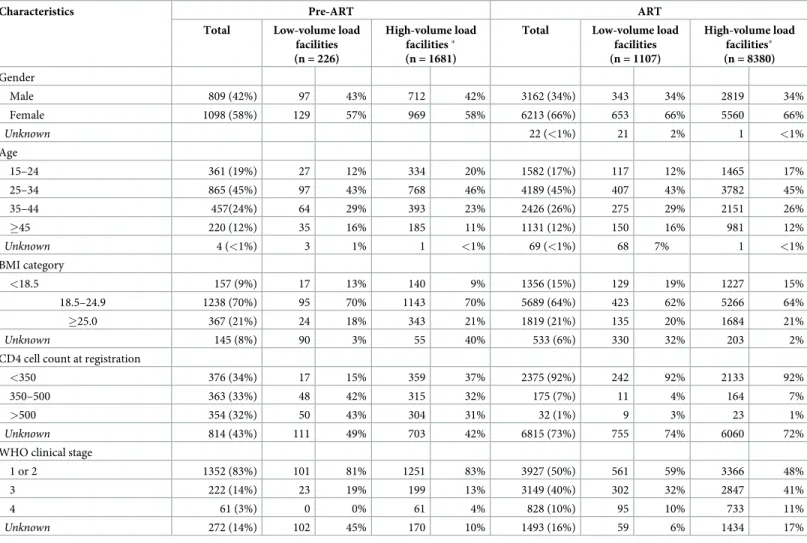
Of the 9,397 ART patients, 6,213 (66%) were female (Table 1). Median age at ART initiation
was 32 years (IQR: 27−38) and the majority (45%) of patients were aged 25−34 years. Among those with documented WHO clinical stage, 50% had WHO stage 3 or 4 conditions. Among ART patients with documented CD4 counts, women had higher median CD4 counts at ART initiation than men, 241 cells/μl and 186 cells/μl, respectively. Of all patients who initiated ART, 2,451 (26%) were pregnant or breastfeeding and started on ART for PMTCT and 8,380 (89%) were enrolled at high-volume facilities.
Pre-ART and ART program outcomes by facility size
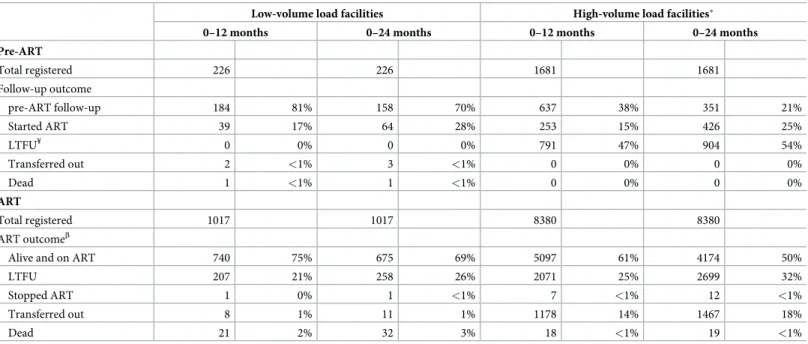
Median follow-up time for the 1,907 pre-ART patients was 8.5 (2.4−23) months. Overall rate of LTFU was 48 (95% CI, 45−52) per 100 person-years. Low-volume facilities did not docu-ment any LTFU patients at 12 or 24 months of follow-up (Table 2). In contrast, among 1,681 pre-ART patients enrolled for HIV care at high-volume facilities, 47% were LTFU after 12 months of follow-up; at 24 months, 54% patients were LTFU. There were no patients reported
Table 1. Baseline characteristics of HIV-infected persons who registered for pre-ART and ART care between April 2012 and March 2013 in Lilongwe, Malawi.
Characteristics Pre-ART ART
Total Low-volume load facilities (n = 226)
High-volume load facilities (n = 1681)
Total Low-volume load facilities (n = 1107)
High-volume load facilities (n = 8380)
Gender
Male 809 (42%) 97 43% 712 42% 3162 (34%) 343 34% 2819 34%
Female 1098 (58%) 129 57% 969 58% 6213 (66%) 653 66% 5560 66%
Unknown 22 (<1%) 21 2% 1 <1%
Age
15–24 361 (19%) 27 12% 334 20% 1582 (17%) 117 12% 1465 17%
25–34 865 (45%) 97 43% 768 46% 4189 (45%) 407 43% 3782 45%
35–44 457(24%) 64 29% 393 23% 2426 (26%) 275 29% 2151 26%
45 220 (12%) 35 16% 185 11% 1131 (12%) 150 16% 981 12%
Unknown 4 (<1%) 3 1% 1 <1% 69 (<1%) 68 7% 1 <1%
BMI category
<18.5 157 (9%) 17 13% 140 9% 1356 (15%) 129 19% 1227 15%
18.5–24.9 1238 (70%) 95 70% 1143 70% 5689 (64%) 423 62% 5266 64%
25.0 367 (21%) 24 18% 343 21% 1819 (21%) 135 20% 1684 21%
Unknown 145 (8%) 90 3% 55 40% 533 (6%) 330 32% 203 2%
CD4 cell count at registration
<350 376 (34%) 17 15% 359 37% 2375 (92%) 242 92% 2133 92%
350–500 363 (33%) 48 42% 315 32% 175 (7%) 11 4% 164 7%
>500 354 (32%) 50 43% 304 31% 32 (1%) 9 3% 23 1%
Unknown 814 (43%) 111 49% 703 42% 6815 (73%) 755 74% 6060 72%
WHO clinical stage
1 or 2 1352 (83%) 101 81% 1251 83% 3927 (50%) 561 59% 3366 48%
3 222 (14%) 23 19% 199 13% 3149 (40%) 302 32% 2847 41%
4 61 (3%) 0 0% 61 4% 828 (10%) 95 10% 733 11%
Unknown 272 (14%) 102 45% 170 10% 1493 (16%) 59 6% 1434 17%
High-volume load facilities enrolled at least 400 ART patients per year
BMI: body mass index; ART: antiretroviral therapy, unknown category is excluded in the percentage calculations
as transferred-out or dead both at 12 and 24 months of follow-up in pre-ART care at high-vol-ume facilities.
Of the 9,397 ART patients, 49 had missing outcomes and 9,348 ART patients contributed 11,527 person-years. The overall rate of LTFU in ART patients was 26 (95% CI 25–27) per 100 person-years and the median follow-up was 20.9 (IQR 3–23) months. ART outcomes were not documented in 49 patients: 40 enrolled in low-volume facilities and 9 in high-volume facilities. At 12 months post-ART initiation, more patients were reported to be alive and on ART in low-volume facilities than in high-volume facilities (p<0.001) and the difference was still sig-nificant at 24 months (Table 2).
Factors associated with loss to follow-up from pre-ART and ART care
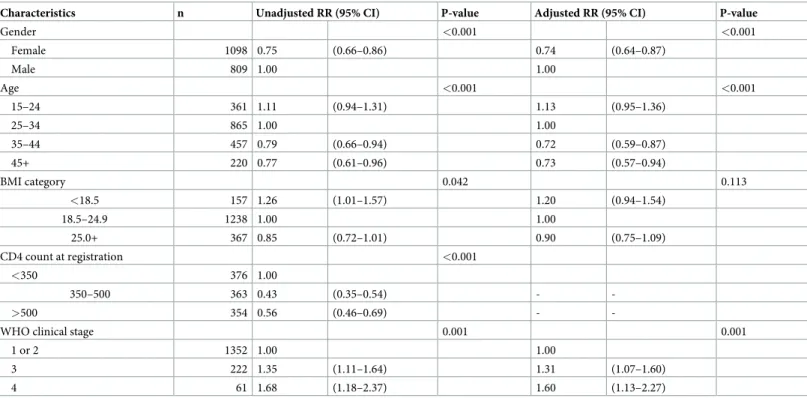
In univariable analysis of pre-ART patients, having a body mass index (BMI)<18.4, baseline WHO stage 3 and stage 4 were associated with an increased risk of LTFU (Table 3). Being female, age 35−44 years, or age45 years and having a baseline CD4 count of>350 cells/μl were associated with a decreased risk of LTFU. These factors remained significantly associated with LTFU after adjusting for potential confounders in the multivariable analysis.
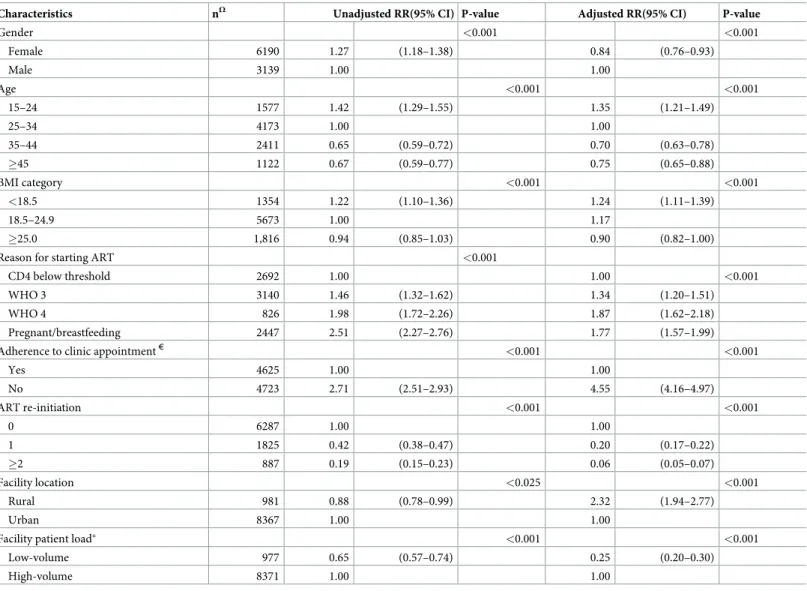
In univariable analysis of ART patients, being female, younger age 15−24 years, BMI<18.5, baseline WHO stages 3 and 4 were associated with increased risk of LTFU (Table 4). Women who started ART based on Option B+ criteria had a higher risk of LTFU than patients who started ART based on CD4 count. The risk of LTFU was higher among patients who were not adherent to scheduled clinic appointments compared to those who were adherent. Predictors of decreased risk of LTFU included age 35years and above, being re-initiated on ART once, being enrolled at a low-volume facility and receiving care from an urban facility.
Table 2. ART program outcomes by time in HIV care among HIV-infected persons who registered for pre-ART and ART care between April 2012 and March 2013 in Lilongwe, Malawi.
Low-volume load facilities High-volume load facilities
0–12 months 0–24 months 0–12 months 0–24 months
Pre-ART
Total registered 226 226 1681 1681
Follow-up outcome
pre-ART follow-up 184 81% 158 70% 637 38% 351 21%
Started ART 39 17% 64 28% 253 15% 426 25%
LTFU¥ 0 0% 0 0% 791 47% 904 54%
Transferred out 2 <1% 3 <1% 0 0% 0 0%
Dead 1 <1% 1 <1% 0 0% 0 0%
ART
Total registered 1017 1017 8380 8380
ART outcomeβ
Alive and on ART 740 75% 675 69% 5097 61% 4174 50%
LTFU 207 21% 258 26% 2071 25% 2699 32%
Stopped ART 1 0% 1 <1% 7 <1% 12 <1%
Transferred out 8 1% 11 1% 1178 14% 1467 18%
Dead 21 2% 32 3% 18 <1% 19 <1%
High-volume load facilities enrolled at least 400 ART patients per year
¥
LTFU: Loss to follow-up
β40 patients had no ART outcomes in paper-based facilities and 9 had no ART outcomes in EMR-based facilities
In the multivariable analysis of ART patients, the association between baseline age, BMI, reason for starting ART, adherence to clinic appointments, ART re-initiation and patient vol-ume facility and LTFU remained significant; the risk of LTFU among patients who were not adherent to clinic appointments was more pronounced (Table 4). After adjusting for other fac-tors, the associations between gender and location of the facility with LTFU were reversed; being female, and receiving ART at a rural facility associated with an increased risk of LTFU. Adherence to scheduled clinic appointments was poor if the reason for starting ART was preg-nancy, breastfeeding, WHO stages 3 or 4 unlike in cases where treatment was started solely based on a CD4 count of less than 350 cells/μl.
Discussion
This study describes LTFU from pre-ART and ART care at urban and rural HIV facilities with low and high patient volumes. Overall LTFU was 48% and 26% per year in the pre-ART and ART cohorts, respectively. Among the pre-ART and ART cohorts, being 35 years of age or older and female were associated with reduced risk of LTFU. Advanced WHO clinical stage, low BMI at ART initiation, poor adherence to clinic appointments and receiving HIV care in rural facilities on the other hand were associated with increased risk of LTFU among ART patients. Re-initiation of ART and receiving ART care at low-volume facilities on the other hand were associated with decreased risk of LTFU.
Our findings highlight critical LTFU issues in pre-ART and ART cohorts. In the pre-ART cohort, we observed an overall LTFU of 48% per year, which falls within the range of 23–88% reported in a systematic review from SSA[11]. However, LTFU in our study was higher than
Table 3. Univariable and multivariable model of characteristics associated with loss to follow-up from pre-ART care in Lilongwe, Malawi.
Characteristics n Unadjusted RR (95% CI) P-value Adjusted RR (95% CI) P-value
Gender <0.001 <0.001
Female 1098 0.75 (0.66–0.86) 0.74 (0.64–0.87)
Male 809 1.00 1.00
Age <0.001 <0.001
15–24 361 1.11 (0.94–1.31) 1.13 (0.95–1.36)
25–34 865 1.00 1.00
35–44 457 0.79 (0.66–0.94) 0.72 (0.59–0.87)
45+ 220 0.77 (0.61–0.96) 0.73 (0.57–0.94)
BMI category 0.042 0.113
<18.5 157 1.26 (1.01–1.57) 1.20 (0.94–1.54)
18.5–24.9 1238 1.00 1.00
25.0+ 367 0.85 (0.72–1.01) 0.90 (0.75–1.09)
CD4 count at registration <0.001
<350 376 1.00
350–500 363 0.43 (0.35–0.54) -
->500 354 0.56 (0.46–0.69) -
-WHO clinical stage 0.001 0.001
1 or 2 1352 1.00 1.00
3 222 1.35 (1.11–1.64) 1.31 (1.07–1.60)
4 61 1.68 (1.18–2.37) 1.60 (1.13–2.27)
RR: risk ratio; CI: confidence interval; adjusted models were based on available data only; CD4 was excluded in the multivariable analysis because data were available in 57% only
previously reported among pre-ART patients in Malawi possibly because of different defini-tions of pre-ART patients[12][13]. Other studies used a limited definition of pre-ART patients i.e. including only those in WHO stage 1 and 2 who were not eligible to start ART. In this study, we defined pre-ART patients more broadly as all persons newly enrolled in HIV care who had not started ART three months post-clinic registration, regardless of their clinical stage or CD4 count. All low-volume facilities, using paper-based data management systems, did not document LTFU status in pre-ART patient card, despite the national guidelines rec-ommendation to document and report all persons who have missed their appointments by 60 days as LTFU. High-volume facilities, on the other hand, have an in-built EMR feature that automatically assigns LTFU status while paper-based systems require that staff review and
Table 4. Univariable and multivariable model of characteristics associated with loss to follow-up from ART care in Lilongwe, Malawi.
Characteristics nΩ Unadjusted RR(95% CI) P-value Adjusted RR(95% CI) P-value
Gender <0.001 <0.001
Female 6190 1.27 (1.18–1.38) 0.84 (0.76–0.93)
Male 3139 1.00 1.00
Age <0.001 <0.001
15–24 1577 1.42 (1.29–1.55) 1.35 (1.21–1.49)
25–34 4173 1.00 1.00
35–44 2411 0.65 (0.59–0.72) 0.70 (0.63–0.78)
45 1122 0.67 (0.59–0.77) 0.75 (0.65–0.88)
BMI category <0.001 <0.001
<18.5 1354 1.22 (1.10–1.36) 1.24 (1.11–1.39)
18.5–24.9 5673 1.00 1.17
25.0 1,816 0.94 (0.85–1.03) 0.90 (0.82–1.00)
Reason for starting ART <0.001
CD4 below threshold 2692 1.00 1.00 <0.001
WHO 3 3140 1.46 (1.32–1.62) 1.34 (1.20–1.51)
WHO 4 826 1.98 (1.72–2.26) 1.87 (1.62–2.18)
Pregnant/breastfeeding 2447 2.51 (2.27–2.76) 1.77 (1.57–1.99)
Adherence to clinic appointment€ <0.001 <0.001
Yes 4625 1.00 1.00
No 4723 2.71 (2.51–2.93) 4.55 (4.16–4.97)
ART re-initiation <0.001 <0.001
0 6287 1.00 1.00
1 1825 0.42 (0.38–0.47) 0.20 (0.17–0.22)
2 887 0.19 (0.15–0.23) 0.06 (0.05–0.07)
Facility location <0.025 <0.001
Rural 981 0.88 (0.78–0.99) 2.32 (1.94–2.77)
Urban 8367 1.00 1.00
Facility patient load <0.001 <0.001
Low-volume 977 0.65 (0.57–0.74) 0.25 (0.20–0.30)
High-volume 8371 1.00 1.00
ΩIncluded only patients with follow-up time; RR: risk ratio, CI: confidence interval
High-volume load facilities enrolled at least 400 ART patients per year
€Compliance; at least 80% of visits happened before 7 days after the scheduled clinic appointment date; ART re-initiation; starting ART after failure to come to the clinic
for at least 60 days from the date the patient was expected to return to the clinic: Some patients had no data for age (46(<1%), reason for starting ART (224(2%)) and ART reinitiation (349(4%)
update patient cards for patients who are LTFU. Documentation of some data elements was suboptimal at low-volume facilities compared to high-volume facilities. For example, BMI and WHO clinical stage were not documented for 40% and 45% of the pre-ART patients’ records respectively versus 3% and 10% in high-volume facilities with EMR. In addition, the LTFU rates were almost twice as high in the pre-ART cohort compared to ART cohort. This may be because of less attention being given to towards interventions that reduce LTFU in pre-ART prior to the test-and-treat era.
Since July 2016, Malawi implemented the test-and-treat approach for ART initiation[14]. Given referral challenges, special clinical considerations, personal preferences and care provid-er’s recommendations, not all newly identified HIV positive individuals will initiate ART on the same day of testing or within seven days as recommended by Malawi guidelines. HIV-infected individuals that have not been initiated on ART on the same day of testing may need to be prioritized by enhancing measures that encourage utilization of HIV care services and active patient tracing to prevent high LTFU rates.
Among patients on ART, we observed LTFU of 26% per year, higher in high-volume facili-ties (27%) compared to low-volume facilifacili-ties (17%). We acknowledge that some of the ART patients may have continued ART elsewhere without a formal transfer-out note, died or simply stopped ART as previous research in Malawi showed [6]. However, the rate of LTFU was still higher than previously reported in the Malawi national ART program where it was 9% per year prior to the implementation of Option B+ [9]. Previous studies have shown high LTFU among women who initiate ART while pregnant or breastfeeding [15–17]. A quarter of the ART patients in this study started ART based on Option B+ criteria and contributed to 39% of the all LTFU patients were LTFU from Option B+. We previously conducted a study where we noted that 47% of pregnant women LTFU received ART only once from a health care provider and missed subsequent appointments, indicating that they may never have started ARVs[16]. Same day ART initiation for pregnant and breastfeeding women may result in inadequate patient preparation, missed opportunities for disclosure, and social support, all of which can contribute to LTFU. Being asymptomatic may contribute to unwillingness to comply with scheduled appointment dates among pregnant and breastfeeding women because they feel healthy and do not perceive the need for medications to sustain their health. Comprehensive interventions to reduce LTFU need to specifically target pregnant and breastfeeding women who start ART for life.
We also observed that high-volume facilities reported higher LTFU rates compared to low-volume facilities. One possible explanation for this may be that high patient-to-provider ratios limit individualized patient education, patient preparation before ART initiation, and ongoing counselling once individuals are on lifelong therapy. Models of HIV service delivery that reduce congestion at health facilities including community-based ART distribution systems, multi-month ART appointments, utilization of other cadres and/or task shifting for adherence counseling, and providing larger quantities of ARVs per visit for stable patients. Similar to pre-vious studies of pre-ART cohorts, we found that being female, older than 35 years, and having a high CD4 count were associated with a lower risk of LTFU [11][18]. On the other hand, low BMI and the presence of WHO stages 3 or 4 defining illnesses at enrollment was associated with a high risk of LTFU. Some of the patients with WHO stages 3 or 4 may have experienced unreported deaths [18]. In cases where CD4 criteria was used for ART eligibility, low CD4 were found to be at risk for LTFU most likely for reason similar to those with WHO stages 3 or 4.
counseling they received upon return to care, or the experience of negative outcomes such as opportunistic infections and weight loss encountered when care was interrupted. We also noted a high risk of LTFU among younger patients, women, those in urban setting, and those who received care at high-volume facilities. In the multivariable analysis, being female was associated with a lower risk of LTFU after adjusting for confounding factors such as age, rea-son for starting treatment and compliance to scheduled appointment dates. Younger women, those who started ART due to pregnancy or breastfeeding, and those who had never been reinitiated on treatment were more likely to be LTFU, while those reinitiated on treatment at least once were less likely to be LTFU. These factors may be contributors to LTFU in countries that have adopted a universal Test and Treat strategy for pregnant and breastfeeding women. HIV programs that use Option B and B+ strategies will need to employ specific interventions, such as active tracing of patients that miss their appointments, prioritization of pregnant and breastfeeding women to optimize retention to care. On the other hand, receiving care from low-volume facilities where patient-to-provider ratios may be lower and may allow for more patient-centered care was associated with lower risk of LTFU–thereby contributing to better adherence to scheduled clinic appointments. An additional factor that negatively impacted adherence to clinic visits was receiving care in a rural facility. ART reinitiating also negatively influenced the risk for LTFU among people receiving ART in a rural facility. Non-adherence to clinic visits has been reported to be independently associated with all-cause mortality [19]. In Malawi, some high-volume facilities are piloting Demographic Data Exchange (DDE) systems that generate a unique national identification (ID). The ID enable tracking of unique HIV positive individuals at different points across the HIV care continuum. Such approaches facilitate tracking of ART patients who transfer care without a formal clinical documentation. The DDE technology can be utilized to identify patients who access ARVs at another facility and determine patients who transfer or receive ad-hoc care without a formal documentation. Expanding such systems however will also need to consider how such technology can be mir-rored in facilities that use paper-based records. Additionally, such systems will need to be implemented in parallel with the development and implementations of privacy laws and guide-lines on protecting the confidentiality and security of personal health information.
Our study is subject to some limitations that should be taken into account when interpret-ing the findinterpret-ings. First, some patients might have been classified as LTFU simply because their true status was not known by the facility where they first sought care. We cannot therefore rule out the possibility that some patients transferred their care elsewhere or may have died. Sec-ond, we may have underestimated the true incidence of LTFU due to the incomplete docu-mentation at paper-based facilities. Third, it is possible that some of the patients classified as LTFU may have died resulting in an overestimation of LTFU. Fourth, pre-ART and ART data were not available for some patients in paper-based facilities. Since the models were based on variables with variable data, this might have led to selection bias in our estimates. Lastly, we could not explore the effect of patient volume and location of the facility on pre-ART LTFU because of the small numbers of LTFU patients. Despite these limitations, our study findings shed light on additional factors related to LTFU such as adherence to clinic appointment, patient volume, re-initiation of ART and the effect of Option B+ on the overall ART cohort.
that reduce LTFU. Interventions that target high risk sub-groups and contexts may also pre-vent LTFU.
Acknowledgments
The authors would like to thank all the staff and numerous donors supporting the 12 ART facilities. We thank the Department for International Development (DFD), UK, for funding the Global Operational Research Fellowship Programme at the International Union Against Tuberculosis and Lung Disease (The Union), Paris, France in which Dr Hannock Tweya works as a senior operational research fellow.
Author Contributions
Conceptualization: Salem T. Gugsa, Sam Phiri, Moses Bateganya, Alice Maida.
Data curation: Rebecca Banda, Johnbosco Mwafilaso, Alice Maida.
Formal analysis: Hannock Tweya, Ikwo Kitefre Oboho, Salem T. Gugsa, Moses Bateganya.
Funding acquisition: Salem T. Gugsa, Moses Bateganya, Alice Maida.
Investigation: Salem T. Gugsa, Sam Phiri, Ethel Rambiki, Rebecca Banda, Johnbosco
Mwafi-laso, Chimango Munthali, Sundeep Gupta.
Methodology: Hannock Tweya, Ikwo Kitefre Oboho, Salem T. Gugsa, Sam Phiri, Sundeep
Gupta, Moses Bateganya, Alice Maida.
Project administration: Hannock Tweya, Salem T. Gugsa, Moses Bateganya, Alice Maida.
Resources: Hannock Tweya, Ikwo Kitefre Oboho, Salem T. Gugsa, Moses Bateganya, Alice
Maida.
Supervision: Hannock Tweya, Salem T. Gugsa, Moses Bateganya, Alice Maida.
Validation: Hannock Tweya, Ikwo Kitefre Oboho, Moses Bateganya, Alice Maida. Visualization: Hannock Tweya, Ikwo Kitefre Oboho, Moses Bateganya.
Writing – original draft: Hannock Tweya, Ikwo Kitefre Oboho, Salem T. Gugsa, Moses
Bate-ganya, Alice Maida.
Writing – review & editing: Hannock Tweya, Ikwo Kitefre Oboho, Salem T. Gugsa, Sam
Phiri, Ethel Rambiki, Rebecca Banda, Johnbosco Mwafilaso, Chimango Munthali, Sundeep Gupta, Moses Bateganya, Alice Maida.
References
1. UNAIDS. Global Statistics 2015 [Internet]. Geneva, Swirtzerland; 2015. Available from:http://www. unaids.org/sites/default/files/media_asset/20150901_FactSheet_2015_en.pdf
2. UNAIDS. 2006 Report on the global AIDS epidemic [Internet]. 2006 [cited 2016 Apr 20]. Available from:
http://data.unaids.org/pub/report/2006/2006_gr_en.pdf
3. UNAIDS. WHO. Global update on HIV treatment: Results, impact and opportunities. [Internet]. 2013 [cited 2016 Apr 16]. Available from:http://www.unaids.org/sites/default/files/media_asset/20130630_ treatment_report_en_0.pdf
5. Rastegar DA, Fingerhood MI, Jasinski DR. Highly active antiretroviral therapy outcomes in a primary care clinic. AIDS Care [Internet]. 2003 Apr [cited 2016 Apr 16]; 15(2):231–7. Available from:http://www. ncbi.nlm.nih.gov/pubmed/12856344 https://doi.org/10.1080/0954012031000068371PMID:12856344 6. Tweya H, Feldacker C, Estill J, Jahn A, Ng’ambi W, Ben-Smith A, et al. Are They Really Lost? “True”
Status and Reasons for Treatment Discontinuation among HIV Infected Patients on Antiretroviral Ther-apy Considered Lost to Follow Up in Urban Malawi. PLoS One. 2013; 8(9).
7. Berheto TM, Haile DB, Mohammed S. Predictors of Loss to follow-up in Patients Living with HIV/AIDS after Initiation of Antiretroviral Therapy. N Am J Med Sci [Internet]. 2014 Sep [cited 2016 Mar 2]; 6 (9):453–9. Available from:http://www.pubmedcentral.nih.gov/articlerender.fcgi?artid=4193152&tool= pmcentrez&rendertype=abstract https://doi.org/10.4103/1947-2714.141636PMID:25317390 8. Hassan AS, Fielding KL, Thuo NM, Nabwera HM, Sanders EJ, Berkley JA. Early loss to follow-up of
recently diagnosed HIV-infected adults from routine pre-ART care in a rural district hospital in Kenya: a cohort study. Trop Med Int Health [Internet]. 2012 Jan [cited 2016 Apr 16]; 17(1):82–93. Available from:
http://www.pubmedcentral.nih.gov/articlerender.fcgi?artid=4230408&tool=pmcentrez&rendertype= abstract https://doi.org/10.1111/j.1365-3156.2011.02889.xPMID:22943164
9. Tweya H, Gareta D, Chagwera F, Ben-Smith A, Mwenyemasi J, Chiputula F, et al. Early active follow-up of patients on antiretroviral therapy (ART) who are lost to follow-follow-up: The “Back-to-Care” project in Lilongwe, Malawi. Trop Med Int Heal. 2010; 15(SUPPL. 1):82–9.
10. Malawi Ministry of Health. Clinical Management of HIV in Children and Adults: Malawi integrated guide-lines for providing HIV services. Second Edition. Lilongwe, Malawi; 2014.
11. Plazy M, Orne-Gliemann J, Dabis F, Dray-Spira R. Retention in care prior to antiretroviral treatment eli-gibility in sub-Saharan Africa: a systematic review of the literature. BMJ Open [Internet]. 2015 Jan 1 [cited 2016 Mar 3]; 5(6):e006927. Available from:http://bmjopen.bmj.com/content/5/6/e006927. abstract https://doi.org/10.1136/bmjopen-2014-006927PMID:26109110
12. Tayler-Smith K, Zachariah R, Massaquoi M, Manzi M, Pasulani O, van den Akker T, et al. Unacceptable attrition among WHO stages 1 and 2 patients in a hospital-based setting in rural Malawi: can we retain such patients within the general health system? Trans R Soc Trop Med Hyg [Internet]. 2010 May [cited 2016 Mar 21]; 104(5):313–9. Available from:http://www.ncbi.nlm.nih.gov/pubmed/20138323 https:// doi.org/10.1016/j.trstmh.2010.01.007PMID:20138323
13. Evangeli M, Newell M-L, McGrath N. Factors associated with pre-ART loss-to-follow up in adults in rural KwaZulu-Natal, South Africa: a prospective cohort study. BMC Public Health [Internet]. BioMed Central; 2016 Jan 27 [cited 2016 May 4]; 16(1):358. Available from:http://bmcpublichealth.biomedcentral.com/ articles/10.1186/s12889-016-3025-x
14. Malawi Ministry of Health. Ministry of Health Integrated HIV Program Report July–September 2016. Lilongwe, Malawi; 2016.
15. Tenthani L, Haas AD, Tweya H, Jahn A, van Oosterhout JJ, Chimbwandira F, et al. Retention in care under universal antiretroviral therapy for HIV-infected pregnant and breastfeeding women (‘Option B+’) in Malawi. Aids [Internet]. 2014; 28(4):589–98. Available from:http://www.ncbi.nlm.nih.gov/entrez/ query.fcgi?cmd=Retrieve&db=PubMed&dopt=Citation&list_uids=24468999 https://doi.org/10.1097/ QAD.0000000000000143PMID:24468999
16. Tweya H, Gugsa S, Hosseinipour M, Speight C, Ng’ambi W, Bokosi M, et al. Understanding factors, out-comes and reasons for loss to follow-up among women in Option B+ PMTCT programme in Lilongwe, Malawi. Trop Med Int Heal [Internet]. 2014; 19(11):1360–6. Available from:http://www.ncbi.nlm.nih. gov/entrez/query.fcgi?cmd=Retrieve&db=PubMed&dopt=Citation&list_uids=25087778
17. Wang B, Losina E, Stark R, Munro A, Walensky RP, Wilke M, et al. Loss to follow-up in a community clinic in South Africa—roles of gender, pregnancy and CD4 count. S Afr Med J [Internet]. 2011 Apr [cited 2016 Apr 25]; 101(4):253–7. Available from:http://www.pubmedcentral.nih.gov/articlerender. fcgi?artid=3834586&tool=pmcentrez&rendertype=abstractPMID:21786730
18. Mugglin C, Estill J, Wandeler G, Bender N, Egger M, Gsponer T, et al. Loss to programme between HIV diagnosis and initiation of antiretroviral therapy in sub-Saharan Africa: systematic review and meta-analysis. Trop Med Int Health [Internet]. 2012 Dec [cited 2016 Feb 6]; 17(12):1509–20. Available from:
http://www.pubmedcentral.nih.gov/articlerender.fcgi?artid=3895621&tool=pmcentrez&rendertype= abstract https://doi.org/10.1111/j.1365-3156.2012.03089.xPMID:22994151