Prediction of host-virus interaction networks
Janet M. Doolittle
A dissertation submitted to the faculty of the University of North Carolina at Chapel Hill in partial fulfillment of the requirements for the degree of Doctor of Philosophy in the
Curriculum of Bioinformatics and Computational Biology.
Chapel Hill 2012
Approved by:
Tim Elston, PhD
Shawn Gomez, Eng.Sc.D.
Klaus Hahn, PhD Keith Burridge, PhD Anne Taylor, PhD
ABSTRACT
JANET DOOLITTLE: Prediction of host-virus interaction networks (Under the direction of Shawn Gomez)
As with other viral pathogens, HIV-1 and dengue virus (DENV) are dependent on their hosts for the bulk of the functions necessary for viral survival and replication. Thus,
successful infection depends on the pathogen's ability to manipulate the biological pathways and processes of the organism it infects, while avoiding elimination by the immune system. Protein-protein interactions are one avenue through which viruses can
connect with and exploit these host cellular pathways and processes.
We developed a computational approach to predict interactions between HIV and
human proteins based on structural similarity of 9 HIV-1 proteins to human proteins having known interactions. Using functional data from RNAi studies as a filter, we generated over 2,000 interaction predictions between HIV proteins and 406 unique
human proteins. Additional filtering based on Gene Ontology cellular component annotation reduced the number of predictions to 502 interactions involving 137 human
proteins. We find numerous known interactions as well as novel interactions showing significant functional relevance based on supporting Gene Ontology and literature evidence.
We then applied this approach to predict interactions between (DENV) and both of its hosts, Homo sapiens and the insect vector Aedes aegypti. We predict over 4,000
A. aegypti. Additional filtering based on shared Gene Ontology cellular component
annotation reduced the number of predictions to approximately 2,000 for humans and 18 for A. aegypti. Of 19 experimentally validated interactions between DENV and humans extracted from the literature, this method was able to predict nearly half. Our results
suggest specific interactions between virus and host proteins relevant to interferon signaling, transcriptional regulation, stress, and the unfolded protein response.
Viruses manipulate cellular processes to their advantage through specific interactions with the host's protein interaction network. The interaction networks
presented here provide a set of hypothesis for further experimental investigation into viral
ACKNOWLEDGMENTS
I am very grateful to the many people who have made this dissertation possible. First, I would like to sincerely thank my co-advisors Shawn Gomez and Klaus Hahn, who have supported me in countless ways over the years. They have given me advice,
encouragement, scientific opportunities, financial support, and taught me how to think about science. I am also indebted to Keith Burridge, Erica Wittchen, and Tim Elston for
their support and advice on various projects. Thank you to the members of my committee for your guidance and suggestions.
I would also like to thank all the members of the Gomez and Hahn labs. From the
Hahn lab, I would especially like to recognize Evan Trudeau, Marie Rougie, Jason Yi, and Ellen O’Shaughnessy for training me in “wet bench” biology and helping me with
collaborative projects. From the Gomez lab, special thanks to Jen Staab, Matt Berginski, and Kyla Lutz for their friendship and suggestions on my work. I am grateful to the administrative staff of the Pharmacology, Biomedical Engineering, and Genetics
departments, who have helped me in many different ways, especially Sausyty Hermreck. I acknowledge the Bioinformatics and Computational Biology training program at UNC
for financial support during 2009-2010.
I am grateful to all my friends that have not been mentioned yet, especially Alicia
write. Last but not least, I would like to thank my parents, Frank and Deb, and brother,
PREFACE
Parts of this dissertation have been previously published in Open Access journals:
Doolittle, J. M., & Gomez, S. M. (2010). Structural similarity-based predictions of protein interactions between HIV-1 and Homo sapiens. Virology Journal, 7, 82. Doi:10.1186/1743-422X-7-82
TABLE OF CONTENTS
LIST OF TABLES ... xi
LIST OF FIGURES ... xii
LIST OF ABBREVIATIONS ... xiii
CHAPTER I: INTRODUCTION ...1
Importance of Host-Virus Interactions ...1
Experimental Host-Virus Interactomes ...2
Previous Methods to Predict Host-Pathogen Interactions ...4
CHAPTER II: STRUCTURAL SIMILARITY-BASED PREDICTIONS OF PROTEIN INTERACTIONS BETWEEN HIV-1 AND HOMO SAPIENS ...7
Introduction ...7
Results and Discussion ...9
Conclusions ...20
Methods...22
Figures and Legends ...29
CHAPTER III: MAPPING PROTEIN INTERACTIONS BETWEEN DENGUE VIRUS AND ITS HUMAN AND INSECT HOSTS ...39
Introduction ...39
Conclusions ...63
Methods...64
Figures and Legends ...69
CHAPTER IV: CONCLUSION ...82
Summary of Findings ...82
Challenges ...82
Continuing Progress in the Field...85
Future Directions ...88
Concluding Remarks ...89
APPENDICES ...91
APPENDIX 1: Twenty-five selected structural similarities between HIV-1 and human proteins from the Dali Database ...91
APPENDIX 2: Twenty-five selected interaction predictions between HIV-1 and human ...92
APPENDIX 3: Full prediction network ...93
APPENDIX 4: Twenty-five selected interactions after the CC filter ...94
APPENDIX 5: HIV-1 protein identifiers ...95
APPENDIX 6: Twenty-five selected interaction predictions between DENV2 and human ...97
APPENDIX 7: Twenty-five selected interaction predictions between DENV2 and A. aegypti ...98
APPENDIX 8: Twenty-five selected interaction predictions between DENV2 and human after the CC Filter ...99
APPENDIX 9: Twenty-five selected interaction predictions between DENV2 and A. aegypti after the CC Filter ...100
APPENDIX 11: Predictions involving orthologous human
LIST OF TABLES
Table 2.1. Coverage of HIV-1 proteins ...30
Table 2.2. Summary of predicted interactions ...32
Table 2.3. Method evaluation ...35
Table 2.4. Accuracy of random predictions ...36
Table 3.1. Known interactions between H. sapiens and DENV ...69
LIST OF FIGURES
Figure 2.1. Diagram of approach ...28
Figure 2.2. Structural prediction workflow ...29
Figure 2.3. Selected structural similarities ...31
Figure 2.4. Predicted interaction network after cellular component filtering ...33
Figure 2.5. Significantly enriched Gene Ontology terms in the human-HIV-1 interaction network ...34
Figure 2.6. Overlap with previous studies ...37
Figure 3.1. Diagram of approach ...68
Figure 3.2. GO Biological Process term enrichment of host proteins ...71
Figure 3.3. GO Molecular Function term enrichment of host proteins ...72
Figure 3.4. Predicted interactions with literature support ...73
Figure 3.5. Predicted interactions in A. aegypti after CC filtering...74
Figure 3.6. GO term enrichment of A. aegypti proteins based on data from Guo et al. ...75
Figure 3.7. Interactions predicted using both the original fly data and the mosquito interactome ...76
Figure 3.8. DENV and ER Stress ...77
Figure 3.9. Structural similarities between NS3 and human proteins involved in apoptosis ...78
Figure 3.10. DENV influences IFN signaling...79
LIST OF ABBREVIATIONS
ACTN2: alpha actinin 2 ACTN4: alpha actinin 4
ARFIP2: arfaptin 2 C: DENV capsid protein
CA: HIV-1 capsid protein CC: Cellular Component
DAVID: Database for Annotation, Visualization and Integrated Discovery
DCTN1: dynactin 1
dDENV-similar: D. melanogaster proteins with structural similarity to a DENV protein
DENV: dengue virus DF: Dengue Fever
DHF: Dengue Hemorrhagic Fever
DroID: Drosophila Interactions Database DSS: Dengue Shock Syndrome
E: DENV envelope protein EBV: Epstein-Barr virus
EEA1: early endosomal autoantigen 1 eIF2a: eukaryotic initiation factor 2a ESCRT: endosomal sorting complex
GO: Gene Ontology
GST: Glutathione S-transferase
GTP: guanosine triphosphate GTPase: guanosine triphosphatase HCV: hepatitis C virus
hDENV-similar: human proteins with structural similarity to a DENV protein HHPID: HIV-Human protein interaction database
HIV-1: Human immunodeficiency virus type 1 HPRD: Human Protein Reference Database
Hrs: hepatocyte growth factor regulated tyrosine kinase substrate
IFN: interferon IN: HIV-1 integrase
KSHV: Kaposi Sarcoma-associated virus M: DENV matrix protein
MA: HIV-1 matrix protein
MSN: moesin
n-butyrate: sodium butyrate
NC: HIV-1 nucleocapsid protein
NCK adaptor proteins 1 and 2 (NCK1/2)
NS1: DENV non-structural protein 1 NS2A: DENV non-structural protein 2A NS2B: DENV non-structural protein 2B
NS4B: DENV non-structural protein 4B
NS5: DENV non-structural protein 5 PDB: Protein Data Bank
PERK: PKR-like ER kinase
PIG: Pathogen Interaction Gateway PKC: Protein kinase C
PR: HIV-1 protease
prM: DENV matrix protein before cleavage of the pr peptide RASA1: RAS GTPase activating protein 1
RNAi: Ribonucleic Acid Interference ROCK1: Rho-associated protein kinase 1
RT: HIV-1 reverse transcriptase
SIFTS: Structure integration with function, taxonomy and sequence SPTA1: erythrocytic spectrin alpha
SPTB: erythrocytic spectrin beta
TAP-MS: Tandem Affinity Purification-Mass Spectrometry
TPA: 12-O-tetradecanoylphorbol-13-acetate UPR: Unfolded Protein Response
CHAPTER ONE
INTRODUCTION
IMPORTANCE OF HOST-VIRUS INTERACTIONS
The viral lifecycle cannot be completed without extensive aid from a host cell. Viruses encode very few proteins and must subvert the biological machinery and processes of their hosts to replicate. The strikingly few proteins encoded by viruses and
their heavy dependence on their hosts raise the questions: How can a pathogen encoding so few proteins evade the sophisticated and multi-pronged human immune system and
how can we stop it?
Identifying the ways in which a virus manipulates a human cell will lead to the development of novel anti-viral drugs. Many antiviral drugs target viral enzymes. For
example, successful anti-HIV drugs include inhibitors of the viral protease and reverse transcriptase enzymes, which are often used in combination therapy due to the fast
mutation rate of the viral genome and rapid development of resistance. Many clinically relevant viruses encode very few enzymes; most targets that are considered “druggable” are enzymes. However, the viral lifecycle could also be disrupted by targeting the host
pathways required for replication, a strategy that has been successful for cellular kinases (Schang, 2006). In addition, despite the challenges, several small molecules blocking
(Arkin & Wells, 2004). The entry inhibitor class of anti-HIV drugs prevents interactions
between HIV and cell surface receptors. One example is maraviroc (Selzentry, Pfizer), an FDA approved drug that blocks viral entry by preventing the HIV gp120 protein from binding to human CCR5 (Dorr et al., 2005). Further understanding of protein interactions
that mediate essential steps of the viral lifecycle will yield novel drug targets. Understanding the interface through which the pathogen connects with and
manipulates its host requires knowledge of the molecular points of interaction between them. Specifically, knowledge of the protein interactions between pathogen and host is of particular value. While the prediction of protein interactions within species such as S.
cerevisiae and H. sapiens has been pursued for some time (Jansen et al., 2003; Qi,
Klein-Seetharaman, & Bar-Joseph, 2007; Yamanishi, Vert, & Kanehisa, 2004; L. V. Zhang,
Wong, King, & Roth, 2004), it is only recently that host-pathogen interactions have come under greater scrutiny. Computational approaches are of significant value in the host-pathogen context as large-scale experimental characterization of these interactions is
non-trivial (Calderwood et al., 2007; De Chassey et al., 2008; Tan, Ganji, Paeper, Proll, & Katze, 2007; Uetz et al., 2006).
EXPERIMENTAL HOST-VIRUS INTERACTOMES
Little is known about the network of protein interactions between pathogens and their hosts. Most protein interaction studies are small scale, determining only one or a few interactions at once. However, large-scale screens, mostly using yeast 2-hybrid
protein-protein interactions that are valuable for constructing the host-pathogen network despite
the high rate of false positives and false negatives in Y2H studies.
A combination of Y2H screening and literature mining were used to construct an hepatitis C virus (HCV)-human interactome involving 481 interactions between 11 HCV
proteins and 421 human proteins (De Chassey et al., 2008). Both direct and functional interactions were found for an H1N1 strain of influenza virus by Y2H and microarray
analysis, with the functional importance of human proteins validated by siRNA (Shapira et al., 2009). For vaccinia virus, the virus used as a vaccine for smallpox, a Y2H screen found 109 interactions between viral and human proteins, with 63% of selected
interactions confirmed by GST-tagged pulldown (L. Zhang et al., 2009).
In addition, several studies have been conducted on herpesviruses. Y2H screens
were conducted to test for interactions between Epstein-Barr Virus (EBV) proteins and for interactions between EBV and human proteins. Fifty-two EBV proteins were shown to participate in 60 interactions, either with other EBV proteins or with themselves
(homodimerization). In addition, 40 EBV proteins interacted with 112 human proteins in the screen, with some human proteins interacting with multiple viral proteins
(Calderwood et al., 2007). The network of interactions between Kaposi Sarcoma-associated herpesvirus (KSHV) proteins was determined by Y2H and merged into the
human interactome based on predicted interactions. The intraviral network was highly interconnected and exhibited properties differing from that of the human interactome. However, the merged host-pathogen network recovered many properties of the human
Several general principals emerge from these large-scale studies. First, networks
of interactions between viral proteins are very highly interconnected, whereas most cellular proteins have few interaction partners (Shapira et al., 2009; Uetz et al., 2006). In addition, a number of viral proteins were found to interact with multiple human proteins,
suggesting that one viral protein may have many functions in hijacking the cell
(Calderwood et al., 2007; De Chassey et al., 2008). A common finding in several screens
is that viruses tend to interact with human proteins that are highly connected in the human interactome. Two ways to measure connectivity in a network are degree, or the number of edges that directly connect the node to other nodes, and betweenness, or the
number of shortest paths between any two nodes that pass through a particular node. Viral proteins have a tendency to interact with human proteins that have a significantly
higher degree (hubs) and betweenness than other human proteins (Calderwood et al., 2007; De Chassey et al., 2008).
PREVIOUS METHODS TO PREDICT HOST-PATHOGEN INTERACTIONS Even large scale experimental methods, such as Y2H, do not provide full
coverage of the host-pathogen network. Therefore, several recent computational methods have been developed and applied to host-pathogen interactions, suggesting additional
potential interactions in different host-pathogen systems. For instance, Dyer et al. used Bayesian statistics to first calculate the probability of protein interactions between proteins from the same species based on their domain composition. Then they predicted
Sobral, 2007). Also focusing on malaria, Lee and colleagues generated predictions based
on interactions between orthologous proteins from eukaryotes (Lee et al., 2008). However, these methods are difficult to apply to viruses. Especially for viruses with small genomes, viral proteomes have few domains, with even fewer shared between the
host and virus, and few orthologs in mammalian species.
In the context of HIV-human interactions, two previous computational methods
were applied. In the first study, Tastan et al. used a computational approach based on the random forest method to predict protein interactions using features taken from human proteins and the human interactome (Tastan, Qi, Carbonell, & Klein-Seetharaman, 2009).
This approach requires a large training set of already known interactions, and can only be applied to well-studied viruses, like HIV. In the second study, Evans et al. predicted
possible interactions using short sequence motifs found in both HIV-1 and human proteins and the human domains that bind these motifs (Evans, Dampier, Ungar, & Tozeren, 2009). However, not all interactions are mediated by short linear motifs and it is
unclear whether the same relationships between domains and motifs that are found in human interactions are relevant to host-virus interactions.
Most approaches have not utilized the significant amount of protein structure information that is increasingly available. Specifically, rapid progress in structure
determination technologies has led to the establishment and deposition of massive numbers of protein structures into the Protein Data Bank, with over 60,000 protein structures currently deposited (Berman, Henrick, & Nakamura, 2003). In combination
Russell, 2003; Davis et al., 2006; Lu, Lu, & Skolnick, 2002). The central premise in such
approaches is that, given a set of proteins with defined structures and associated
interactions, proteins with similar structures or substructures will tend to share interaction partners. In the context of host-pathogen interactions, Davis et al. used sequence and
structural comparisons to known complexes to predict potential protein interactions for non-viral pathogens responsible for several neglected diseases (Davis, Barkan, Eswar,
McKerrow, & Sali, 2007). Many of the pathogen proteins had no known crystal structure and were predicted by homology modeling.
Here, we present a novel method for predicting host-pathogen interactions using
similarities between protein structures. Our approach is broadly applicable to any virus for which crystal structures exist or reliable structural models can be made. A large set of
previously known interactions is not required to train the classifier, which is important when studying neglected viruses such as dengue virus. Furthermore, sequences or domain classifications do not need to be conserved between the virus and its host.
Predictions were made for HIV-1, a well-studied virus, and dengue virus, a poorly understood virus for which there is no vaccine or specific treatment. No previous large
scale interaction networks have been created for dengue virus and humans, and few small scale protein interaction studies have been performed. Knowledge of virus-host protein
interactions will lead to new drug targets for treatment of human disease. In addition, interactions were predicted for the mosquito vector of dengue virus, providing insights into this phase of the viral lifecycle that may aid vector control efforts.
CHAPTER TWO
STRUCTURAL SIMILARITY-BASED PREDICTIONS OF PROTEIN INTERACTIONS BETWEEN HIV-1 AND HOMO SAPIENS
INTRODUCTION
Pathogen invasion and survival requires that the pathogen interact with and manipulate its host. Human immunodeficiency virus type 1 (HIV-1) encodes only 15 proteins and must therefore rely on the host cell's machinery to accomplish vital tasks
such as the transport of viral components through the cell and the transcription of viral genes (Frankel & Young, 1998; Goff, 2007). HIV-1 infects human cells by binding to
CD4 and a co-receptor, fusing with the cell membrane and uncoating the virion core in the cytoplasm (Frankel & Young, 1998). The genomic RNA is then reverse transcribed and the DNA enters the nucleus as part of a viral pre-integration complex, containing
both viral and host proteins. Afterwards, the viral DNA is inserted into the genome by viral integrase (IN) (Goff, 2007). The integrated provirus is transcribed by host RNA
polymerase II from a promoter located in the provirus long terminal repeat, and the RNA is exported to the cytoplasm (Frankel & Young, 1998; Goff, 2007). Host machinery translates HIV-1 mRNA, and several of the resulting proteins are transported to the cell
enables it to infect other cells (Frankel & Young, 1998). Throughout this process, host
proteins play an indispensable role.
Here, we develop a map of interactions between HIV-1 and human proteins based on protein structural similarity. In this approach, we first retrieve structural similarity
between host and pathogen proteins identified by an established method that compares known crystal structures. Human proteins identified as having a region of high structural
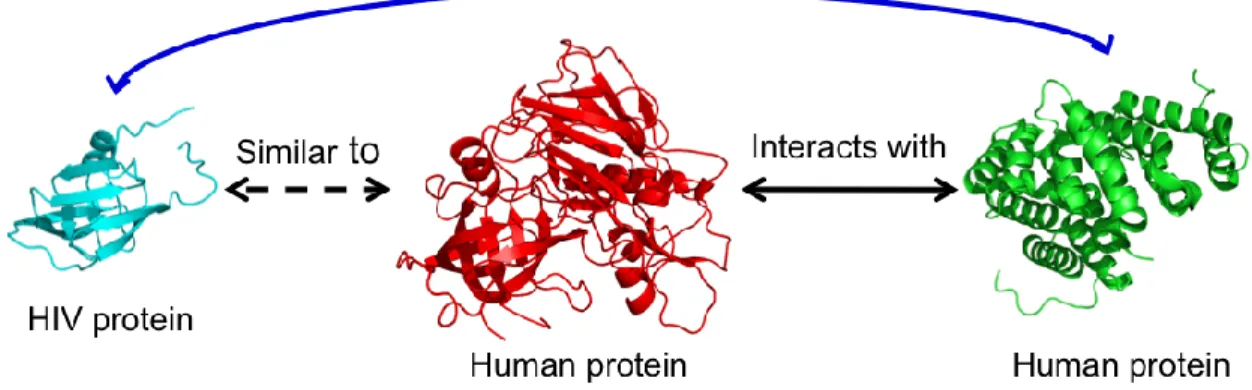
similarity to an HIV protein are referred to as "HIV-similar." Next, we identify known interactions for these HIV-similar proteins, with the one or more human proteins that they interact with referred to as "targets." We then assume that HIV proteins have the same
interactions as their human, HIV-similar counterparts, allowing HIV to plug into the host cell protein network at these points (Figure 2.1). Using data from recent RNAi screens
and cellular co-localization information, we refine this interaction map to enrich for those interactions having the greatest potential to be correct based on the available information. Evaluation of these predictions shows a statistically significant enrichment of known
interactions and numerous novel interactions with potential functional relevance. These predictions provide an additional tool for further investigations into the lifecycle of
RESULTS AND DISCUSSION
Identification of HIV-similar human proteins
To construct a map of interactions between HIV-1 and human proteins, we established a multi-step protocol that begins with the identification of human proteins
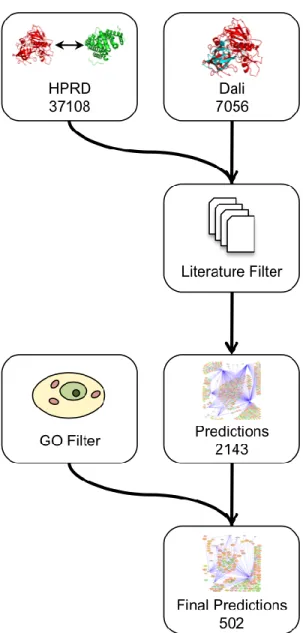
having significant structural similarity to HIV-1 proteins (Figure 2.2). We used the Dali Database (Holm, Kääriäinen, Rosenström, & Schenkel, 2008; Holm & Sander, 1993),
which contains 3D structure comparisons for all protein structures in the Protein Data Bank (PDB); all publicly available crystal structures for HIV-1 and H. sapiens are contained within PDB. While the crystal structure for many human proteins is unknown,
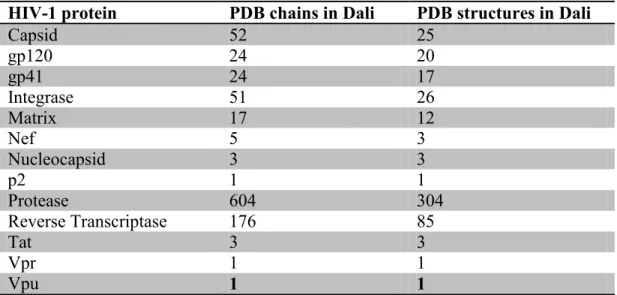
most HIV-1 proteins have been at least partially resolved. Specifically, crystal structures exist for PR, RT, IN, CA, MA, NC, Gag p2, gp120, gp41, Nef, Tat, Vpr, and Vpu (Table
2.1). The three enzymes encoded by HIV-1, protease (PR), reverse transcriptase (RT), and integrase (IN) are the best characterized structurally, having at least 25 structures each in the PDB, with PR having over 300. CA, gp41, and gp120 are also well studied.
We note, however, that many of these structures represent only part of the full-length protein. HIV-1 proteins having regions of high similarity to at least one human protein
include: gp41, gp120, CA, MA, Gag p2, PR, IN, RT, and Vpr (selected similarities to IN are given in Appendix 1). Therefore, predictions were made for nearly every HIV-1
protein that has a published structure.
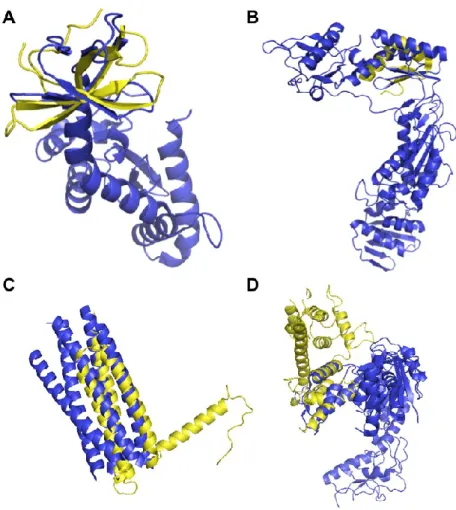
Selected examples of structural similarities between the HIV-1 proteins IN, RT, and gp41 and human proteins determined by Dali are shown in Figure 2.3. The structural
the precise location of protein interaction sites is not known, we used the entire structure
in our investigation.
Protein interaction prediction
After identifying which specific HIV-1 and human proteins have high structural
similarity, we extract all known interactions for human proteins from the Human Protein Reference Database, which contains over 37,000 documented protein interactions
(Mishra et al., 2006). Again, the central premise is that given a network of protein interactions, proteins with similar structures or substructures will tend to have similar interaction partners. Thus, our hypothesis is that HIV-1 proteins having similar structure
to one or more human proteins are also likely to participate in the same set of protein interactions (Figure 2.1). Under these assumptions, we directly mapped HIV-1 proteins to
their high-similarity matches within this network.
To reduce the number of predictions and provide an additional line of functional evidence for interactions and their possible biological relevance, we filtered these results
using two types of datasets on host proteins involved in HIV-1 infection, collectively referred to as "Literature Filters" hereon. The first filter type represents host proteins that
have been shown to impair HIV-1 infection or replication when knocked down by siRNA or shRNA. Three genome-scale siRNA screens have been conducted in HeLa or 293T
cells (Brass et al., 2008; König et al., 2008; Zhou et al., 2008). A fourth study with a similar goal was conducted using shRNA in Jurkat T-cells, a more realistic model of HIV-1 infection (Yeung, Houzet, Yedavalli, & Jeang, 2009). Each of the four screens
lines and stages of the HIV-1 life cycle investigated. The second type of data used to
filter predictions identifies human proteins present in the HIV-1 virion. During budding, host proteins from both the cell surface and the cytoplasm, including some involved in the cytoskeleton, signal transduction, metabolism, and chaperone functions, may be
incorporated into the virion (Chertova et al., 2006). While some of these proteins may be taken up by the budding virus simply by chance, others are known to be specifically
incorporated into the virion and may play key roles in viral life cycle or pathogenesis. For example, TSG101 may be incorporated due to its interaction with Gag and facilitates budding (Cantin, Méthot, & Tremblay, 2005; Chertova et al., 2006).
We considered only predicted interactions where the target protein was observed in at least one of the previously described Literature Filters. The resulting predicted
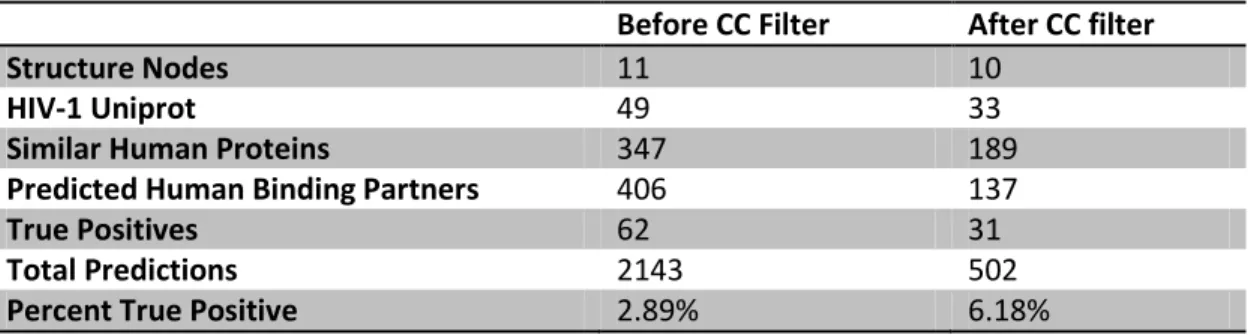
HIV-human interaction network consists of 2,143 interactions, considering all unique combinations of Uniprot accessions for an HIV-1 protein and a predicted human interactor (Figure 2.2). Of the predictions that were made, 62 were verified as true
interactions based on data from two databases of known host-pathogen interactions, HHPID and PIG (Appendices 2 and 3). There were 347 human proteins predicted to have
structural similarities with an HIV-1 protein, and the predictions implicate a total of 406 unique human proteins as potentially interacting with HIV-1 (Table 2.2).
We visually examined some of the structural similarities that led to predictions that were already known. SMN2 is structurally similar to IN (Figure 2.3A, Appendix 1) and both SMN2 and IN are known to interact with SIP1 (Gemin2) (Fu et al., 2009;
aid viral reverse transcription (Hamamoto, Nishitsuji, Amagasa, Kannagi, & Masuda,
2006). There are also several predicted interactions between IN and host proteins that interact with SMN2 that have not yet been tested (Appendix 1). The structural similarities shown in Figure 2.3B-D also led to predictions of known interactions, even though only
parts of the proteins are structurally similar.
Protein co-localization
To further narrow the list of likely interactions, we refined these results by requiring both the HIV-1 protein and the target human protein to be present in the same location within the cell, based on GO cellular component (CC) annotation. The refined
set of predictions is shown in Figure 2.4. Including this filtering step reduced the number of interaction predictions to 502, involving 189 HIV-similar proteins having 137 known
different binding partners. There are 31 predictions corresponding to already known HIV-human interactions (Table 2.2, Appendix 4). Using the criterion that interacting proteins must have some evidence of co-localization not only reduced the size of the predicted
interactome, but also increased the percentage of true positive predictions from ~3% true positives before filtering to over 6% after filtering (Table 2.2).
Taking localization into account, gp41 has many more predicted interactors than any other HIV-1 protein. This is most likely due to the relatively large number of GO
cellular component terms that were annotated to gp41 and also relevant to the host cell. Since gp41 is found in more parts of the cell than other HIV-1 proteins, a larger number of human proteins were able to meet the co-localization criterion.
about its interactions. Therefore, some information is lost if predictions are described at a
gene level. Nevertheless, it may be of interest to consider interactions on a gene basis (See Appendix 5 for the mapping of HIV-1 IDs). When counted according to the HIV-1 protein names and human target Entrez Gene IDs, we made 883 interaction predictions,
56 of which were true positives according to HHPID and PIG. Following CC filtering, we had 22 true positive predictions among 265 total predictions (~10% of known true
positives). While these results tend to suggest higher rates of predictive accuracy when using our method, we report our more conservative Uniprot-based accuracy values as our best estimates.
Properties of human proteins predicted to interact with HIV-1
Using the CC-filtered predictions, we next examined the function of human
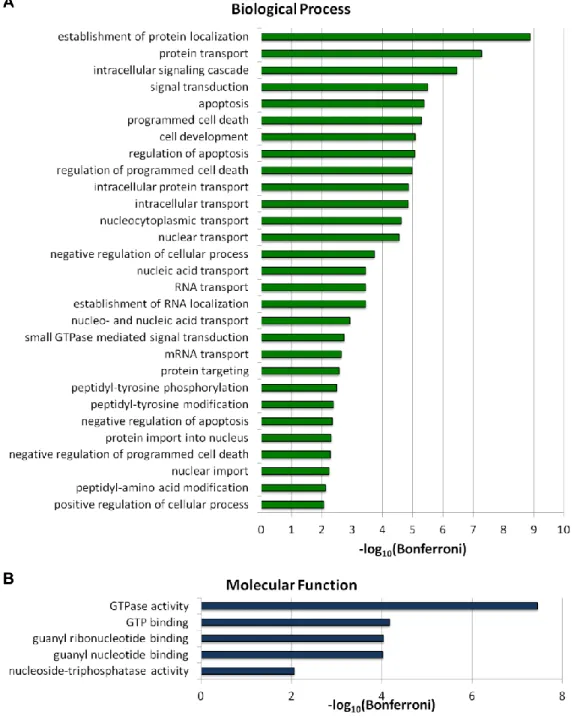
proteins predicted to interact with HIV-1 during infection. In this instance, we sought biological process and molecular function GO terms that were enriched among these target proteins. Examining the functions of the human proteins found in our filtered list of
interactions, significant enrichment is observed in the processes of protein transport, nucleic acid transport, signaling, cell death, and post-translational modifications (Figure
2.5A); all of these processes are known to be manipulated or altered by HIV-1 during infection. During the course of the HIV-1 lifecycle, viral protein and nucleic acids must
be transported from one part of the cell to another to ensure viral replication. The Pre-Initiation Complex, consisting of a number of viral and host proteins and the viral genome, must be transported from the site of viral entry to the nucleus for integration of
inhibit apoptosis in infected cells to prevent the cell from dying before the virus can
replicate and assemble. On the other hand, HIV-1 can also promote apoptosis of immune cells using several pathways; the progressive destruction of CD4+ T cells is a well-known indication of AIDS (Gougeon, 2003).
Interestingly, all of the significantly enriched molecular function GO terms relate to GTP binding or hydrolysis (Figure 2.5B). GTPases are involved in a number of host
processes that HIV-1 may take advantage of, including nuclear transport and cytoskeletal rearrangements that facilitate viral entry and cellular motility. Statins, a class of drugs that lowers cholesterol levels in the blood, have also been shown to inhibit HIV-1
infection by preventing viral fusion with the cell membrane through a mechanism that involves inhibition of Rho GTPases (Del Real et al., 2004). In addition, p115-RhoGEF
inhibits HIV-1 gene expression through the activation of RhoA (L. Wang et al., 2000). Furthermore, both Rho and ROCK play a role in the cellular motility that allows HIV-1 infected monocytes to cross the blood-brain barrier, leading to HIV-1 encephalitis
(Persidsky et al., 2006).
Actin microfilaments of the cytoskeleton are regulated by actin-binding proteins
as well as Rho family small GTPases including Rho, Rac, and Cdc42 (Matarrese & Malorni, 2005). IN, RT, and gp41 were all predicted to interact with RhoA, Rac1, and
Cdc42 (Figure 2.4). We found that gp41 has regions of structural similarity with many cytoskeleton related proteins, including erythrocytic spectrin alpha (SPTA1), erythrocytic spectrin beta (SPTB), alpha actinin 4 (ACTN4), alpha actinin 2 (ACTN2), moesin
GTPase activating protein 1 (RASA1), among others. The cytoskeleton is manipulated by
HIV-1 during virion fusion, assembly, and budding (Matarrese & Malorni, 2005). Drugs that cause depolymerization of microtubules and actin filaments can block HIV-1
movement through the cell. Actin has also been found within HIV-1 virions, and is
incorporated through binding with NC (Wilk, Gowen, & Fuller, 1999). Thus, our predictions may aid further investigation into the ways in which HIV-1 manipulates the
cytoskeleton.
By integrating a variety of high-quality functional data sets in the Literature Filter, we created a smaller interaction map that has the potential to provide a physical
interaction context for a number of experimental findings. As an example, retroviral budding is known to involve members of the endosomal sorting complexes (ESCRTs).
The ESCRT complexes normally induce the formation of multivesicular bodies in the endosome, but can be recruited to the plasma membrane by Gag to aid in viral budding. Many members of the ESCRT machinery appear in our results, including VPS4A,
STAM2, EEA1, RAB5A, and TSG101 (Goff, 2007). Early endosomal autoantigen 1 (EEA1) is recruited to early endosomes by Rab5 and phosphatidylinositol 3-phosphate
(Raiborg et al., 2001). Our results show that gp41 and Gag p2 may interact with RAB5A because they are structurally similar to EEA1 (Figure 2.4). EEA1 contains a FYVE
domain and colocalizes with human hepatocyte growth factor regulated tyrosine kinase substrate (Hrs) protein (Deretic et al., 2004; Raiborg et al., 2001). Gp41 is also known to interact with AP1G2, an important component of clathrin-coated vesicles. AP1G2
Ritter, Sidhu, McPherson, & Bonifacino, 2004). The Gag p6 protein is a known mimic of
Hrs, and like Hrs can recruit TSG101, which is required for the formation multivesicular bodies and viral budding (Pornillos et al., 2003). Gag p2 and a model of gp41 show structural similarity to the human protein CEP55, which acts during cytokinesis to recruit
TSG101 to the thin membrane between the daughter cells, where it is needed for the final separation of two cells (Carlton & Martin-Serrano, 2007). Our results suggest that gp41,
IN, and the p2 region of Gag may all be able to interact with TSG101 (Figure 2.4). Overall, interaction predictions are supported by a variety of studies implicating host mechanisms of vesicle formation in HIV-1 infection.
Additional method assessment
To further assess our predictions, we determined how many known interactions,
curated within either HHPID or PIG, could have possibly been predicted using our method and the available data. First, in order for our approach to suggest a possible HIV-human interaction, the HIV protein must be represented among the crystal structures
from PDB that are included in the Dali Database. In addition, any host factors predicted to interact with HIV-1 must have at least 1 known interaction with another human
protein, and to be considered further, each of these must also have representative
structures within PDB and Dali. Finally, in this work we included only those proteins that
have been implicated in HIV-1 infection through RNAi studies or studies of the protein composition of the virion. Because we removed any human target proteins that did not pass the Literature Filter, we did not make predictions for human proteins not mentioned
A total of 319 known host-pathogen interactions satisfied these criteria. Sixty-two
of these interactions (~19%) were predicted by our methodology, and are the set of predictions considered to be true positives (shown in Table 2.3). We also investigated how many of these possible interactions could have been found after using the cellular
component filter, and determined that only 166 known interactions met the additional criterion of being annotated to the same cellular component. Within this set, our method
found 31 of these (~19%). This result suggests that while considering cellular localization decreased the number of interactions considered, the number of true positive predictions did not improve. Obviously, without experimental validation we cannot determine
whether the CC filter led to better prediction accuracy within the set of predictions not previously described in the literature or elsewhere. It is clear, however, that GO cellular
component annotation is incomplete and the lack of shared annotation does not completely exclude the possibility that two proteins may interact; inclusion of the CC filter did double the percentage of true positives predicted when considering unknown
potential interactions as well as those previously known.
As an additional form of assessment, we investigated how often we could expect
to find previously known interactions by chance alone. Starting from proteins in HPRD, we found that ~0.17% of the known interactions could be found at random (see
Methods). CC filtering of these random predictions gave a slight improvement with an average of 0.29% true positives (Table 2.4). Using only HPRD human target proteins that pass the Literature Filter increased the true positive accuracy of random predictions to
average of 1.03% true positives were found (Table 2.4) versus 6.18% when using our
method (Table 2.2). Thus the Literature Filter and the CC Filter improved the accuracy of the true positive predictions individually, and to an even greater extent when combined. However, even with both filters, at best ~1% of the random predictions were found to be
true positives, further indicating that incorporating structural information generates predictions with enhanced accuracy and biological validity.
Overlap with other studies
We also compared our predictions to those made by two previous computational studies predicting protein-protein interactions between HIV-1 and humans, namely the
studies by Evans et al. and Tastan et al. (Evans et al., 2009; Tastan et al., 2009). Since these investigations reported their results in terms of genes, we compared them to our
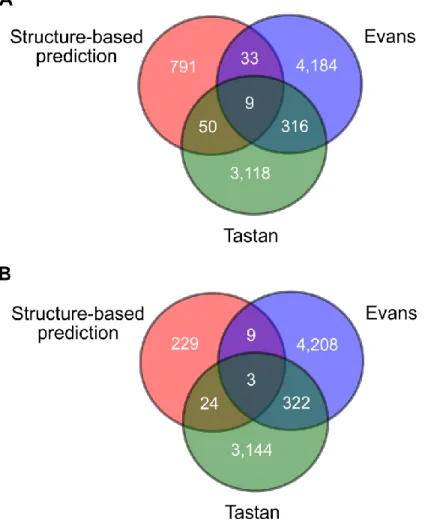
predictions as counted by gene, to find interactions predicted by multiple methods (Figure 2.6). We did not find a high degree of overlap between the predictions made by the various studies. This was not surprising, as even large-scale experimental protein
interaction studies typically show little overlap in their results. Furthermore, the
methodology used to generate the predictions differed significantly between studies. Our
method used structural similarity to predict interactions, whereas Evans et al. looked for the presence of sequence motifs and counter domains and Tastan et al. integrated a
variety of information, including information from GO, properties of the human interactome, and sequence motifs (Evans et al., 2009; Tastan et al., 2009). There are a greater total number of shared predictions between Evans et al. and Tastan et al. than
the work of Evans et al., as one of the features used in their prediction method. In
addition, the other two studies had a larger number of predictions overall. Approximately 7% of the predictions by Tastan et al. were found in the study by Evans et al.
Approximately 5% of our predictions (Literature and CC filtered) were found by Evans et
al. and 10% were shared with Tastan et al.
There were a few predictions that were shared between all methods. For our
results before CC filtering, we found that there were 9 interactions predicted by all three methods (Figure 2.6A). Of these, four were determined to be true positives in our results: RT and MAPK1, gp41 and LCK, gp41 and PTPRC, and IN and PRKCH. The other five
interactions (RT and PIN1, p2 and MAPK1, p2 and YWHAZ, gp41 and PLK1, gp41 and MAPK1, gp41 and CLTC, IN and XPO1, and IN and YWHAZ) are not known to occur,
and may be good candidates for further investigation since they were predicted by three diverse methods. After we filtered our predictions by shared cellular components, three predictions were still common between all three studies, gp41 and LCK, gp41 and PLK1,
IN and XPO1, one of which is a known interaction (Figure 2.6B). In summary, although few predictions were shared by all three studies, a large proportion of them are already
CONCLUSIONS
We have generated a map of potential protein-protein interactions between HIV-1 and its human host. The computational methodology used to create this map is based on the assumption that proteins with similar structures will share similar interaction partners.
Thus HIV-1 proteins having a structure similar to one or more human proteins may potentially "plug in" to the host protein interactome at these points, providing the
interface through which manipulation of downstream host processes can occur. From previous literature, many human proteins are known to play some role in HIV-1 infection. However, in most cases the nature of this role is unknown. Here, we provide
specific predictions of how these human proteins may influence viral infection, namely by interacting with certain HIV-1 proteins.
In principle, our approach is applicable to any host-pathogen system with known protein structures. HIV-1 has a small proteome, with most of its protein structures at least partially determined. In addition, HIV-1 also has a large set of identified interactions that
can be used for model validation. While few pathogens currently have such rich data sets, continued progress will help to remedy such deficiencies.
Identification of points of modulation between a host and pathogen requires multiple lines of evidence. Computational methods can help integrate these data,
providing a promising avenue for the discovery of novel host pathogen interactions mediated by structural similarities and enhancing our understanding of functional relationships characterized through modern screening methods such as siRNA.
only further our basic understanding of pathogen survival mechanisms, but may also
METHODS Data Sources
We used the Dali Database for structure comparisons (downloaded in January 2009), and the Human Protein Reference Database (HPRD), HHPID, and PIG for protein
interactions (downloaded February, July and June 2009, respectively) (Driscoll, Dyer, Murali, & Sobral, 2009; Fu et al., 2009; Holm et al., 2008; Holm & Sander, 1993; Mishra
et al., 2006). The literature sources and various databases each have their own system of identifiers. PDB codes obtained from Dali were mapped to their corresponding taxonomy and Uniprot accessions using data from the SIFTS initiative (Berman et al., 2003; Tagari
et al., 2006; Velankar et al., 2005). Other identifier mappings were carried out using DAVID Gene ID Conversion or Uniprot ID mapping (Bairoch et al., 2005; Dennis et al.,
2003; Huang, Sherman, & Lempicki, 2009). Network diagrams were created in Cytoscape (Shannon et al., 2003). Images of protein structures were created in MacPyMol (DeLano, 2002).
Determination of structural similarity between HIV-1 and host proteins
We used the Dali database to ascertain structural similarity. Dali compares the 3D
structural coordinates of two PDB entries by alignment of alpha carbon distance matrices, allowing for differences in domain order, and produces a structural similarity score
(Berman et al., 2003; Holm et al., 2008; Holm & Sander, 1993). The Dali Database includes structural comparisons of proteins from PDB90, a subset of the PDB where no two proteins share more than 90% sequence similarity, were used as queries against the
Taxonomy ID: 11676) and having a z score above 2.0, with the HIV-1 protein being
either the query or the hit. We refer to these human proteins as "HIV-similar" proteins. No proteins of unknown structure were considered.
Interaction Prediction
We found known interactions between HIV-similar proteins and target human proteins, using data from the HPRD database, which contains literature curated
interactions between pairs of human proteins (Mishra et al., 2006). For each HIV-similar protein, we predict that the target proteins, which are known to both interact with the HIV-similar protein and pass the Literature Filter, might also interact with the
corresponding HIV-1 protein. Therefore, interactions between the HIV-similar and the human target proteins were mapped directly to the corresponding HIV protein.
Filtering
To reduce the number of predictions and add information from functional studies, predictions were filtered based on previous implication of the human protein in the
HIV-1 infection process. One criterion was presence of the host protein in the HIV-HIV-1 virion. Host proteins known to be incorporated into or onto HIV-1 during budding were taken
from several literature sources (Cantin et al., 2005; Chertova et al., 2006; Saphire, Gallay, & Bark, 2006). The presence of host proteins in or on HIV-1 may be a result of specific
recruitment and serve a functional role, may result from localization of the protein near the site of budding, or may simply occur by chance. Predicted interactions between HIV-1 proteins and human proteins that are incorporated into the HIV-HIV-1 virion were retained.
Another filtering criterion was the host protein's essentiality for HIV-1 infection.
Recently, several large-scale experiments using siRNA or shRNA knockdowns to identify host proteins involved in the HIV-1 life cycle have been published (Brass et al., 2008; König et al., 2008; Yeung et al., 2009; Zhou et al., 2008). The probe ids of the
genes implicated by Yeung et al. were mapped to their Entrez Gene IDs using the appropriate Affymetrix annotation file (http://www.affymetrix.com/products_services/
arrays/specific/hgu133plus.affx#1_4) (Yeung et al., 2009). This filter is referred to as the "Literature Filter." Host proteins that were implicated in at least one of these studies as having a possible role in HIV-1 infection or replication and are also known to interact
with an HIV-similar protein were predicted to interact with an HIV-1 protein in the final predicted network.
To create a smaller and potentially more reliable list for further experimental validation, we filtered the predictions based on shared sub-cellular localization. The CC Filtered dataset contains interaction predictions where the two proteins share Gene
Ontology (GO) cellular component annotation. Pairs of HIV-1 and human proteins predicted to interact were only included in this dataset if both proteins were annotated by
DAVID as being present in the same cellular compartment (Dennis et al., 2003; Huang et al., 2009). Pairs with only the terms "cell" and "cell part" in common were excluded due
to a large number of such pairs and the relative lack of specificity of these high level terms.
Validation of Predictions
PDB structures for the same HIV-1 protein were found to be similar to multiple PDB
structures for an HIV-similar protein, leading to the same interaction predictions. Therefore, the predictions were counted as unique pairs of Uniprot accessions. In
addition, for ease of viewing the predicted interactome, each node representing an HIV-1
protein is labeled with the protein name while each human protein is represented by Entrez Gene ID. To determine the correct mapping of PBD codes to HIV-1 proteins, the
molecule name associated with each PDB chain was searched for keywords indicating the protein, with ambiguous cases treated on an individual basis. For example, PDB molecule names containing the word "capsid" but not "nucleocapsid" were assigned to the node
"capsid." Furthermore, molecule names indicating polyproteins, such as those containing the phrase "gag-pol", were checked individually to determine which specific part of the
polyprotein was represented by the entry. Two PDB structures were found to represent more than one mature HIV-1 protein: 1l6nA contains both capsid and matrix, while 1bajA contains capsid and p2 (Tang, Ndassa, & Summers, 2002; Worthylake, Wang,
Yoo, Sundquist, & Hill, 1999); these structures are represented as "capsid, matrix" and "capsid, p2" respectively. When counting predictions at the gene level, we considered
pairs of HIV-1 node names and human target Entrez Gene IDs.
To determine which predictions are true positives, PIG and HHPID entries for the
predicted human interactors were examined to see if they contained the HIV-1 protein they were predicted to interact with (Driscoll et al., 2009; Fu et al., 2009). These
interaction databases consist of PPIs curated from the literature. HHPID uses keywords to
interactions were included (Tastan et al., 2009). The Uniprot accessions associated with
the HIV-1 protein PDB entry, in the case of PIG, or the Entrez Gene ID mapped to that Uniprot accession, in the case of HHPID, were checked to see if it was present as an already known interaction of the human protein.
GO Term Enrichment
The Gene Ontology (GO) provides a system of terms to consistently describe and
annotate gene products (Ashburner et al., 2000). GO term enrichment was performed using the DAVID Functional Annotation Chart tool. The GO is organized as a tree structure, with terms becoming more specific as distance from the root increases.
Therefore, to avoid very general and uninformative GO terms, only those that are found at least 5 steps removed from the overall root of GO were considered. The p-values were
corrected for multiple testing using the Bonferroni procedure and transformed by taking the -log10 for easier visualization.
Computational evaluation
Two forms of computational validation of the method were conducted. As it is not possible to predict all known interactions due to lack of protein structures and other
factors, we first determined the largest set of known interactions that it is theoretically possible to predict using our approach. To do this, we first determined the sets of all
proteins that could be considered. This includes the set of all HIV-1 proteins in Dali (HIV set), the set of all human proteins that are represented in both Dali and HPRD (possible HIV-similar set), and the set of all human proteins in HPRD that are known to interact
possible target set was checked to see if it represented a known interaction curated in
HHPID or PIG. The resulting number of true interactions that could have been found by the method was compared to the number of true positives that were actually found, both before and after filtering by cellular components.
In the second approach, actual prediction results were compared to predictions based on randomly selected HIV-human protein pairs. The HIV-1 proteins were chosen
from the 69 Uniprot accessions represented at least once by structures in the Dali
Database. For human proteins, two different sets of human Uniprot proteins were created, one containing all the proteins in HPRD, and the other containing the subset of these
human proteins that also passed the Literature Filter. The set of all human proteins in HPRD consisted of 8,582 proteins and was used to assess the accuracy of purely random
predictions, while the second set of 830 proteins was used to observe the effect of the Literature Filter.
Since the structural similarity step was omitted, the predictions based on a human
protein being similar to an HIV-1 protein and incorporated into the virion could not be simulated with the random selection procedure. We found that if we excluded this class
of predictions from our real results, the number of unique predictions made was reduced to 2,139, but all 62 true positives were still included. Therefore, we randomly selected
2,139 pairs of HIV-1 proteins and human proteins from the entire HPRD, and a second set of 2,139 pairs of HIV-1 proteins and Literature Filtered human proteins for
evaluation. Next, any known interactions between the randomly chosen pairs were found
step of the method. The CC Filter reduced the number of predictions to a variable degree,
depending on how many of the random predictions were annotated with the same GO cellular component term. The entire procedure was repeated 1,000 times. The mean and standard error of the mean for each of the four variously filtered random prediction sets
was calculated using R. The distributions of random predictions after Literature Filtering were approximately normal, so one-sided single sample t-tests were performed to
determine if the method performed significantly better than random. In addition, we performed Wilcoxon signed-rank tests that do not make assumptions about normality. When comparing our results to random predictions that had undergone the same filtering
steps, either the Literature Filter or both the Literature and CC Filters, the p-values were less than 2.2e-16 for all statistical tests. In addition, even when performing the
randomization procedure 10,000 times, none of the randomly selected interaction sets had a true positive rate higher than that observed in our results, suggesting a p-value of no greater than 0.0001.
To compare our predictions to those made by Evans et al. and Tastan et al., we found the intersection of the prediction sets, counted by HIV-1 protein name and human
Entrez Gene ID (Evans et al., 2009; Tastan et al., 2009). Because each study used
different names for the HIV-1 proteins, we had to map the naming schemes to each other
to find common predictions. For example, Evans et al.'s "CA" and "GAG" and Tastan et al.'s "gag_capsid" and "gag_pr55" were mapped to our "capsid." Proteins for which we made no predictions, such as Rev, were not mapped to anything in our results, but were
FIGURES AND TABLES
Figure 2.2. Structural prediction workflow. Structural similarities from Dali and known interactions between human proteins from HPRD are used to predict
Table 2.1. Coverage of HIV-1 proteins.
HIV-1 protein PDB chains in Dali PDB structures in Dali
Capsid 52 25
gp120 24 20
gp41 24 17
Integrase 51 26
Matrix 17 12
Nef 5 3
Nucleocapsid 3 3
p2 1 1
Protease 604 304
Reverse Transcriptase 176 85
Tat 3 3
Vpr 1 1
Vpu 1 1
Table 2.2. Summary of predicted interactions.
Before CC Filter After CC filter
Structure Nodes 11 10
HIV-1 Uniprot 49 33
Similar Human Proteins 347 189
Predicted Human Binding Partners 406 137
True Positives 62 31
Total Predictions 2143 502
Percent True Positive 2.89% 6.18%
Figure 2.4. Predicted interaction network after cellular component filtering.
Figure 2.5. Significantly enriched Gene Ontology terms in the human-HIV-1 interaction network. GO terms removed at least 5 levels from the root for (A) Biological process and (B) Molecular function. Bonferroni corrected p-values ( = 0.01) were –log10 transformed. “nucleo- and nucleic acid transport” is an abbreviation
Table 2.3. Method evaluation.
Before CC After CC Predicted True Positives 62 31 Possible True Interactions 319 166
Percent Found 19.44% 18.67%
Table 2.4. Accuracy of random predictions.
Filtering Method Mean Accuracy Standard Error
None 0.166% 2.79e-3%
CC 0.286% 6.09e-3%
Lit 0.567% 4.84e-3%
Lit and CC 1.030% 1.07e-2%
CHAPTER THREE
MAPPING PROTEIN INTERACTIONS BETWEEN DENGUE VIRUS AND ITS HUMAN AND INSECT HOSTS
INTRODUCTION
With over 50 million cases per year, dengue virus (DENV) is a significant and growing threat to worldwide human health. Widespread among tropical and sub-tropical regions, this NIAID Category A pathogen consists of four serotypes, DENV1 to DENV4,
and is a member of the family Flaviviridae (NIAID, 2012). DENV causes a range of diseases in humans, from the mild Dengue Fever (DF) to the more deadly Dengue
Hemorrhagic Fever (DHF) and Dengue Shock Syndrome (DSS). While the average number of cases reported to the WHO and the number of countries reporting cases of DENV have increased dramatically in the past five decades, relatively little is known
about this important tropical pathogen that still lacks a vaccine, specific drug treatment, and relevant animal model (Kroeger & Nathan, 2006).
DENV is and arbovirus, carried and spread to humans primarily by the mosquito vector Aedes aegypti and to a lesser extent Aedes albopictus. Thus, DENV displays the remarkable capability to survive and replicate in two very different host organisms,
accomplished by a genome encoding a mere 10 proteins (Perera & Kuhn, 2008). To be successful, DENV must be able to manipulate each of its hosts at a molecular level. This
that allow the virus to bend existing host cellular systems to the purpose of furthering the
viral lifecycle. However, understanding this host-pathogen system is particularly difficult given the complexities of host-virus dynamics as well as the lack of a useful animal model system. In light of these challenges, computational approaches provide an
important tool in studies of host-pathogen systems. In particular, computational approaches for predicting host-pathogen protein interactions provide opportunities for
identifying specific targets for further experimental work, understanding system
behavior, and determining plausible therapeutic candidates. Despite their potential value, such computational approaches have not been widely applied to the problem of predicting
host-pathogen interactions. In particular, we are not aware of any studies focused on computational large-scale prediction of protein-protein interactions between DENV and
humans and know of only one recent study on Aedes (Guo et al., 2010).
Here, we establish a network of predicted interactions between DENV proteins and proteins from its human and insect hosts. These predictions are based on protein
structural similarity, where we first determine structural similarities between pathogen and host proteins using an established method for comparing 3D structures. We refer to
host proteins having a region of high structural similarity to a DENV protein as “DENV-similar.” Next, we identify known intra-species interactions for these DENV-similar
proteins, and refer to the one or more host proteins that they interact with as “targets.” We then assume that the similar structural features seen between DENV proteins and their host DENV-similar counterparts allow the DENV protein to participate in the same
create a smaller network of interactions having the greatest potential to be correct. These
predictions include numerous novel interactions with potential functional relevance and we highlight predictions relevant to stress, the Unfolded Protein Response (UPR), and the interferon pathway. This computational network approach provides an additional tool for
the investigation of poorly-characterized host-pathogen systems such as DENV, as well as helping to identify potential targets in both hosts that may be used in future DENV
RESULTS AND DISCUSSION
Identification of Dengue-Similar Host Proteins
To develop a network of interactions between DENV and its hosts, H. sapiens and A. aegypti, we employed a method we developed previously in the prediction of protein
interactions between HIV and human (Doolittle & Gomez, 2010) (see Methods for further details). First, we obtained 3D structures for the DENV proteins, from two
sources. Experimentally determined structures were taken from the PDB and consist of 31 PDB entries representing the DENV2 proteins E, pr peptide, prM, C, NS2B, NS3, and NS5 (Berman et al., 2003). Because there are no experimentally determined structures for
NS1, NS2A, NS4A, and NS4B, we used the I-TASSER server to predict the structure of these proteins (Y. Zhang, 2008). In this way, we investigated possible interactions for
every DENV protein.
To determine structurally similar host proteins, we used DaliLite to compare DENV structures against every other structure in the PDB (Berman et al., 2003; Holm et
al., 2008; Holm & Sander, 1993). We considered only significant structural matches with proteins from DENV’s hosts. We found 300 human proteins with similarity to a DENV
protein (hDENV-similar). However, we found no similarities between DENV proteins and A. aegypti proteins. This is not surprising, given that there are currently only 17
structures from A. aegypti in the PDB. Therefore, we looked for similarities between DENV proteins and the fly, Drosophila melanogaster, and found 15 proteins with structural similarity to DENV, which were then used as dDENV-similar proteins in
Known DENV-Host Interactions
A particular challenge in host-pathogen studies is the general lack of interaction data. HIV is perhaps the most well characterized virus in this regard, with over 800 direct interactions documented in NCBI’s HIV-Human protein interaction database (over 2,500
interactions if indirect interactions are included) (Fu et al., 2009). In contrast, a recent compilation of host-pathogen interactions from public databases describes a total of 3
DENV-human interactions (Dyer, Murali, & Sobral, 2008).
Through a more comprehensive search of the literature, we have found 20
documented interactions between DENV and human proteins (Table 3.1). Almost half of
the documented protein interactions involve E protein and a receptor on the cell surface. Two of these, CD14 and HSPA5, have been shown to function as DENV receptors,
although their binary interaction with E protein was not explicitly demonstrated; it may be that some other protein in complex with these receptors is the direct interaction partner of E protein (Y.-C. Chen, Wang, & King, 1999; Jindadamrongwech, Thepparit, & Smith,
2004). Furthermore, there is evidence that DENV receptor usage may be virus strain and cell type specific (Bielefeldt-Ohmann, Meyer, Fitzpatrick, & Mackenzie, 2001). Indeed,
RPSA has been shown to be a DENV receptor, suggesting an interaction with E, but only for DENV1 (Thepparit & Smith, 2004). Because our predictions were focused on
DENV2, this interaction was not considered for our predictions, but was included in Table 3.1 for completeness. Interactions not shown to be specific for a different serotype were included in our list of true positive interactions. Therefore, a total of 19 protein
There are no well-characterized protein-protein interactions between DENV and
A. aegypti. However, in the C6/36 cell line from A. albopictus, tubulin is believed to
interact with DENV2 E protein (Chee & AbuBakar, 2004). In addition, one protein, likely to be HSP90, has been put forward as a putative receptor for DENV2 in A. aegypti,
having been shown to bind to the E protein (Salas-Benito et al., 2007). However, its identity has not been conclusively demonstrated. In addition, mosquito La auto-antigen is
known to interact with the 3’ end of DENV RNA and may play some role in RNA synthesis (Yocupicio-Monroy, Padmanabhan, Medina, & del Angel, 2007). Human La auto-antigen (SSB) is also known to interact with the ends of the viral RNA, as well as
NS3 and NS5 (García-Montalvo, Medina, & del Angel, 2004). If the functions of the mosquito and human La proteins in DENV infection are similarly conserved, mosquito
La may interact with NS3 and NS5 as well, although this has not been shown. It is likely that some of the protein interactions that enable DENV to manipulate the cellular
pathways of two hosts are conserved between the species.
Prediction of Protein Interactions
After determining which host proteins are structurally similar to DENV proteins,
we inquired into the known protein-protein interactions that each DENV-similar protein participates in. For the hDENV-similar set, we obtained known human protein
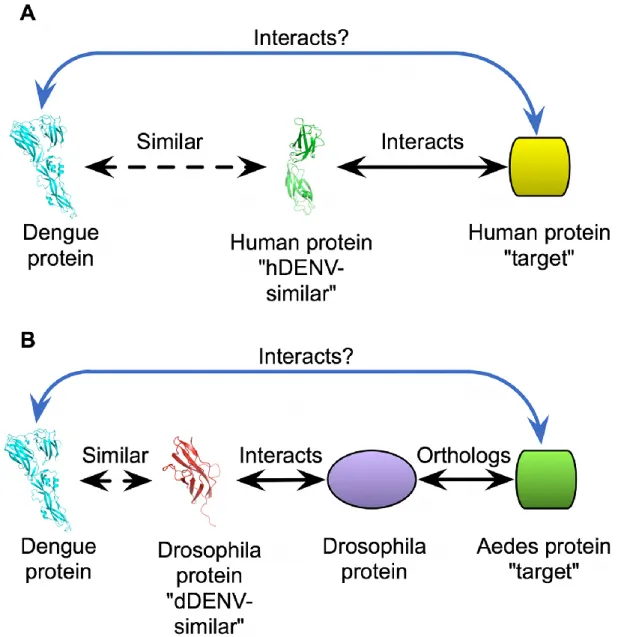
interactions from the Human Protein Reference Database (HPRD), which consists of over 37,000 interactions found in the literature (Mishra et al., 2006). We predicted that DENV proteins could interact with the partners of their corresponding hDENV-similar proteins,
interactions, involving 2,321 different human proteins (Table 3.2). Of the 19 known
protein-protein interactions between DENV and human, 9 are present among our predictions (Chang et al., 2001; Y.-C. Chen et al., 1999; Chiu, Shih, Yang, & Yang, 2007; J. J. E. Chua, Ng, & Chow, 2004; J. J.-E. Chua, Bhuvanakantham, Chow, & Ng,
2005; Ellencrona, Syed, & Johansson, 2009; García-Montalvo et al., 2004; Jiang, Yao, Duan, Lu, & Liu, 2009; Jindadamrongwech et al., 2004; Kurosu, Chaichana, Yamate,
Anantapreecha, & Ikuta, 2007; Limjindaporn et al., 2007, 2009; Lozach et al., 2005; Noisakran et al., 2008; Reyes-Del Valle, Chávez-Salinas, Medina, & Del Angel, 2005). This method may not predict all interactions, for example those mediated by sequence
motifs rather than structural features. A table of some DENV-human protein interaction predictions is provided in Appendix 6.
For the dDENV-similar proteins, we used the interactions curated in IntAct for D. melanogaster and potential D. melanogaster interactions suggested by the yeast-2-hybrid
data sets in DroID (Aranda et al., 2010; J. Yu, Pacifico, Liu, & Finley, 2008). However,
rather than making direct predictions using these interactions, as we did for human proteins, we determined orthologs of the D. melanogaster proteins in A. aegypti, since
this is the true host of DENV. We then predict that the A. aegypti ortholog of a D. melanogaster protein that interacts with a dDENV-similar protein may also interact with
the corresponding DENV protein (Figure 3.1B). As a result of this procedure, we predict that 158 A. aegypti proteins participate in 176 interactions with DENV proteins (Table 3.2). We note that this method did not predict interactions between E and mosquito
However, 12 of the proteins predicted to interact with DENV were orthologs of proteins
involved in DENV2 infection in humans or fly. A table of some DENV-Aedes protein interaction predictions is provided in Appendix 7.
GO term enrichment
Due to the sparseness of known interactions to which we can compare and evaluate our predictions, we examined the functional roles of host proteins for patterns
relevant to DENV infection. To this end, we determined the GO term enrichment among the DENV-similar and target proteins for each host. We find that many of the most significantly enriched terms among these sets of proteins are for processes or functions
known to be important for DENV infection (Figures 3.2 and 3.3). Our results are also consistent with a study of altered protein expression during DENV infection in which
several of the proteins identified have functions related to the GO terms RNA processing, transcription, or regulation of stress response, which were enriched in our predictions (Pattanakitsakul et al., 2007).
For human target proteins (dark blue bars in Figure 3.2), processes involving signaling, cell death and apoptosis, and positive or negative regulation terms are much
more frequent than would be expected if chosen at random. These processes are in agreement with processes and pathways that are altered during the course of infection.
Human proteins with structural similarities to DENV (red bars) are enriched for terms describing blood coagulation and hemostasis, indicating that DENV proteins appear to have structural similarities that mimic human proteins involved in the pathways
controlling the cessation of bleeding. One of the defining symptoms of DHF is