FIXED EFFECTS INFERENCE FOR CLUSTERED DATA IN
GAUSSIAN LINEAR MODELS
Jacqueline L. Johnson
A dissertation submitted to the faculty of the University of North Carolina at Chapel Hill in partial fulfillment of the requirements for the degree of Doctor of Public Health in the Department of Biostatistics, School of Public Health.
Chapel Hill 2007
Approved by:
Co-Advisor: Diane J. Catellier
Co-Advisor: Keith E. Muller
Reader: Lisa M. LaVange
Reader: David M. Murray
c
2007
ABSTRACT
Jacqueline L. Johnson: Fixed Effects Inference for Clustered Data In Gaussian Linear Models (Under the direction of Dr. Diane J. Catellier and Dr. Keith E. Muller)
Important public health research often requires the use of community based studies due
to logistical, ethical and cost constraints. Such designs require special methods of analysis.
Gaussian clustered data are often analyzed with either a mixed effects linear model on individual
level data or two-stage analysis of cluster means. For data with a large number of clusters and
large number of observations within each cluster, both techniques provide unbiased hypothesis
tests. In small samples with unbalanced data, however, even moderate imbalance in cluster size
across treatment groups can bias hypothesis tests in the two stage analysis of cluster means.
The use of large sample approximations for one-stage mixed model test statistics for analysis
of small, unbalanced clustered experiments may also lead to inaccurate hypothesis tests.
I derived a formulation of quadratic form theory which leads to a method to obtain exact
test size for hypothesis tests in the two stage model. This theory is used in an enumeration
study of type I error for a test of treatment difference in the two stage analysis of cluster means
where means are either unweighted or weighted by their cluster size. These enumerations focus
on scenarios of imbalance common to non-randomized cluster data settings.
Next I performed a simulation study of type I error for a test of treatment difference in both
the analysis of individual level data and of cluster means for scenarios of imbalance common to
randomized clustered data trials. Ten methods were considered; of these, a two stage analysis
of cluster means with means weighted by their theoretical variance controlled type I error under
the most cases. In this analysis, the weights contain restricted maximum likelihood estimates
of variance components estimated from the individual level data and are constrained to be
positive.
Many current clustered data studies currently show a misalignment between power
calcu-lations and data analysis; that is, the power analysis is done for a simplified version of the
actual test computed. I showed how to perform an appropriate and valid power analysis for
ACKNOWLEDGMENTS
First, I would like to thank my advisors, Diane Catellier and Keith Muller, for their
men-torship and friendship throughout the writing of this dissertation. I would also like to thank
Keith Muller for his leadership, caring, and encouragement throughout all stages of my graduate
education. I am also grateful to the members of my committee, Lisa LaVange, David Murray,
and John Preisser, for their helpful ideas and comments. I would also like to thank Robert
Hamer, Michael Schell, Larry Kupper, and Ruth Marinshaw for their guidance and friendship
during specific phases of my education. Finally, I am very grateful to my family and friends for
their continual love and support, without which I would have never attempted nor finished this
dissertation and doctoral program.
TABLE OF CONTENTS
LIST OF TABLES . . . viii
LIST OF FIGURES . . . ix
1 Introduction and Literature Review 1 1.1 Introduction . . . 1
1.2 Aims . . . 3
1.3 Notation . . . 5
1.4 Statement of Models and Hypothesis . . . 8
1.5 Literature Review . . . 10
1.6 Motivating Data Example . . . 16
2 Exact Type I Error in the Two Stage Analysis of Cluster Means 20 2.1 Introduction . . . 20
2.2 Hypothesis Testing for Cluster Means . . . 22
2.3 Theoretical Result to Compute Probabilities Under Violation of Assumptions . . 26
2.4 Description of Enumerations . . . 27
2.5 Results of Enumeration Study . . . 29
2.6 Conclusions and Recommendations . . . 32
2.7 Proof . . . 33
3 Comparison of Type I Error for One Stage and Two Stage Models 43 3.1 Introduction . . . 43
3.2 Statement of Models and Hypothesis . . . 44
3.3 Hypothesis Testing for Clustered Data with Balanced Cluster Sizes . . . 47
3.4 Hypothesis Testing for Clustered Data with Unbalanced Cluster Sizes . . . 51
3.5 Description of Simulations . . . 53
3.6 Results of Simulation Study . . . 57
4 Power Analysis for Continuing a Longitudinal Cluster Sample 80
4.1 Introduction . . . 80
4.2 Literature Review . . . 81
4.3 Performing the Power Analysis . . . 84
4.4 Data Example . . . 88
4.5 Further Remarks . . . 89
5 Summary and Future Research 91 Bibliography . . . 94
LIST OF TABLES
1.1 Notation in This Document Compared to Traditional Mixed Model Notation . . 7
1.2 Summary of Non Matrix Notation . . . 7
1.3 Type I Error for One Stage and Two Stage Analyses . . . 19
2.1 Summary of Non Matrix Notation . . . 34
2.2 Type I error over all cases and byρ,m1×m2 and m2/m1 . . . 35
2.3 Type I error by ¯n1×n¯2 and ¯n2/n¯1 . . . 36
2.4 Type I error by r1×r2 and r2/r1 . . . 37
2.5 Type I error by m2/m1×n¯2/n¯1 . . . 38
2.6 Type I error by m2/m1×n¯2/n¯1 (cont.) . . . 39
3.1 Number of convergent scenarios for tests 2, 4, and 10, by ρand m1×m2 . . . 62
3.2 Number of scenarios with a negative variance component estimate, by ρ and m1×m2 . . . 63
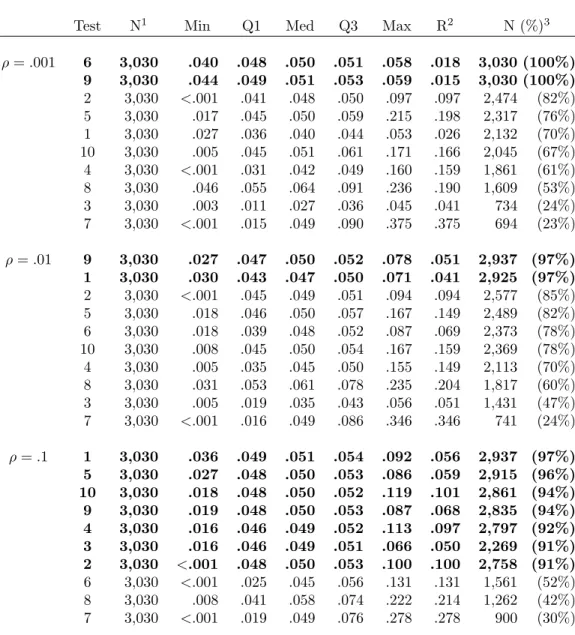
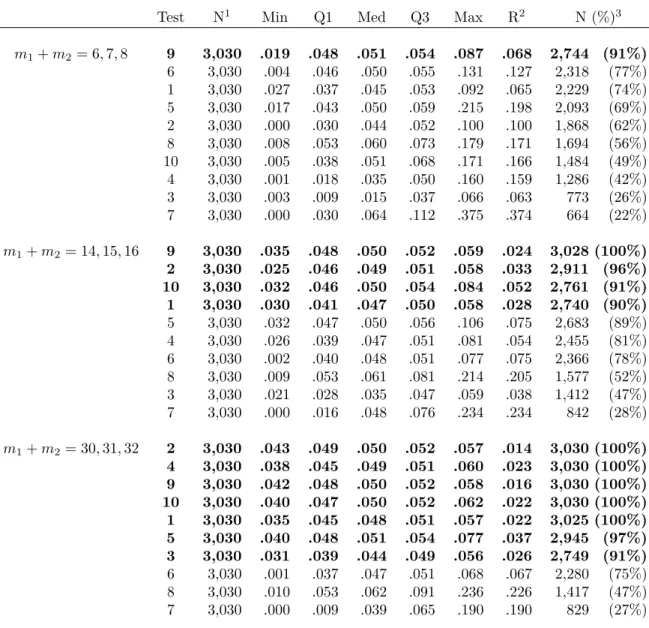
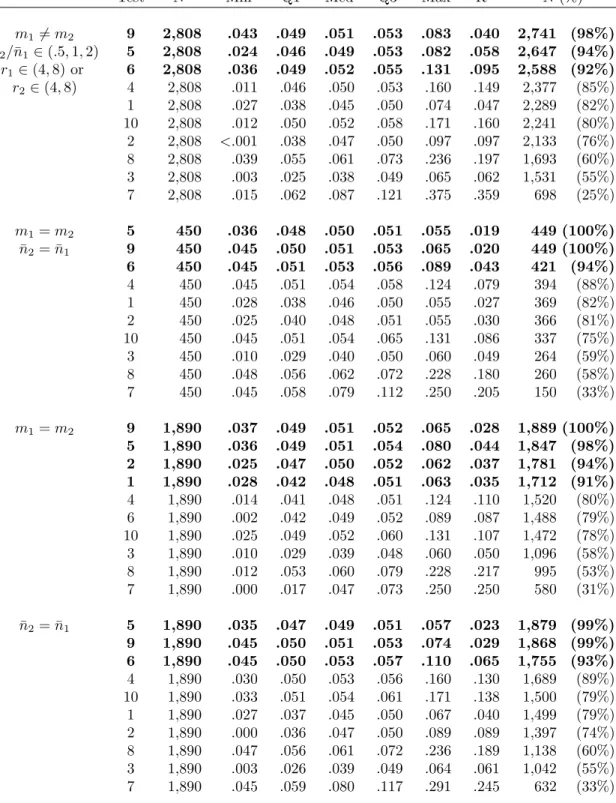
3.3 Type I error over all cases . . . 64
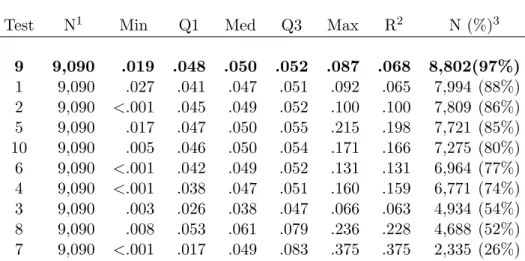
3.4 Number (%) of total (N=9,090) cases where test i (down) is biased and test j (across) is unbiased. . . 65
3.5 Difference in Number (i, j) and Number (j, i) from Table 3.4. . . 65
3.6 Type I error by ρ . . . 66
3.7 Type I error by m1+m2 . . . 67
3.8 Type I error for selected scenarios of balance . . . 68
LIST OF FIGURES
2.1 Type I Error for ρ×m1×m2×n¯1×n¯2 - Analysis of Unweighted Means . . . . 40
2.2 Type I Error forρ×m1×m2×n¯1×n¯2 - Analysis of Means Weighted By Cluster Size . . . 41
2.3 Type I Error for ρ×m1×m2×n¯1×n¯2 - Comparison of Weights . . . 42
3.1 Type I Error for Test 1 by ρ,m1,m2, ¯n1, and ¯n2 . . . 70
3.2 Type I Error for Test 2 by ρ,m1,m2, ¯n1, and ¯n2 . . . 71
3.3 Type I Error for Test 3 by ρ,m1,m2, ¯n1, and ¯n2 . . . 72
3.4 Type I Error for Test 4 by ρ,m1,m2, ¯n1, and ¯n2 . . . 73
3.5 Type I Error for Test 5 by ρ,m1,m2, ¯n1, and ¯n2 . . . 74
3.6 Type I Error for Test 6 by ρ,m1,m2, ¯n1, and ¯n2 . . . 75
3.7 Type I Error for Test 7 by ρ,m1,m2, ¯n1, and ¯n2 . . . 76
3.8 Type I Error for Test 8 by ρ,m1,m2, ¯n1, and ¯n2 . . . 77
3.9 Type I Error for Test 9 by ρ,m1,m2, ¯n1, and ¯n2 . . . 78
3.10 Type I Error for Test 10 byρ,m1,m2, ¯n1, and ¯n2 . . . 79
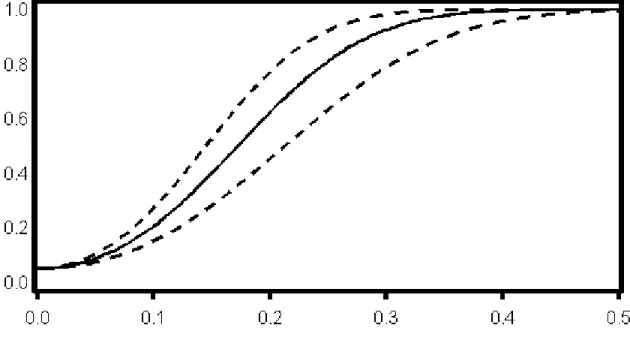
4.1 Power as a Function Mean Difference . . . 90
Chapter 1
Introduction and Literature Review
1.1 Introduction
The term “clustered data” commonly refers to data collected on individuals who are nested
within a specific geographical or civil unit, e.g., children within schools, employees within
work-sites, or patients within physician practices. Clustered designs are often intentionally used to
study the relationship of characteristics at the individual and cluster level on the response of
interest. Many public health studies also require the use of clustered instead of fully
inde-pendent data collection designs due to logistical, ethical and cost constraints. For randomized
studies, the trials through which clustered data arise are usually called group randomized trials
or cluster randomized trials [7, 24]. Such trials have been performed broadly across areas of
medicine and public health, most notably in the areas of smoking prevention, physical activity
promotion, occupational safety, nutrition, dentistry, and health policy. Clustered designs also
arise with the framework of sample surveys, though we do not consider these here. Specific
features of clustered data are: the independent sampling unit is the cluster; characteristics of
individuals within a cluster tend to be correlated, equally among each other; and the
explana-tory variable of primary scientific interest, e.g., treatment group, is applied at the cluster level,
while data are collected at the individual or within-cluster level.
Many continuous outcomes of interest in public health studies with clustered data have
an approximate Gaussian distribution. The analysis of Gaussian clustered data within the
framework of a univariate or repeated measures mixed linear model with Gaussian errors is
discussed in this dissertation. For simplicity, in this paper, we refer to the explanatory variable
groups applies to any fixed cluster level explanatory variable.
If clustered data are balanced so that each cluster contributes the same number of
observa-tions, and if data have a common within-cluster correlation and individual error variance across
treatment groups, then the set of outcome cluster means are sufficient statistics for inference
about treatment group means. That is to say that knowledge of the individual level outcome
data gives no additional information about the treatment means over that given by the outcome
cluster means. This is true even when the outcome of interest depends on additional covariates
other than treatment group, so long as the relationship between the outcome and covariates
is the same across treatment groups. With the addition of covariates other than treatment
group, knowledge of outcome cluster means and cluster covariate averages suffices for inference
about treatment group. Sufficiency of cluster averages for inference about treatment groups is
due to the special compound symmetric covariance structure of clustered data.
If data are unbalanced, so that a different number of observations is taken in each cluster,
then the set of outcome cluster means (with, also, cluster covariate averages, if applicable)
are no longer sufficient statistics for inference about treatment group means. This means
that inference conducted on cluster means with, potentially, also cluster covariate averages, is
different than that conducted on individual level data.
Varnellet al.[35] showed that current researchers analyze both cluster means and individual
level data. They reviewed group randomized trials published in the American Journal of
Public Health and Preventative Medicine from 1998 to 2002, and showed that of the 47 trials
that employed at least one statistical analysis appropriate for group randomized trials (some
analyses did not account for the correlation within clusters at all), 15 (32%) analyzed cluster
means or another summary statistic and 32 (68%) analyzed individual level data. Analysis
of cluster means is often called a “two-stage” model, whereby the cluster means are computed
first, often adjusted for covariates through a preliminary model excluding treatment group, and
cluster means are the values of the response in a linear model at the second stage [24, p. 112].
Analysis of the individual level data is often called a “one-stage” analysis, where correlated
individual level data are analyzed via a mixed effects linear model [24, p. 112].
In this dissertation, we confine interest to Gaussian linear models that include a single
fixed effect (e.g., treatment), a random cluster effect, and the usual residual random error.
Such a model is called a two-variance components model [14], two-way nested [27], multi-level
[8] or hierarchical model [2], or a one-way mixed model [14]. Though analysis of data from
epidemiological studies typically adjust for additional fixed covariates or levels of clustering, it
is an important first step to explore the properties of hypothesis tests in the simplest model
with no covariates and one level of clustering.
If data have a common within-cluster correlation and common individual error variance,
and if data have balanced cluster sizes, both the one-stage and two-stage approaches give the
same hypothesis test for the fixed effects [9]. Further, this test is the uniformly most powerful
size-α test and has exact null and non-null distributions. Also, this test statistic is derived
from closed formed expressions for the maximum likelihood estimates for the fixed effects and
variance components, which have known distributions.
If any of the previous conditions about common variance, correlation, or cluster size do not
hold, the one-stage and two-stage analysis approaches lead to different tests. No uniformly
most powerful size-αtest for the fixed effects exist; the unbalanced versions of the test statistics
used for balanced data now have only approximate distributions; and closed form expressions
for estimates of variance components are no longer available.
Research is needed to study the distributional properties of the hypothesis test statistics for
fixed effects in the one-stage and two-stage analysis of unbalanced clustered data. In Chapter
2, enumerations of type I error for hypothesis tests for fixed effects in the two-stage model
are presented. Situations of imbalance common to non-randomized clustered data settings are
considered there. In Chapter 3, simulations of type I error for hypothesis tests for fixed effects
in both the one-stage and two-stage models are presented. These emphasize designs common
to group randomized trials. In Chapter 4, a method is described which computes power for
the hypothesis test which best controlled type I error in Chapter 3. The aims of these chapters
are described in more detail in the next section.
1.2 Aims
1.2.1 Chapter 2, Paper 1
1. Show how to write the null and non-null distributions of the two-stage cluster means
chi-square random variables. Probabilities for this sum can be computed using Davies
[4] algorithm. In the null case, these probabilities are exact; in the alternative case, they
are exact given a well-approximated critical value.
2. Produce a SAS/IML module that computes probabilities from the distribution described
in Aim 1.
3. Use the modules in Aim 2 to perform an enumeration study showing the bias in type
I error for the two-stage cluster means model test statistic for a range of scenarios of
imbalance in number of observations per cluster and number of clusters common to non
randomized clustered data studies. We will consider the two-stage cluster means model
test statistic with cluster means unweighted and weighted by cluster size.
1.2.2 Chapter 3, Paper 2
1. Conduct simulations of type I error for the one-stage individual level and two-stage
clus-ter means model test statistics for a variety of conditions of imbalance common to group
randomized trials. Ten tests are considered. For the one-stage model, degrees of
free-dom will be calculated (1-2) by the method of Kenward and Roger [13] and (3-4) as the
number of clusters minus the number of treatment groups. Both methods will include
simulations with variance components unconstrained and constrained to be positive. For
the two-stage model, the following weight matrices will be considered: (5) unweighted,
(6) weighted by cluster size, (7) weighted by inverse of cluster size, (8) weighted by the
inverse of the sample variance of each cluster mean, and (9-10) weighted by the inverse of
the theoretical variance of each cluster mean, with variance components estimated from
the entire data. The last two stage analysis will be performed with variance components
unconstrained and constrained to be positive.
2. Suggest which of the tests in Aim 1 controls type I error for the most scenarios of
imbal-ance.
3. Suggest conditions of imbalance under which each test as well as more than one test
provides an unbiased test for the fixed effects.
1.2.3 Chapter 4, Paper 3
1. Show how to compute power for unbalanced clustered data in the two stage analysis of
cluster means with means weighted by the inverse of estimates of their theoretical variance.
2. Illustrate use of this method using data from a study on adolescent drinking behavior.
In the remainder of this chapter, I discuss literature relevant to each of these topics; material
for each paper is developed in more detail in Chapters 2, 3, and 4. Chapter 2, 3, and 4 were
written as stand alone papers, and so repeat some of the literature review presented in this
chapter.
1.3 Notation
1.3.1 Matrix Notation
This section describes the notational conventions used in this document. Lower case bold
indicates a (column) vector, upper case bold a matrix. Upper case italics indicates a
non-matrix random variable. Matrix notation dominates over random variable notation, so that
randomness of a matrix must be inferred from context.
We follow the notation of McCulloch and Searle [19], Appendix M, Section 3, to conveniently
denote stacked column vectors and diagonal matrices with similar notation. Define the indices
iandj such thati= 1, ..., aandj= 1, ..., b. Letu=cuij denote the stacked column vector
u, where u=u011 u012 . . . uij0 . . . u0ab 0. LetU =dUij denote the diagonal matrix
U with diagonal elements U11,U12, ...,Uij, ...,Uab. These notations are identical except for
the subscript on the opening brace; the subscript c denotes a stacked column vector and the
subscriptddenotes a diagonal matrix.
Kronecker product multiplication of matrix A by matrix B is denoted by A⊗B,where
A⊗B=
a11B a12B ... a1aB
a21B a22B ... a2aB
... ... ... .. ab1B ab2B ... aabB
,
andaij is the element in thei-th row andj-th column of matrixA. All other matrix operators
1.3.2 Distributions
Let x∼ NN(µ,Σ) indicate that the vectorx (N ×1) follows an N-variate normal
distri-bution with mean vector µand covariance matrix Σ. Let X ∼ F(ν1, ν2, ω) indicate that the
random variable X has a noncentral F distribution withν1 numerator degrees of freedom, ν2
denominator degrees of freedom, and noncentralityω. LetX∼χ2(ν1, ω) indicate thatX has
a non-central chi-square distribution withν1degrees of freedom and noncentralityω. With zero
noncentralities, both the noncentral F and χ2 distributions reduce to central versions. Kotz
et al. [17] gives detailed information about these distributions.
1.3.3 Data Indices and Model Notation
Theory and results in this document are discussed within the framework of the general linear
mixed model and the general linear univariate model. Notational conventions from these areas
are used heavily in this document, e.g., Verbeke and Molenberghs [36] or Muller and Stewart [23].
Such notation can differ from other notational schemes that also would have been defensible,
namely, that used in any of multivariate, hierarchical, or multi-level linear models or in the
field of group or cluster randomized trials. When necessary for clarity, notation from these
fields must be employed. In particular, because this dissertation focuses heavily on properties
of balanced versus unbalanced data, we make different choices of notation for total number of
observations, number of independent sampling units, and number of observations per cluster,
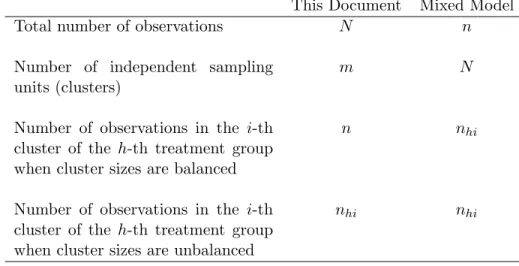
than those usually made in traditional mixed model notation. Table 1.1 summarizes these
notational differences. Table 1.2 summarizes the notation used in this document to describe
the structure of clustered data.
Table 1.1: Notation in This Document Compared to Traditional Mixed Model Notation
This Document Mixed Model
Total number of observations N n
Number of independent sampling units (clusters)
m N
Number of observations in the i-th
cluster of the h-th treatment group
when cluster sizes are balanced
n nhi
Number of observations in the i-th
cluster of the h-th treatment group
when cluster sizes are unbalanced
nhi nhi
Table 1.2: Summary of Non Matrix Notation
Symbol Definition
Indicies
h= 1, . . . , g Indexes treatment groups
i= 1, . . . , mh Indexes clusters within treatment group
j= 1, . . . , nhi Indexes observations within cluster
Numbers of Clusters and Observations
g Number of treatment groups
mh Number of clusters in treatment grouph
m=Pgh=1mh Total number of clusters
nhi Number of observations within a cluster when
clus-ter sizes are unequal
n Number of observations within a cluster when
clus-ter sizes are equal
nh=Pmi=1h nhi Number of observations in treatment grouph
N =Pgh=1Pmh
i=1nhi Total number of observations
Outcome Notation
yhij Outcome for observationj of clusteriin treatment
grouph
yhi= n1
hi
Pnhi
j=1yhij Outcome mean for clusteriin treatment grouph
yh= m1
h
Pmh
i=1
Pnhi
1.4 Statement of Models and Hypothesis
1.4.1 One-Stage Model
Define a linear model for continuous Gaussian outcome y1 that includes fixed effects given
inβ (g×1),a random effect for cluster given inb(m×1),and a random error,e1 (N ×1):
y1=X1β+Z1b+e1. (1.1)
The matricesX1(N×g) andZ1(N×m) are design matrices for the fixed and random effects,
respectively. This review assumesX1 contains only an effect for treatment group andZ1 only
an effect for cluster.
Vectors or matricesy1,X1,Z1,ande1 are stacked by treatment group and cluster so that
y1 =
cy1,hi ,X1=
cX1,hi ,Z1 =
cZ1,hi , ande1 =
ce1,hi . Without loss of generality,
assume the fixed effects design matrixX1 has a cell mean coding for treatment group so that
X1=
d1nh . The design matrix for the random cluster effect isZ1=
d1nhi . When data
have balanced cluster sizes, these simplify toX1 =
d1mhn and Z1 =Im⊗1n.
We assume b∼ Nm 0, σc2Im
independently of e1 ∼ NN 0, σ
2
eIN
so that:
y1 ∼ NN(X1β,Σ1) ,
where the covariance matrix Σ1 (N ×N) is compound symmetric and has the form:
Σ1 =σ2cZ1Z01+σ2eIN =
dσ
2
c1nhi1
0
nhi+σ
2
eInhi .
Σ1 may be expressed in terms of the total variance,σ2y, and within cluster correlation, ρ, as:
Σ1 =σ2y
d1nhi1
0
nhiρ+Inhi(1−ρ) ,
where ρ = σc2/ σc2+σe2 and σy2 = σc2 +σe2 or, equivalently, σc2 = σ2yρ and σe2 = σ2y(1−ρ).
Implicit in construction ofΣ1 is the assumption that data across all treatment groups have the
same variance parameters. When data have balanced cluster sizes the covariance matrix Σ1
simplifies to:
Σ1 =Im⊗ σ2c1n10n+σe2In
=Im⊗σ2y
d1n1
0
nρ+In(1−ρ) .
1.4.2 Two-Stage Model
To transform from a model for individual level data to a model for cluster means,
pre-multiply model (1.1) by the matrix T1 (m×N), where T1 =
d1
0
nhi/nhi . This yields a
model for y2 (m×1) =T1y1 where:
y2=X2β+Z2b+e2, (1.2)
and X2 (m×g) = T1X1, Z2 (m×m) = T1Z1, and e2 (m×1) = T1e1. Parameters in β
and bwere not affected by the transformation.
The vector of outcomes, y2, and of random errors, e2, contain cluster averages, so that
y2 = cyhi and e2 =
cehi . The fixed and random effects design matrices are X2 =
d1
0
nhi/nhi d1nh =
d1mh and Z2 =
d1
0
nhi/nhi d1nhi =Im.
In line with previous assumptions, we assume b ∼ Nm 0, σc2Im
independently of e2 ∼
Nm 0, σ2eT1T01
so that:
y2∼ Nm(X2β,Σ2) ,
whereΣ2 (m×m) is given by:
Σ2 =T1Σ1T01 =dσc2+σe2/nhi .
In terms of the alternate parameterization with σy2, ρ instead of σe2, σ2c:
Σ2 =σy2
d[1 + (nhi−1)ρ]/nhi .
1.4.3 General Linear Hypothesis
Define a vector of secondary contrast parameters,θ(a×1) =Cβ, whereC(a×g) contains
desired contrasts for the fixed effects. For clustered data y1 and y2 in models 1.1 and 1.2,
elements ofθ are linear combinations of cluster means. We study the two-sided general linear
hypothesis (GLH):
H0:θ=θ0 versus H1 :θ6=θ0. (1.3)
In most hypotheses of interest,θ0 =0. Such a hypothesis test describes differences in the fixed
effects only. We do not consider tests for variance components or ratios of variance components
in this dissertation. If θ is estimable, requiringC to have full row rank [rank(C) =a] ensures
requirement is automatically satisfied ifX is full rank, so that (X0X)−1 exists [21].
1.5 Literature Review
1.5.1 Hypothesis Testing for Clustered Data with Balanced Cluster Sizes
The analysis of clustered data has special properties when data have balanced cluster sizes.
This section describes estimation and hypothesis testing of fixed effects for such balanced data.
In practice, these methods are applied to unbalanced clustered data as well. Section 1.5.2
describes the properties of methods of estimation and hypothesis testing for balanced clustered
data when applied to unbalanced data.
1.5.1.1 Estimation of Fixed Effects for the One Stage Model for Individual Data
Consider the one-stage model for individual level data y1 ∼ NN(X1β,Σ1) given in model
1.1. When Σ1 is unknown, and therefore contains nuisance parameters which must be
esti-mated, the restricted maximum likelihood (REML) estimator for βis:
b
β1=
X01Σb
−1
1 X1
−1
X01Σb
−1
1 y1,
where Σ1b (N ×N) is the REML estimator for Σ1. When individual level clustered data y1
have balanced cluster sizes, that is, when nhi ≡n for all h,i, the estimator Σ1b can be stated
in terms of a Kronecker product of the same covariance matrix for all clusters. That is,
b
Σ1 =Im⊗
b
σ2
y[1n10nbρ+In(1−ρb)] . Because of this, the inverse ofΣb1 can be written with
the closed form expression:
b
Σ−11 =Im⊗ 1
b
σ2
y(1−ρb)
In− b
ρ
[1 + (n−1)ρb]
1n10n
.
For balanced data with no covariates, X1 =
d1mhn , and we can show that X
0
1Σb
−1
1 =
b
σ2y[1 + (n−1)ρb]
−1
X01. Thus, for balanced data:
b
β1 =
X01Σb
−1
1 X1
−1
X01Σb
−1
1 y1
=
b
σ2y[1 + (n−1)ρb] −1X01X1
−1
b
σ2y[1 + (n−1)ρb] −1X01y1
= X01X1
−1
X01y1.
We now have an estimator for the fixed effects that does not depend on the variance components.
That is, for balanced data, the weighted least squares and ordinary least squares estimators of
βcoincide. Puntanen and Styan [26] and Tian and Wiens [34] gave a comprehensive review of
when weighted or ordinary least squares estimators coincide for general datay∼ N(µ,Σ).
1.5.1.2 Estimation of Fixed Effects for the Two Stage Model for Cluster Means
Consider the two-stage model for cluster means y2 ∼ Nm(X2β,Σ2) given in model 1.2.
When data are balanced, nhi≡nfor all h, i,so that the cluster means have covariance:
Σ2=Im⊗ σy2/n 1 + (n−1)ρ .
That is, for balanced data, all cluster means have the same variance, andΣ2 can be written as
Σ2 =σ2Im where: σ2 = σy2/n 1 + (n−1)ρ . Independence, normality, and homogeneity
of errors of the cluster means meet the assumptions of the general linear univariate model
(GLUM).
In the general linear univariate model, the best linear unbiased and maximum likelihood
estimator for the fixed effects, β, is:
b
β2= X02X2
−1
X02y2.
1.5.1.3 Equivalence of Estimators from One and Two Stage Models
Matrix algebra allows showing that:
X01X1 =
d1
0
mhn d1mhn =
dnmh
X01y1 =d10mhn cy1,hi =
c
mh
X
i=1
nyhi
as well as:
X02X2=
d10mh
d1mh =
dmh
X2y2= 1
0
mh
{cyhi}=
c
mh
X
i=1
yhi
.
Thus:
b
β1 = X01X1
−1
X01y1 =dnmh c
mh
X
i=1
nyhi =cyh
and:
b
β2 = X02X2
−1
X02y2 =
dmh c
mh
X
i=1
yhi =
cyh .
That is, for data with balanced cluster sizes, the population treatment means inβare estimated
1.5.1.4 Hypothesis Test for Fixed Effects
The equivalent estimators given in sections 1.5.1.1 and 1.5.1.2 may be written as
b
βs= X0sXs −1
X0sys
wheres= 1,2. Using theory of quadratic forms in normal vectors,βbs∼ Ng
h
β, σ2(X0sXs)
−1i
,
whereσ2 = σ2y/n 1 + (n−1)ρ . Further, an estimator for desired contrasts, θ=Cβ, may
be estimated withbθs=Cβbs, which has distributionbθs ∼ Na
h
θ, σ2C(X0sXs)−1C0 i
.
Using theory for a general linear univariate model, a uniformly most powerful test size α
for the GLH is given by:
Ts=
b
θs−θ0
0h b
Vbθs i−1
b
θs−θ0
/a,
where Vb
b
θs
is the estimated variance of θbs, that is Vb
b
θs
= bσ2
h
C(X0sXs)−1C0 i
. The
quantity bσ
2 denotes the restricted maximum likelihood estimator for σ2, discussed in the next
section. This test statistic can be shown to have distribution:
Ts∼ F(a, m−g, ω),
whereω = (θ−θ0)0
h
C(X0sXs)−1C0 i−1
(θ−θ0)/σ2.
1.5.1.5 Estimation of Variance Components
In the two stage analysis of cluster means, variance components σ2y, ρ or σc2, σe2 are not
separately estimable so that the linear combination σ2 = σy2/n 1 + (n−1)ρ is estimated.
An estimator for σ2 in the two stage analysis of cluster means is:
b
σ2 =y02
h
Im−X2 X02X2
−1
X02
i
y2/(m−g).
This estimator can be derived as an restricted maximum likelihood and ANOVA estimator
b
σ2 = SSE2/(m−g), where SSE2 denotes the sums of squares error.
In the one stage analysis of individual level data, though an estimator of the linear
combi-nationσ2 = σ2y/n 1 + (n−1)ρ =σ2c+σe2/nis needed, current statistical software, designed
for the estimation of parameters of general covariance structures, estimates the variance
com-ponents separately in the parameterization σ2
c, σe2
.
Define the sums of squares due to cluster and error, respectively, as:
SSC1=y01
h
Z1 Z01Z1
−1
Z1−X1 X01X1
−1
X1
i
y1
SSE1=y01
h
IN −Z1 Z01Z1
−1
Z01
i
y1.
as well as mean squares due to cluster and error, respectively:
MSC1 = SSC1/(m−g)
MSE1= SSE1/(N −m).
The parameterization σ2
c, σe2
requires estimates of both σ2
c and σ2c to be positive, sinceσc2
andσ2e are defined as variances. As such, several sources, e.g. Searle [31, p .419], have pointed
out that restricted maximum likelihood estimators forσ2c and σ2e are given by:
b
σc2 = (MSC1−MSE1)/n
b
σe2 = MSE1
when MSC1≥MSE1 (that is, when bσ
2
c is positive) and
b
σ2c = 0
b
σ2e = SST1/(N−m)
when MSC1 < MSE1, where SST1 = SSC1+ SSE1 denotes the total sums of squares of the
individual level data. The probability thatσbc2 <0 is:
Pr
b
σc2<0 = Pr{Fm−1,N−m<1/[1 +nρ/(1−ρ)]}.
It can be shown that when MSC1 ≥MSE1, the estimator bσ
2 =
b
σ2
c +bσ
2
e/n is equivalent to
the best linear unbiased and maximum likelihood estimator obtained in the two-stage analysis;
however this is not the case when MSC1 < MSE1. That is, when MSC1 <MSE1, the linear
combination of restricted maximum likelihood estimators for each of σc2 and σ2e is NOT the
restricted maximum likelihood estimator for the linear combination σ2. The restricted
max-imum likelihood estimator for σ2 is obtained only when variance components estimators are
b
σc2 = (MSC1−MSE1)/nand bσ
2
e = MSE1, and the estimator bσ
2
c is allowed to be negative.
Default behavior of SAS PROC MIXED is to constrain estimates of variance components
1.5.2 Hypothesis Testing for Clustered Data with Unbalanced Cluster Sizes
1.5.3 One Stage Model for Individual Data
When cluster sizes are unbalanced, the weighted least squares estimatorβb1, given in section
1.5.1.1 as:
b
β1=
X01Σb
−1
1 X1
−1
X01Σb
−1
1 y1,
is no longer equivalent to an ordinary least squares estimator. That is, estimation of fixed
effects now requires estimation of the variance components.
Recall that the structure of Σ1 for unbalanced data is:
Σ1 =
dσ
2
c1nhi1
0
nhi+σ
2
eInhi =σ
2
y
d1nhi1
0
nhiρ+Inhi(1−ρ) .
When data are unbalanced, no closed form expressions exist for estimates of the variance
com-ponents in either parameterization; estimates must be obtained by an iterative procedure such
as Newton-Raphson iteration or the EM algorithm [5].
Construction of a hypothesis test for θ = Cβ requires knowledge of the distribution of
b
β1. The estimator βb1 is unbiased, so that E
b
β1
= β; however, no closed form expression
exists for its variance. The common strategy is to approximately estimate this as Vb
b
β1
≈
X01Σb
−1
1 X1
−1
. Kacker and Harville [12] and Dempster et al. [6] pointed out that this
underestimates the true variability in βb1, since
X01Σb
−1
1 X1
−1
is an estimate of the variance
of
∼
β1 = X01Σ−11X1
−1
X01Σ−11y1 not of the variance of βb1.
As in hypothesis testing with balanced data, a hypothesis test for the general linear
hypoth-esis is given by the Wald style test statistic:
T1 =
b
θ1−θ0
0h b
Vbθ1 i−1
b
θ1−θ0
/a.
Since closed form expressions do not exist for the elements ofΣb1,T1cannot be written explicitly
as a quadratic form, and thus its exact distribution is unknown. Applying large sample theory
gives T1−→χD 2(a,ω). Given a random variable X with X ∼ F(ν1, ν2,ω), as ν2 −→ ∞,
X−→YD whereY ∼χ2(ν1,ω). For this reason,T1 is usually given an approximate F(a, ν2,ω)
distribution in order to combat the underestimate of the variance ofβb1. Several methods exist
to estimate the denominator degrees of freedom ofT1. In most cases, none can be shown to be
uniformly superior [18].
One such method is that proposed by Kenward and Roger [13], who multiply T1 by an
inflation factor to account for the additional variability in Vβb1
introduced by estimating
Σ1. Satterthwaite [28] style degrees of freedom are then computed for this inflated statistic.
This approximation has not been studied thoroughly in small clustered data settings, and has
been shown to be biased in settings with other types of small sample data [3, 15, 29]. Another
common choice for denominator degrees of freedom is that for the analysis of balanced data,
ddf =m−g.
1.5.4 Two Stage Model for Cluster Means
From section 1.5.1.2, cluster means with balanced cluster sizes may be analyzed via a general
linear univariate model. The general linear univariate model assumesΣ2 is proportional to an
identity matrix, that is Σ2=σ2I, where as before σ2 = σy2/n 1 + (n−1)ρ .
An optimal test for the general linear hypothesis can be derived with the less restrictive
assumption that Σ2 =σ2W−1, that is, that the covariance matrix is known up to a constant
weight matrixW [19]. In this case, the best linear unbiased and maximum likelihood estimator
for the fixed effects is:
b
β2w= X02W X2
−1
X02W y2.
Withβb2w ∼ Ng
h
β, σ2(X0
2W X2)
−1i
and thus, bθ2w =Cβb2w ∼ Na
h
θ, σ2C(X0
2W X2)
−1
C0i,
a uniformly most powerful size-αtest for the fixed effects can be shown to be given by:
T2w =
b
θ2w−θ0
0h b
Vbθ2w i−1
b
θ2w−θ0
/a,
whereVb
b
θ2w
=σb
2
wC(X
0
2W X2)−1C0. The restricted maximum likelihood estimator for σ2
is:
b
σw2 =y02hW −W X2 X02W X2
−1
X02Wiy2/(m−g).
The statisticT2w has distributionT2w ∼ F(ν1,ν2,ωw), where the noncentrality in the weighted
model isωw = (Cβ−θ0)0
h
C(X02W X2)−1C0
i−1
(Cβ−θ0)/σ2.
The exact distribution of the test statistic Tw depends on the assumption that Σ2 can be
written in the form Σ2 =σ2W−1 where W is known. When this doesn’t hold T2w has only
an approximate F distribution. Cluster means derived from unbalanced clustered data with
estimated; however, many types of weights have W such thatΣ2≈σ2W−1.
If ρ is small and cluster sizes are small,Σ2 ≈ σ2y d1/nhi , so that weighting by cluster
sizes is an appropriate choice. Forgetting to invert the weights also may lead researchers
to erroneously weight by the inverse of cluster size. If cluster sizes are not highly variable,
Σ2≈σ2W−1 directly, so an analysis of unweighted means is performed.
In an attempt to estimate the variance components in the weights, data analysts also choose
W =
d[nhi(nhi−1)]/[y
0
hiyhi−nhiy¯1,hi] , the diagonal matrix of inverses of the estimated
sample variance of each cluster mean, or W =
b
σy2 d[1 + (nhi−1)ρb]/nhi
−1
, the diagonal
matrix of the inverse of estimates of the theoretical variance of each cluster mean with variance
components estimated from all the data. Such estimates of variance components from the data
can be constrained to be positive or allowed to be negative.
1.6 Motivating Data Example
The Trial of Activity in Adolescent Girls (TAAG) [32] was designed to evaluate an
inter-vention to reduce the age-related decline in moderate to vigorous physical activity (MVPA) in
middle school girls. The primary endpoint is the mean difference in intensity-weighted minutes
(MET minutes) of MVPA between intervention and control schools. 18 schools were
random-ized to each of intervention and control for a total of 36 schools. Baseline MVPA data were
collected on a sample of 60 6th grade girls per school, then again two years later on a sample
of 120 8th graders per school. Students were sampled at both time points so that data were
not necessarily collected on the same girls at both data collection points. The primary planned
analysis was a two-stage analysis of endpoint MVPA school means adjusted for baseline MVPA
school means. Further details can be found in Stevenset al. [32] and Murrayet al. [25].
One-stage analysis methods on individual level data which properly adjust for baseline values
cannot be conducted on the TAAG data, because the independent cross-sectional sampling
design resulted in incomplete overlap of girls at the two time points. Nonetheless, one can
analyze these data via both two-stage and one-stage methods if baseline data is omitted. We
perform such an analysis below for instructional purposes only; this analysis was not one actually
conducted for this trial.
Suppose the study had pre-planned subgroup analyses by race. The majority of girls in
the study belonged to three ethnic groups: non-Hispanic white and black, and Hispanic (of any
race). All race groups were not equally represented in all schools. To estimate the treatment
effect among black students, we considered only those schools with at least 2 African American
students, leading to inclusion of 12 intervention schools and 13 control schools. Because the
racial profiles of each school vary widely, each cluster (school) will contribute different numbers
of observations to these data. Clusters sizes in the intervention and control schools were {2,
2, 6, 12, 18, 29, 30, 31, 36, 52, 60, 81}, (mean = 29.9), and {5, 7, 7, 11, 13, 14, 14, 18, 23, 28,
35, 62, 69}, (mean = 23.5), respectively. These cluster sizes are naturally much more variable
that those in the planned primary analysis, but illustrate how extremely unbalanced data can
easily be obtained in an analysis of a subgroup of well-balanced data.
Table 1.3 gives p-values for a test for difference in average MVPA for intervention versus
control schools within the framework of each of the following models :
1. One-stage analysis via a mixed effects model with denominator degrees of freedom
calcu-lated by the method of Kenward and Roger [13].
2. One-stage analysis via a mixed effects model with denominator degrees of freedom equal
tom−g.
3. Two-stage analysis of unweighted cluster means
4. Two-stage analysis of cluster means weighted by cluster size
5. Two-stage analysis of cluster means weighted by the inverse of cluster size
6. Two-stage analysis of cluster means weighted by the inverses of sample variances of each
cluster mean
7. Two-stage analysis of cluster means weighted by the inverse of the theoretical variance,
with variance components estimated with the entire data.
Estimates of variance components for these data were positive.
One stage strategies 1 and 2 and two-stage strategy 7 compute similar, though not equivalent
cluster size equal to 15 or 40 times the minimum cluster size, two stage approaches 3 - 6 give
widely different results.
Table 1.3: Type I Error for One Stage and Two Stage Analyses
Estimated Estimated
MVPA Mean (SE) MVPA Mean (SE) Estimated Denom
Analysis Intervention Group Control Group Difference F DF P-value
1 20.35 (0.90) 18.85 (0.90) 1.50 (1.27) 1.18 15.6 0.26
2 20.35 (0.89) 18.85 (0.89) 1.50 (1.26) 1.19 23 0.24
3 20.96 (1.08) 19.66 (1.12) 1.30 (1.56) 0.83 23 0.41
4 20.14 (0.83) 18.49 (0.77) 1.65 (1.13) 1.47 23 0.16
5 22.25 (1.38) 22.93 (1.13) -0.69 (1.79) -0.38 23 0.70
6 18.70 (0.90) 18.23 (0.78) 0.47 (1.19) 0.39 23 0.70
Chapter 2
Exact Type I Error in the Two
Stage Analysis of Cluster Means
2.1 Introduction
The term “clustered data” commonly refers to data collected on individuals who are nested
within a specific geographical or civil unit, e.g., children within schools, employees within
work-sites, or patients within physician practices. Clustered designs are often intentionally used
to study the relationship of characteristics at the individual and cluster level on the response
of interest. Many public health studies also require the use of a clustered instead of fully
independent data collection designs due to logistical, ethical and cost constraints. For
random-ized studies, the trials through which clustered data arise are usually called group randomrandom-ized
trials, cluster randomized trials, or more generally, community trials [7, 24]. Such trials have
been performed broadly across areas of medicine and public health, most notably in the areas
of smoking prevention, physical activity promotion, occupational safety, nutrition, dentistry,
and health policy. Specific features of clustered data are: the independent sampling unit is
the cluster; characteristics of individuals within a cluster tend to be correlated, equally among
each other; and the explanatory variable of primary scientific interest, e.g., treatment group, is
applied at the cluster level, while data are collected at the individual or within-cluster level.
Many continuous outcomes of interest in public health studies with clustered data have an
approximate Gaussian distribution. In this paper, the analysis of Gaussian clustered data
within the framework of a linear model with Gaussian errors is discussed. For simplicity, in
discus-sion about analyses for difference in treatment groups applies to any cluster level explanatory
variable.
For data with one level of clustering, if data are balanced so that each cluster contributes
the same number of observations, and if data have a common within-cluster correlation and
individual error variance across treatment groups, then the set of outcome cluster means are
sufficient statistics for inference about treatment group means. That is to say that knowledge
of the individual level outcome data gives no additional information about the treatment means
over that given by the outcome cluster means. This is true even when the outcome of interest
depends on additional covariates other than treatment group, so long as the relationship between
the outcome and covariates is the same across treatment groups. With the addition of covariates
other than treatment group, knowledge of outcome cluster means and cluster covariate averages
suffices for inference about treatment group. Sufficiency of cluster averages for inference about
treatment groups is due to the special covariance structure of clustered data.
Because of this special feature, analysis of clustered data is often performed via a “two-stage”
model, whereby the cluster means are computed first, often adjusted for covariates through a
preliminary model excluding treatment group, and cluster means are the values of the response
in a linear model at the second stage [24]. In a review of group randomized trials published
in the American Journal of Public Health and Preventive Medicine from 1998 to 2002, Varnell
et al.[35] showed that of the 47 trials that employed at least one statistical analysis appropriate
for group randomized trials, 15 (32%) analyzed cluster means or another summary statistic.
For clustered data, V(yhi) = σ2y/nhi
[1 + (nhi−1)ρ]; that is, the variance of each cluster
mean is a function of the within cluster correlation, ρ, the individual error variance, σ2y, and
the number of observations in the i-th cluster from the h-th treatment group, nhi. Assuming
homogeneous correlation and error variance across all clusters, cluster means have equivalent
variances for balanced cluster sizes. This property of homogeneity of variances with the
inde-pendence of clusters by the randomization scheme means that balanced Gaussian cluster means
meet the assumptions of the familiar general linear univariate model with Gaussian errors.
Be-cause of this, for balanced data, a uniformly most powerful size-αtest for the fixed effects exists
and has exact null and non-nullF distributions.
violate an assumption of the general linear univariate model. For unbalanced data, researchers
often analyze a weighted univariate linear model to compensate for the heterogeneous variance
of cluster means due to varying cluster sizes. Optimal weights for such a weighted linear model
are equal to the inverse of the variances of the cluster means; however, such weights involve
unknown variance parameters which must be estimated, so that at best, only approximately
optimal weights are available. Further, no closed form expressions for maximum likelihood
estimates of the variance parameters exist, so that estimates of variance parameters must be
computed via iterative methods. Researchers often choose weights that avoid estimation of
variance parameters, but are still approximately optimal.
Departures from optimal weights can inflate or deflate type I error for hypothesis tests for
fixed effects in the weighted univariate linear model with Gaussian errors. In this paper, we
focus on two weighting schemes: analysis of means weighted by cluster size and analysis of
unweighted means. The main objective of this paper is to study the probability of type I
error for a test of treatment difference with these two weighting schemes under the violation
of the homogeneity of variance assumption in a general linear univariate model. To do this,
we present a theorem which allows exact computation of type I error in the general linear
univariate model with Gaussian errors under violation of covariance assumptions and then
perform an enumeration study of type I error for several scenarios of cluster size imbalance.
2.2 Hypothesis Testing for Cluster Means
2.2.1 Notation
Discussion in this paper makes uses of matrix and random variable notation throughout.
Lower case bold indicates a (column) vector, upper case bold, a matrix. Upper case italics
indicates a non-matrix random variable. Matrix notation dominates over random variable
notation, so that randomness of a matrix must be inferred from context. Muller and Stewart
[23] gave a review of standard matrix operators used. In particular, this paper makes of use
the direct sum operator, LIi=1Ai = Dg{A1,. . .,AI}, which creates a block diagonal matrix,
as well as the direct (or Kronecker) product: A⊗B={aijB} where aij is the element in the
i-th row andj-th column of matrixA.
Let x ∼ NN(µ,Σ) indicate that the vector x (N ×1) follows an N-variate normal
tribution with mean vector µ and covariance matrix Σ. Let X ∼ F(ν1, ν2, ω) indicate the
random variable X had a noncentral F distribution with ν1 numerator degrees of freedom, ν2
denominator degrees of freedom, and noncentralityω. LetX∼χ2(ν1, ω) indicate thatXhas a
non-central chi-square distribution withν1 degrees of freedom and noncentralityω. With zero
noncentralities, both the noncentral F and χ2 distributions reduce to central versions. Kotz
et al. [17] gave detailed information about these distributions.
This paper discusses hypothesis tests for difference in treatment group for data with one
level of clustering. Table 2.1 describes all notation used in this paper to describe the structure of
clustered data. In particular, we denote the number of treatment groups, clusters per treatment
group, and observations per cluster with g,mh, and nhi, respectively.
2.2.2 Model and Hypothesis Statement
All theory discussed in this paper is in the context of a general linear univariate model with
Gaussian errors. Muller and Stewart [23] or Muller and Fetterman [21], among others, gave
detailed information about this type of model. Specify the model as:
y=Xβ+e (2.1)
where y is the (m×1) vector of cluster means, X is the (m×g) design matrix for the fixed
effects with rank(X) = r, and e is the (m×1) vector of random errors. The vector y can
also be written asy=y11, . . . , y1mh, . . . , yh1, . . . , yhmh 0. We assume e∼ Nm(0,Σ), so that
y∼ N(Xβ,Σ), where Σ=V(y) is described below.
Because the level of the cluster is the independent sampling unit, observations in y are
independent andΣis diagonal. The exchangeable sampling scheme of clustered data naturally
leads to an assumption of compound symmetric covariance structure forΣ, withV(yhij) =σy2
∀h, i, j and corr yhij, yhij0 = ρ for all observations j 6= j0. Such a structure for observations
within a cluster implies that all observations have the same variance, σ2y, and pairs of
obser-vations with a cluster have the same correlation, ρ. Using these descriptions, the variance of
each cluster mean can be shown to be:
V(yhi) = σy2/nhi
[1 + (nhi−1)ρ]. (2.2)
Letσ2hidenote this expression for V(yhi) so that Σ=Lgh=1Lmh
We study the two sided general linear hypothesis (GLH) H0 :θ =θ0 versus H1 :θ 6= θ0,
whereθ=Cβ, a linear combination of elements ofβ. In most hypotheses of interest,θ0 =0.
Such a hypothesis test describes differences in the fixed effects only. Ifθ is estimable, requiring
C (a×1) to have full row rank [rank(C) =a] ensures the GLH is testable. θ is estimable if
and only if C =C(X0X)−(X0X). Note that this requirement is automatically satisfied ifX
is full rank, so that (X0X)−1 exists [21].
2.2.3 Hypothesis Testing for Cluster Means with Balanced Data
When data are balanced, nhi ≡ n for all h, i, so that σ2hi = σ2 for all h, i. That is, for
balanced data, all cluster means have the same variance, and Σ = σ2Im. Independence,
normality, and homogeneity of errors of the cluster means meet the assumptions of the general
linear univariate model.
In the general linear univariate model, the best linear unbiased estimator for the fixed effects,
β, is:
b
β= X0X−1X0y.
In turn, the best linear unbiased estimator for the contrasts θ =Cβ is θb =Cβb. Since y ∼
N Xβ, σ2Im
, it follows that βb ∼ N
h
β, (X0X)−1σ2
i
and θb ∼ N
h
θ,C(X0X)−1C0σ2
i .
Also, the reduced maximum likelihood estimator forσ2 is:
b
σ2 =y0
h
Im−X X0X −1
X
i
y/(m−r).
Using quadratic form theory for normal vectors,
b
θ−θ0
0h
Vbθ i−1
b
θ−θ0
/σ2
∼χ2(a,ω) independently of (m−r)bσ
2/σ2 ∼χ2(m−r), so that:
Tu=
b
θ−θ0
0h
Vbθ i−1
b
θ−θ0
/a
/bσ
2∼ F(a, m−r, ω).
The noncentrality factor ω is given by ω= (θ−θ0)0
h
C(X0X)−1C0
i−1
(θ−θ0)/σ2. Tu can
be shown to provide a uniformly most powerful size αtest for the general linear hypothesis.
Algebra expressesTu as:
Tu =
(y−ac)0Ah(y−ac)/a
(y−ac)0Ae(y−ac)/(m−r)
(2.3)
where ac = XC0(CC0)−1θ0, Ah = X(X0X)−1C0
h
C(X0X)−1C0
i−1
C(X0X)−1X0, and
Ae=Im−X(X0X)
−1
X. This form ofTu is useful, because it expresses both the numerator
and denominator as quadratic forms in the same vector, necessary for application of theory
developed later in this paper.
2.2.4 Extension to Weighted Model
The general linear univariate model assumes Σis proportional to an identity matrix, that
isΣ=σ2I. An optimal test for the general linear hypothesis can still be derived with the less
restrictive assumption that Σ = σ2W−1, that is, that the covariance matrix is known up to
a constant weight matrixW [19]. In this case, a uniformly most powerful size-α test for the
fixed effects is given by:
Tw=
(y−ac)0Ahw(y−ac)/a
(y−ac)0Aew(y−ac)/(m−r)
where Ahw = W X(X0W X)−1C0
h
C(X0W X)−1C0
i−1
C(X0W X)−1X0W and Aew =
W −W X(X0W X)−1X0W. Following similar arguments as in the previous section, Tw ∼
F(a,m−r,ωw), where the noncentrality in the weighted model is:
ωw = (Cβ−θ0)0
h
C X0W X−1C0
i−1
(Cβ−θ0)/σ2.
2.2.5 Hypothesis Testing for Cluster Means with Unbalanced Data
The exact distribution of the test statistic Tw depends on the assumption that Σ can be
written in the formΣ=σ2W−1. When this doesn’t hold this statistic has only an approximate
F distribution.
For unbalanced clustered data where Σ=Lgh=1Lmh
i=1σ2hi,Σdoes not have this form, since
the variance components are unknown. The common strategy is to choose a W such that
Σ≈σ2W−1.
Ifρis small and cluster sizes are small,Σ≈σy2Lah=1Lmh
i=1(1/nhi), so that a sensible choice
is W = La
h=1
Lmh
i=1(nhi). If cluster sizes are not highly variable, Σ ≈ σ2W−1 directly, so
that data analysts may choose an unweighted means approach with W = Im. Research is
needed to investigate the impact of these approximate weights on the type I error rate of a
hypothesis test for fixed effects in the weighted general linear univariate model, when applied
2.3 Theoretical Result to Compute Probabilities Under Violation of Assumptions
To study type I error in the general linear univariate model under violation of the
homogene-ity of variance assumption one can perform a series of simulations, which can take considerable
computation time, or employ approximations in the style of Satterthwaite [28], which naturally
have inherent imprecision.
Using theory outlined in several sources, e.g., Box [1] and Johnson and Kotz [11, Ch. 29],
Theorem 1 below gives a method to exactly enumerate rather than simulate test size for the
hypothesis test for fixed effects in the general linear univariate model. A single computation of
type I error takes seconds, several thousand take minutes, as opposed to hours or days required
for a simulation study.
Theorem 1
Suppose y∼ Nm(µ,Σ) whereΣis any known covariance matrix. Let Φbe the Cholesky
factor ofΣso that Σ=ΦΦ0. Define the test statistic:
T = (y−c)
0
A1(y−c)/ν1
(y−c)0A2(y−c)/ν2
,
whereA1andA2are any known, constant matrices. Also defineA3=Φ0(A1/ν1−fA2/ν2)Φ,
where f = F−1(1−α, ν
1, ν2). Express A3 as its spectral decomposition A3 = VDg(λ)V0,
whereλandV are the vector of eigenvalues and matrix of eigenvectors ofA3, respectively.
Fi-nally, define a random vectorxsuch that such thatx2 ∼χ2(1,ω) withω=V0Φ−1(µ−c)2.
Here, the square notation denotes squaring each element of the vector.
Then:
Prob{T ≤f}= Prob
( N X
i=1
λix2i ≤0 )
,
where the{λi} and {xi} are elements of λand x, respectively. That is, the CDF of T can be
written as a sum of weighted central on non-central chi-square random variables with weights
given inλand noncentralities given inω. With these weights and noncentralities, probabilities
from the CDF ofT can be computed using the algorithm in Davies [4]. Proof of Theorem 1 is
given in the Appendix.
2.4 Description of Enumerations
The remainder of this paper describes an enumeration study to compute type I error for a
hypothesis test of treatment difference in the analysis of cluster means in a weighted univariate
linear model with Gaussian errors under the violation of the homogeneity of variance assumption
due to varying cluster sizes.
2.4.1 Application of Theorem 1 to Clustered Data
Theorem 1 may be applied to calculate type I error for clustered data with the following
steps:
1. Specify the model matrices C,X,Σ,θ0 and target type I error, α.
2. Specify the matrix of weights,W.
3. Compute constantsν2 =m−rank (X),ν1 = rank (C), andf =F−1(1−α, ν1, ν2).
4. Compute the matrices:
A1 =W X X0W X
−1
C0
h
C X0W X−1C0
i−1
C X0W X−1X0W A2 =W −W X X0W X
−1
X0W c=XC0 CC0−1θ0.
These are equivalent to matricesAhw and Aew defined in section 2.2.4, andac in section
2.2.3, respectively.
5. Compute Φ, the Cholesky factor of Σ, such thatΣ=ΦΦ0.
6. Compute the matrixA3 =Φ0(A1/ν1−fA2/ν2)Φ.
7. ComputeλandV, the vector of eigenvalues and matrix of eigenvectors ofA3, respectively.
8. Use λ as the vector of weights in a module that perform Davies’ algorithm, available at
http://www.bios.unc.edu/∼muller. For type I error calculations,ω=0.
A module that performs these calculations, CLUSMOD, may be downloaded for free off the
2.4.2 Description of Parameters of Imbalance
We study a two group comparison, since most analyses of clustered data involve two
treat-ment arms [35]. We characterize imbalance in the number of observations per cluster with four
parameters: the average cluster sizes of each treatment group, denoted as n1 and n2, and the
ratio of maximum to minimum cluster sizes for each treatment group, denoted as r1 and r2.
Though the theoretical development in this paper primarily focuses on imbalance in the number
of observations per cluster across treatment groups, imbalance in the number of clusters affects
type I error, sometimes dramatically when combined with imbalance in number of observations
per cluster. Thus, the number of clusters per treatment group, denoted as m1 and m2, were
also varied. The fifth and final parameter varied was the within cluster correlation, ρ. All
computations assumed target α= 0.05.
2.4.3 Values of Parameters of Imbalance
Values for each ofρ,m1,m2,n1 andn2 were chosen as follows to best represent scenarios of
non-randomized clustered designs in the literature, which often differ from randomized studies
in that they more often have unbalanced number of clusters per treatment group. This
enumer-ation studiedm1,m2∈ {2, 4, 8, 16, 32},n1,n2∈ {8, 16, 32, 64, 128, 256},r1,r2 ∈ {1, 2, 4, 8}
and ρ ∈ {0.001, 0.01, 0.1}. Any design with r1 = r2 = 1 and n1 = n2 has balanced cluster
sizes for all clusters and so has type I error equal to 0.05 exactly; all others are unbalanced
designs. Davies [4] algorithm did not converge for many of the m1 = 2, m2 = 2 cases, so this
combination of number of clusters per treatment group was omitted.
A full factorial combination of these parameters yields 41,472 cases of imbalance. Many of
these lead to the same design with respect to type I error computation. For example, a case
with m1 =m2 = 4, n1 = n2 = 8, r1 = 1 and r2 = 2 will have the same type I error as a case
withr1 andr2 reversed. Unique cases can be characterized as those which have (m1 < m2), or
(m1=m2 andn1 < n2), or (m1 =m2,n1=n2, and r1≤r2). Of the 41,472 cases, 20,880 are unique. Type I error was computed only for unique cases.
2.4.4 Generation of Cluster Sizes
Cluster sizes were selected from a Gaussian distribution with mean nh, the specified
average cluster size for treatment group h; the standard deviation of the Gaussian
distri-bution was computed as follows. Define nh,max and nh,min as the maximum and
min-imum cluster sizes, respectively, in treatment group h. Since the Gaussian distribution is
symmetric, nh = (nh,max+nh,min)/2. By definition of the enumeration study parameters,
nh,max=rhnh,min. Substituting this back into the previous expression and solving fornh,max
and nh,min yields nh,min= 2h/(rh+ 1) and nh,max= 2hrh/(rh+ 1). Since≈95% percent of
the Gaussian distribution in within two standard deviations of the mean, we fixed nh,min and
nh,max at two standard deviations from mean, so that the standard deviation, σ, can then be
calculated asσ = (nh,max−nh,min)/4 = 2h(rh−1)/4 (rh+ 1). Thus, cluster sizes were given
the distribution:
nhi∼ N n
nh, [2hrh/(rh+ 1)]2
o
.
Define c2 = Prob{(Z <−2)}, where Z ∼ N(0,1). Cluster sizes {nhi} were then computed
such that:
nhi=Z−1[c2+ (i−1) (1−c2)/mh]σ+nh
forh= 1,2 andi= 1, . . . , mh, whereZ−1(p) denotes a function with returns the p-th quantile
from a standard normal distribution. Cluster sizes were not rounded so that actual ratios for
maximum to minimum cluster size were achieved.
2.5 Results of Enumeration Study
2.5.1 Overview
The purpose of this enumeration study is to evaluate which values of each of number of
clusters per treatment group, number of observations per cluster, ratio of maximum to minimum
cluster size, and within-cluster correlation affect Type I error from nominal levels. For the
discussion that follows, we define type I error,α, to be approximately unbiased if it varies from
0.05 by less than a multiplicative factor of 2; that is, if 0.025≤α≤0.1.
Discussion of these enumeration results is complicated as this study enumerated Type I error
of the parameters of imbalance, so summarization over imbalance factors or combinations of
factors yields at best only general conclusions.
2.5.2 Main Effects of Imbalance Parameters
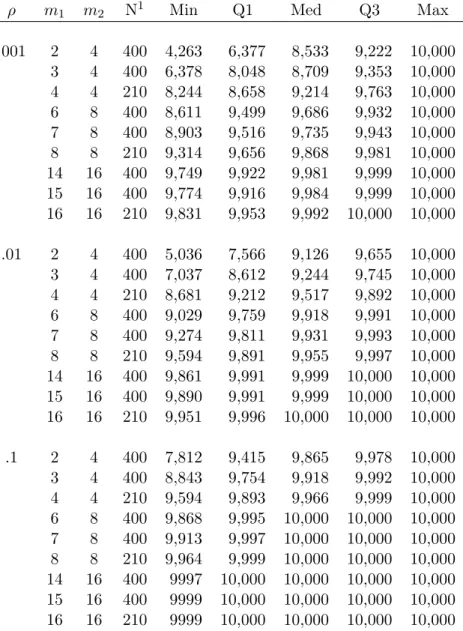
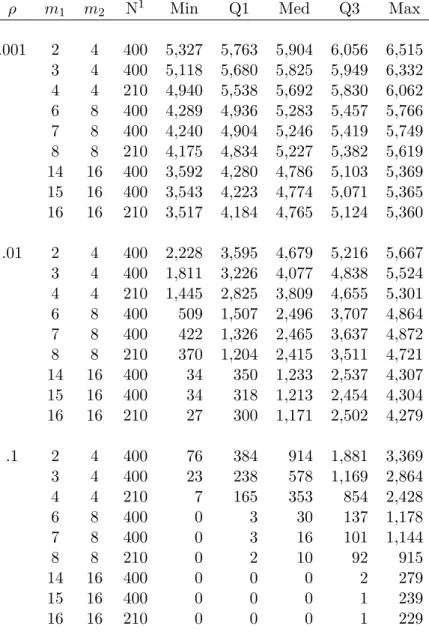
Tables 2.2 - 2.4 give descriptive statistics for type I error over all cases and for the main
effects of each parameter of imbalance and ratios of them, where applicable. No one parameter
of imbalance by itself was a major predictor of type I error, so only few conclusions may be
drawn from displays of type I error for the main effect of each imbalance parameter.
2.5.2.1 Within Cluster Correlation
Section 2 of Table 2.2 displays type I error by ρ, where ρ ∈ {.001, .01, .1}. Regardless of
the imbalance in number of clusters or cluster sizes, the analysis of means weighted by cluster
size was approximately unbiased when ρ=.001. Though sometimes still biased, the analysis
of unweighted means was approximately unbiased for many more cases than the analysis with
cluster size weights when ρ=.1.
Asρ increased, type I error for the analysis of means weighted by cluster size became more
biased. For the analysis of unweighted means, as ρ increased, type I error became less biased,
so that the two weighting schemes show opposite relationships between type I error and ρ.
2.5.2.2 Number of Clusters Per Treatment Group
Sections 3-6 of Table 2.2 display type I error for combinations of m1×m2 and their ratio,
m2/m1, where m1, m2 ∈ {2, 4, 8, 16, 32}. Descriptive statistics are similar for combinations
ofm1×m2 with the same ratio, so combinations ofm1×m2 are displayed in order ofm2/m1.
When m1 = m2, that is, when the number of clusters per treatment group is equal, the
analysis of unweighted means provided approximately unbiased type I error regardless of ρ or
imbalance in cluster sizes. No other combinations or ratios of number of clusters uniformly
lead to approximately unbiased type I error in the analysis of unweighted means, nor did any
combinations or ratios of number of clusters do so for the analysis of means weighted by cluster
size.
In general, as m2/m1 increased, type I error became more biased for both weightings. As