THE ROLE OF DEPRESSION IN HIV TRANSMISSION AMONG PEOPLE WHO INJECT DRUGS IN VIETNAM
Sara N. Levintow
A dissertation submitted to the faculty at the University of North Carolina at Chapel Hill in partial fulfillment of the requirements for the degree of Doctor of Philosophy in the
Department of Epidemiology in the Gillings School of Global Public Health.
Chapel Hill 2020
Approved by: Brian W. Pence Vivian F. Go
ABSTRACT
Sara N. Levintow: The role of depression in HIV transmission among people who inject drugs in Vietnam
(Under the direction of Brian W. Pence)
The high incidence of HIV among people who inject drugs (PWID) demands closer examination of the drivers of transmission in this population. The burden of depression is high among PWID and may lead to persistent injecting behaviors, insufficient use of antiretroviral therapy (ART), and uncontrolled viremia. This
dissertation study investigates the role of depression in transmission risk behaviors, ART initiation, and viral suppression, and models secondary transmission events among PWID in Vietnam, a key population in the country’s HIV epidemic.
We analyzed data from 455 PWID living with HIV who enrolled in a randomized controlled trial of a prevention intervention in 2009-2013. Study visits every six months over two years measured depressive symptoms using the Center for Epidemiologic Studies Depression Scale (CES-D). Combining causal inference methods with
mathematical modeling, we estimated the effect of depression as risk differences (RDs) in injection equipment sharing and condomless sex, cumulative incidence differences (CIDs) in ART initiation and viral suppression, and differences in total secondary transmissions projected to arise from participants.
mild symptoms) increased injection equipment sharing (RD = 3.9 percentage points, 95% CI: -1.7, 9.6) but decreased condomless sex (RD = -1.8, 95% CI: -6.4, 2.8) in the period three to six months later. Severe depressive symptoms lowered the cumulative incidence of ART initiation at six months (CID = -7.5, 95% CI: -17.2, 2.2) and 12 months (CID = -7.1, 95% CI: -17.9, 3.7), without appreciable differences in viral suppression. Across modeling analyses, the highest numbers of secondary transmissions were modeled for participants with severe depressive symptoms. However, there was substantial variability in model simulations due to the majority of transmissions arising from a small number of participants.
Future work probing these mixed findings for the effect of depression on sharing injection equipment (but not condomless sex) and on ART initiation (but not viral
ACKNOWLEDGEMENTS
During my first semester at UNC, the simple words “the map is not the terrain” were used to describe the PhD journey to come, and those words have stuck with me over the past six years. There is no getting through these steepest of terrains without the support of mentors, colleagues, friends, and family.
I am grateful to my advisor and dissertation chair, Brian Pence, for his
mentorship that has shaped my time at UNC and tremendously benefited me as both a researcher and human. I thank Vivian Go for her endless enthusiasm and support for my involvement with Vietnam studies and for providing the opportunity to contribute to such impactful work. Kim Powers introduced me to the infectious disease modeling world at the start of this journey, and working together ever since has been the highlight of my training. I am grateful for the opportunity to learn from Carl Latkin, whose
thoughtful feedback from my master’s paper to this dissertation has greatly benefited all of my work. I thank Steve Cole for his steadfast support of my research, teaching, and professional goals and for being so much more than the committee’s pinch hitter. This was truly a dissertation dream team.
gratitude to the incredible work of the UNC Vietnam team, the original funding for the Prevention for Positives trial (R01 DA022962), and the participants who volunteered their time to help us learn from their experiences.
At UNC, I have benefited like many others from the mentorship of Steve
Meshnick throughout my training in infectious disease epidemiology. I thank Bill Miller for his willingness to hire me as an research assistant my first year; I cannot imagine a better person to usher me into the HIV research world. I am grateful to Ann Dennis for involving me in exciting phylogenetic work and for being my inspiration for learning R. I never could have imagined that teaching R programming would be such a huge part of this experience for me – and how hugely fulfilling it would be. I thank my fellow
instructors, students, and workshop participants for learning together with me. I am incredibly appreciative of the staff in the Department of Epidemiology who have helped me through every step of this long process, especially Valerie Hudock, Chandra
Caldwell, and Spencer Gee. And to my MSPH/PhD cohort and fellow Pence advisees, I am honored to have been on this journey together surrounded by such brilliant and caring individuals.
I would also like to acknowledge my mentor Alan Brookhart and colleagues at NoviSci. Working at NoviSci was intended as a “break” from my dissertation, but along the way, this dissertation benefited immensely from all I learned from such a vibrant, remarkable group. Working together is nothing short of inspiring, and I am so fortunate for the opportunity to continue being a part of the team.
Felicia LeClere who motivated me to go to graduate school. At Davidson College, I received an unparalleled introduction to academic research, and words do not suffice to thank Scott Tonidandel and Verna Case for the opportunities they made possible for me. I also thank my high school teachers at Stone Ridge (especially Dr. Audilet and Ms. Lorenson) who first drew me to science and statistics and started me down this path.
I can never thank my friends enough for all of their love and support. Writing a dissertation is a long, isolating experience. They never failed to bring love, happiness, and adventure into my life. Thank you for always reminding me that life is so, so full.
TABLE OF CONTENTS
LIST OF TABLES ... xii
LIST OF FIGURES ... xiii
LIST OF ABBREVIATIONS ... xv
CHAPTER I: SPECIFIC AIMS ... 1
Significance... 10
Innovation ... 11
CHAPTER III: METHODS ... 14
Overview ... 14
Parent Trial ... 15
Study Population ... 17
Measures ... 17
Depression ... 18
Injecting Behavior ... 19
Sexual Behavior ... 20
ART Use ... 20
Competing Events ... 21
Data Analyses ... 21
Aim 1 Analysis ... 22
Aim 2 Analysis ... 24
Aim 3 Analysis ... 27
CHAPTER IV: ESTIMATING THE EFFECT OF DEPRESSION ON HIV TRANSMISSION RISK BEHAVIORS AMONG PEOPLE WHO INJECT DRUGS IN VIETNAM: A CAUSAL APPROACH ... 30
Introduction ... 30
Methods ... 32
Parent Trial Design and Population ... 32
Measures ... 32
Statistical Analysis ... 34
Results ... 36
Discussion ... 38
CHAPTER V: DEPRESSION, ANTIRETROVIRAL THERAPY INITIATION, AND HIV VIRAL SUPPRESSION AMONG PEOPLE WHO INJECT DRUGS IN VIETNAM ... 50
Introduction ... 50
Methods ... 51
Parent Trial Design and Population ... 51
Statistical Analysis ... 54
Results ... 59
Discussion ... 61
CHAPTER VI: THE ROLE OF DEPRESSION IN HIV TRANSMISSION AMONG PEOPLE WHO INJECT DRUGS IN VIETNAM: A MATHEMATICAL MODELING ANALYSIS ... 77
Introduction ... 77
Methods ... 78
Study Population ... 78
Model Equations ... 80
Model Parameters ... 81
Modeling Analysis... 82
Ethics ... 83
Results ... 84
Descriptive Analyses ... 84
Modeling Analyses ... 85
Discussion ... 87
CHAPTER VII: CONCLUSIONS ... 104
Summary of Findings ... 104
Strengths and Limitations ... 106
Measurement ... 106
Missingness ... 107
Selection ... 108
Generalizability ... 108
Public Health Implications and Future Directions ... 108
APPENDIX ... 111
LIST OF TABLES
Table 3.1. Observed and estimated Bernoulli model parameters for Aim 3 ... 29 Table 4.1. Characteristics of HIV-positive male PWID in Thai Nguyen,
Vietnam at baseline and follow-up visits at 6, 12, 18, and 24 months ... 44 Table 4.2. Weighted risk differences for risk behavior outcomes by
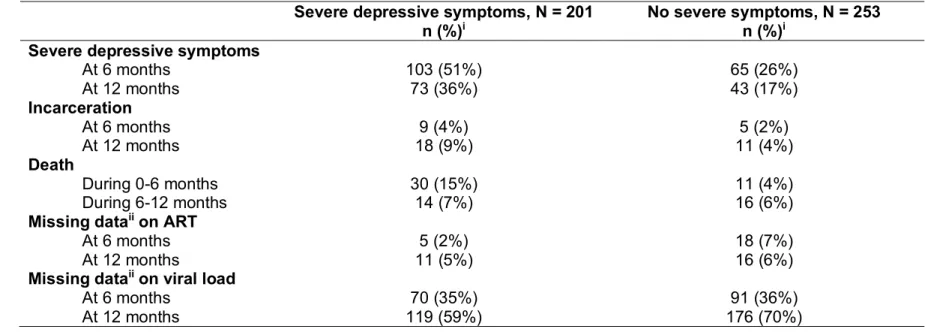
depressive symptoms. ... 45 Table 5.1. Time-fixed and time-varying characteristics of 455 HIV-positive male PWID in Thai Nguyen, Vietnam at study baseline, 6 months, and 12 months ... 66 Table 5.2. Distribution of depression, competing events, and missing data over 12 months, by baseline depression ... 67 Table 5.3. Estimates of 6-month and 12-month cumulative incidence of ART initiation and viral suppression by depression scenario and cumulative incidence differences contrasting always-depressed vs. never-depressed
scenarios ... 68 Table 6.1. Characteristics of study population associated with HIV
LIST OF FIGURES
Figure 3.1. Conceptual model of dissertation study aims ... 15 Figure 3.2. Sources and frequency of data collection for parent trial and dissertation study ... 18 Figure 3.3. Aim 1 marginal structural modeling approach ... 23 Figure 3.4. Directed acyclic graph with hypothesized associations for key variables in Aim 2 ... 26 Figure 4.1. Distribution of depressive symptoms and competing events over 24 months ... 46 Figure 4.2. Weighted risks of any injection equipment sharing and any
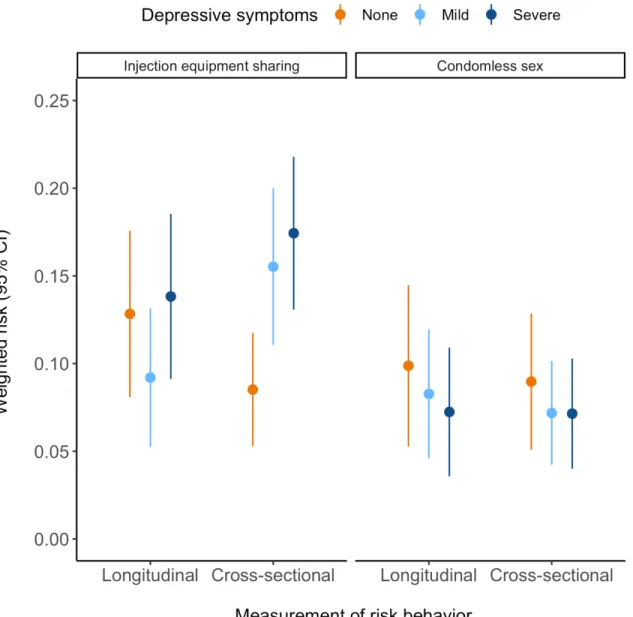
condomless sex by depressive symptoms ... 47 Figure 4.3. Weighted risks of any injection equipment sharing and any
condomless sex exploring three levels of depressive symptoms ... 48 Figure 4.4. Weighted risk differences for injection equipment sharing and condomless sex by severe depressive symptoms, based on
treatment of competing events ... 49 Figure 5.1. Estimates of 6-month and 12-month cumulative incidence of ART initiation and viral suppression ... 69 Figure 5.2. Weighted cumulative incidence of competing events (death,
incarceration) prior to ART initiation (n = 397) and viral suppression (n = 342) ... 70 Figure 5.3. Estimates of 6-month and 12-month cumulative incidence
differences for ART initiation and viral suppression, contrasting
always-depressed vs. never-depressed scenario ... 71 Figure 5.4. Weighted cumulative incidence of ART initiation and viral
suppression in the same sample of participants with neither ART initiation nor viral suppression at baseline (n = 332). ... 72 Figure 5.5. Cumulative incidence of ART initiation, by imputation ... 73 Figure 5.6. Cumulative incidence of viral suppression, by imputation... 74 Figure 5.7. Cumulative incidence differences for ART initiation, by
Figure 6.1. Distribution of potentially susceptible partners overall and by
baseline depressive symptoms ... 92 Figure 6.2. Modeled secondary transmission events in the three months prior to baseline by depressive symptom group. ... 93 Figure 6.3. Modeled secondary transmission events in follow-up months 3-6 by depressive symptom group. ... 94 Figure 6.4. Modeled secondary transmission events in follow-up months 3-6 by depressive symptoms assessed at 6 months (instead of baseline). ... 95 Figure 6.5. Sensitivity analysis accounting for possible misreporting of
partner HIV status (baseline transmission by baseline depression). ... 96 Figure 6.6. Sensitivity analysis accounting for possible misreporting of
partner HIV status (6-month transmission by baseline depression). ... 97 Figure 6.7. Sensitivity analysis accounting for possible misreporting of
partner HIV status (6-month transmission by 6-month depression). ... 98 Figure 6.8. Sensitivity analysis allowing for constant transmission
probability (baseline transmission by baseline depression). ... 99 Figure 6.9. Sensitivity analysis allowing for constant transmission
probability (6-month transmission by baseline depression). ... 100 Figure 6.10. Sensitivity analysis allowing for constant transmission
probability (6-month transmission by 6-month depression). ... 101 Figure 6.11. Mean probability of infection (with ranges) for injecting
partners reported at baseline and 6 months by depressive symptoms. ... 102 Figure 6.12. Mean numbers of secondary transmission events (with
LIST OF ABBREVIATIONS AIDS Acquired immunodeficiency syndrome ART Antiretroviral therapy
CD4 Cluster of differentiation 4
CES-D Center for Epidemiologic Studies Depression Scale
CI Confidence interval
CID Cumulative incidence difference
EIA Enzyme immunoassay
HIV Human immunodeficiency virus HPTN HIV Prevention Trials Network IQR Interquartile range
MMT Methadone maintenance treatment MICE Multiple imputation by chained equations PWID People who inject drugs
RD Risk difference
CHAPTER I: SPECIFIC AIMS
Despite global progress in controlling the HIV epidemic, people who inject drugs (PWID) remain disproportionately at risk of HIV infection (1–3). Sharing drug
preparation and injection equipment is one of the most efficient means of HIV acquisition and transmission (4,5), with injection drug use accounting for nearly one-third of HIV cases outside of sub-Saharan Africa (6,7). For PWID living with HIV, barriers to HIV care engagement and antiretroviral therapy (ART) use can inhibit viral suppression, resulting in onward HIV transmission to susceptible partners (8–10). Equipment sharing in the absence of viral suppression continues to sustain the HIV epidemic among PWID, particularly in Asia and eastern Europe (11,12).
Reducing injection behaviors and achieving widespread ART use present
has not been investigated, and the potential prevention impacts of depression interventions for PWID remain unknown.
The role of depression in HIV transmission among PWID is critical to investigate in Vietnam. Vietnam has one of the highest burdens of injection drug use worldwide, with an estimated 335,000 active PWID (42) and a history of societal marginalization and stigmatization of this vulnerable group (43,44). This study focused on 455 PWID who enrolled in a randomized controlled trial of an HIV prevention intervention in Thai Nguyen, Vietnam from 2009 to 2013 (45). In the trial, depression was assessed with the Center for Epidemiologic Studies Depression Scale (CES-D) (46), a measure of current symptoms widely used among PWID (47–49) and validated in Vietnam (50,51). Our prior work found that nearly half of trial participants experienced severe depressive symptoms (20), and in this study, we investigated the role of depression in HIV transmission by addressing the following three aims:
Aim 1: Estimate the association of depression with transmission risk behaviors. Questionnaires implemented every six months over two years assessed injection equipment sharing and condomless sex in the past three months. Previous studies of the relationship between depression and these behaviors have been unable to infer causality, as they have evaluated only the cross-sectional association between contemporaneously assessed depression and behaviors and have not accounted for the episodic nature of depression and confounders. We sought to overcome past
depression among PWID with HIV increased both injection equipment sharing and condomless sex over two years of follow-up.
Aim 2: Estimate the association of depression with ART initiation and viral suppression. At each trial visit, data were collected on physician- and self-reported ART use, and to obtain viral load data for this study, we performed HIV RNA testing on stored plasma specimens. Although an inverse relationship between depression and HIV treatment outcomes has been established, prior work has not focused on PWID; studies have been conducted among clinical cohort patients who were engaged in HIV care. This analysis provides insights into the association between depression, ART initiation, and viral suppression specifically in the PWID population, with most participants not in care at the start of follow-up. We hypothesized that PWID with depression had lower cumulative incidences of ART initiation and viral suppression, compared to PWID without depression.
Aim 3: Quantify the overall role of depression in HIV transmission by
modeling secondary HIV transmission among PWID. We developed a mathematical model that combined behavioral and viral load data to estimate secondary HIV
transmission events from PWID to their potentially susceptible injecting partners. While prior research has focused on individual components of transmission risk (e.g.,
CHAPTER II: BACKGROUND
The HIV epidemic contributes to substantial morbidity and mortality worldwide, resulting in 78 million infections and 35 million deaths to date (52–54). For people living with HIV, ART is successful in controlling viral replication, slowing progression to AIDS, and reducing risk of HIV transmission (55,56). However, there remain significant global disparities in controlling the epidemic; a particularly vulnerable group are PWID (1,3,6). HIV can be spread if certain bodily fluids (e.g., blood) from a person with HIV come into contact with a mucous membrane or damaged tissue or directly enter the bloodstream, making the sharing of injection drug use equipment one of the most efficient means of HIV transmission (4,5). Because most PWID with HIV have limited access to and insufficient use of harm reduction services and ART (2,9,10), injection drug use and viremia often persist, resulting in a high risk of HIV transmission to injecting or sexual partners (8–10). The combination of equipment sharing in the absence of viral
suppression results in continued HIV incidence among PWID, particularly in southeast Asia, central Asia, and eastern Europe (11,12).
an urgent need for prevention programs to facilitate ART use for PWID living with HIV and reduce transmission to partners, as reflected in recent HIV prevention trials
assessing the feasibility of future interventions for PWID in Vietnam (61). Risk reduction and viral suppression are both critical components of combination HIV prevention (15,55), but their success among PWID relies on addressing barriers unique to this population.
Vietnam has one of the highest burdens of injection drug use worldwide, with an estimated 200,000-300,000 PWID (7,42) and a history of societal marginalization and stigmatization of this vulnerable group (43,44). In the early 2000s, government policies to address drug use in Vietnam grew repressive and punitive, instituting compulsory detoxification and detention facilities known as “06 centers.” From 2006 to 2010, there were 169,000 admissions to 06 centers, where residents encountered crude attempts at detoxification, “moral education”, and forced labor (62). This stigmatization of injection drug use hindered the efforts of policy leaders and healthcare workers in advocating for and implementing evidence-based harm reduction interventions (63). Beginning in 2008, substance use treatment policy in Vietnam began to shift, as pilot programs for methadone maintenance demonstrated significant impacts on relapse rates (64) in addition to improved healthcare utilization and cost effectiveness (65). The government committed to expansion of the methadone maintenance program, and in 2013, formally recognized drug addiction as a chronic condition due to both biological and
Despite transitioning to a more progressive approach on drug use in recent years, Vietnam’s history of punitive policies and severe stigmatization have deterred PWID from accessing health services, such as HIV testing and treatment. This group is difficult to reach for intervention (13), and even when PWID do enter care, simply offering ART is insufficient for successful HIV treatment and prevention. A substantial proportion continue to engage in (or relapse to) injection drug use without achieving viral suppression (66). Insufficient adherence to ART is common and can lead to treatment failure and development of drug resistance (67–69). This persistence of injecting behaviors, limited engagement in HIV care, and poor adherence to ART have significant implications for continued HIV spread among PWID, particularly due to the high transmission probability of parenteral exposure (4). In order for prevention efforts to be successful, these challenges to risk reduction and viral suppression must be
addressed, and the mental health of PWID may be at the root of these challenges. The burden of depression is high among PWID and may interfere with HIV prevention efforts. Depression (also known as major depressive disorder or clinical depression) is characterized by symptoms of sadness, hopelessness, loss of interest or pleasure, feelings of guilt or low self-worth, sleep and appetite disruptions, fatigue, and poor concentration (70). In Vietnam, the translation and clinical term for depression is trầm cảm, and qualitative work in Vietnam has found that ART clients conceptualize depression primarily as a loss of social support, acute stigma and isolation, and suicidal thoughts (71). In Vietnam and other areas, depression has been found to be
with the CES-D (46). The CES-D is a measure of current depressive symptoms widely used among PWID (47–49) and validated in Vietnam (50,51). Although not a clinical diagnostic, a score of 16 or greater indicates probable depressive symptoms in the general population, with higher cut-points used for patients with comorbid chronic illness, such as HIV (50); notably, our study used a conservative cut-point of 23 to indicate severe depressive symptoms. This estimate of 44% is considerably higher than pooled prevalence estimates of depression for people living with HIV that range from 13% to 24% (72) and global estimates that 4.4% of the world’s population suffers from depression (73).
The relationship between depression and injection drug use is complex. There is evidence that depression is a risk factor for injection drug use (74,75) and that
depressive symptoms may be substance-induced (76) or a consequence of stigma and isolation experienced by PWID (77). Regardless of whether depression precedes or results from drug use, its presence and severity are closely linked to frequency of injection and risks of relapse or remission (48,74,78). This interconnected nature of depression and injection drug use fits into the broader psychological framework that depressed mood manifests as cognitive distortions, maladaptive coping, and loss of risk aversion (79). These symptoms of depression may then facilitate the “perfect storm” of behavioral and biological conditions that enable HIV transmission to occur.
decreased CD4 cell count (18,23,26), higher viral load (23,24,26,28,30,31), and greater risk of mortality (29,32). There is also some evidence that depression promotes
behaviors associated with transmission to injecting and sexual partners, such as
sharing injection equipment and condomless sex (33–41). This combination of ongoing behaviors and uncontrolled viremia – potentially driven by depression – must be
addressed to slow the spread of the epidemic among PWID and susceptible partners. While depression is recognized as a high burden among people living with HIV, the extent to which depression treatment could prevent future HIV spread is not well understood. There are numerous evidence-based pharmacologic and
psychotherapeutic approaches for treating depressive symptoms (80), and among people living with both HIV and depression, depression interventions have included antidepressant medication, cognitive behavioral therapy, and problem solving therapy (79,81–87). To date, few studies have examined the effect of depression treatment on injecting and sexual behaviors (79,85), none among PWID with HIV. There is
accumulating evidence that depression treatment can promote adherence to
antiretroviral therapy and viral suppression (81–84). Improving our understanding of the role of depression in HIV transmission will lay the groundwork for future research on depression treatment among PWID and potential impacts on HIV transmission.
depression treatment has the potential to confer important benefits in terms of both mental health and HIV prevention.
Significance
Controlling the HIV epidemic among PWID may require addressing depression as an underlying cause of uncontrolled viremia and ongoing behaviors that result in transmission to injecting or sexual partners. Prior studies have found that depression is exceedingly common among PWID and is associated with poor HIV outcomes;
however, the current research lacks a unified perspective that considers these individual associations together and assesses the overall effect of depression on onward
transmission. Persistent injecting and sexual behaviors in conjunction with low viral suppression are the key drivers of forward HIV spread. Yet, no prior study has
combined empirical data on both behaviors and viral load to investigate how depression may facilitate these conditions for HIV transmission to occur. If depression is fueling the HIV epidemic among PWID, then the recognition and treatment of depressive
symptoms is imperative, not only for health outcomes of PWID, but for slowing the spread of HIV to susceptible partners.
role of depression therein, it is critical to better understand how depression may drive onward transmission and the extent to which successful depression treatment could avert future infections.
Innovation
This study is an innovative approach, combining causal inference methods with mathematical modeling to quantify the role of depression in promoting injecting and sexual behaviors, hindering ART initiation and viral suppression, and ultimately
contributing to forward HIV transmission among PWID in Vietnam, a key population in the country’s HIV epidemic.
In Aim 1, we used a causal approach to overcome past methodological issues in estimating the effect of depressive symptoms on the injecting and sexual behaviors that can facilitate HIV transmission or acquisition. To our knowledge, all previous studies have assessed only correlations between depression and behaviors (without inferring causality) and have not accounted for the episodic nature of depression and
confounders (33–41). Potentially due to these methodological issues, existing evidence for associations between depression and transmission risk behaviors has been
In Aim 2, we expanded upon pre-existing research linking depression to poor HIV treatment outcomes (18,21–32) by investigating these associations in the PWID
context. A large body of literature has found lower ART initiation and viral suppression in clinical cohorts of HIV patients engaged in care, with little (if any) ongoing injection drug use. In contrast, the majority of our study population was not in care at the start of follow-up and all reported current injection drug use. Thus, our analysis provides
insights into the association between depression, ART initiation, and viral suppression outside of well-established clinical cohorts and specifically among PWID.
In Aim 3, the development of a mathematical model of HIV transmission among PWID is novel. HIV spread through sexual transmission has been the focus of previous modeling work, with fewer studies exploring the contribution of injection drug use to the epidemic (14,15,93–98) We developed a Bernoulli process mathematical model to estimate the expected number of secondary HIV transmission events from study participants (99), incorporating each participant’s specific behaviors, numbers of partners and acts within those partnerships, and transmission probability given viral load. Previously developed Bernoulli models among PWID used little empirical data and instead relied on simplistic and likely inappropriate assumptions, such as assuming a constant probability of transmission regardless of behavior type or an individual’s stage of infection (93). In contrast, our model used behavior and viral load data measured directly from the study population to account for realistic heterogeneity in HIV
infectiousness.
Using this model, our study is the first to quantify the role of depression in
CHAPTER III: METHODS
Overview
The overall goal of this study is to investigate the role of depression in HIV transmission among PWID in Vietnam. Longitudinal data from a randomized controlled trial of an HIV prevention intervention among PWID in Vietnam were used to estimate the effect of depression on transmission risk behaviors (Aim 1), ART initiation and viral suppression (Aim 2), and secondary HIV transmission events (Aim 3).
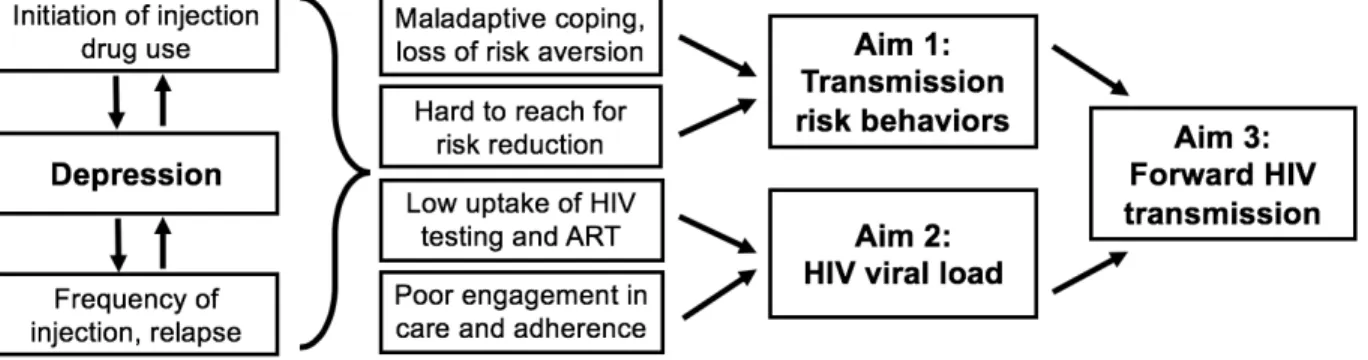
Figure 3.1 depicts the conceptual model underlying all methods for this study. In Aims 1 and 2, we estimated the effect of depression on the key determinants of HIV transmission: behaviors and viral load. We hypothesized that in the context of injection drug use, depressive symptoms manifest as maladaptive coping and loss of risk
aversion, resulting in a higher likelihood of sharing injection drug use equipment and engaging in condomless sex, while also making this group difficult to reach for interventions to change these behaviors. In addition, depressive symptoms were
Figure 3.1. Conceptual model of dissertation study aims.
Parent Trial
This dissertation study was nested within a randomized controlled trial of a multi-level HIV stigma and risk reduction intervention that enrolled PWID living with HIV in Thai Nguyen, Vietnam from 2009 to 2013 (known as the “Prevention for Positives” trial; ClinicalTrials.gov identifier: NCT01689545). Thai Nguyen is a province in northeastern Vietnam with an estimated HIV prevalence of 34% among its approximately 6,000 PWID (57–59). Out of 180 sub-districts in Thai Nguyen, participants were recruited via snowball sampling from the 32 sub-districts with the most PWID. Recruiters (former and current PWID) approached members of drug networks in private places to discuss study enrollment and then accompanied or referred interested participants to the study site for screening. At screening, participants were tested for HIV using two rapid EIA tests run simultaneously (Determine: Abbot Laboratories, Abbott Park, IL and Bioline: SD, Toronto Canada), with discordant results resolved with a third rapid assay (HIV Rapid Test: ACON, San Diego, CA).
male, and females would require a different intervention), 3) age ≥18 years, 4) reported having sex and injecting drugs in the prior six months, and 5) planned to live in Thai Nguyen for the next 24 months.
A two-stage process was used to randomize the 32 sub-districts of participants to a structural-level intervention and to randomize the 455 participants across sub-districts to an individual-level intervention (45). This process resulted in four trial arms to which participants could belong: 1) control (standard of care), 2) individual (individual
intervention only), 3) sub-district (sub-district intervention only), and 4) combined (individual and sub-district interventions).
The sub-district intervention aimed to reduce community-level HIV and injection drug use stigma, and the individual intervention sought to support participants in coping with HIV and reducing transmission risk behaviors. Sub-districts randomized to the structural-level intervention received a community-wide program consisting of a video screening and series of HIV education sessions, while sub-districts assigned to standard of care received standard messaging through educational pamphlets and public loudspeakers. Participants randomized to the individual-level intervention received enhanced HIV post-test counseling and group support sessions; those
Study Population
Out of 2,136 people approached for trial recruitment in Thai Nguyen, 1,739 were screened for eligibility, and among those screened, 455 participants were enrolled and completed the baseline visit (1,215 were not eligible, and 69 did not attend the baseline visit or otherwise refused to participate). Follow-up visits took place at 6, 12, 18, and 24 months following baseline. At each visit, a structured questionnaire was administered, and participants were asked to provide blood specimens to assess CD4 cell count. Written informed consent was obtained from all eligible participants at screening and enrollment, and at baseline and follow-up visits, participants were reimbursed 75,000 Vietnamese Dong ($3.50 USD) plus 5,000 Vietnamese Dong ($0.23) per kilometer traveled.
Measures
At each visit, the questionnaire was administered by a trained interviewer face-to-face in a private room at the project facility and took approximately 1-1.5 hours to
complete. Key variables for this dissertation study from the questionnaire were demographics, injection drug use and other substance use, sexual behavior, depression, quality of life, and ART use. In addition to the questionnaire data, this dissertation study used measures of CD4 cell count and viral load from blood
Figure 3.2. Sources and frequency of data collection for parent trial and dissertation study.
Depression
For the main exposure of interest across Aims 1-3, we used CES-D scores to categorize participants by depressive symptom severity. Consistent with past work (20,46,50,51), we defined severe depressive symptoms as CES-D scores ≥23, mild depressive symptoms as scores 16-22, and no symptoms as scores <16.
Injecting Behavior
In the questionnaire, participants reported injection drug use from the prior three months. Participants were asked about the type of drug most frequently injected, the number of days during the past three months they injected that drug, and if they had ever overdosed. Participants were also asked about injection equipment sharing with injecting partners over the last three months, with an injecting partner defined as someone in the same room as or in close proximity to the participant when they were both injecting drugs. Participants reported a global measure of injection equipment sharing across all partners from the prior three months (any/none), in addition to detailing types and numbers of sharing behaviors per injecting partner (for up to 10 partners). Specifically, for each partner, participants were asked to report the frequency in those three months of: 1) sharing the same needle or syringe, 2) sharing drug
solution, and 3) sharing the same ampoule of distilled water or novocaine. Participants were also asked if each partner had HIV, with possible responses being “Yes”, “No”, or “Don’t know”.
between depression, ART initiation, and viral suppression. To model secondary
transmissions in Aim 3, we used the partner-specific measures of types and numbers of sharing acts.
Sexual Behavior
Participants were asked if they had sex with a male or female partner without using a condom in the prior three months. Similar to the global measure of injection equipment sharing, this measure of condomless sex (i.e., any/none in the last three months) was used as a primary outcome for Aim 1 and included as a potential confounder in Aim 2.
ART Use
As part of the questionnaire at each visit, participants were asked if they were currently taking ART, and in addition, participants were seen by the study physician who also ascertained current ART use. The outcome of ART initiation for the Aim 2 analysis was defined based on both participant- and physician-reported data. A participant was considered to have initiated ART in the prior six months as of the first visit at which the study physician reported participant ART use. If the physician’s report of ART use was missing (occurring for 17% of study visits overall), we used the participant’s report of ART use in the previous six months. In prior work in this population, we found 92% concordance between participant- and physician-reported ART use (103).
Viral Load
using COBAS® AmpliPrep/COBAS® TaqMan® HIV-1 Test platform (Roche Diagnostics GmbH) with a lower limit of detection of 20 copies/mL. The viral load data was
incorporated into the transmission model in Aim 3 and was used to define the outcome of viral suppression for the Aim 2 analysis. Participants were considered to have experienced the viral suppression outcome as of the first visit with viral load <400
copies/mL. This cut-point was chosen given prior work showing that HIV transmission is highly unlikely when viral load is <400 (104).
Other Covariates
Potential confounders included in the Aims 1-2 analyses were marital status (single, married or cohabitating, separated, divorced or widowed), age (in years), employment status (full-time, part-time, unemployed), history of overdose (yes/no), current alcohol use (yes/no), HIV diagnosis prior to enrollment (yes/no), CD4 cell count category (<200, 200-349, 350-499, ≥500 cells/µL), and intervention arm (Control, Individual, Subdistrict, Combined).
Competing Events
Study outreach workers attempted to trace participants who missed a follow-up visit (at 6, 12, 18, 24 months) using the contact information collected at baseline. During tracing procedures, outreach workers asked participant contacts if the participant had died or was incarcerated. These measures of death and incarceration were included as competing events across Aims 1-3.
Data Analyses
the study population, as reflected by variability in CES-D score across 24 months. Rather than relying on a single measure of depressive symptoms, each analysis incorporated assessments from multiple time points to more fully capture the relationships between depression and the outcomes of interest.
All analyses were conducted using R Version 3.4.3 (105). See Appendix 1 for R packages used in analyses.
Aim 1 Analysis
To estimate the effect of depression on transmission risk behaviors, we used marginal structural models, a method for causal inference used for time-varying
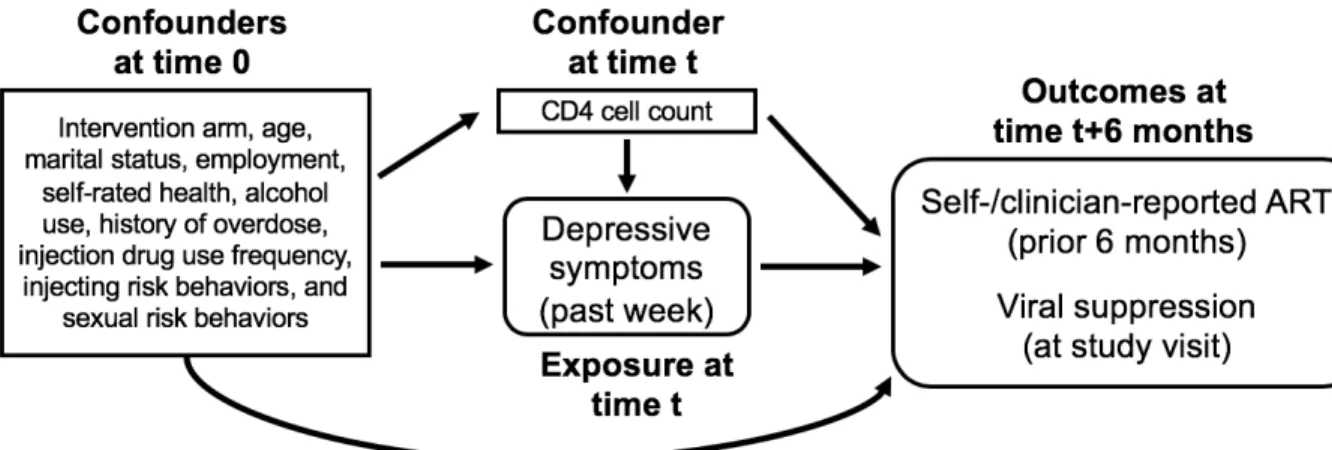
Figure 3.3. Aim 1 marginal structural modeling approach.
We used inverse probability weighted estimation of marginal structural models (90,107). The weights were estimated from a propensity score model for the probability of severe depressive symptoms at each visit as a function of time-fixed and time-varying confounders, identified prior to analysis. Time-fixed confounders had a constant
(baseline) value over all visits and included marital status, age, employment status, intervention arm, history of overdose, current alcohol use, HIV diagnosis prior to enrollment, and history of ART use. Time-varying confounders measured at one time point may affect subsequent depression and risk behaviors; they may also be
influenced by depression and risk behaviors from a previous time point. Thus, time-varying covariates may act as either confounders or mediators, depending on the time point assessed (90,108). For this analysis, time-varying covariates were CD4 cell count category, history of depressive symptoms, and history of transmission risk behaviors, using the value from the visit prior to the assessment of depressive symptoms.
the study population removes the association between depressive symptoms and the potential confounding variables included in the propensity score model, permitting estimation of a causal effect under the key assumptions of consistency, conditional exchangeability, positivity, and no model misspecification (107,109). In the weighted study population, we estimated the RD for the risk behavior outcomes using generalized estimating equations to account for repeated observations on participants (110–112). For the longitudinal analysis, this weighted RD can be interpreted as the causal effect of depressive symptoms on the risk behavior outcome: that is, the difference in risk of the behavior in the period three to six months later if all participants had depressive
symptoms compared with the risk if they all did not have depressive symptoms. To account for missing data due to missed study visits, we used multiple imputation by chained equations (MICE) for all variables included in the analysis (113,114), imputing and analyzing 50 datasets. We included participants who were incarcerated or had died during the study period in the main analysis up until the six-month follow-up interval during which the competing event occurred, censoring them at that interval. In sensitivity analyses, we instead used the imputed risk behavior outcome for that six-month interval (and censored them at the following interval), given the
possibility of engaging in unmeasured risk behaviors prior to incarceration or death. Aim 2 Analysis
under three scenarios: 1) Natural course: the incidence of the outcome in the observed study population, 2) Never depressed: the incidence of the outcome if participants never had severe depressive symptoms (i.e., symptoms were mild or absent, defined as CES-D score <23, at all study visits up to and including the visit prior to outcome
ascertainment), and 3) Always depressed: the incidence of the outcome if participants always had severe depressive symptoms (CES-D ≥23 at all study visits up to and including the visit prior to outcome ascertainment). Death and incarceration were treated as competing rather than censoring events for the outcomes of interest.
Figure 3.4. Directed acyclic graph with hypothesized associations for key variables in Aim 2.
As in Aim 1, application of the weights to the study population removes the association between the potential confounding variables included in the model and depressive symptoms, permitting estimation of a causal effect between depression and our outcomes of interest under key assumptions of consistency, conditional
exchangeability, positivity, and no measurement error (107,109). In the weighted study population, we estimated the cumulative incidence of each outcome at 6 and 12 months as the cumulative sum of the weights for participants experiencing the outcome, divided by the total sample size. To ensure that depression occurred prior to the outcome, outcomes lagged their assigned weight values by 6 months (i.e., baseline weight values were used for outcomes at 6 months; 6-month weight values were used for outcomes at 12 months). We estimated the CID contrasting the never-depressed and
depressive symptoms, compared with the risk if participants never had severe depressive symptoms.
We focused on cumulative incidence estimates at 6 and 12 months (rather than the full 24-month follow-up period) due to substantial missing data on viral load. This missingness was due to insufficient sample volume (<1mL) for 31% of specimens at 6 months, 59% at 12 months, 48% at 18 months, and 55% at 24 months. To limit the influence of missing data, we evaluated both outcomes of interest only at the two earliest follow-up visits (6 and 12 months). Similar to Aim 1, we used MICE to analyze 50 complete datasets with values imputed for missing viral load and other study
variables with intermittent missing data not due to death or incarceration (<15% across all variables at all visits) (113,114). Rubin’s formula was used to pool results and calculate variance accounting for within- and between-imputation variability (113). Aim 3 Analysis
Combining behavioral and viral load data from Aims 1 and 2, we developed a modified Bernoulli process mathematical model (99,115–118) to estimate the parenteral HIV transmissions from each study participant in two periods: the three months before baseline and the three months before the six-month visit. Transmission estimates were based on viral load measurements taken at the end of a given period, reported numbers of injecting partners in the period, sharing acts within those partnerships over the
For each named partner in a specified period, we estimated the probability that the participant would transmit HIV to that partner as a function of the probability that the partner was already HIV-infected, the number of acts between the participant and
partner over the period, and the probability of HIV transmission in one sharing act with a susceptible partner. This per-act transmission probability was calculated as a function of the participant’s viral load. For each participant, we then summed across the partner-specific probabilities to obtain the total number of secondary transmissions estimated for that participant in a given three-month period.
Our model parameters came from both the observed data and published
estimates from the scientific literature (Table 3.1). The number of sharing acts and the probability of partner HIV infection were based on questionnaire reports at baseline and six months. For the probability of HIV infection among partners whose HIV status was reported as unknown, we used an estimate of overall HIV prevalence (34%) among PWID in Thai Nguyen during the study period (57–59). Participant viral load was fully observed at trial baseline, and for missing viral load due to insufficient samples at six months (31% of participants), we used MICE (113,114) to impute viral suppression status and assign viral load. To derive the per-act transmission probability using participant viral load, we relied on prior transmission estimates (119–121) for the average viral load set-point, transmission probability per sharing act at that set-point, and increase in infectiousness per log10 increase in viral load above the set-point value.
Further details about these model parameters are included in Chapter VI.
symptoms) and compared the total number of estimated transmissions by depressive symptom group, the probability of infection per partner, and the number of estimated transmissions per participant. To account for different sample sizes by depression, we weighted the number of total transmissions such that each group was upweighted to stand in for the full study population.
Table 3.1. Observed and estimated Bernoulli model parameters for Aim 3.
Model Parameter Estimate Source
Number of sharing acts with partner
Participant-reported frequency category
Assigned count per 90 days
Trial data Literature
(122) Never 0
<1 time a month 1.5 2-3 times a month 7.5 1 time a week 12 2-3 times a week 30 Everyday 90 Probability of pre-existing
HIV infection for partner Participant-reported partner HIV status Assigned probability of HIV infection Literature Trial data (58,59) HIV-positive 1
HIV-negative 0 Unknown 0.34
Participant’s HIV viral load Observed copies/ml with multiple imputation of viral
suppression status where missing: Trial data Impute suppression Randomly assign viral load 1-400
Impute no suppression Carry forward baseline value (>400) Viral load set-point log
10 4.5 copies/ml Literature (119) Transmission probability at
viral load set-point 0.008 (range 0.0063-0.024) Literature (120) Rate ratio per log10
CHAPTER IV: ESTIMATING THE EFFECT OF DEPRESSION ON HIV TRANSMISSION RISK BEHAVIORS AMONG PEOPLE WHO INJECT DRUGS IN
VIETNAM: A CAUSAL APPROACH Introduction
Despite global progress in combating the HIV epidemic, PWID remain disproportionately at risk of HIV infection (1–3). Sharing injection equipment is an efficient means of HIV transmission (4,5), and high HIV incidence continues among PWID, particularly in southeast Asia, central Asia, and eastern Europe (11,12). Because PWID have limited access to and insufficient use of harm reduction services and ART (9,10), injection drug use and viremia often persist, resulting in a high risk of HIV transmission to injecting or sexual partners (8).
Persistent risk behaviors and lack of HIV treatment engagement may be driven – at least in part – by a high burden of depression among PWID. Up to 50% of PWID suffer from severe depressive symptoms (16–20), and comorbid depression
consistently results in poor HIV treatment outcomes (21,25–29). By lowering ART uptake and viral suppression, depression may also be an important driver of continued HIV incidence among PWID. However, while the deleterious effect of depression on HIV care and treatment engagement is well established, its effect on the injecting and sexual behaviors that can facilitate HIV transmission or acquisition is not well understood.
behaviors, without inferring causality (33–41). In these studies, depression and risk behaviors have typically been evaluated for the same time period (e.g., self-report covering the last month), without the ability to infer whether depression preceded risk behaviors or vice versa (36–38,40,41). Potential confounders of the relationship between depression and risk behaviors were also measured for the same
retrospectively assessed time period. Studies that used traditional statistical adjustment for these contemporaneous covariates (35,39) may have induced bias if these variables acted as causal mediators rather than confounders (108). In addition, although
depression is known to be episodic (123), prior analyses have primarily relied on a single assessment rather than accounting for changes in both depressive symptoms and time-varying confounders (34,35,39,41).
Possibly stemming from these methodological issues, existing evidence for an association between depression and transmission risk behaviors is inconsistent. While an early meta-analysis found little evidence for an association between depression and sexual risk behaviors (33), more recent studies have found higher sexual risk
associated with depression (35,36,41) or a non-linear association (37) in which mild symptoms are most predictive of sexual risk. The few studies that have evaluated the association of depression with injecting risk behaviors have suggested that depressive symptoms were associated with greater injecting risk behaviors (36,38–40).
separated depression from risk behaviors and accounted for the episodic nature of depression. Data for this study came from PWID living with HIV in Vietnam who reported behaviors associated with risk of HIV transmission to injecting partners (sharing injection drug use equipment) and sexual partners (condomless sex). We hypothesized that depression increased both injection equipment sharing and condomless sex over two years of follow-up. Through a methodologically rigorous investigation, we aimed to study depression as a potential underlying cause of HIV transmission and to provide clearer evidence to inform interventions against depression to avert future HIV infections among PWID.
Methods
Parent Trial Design and Population
We used longitudinal data from a randomized controlled trial of a HIV stigma and risk reduction intervention among PWID living with HIV in Thai Nguyen, Vietnam from 2009-2013 (45). The trial enrolled 455 participants who met the following eligibility criteria: 1) confirmed HIV diagnosis, 2) male (given that 97% of PWID in Thai Nguyen are male), 3) age ≥18 years, 4) had sex in the past six months, 5) injected drugs in the previous six months, and 6) planned to live in Thai Nguyen for the next 24 months. Measures
measured CD4 cell count over follow-up. At baseline, participants responded to the questionnaire prior to receiving HIV testing results.
The exposure of interest was depressive symptoms over the past week, as assessed by the 20-item CES-D, which has been validated as a reliable measure of depressive symptoms in Vietnam (46,50). Consistent with past work, we defined severe depressive symptoms as CES-D scores ≥23, mild depressive symptoms as scores 16-22, and no symptoms as scores <16 (20,46,50,51). The transmission risk behavior outcomes were any sharing of injection equipment (needles, syringes, solutions, or distilled water) and any condomless sex, reported for the prior three months. We also descriptively examined the numbers of risk acts in the prior three months reported at each visit.
Questionnaire and laboratory data included potential confounders of the
depression-risk behavior relationship. Time-fixed covariates, which were assumed to be stable throughout the study period, were marital status, age, employment status,
≥500 cells/μL), history of depressive symptoms, and history of transmission risk behaviors.
Statistical Analysis
In the main analysis, we used marginal structural models to estimate the average causal effect of severe depressive symptoms on the risks of any injection equipment sharing or any condomless sex (separately) in the period three to six months later, controlling for time-fixed and time-varying confounders. We evaluated each risk
behavior outcome (reported with respect to the prior three-month period) at the next six-month visit in order to temporally separate it from the exposure of depressive symptoms (hereafter referred to as the “longitudinal effect”). In a second analysis, to facilitate comparison with prior research, we used marginal structural models to estimate the association between depressive symptoms and risk behaviors reported at the same visit, where temporal ordering could not be differentiated (“cross-sectional association”).
subsets of the study population. The denominator of the weights was the predicted probability of depressive symptoms from the propensity score model, and weights were stabilized using the marginal probability of depressive symptoms in the numerator.
Application of the weights to the study population removes the association between depressive symptoms and potential confounding variables included in the propensity score model, permitting estimation of a causal effect under key assumptions (107,109) (see Discussion). In the weighted study population, we estimated RD for the risk behavior outcomes using generalized estimating equations to account for repeated observations on participants (110–112). For the longitudinal analysis, this weighted RD can be interpreted as the causal effect of depressive symptoms on the risk behavior outcome: that is, the difference in risk of the behavior in the period three to six months later if all participants had depressive symptoms compared with the risk if they all did not have depressive symptoms.
To account for missing data due to missed study visits, we used MICE (113,114), imputing and analyzing 50 datasets. We included participants who were incarcerated or died during the study period in the main analysis up until the six-month follow-up interval during which incarceration or death occurred, censoring them at that interval. In
Ethics
This study was approved by the ethical review committees at the Thai Nguyen Center for Preventive Medicine, the Johns Hopkins Bloomberg School of Public Health, and the University of North Carolina at Chapel Hill Gillings School of Global Public Health. Written informed consent was obtained from all participants.
Results
Based on inclusion criteria, all 455 participants were male, HIV-positive, and reported being sexually active and using injection drugs at baseline. The median age of participants was 35 years (interquartile range [IQR]: 30, 39), and half were married or cohabitating (47%) (Table 4.1). One-third had a high school education (34%), and the majority were employed full-time (69%). Most participants were newly diagnosed with HIV at baseline (74%), while 15% had been previously diagnosed but were not taking ART, and 11% were previously diagnosed with current ART use. The median CD4 cell count was 241 cells/µL (IQR: 126, 370). General health was rated as poor by 30%. Nearly half reported injecting heroin daily (45%), 18% had a history of overdose, and 67% reported current alcohol use. Participants completed between zero and four follow-up study visits (median=4, IQR: 2, 4) at six-month intervals over 24 months, with 87% completing at least one follow-up visit.
with injecting partners over the past three months (73%); these participants reported a median of 21 sharing acts during those three months (IQR: 7, 52).
After the baseline visit – when the majority of participants were diagnosed with HIV and received risk reduction counseling – sharing injection equipment and
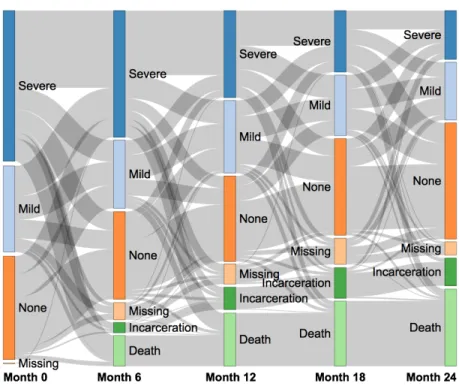
condomless sex decreased across trial arms (previously reported in (45)). However, among participants attending ≥1 follow-up visits (n=397), 21% reported sharing injection equipment at ≥1 visits, and 7% reported condomless sex at ≥1 visits. The severity of depressive symptoms varied over time; among participants attending ≥1 follow-up visit, 59% experienced severe depressive symptoms at ≥1 visits (Figure 4.1). The percentage of participants experiencing competing events increased over time, with 8%
incarcerated and 23% deceased at 24 months.
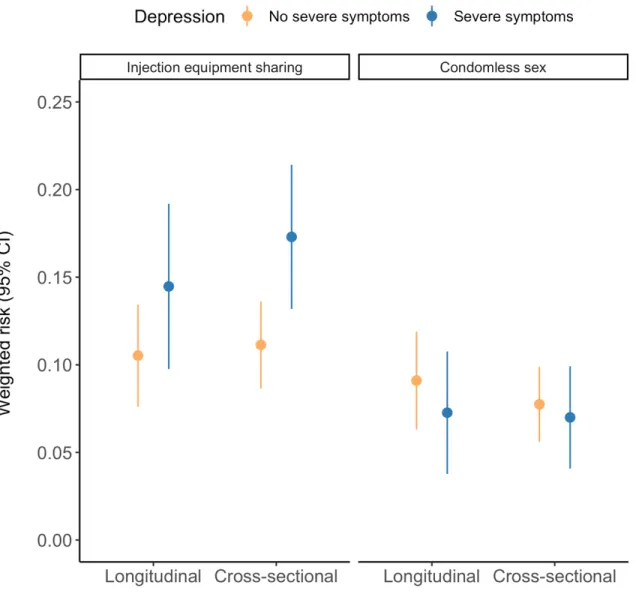
In our main analysis, we estimated that severe depressive symptoms (compared to no or mild symptoms) increased the risk of sharing injection equipment by 3.9
percentage points (95% CI: -1.7, 9.6) and decreased the risk of condomless sex by 1.8 percentage points (95% CI: -6.4, 2.8) in the period three to six months later (Table 4.2, Figure 4.2). In the cross-sectional analyses, the association between severe depressive symptoms and contemporaneous injection equipment sharing (RD = 6.2, 95% CI: 1.4, 11.0) was stronger than the estimated longitudinal effect, while the association with condomless sex was attenuated (RD = -0.7%, 95% CI: -4.5%, 3.0%).
depressive symptoms differed for the longitudinal effect versus the cross-sectional association. In longitudinal analyses, we observed a U-shaped relationship in which the risk of injection equipment sharing in the period three to six months later was 12.8% (95% CI: 8.1%, 17.6%) among those with no depressive symptoms, 9.2% (95% CI: 5.3%, 13.2%) among those with mild symptoms, and 13.8% (95% CI: 9.1%, 18.5%) among those with severe symptoms. In contrast, in the cross-sectional analysis, we observed a monotonic increasing relationship in which those with no depressive symptoms had the lowest risk of 8.5% (95% CI: 5.3%, 11.8%) while those with mild symptoms had a risk of 15.5% (95% CI: 11.1%, 20.0%) and those with severe symptoms had a risk of 17.4% (95% CI: 13.1%, 21.8%).
We did not find appreciable differences in sensitivity analyses that varied censoring time for participants who were incarcerated or deceased (Figure 4.4). Discussion
Using two years of longitudinal data and methods for causal inference, we found that severe depressive symptoms increased the risk of sharing injection equipment but not the risk of condomless sex among PWID. To overcome past methodological issues, we used marginal structural models to capture the episodic nature of depression,
enforce temporal ordering of depression and risk behaviors, and control time-varying confounding in the analysis. By focusing on PWID living with HIV in Vietnam, a population at high risk of ongoing HIV transmission, we aimed to better understand depression as an underlying cause of risk behavior and potential onward transmission.
comparing participants with severe depressive symptoms to those with mild or no depressive symptoms. This longitudinal effect was only slightly weaker than the corresponding cross-sectional association (RD = 6.2, 95% CI: 1.4, 11.0) found in the analysis that did not enforce temporality. Our estimate for this effect shows that a risk difference ranging from a 1.7 percentage point decrease, a small negative association, to a 9.6 percentage point increase, a substantial positive association, is compatible with the data. Given that the overall risk of injection equipment sharing was 10% across follow-up visits, the point estimate of a 3.9 percentage point increase is substantively meaningful.
Previous research has suggested a possible non-linear relationship between the severity of depressive symptoms and occurrence of transmission risk behaviors. This literature has focused on sexual risk behavior, finding that mild depressive symptoms are associated with higher sexual risk behavior but this risk decreases with severe depressive symptoms (37). Our secondary analysis for the risk of condomless sex evaluated three levels of depressive symptoms, but findings were similar to our main analysis, suggesting slight decreases in condomless sex with increasing severity of depressive symptoms. Participants with depressive symptoms – regardless of severity – may be experiencing fatigue, social isolation, and loss of interest in sex, thereby
reducing the risk of engaging in this behavior (125).
between mild and severe symptoms (36,38,40). We found that participants with no depressive symptoms had the lowest cross-sectional risk of sharing injection equipment (suggesting a monotonic increase in risk with increasing symptom severity), while participants with mild depressive symptoms had the lowest risk of sharing injection equipment three to six months later (suggesting a U-shaped relationship, where risk increased with no symptoms or severe symptoms). Interestingly, this U-shaped relationship for longitudinal injecting risk is the inverse of previous findings on sexual risk (where those with mild depressive symptoms had the highest risk) (37). This may be due to mild depressive symptoms manifesting differently for injecting behavior
compared to sexual behavior. Depressive symptoms could lead to cognitive distortions, maladaptive coping, and loss of risk aversion (126–128), and such symptoms may need to become severe in order to be expressed behaviorally as increased frequency of injection drug use (to treat severe symptoms) and consequently, greater sharing of equipment.
Although the relationship between depression and risk behaviors has been studied previously, the unique contribution of this study is its methodological rigor in inferring causality rather than correlation. Our modeling approach controlled time-varying confounding and incorporated the episodic nature of depressive symptoms by using longitudinal data from five study visits over two years. Estimation of the
between temporal ordering and etiologic relevance in the context of data limitations particular to this study. Separating the measurement of depressive symptoms and risk behaviors by six months (with a three-month “blackout period” in between) was
necessitated by the parent trial’s data structure. A shorter time interval with more complete data coverage may allow better capture of the effect of episodic depressive symptoms on subsequent risk behavior. In addition, this incomplete interval coverage could have attenuated effect estimates relative to what they might have been if the entire interval were included (i.e., if depressive symptoms were more likely to influence risk behaviors in the first three months of the follow-up interval).
Inferring causality relies on several key assumptions, which must be evaluated carefully in light of the limitations of this study (107,109). The assumption of no
unmeasured confounding (i.e., that participants with and without depression are exchangeable) is critical to using observational studies for causal inference. Although we controlled for a variety of confounders, it is possible that unmeasured confounding biased estimates of the effect of depression on risk behaviors. We also assumed positivity (i.e., participants with and without depressive symptoms were in all
recruited by former drug users (aware of their injection drug use), indicating a
willingness to disclose sensitive behaviors. Finally, the assumption of consistency holds that any variability in treatment (i.e., multiple versions of treatment) is irrelevant to the effect of treatment on the outcome. Here, we did not model a specific treatment or intervention on depression. Therefore, our results should only be interpreted as the hypothetical effect of eliminating severe depressive symptoms without specifying the treatment or intervention used for elimination.
Our conclusions are specific to this sample and may not be representative of all PWID living with HIV. Participants were not randomly sampled and may differ from other PWID with HIV in Vietnam. While men who inject drugs drive the HIV epidemic in
Vietnam, our findings may not be applicable to other groups, such as women or PWID in other regions. However, our findings may be broadly generalizable to other Asian and European countries where the HIV epidemic is concentrated among similar groups. There is also increasing relevance to understanding drivers of transmission risk
behaviors among PWID in the United States, as the current opioid epidemic has begun to result in explosive HIV outbreaks (129–131). Importantly, the risk behavior outcome in our study does not allow direct prediction of forward HIV transmission risk, as we did not take into account viral suppression status, the frequency of risk acts, or partner susceptibility to HIV. These determinants of transmission will be incorporated into a future mathematical modeling analysis that will explicitly estimate forward transmission events from this study population.
Vietnam. During the study period (2009-2013), there was very limited access to mental health services for people living with depression in Vietnam (88). However, in recent years, mental health services have become a national health priority, and there is
growing attention and funding for increasing local services and availability of depression treatment (88,132). Screening and treating depressive symptoms among PWID
Table 4.1. Characteristics of HIV-positive male PWID in Thai Nguyen, Vietnam at baseline and follow-up visits at 6, 12, 18, and 24 months.
Characteristic at baseline (n = 455 participants) Median (IQR) or N (%)†
Age in years (range 19-60) 35 (30, 39)
Married or cohabitating 215 (47)
High school education or greater 153 (34)
Full-time employment 315 (69)
Newly diagnosed with HIV 336 (74)
Prior HIV diagnosis, no ART use 68 (15)
Prior HIV diagnosis, current ART use 51 (11)
CD4 cell count (cells/µl) 241 (126, 370)
Self-rated health as poor 136 (30)
Daily injection drug use 207 (45)
History of overdose 84 (18)
Current alcohol use 307 (67)
Severe depressive symptoms (CES-D≥23) 201 (44) Any sharing of injection equipment in prior 3 months 332 (73) Number of sharing acts in prior 3 months (if reported any) 21 (7, 52) Any condomless sex in prior 3 months 108 (24) Number of condomless acts in prior 3 months (if reported any) 10 (5, 20) Characteristic over follow-up (n = 397 attended ≥1 visit) Median (IQR) or N (%)‡
CD4 cell count (cells/µl) 251 (148, 376)
Any severe depressive symptoms (CES-D≥23) 235 (59) Any sharing of injection equipment in prior 3 months 82 (21) Any condomless sex in prior 3 months 29 (7) † Median and N (%) at baseline visit for all n=455 participants.
Table 4.2. Weighted risk differences for risk behavior outcomes by depressive symptoms.
Injection equipment sharing: Main analysis Injection equipment sharing: Secondary analysis
Depressive symptoms contrast
Risk behavior measurement
RD (95% CI) Depressive symptoms
contrast
Risk behavior measurement
RD (95% CI)
Severe vs. Not severe Longitudinal 3.9 (-1.7, 9.6) Severe vs. Mild Longitudinal 4.6 (-1.5, 10.7) Severe vs. None Longitudinal 1.0 (-6.0, 8.0) Severe vs. Not severe Cross-sectional 6.2 (1.4, 11.0) Severe vs. Mild Cross-sectional 1.9 (-4.4, 8.2) Severe vs. None Cross-sectional 8.9 (3.6, 14.3)
Condomless sex: Main analysis Condomless sex: Secondary analysis
Depressive symptoms contrast
Risk behavior measurement
RD (95% CI) Depressive symptoms
contrast
Risk behavior measurement
RD (95% CI)
Severe vs. Not severe Longitudinal -1.8 (-6.4, 2.8) Severe vs. Mild Longitudinal -1.0 (-6.3, 4.2) Severe vs. None Longitudinal -2.6 (-8.7, 3.5) Severe vs. Not severe Cross-sectional -0.7 (-4.5, 3.0) Severe vs. Mild Cross-sectional -0.0 (-4.5, 4.4) Severe vs. None Cross-sectional -1.8 (-6.8, 3.2)
4
Figure 4.1. Distribution of depressive symptoms and competing events over 24 months. Stacked rectangles at each time point correspond to mutually exclusive states, and shaded paths indicate transitions between states in each intervening 6-month period. The six states are severe symptoms (CES-D≥23), mild symptoms
Figure 4.2. Weighted risks of any injection equipment sharing and any
Figure 4.3. Weighted risks of any injection equipment sharing and any
Figure 4.4. Weighted risk differences for injection equipment sharing and condomless sex by severe depressive symptoms, based on treatment of competing events. For participants experiencing a competing event (death or