Christina E. Getaz. “I mean, I think it still works”: How Do Library Staff Develop Expertise and Support Users in Circulating Collections of Audiovisual Production Equipment? A Master’s Paper for the M.S. in L.S. degree. April 2020. 51 pages. Advisor: Brian Sturm.
Abstract: Libraries house and circulate many types of materials and technologies. In academic libraries, circulating equipment often supports coursework and curricular goals around experiential education. These collections create specific demands on the librarians who manage them in terms of selection, upkeep, and user support and reference. This study consisted of a web-based survey that asked academic library staff about the breadth of audiovisual production equipment collections, their own experiences developing knowledge to support these collections, and provision of user support services and materials.
Headings:
Academic libraries—Circulation and loans Nonbook collections in libraries
“I MEAN, I THINK IT STILL WORKS”: HOW DO LIBRARY STAFF DEVELOP EXPERTISE AND SUPPORT USERS IN CIRCULATING COLLECTIONS OF
AUDIOVISUAL PRODUCTION EQUIPMENT?
by
Christina E. Getaz
A Master’s paper submitted to the faculty of the School of Information and Library Science of the University of North Carolina at Chapel Hill
in partial fulfillment of the requirements for the degree of Master of Science in
Library Science.
Chapel Hill, North Carolina
April 2019
Approved by
1
Table of Contents
Introduction ... 2
Literature Review... 3
Research Questions ... 11
Methodology ... 12
Positionality ... 12
Recruitment of Research Participants ... 12
Survey Development ... 14
Results ... 16
Collection Size ... 16
Collection Contents ... 18
Challenges ... 22
Staff Experiences... 24
User Support Materials... 26
LibGuides ... 26
Equipment Manuals ... 26
Video Tutorials... 28
Instruction ... 30
Reference... 31
User Support Overall... 32
Discussion ... 34
Conclusion ... 37
References ... 38
Appendix A: Recruitment Document ... 42
2
Introduction
The role of libraries is changing, as is the necessary expertise of librarians. Libraries have long offered materials and services beyond books and other information formats. This includes a wide variety of physical objects and equipment. In academic libraries, increased interest in experiential education in the curriculum often supports the development of materials and technology collections. Audiovisual production equipment may be of particular use in departments like film and journalism, but it can be used in other disciplines as well. Much of this equipment, such as DSLR cameras, is expensive. Circulating equipment allows students to accomplish coursework as well as learn about the equipment itself. However, these collections place unique demands on librarian or library staff expertise to maintain the collection and provide user support and reference and instruction services. The study described in this paper consisted of a web-based survey of library staff members who work with collections of audiovisual production equipment in academic libraries. In particular, this survey asked participants about:
1) the types of AV production equipment their academic libraries circulate, 2) the strategies staff members use to develop the expertise necessary to support
these collections and
3
Literature Review
Many authors consider collections of things, especially collections of technological equipment, to be a part of the current cycle of library reinvention (see Holderman, 2017; Robison & Shedd, 2017; Shurtz, Sewell, Halling, McKay, & Pepper, 2015). It is important to note, however, that these collections do not always exist within libraries. Robison and Shedd (2017) use the phrase “building a library of things” in the subtitle of their book, From Audio Recorders to Zucchini Seeds. The collections featured in the book exist in several different settings: some of the “libraries of things” are part of collections in public or academic libraries, but others are not associated with a traditional library. Söderholm (2018) writes that many tool lending services are “built on the library as a model of provision” (p. 374), rather than actually being affiliated with a nearby library.
4 artificial intelligence” (p. 332) and is compatible with existing categories in MARC, BIBFRAME, and WorldCat. In the context of academic libraries today, circulating collections of laptops or cameras may be designated by a term like “technology lending program” or “device-lending”, both of which are used by Chapman and Woodbury (2012), or “equipment lending” (see Jensen, 2008 and others). Rubel (2017) uses both “realia” and “learning object” to describe collections of anatomical models and educational manipulatives in an academic library.
Whatever they are called, the range of RWOs in libraries is broad. Massis (2013) lists several examples from around the United States, including cake pans in a public library in Maryland and iPads at Columbus State in Ohio. Hamden-Sydney College has bicycle pumps and tool kits, along with audiovisual equipment and microcontrollers (Burns, 2017). Moyer and Thiele (2012) report on a Kindle lending program in a public library. Chapman and Woodbury (2012) name a long list of devices included in academic library lending services across the country: “digital voice recorders, iPads, iPods, video cameras, digital cameras, chargers, adaptors, cords, DVD players, game controllers, Nintendo Wiis, headphones, calculators, tripods, laptops, projectors, USBs, Kindles, hard drives, computer mouse, and media card readers” (p. 211).
5 programs in libraries” (p. 210). In fact, Cross and Tucci (2017) discuss an emerging technology collection that was implemented as an addition to the existing laptop lending program. Laptop circulation offers flexibility to students and also increases the number of computers in a library (Sumney & Gutiérrez, 2012). Cassidy et al. (2014) report on an academic library user survey that aimed to learn how students wanted to access library materials; the survey results included write-in answers suggesting laptop check-out, which would offer additional tools to access digital library materials. More specialized collections, such as video game consoles, also fulfill an information delivery purpose: students studying game design need the equipment with which to play the games (Buller, 2017).
Baker et al. (2014) name the following as some services that collections of things in public libraries could provide: providing access to items that are cost-prohibitive for some users, making available tools that are only rarely needed by an individual, and giving patrons the opportunity to borrow and try an item as part of considering purchase. In an academic library, a collection of things may provide some of those services, but it can also directly support curricular needs (Buller, 2017). RWOs in academic and school libraries support curriculum by allowing students not just to consume information but also to experience materials or artifacts and create physical and digital deliverables. For example, in addition to accessing library information resources, laptops allow students to accomplish tasks (Sumney & Gutiérrez, 2012).
6
program supports the institution’s strategic plan, which “emphasizes the need for
technology in learning, including ‘lifelong’ and ‘experiential’ learning” (p. 224). Johnson (2016) argues that interest in experiential learning, along with availability of technology, the rise of participatory culture, and the sharing options of the internet broadly underscore the increase in creative spaces in libraries as well, such as makerspaces and studios for media production. This suggests an increased valuation of experiential learning in the broader culture.
Studies of collections of things demonstrate curricular connections and the presence of experiential learning in curricula. Hindmarch and Arens (2009) report on the establishment of a materials collection in the architecture school at Cal Poly. They note that materials collections for architecture students and firms are not new, but that the CalPoly team worked to “refine the concept to meet the needs of educators and students in a changing world” (Hindmarch & Arens, 2009, p. 4). The collection design is directly oriented toward curricular goals: the materials collection augments the studio
environment, contributes to simulation of real-world office collaboration situations, and introduces students to issues with materials (Hindmarch & Arens, 2009). Similarly, a circulating collection of video game consoles at the University of Denver was developed to support new courses in video game design (Buller, 2017). At Ferris State University in Michigan, a manipulatives collection supports early childhood education curriculum, while health science students can check out anatomical models (Rubel, 2017). The
7
software has supported video production assignments in English, history, education, business, and “more recently, science, specifically virology, ecology, and climate change” (Shuldman, 2017, p. 142).
Simpson (2019) identifies a “dearth of information available on how modern university libraries approach and provide these services for […] RWOs aside from cataloging processes” (p. 333).In addition to studies like Holden and Hsieh (2007), looking at prevalence of technology lending in academic libraries, Chapman and
Woodbury (2012) cite studies that look at implementation of technology lending as well as usage patterns and patron satisfaction. Much of the literature is written by practitioners who have established such a service and/or overcome obstacles with an existing lending service, and can report on how the service is working for them (for example, Buller, 2017; Burns, 2017; Cross & Tucci, 2017; Jensen, 2008; McCoy, 2017; Rubel, 2017; Sumney & Gutiérrez, 2012; Wood, Melita, & Wildman, 2004).
Despite these librarians writing about their own technology lending services, and the widespread presence of RWOs in libraries, Simpson (2019) notes that these
8
maintenance, repair, and, over time, well-informed replacements or upgrades (Burns, 2017; Wood et al., 2004; Simpson, 2019). In many cases, this expertise can be developed on the job. This is how many librarians develop more traditional subject-area knowledge, and with ever-changing technologies and user needs, developing new skills is an
inevitable element of a librarian’s job (Bagshaw & Yorke-Barber, 2018).
When SUNY-Cortland first started circulating digital cameras in the early 2000s, the roles of staff in different parts of the library were initially distinct: “The Classroom Media Services staff was responsible for visual technology, projection, and duplications. The Library Production staff possessed the expertise on manipulating digital images and placing them into materials. The Circulation staff was responsible for checking items in and out” (Wood et al., 2004, p. 414). The Circulation Staff, of course, interacted with the patrons the most, and thus needed to provide reference and support use of the equipment. Therefore, this group began both employing existing expertise and seeking further
training, often from colleagues in the other divisions, and the role of divisions necessarily became more fluid (Wood et al., 2004). This strategy of learning from colleagues is also seen with regards to other types of subject-area knowledge in academic libraries
9
library gaming club, a model which was recreated around a video game collection, and for which there was also interest in light of the library’s new emerging technologies collection (Cross & Tucci, 2017).
Wood et al. (2004) also encountered the need to train users on the circulating digital cameras: in this case, librarians developed laminated instruction cards that
accompanied equipment check-outs. Jensen (2008) also names “finding ways to provide adequate technical support to users” (p. 223) as a challenge faced in equipment lending at the University of Alaska Fairbanks. This library provides technical support with
equipment manuals for checkout and two dedicated staff members who, together, cover evenings and weekends as well as daytime hours (Jensen, 2008). Bagshaw and Yorke-Barber (2018) found that academic librarians themselves often advance their subject-area knowledge through the process of creating LibGuides for their patrons, suggesting that staff expertise and user training could be connected processes. The University of Delaware’s multimedia kit intake procedure, in which the staff work through the functioning of each new type of kit to create a script to use at check-out accomplishes both staff development and the creation of user support information (McCoy, 2017). This library also collaborated with their colleagues in IT to develop library instruction sessions about the audiovisual equipment in the collection (McCoy, 2017).
Except for the case of laptops, studies of the prevalence of certain types of
10
11
Research Questions
• What types of audiovisual production equipment do academic libraries currently
circulate?
• How have staff members developed knowledge about the equipment in these collections, either prior to or in the course of their current position?
12
Methodology
Positionality
I became interested in this topic and developed my research questions through the experience of working with a circulating collection of audiovisual production equipment in an academic library. I am still in this position, though my workplace was not included in this study. However, this work has shaped how I understand this project. An
overarching impact of being in this position while working on this project is that I have been very oriented towards problem-solving in my own workplace. This informed my research questions and the questionnaire that I developed. I wanted to know what others have tried and what works (and what does not) in settings with this collection type both to contribute to knowledge of this topic overall and to inform myself and my colleagues.
I do not believe my positionality creates ethical concerns, because I do not think that I personally would benefit in any unfair way from the results of this study. However, I do think that some of what I learned from this study will be beneficial information for my current place of work. If nothing else, it shows that our challenges and questions about how to best manage our collection are shared by others.
Recruitment of Research Participants
13
not specify any particular type(s) of equipment under that term that does or does not qualify. The recruitment message is in Appendix A.
Participants were recruited in late February and the first week of March 2020. First, the recruitment message was posted to two professional listservs or forums. Posting the message to two additional list-servs was attempted but not successful. A week later, I sent an email message to a list of fifty academic libraries with circulating AV equipment for whom a contact email could be identified from publicly available online information. To create this list, I performed successive Google searches with the constraint “site: .edu” for several phrases related to equipment lending. From the search results, I found email contact information for libraries. This was either a general circulation email or a specific staff email for a person who appeared likely to be responsible for circulation generally or circulation of equipment specifically, whichever was available.
In order to specifically solicit response from library staff members, this list
included colleges and universities in the U.S. where, according to online information, AV production equipment appears to be circulated through the library system. That is, if a media resources center appears to be a part of the library, it was included in this list. If it appears to be part of a separate IT department or otherwise not part of the library, it was not included in this list. I also excluded equipment lending that was limited to faculty.
14
However, it likely favors collections that have an easier-to-find presence on the open web, specifically, those with pages that showed up in the first several pages of Google search results.
Another limitation of the recruitment strategies is potential ambiguity and
unknown variety in the roles of those who participated. The questionnaire did not ask for job title or other information like number of years in current position or working with the collection of interest. Participants probably do not all have equivalent knowledge about the operations of their respective collections.
Survey Development
A survey was chosen for this study in hopes that it would offer information about a variety of circulating collections of audiovisual production equipment in academic libraries. I studied the methods used and the data collected by Bierbaum (1985 and 1990) and Simpson (2019) to develop my survey questions. All of these studies more broadly looked at 3D objects that are cataloged in libraries. The parameters of this study are more specific: it is concerned with a certain type of objects, and not just with their presence, but also how staff and users develop and share knowledge about them.
15
16
Results
The survey received 64 partial or complete responses between February 26, 2020 and March 10, 2020. Most partial responses did not include any activity after the first page of the survey, and all 16 incomplete responses have been omitted from analysis. Two additional responses were omitted because the answers indicated either that
audiovisual production equipment was in the library but did not actually circulate or that the library in question was a public library. The following discussion is based on the remaining 46 completed survey responses. Many questions are printed below for reference to their answers, and the complete survey instrument is in Appendix B.
Collection Size
17
These numbers offer a snapshot of the sizes of these collections and can offer context for the remainder of the data collected. However, this collection size data has some weaknesses. First of all, the cataloging conventions could vary. One library may have batteries cataloged separately from cameras, for example, and another may have them cataloged together as a kit. This could mean wide variance in the number of cataloged items, even between two libraries that have the exact same number of DSLR cameras. Second, this is self-reported data and does not necessarily come directly from a count in a catalog. Additionally, as the range of equipment discussed below indicates, there is a wide range of items that could potentially be in such a collection, and the borders of the category “audiovisual production equipment” are porous.
Figure 1 Answers to the question: Approximately how many pieces of audiovisual production equipment are in this circulating collection? This is the number of cataloged items.
0 2 4 6 8 10 12 14 16 18
Less than 10 11-50 51-100 101-500 501-1000 1001-1500
N um ber o f L ibrari es
Size of collection, in cataloged items
18
Collection Contents
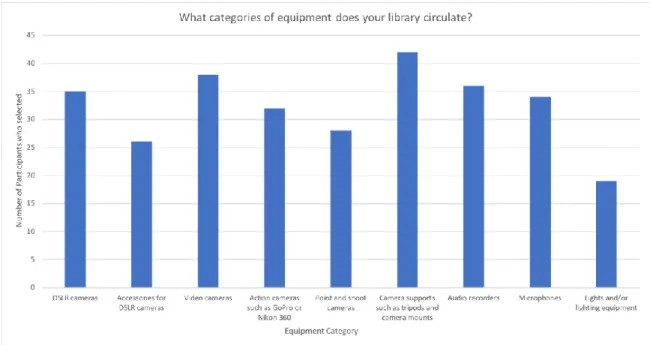
The survey asked participants to select categories of equipment that their library circulates. The given categories were:
• DSLR cameras
• Accessories for DSLR cameras such as lenses and flashes • Video cameras
• Action cameras such as GoPro or Nikon360 • Point and shoot cameras
• Camera supports such as tripods and camera mounts • Audio recorders
• Microphones
• Lights and/or lighting equipment • Other (please specify)
Most participants’ libraries circulate equipment in several of the above categories, including 11 who reported equipment in all the specified categories. The single collection reported to have over 1000 cataloged items is among those with all categories, as are nine libraries in the 101-500 items range and one in the 51-100 items range. Only one
participant selected none of the given categories; this participant listed “ECHO pens, projectors, mobile PA systems” in the “other” field.
19
least one of the camera categories (DSLR, action, video, and point-and-shoot). Of the total forty-six, forty-two (91%) participant libraries circulate camera supports. Only three libraries have some type of camera and do not have camera supports, and two of these three have less than ten items in the collection. Twenty participants (43%) reported having all four categories of camera, and eight (17%) more have three categories of camera. Of the 35 libraries that circulate DSLR cameras, 26 also circulate accessories for DSLR cameras such as lenses and flashes. Here, the issue of cataloging disparities might again be relevant: a camera needs a lens, and lenses can typically be switched out on DSLR camera bodies and thus could be considered separate apparatuses. However, it is possible that in some libraries, cameras and lenses are only checked out together, possibly grouped together in kits. This could explain situations in which participants selected “DSLR cameras” but not “Accessories for DSLR cameras such as lenses and flashes.”
Audio recorders and microphones were also well-represented in participants’ libraries: 36 (78%) have audio recorders and 34 (74%) have microphones. Thirty-two have both, while two have microphones but no audio recorders and four have audio recorders but no microphones. Though more participants have cameras of some sort than audio recorders and/or microphones, audio gear and photography gear mostly occur together in collections: only six (13%) of the 45 participants who reported having one or more camera categories did not have audio recorders or microphones.
20
microphones and at least one type of camera. Only one small (less than 10 items in the collection) library has lighting equipment but not camera supports.
The prevalence of each equipment category is visualized in Figure 2 and given numerically in Figure 3.
Equipment Category Number of libraries
that circulate Percentage
Camera supports such as tripods and camera
mounts 42 91%
Video cameras 38 83%
Audio recorders 36 78%
DSLR cameras 35 76%
Microphones 34 74%
Action cameras such as GoPro or Nikon 360 32 70%
Point and shoot cameras 28 61%
Accessories for DSLR cameras 26 57%
Lights and/or lighting equipment 19 41%
21
Of 46 participants, 22 entered additional equipment that their library circulates in the “other” field. Some participants wrote long lists, such as this example:
binoculars, VR cameras, projectors, projector screen, Mac chargers, iphone and android phone chargers, Nintendo Switch & games, hard drives, thumb drives, misc. cables and adapters, SD card readers, Wacom drawing tablets, megaphone, VR headsets.
Equipment listed more than once includes VR headsets or cameras (4 participants), PA systems or speakers (4), iPads (4), Wacom drawing tablets (2), webcams (4), green screens (2), photography or audio accessories for smart phones (4), external hard drives (6), and laptops (10). One response that listed laptops specified that the laptops had Adobe Creative Cloud software. Several participants mentioned chargers: five mentioned both phone and laptop chargers, and another four mentioned chargers in general. Twelve participants mentioned adaptors or cables of some kind. Projection equipment of various kinds was mentioned by 11 participants. One library has “projectors ranging from 8mm to slide to digital,” and others have projection screens as well. Some participants also mentioned recording and video equipment designed specifically for educational or work settings, such as 360 Meeting Owls (2 participants).
The range of equipment mentioned indicates flexible borders between audiovisual production equipment and other technologies that academic libraries circulate. For
22
might also come to mind when asked about AV production equipment. Additionally, projectors are not exactly used for audiovisual production, but are a tool for sharing the results of that production. The category “audiovisual production equipment” was contrived to focus this study, but these suggest that it probably has limited utility in practice. As one participant noted, “this survey is specifically about AV items, but our overall collection also includes laptops, charging accessories, and display adapters.” This comment, along with the responses that listed this type of equipment with qualification, demonstrate that academic library technology collections may contain multiple types of equipment that could be of use to patrons.
Challenges
The survey asked this open-ended, not-required question: From your perspective, what are the most challenging aspects of circulating audiovisual production equipment in
your library? Forty-three participants provided an answer. These responses ranged from
brief responses about one issue to descriptive lists of several issues, such as this one: Training our student employees to give patrons a consistent experience ; in cases where parts of kits are missing, trying to determine if the kit was actually whole at point of checkout ; dealing with patron disputes about return of incomplete kits ; having patrons find creative ways of 'returning' kits after hours (i.e. giving to library security ; stuffing through the book drop).
Of the 43 responses, 19 (44%) mentioned challenges related to keeping parts of equipment and kits in service and together:
• “ensuring that all pieces come back with kits and are not broken”
23 • “counting all the pieces as they are checked out and returned”
• “checking the condition of equipment between loans, replacement of missing peripherals (cables, chargers, sd storage, deleting files left on equipment)” • “Make sure all of the bits and pieces come back, if it is in a kit. For example, if
you circulate the camera, cords, battery, etc. as "one item." Doing inventory to make sure everything is returned is hard to keep up with.”
• “Inventory control and consistency among the kits. It is often difficult to find exact replacements”
A related category of challenge participants mentioned is maintenance (12 of 43 responses, 28%), with issues such as “dealing with damage of equipment,” “keeping them up to date and ensuring they are still functioning properly,” and “finding funding to keep equipment up to date and managing broken pieces.”
Other comments were about challenges related to staff or users. Six participants mentioned employee training challenges, such as:
• “Making sure my staff are trained well enough to troubleshoot small issues.” • “empowering staff to answer questions about equipment”
24
Staff Experiences
Participants were split concerning prior experience: 25 reported that they had not had experience or training with any of the equipment types in their collection before working with it, while 21 did have some experience or training. When asked how well prior experience prepared participants for their current position, on a 5-point scale from “Not at all” to “Very well,” all 21 participants with prior experience answered
“Somewhat” (6 participants), “Well” (7 participants), or “Very well” (8 participants). Participants who reported prior experience or training were given the following, open-ended prompt: Please briefly describe this experience or training here. (e.g., photojournalism coursework, making a podcast). The experience or training mentioned
stemmed from personal interests, previous professional positions, academic coursework, staff training for the current position, and training from vendors. Responses included:
• “undergrad art degree, working for av departments, working as a creative professional”
• “I was an amateur photographer with familiarity with DSLR cameras.”
• “Self-taught, making media projects on my own. I certainly learned much more after being in charge of the collection.”
Whether they had prior experience or not, most participants have furthered their knowledge of the technologies in their collection in a variety of ways. All participants were asked: Have you furthered your knowledge of the equipment in your collection through any of the following? (select all that apply) From the 9 multi-check options listed
25
strategy is included in parentheses in the list below, and these answers are visualized in Figure 4.
Creating user-support materials (selected by 24 participants)
Consulting user-support materials created by others in your library (14) Consulting user-support materials created by other libraries (14)
Using the equipment for projects at work (20) Using the equipment outside of your work tasks (23)
Learning from colleagues in your or other departments (21) Attending workshops or classes offered by your institution (4) Attending workshops or classes offered elsewhere (9)
Learning from online tutorials (31)
There were very few comments in the “other” field for this question. Two clarified a reason that that individual had used few or none of these (e.g., “No. I manage the person that manages it.”), and one participant added that they had done “a significant amount of online research - most sources are not library related.”
26
User Support Materials
Participants were asked specifically about five types of user support services that could exist in relation to audiovisual production equipment: LibGuides, equipment manuals, video tutorials, instruction, and reference.
LibGuides
Twenty-seven participants (58% of the 46 participants) reported that their libraries have a LibGuide or similar resource that supports their collection of AV production equipment, while 19 said that their libraries did not have such a guide. Of these
participants, one did clarify in the final open-answer question that they are developing a LibGuide, but it is not yet live.
Equipment Manuals
27
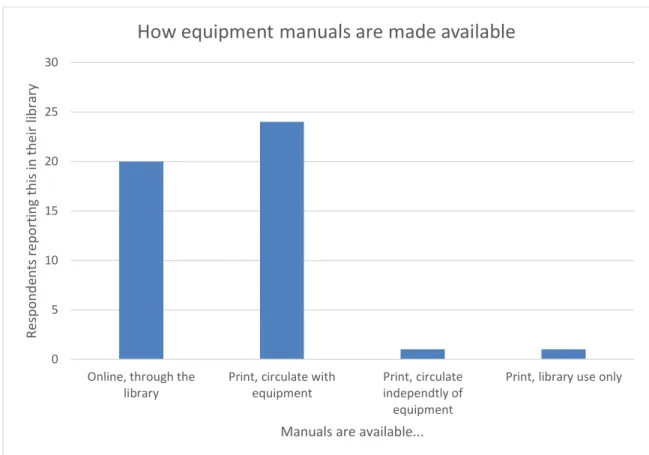
Figure 5 Partial answers to the question: Does your library make manuals for the equipment available to patrons? (select all that apply)
Twelve participants selected “Manuals are made available in another way”, though two of these specified that manuals are linked to through a LibGuide and another
explained that “all of our equipment come with a QR code attached to the case that links to a google doc that has custom instructions for the equipment.” These three cases have been included in the category “Manuals available online through the library.”
Comments explaining other equipment manual delivery methods mentioned include: • “Most of the time we send them online to find the manual if we don't have it. We also make sure for our Nikons that only students who have taken a class learning how to use them get to check them out.”
0 5 10 15 20 25 30
Online, through the library
Print, circulate with equipment
Print, circulate independtly of equipment
Print, library use only
R es pondent s re port ing t hi s i n t hei r library
Manuals are available...
28 • “Manuals online via a search engine, not hosted through the library site.”
Only one participant selected four of the options for manuals being made available (online through the library, print circulating with and without equipment, another way), but commented that
This is an area where we are not strong - so much goes into the physical aspects of circulation, documentation is often left for last. We do circulate some
equipment with the manual inside the kit, and in past iterations of our online equipment list, we have included links to PDF manuals. This has never been universal for all equipment.
Video Tutorials
29
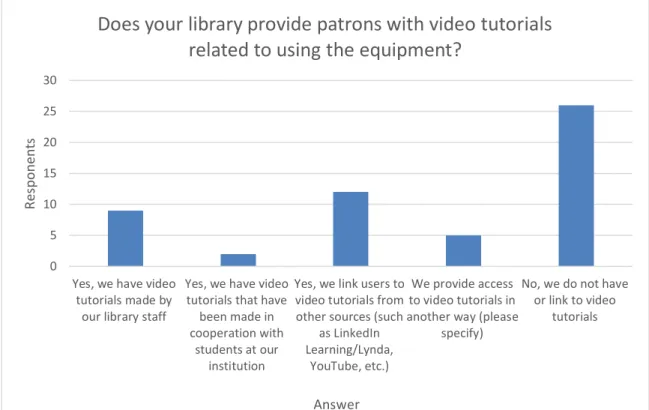
Figure 6 Answers to the question: Does our library provide patrons with video tutorials related to using the equipment?
Of the five participants who said that their library provides video tutorials in another way, one said that “we try to mention that manufacturers will often have video tutorials available,” and two mentioned that their student patrons are typically in classes related to the equipment:
• “If they come to the desk asking how to use it we will help them find online tutorials that they can watch. Most of the students have used camera equipment in class and know how to use them.”
• “Most of our students have been trained to use this kind of equipment in their multimedia and convergence classes.”
0 5 10 15 20 25 30
Yes, we have video tutorials made by
our library staff
Yes, we have video tutorials that have
been made in cooperation with
students at our institution
Yes, we link users to video tutorials from other sources (such
as LinkedIn Learning/Lynda,
YouTube, etc.)
We provide access to video tutorials in another way (please
specify)
No, we do not have or link to video
tutorials R es ponent s Answer
30
Instruction
Slightly more than half of participants reported that their library has some sort of instruction related to the equipment collection. While 21 participants said that their library does not offer instruction, the remaining 25 (54%) indicated one or more context for instruction. Figure 7 depicts the range of responses.
Figure 7 Answers to the question: Does the library offer user instruction related to the use of audiovisual production equipment?
Of those offering instruction of some sort, the most commonly selected answer was “Yes, the library offers users instruction in another context” (16 participants, 64% of those offering instruction). The “other contexts” mentioned were predominantly one-on-one and/or as-needed instruction, such as the following:
0 5 10 15 20 25
No, the library does not offer instruction related to using
audiovisual production equipment
Yes, the library offers user instruction in another context
(please specify)
Yes, in collaboration with course
instructors
Yes, the library hosts its own instruction sessions
Yes, in collaboration with another group or entity on campus
R es pondent s w ho select ed Answers
31 • “Lab attendants teach individual students about equipment or software as needed,
or lab attendants or the lab manager meets with entire classes that do multimedia projects as needed.”
• “one on one tutorials with patrons”
• “We will show the patron how to operate the equipment if they need instructions.” • “When people request equipment, they can request a one-on-one tutorial of that
equipment before taking it out.” • “On-demand, usually project-based.”
Reference
When asked about reference, 23 participants (50%) said that their library did provide reference or consultation services related to the equipment collection, while the
remaining 23 said that their library did not. Five of those that reported no reference did say, in answer to the previous question, that their library has some sort of instruction available. From considering the answers to these two questions together, some of these appear to possibly offer something that in practice is similar to reference, e.g., “[Users] can contact the Media Services department.”
Of the 23 participants who reported reference services, three specifically stated that all staff in a particular unit provides reference:
• “[…] Recording Studios staff members...all of us”
32 • “All of our staff, librarians, adult and student staff. Most of our student staff are
journalism, broadcast, strategic communication or visual communication students”
Others named specific job titles or sets of employees, including: • “Circulation Librarian”
• “Systems Librarian, Public Services Librarian, Online Learning Librarian” • “Digital Makerspace Coordinator”
• “Media Lab Manager, Recording Studio Assistant, Media Lab Assistant, Teaching & Learning Librarian, Information Literacy Librarian”
• “graduate assistants with technical expertise and librarians” • “Senior Media Library Assistant”
• “Four full-time employees and 8-10 student workers”
• “Director, assistant director, library technician (me), and sometimes the student workers.”
A few described more informal or ad-hoc reference provision:
• “If students wanted to meet with one of the reference librarians, we would be happy to set up a meeting so that we could talk about what they wanted to do with the equipment.”
• “service desk supervisors provide causal reference “
User Support Overall
33
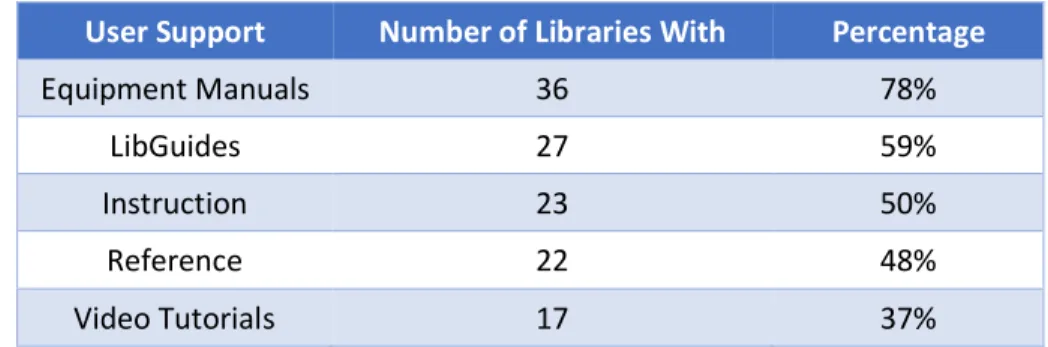
reported having each of the five types. Twenty-nine had three or more types. Figure 8 shows the incidence of some sort of each user support type.
Figure 8 Participants who reported each type of user support for circulating AV equipment in their library
The final question asked participants: If there are user-support materials or services that your library provides that were not mentioned in the previous questions, please list
them here. While a few participants used this space to clarify answers to other questions,
there were only four specific answers to this question. Two participants mentioned services that their institution’s IT department offers that relate to their audiovisual equipment. One participant, whose library does not have any of the user support services previously discussed, cited “older staff with vast experience with various equipment.” Another, who reported that their library offers reference related to the equipment, commented that “we direct students to google the equipment for tips on use.”
User Support Number of Libraries With Percentage
Equipment Manuals 36 78%
LibGuides 27 59%
Instruction 23 50%
Reference 22 48%
34
Discussion
The findings of this study tend to fit with the image of academic library technology circulation given by a review of previous literature. Fundamentally, this study supports the notion that there are many types of audiovisual equipment circulated by academic libraries. Additionally, most participants in this survey have several types of equipment, which reflects the practitioner examples in the literature. It also suggests varying contexts for AV equipment circulation, elements of AV equipment circulation that are distinct from traditional library circulation, and that staff working with these collections develop knowledge about them on the job. Each of these issues is considered below.
35
previously mentioned practitioner literature, where various strategies for developing user and staff training on the equipment were discussed. However, this is also a potential area of disparity between the literature and my participants: it seems possible that librarians who write an article about their professional experience in technology circulation might tend to be those whose workplaces have invested time into developing services related to the collection and found some success with specific strategies. It is possible that some of this study’s participants are in libraries that have not been able to do so or who have not found that to be necessary for their context.
The challenges of keeping track of parts, incomplete returns, and maintenance mentioned by participants also reflect the literature about technology circulation
programs, which often describe the development of procedures and materials to address these issues (see Buller, 2017; McCoy, 2017; Woods et al., 2004). This is an area in which circulating equipment is meaningfully different than circulating books or DVDs. The prevalence of the “parts get lost or don’t get returned” issue among participants in this study suggests that equipment circulation may need more rigorous or involved procedures than traditional library circulation. One participant (quoted in full in the results section in the discussion of equipment manuals) commented that “so much goes into the physical aspects of circulation.” There were no specific methods mentioned by participants in this study, only the existence of the problem, but Buller’s (2017) example of forms that show the different parts of a kit represents one such circulation procedure.
36
37
Conclusion
A major limitation of this study is that it only collected self-reported data from human sources. Therefore, it is not possible to corroborate, contextualize, or illuminate their stories and reported data points with other data about their collections, such as circulation information or library instructional materials themselves. An analysis of user support for AV equipment collections – be it a content analysis of LibGuides, instruction case studies, analysis of reference questions, etc. – would be a potential avenue for future research. Further studies could also investigate similar questions in other contexts, such as makerspaces, materials collections, or tool libraries. As the understanding of the needs of technology circulation expands, this knowledge could inform topics courses or
38
References
Bagshaw, A., & Yorke-Barber, P. (2018). Guiding Librarians: Rethinking Library Guides as a Staff Development Tool. Journal of the Australian Library and Information Association, 67(1), 31–41. https://doi.org/10.1080/24750158.2017.1410629
Baker, D. M., Michnik, K., & Eriksson, C. (2014). Non-traditional library collections – in digital and other worlds. Interlending & Document Supply. https://doi.org/10.1108/ILDS-09-2014-0043
Bierbaum, E. G. (1985). The Third Dimension: Public Library Quarterly, 6(3), 33–50.
https://doi.org/10.1300/J118v06n03_05
Bierbaum, E. G. (1990). Beyond Print: Object Collections in Academic Libraries. Collection Building, 10(2), 7-11.
Buller, R. (2017). Lending Video Game Consoles in an Academic Library. Portal: Libraries and the Academy, 17(2), 337–346. https://doi.org/10.1353/pla.2017.0020
Burns, B. (2017). Technology and Small College Libraries: Trying to Be Everything to Everyone. In Audio Recorders to Zucchini Seeds (pp. 103–112). Oxford: ABC-CLIO, LLC.
Cassidy, E. D., Colmenares, A., Jones, G., Manolovitz, T., Shen, L., & Vieira, S. (2014). Higher Education and Emerging Technologies: Shifting Trends in Student Usage. The Journal of Academic Librarianship, 40(2), 124–133.
39 Chapman, J., & Woodbury, D. (2012). Leveraging quantitative data to improve a device‐
lending program. Library Hi Tech, 30(2), 210–234.
https://doi.org/10.1108/07378831211239924
Cross, E., & Tucci, R. (2017). The Emerging Technology Collection at Carleton University Library: Supporting Experiential Learning in the University Curriculum. Partnership : The Canadian Journal of Library and Information Practice and Research; Toronto,
12(1), 1–19. http://dx.doi.org.libproxy.lib.unc.edu/10.21083/partnership.v12i1.3917
Hindmarch, L., & Arens, R. M. (2009). The Academic Library and Collaborative
Architectural Education: Creating a Materials Collection at Cal Poly. Art Documentation: Journal of the Art Libraries Society of North America, 28(2), 4–12.
https://doi.org/10.1086/adx.28.2.27949517
Holden, H. and Lei Hsieh, M. (2007). The state of wireless laptop lending programs. Library Hi Tech, 25(2), pp. 260-275.
https://doi-org.libproxy.lib.unc.edu/10.1108/07378830710755018
Holderman, S. (2017). The Decline of Circulation: Reversing the Trend through Technology Checkout. The Journal of Academic Librarianship, 43(5), 451–453.
https://doi.org/10.1016/j.acalib.2017.07.004
Jensen, K. (2008). Beyond “Classroom” Technology: The Equipment Circulation Program at Rasmuson Library, University of Alaska Fairbanks. Journal of Access Services, 5(1–2), 221–231. https://doi.org/10.1080/15367960802198754
40
Massis, B. E. (n.d.). From iPads to fishing rods: Checking out library materials | Emerald Insight. New Library World. Retrieved from
http://www.emerald.com/insight/content/doi/10.1108/03074801311291983/full/html
McCoy, S. (2017). Loaning Technology and Media Production Equipment. In Audio Recorders to Zucchini Seeds (pp. 123–138). Oxford: ABC-CLIO, LLC.
Moyer, J. E., & Thiele, J. (2012). E‐books and readers in public libraries: Literature review and case study. New Library World. https://doi.org/10.1108/03074801211226346
Robison, M., & Shedd, L. (2017). Audio Recorders to Zucchini Seeds. Oxford: ABC-CLIO, LLC.
Rubel, D. T. (2017). Picture Perfect: Using Photographic Previews to Enhance Realia
Collections for Library Patrons and Staff. Information Technology and Libraries, 36(2), 59–67. https://doi.org/10.6017/ital.v36i2.9474
Shuldman, M. (2017). Faculty/Librarian Collaboration in the Age of Media: Building a Collection of Media Services to Support the Integration of Video Production into the Curriculum. In Audio Recorders to Zucchini Seeds (pp. 139–152). Oxford: ABC-CLIO, LLC.
Shurtz, S., Sewell, R., Halling, T. D., McKay, B., & Pepper, C. (2015). Assessment of an iPad Loan Program in an Academic Medical Library: A Case Study. Medical Reference Services Quarterly, 34(3), 265–281. https://doi.org/10.1080/02763869.2015.1019743
Simpson, J. (2019). Real World Objects: Conceptual Framework and University Library Consortium Study. The Journal of Academic Librarianship, 45(4), 332–342.
41
Söderholm, J. (2018). Tool lending librarianship. Journal of Librarianship and Information Science, 50(4), 374–385. https://doi.org/10.1177/0961000616666627
Spang, L., & Tucker, D. (1995). Incorporating a comprehensive media services unit into an existing university library facility: The Wayne State University Libraries’ experience after 10 years. The Journal of Academic Librarianship, 21(3), 187–194.
https://doi.org/10.1016/0099-1333(95)90038-1
Summey, T., & Gutiérrez, A. (2012). Laptops to Go: A Student Assessment of a Library Laptop Lending Service. Journal of Access Services, 9(1), 28–43.
42
Appendix A: Recruitment Document
This message was sent to two professional listservs: Greetings!
My name is Christina Getaz and I am an MSLS student at UNC-Chapel Hill’s School of Information and Library Science.
I am conducting a research study about circulating collections of audiovisual production equipment in academic libraries. Specifically, I am interested in staff experiences with these collections and what user support materials support the collections.
If you work in an academic library setting with a collection of audiovisual production equipment (cameras, audio recorders, microphones, etc.) that circulates, I invite you to participate in this study. More information and the survey itself can be found here:
https://unc.az1.qualtrics.com/jfe/form/SV_eLQsNF2P5SSjLyB
Thank you very much! Christina Getaz
The message was slightly amended to the following for the targeted list of libraries, so that the body read:
My name is Christina Getaz and I am an MSLS student at UNC-Chapel Hill’s School of Information and Library Science.
I am conducting a research study about circulating collections of audiovisual production equipment in academic libraries. Specifically, I am interested in staff experiences with these collections and what user support materials support the collections.
You are receiving this email because your institution appears to circulate equipment. If this is not the case or you work with that collection, feel free to disregard this email.
If you do work in an academic library setting with a collection of audiovisual production equipment (cameras, audio recorders, microphones, etc.) that circulates, I invite you to participate in this study. More information and the survey itself can be found here:
43
Appendix B: Survey Instrument
University of North Carolina at Chapel Hill Research Information Sheet
IRB Study #: 20-0279
Principal Investigator: Christina Getaz
The purpose of this research study is to learn about academic library staff experiences and responsibilities related to circulating collections of audiovisual production
equipment. You are being asked to take part in a research study because you work in an academic library that has circulating audiovisual production equipment.
Being in a research study is completely voluntary. You can choose not to be in this research study. You can also say yes now and change your mind later.
If you agree to take part in this research, you will be asked questions about your experiences with circulating audiovisual production equipment in your current
professional position. The survey is mostly multiple-choice questions with a few open-answer questions. Your participation in this study will take about 15 - 20 minutes.
You can choose not to answer any question you do not wish to answer. You can also choose to stop taking the survey at any time. You must be at least 18 years old to participate. If you are younger than 18 years old, please stop now.
Risks: There should be minimal risks involved with taking part in this research. However, participating in this research could contribute to work-related stress.
Benefits: This research will contribute to knowledge about managing and supporting users of circulating collections of audiovisual production equipment in academic libraries. There are no direct personal benefits to you for participating.
To protect your identity as a research subject, no identifiable information will be collected.
44
Question 1. Do you agree to participate in this study?
o
Yeso
NoSkip To: End of Survey If University of North Carolina at Chapel Hill Research Information Sheet IRB Study #: Principal Inv... = No
Question 2. What categories of equipment does your library circulate?
▢
DSLR cameras▢
Accessories for DSLR cameras, such as lenses and flashes▢
Video cameras▢
Action cameras such as GoPro or Nikon 360▢
Point and shoot cameras▢
Camera supports such as tripods and camera mounts▢
Audio recorders▢
Microphones▢
Lights and/or lighting equipment▢
Other (please specify)45
Question 3. Approximately how many pieces of audiovisual production equipment are in this circulating collection? This is the number of cataloged items.
o
Less than 10o
11-50o
51-100o
101-500o
501-1000o
1001-1500o
More than 1500Question 4. From your perspective, what are the most challenging aspects of circulating audiovisual production equipment in your library?
________________________________________________________________
________________________________________________________________
Question 5. Before working with this collection, did you have experience or training with any of the equipment types in this collection?
o
Yeso
NoSkip To: Question 8 If Before working with this collection, did you have experience or training with any of the equipmen... = No
Question 6. Please briefly describe this experience or training here. (e.g., photojournalism coursework, making a podcast)
46
Question 7. How well do you feel this experience or training prepared you for working with the collection?
o
Very well (1)o
Well (2)o
Somewhat (3)o
Not very well (4)o
Not at all (5)Question 8. Have you furthered your knowledge of the equipment in your collection through any of the following? (select all that apply)
▢
Creating user-support materials▢
Consulting user-support materials created by others in your library▢
Consulting user-support materials created by other libraries▢
Using the equipment for projects at work▢
Using the equipment outside of your work tasks▢
Learning from colleagues in your or other departments▢
Attending workshops or classes offered by your institution▢
Attending workshops or classes offered elsewhere▢
Learning from online tutorials47
Question 9. Is there a LibGuide or similar resource that supports the circulating audiovisual production equipment?
o
Yeso
NoQuestion 10. Does your library make manuals for the equipment available to patrons? (select all that apply)
▢
Yes, manuals are available online through the library▢
Yes, there are print manuals for library use only▢
Yes, there are print manuals that circulate independently of the equipment▢
Yes, there are print manuals that circulate with equipment▢
There are manuals available in another way (pleasespecify)________________________________________________
48
Question 11. Does your library provide patrons with video tutorials related to using the equipment? (select all that apply)
▢
Yes, we have video tutorials made by our library staff▢
Yes, we have video tutorials that have been made in cooperation with students at our institution▢
Yes, we link users to video tutorials from other sources (such as LinkedIn Learning/Lynda, YouTube, etc.)▢
We provide access to video tutorials in another way (please specify) ________________________________________________▢
No, we do not have or link to video tutorialsQuestion 12. Does the library offer user instruction related to the use of audiovisual production equipment? (select all that apply)
▢
Yes, in collaboration with course instructors▢
Yes, in collaboration with another group or entity on campus▢
Yes, the library hosts its own instruction sessions▢
Yes, the library offers user instruction in another context (please specify)________________________________________________49
Question 13. Does library staff offer reference or consultation services related to the use of audiovisual production equipment?
o
Yeso
NoSkip To: Question 15 If Does library staff offer reference or consultation services related to the use of audiovisual pro... = No
Question 14. Which staff members provide this reference or consultation service? Please specify job titles or roles.
________________________________________________________________
Question 15. If there are user-support materials or services that your library provides that were not mentioned in the previous questions, please list them here.