EXAMINING PERCEIVED MESSAGE EFFECTIVENESS AS A MARKER FOR THE IMPACT OF BRIEF HEALTH BEHAVIOR INTERVENTIONS
Sabeeh A. Baig
A dissertation submitted to the faculty at the University of North Carolina at Chapel Hill in partial fulfillment of the requirements for the degree of Doctor of Philosophy in the Department
of Health Behavior in the Gillings School of Global Public Health.
Chapel Hill 2018
iii ABSTRACT
Sabeeh A. Baig: Examining Perceived Message Effectiveness as a Marker for the Impact of Brief Health Behavior Interventions
(Under the direction of Noel T. Brewer)
Introduction. Interventionists often select health communication messages based on audience ratings of perceived message effectiveness (PME). I sought to examine the roles of message perceptions (persuasive potential) and effects perceptions (potential for behavior
change), two types of PME, in message selection using anti-smoking messages about cigarette smoke chemicals (chemical messages) as a case study.
Methods. In three papers, I examined several aspects of the validity of the UNC PME Scale focusing on effects perceptions. The first paper used data from three national samples of adults (n = 999 and n = 1,692) and adolescents (n = 869). The second and third papers used data from a three-week trial of the impact of chemical messages among 703 U.S. adult smokers. At the final visit, a survey assessed message perceptions, effects perceptions, quitting behaviors and quitting antecedents drawn from the UNC Tobacco Warnings Model (TWM).
Results. In the first paper, the UNC PME Scale demonstrated strong psychometric properties in diverse populations and across varied chemical messages. In the second paper, message perceptions demonstrated predictive validity only with an early behavioral antecedent from the TWM (attention to the message). However, effects perceptions demonstrated predictive validity with four later antecedents from the TWM: negative affect; thinking about the chemicals in cigarette smoke, or harms of smoking; and quit intentions. Effects perceptions also
iv
third paper, effects perceptions, but not message perceptions, mediated the impact of chemical messages on these three quitting behaviors, although the corresponding effect sizes were small to medium.
v
ACKNOWLEDGMENTS
I would like to express immense gratitude to my dissertation committee for guiding me through this process. Their thoughtful comments greatly improved the quality of my work. I especially thank Dr. Brewer, my advisor and committee chair, for his support throughout my training and for always pushing me to clarify my thinking and presenting it in a way that is accessible to everyone. Noel, you have been an incredible advocate and friend, and I look forward to working together on other topics in the future.
To my parents, I am incredibly indebted to you for showing me the importance of service to others, which has always been my motivation for working in public health. I also appreciate that I can count on my hands the number of days in the last four or so years that I did not talk to either one of you, if only for a few minutes. Thank you for enabling all my successes—they are yours more than mine.
vi
TABLE OF CONTENTS
LIST OF TABLES ... ix
LIST OF FIGURES ... x
CHAPTER 1: OVERVIEW ... 1
CHAPTER 2: CONCEPTUAL REVIEW OF PERCEIVED MESSAGE EFFECTIVENESS ... 5
Conceptual criteria for perceived message effectiveness measures ... 6
Sensitive to differences in messages ... 7
Predicts behavior ... 8
Focuses on behavior ... 13
About the respondent ... 16
Psychometric criteria for perceived message effectiveness measures ... 17
Construct validity ... 17
Minimal measurement error ... 18
Brief in length ... 20
Discussion ... 21
CHAPTER 3: VALIDATION OF THE UNC PERCEIVED MESSAGE EFFECTIVENESS SCALE .... 23
Methods ... 26
Participants... 26
Procedures... 28
Measures ... 28
Data analysis ... 29
Results ... 32
vii
Differential item and test functioning ... 33
Construct validity ... 34
Discussion ... 35
Strengths and limitations ... 36
Conclusions ... 37
CHAPTER 4: RESEARCH DESIGN AND METHODS ... 43
Overview of parent study ... 43
Data preparation... 44
Analysis plan for Aim 2 ... 45
Analysis plan for Aim 3 ... 55
Power calculations... 57
CHAPTER 5: PREDICTIVE VALIDITY OF MESSAGE PERCEPTIONS AND EFFECTS PERCEPTIONS IN THE CONTEXT OF ANTI-SMOKING MESSAGES ... 61
Methods ... 64
Participants and procedures ... 64
Measures ... 65
Data analysis ... 66
Results ... 68
Dimensionality ... 68
Predictive validity ... 70
Discussion ... 71
Conclusions ... 74
CHAPTER 6: MESSAGE PERCEPTIONS AND EFFECTS PERCEPTIONS AS PROXIES FOR IMPACT ON BEHAVIOR ... 80
Methods ... 83
viii
Measures ... 84
Data analysis ... 85
Results ... 87
Mediation by message perceptions ... 87
Sequential mediation by message perceptions through effects perceptions ... 88
Mediation by effects perceptions ... 88
Discussion ... 89
Conclusion ... 91
CHAPTER 7: FUTURE DIRECTIONS FOR OPTIMIZING USE OF PERCEIVED MESSAGE EFFECTIVENESS IN FORMATIVE RESEARCH ... ..98
Message perceptions as a moderator ... ..98
Effects perceptions and health promoting behaviors ... 100
Effects perceptions item pool ... 101
Strengths and limitations ... 102
Conclusions ... 105
APPENDIX: SURVEY MEASURES FOR PROPOSED ANALYSES IN AIMS 2 AND 3 ... 106
ix
LIST OF TABLES
Table 3.1. Messages about the chemicals in cigarette smoke ... 38 Table 3.2. Participant characteristics ... 39 Table 3.3. Factor loadings for the UNC Perceived Message Effectiveness Scale ... 40 Table 4.1. Construct validators categorized according to relevance in message
processing based on the Message Impact Framework and UNC Tobacco
Warnings Model ... 58 Table 5.1. Measures for all construct validators with ordinal reliability
coefficients for multi-item scales ... 75 Table 5.2. Participant characteristics ... 77 Table 6.1. Measures for all outcomes in multiple mediation analyses
x
LIST OF FIGURES
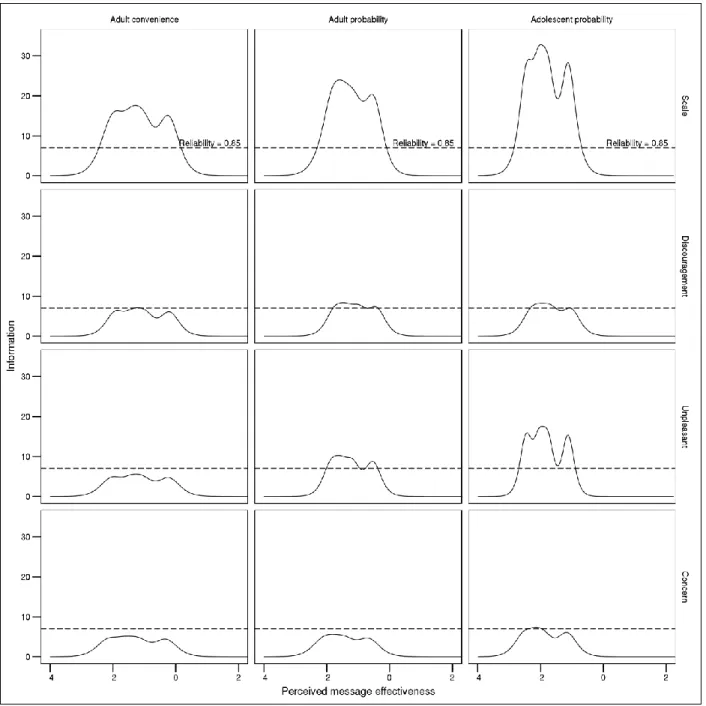
Figure 3.1. Information curves for the UNC Perceived Message
Effectiveness Scale ... 41 Figure 3.2. Effect sizes for differential item functioning and
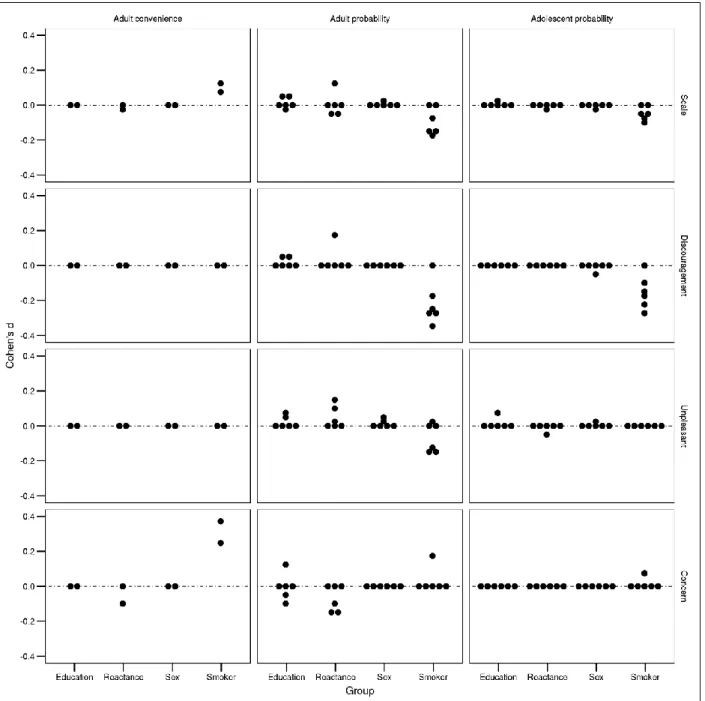
differential test functioning exhibited by the UNC Perceived
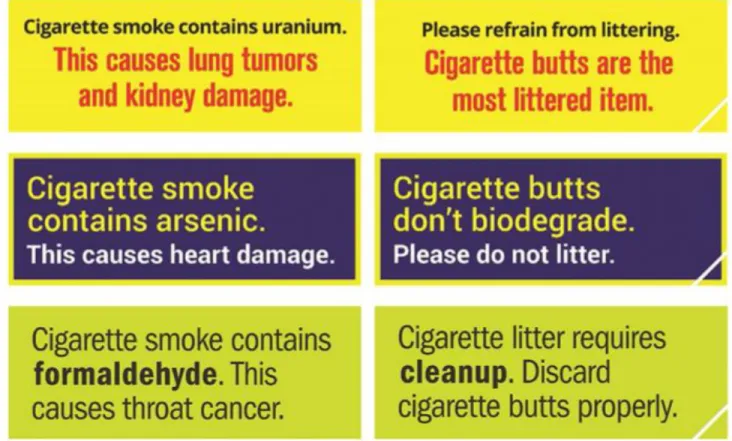
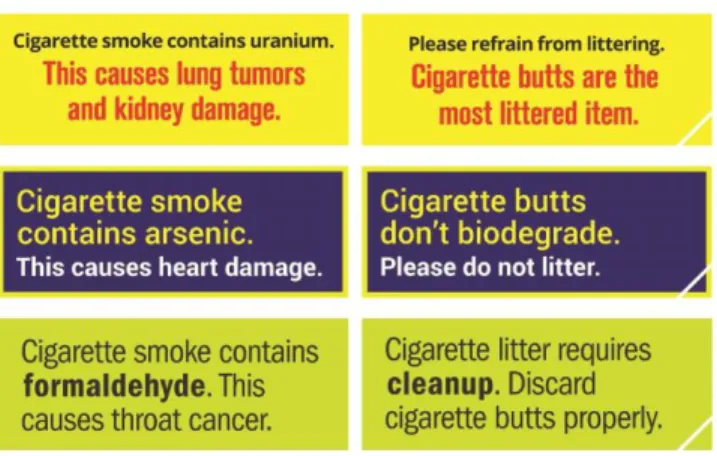
Message Effectiveness Scale ... 42 Figure 4.1. Cigarette pack labels placed on smokers’ cigarette packs
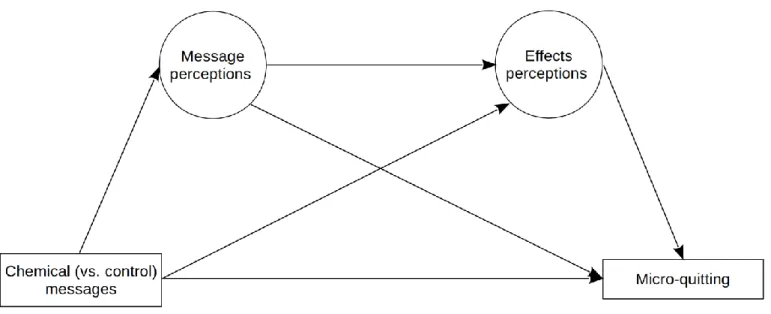
in intervention and control arms ... 59 Figure 4.3. Complex mediation model of the impact of chemical
messages on micro-quitting through effects perceptions ... 60 Figure 5.1. Confirmatory factor analytic model of message perceptions
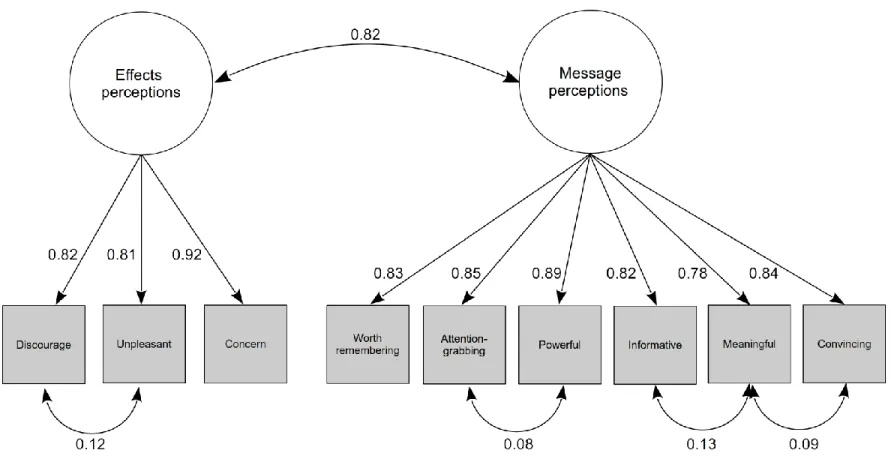
and effects perceptions ... 78 Figure 5.2. Predictive validity of message perceptions and effects
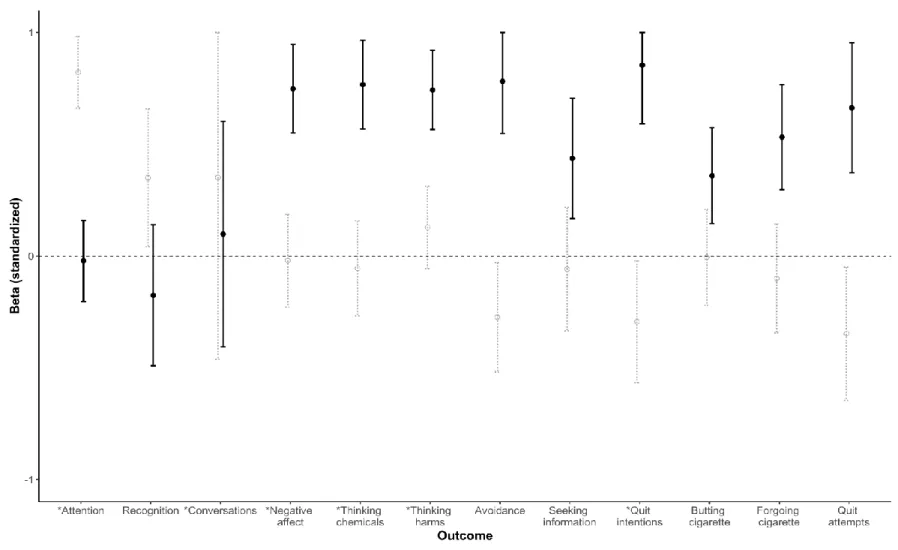
perceptions with behavioral antecedents from the UNC Tobacco
Warnings Model, quitting behavior, and related constructs ... 79 Figure 6.1. Messages placed on smokers’ cigarette packs in
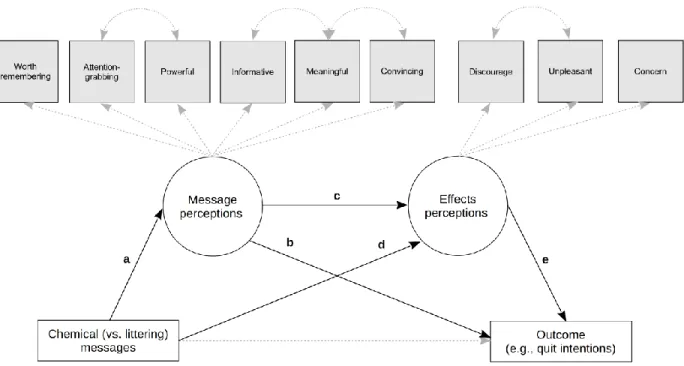
the intervention and control arms ... 93 Figure 6.2. Path diagram for structural equation model with
mediated effects of chemical messages on a given outcome through message perceptions alone, message perceptions and effects perceptions
sequentially, and effects perceptions alone ... 96 Figure 6.3. Standardized indirect effects of chemical messages through
1
CHAPTER 1: OVERVIEW
Brief health behavior interventions often rely on high-impact health messages, but
developing such messages pose unique methodological challenges. First, it is difficult to identify health messages that are promising in the early stages of development without longitudinal data on their behavioral impact that can only be collected after the messages have been disseminated
in the field. Second, brief exposure to a health message, as in an online or phone survey
experiment, usually does not lead to meaningful changes in cognitive mediators of behavior from
psychological theories that an effective message should change.133 Third, evaluation studies that use extensive self-report measures and ask participants to rate many brief messages may impose a high cognitive burden on participants.
In order to overcome the aforementioned methodological challenges, some researchers
have assessed perceived message effectiveness (PME) as an early indicator of the importance of a health message in changing behavior specifically. As PME is applicable to brief messages in general, a common definition is the "extent to which a message recipient believes that a health message will affect him or her personally in terms of the particular message objectives.”152 The
theoretical literature on PME references two operationalizations of the construct, one that focuses on message perceptions and the other on effects perceptions. The former is rooted in
communication theories of persuasion and focuses on message features that would lead to further processing of a health message and subsequent attitude changes. The latter is rooted in research
on intentions, risk perceptions, and other potential mediators of behavior and focuses on the likelihood of a health message actually changing a referenced behavior among message
2
recipients. Many existing measures of PME combine aspects of both operationalizations.49 A major barrier to theoretically informed use of PME is the lack of scientific consensus on any relationship between PME and behavioral impact. PME may mediate the impact of brief messages on behavior; or behavior may mediate the impact of messages on PME. Alternatively,
PME and behavior may be on separate causal pathways while being strongly correlated. Another major barrier to appropriately using PME is the dearth of data on the validity of the distinction
between the two types of PME. Without this data, it is difficult to determine whether brief messages should be evaluated on both types of PME and, if so, how the types of assessments correspond to stages of message development; or only one type and, if so, which.
In my dissertation, I propose to examine PME as a psychological marker of the
behavioral impact of health messages specifically in the context of brief messages about the chemicals in cigarette smoke (chemical messages). Chemical messages are an important case study because tobacco use is the leading cause of preventable deaths in the US, with cigarette
smoking accounting for the majority of lung cancer deaths among men and women.143 The main source of harm from cigarette smoking is the toxic chemicals in cigarette smoke, many of which are known carcinogens.95 The public is interested in learning more about the chemicals in cigarette smoke,64 and awareness about these chemicals is associated with greater
discouragement from wanting to smoke.23
This research will involve three large national samples of smokers and non-smokers: an online convenience sample of 1,035 adults (Study 1), an online probability sample of 1,758 adults (Study 2), and an online probability sample of 879 adolescents (Study 3). Participants
rated at least two chemical messages in each of the three studies. This research will also examine
3
three novel anti-smoking messages either about chemicals or littering cigarette butts, rotated on
their cigarette packs. The specific aims of the dissertation are to:
Aim 1. Establish the psychometric properties of a PME scale that focuses on effects
perceptions.Activities to address this aim:
1. Conduct an item analysis of the UNC PME scale to assess its reliability and construct
validity in Study 1.
2. Examine differential item functioning and differential test functioning in the UNC PME
scale by key grouping variables related to smoking disparities in Study 1.
3. Assess the construct validity of the UNC PME Scale using multitrait-multimethod confirmatory factor analysis in Study 1.
4. Replicate the results from Study 1 in Studies 2 and 3.
Aim 2. Examine the construct validity of two PME scales, one that focuses on effects
perceptions and the other on message perceptions.Activities to address this aim:
1. Examine the dimensionality of items from the UNC PME Scale and an established
message perceptions scale41 using multiple-group confirmatory factor analysis in Study 4. 2. Compare the strength of the correlations between both scales with hypothesized
constructs (drawn primarily from the UNC Tobacco Warning Model and the Message Impact Framework) using structural equation modeling in Study 4.
Aim 3. Identify whether PME focusing on effects or message perceptions is a better proxy
for behavioral outcomes.Activities to address this aim:
1. Empirically test a structural model for the impact of chemical messages on micro-quitting simultaneously through both types of PME as measured by the UNC PME Scale and the
4
2. Replicate the results for three additional outcomes in Study 4: quit intentions,
smoking-related social interactions, and chemical information seeking.
The proposed research will advance the theory of PME so that researchers can confidently use PME to develop brief messages that optimally impact behavior. First, it will
clarify the psychometric properties, including the construct validity, of two types of PME that researchers have used interchangeably in message development. Second, it will provide evidence for the roles that both types of PME may have in message processing and impact. The main
results of the proposed research should be generalizable to the use of PME in other contexts besides cigarette smoking, such as breast cancer screening and human papillomavirus vaccination.
This dissertation has six additional chapters. Chapter 2 is a conceptual review of the
empirical and theoretical literature on PME and develops the conceptual framework for the proposed research. Chapter 3 is a validation study of the UNC PME Scale completed in
fulfillment of Aim 1, and Chapter 4 lays out the analytic framework for Aims 2 and 3. Chapters 5
and 6 are two comparative validation studies involving effects and message perceptions completed in fulfillment of Aims 2 and 3, respectively. Finally, Chapter 7 provides additional
5
CHAPTER 2: CONCEPTUAL REVIEW OF PERCEIVED MESSAGE EFFECTIVENESS
Interventions in health psychology and health communication often rely on high-impact
health messages.103 Developing brief messages that can change risky health behaviors is a multi-stage process, often beginning with a pool of candidate messages. It is critical to identify the
most promising messages during the early stages of development. However, assessing the behavioral impact of a health message is exceedingly resource and time-intensive and requires longitudinal data that can usually only be collected after the message has been disseminated. In
behavioral contexts, perceived message effectiveness (PME) refers to the extent that a message recipient thinks that a message will affect their own behavior, potentially through effects on
related attitudes, beliefs, and intentions. Researchers have used PME to select important messages in many contexts, including cigarette smoking and marijuana use. The theoretical literature on PME robustly shows that it is correlated with attitudes and behavioral intentions in a
variety of substantive contexts (e.g., nutrition and dental hygiene). Thus, researchers have treated selecting important messages based on PME ratings as a sufficient strategy for winnowing down a pool of candidate messages during formative research.
The theoretical literature on PME does not have a consensus on how to define the
construct, posits different psychological mechanisms for how PME may be related to behavior, and is largely silent on the relevant measurement challenges. In this review, I identify conceptual and psychometric criteria for the efficient use of PME in behavioral contexts and summarize key
6
measurement of PME with respect to each criterion. I use brief pack messages about the toxic
chemicals in cigarette smoke (chemical messages) as a case study throughout this review because such messages are a recent example of a health communication intervention that relies on high-impact messages that were selected using PME.6 Chemical messages are also an ideal case study because a sizable literature has emerged on developing such messages, their
behavioral impact, and underlying psychological mechanisms.5,23,64,95,110 Ultimately, this review seeks to provide an agenda for future research on PME that will improve its use in increasingly common online message evaluation studies in which participants are briefly exposed to multiple messages.
Conceptual criteria for perceived message effectiveness measures
Researchers have conceptualized PME in several different ways, but all
conceptualizations share the common goal of identifying promising messages. I begin this section with a brief review of the corresponding definitions to concisely introduce the challenges in using PME in formative research. Many definitions of PME lack conceptual clarity and specificity. Two examples are, “Evaluative assessments of each message’s persuasive
qualities,”11 and, “The extent to which a message has been favorably received and evaluated.”19
A third definition, "A summative perception of message quality based on various message content and format elements, which can include the soundness, strength, and/or novelty of the presented evidence and arguments as well as edits, cuts, visual images, etc,"152 additionally treats design elements that may influence PME as its indicators and suggests that the judgment is multidimensional. The previous three definitions are largely silent on the role of the message recipient and the target behavior. Two more definitions, “An estimate of the degree to which a
7
recipients of that message,”49 and, “The extent to which a message recipient believes that a
health message will affect him or her personally in terms of the particular message
objectives,”152 focus on the message recipient, but do not refer to the target behavior explicitly.
Thus, some of the challenges in using PME are theoretically unclear definitions, inconsistent use
of referents, and unknown dimensionality. I address each of these challenges and others in the next few sections by focusing on the qualities that an adequate measure of PME should have.
Sensitive to differences in messages
A measure of PME should practically differentiate among candidate health messages. Formative research on chemical messages often relies on brief exposure to such messages, for
example, in an online message evaluation study. Brief exposure does not usually impact
constructs that effective messages can be expected to change (e.g., risk perceptions or quit intentions) in part because of the cognitive constraints (e.g., limited viewing time or distraction) associated with such message testing scenarios.134,145 PME is an exception, as prior experimental studies have shown that brief exposure to health messages impacts it. For example, a study in which U.S. young adults evaluated 12 oral health promotion messages found that PME ratings sufficiently differentiated between the individual messages.2 As another example, a study in which U.S. adolescents evaluated 30 anti-drug public service announcements (PSAs) found that 16 of the anti-drug PSAs had higher PME ratings than the control, nine had lower PME ratings,
and wide variation in mean PME ratings of all PSAs.60 While some existing measures of PME practically differentiate among messages leading researchers to generally support its use in decision making about health messages,11,49 at least one researcher has recommended against using PME ratings in formative research on health messages due to PME measures that do not
8
It is not enough for a PME measure to just be sensitive to health messages because the
early stages of development often focus on identifying meaningful content, potent communication frames, and other useful message features. A PME measure should also practically differentiate among message elements. For example, the recent development of
chemical messages proceeded through a number of stages including the selection of discouraging chemicals, comparing communication frames, as well as testing different combinations of
elements together in a single message. Prior studies have shown that familiar toxic chemicals in cigarette smoke discourage people from wanting to smoke more than unfamiliar chemicals.23,64 Communication frames about the health harms associated with exposure to chemicals or
common unappealing products that chemicals are found in discourage smoking more than only
mentioning a chemical name by itself.5,110 A PME measure should be sensitive to toxic chemicals and corresponding communication frames and produce ratings that are sufficient to rank individual chemical messages that vary by these features. As another example, prior studies
have found that pictorial cigarette warning increase quit intentions more than text-only warnings.21,107,108 Thus, a PME measure should be sensitive to the presence of graphics in cigarette warning labels. As a theoretical example, in substantive contexts where tailoring or
targeting increase the effectiveness of messages,8,106,109 a PME measure should produce ratings that are higher for tailored or targeted messages than general messages. These examples
demonstrate that, for a given context, a PME measure should be sensitive to a variety of message elements in order for that measure to be applicable in the early and late stages of message
development.
Predicts behavior
9
meaningful in message selection.49,105 A small number of recent longitudinal studies have
examined the relationships between PME and intentions and or behavior mostly in the context of cigarette smoking. In a four-month study that exposed U.S. adult smokers to at least one of 14 Tips From Former Smokers campaign advertisements, PME at baseline predicted quit attempts at
follow-up.40 A two-week study that exposed Australian adult smokers to anti-smoking advertisements found that PME predicted changes in quit intentions from baseline.20 Another two-week study in which U.S. adult smokers saw smoking cessation advertisements found that baseline PME predicted quit intentions at follow-up.41 In a three-week study that exposed Australian adult smokers to anti-smoking advertisements, researchers found that one measure of
PME predicted quit intentions and changes in smoking behavior at follow-up after controlling for
baseline intentions while a second measure did not predict either outcome.19 Outside of tobacco control, 428 African-American women evaluated social marketing and educational
advertisements from the Take the Charge. Take the Test. campaign about HIV testing.42 The four-week study found that PME predicted 6-month and 12-month HIV testing intentions at follow-up after controlling for baseline intentions and the most recent HIV test.42 However, PME did not predict HIV testing at follow-up.42 These studies generally support the predictive validity of PME, and further evidence should come from longitudinal studies with diverse substantive contexts. These studies generally support the predictive validity of PME, although this may vary
depending on the measure being used.
A larger number of cross-sectional studies in a number of contexts, not just cigarette smoking, provide additional evidence of the predictive validity of PME. They generally do so by
examining the relationship of PME with intentions, which is the strongest predictor of
10
of U.S. adult smokers who watched four PSAs about smoking, researchers found that PME
aggregated over the four PSAs was associated with overall intentions to quit smoking.85 A study in which U.S. adults viewed video messages promoting colonoscopy and had the option to visit a colonoscopy information page afterwards found that PME was associated with intention to seek
information about colonoscopy, which in turn was associated with information-seeking
behavior.46 A meta-analysis of 40 studies found a modest overall correlation between PME and behavioral attitudes, the main predictor of behavior change from the conceptual model of PME that informed their study.49 This meta-analysis included studies of messages about a range of topics, including nutrition,29 self-control,47 and sexually transmitted diseases,71 presented on various forms of media. Another meta-analysis of 23 studies on the impact of verbal
person-centered messages on social support outcomes found that PME was strongly correlated with social support outcomes although this effect was based on only two of the 23 studies included in the meta-analysis.70
In addition to the growing evidence for the predictive validity of PME in a variety of behavioral contexts, a few studies have shown that PME is a mediator of the impact of health messages on behavior. For example, four cross-sectional studies found positive to strong
support75 that PME mediated the effect of message exposure on attitude towards the behavior in the context of 15 messages about separate behaviors including flossing, binge drinking,
television addiction, and exercising.48 An experimental study from the same authors found strong support for PME mediating the impact of message exposure on intentions in the context of two messages about risky sexual behaviors and social networking.48 In addition, a seven-week evaluation study of 128 intervention strategies for encouraging healthy food choices found that
11
selected interventions provided nutritional information to participants directly via product
labeling or campaigns or indirectly via announcing incentives or disincentives to guide food choices.16 Finally, a previously mentioned meta-analysis of 23 studies found that PME mediated the effect of verbal person-centered messages on social support outcomes.70
Despite the cross-sectional and longitudinal evidence for the predictive validity of PME, understanding the psychological mechanisms underpinning PME is essential to appropriately
using it in message selection. To this end, researchers continue to debate what it means for PME to be a mediator of the impact of messages on behavior or even just a predictor of behavior. Much of the earlier conceptual work treats PME as a necessary and a sufficient condition for a
health message to affect behavior.50,60 This conceptualization of PME is based on
communication theories of persuasion,58 such as the Elaboration Likelihood Model (ELM).116 A number of these theories identify attitudes as a major proximal determinant of behavior and define persuasion as changing attitudes that are relevant to behavior change. According to the
ELM, people process messages centrally via elaboration or peripherally via heuristics, with central processing having a greater likelihood of causing sustained persuasion.125 Central and peripheral processing exist on a continuum with central processing dominating when motivation
and ability to process messages are high and peripheral processing dominating when both are low.25 Motivation and ability vary as functions of message features such as argument quality and understandability.27,79 The earlier theoretical work essentially identifies PME as an indicator of the extent to which a message has these and other desirable features that motivate and facilitate higher levels of elaboration. Thus, PME is a necessary condition for message impact in that it
functions as a gatekeeper to higher levels of elaboration. It is also a sufficient condition for
12
people who view a message with high PME and will centrally process and be persuaded by it.
Accordingly, interventionists have often selected promising messages based on PME evaluations without further post-testing of their behavioral impact.
In more recent conceptual work, researchers have generally walked back the claim that
PME is a necessary and sufficient condition for a message to achieve its desired outcome. This is partly because the claim implies that a person must think that a health message is effective in
order for that message to impact behavior and implies a high level of elaboration on the part of the viewer. Print advertising and marketing often contain health messages, providing naturalistic exposure to such messages. Consumer psychological research on how people view and process
print marketing and advertising shows that people pay little to no attention to messages
embedded in ads118 and process them heuristically with minimal elaboration.12,55 In addition, research at the intersection of economics, neuroscience, and psychology has demonstrated the importance of affect135,136 and emotion115,137 as well as feeling29,30 as sources of information in processing a variety of stimuli and decision making. These streams of research suggest that people view a message for a short period of time and use their initial affective and emotional responses to and feelings towards that message to summarily understand it. Although the level of
elaboration is relatively low in this type of processing, people likely achieve a level of understanding that is necessary for a message to impact behavior at all. Therefore, it can be
argued that PME that captures this overall impression of a message mediates the impact of a message as a necessary, but not a sufficient condition. This represents the ideal scenario in which PME is a marker for the likelihood that a given message will impact behavior. In this scenario,
researchers could use PME to select a few promising health messages from a much larger pool of
13
observations correspond to a recent meta-analysis suggesting that PME evaluations may not
substitute actual studies of behavioral impact.112
Another possibility is that messages affect PME through the outcome that they are designed to change. In other words, people process a message, which causes changes in the
corresponding behavior to varying degrees. As a result, when asked about PME, people infer the extent to which a message impacted them by first thinking about their behavior. This account of
PME corresponds to Self-Perception Theory,9,10,128 and, if true, would imply that PME is a retrospective judgment. To my knowledge, only one study, also mentioned previously, has examined whether behavior predicts PME.48 This study found strong evidence against PME being a retrospective judgment in the context of messages about drinking and driving, television
addiction, and other behaviors.48 More studies are needed to confirm that PME is not a retrospective judgment. The other possibility is that messages affect behavior and PME in parallel as separate outcomes that have a bidirectional relationship. This account of PME
receives theoretical support from dual-process theories that specify that outcomes can come about through implicit (often automatic) or explicit (often controlled) processes.55 The latter has only been mentioned in one study as a logical possibility.152 In both alternate accounts, because PME would not demonstrate predictive validity with behavior, it would be harder to pinpoint what PME stands for and confidently use it to select important messages in formative research. It
may still be possible to use PME in the case that it has a bidirectional relationship with behavior because it would at least capture some information about behavior while not explicitly violating predictive validity with behavior.
Focuses on behavior
14
is to use items that assess the perceived effects of a message on established determinants of
behavior. These perceptions are often called effects perceptions, and researchers have traditionally assessed PME using them or message perceptions.105 An example of an effects perception is the extent to which viewers of an anti-smoking message think it makes smoking
less appealing to them. Another example is how much the recipients of a marijuana risk message think it encourages them to avoid marijuana use.153 In comparison, the extent to which a message is perceived as compelling or informative are two examples of message perceptions. PME
assessed using effects perceptions, also called impact or personalized PME, quantify the recipient’s overall impression of a message and is a judgment about how much they think that
the message would change behavior or its important antecedents. On the other hand, PME
assessed using message perceptions, also called attribute or ad-directed PME, is a judgment about whether a message has characteristics that should enable further processing of that message. PME assessed using effects perceptions is often more narrowly concerned with
predicting changes in behavior among the target audience and follows from previously cited research on PME as a necessary but not a sufficient condition for message impact. In contrast, PME assessed using message perceptions is more general and may be a marker for the broad
persuasive potential of a message and follows from previously cited research on PME as a necessary and a sufficient condition for message impact.
Although the distinction between the two types of PME is not new,62 a fair amount of applied research has not adhered to the distinction, often treating PME assessed using effects or message perceptions interchangeably. Recent meta-analyses have shown that approximately half
of the existing PME measures focus on effects perceptions while the other half focus on message
15
PME in a single scale without considering that they are conceptually distinct constructs.105,152 Future psychometric studies should compare the validity of PME measures focusing on impact with that of PME measures focusing on message attributes. I propose that only effects
perceptions be labeled as PME because they focus on behavior as the target of PME judgments
and often draw on research on behavioral intentions,129,131,147 outcome expectancies of performing a the behavior,61, and risk perceptions.57,130 Thus, effects perceptions are more proximal to behavior than message perceptions, which are appraisals of specific message features (e.g., argument strength). Message perceptions may even be a determinant of effects perceptions, a suggestion that other researchers have also made.50,152
Another way to focus on behavior is by specifying the behavior of interest in the actual
items being used to assess PME. Effects perceptions items commonly reference the target behavior while message perceptions items generally do not do so.105 The suggestion to use behavioral referents corresponds to the principle of compatibility originally articulated as a
fundamental requirement for the predictive validity of a measure of intention with the
corresponding behavior in the context of the Theory of Reasoned Action.59 According to this principle, a construct must be measured at the same level of generality or specificity as the
behavior of interest for it to demonstrate predictive validity with that behavior.59 Generality or specificity of behavior are characterized by four criteria: action (e.g., refrain from), target (e.g.,
cigarette smoking), context (e.g., on or near school premises), and time (e.g., the next time that there is a social opportunity to do so).59 Context and time are most likely inapplicable to the measurement of PME because health messages often address risky behaviors at a
population-level so that their occurrence varies by setting and people have different patterns of engagement.
16
However, specifying the behavior (e.g., cigarette smoking) as the target of the judgment would
ensure compatibility of a measure of PME with behavior and improve predictive validity. To my knowledge, no experimental studies have examined how specification of a behavioral referent impacts the reliability and predictive validity of a measure of PME.
About the respondent
Another way to improve the measurement of PME is to include personal referents in the
items on a measure. Effects perceptions items commonly use personal referents to direct the message recipient to consider its effects on their own attitudes, beliefs, and perceptions while message perceptions items generally do not do so.105 The clearest rationale for including personal referents comes from the perceptual component of the third-person effect, which states that
people tend to think that media messages have a stronger impact on others than themselves.44 More than three decades of research documented in individual studies, systematic reviews, and meta-analyses demonstrate that this self-other asymmetry in media perception is generally robust
to variations in substantive topics and research methodology.36,37,54,132,139 Usually, researchers are interested in the extent to which the person who views a message thinks it will impact them. Therefore, measuring PME without using personal referents in the items may not suit
researchers’ purpose in using it in message development because the resulting PME judgments
may be about variable focal groups (e.g., respondents or the general public). Furthermore,
17
Psychometric criteria for perceived message effectiveness measures
Construct validity
Many measures of PME have not been rigorously validated even though they continue to be used in formative research on health messages.105,152 The distinction between effects and message perceptions should be central to any validation efforts. While effects and message perceptions are conceptually distinct, the only study to my knowledge that has formally tested
the dimensionality of both types of perceptions found mixed support for their measuring a single construct or separate, but strongly correlated constructs.50 The study did not formally examine sources of measurement error or nuisance multidimensionality that, when incorporated into a
measurement model, could have provided additional insights about the dimensionality of both
types of perceptions. Future psychometric studies should demonstrate the distinction between effects and message perceptions in a variety of behavioral contexts.
A measure of PME should also demonstrate predictive validity with behavior. Related
validation efforts would ideally include PME assessed using effects perceptions or message perceptions and extend to early, middle, and late cognitive determinants of behavioral impact such as those from the UNC Tobacco Warnings Model (TWM) in the context of chemical
messages.65 Focusing on the predictive validity of PME assessed using effects perceptions or message perceptions with early, middle, and late cognitive determinants of behavioral impact
would provide meaning to the distinction between effects and message perceptions even if measurement models are not fully sensitive to it. For example, paying attention to and noticing chemical messages is an early cognitive determinant of behavioral impact from the TWM, and
thinking about the chemical messages is a late cognitive determinant. Research findings that
18
but effects perceptions more strongly predict thinking about the chemical messages would
suggest that effects perceptions are more proximal to behavior than message perceptions. This suggestion would stand even if neither effects nor message perceptions predicted behavior in the context of chemical messages.
Future validation efforts would also benefit from a focus on identifying plausible psychological mechanisms underlying PME, as suggested in a recent meta -analysis.112 More specifically, these efforts would focus on determining the role, if any, that effects and message perceptions have in message processing and provide further insights about the distinction between them. For example, research findings in a number of substantive contexts that message
perceptions have no role in message processing while effects perceptions mediate the behavioral
impact of messages would give precedence to the use of effects perceptions in assessing PME over message perceptions. These findings would indicate that PME assessed with message perceptions is a criterion variable while PME assessed with effects perceptions is not, provided
that a plausible theoretical explanation for the mediation exists. Thus, validation efforts that focus on potential psychological mechanisms underlying PME could provide a conceptual foundation that guides its use in message development.
Minimal measurement error
Two generally understudied aspects of most psychological scales are differential item
functioning (DIF) and differential test functioning (DTF). DIF denotes the phenomenon that a given item functions differently in one context as compared to another.93 DTF refers to the phenomenon that DIF in one or more items on a scale aggregates and thereby causes unreliable
19
ignored. Problematic DIF or DTF can make it difficult to accept a statistically significant
difference on a scale because that difference may actually be caused by measurement error.140 DIF and DTF are equally valid concerns for PME assessed using effects or message perceptions. While DIF and DTF analyses are becoming more common in other areas of psychological
assessment, I am aware of no studies that have looked at the presence of DIF and DTF in existing PME measures.
DIF and DTF in a PME measure may originate from subgroups interpreting one or more items differently. Because researchers are often interested in developing messages among diverse populations, including those with health disparities, a PME measure should exhibit similar
psychometric properties among subgroups of interest. DIF and DTF analyses would verify that
the psychometric properties of a PME measure do not vary in selected subgroups or provide corrected scaled scores in the case that they do for use in between-group comparisons of PME ratings. They may also identify items that are particularly susceptible to DIF so that they can be
dropped from future iterations of a PME measure.
DIF and DTF also applies to evaluation studies in which each participant rates multiple messages. The psychometric properties of a PME measure should not change in the context of
specific health messages. In other words, the characteristics of specific health messages should not influence the psychometric properties of a PME measure. If a PME measure yields
statistically significantly different rankings for a set of messages and the measure exhibits DIF or DTF in the context of one or more messages, then at least some of the statistically significant differences contributing to the rankings are attributable to measurement error. Thus, the presence
of DIF and DTF in a PME scale originating from candidate messages could lead to less than
20
Particular item features may also contribute to measurement error in a PME scale. For
example, not specifying the personal referent may contribute to a lack of clarity in PME items and thereby increase measurement error. This applies to scales that uniformly exclude personal referents or include them only in some items. The latter case is arguably more problematic
because any measurement error from excluding the personal referent would be confined to some items and not be distributed over the entire scale. Similar concerns apply to the use of behavi oral
referents in PME scales. It is also possible that effects perceptions are more prone to
measurement error than message perceptions or vice versa. Thus, the method of assessing PME may also contribute to measurement error on a scale. Future studies should explore these
possibilities in a variety of substantive contexts with the goal of minimizing measurement error
in PME scales.
Brief in length
Existing measures of PME tend to be lengthy with shorter scales having six items and
longer scales having ten.49,105,152 For PME to be an efficient tool for evaluating a large pool of messages, a measure must be brief. Shorter scales should enable researchers to repeatedly expose participants to multiple messages and have them rate each of the messages on PME. This is in
contrast to longer measures, which are likely to pose a higher cognitive burden on the
participant. Longer scales are also likely to contribute to survey fatigue. Both factors could cause participants’ item response behavior to change as they progress through a message evaluation
study and introduce unknown sources of measurement error that affect the quality of PME ratings. Both factors could also impose a lower ceiling on how many messages participants can
21
Discussion
This review points to three key observations that may guide future research on PME as an efficient tool for message development. First, PME has been traditionally assessed using two conceptually distinct types of perceptions, effects perceptions and message perceptions. This
distinction has often been overlooked in the measurement of PME so that many existing measures include items that assess effects and message perceptions. The distinction has also
often been overlooked in studies that use PME, which tend to treat both types of PME as equally valid tools for message development. I suggest that only effects perceptions are PME given the broad goal of interventions that rely on brief messages to change viewer behavior. In contrast,
message perceptions may be an antecedent of PME, which is a hypothesis that future validation
studies should address.
The second observation is that efforts to validate PME scales would benefit from
focusing on identifying plausible mechanisms underlying any role in message processing instead
of providing correlational evidence for the PME-behavior correspondence. A recent meta-analysis of PME suggested that the wealth of correlational data for the PME-behavior
correspondence does not adequately demonstrate its construct validity, nor its utility in message
development.112 It is premature to discard all correlational construct validity data because PME scales suffer from a lack of standardization. Focusing validation efforts on underlying
psychological mechanisms may identify a theoretical importance for PME in message processing, thereby transforming it from the criterion variable that it is currently treated as.
The last observation is that psychometric studies of PME scales would benefit from
focusing on lesser studied aspects of self-report measures such as whether individual items on a
22
phenomena would arise from measurement error in a PME scale and may obscure comparisons
among types of brief messages, individual messages, and subgroups. Because the number of potential applications of PME are quite large, a PME scale should exhibit minimal measurement error so that researchers can use it to make optimal decisions about messages in a variety of
23
CHAPTER 3: VALIDATION OF THE UNC PERCEIVED MESSAGE EFFECTIVENESS SCALE1
Overview
Background. Interventionists commonly identify promising messages for health
communication efforts based on audience members’ ratings of perceived message effectiveness
(PME).
Purpose. We sought to validate a new PME measure that improved on existing scales by focusing on the behavior and respondent, being brief, and having strong psychometric properties.
Methods. Participants were a national convenience sample of 999 adults and national
probability samples of 1,692 adults and 869 adolescents recruited in 2015. Smokers and non-smokers rated up to six brief messages about the chemicals in cigarette smoke on two PME scales. The first was the new 3-item UNC PME Scale that assessed effects perception. The
second was an established 6-item PME scale that assessed message perceptions. We examined the UNC PME Scale’s psychometric properties and compared both scales using item factor
analysis.
Results. The UNC PME Scale measured the same construct across multiple chemical
messages (all factor loadings ≥ 0.86). It exhibited high reliability (> 0.85) over very low to
moderate levels of PME (z = -2.5–0.2), a range that is useful for identifying more promising
messages. Samples of adults and adolescents showed a similar pattern of results. As expected,
24
the UNC PME Scale was strongly positively correlated with the message perceptions scale (r =
0.84). It also exhibited strong psychometric properties among participants regardless of education, reactance, sex, and smoking status.
Discussion. The UNC PME Scale reliably and validly measured PME among adults and
adolescents from diverse groups. This brief scale may be used to efficiently evaluate candidate anti-smoking messages and may be suitable for adaptation to other risky behaviors.
Keywords: health communication, message development, formative research, item response theory
Validation of the UNC Perceived Message Effectiveness Scale
Perceived message effectiveness (PME) is concerned with the perception that candidate messages will or will not achieve their objectives, and the use of PME as a tool for message selection has become increasingly common since year 2000.105 Many researchers specifically use PME as an early indicator of a health message’s potential to change behavior. There is growing evidence for the predictive validity of PME, with a small number of longitudinal studies
demonstrating that PME predicts changes in smoking behavior in the context of anti-smoking messages.19,40 A comparatively larger number of cross-sectional studies show that PME is associated with attitudes49 and behavioral intentions in a variety of health messaging contexts, including those seeking to promote colonoscopy,46 improving social support outcomes,70 and preventing sexually transmitted diseases.42
PME measures have traditionally used two different types of perceptions to inform their
measurement.105 The first type are message perceptions, two examples being the extent to which a message is thought of as compelling or informative. Message perceptions are rooted in
25
that important characteristics of a message such as argument quality function as a gateway to
greater elaboration about the message.58,79,116 Greater elaboration facilitates, in turn, attitude change that may affect performance of a behavior. PME assessments that use message perceptions (i.e., attribute or ad-directed PME) are judgments about whether a message has
characteristics that should enable further processing of that message.125 In addition, this type of PME is more general and may be a marker for the broad persuasive potential of a message.153
The second type of perceptions used in PME measures are effects perceptions. The extent to which the viewers of an anti-smoking message think that it makes smoking less appealing to them is an example of an effects perception. Another example is how much the recipients of a
marijuana risk message think that it encourages them to avoid marijuana use. Effects perceptions
are rooted in research at the intersection of economics, neuroscience, and psychology suggesting that people view a message for a brief period of time and use their initial affective responses to summarily process it.30,135,137 The resulting overall impression may motivate behavior change. PME assessments that use effect perceptions (i.e., impact or personalized PME) quantify the overall impression of a message and are judgments about a message’s potential to change important antecedents of behavior. Furthermore, this type of PME is often more narrowly
concerned with predicting changes in behavior among the target audience. As a result, effects perception items use behavioral and personal referents that direct respondents to consider the
effects of messages on their own attitudes, beliefs, thoughts, or behaviors.105
Although there is a clear conceptual distinction between message a nd effects perceptions, there is a notable tendency among researchers to use them interchangeably or combine them in a
26
PME judgments in message development altogether.112,114 Given that many health messages aim to change behavior and effect perceptions are conceptually proximal to behavior, PME scales with a clear effects orientation are a promising direction for the literature. Additional concerns about the measurement of PME are that existing scales are either lengthy or too generic and do
not uniformly use behavioral or personal referents in their items. Both practices may increase measurement error in a scale by increasing the cognitive burden on respondents or reducing the
clarity and precision of PME judgments. A high cognitive burden on respondents may also limit the number of messages that can be efficiently evaluated using PME judgments in a single study.
To address issues in the current measurement of PME, we developed the UNC Perceived
Message Effectiveness Scale, conceptualizing PME as the extent to which a person believes that
a health message will affect them in ways that are consistent with message objectives, particularly changing behavior.152 The UNC PME Scale has only three items that uniformly focus on behavior and the respondent. We sought to examine its psychometric properties in the
context of brief messages about the chemicals in cigarette smoke that were designed to discourage smoking. Three main goals for the use of PME guided our study. First, the UNC PME Scale should measure the same construct across different messages so that researchers can
meaningfully compare individual messages using PME ratings. Second, it should function
similarly among diverse populations so that researchers can compare messages among subgroups
of interest, such as those with health disparities. Finally, unlike many PME measures used in the literature,105,152 it should demonstrate construct validity.
Methods
Participants
27
We recruited a convenience sample of U.S. adults (ages ≥ 18; n = 1,034) using Amazon
Mechanical Turk. In addition, the Carolina Survey Research Laboratory invited all
13–25-year-olds, all smokers, and a randomly selected subset of adult (ages ≥ 25) non-smokers, who had
previously completed a tobacco-related phone survey to participate in an online follow-up
survey.17,23 Data collection was multimodal (desktop computers, mobile devices, and by mail), with nonresponders being contacted up to three times through telephone reminder calls and priority mailings. The follow-up survey had an overall response rate of 73% (2637/3612). We
treated the data from adults (18+; n = 1,758) and adolescents (13–17; n = 877) as separate probability samples. After eliminating participants with missing data on the UNC PME Scale,
construct validators, or demographic characteristics, the three analytic samples had 999 (adult convenience), 1,692 (adult probability), and 869 (adolescent probability) participants.
Procedures
In a repeated-measures design, participants in the adult convenience sample rated two chemical messages. Those in the probability samples rated six chemical messages in one of five randomly assigned orders. The messages varied by chemical and associated contextual
information (Table 3.1). Adult convenience participants received $3 while adult and adolescent
probability participants received $45 for completing their respective surveys, which were much longer. The Institutional Review Board at the University of North Carolina approved the procedures for all three samples.
Measures
UNC PME Scale. In the adult convenience study, we developed twelve candidate items
28
response scale for all items ranged from "strongly disagree" to "strongly agree" (coded as 1–5).
Exploratory factor analysis using maximum likelihood estimation and promax rotation revealed a four-factor solution of effects perceptions, message perceptions, message reactance,66 and
message credibility.
The factor for effects perceptions had four items that assessed respondents’ perceptions of
discouragement, concern, unpleasantness, and appeal as related to the contents of the chemical
messages. The discouragement item, "This message discourages me from wanting to smoke," came from our previous work on cigarette warnings and is theoretically derived from work on behavioral intentions.131,147 The concern item, "This message makes me concerned about the health effects of smoking," focused on the health consequences of smoking, and is derived from
work on affect and risk perception.57 The unpleasantness item, "This message makes smoking seem unpleasant to me," and the appeal item, "This message makes smoking seem less appealing to me,"110 were focused on reduced pleasure from smoking and are derived from work on
smoking expectancies.18 Due to the overlap between these last two items (r = .84) and cognitive testing revealing greater clarity in the unpleasantness item, we dropped the appeal item yielding the 3-item UNC PME Scale (𝛼 = .93). For clarity, we generally refer to the UNC PME Scale as
our effects perceptions scale in the remainder of this paper to emphasize the conceptual difference between it and the message perceptions scale that we utilized.
Other measures. To support analyses of construct validity, we assessed message
perceptions, message reactance, and message credibility for each chemical message. The 6-item message perceptions scale (assessed in adult convenience sample only) references the respondent
29
measured message credibility (adult convenience sample only) using two items, "This message is
believable to me," and "This message seems credible to me." The five-point response scale for all items ranged from "strongly disagree" to "strongly agree" (coded as 1–5). We predicted that our effect perceptions scale would correlate positively with the message perceptions scale and
message credibility but would be negatively correlated with message reactance.
The survey also assessed smoking status and standard demographic variables. Adult
smokers were those individuals who had smoked at least 100 cigarettes in their lifetime and currently smoke every day or some days,43 and adolescent ever smokers were those who had ever tried smoking cigarettes, even one or two puffs.3
Data analysis
Analyses used R (ver. 3.4.3)121 with three selected add-on packages, lavaan (ver. 0.5-23.1097)124 and mirt (ver. 1.27.1)32 for estimating psychometric models and ggplot2 (ver. 2.2.1)148 for plotting related mathematical functions.
Psychometric properties. To parse variability in the items on our effects perceptions scale that is inherent to PME from variability that is specific to chemical messages, we used a two-tier item bifactor analytic (IFA) model with a general factor for PME spanning all chemical
messages and orthogonal message-specific factors.26 We compared the loadings on and variance accounted for by the general factor with those for the message-specific factors to determine the
extent to which the scale may function differently in the context of specific chemical messages.87 We also examined information curves from the IFA model to characterize scale and item
reliability. The information score is a quantification of the variability that a measure captures
about the construct of interest and varies across the possible range (standardized) of the
30 greater reliability.
To arrive at the preferred IFA model with acceptably low levels of measurement non-invariance across messages in the message-specific and general PME factors, we estimated a series of increasingly constrained IFA models and compared them using the likelihood ratio (LR)
test for nested models. We confirmed model selection by examining global fit of the preferred model using the appropriate IFA 𝜒2 analog and the root mean square error of approximation (RMSEA), item fit with graded response parameterization using the S–𝜒2 index, and person fit
using the Zh index. The preferred IFA model incorporated strong invariance across chemical messages in the general and specific dimensions and had adequate global fit in the adult
convenience (G2 = 1839, df = 15606, p > .05), adult probability (M2 = 973, df = 153, p < .001), and adolescent probability (M2 = 277, df = 153, p < .001) samples. The RMSEA (range = 0– 0.056) was small in the three samples. The IFA model did not exhibit systematic deviations in
item fit in the adult convenience (range S–𝜒2 = 35.7–46.5, range df = 28–33), adult probability (range S–𝜒2 = 134-213, range df = 101–112), and adolescent probability (range S–𝜒2 = 22.4– 56.0, range df = 21–29) samples. The model also fit better than expected for a large majority of
participants (range Zh > 0 = 77.8–82.9%) in each of the three samples.
Differential item and test functioning. To determine whether individual items on our effects perceptions scale had similar psychometric properties among subgroups that differed by
education (adults: ≤ some college, or > some college; adolescents: middle school, or high
school), reactance (≤ "neither disagree or agree," or higher), sex, and smoking status (adults:
smoker or not; adolescents: ever-smoker or not), we conducted differential item functioning
31
used the LR/f ratio to select anchor items.150 Next, we estimated a series of more constrained models and used the LR test for nested models to identify items with any DIF. Additional LR tests revealed whether an instance of DIF was related primarily to the reliability or
dimensionality of the involved item or both.
To assess whether any observed DIF caused our effects perceptions scale as a whole to function differently for subgroups in terms of reliability and dimensionality, we conducted
differential test functioning (DTF) analyses using effect sizes. Specifically, we calculated Cohen’s d based on a final model with between-group constraints for DIF to characterize the
magnitude of any instance of DTF as well as DIF.93 Effect sizes with absolute values of 0.2 amounted to negligible DIF or DTF while those greater than 0.2 warranted further
investigation.93,138 DIF testing involves many comparisons, inflating the false-discovery rate. DIF on individual items may cancel out at the scale level if the direction of DIF varies across items within the scale or the magnitude is small. Conducting DTF analyses using effect sizes
allowed us to avoid unnecessarily flagging items and pursue all possibilities of DIF without having to correct for inflated false-discovery rates.
Construct validity. We evaluated the construct validity of our effects perceptions scale
by examining the average correlations across messages between our scale and the message perceptions scale, message credibility, and message reactance. To take advantage of our
multitrait-multioccasion data,69 we used the correlated trait-correlated uniqueness (CTCU) model to estimate all factor correlations and variance components.84 We also compared the unexplained variance (uniqueness) in the items on our effects perceptions scale and the message perceptions
scale to assess the measures’ relative susceptibility to measurement error. The CTCU model in
32
reactance, and message credibility that spanned the two messages. The CTCU model in the
probability samples had two correlated factors for our message perceptions scale and message reactance that spanned the six messages. The models retained relevant constraints for
measurement invariance from the IFA model for our effects perceptions scale and applied similar
constraints for all construct validators. In the three samples, the CTCU model had adequate global fit (RMSEA = 0.074–0.10; CFI = 0.95–0.98).
Results
The mean ages of adult convenience and probability participants were 33.8 (SD = 11.0) and 43.1 (SD = 17.7), respectively; adolescents had a mean age of 15.0 (SD = 1.37). Fewer than half of adult convenience (46.7%) and probability (30.0%) participants had a bachelor’s or
advanced degree (Table 3.2). In both adult samples, around one-third of participants
(convenience = 31.1%, probability = 37.4%) were current smokers, and 10.2% of adolescents had ever tried smoking cigarettes.
Psychometric properties
Our effects perceptions scale measured the same construct in the context of six unique chemical messages. In the adult convenience sample, the three items strongly loaded on the
general factor for PME (0.89–0.92) and weakly loaded on the message-specific factors (0.18– 0.27; Table 3.3). The general factor for PME accounted for the vast majority of the variance in the items (82.6%). In comparison, the two message-specific factors together explained an
additional 5.2% of the variance in the items. These patterns indicated that participants
understood the scale similarly in the context of two chemical messages. The adult and adolescent probability samples also replicated these findings across the larger set of six chemical messages.
33
probability z = -2.3) to mean levels (convenience: z = 0.2; probability: z = -0.1) of PME with
large amounts of information that corresponded to high reliability (≥ 0.85; Figure 3.1). In
contrast, the scale reliably measured extremely low (z = -2.9) to somewhat low (z = -0.7) levels of PME among adolescents. This is because the majority of participants (≥ 55%) in the three
samples responded to each of the three items with the highest option, "strongly agree" (coded as 5) irrespective of message resulting in left skewed response distributions. Thus, our effects perceptions scale did not provide information about individuals who were likely to elicit higher
PME than the five-point response scale allowed. This ceiling effect was more pronounced among adolescents and present in all items in the three samples. In the three samples, concern
contributed the least amount of information (max = 5.1–7.3) to the scale. Discouragement contributed the most information (max = 7.1) in the adult convenience sample while unpleasant did so in the adult (max = 10.3) and adolescent (max = 17.5) probability samples.
Differential item and test functioning
Among adults and adolescents who varied by education, reactance, sex, or smoking status, our effects perceptions scale exhibited similarly strong psychometric properties (Figure
3.2). Across all three samples, the items on our effects perceptions scale exhibited negligible to small DIF (absolute value Cohen’s d = 0.003–0.18) in 34 out of 168 potential instances of DIF
(all p < .01) and larger DIF (absolute value d = 0.22–0.36) in eight instances (all p < .01). The 34 instances of negligible to small DIF were distributed over all three samples, all three items, all
four grouping variables, and all six chemical messages. Similarly, the eight instances of larger DIF were distributed over all three samples and all chemical messages even though they
34
psychometric properties among adult and adolescent participants who varied by the
aforementioned characteristics.
Most of the statistically significant instances of DIF may be attributable to high power to detect even negligible DIF. DTF analyses provided evidence in support of this possibility. Any
observed DIF canceled out due to the presence of an item with DIF in the opposite direction or was minimized by the presence of items with no DIF. As a result, across all 56 potential
instances of DTF, our effects perceptions scale did not exhibit DTF in 25 instances and exhibited only negligible to small DTF that did not warrant further investigation in 31 (absolute value d = 0.00004–0.18). Thus, our effects perceptions scale as a whole maintained strong psychometric
properties among adults and adolescents who varied by selected demographic characteristics.
Construct validity
Our effects perceptions scale demonstrated convergent validity through a high positive correlation with the message perceptions scale (r = 0.84) and a moderate positive correlation
with message credibility (r = 0.62) in the adult convenience sample. It also demonstrated convergent validity through weak to moderate negative correlations with message reactance in the adult convenience (r = -0.49), adult probability (r = -0.40), and adolescent probability
samples (r = -0.30). The items on our effects perceptions scale also had lower amounts of unexplained variance (uniqueness = 0.19–0.21) than those on the message perceptions scale
(uniqueness = 0.29–0.39) in the adult convenience sample. Estimates of unexplained variance in the items on our effects perceptions scale in the adult (uniqueness = 0.18–0.24) and adolescent (uniqueness = 0.19–0.21) probability samples were comparable to those in the adult convenience