ORIGINAL ARTICLE
Allelopathic interactions of linoleic acid and nitric
oxide increase the competitive ability of
Microcystis
aeruginosa
Hao Song
1, Michel Lavoie
2, Xiaoji Fan
3, Hana Tan
3, Guangfu Liu
1, Pengfei Xu
1,
Zhengwei Fu
3, Hans W Paerl
4,5and Haifeng Qian
1,61College of Environment, Zhejiang University of Technology, Hangzhou, China;2Quebec-Ocean and Takuvik
Joint International Research Unit, Université Laval, Lavel, QC, Canada;3College of Biotechnology and
Bioengineering, Zhejiang University of Technology, Hangzhou, China;4Institute of Marine Sciences,
University of North Carolina at Chapel Hill, Morehead City, NC, USA;5College of Environment,
Hohai University, Nanjing, China and6Xinjiang Key Laboratory of Environmental Pollution and
Bioremediation, Chinese Academy of Sciences, Urumqi, China
The frequency and intensity of cyanobacterial blooms are increasing worldwide with major societal and economic costs. Interactions between toxic cyanobacteria and eukaryotic algal competitors can affect toxic bloom formation, but the exact mechanisms of interspecies interactions remain unknown.
Using metabolomic and proteomic profiling of co-cultures of the toxic cyanobacteriumMicrocystis
aeruginosawith a green alga as well as of microorganisms collected in aMicrocystisspp. bloom in Lake Taihu (China), we disentangle novel interspecies allelopathic interactions. We describe an interspecies molecular network in whichM. aeruginosainhibits growth ofChlorella vulgaris, a model green algal competitor, via the release of linoleic acid. In addition, we demonstrate howM. aeruginosa
takes advantage of the cell signaling compound nitric oxide produced by C. vulgaris, which
stimulates a positive feedback mechanism of linoleic acid release byM. aeruginosaand its toxicity. Our high-throughput system-biology approach highlights the importance of previously unrecognized allelopathic interactions between a broadly distributed toxic cyanobacterial bloom former and one of its algal competitors.
The ISME Journal(2017)11,1865–1876; doi:10.1038/ismej.2017.45; published online 11 April 2017
Introduction
The frequency and intensity of toxin-producing cyanobacterial blooms (CBs) are increasing world-wide because of nutrient over-enrichment from human population growth, urbanization, agricultural and industrial expansion and the synergistic effects of global climate change (Paerl, 2009; Paerl and Paul, 2012; Rigosi et al., 2014, 2015). This threatens the sustainability of freshwater ecosystems by negatively affecting water and habitat quality, drinking water supplies and food webs (Carmichael, 2001; Paerl, 2008). In the United States of America, eutrophica-tion and resultant CBs have been estimated to cost from ten to hundreds of billions of dollars per year (Doddset al., 2008; Hamiltonet al., 2014). In China, numerous large, shallow lakes such as Lake Taihu and Lake Chaohu have suffered serious CBs from late
spring to autumn since the 1990s (Duanet al., 2009; Jiang et al., 2014). Clearly, CBs are a growing environmental, ecological and economic concern worldwide.
Freshwater CBs are promoted by increasing loads of nitrogen (N) and phosphorus (P), light, rising temperatures and altered precipitation pat-terns accompanying climate change (Paerl and Paul, 2012; Wanget al., 2012). However, the biotic factors triggering toxic CBs are still poorly understood. Allelopathy, the production and release of biomole-cules to inhibit or kill competitor species, can alter plankton community composition (Uronen et al., 2007). The study of the roles and mechanisms of allelopathic interactions between algal competitors and cyanobacteria in bloom and toxicity dynamics are of increasing interest (Paerl et al., 2001; Leão
et al., 2009; Beversdorf et al., 2013). Even though pre-conditioned media of cyanobacteria cultures have been shown to inhibit the growth of algal competitors (Borowitzka, 2016), the underlying mechanisms remain largely unknown and the importance of allelopathic interactions in the estab-lishment of toxic CBs is yet to be demonstrated.
Correspondence: H Qian, College of Environment, Zhejiang university of Technology, No 18, Chaowang Road, Hangzhou, Zhejiang 310032, China.
E-mail: [email protected]
A range of secondary metabolites (for example, anatoxin, microcystin and microcarbonin A) have been isolated that can be toxic to biota (from zooplankton to humans) and negatively affect the growth of algal competitors; however, the complex network of interactions at the molecular levels has remained elusive (Borowitzka, 2016). One widely distributed toxic cyanobacterial genus that forms increasingly problematic blooms is Microcystis.
Microcystis is known to inhibit photosynthesis in the dinoflagellatePeridinium gatunensevia produc-tion of microcarbonin A (Sukenik et al., 2002), and can also inhibit the growth of several green algal species with a as yet unknown mechanism (Maet al., 2015; Bittencourt-Oliveira et al., 2015).
Here, we disentangled the complex network of interactions mediating the negative allelopathic effect(s) of Microcystis aeruginosa on one of its competitors, the green alga,Chlorella vulgaris—two dominant species often co-occurring in blooms (Cai et al., 2014). We cultivated both species separated by a dialysis membrane in the laboratory and analyzed the effects on each other at the proteome and metabolome levels as well as on the biochemistry of the signaling molecules involved. We further explored the presence of cyanobacterial allelopathic molecules in Lake Taihu (China) and monitored changes in the microbial community structure during a Microcystisbloom.
Materials and methods
Algal culturing techniques
Axenic cultures ofC. vulgaris (strain FACHB-24) and
M. aeruginosa(strain FACHB-905) were obtained from the Institute of Hydrobiology (Chinese Academy of Sciences, Wuhan, China). These algae were grown in sterilized BG-11 liquid medium and incubated in an environmental chamber at 25 ± 0.5 °C under cool white fluorescent lights (46μmol m−2s−1, 12 h light/12 h
dark). The cell density of cultures was monitored by spectrophotometry daily, and 6 and 12 h time points were added on the first day. For the cell density measurements, we used a regression equation relating cell density (y× 105ml−1), as determined by a
hema-cytometer, and the optical density at 685 nm or OD685 (x), that is,y= 162.1x+1.4 (R2= 99.34%) forC. vulgaris
(Qianet al., 2013), andy= 34.1x+0.7 (R2= 99.17%) for
M. aeruginosa (Qian et al., 2010). All manipulations followed sterile techniques under a laminar flow hood.
Co-culture experimental design
A co-culture device was used to investigate allelo-pathic interactions between M. aeruginosa and
C. vulgaris (Paul et al., 2009; Poulson-Ellestad
et al., 2014). Permeable dialysis cellulose membrane tubing (pore size 12 kDa, 76 mm × 49 mm; Sigma-Aldrich, St Louis, MO, USA) was used to separate the cultures of both species in co-culturing
experiments (Poulson-Ellestad et al., 2014). Dialysis membrane tubing was cut into sections of ∼35 cm, soaked overnight in deionized water and then rinsed eight times with deionized water according to the manufacturer's recommendations. One end of the dialysis membrane tubing was closed by tying a knot, autoclaved at 121 °C for 15 min, and the other end of the dialysis bag was suspended with a sterilized wire, which was tied to a glass rod. This device allowed for transport of allelopathic compounds from M. aerugi-nosathrough the dialysis membrane over the course of the experiment, but cell contact between species was prevented (Paulet al., 2009).
The sterilized dialysis system was kept under laminar flow until use. Preparation of algal cultures first involved transferring 200 ml of C. vulgaris
cultures into a sterilized 1000 ml glass beaker. Then, a dialysis bag filled with 200 ml of fresh medium was inoculated withM. aeruginosacultures via the Teflon tubing, and submerged into glass beakers containing the C. vulgariscultures. The co-culturing device was agitated at 90 rotations per min on a laboratory shaker. Reverse co-cultures with
C. vulgarisinside the dialysis bag andM. aeruginosa
in the glass flask were also performed, and no differences in growth rates were measured in either of the co-culturing systems used. Control cultures were also prepared similarly, except that only one species was cultivated in both the dialysis bag and the beaker. Different initial cell densities of
M. aeruginosa were tested (from 7.5 × 10⁴ to 3 × 10⁵
cells per ml), but the initial cell density of the
C. vulgariscultures remain constant to 1.8 × 10⁶cells
per ml, resulting in ratios of initial cell density of
C. vulgaristoM. aeruginosaof 6–24. Cell densities of
M. aeruginosa were representative of cell density measured using a hemocytometer in Lake Taihu water samples for that species (from 1 × 10⁴cells per
ml in oligotrophic situations and reaching 3 × 10⁵
cells per ml at the bloom peak). The initial cell density chosen forC. vulgariswas within twofold of cell densities measured in Lake Taihu.
After 1–4 days of co-culture, the cell yield was measured and the relative growth inhibition of
C. vulgariswas calculated with the following equation: 100 × OD control−OD treatment/OD control (OD, optical density). OD control and OD treatment refer to the optical density at 685 nm of the control monocultures and of the treatment (co-cultures). Total nitrogen and total phosphorus were also measured at the start and at the end of the 4-day experiments. All subsequent measurements in algal cultures described below were done using co-cultures with a ratio of initial cell density of C. vulgaristo M. aeruginosa of 12:1 as well as with monocultures.
Cellular and subcellular structure analysis
The observation of the C. vulgaris cell surface microstructure was performed using a ZEISS SUPRA 55 high-performance field emission scanning
electron microscope (Carl Zeiss Meditec AG, Jena, Germany). The C. vulgaris cells cultured alone or co-cultured with M. aeruginosa for 4 days (C. vulgaristoM. aeruginosainitial cell density ratio of 12:1) were harvested by centrifugation at 7000 r.p.m. and fixed with 2.5% glutaraldehyde, 0.4% parafor-maldehyde and 0.1 M sodium phosphate buffer (pH 7.2) for 24 h. The fixed algae were dehydrated in absolute alcohol and dried with hexamethyldisili-zane, and the dry samples were coated with a 0.5–1 cm2 area of conductive adhesive. Images of
C. vulgaris cell surface were processed with the Image-Pro Plus software (Media Cybernetics, Silver Spring, MD, USA).
Subcellular structures were visualized using trans-mission electron microscopy. Algal samples from the control and co-culture were fixed with 1.0% OsO4
and embedded in epoxy resin. The samples were then cut into ultra-thin sections (70–90 nm) using a Reichert Ultracut S ultramicrotome and stained sequentially with uranyl acetate and lead citrate. A JEM-1230 transmission electron microscope (JEOL Ltd., Tokyo, Japan) was used to observe the ultra-structure ofC. vulgaris.
Measurement of chlorophyll fluorescence parameters
MINI-PAM-II (Walz, Effectich, Germany) was used to measure Fv/Fm ratio (maximum photosynthetic
effici-ency of photosystem II), relative electron transport rates and photochemical quenching (qP) ofC. vulgaris
cultured alone or co-cultured withM. aeruginosa for 4 days (ratio ofC. vulgaristoM. aeruginosainitial cell density of 12:1). The algae were placed in a dark environment for 15 min before the measurements of chlorophyll fluorescence parameters.
Metabolomic analyses
Approximately 0.3 g ofC. vulgarisor M. aeruginosa
was collected by centrifugation after 4 days of co-culture or of monoco-cultures (control) for the analysis of the metabolome of each species. Algal cells were dissolved with 8 ml solvent (including methanol: water = 4:1 v/v; 400μl chloroform; 20μl internal standard) and sonicated for 6 min (power = 950 W, frequency = 20 kHz) on ice using a Ultrasonic cell crusher SCIENTZ-II D. Algal homogenates were then centrifuged at 12 000 r.p.m. for 15 min and super-natants were collected for further purification. In parallel, C. vulgaris cultures (grown in co-cultures withM. aeruginosaor in monocultures) were filtered on 0.7-μm Whatman GF/F fiberglass filters at 0.1 MPa and the filtrates were collected for metabo-lomic analysis of the culture medium. All super-natants were then freeze-dried, dissolved in 500μl of 80% methanol and derivatized with 80μl N, O-Bis (trimethylsilyl) trifluoroacetamide (15 mg ml−1)
including 1% chlorotrimethylsilane. Each 2μl ali-quot of the derivatized solution (algae homogenate or culture medium) was injected in a splitless mode
into the 7890B-5977A GC/MSD GC-MS system (Agilent Technologies, Palo Alto, CA, USA). Meta-bolite separation was carried out on a non-polar DB-5 capillary column (30 m × 250μm I.D., J&W Scientific, Folsom, CA, USA), with high-purity helium as the carrier gas at a constant flow rate of 1.0 ml min−1. The GC oven temperature program was
as follows: beginning at 90 °C, followed by a 10 °C min−1ramp up to 180 °C, a 5 °C min−1 ramp up to
240 °C, a 25 °C min−1ramp up to 290 °C and a final
11 min maintenance at 290 °C. The electron impact ion source was held at 260 °C with a filament bias of
−70 V. Full-scan mode (m/z50–450) was used, with an acquisition rate of 37.132 spectrum per s in the MS setting. All the MS data were finally analyzed using the ChromaTOF software (v 4.34, LECO, St Joseph, MI, USA).
Proteomic analyses
After 4 days of co-culture or in monocultures (control), ~ 0.3 g of algal fresh weight per sample of
C. vulgaris or M. aeruginosa was collected by centrifugation, extracted and digested with trypsin for analysis of the proteome of each species by 8-plex isobaric tags for relative and absolute quantitation (iTRAQ). Equal amounts of iTRAQ-labeled (AB Science, Framingham, MA, USA) peptides from each group were mixed and resolved into 15 fractions by high-performance liquid chromatography followed by Q Exactive plus hybrid quadrupole-Orbitrap mass spectrometry (Thermo Fisher Scientific, Waltham, MA, USA). The resulting mass spectrometry/mass spectrometry data were processed using the Mascot search engine (v.2.3.0) and searched against a Uniprot
Chlamydomonas database for C. vulgaris or a M. aeruginosa protein database for M. aeruginosausing MaxQuant (v1.0.13.13) with a false discovery rate of 1% and peptide ion score set to⩾20. Mass error was set to 10 p.p.m. for precursor ions and 0.02 Da for fragment ions.
Functions were attributed to the quantified pro-teins using gene ontology annotation, Kyoto Ency-clopedia of Genes and Genomes pathway analysis, functional enrichment and secondary structure ana-lysis. Two replicates with tag swapping were con-ducted for each of the two biological replicates.
Detection of intracellular reactive oxygen species, nitric oxide content, superoxide dismutase activity, pyruvate, acetyl-CoA and linoleic acid cell contents
The amount of reactive oxygen species (ROS) per cell produced by C. vulgaris when co-cultured or not (control) with M. aeruginosa for 6 h to 4 days were measured using the cell-permeant probe 2′,7′ -dichlorodihydrofluorescein diacetate following the manufacturer’s instructions (Beyotime Institute of Biotechnology, Haimen, China). Quantification of nitric oxide (NO) in C. vulgaris cells was detected with the fluorescent dye
2′,7′-difluorofluorescein diacetate (Beyotime Insti-tute of Biotechnology, Nantong, China). Fifty milli-liters of algal cultures were collected by centrifugation at 7000 r.p.m., and were used to measure superoxide dismutase (SOD) activity as well as pyruvate and acetyl-CoA contents (Qian
et al., 2008). SOD activity was measured using a SOD kit (Dojindo Laboratories, Kumamoto, Japan). The pyruvate and acetyl-CoA cell content was deter-mined using commercially available pyruvate (Nanj-ing Jiancheng Bioengineer(Nanj-ing Institute, Jiangsu, China) and acetyl-CoA kits (Jiangsu, Comin, Suzhou, China) following the instructions provided by the manufacturer. Total linoleic acid (LA) concentra-tions at each station of Lake Taihu as well as in co-cultures of M. aeruginosa and C. vulgaris (4 days, treatment 12:1) and in control monocultures were analyzed by gas chromatography (Worket al., 2010). Further information on ROS, NO and LA analyses is provided in Supplementary Materials and Methods.
Effects of exogenous NO on the growth and LA synthesis in monocultures and co-cultures
We evaluated the effects of different NO concentrations on cell growth and LA synthesis in co-cultures of both species or in monocultures ofM. aeruginosaover 96 h. The NO concentrations were adjusted by adding diffe-rent concentrations (0.05, 0.1, 0.25 and 0.5μM) of
sodium nitroprussate (SNP, Sigma Company, St Louis, MO, USA), a well-known NO donor or of 2-phenyl-4,4,5,5-tetramethyl-imidazoline-1-oxyl-3-oxide (c-PTIO, Sigma Company; 0.05, 0.1, 0.25 and 0.5μM), a NO
scavenger, in the culture medium. We also tested the influence of c-PTIO (0.05, 0.1, 0.25, 0.5, 2 and 4μM)
addition on the growth ofC. vulgarisin monocultures and on NO concentrations in these cultures. The effect of co-cultures of both species (initial cell density ratio of
C. vulgaristoM. aeruginosaof 12:1) for 4 days on NO concentrations was also studied. The pH of each culture was adjusted to the same initial value before the experiments.
Effects of different putative allelochemical molecules onC. vulgaris growth and NO production
We tested the effects of different potential allelo-pathic molecules (LA, methyl palmitoleate, micro-cystin, mono (2-ethylhexyl-phtalate); 1μg l−1),
which were previously identified as candidates mediating the allelopathic interactions ofM. aerugi-nosa on C. vulgaris, on the growth of C. vulgaris
in monocultures. The effects of LA addition (20– 60μg l−1LA; the most potent allelochemical) on the
growth of C. vulgaris in monocultures and NO concentrations were also determined.
Field sampling
Lake Taihu is located in the Yangtze Basin, bordering Shanghai, Jiangsu, and Zhejiang provinces in the
southeastern part of China (30°55′40″–31°32′58″N; 119°52′32″–120°36′10″ E). To compare the difference between aquatic microbial communities in the region of algal blooms and non-algal blooms, eight sampling transects encompassing the northern half of Lake Taihu were conducted during 10–11 August 2015, when a CB was present. Further information on eight sampling transects and microbial diversity analyses are provided in Supplementary Materials and Methods.
Statistical analyses
Statistical significance among data for the biochem-ical and physiologbiochem-ical measurements was tested by analysis of variance followed by the Dunnett’s post hoc test using the StatView 5.0 program (Statistical Analysis Systems Institute, Cary, NC, USA). When the probability (P) was less than 0.05, the means were considered significantly different. The metabolomic data sets were imported into the SIMCA-P+ 14.0 software package (Umetrics, Umeá, Sweden). All analyses were performed in triplicate unless other-wise stated. All data are presented in the tables and figures as mean ± s.e.m.
Results and Discussion
M. aeruginosa inhibits C. vulgaris growth
C. vulgaris growth was significantly inhibited by
M. aeruginosa. After 1–4 days of co-culture, the cell yield ofC. vulgarisdecreased by 9–24%, using initial cell number ratio of C. vulgaris to M. aeruginosa
varying from 24:1 to 6:11 (Figure 1a). As the inhibitory effect of M. aeruginosa on the growth of
C. vulgaris did not increase significantly when the initial cell number ratio decreased from 12:1 to 6:1, we chose the treatment with an initial cell number ratio of C. vulgaris to M. aeruginosa of 12:1 for all subsequent analyses involving co-cultures. In con-trast, the growth of M. aeruginosa did not change significantly when co-cultured withC. vulgaris(data not shown). Over the 4-day experiment, total dissolved P and N concentrations remained constant over time and did not change significantly among treatments (co-cultures with a 12:1 C. vulgaris to
M. aeruginosa initial cell density ratio and control monocultures of C. vulgaris; Supplementary Figure S1). Both species grew exponentially over the exposure time in the co-cultures or monocul-tures. This suggested that the inhibitory effect of
M. aeruginosa on the growth of C. vulgaris was mediated by allelopathy rather than exploitation competition. Moreover, the mean pH was similar in the co-cultures and in monocultures of C. vulgaris
(pH increasing from 7.1 to 7.6 from day 1 to day 4), indicating that M. aeruginosa allelopathy was not related to changes in the pH of the medium. This is in accordance with the reported allelopathic effects of M. aeruginosa on several other species of green algae (Bittencourt-Oliveira et al., 2015; Ma et al.,
2015). Scanning electron microscope analyses also indicated that the abundance of dividing cells of
C. vulgaris in the treatment (co-culture) group decreased by twofold relative to the control group (C. vulgaris in monoculture; Figure 1b). Approxi-mately 20% of total cells were dividing in the control group, while ~ 10% of cells in the treatment (co-culture) group were dividing (Figure 1b), indicating that M. aeruginosa inhibited cellular division pro-cesses inC. vulgaris.
Proteomic and metabolomic response of algae
Co-cultures affected the synthesis of several proteins and metabolites in both species (Tables 1,2 and
Supplementary Table S1). We detected and quanti-fied 41 differentially expressed proteins (18 under-expressed and 23 overunder-expressed) in C. vulgaris in response to the presence ofM. aeruginosa(Table 1), whereas there were 25 differentially expressed proteins in M. aeruginosa (9 underexpressed and 16 overexpressed) when co-cultured withC. vulgaris
(Supplementary Table S1). On the basis of our proteomics and metabolomics analyses, M. aerugi-nosa allelopathy has an impact on multiple meta-bolic pathways involved in energy generation and metabolism, including glycolysis, carbon fixation and fatty-acid biosynthesis. M. aeruginosa allelopa-thy significantly inhibited the photosynthetic cap-ability of C. vulgaris, as evidenced by the decreased
Figure 1 Effect ofMicrocystis aeruginosaonChlorella vulgarisphysiology. (a) Effects ofM. aeruginosaallelopathy on the cell yield of C. vulgarisover 4 days with different initial cell density ratios ofC. vulgaristoM. aeruginosa. Inhibition of cell yield (%) ofC. vulgarisis calculated in co-cultures ofM. aeruginosaandC. vulgariscompared to control monocultures ofC. vulgarisin the dialysis system without the presenceof M. aeruginosa. (b) The effect ofM. aeruginosaallelopathy on the cell surface ofC. vulgarisas visualized by scanning electron microscope (SEM).C. vulgarismonoculture (left images) and co-culture (right images). (c) Effects ofM. aeruginosaallelopathy on photosynthetic efficiency (Fv/Fm), photochemical quenching (qP) and relative electron transport rate (ETR) ofC. vulgaris. (d) Effects ofM. aeruginosaallelopathy on ROS content ofC. vulgaris. ROS content is expressed in relative units of fluorescence intensity per cell. (f) Effects ofM. aeruginosaallelopathy on SOD activity ofC. vulgaris. Inb–f, an initial cell density ratio ofC. vulgaristoM. aeruginosaof 12:1 was used in the co-culture and algae were cultivated for 4 days. Monoculture represents treatments withC. vulgarisgrown in the dialysis system without the presence ofM. aeruginosa. Asterisks represent statistically significant differences relative to control (*Po0.05, analysis of variance (ANOVA)). Values are mean ± s.e.m. (n= 4).
expression of 10 proteins involved in electron transfer in the chloroplast (for example, cytochrome b6-f complex subunit 4: 0.7-fold, photosystem I iron– sulfur center: 0.4-fold of the control, see Table 1) as
well as a threefold decrease in the expression of ribulose bisphosphate carboxylase (Rubisco) large-chain protein. The negative allelopathic effect ofM. aeruginosa on C. vulgaris photosynthesis also
Table 1 The effect ofM. aeruginosaallelopathy on the proteome ofC. vulgaris
Up or down expression Protein names and categories Ratio P-value
Photosynthesis
n Cytochrome b6-f complex subunit 4 0.7 3.44E−03
. Photosystem I iron-sulfur center 0.4 6.82E−09
. Light-independent protochlorophyllidereductase subunit N 0.7 2.04E−02
. Photosystem II protein D1 0.5 6.51 E−04
. Photosystem II reaction center protein H 0.7 1.04E−04
. Photosystem I reaction center subunit IX 0.6 2.4 E−02
. Photosystem I P700 chlorophyll a apoprotein A 0.2 2.28E−04
. Ribulose bisphosphate carboxylase large chain 0.3 1.50E−02
. Ribulose bisphosphate carboxylase small chain 0.4 2.27E−03
. Ferredoxin—NADP reductase 0.7 7.88E−05
n Cytochromef 1.3 2.97E−05
Membrane transporters
. 1-acyl-sn-glycerol-3-phosphate acyltransferase 0.5 4.23E−02
n ‘Cytochrome b–c1 complex subunit Rieske, mitochondrial’ 1.4 3.80E−02
Protein homeostasis
. ‘30S ribosomal protein S8, chloroplastic’ 0.3 3.88E−02
n 40S ribosomal protein S4 1.4 2.24E−07
n 40S ribosomal protein S6 1.4 5.95E−03
n Ribosomal protein S7 1.4 6.56E−03
n 40S ribosomal protein S27 1.5 7.57E−03
n 40S ribosomal protein S8 1.4 3.03E−03
n 60S ribosomal protein L13 1.4 1.97E−05
n 40S ribosomal protein S18 1.6 4.41E−05
n Peptidyl-prolylcis-trans isomerase (fragment) 1.5 1.06 E−02
Energy
. Kinesin-like protein 0.7 3.47E−03
n Glucose-6-phosphate 1-dehydrogenase 1.5 2.18E−02
n ATP synthase F0 subunit beta 1.6 1.25E−04
n Glyceraldehyde-3-phosphate dehydrogenase (fragment) 1.3 2.14E−02
n Fructose-bisphosphate aldolase 1.7 4.92E−04
n Glycerol-3-phosphate dehydrogenase [NAD(+)] 1.4 1.21E−03
The uptake and transportation of nitrogen
. Nitrate transporter NTR 0.4 2.90E−02
n Nitrate reductase 1.6 4.77E−02
n Ferredoxin-nitrite reductase 1.4 2.85E−03
Stress and defense
n Glutaredoxin 1.4 8.78 E−06
n Cysteine synthase 1.6 2.24 E−03
Signal transduction
n Putative nitric oxide synthase 1.5 4.47E−02
Stability and repair of DNA structure
. Histone H2B 0.4 3.29E−02
. Histone H4 0.5 8.67E−05
. Heat shock protein 90 0.6 6.41E−03
. GrpE protein homolog (fragment) 0.5 1.04E−02
Nucleoside metabolic process
n Adenylosuccinatelyase 1.5 9.78 E−07
Fatty-acid metabolism
n Acyl-coenzyme A synthase 1.4 2.65 E−07
n 3-Oxoacyl-[acyl-carrier-protein] synthase 1.3 3.31 E−03
Differentially expressed proteins that were significantly over (n) and under (.) expressed by41.2 ando0.83, respectively, inC. vulgarisexposed toM. aeruginosaallelopathy relative to protein expression inC. vulgarismonocultures are shown and categorized in metabolic pathways and cellular functions.
translated into a significant decrease of Fv/Fm,
electron transport rate and qP by 8.7%, 28.3% and 43.6% relative to the control after 4 days of co-culture, respectively (Figure 1c), which are indi-cative of a decrease of photosynthetic efficiency of photosystem II (Qianet al., 2010, 2011; Kiran Kumar Reddyet al., 2014). A significant 3.3-fold decrease in glucose cell content, a 1.3- to 1.7-fold increase in the cell content of the two key glycolysis enzymes (glyceraldehyde-3-phosphate dehydrogenase, fructose-bisphosphate aldolase, ATP synthase F0 subunit beta; Table 1), as well as an increase in ATP synthase F0 subunit beta cell content were observed. In concert, these results suggest that the enzymes involved in glucose oxidation and energy production (via the glycolytic pathway and the tricarboxylic acid cycle) were enhanced in C. vulgaris, potentially boosting NADPH synthesis. Moreover, we measured a 1.4-fold increase in ribulose-5-phosphate (an intermediate in the pentose phosphate pathway) concentration in C. vulgaris exposed to M. aerugi-nosaallelopathy as well as a 1.5-fold increase in the abundance of one key enzyme of the pentose phosphate pathway (that is, glucose-6-phosphate 1-dehydrogenase). This likely compensated for the decrease in photosynthetically produced NADPH (Kletzien et al., 1994), which is the main reducing potential utilized for the generation of Asc and reduced glutathione (Noctoret al., 1998) under stress conditions (Gill and Tuteja, 2010; Zhaoet al., 2015). The expression of enzymes involved inβ-oxidation (acyl-coenzyme A synthase) and synthesis (3-oxoa-cyl-[acyl-carrier-protein] synthase) of fatty acids also significantly increased inC. vulgarisby 1.4- and 1.3-fold relative to control, respectively, in response to
M. aeruginosa allelopathy. Although pyruvate cell content did not change significantly, acetyl-CoA (precursor of fatty acids) amount per cell increased significantly by 1.3-fold (Supplementary Figure S2). Our results suggest that the synthesis of the bio-chemical machinery associated with both fatty-acid synthesis and oxidation was stimulated inC. vulgaris
exposed to M. aeruginosa. The perturbations that impacted C. vulgaris lead to a 1.9-fold increase of lignoceric acid production as well as to a decrease in LA and beta-mannosylglycerate by 0.7- and 0.5-fold, respectively (Supplementary Table S2). The induction of fatty-acid synthesis combined with the differential expression of a range of osmoprotective compounds (sarcosine, proline, DL anabasine, allo-inositol and 2-hydroxyvaleric acid; Supplementary Table S2) is suggestive of membrane-restructuring processes taking place in response to possible changes in membrane permeability.
Underexpression of the photosynthetic machinery combined with overexpression of enzymes involved in fatty-acidβ-oxidation suggest thatC. vulgaris became carbon-limited as recently demonstrated in the diatom
Thalassiosira pseudonanaexposed to the allelopathic molecules released by the toxic dinoflagellateKarenia brevis(Poulson-Ellestadet al., 2014).
The significant decrease in expression of the proteins histone H4 and histone H2B (involved in nucleosome assembly and chromosomal segregation in the G2 phase) by 2- and 2.5-fold in C. vulgaris
exposed to M. aeruginosa allelopathy relative to control monocultures is consistent with the SEM results showing cell division inhibition inC. vulgaris
(Figure 1b). M. aeruginosa also induced atrophy of the C. vulgaris nucleus based on transmission electron microscopy analysis (Supplementary Figure S3).
C. vulgarissignaling compounds
ROS production in C. vulgarisincreased by 3.3-fold in co-cultures withM. aeruginosa (Figure 1d), even though the expression of two antioxidant enzymes increased by 1.4- and 1.6-fold and SOD activity significantly increased between 6 h and 3 days of exposure (Figure 1e). In parallel, we measured a significant 2.5-fold decrease in nitrate transporter expression (Table 1). Hence, it is possible that the recently discovered ROS-induced decrease in N
Table 2 CellularM. aeruginosametabolites whose concentrations increased (n) or decreased (.) when grown in co-cultures with C. vulgaris
Up or down expression Candidate metabolite Biological subcategory Fold change P-value
n Methyl palmitoleate Fatty-acid biosynthesis 7.7 1.67E−08
n Linoleic acid Fatty-acid biosynthesis 5.1 2.07E−03
n Mono(2-ethylhexyl)phthalate Fatty-acid biosynthesis 5.2 3.07E−03
. Oxalic acid Tricarboxylic acid cycle/osmoregulation 0.5 1.21E−08
. Xanthine Purine metabolism 0.6 2.11 E−03
. Phenylacetic acid Phenylalanine metabolism 0.5 2.05E−08
. 3-Hexenedioic acid Organic acid metabolism 0.7 1.99E−05
. Pyrrole-2-carboxylic acid Organic acid metabolism 0.8 5.12E−04
. Cytidine-monophosphated egrprod Pyrimidine metabolism 0.7 3.34E−07
. 3-hydroxy-L-proline Arginine and proline 0.5 4.47E−05
. Erythrose Metabolism glycolysis 0.8 2.17E−05
. Digitoxose Glycolysis 0.6 2.35E−06
Metabolites that were significantly over (n) and under (.) expressed inM. aeruginosagrown in co-cultures withC. vulgarisrelative to control monocultures ofM. aeruginosaare shown and categorized in metabolic pathways and cellular functions.
assimilation in the diatomPhaeodactylum tricornu-tum(Rosenwasseret al., 2014) could also occur inC. vulgarisexposed toM. aeruginosa.
In contrast, expression of proteins involved in NO production in C. vulgaris increased (for example, nitrate reductase: 1.6-fold; putative NO synthase (putative NOS): 1.5-fold; see Table 1). These proteins are involved in reshuffling and recycling of internal nitrogen stores and the synthesis of NO, which is increasingly recognized as a key cell-signaling molecule in algae (Yordanova et al., 2010). Further-more, our metabolomics data indicate that the cell content of sarcosine (a metabolite in the putative pathway leading to NO production via NOS) mark-edly increased by 10.7-fold (Supplementary Table S2). Such a high NO production, which is further measured and discussed later in the manuscript, could play several signaling roles. These include programmed cell death as demonstrated in Chlamy-domonas reinhardtii(Yordanova et al., 2010), influ-ence on cell development and division as demonstrated in higher plants (Ferrer and Ros Barcel, 1999) and could also influenceM. aeruginosa
allelopathy.
C. vulgarisaffectsM. aeruginosametabolism
In the presence of C. vulgaris, M. aeruginosa
increased the expression of proteins involved in the synthesis of fatty acids by 1.5- to 2.3-fold (long-chain fatty-acid CoA ligase, acyl-carrier protein, acyl-carrier protein), energy generation by 1.3- to 1.5-fold (for example, citrate synthase, ATP synthase subunits), photosynthesis by 1.4- to 1.6-fold (Psb28, Ycf3) and amino acid by 1.7-fold (threonine synthase; Supplementary Table S1). Since NO produced by C. vulgaris is the main signaling molecule affecting M. aeruginosa allelopathy and LA production (see below), it is also likely that NO affects energy generation via tricarboxylic acid cycle and photosynthesis. NO is indeed known to have a positive effect on plant development and differentia-tion (Tanet al., 2008; Fröhlich and Durner, 2011).
Interspecies network of interactions
At the metabolomics level, cell content of several fatty acids and metabolites particularly increased in
M. aeruginosa co-cultured with C. vulgaris: methyl palmitoleate (7.7-fold), LA (5.1-fold), mono
(2-Figure 2 The effect of multiple exogenous metabolite additions onC. vulgaris. (a) Cell yield inhibition (%) ofC. vulgarisin monoculture exposed to 1μg l−1linoleic acid (LA), methyl palmitoleate, microcystin and mono (2-ethylhexyl) phthalate for different periods of time. (b) The effect of SNP (NO donor) on LA production (μg l−1) in monocultures ofM. aeruginosa.(c) The effect of c-PTIO (NO scavenger) on LA (μg l−1) production inM. aeruginosacultivated in co-cultures. (d) NO concentrations (nmol l−1) inC. vulgariswith monoculture and co-culture exposed to 20–60μg l−1LA for different periods of time. (e) The effect of SNP on NO concentrations (nmol l−1) in monocultures of M. aeruginosa. (f) The effect of SNP on cell yield ofM. aeruginosain monocultures. (g) The effect of c-PTIO on the cell yield ofC. vulgaris cultivated in co-cultures. (h) Cell yield inhibition (%) ofC. vulgarisalone exposed to 0.05–4μMc-PTIO for different periods of time. (i) The effect of c-PTIO on the cell yield ofC. vulgariscultivated in co-cultures. Controls ina,hareC. vulgarismonocultures grown in the BG-11 medium without addition of metabolites or c-PTIO. Asterisks represent statistically significant differences relative to control (*Po0.05, ANOVA). Values are mean ± s.e.m. (n= 3).
ethylhexyl) phthalate (5.2-fold; Table 2) and micro-cystin (3.2-fold; independently analyzed by high-performance liquid chromatography). Furthermore, the concentration of methyl palmitoleate and LA in co-culture medium also increased by 8.7- and 9.4-fold relative to the control, respectively (Supplementary Table S3). To explore the allelo-pathic potential of these molecules, we added them individually to C. vulgaris monocultures. The cell yield of C. vulgaris after 4 days of exposure to 1μg l−1of LA, methyl palmitoleate, microcystin and
mono (2-ethylhexyl) phthalate was inhibited by 13.6%, 1.2%, 4.9% and 4.3%, respectively, relative to untreated controls (Figure 2a), suggesting that LA could be an important allelopathic molecule pro-duced byM. aeruginosa. The LA (Figures 2b and c, see control bars) and microcystin concentrations we used were representative of those measured in co-cultures. The fatty-acid LA has been previously shown to inhibit growth, as chlorophyll production of phytoplankton including green algae, although at high concentrations (4 mg l−1; Ikawa et al., 1996;
Chianget al., 2004; Wu et al., 2006). However, our results suggest that trace LA concentrations can be an effective allelopathic molecule in short-term (4 days) growth experiments of C. vulgaris. The toxicity targets and action mechanisms of fatty acids remain poorly understood in phytoplankton and
other microorganisms (Desbois and Smith, 2010). LA may adsorb on or penetrate into the cell and then induce metabolic perturbations inC. vulgaris.
Analyses of LA production byM. aeruginosain the presence or absence of NO (Figures 2b and c) also indicate that M. aeruginosa-induced NO pro-duction in C. vulgaris stimulates LA production by
M. aeruginosa and enhances the negative allelo-pathic interaction with M. aeruginosa. Indeed, we measured LA concentration in cultures with
M. aeruginosa alone (Figure 2b) and found that
M. aeruginosa produced little LA (see control bars). However, in the presence of NO, LA concentration was induced (Figure 2b). Moreover, the LA concen-tration was higher in M. aeruginosa grown in co-cultures (Figure 2c, see control bars) than in M. aeruginosa monocultures alone (Figure 2b, see control bars). Quantitative analysis of NO production in laboratory algal cultures with/without addition of LA (Figures 2c and d) indicates that LA, which is produced by M. aeruginosa according to our meta-bolomic study, is the key molecule stimulating NO production byC. vulgaris. Indeed, under our experi-mental conditions, we observed that the addition of 20 to 60μg l−1 LA (close to those measured in
M. aeruginosa grown in co-cultures, see Figure 2c control bars after 4 days) in cultures of C. vulgaris
alone increased NO production to 84.2 nM after
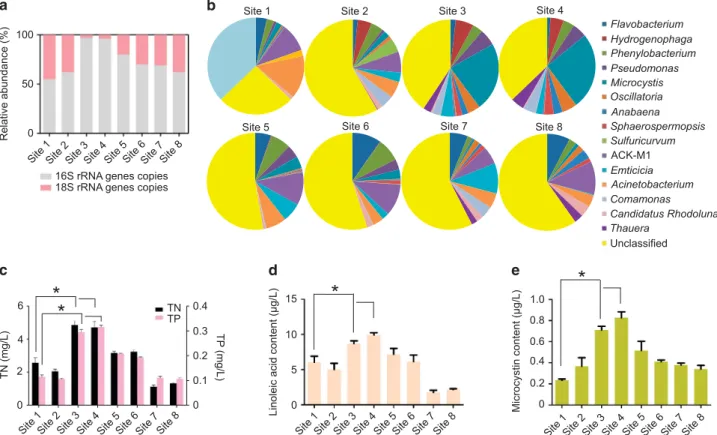
Figure 3 Aquatic microbial community profile analyses. (a) The mean relative abundance of 16S rRNA genes and 18S rRNA genes copies in surface samples collected in Lake Taihu. (b) Genera-level taxonomic distribution of the major aquatic microorganism community profile. Total nitrogen (TN) and total phosphorus (TP;(c)), LA (d) and particulate microcystin concentration (e) in surface water of Lake Taihu over the sampling period (mean of the eight stations). Asterisks represent statistically significant differences between treatments (*Po0.05, ANOVA). Data are means ± s.e.m. (n= 4 per site).
4 days of exposure, which was close to the NO concentration produced byC. vulgarisafter 4 days in co-cultures (91.2 nM NO; Figure 2d), indicating that
LA is a key allelopathic molecule inducing NO release fromC. vulgaris.
To further demonstrate that NO produced by
C. vulgarisplays an essential role in stimulating M. aeruginosa allelopathy, we added SNP (NO donor) and c-PTIO (NO scavenger) to adjust the NO concentration in the medium of cultures of M. aeruginosa alone or in co-cultures. We found that NO concentration in M. aeruginosa increased in a concentration-dependent manner with SNP (Figure 2e). NO concentration in M. aeruginosa
increased significantly after 6 h of exposure, and reached about 66.3 nM in the presence of 0.25μM
SNP (Figure 2e), which was similar to the NO concentration (~52.9 nM) measured in C. vulgaris,
which was cultivated in co-cultures for 24 h (initial cell number ratio of C. vulgaris to M. aeruginosa= 12:1; Figure 2d). Experiments carried out in the presence of 0.25μM SNP in monocultures of M. aeruginosa revealed that this NO concentration did not affect M. aeruginosa growth significantly (Figure 2f). At the same time, LA levels reached 36.1μg l−1 in the M. aeruginosa monoculture
(Figure 2b), which represents a 3.2-fold increase relative to that of the control (without added SNP) after 4 days of exposure (Figure 2b). This increase was close to that found in our metabolomics analysis, where LA concentration in M. aeruginosa
increased by 5.1-fold relative to the control after 4 days of co-culture (Table 2). This indicated that NO produced byC. vulgaris induced LA excretion from
M. aeruginosa. The addition of c-PTIO into co-culture medium scavenged C. vulgaris-produced NO completely (Figure 2g). At the same time, the
total LA concentration in the C. vulgaris compart-ment of the co-culture system decreased by fivefold after 4 days of exposure to 0.5μMc-PTIO relative to
the c-PTIO-free control without addition of c-PTIO (Figure 2c).
Taken together, our results clearly showed that NO could be an important signaling molecule regulating the production of secondary metabolites (such as LA) in M. aeruginosa, indicating that M. aeruginosa
allelopathy to C. vulgaris can be enhanced in the presence ofC. vulgaris. Furthermore, NO scavenging by c-PTIO treatment (⩾0.05μM) could maintain
optimal C. vulgaris growth alone (Figure 2h) or in co-culture experiments (Figure 2i), highlighting the fact that additional NO-scavenging processes could inhibit or suppress the negative allelopathic interac-tions betweenM. aeruginosaandC. vulgarisand that the strength of M. aeruginosaallelopathy should be maximized when both species are close to each other such as in aggregates or algal colonies.
Cyanobacteria allelopathy in nature
The absolute abundance of cyanobacterial 16S rRNA was much higher at stations 3 and 4 than in other stations of Lake Taihu (Supplementary Table S4). The absolute abundance of eukaryotic organisms (18S rRNA), however, increased much less than that of prokaryotic organisms at stations 3–4 (Supplementary Table S5). We also found that the relative abundance of eukaryotic algae decreased significantly in parallel with the CBs (Figure 3a). The operational taxonomic unit data revealed that ~ 70% of aquatic microorganisms belonged to cyanobacteria at stations 3 and 4, while cyanobacteria at other sampling sites occupied only 40% of the aquatic microbial community. At stations 3 and 4 the
percentage ofMicrocystisincreased by approximately eightfold relative to other sites (Figure 3b). Although these differences in microbial abundance among lake stations could be related, at least partly, by an increase in nutrient (N and P) concentrations (Figure 3c), we found that Microcystis allelopathy could also shape the structure of the microbial community. Indeed, the concentration of the main allelopathic compound of
M. aeruginosa, LA was approximately fivefold higher inMicrocystis spp.-rich stations of Lake Taihu (8.5– 10.4μg LA/L) than at other stations, in which no
Microcystis blooms occurred (~2μg l−1; Figure 3d).
Microcystin concentrations were only between 0.2 and 0.8μg l−1 among the eight stations, indicating that it
was not the main allelopathic compound in Lake Taihu (Figure 3e), which is in line with the findings of Babicaet al.(2007).
Conclusions
Our high-throughput system biochemical and metabo-lomic approach unraveled for the first time the intricate allelopathic interactions between a bloom-forming toxic cyanobacterial species and an algal competitor. We disentangled the network of interactions explaining the negative allelopathic effect of M. aeruginosa on
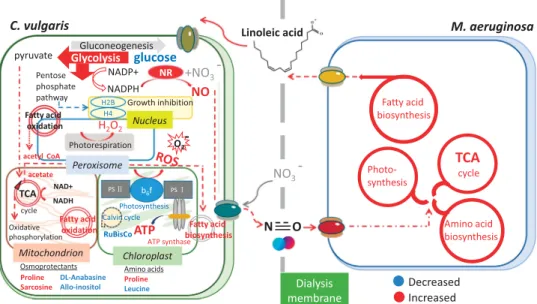
C. vulgaris. M. aeruginosa inhibits the growth of
C. vulgarismainly via the release of LA and also takes advantage of NO, a cell-signaling compound produced by C. vulgaris (as schematized in Figure 4), which stimulated a positive feedback mechanism of LA release byM. aeruginosaas well as its inhibitory effect. Our results highlight the important and previously unrecognized interspecies allelopathic interactions involved in the development and persistence of toxic
M. aeruginosablooms in freshwater ecosystems.
Conflict of Interest
The authors declare no conflict of interest.
Acknowledgements
This work was financially supported by the Natural Science Foundation of China (21277127, 21577128), Zhejiang Provincial Natural Science Foundation of China (LR14B070001), Program for Changjiang Scholars and Innovative Research Team in University (IRT13096), and the US National Science Foundation (INSPIRE 1230543, and Dimensions of Biodiversity 1240851).
References
Babica P, Hilscherová K, Bartová K, Bláha L, Marsálek B. (2007). Effects of dissolved microcystins on growth of planktonic photoautotrophs.Phycologia46: 137–142. Beversdorf LJ, Miller TR, McMahon KD. (2013). The role of
nitrogen fixation in cyanobacterial bloom toxicity in a temperate, eutrophic lake.PLoS ONE8: e56103.
Bittencourt-Oliveira MDC, Chia MA, Oliveira HSBD, Araújo MKC, Molica RJR, Dias CTS. (2015). Allelo-pathic interactions between microcystin-producing and non-microcystin-producing cyanobacteria and green microalgae: implications for microcystins pro-duction.J Appl Phycol27: 275–284.
Borowitzka MA. (2016). Chemically-mediated interactions in microalgae. In: Borowitzka MA, Beardall J, Raven AJ (eds). The Physiology of Microalgae. Springer: UK, pp 321–357.
Cai H, Jiang H, Krumholz LR, Yang Z. (2014). Bacterial community composition of size-fractioned aggregates within the phycosphere of cyanobacterial blooms in a eutrophic freshwater lake.PLoS ONE9: e102879. Carmichael WW. (2001). Health effects of toxin producing
cyanobacteria: 'the cyanoHABs'.Hum Ecol Risk Assess
7: 1393–1407.
Chiang IZ, Huang WY, Wu JT. (2004). Allelochemicals of
Botryococcus braunii (Chlorophyceae). J Phycol 40: 474–480.
Desbois AP, Smith VJ. (2010). Antibacterial free fatty acids: activities, mechanisms of action and biotechnological potential.Appl Microbiol Biotechnol85: 1629–1642. Dodds WK, Bouska WW, Eitzmann JL, Pilger TJ, Pitts KL,
Riley AJ et al. (2008). Eutrophication of US fresh-waters: analysis of potential economic damages.
Environ Sci Technol43: 12–19.
Duan HT, Ma RH, Xu XF, Kong FX, Zhang SX, Kong WJet al.
(2009). Two decade reconstruction of algal blooms in China’s lake Taihu.Environ Sci Technol43: 3522–3528. Ferrer MA, Ros Barcel ÓA. (1999). Differential effects of nitric oxide on peroxidase and H2O2production by the xylem
ofZinnia elegans.Plant Cell Environ22: 891–897. Fröhlich A, Durner J. (2011). The hunt for plant nitric
oxide synthase (NOS): is one really needed?Plant Sci
181: 401–404.
Gill SS, Tuteja N. (2010). Reactive oxygen species and antioxidant machinery in abiotic stress tolerance in crop plants.Plant Physiol Biochem48: 909–930. Hamilton DP, Wood SA, Dietrich DR, Puddick J. (2014).
Costs of harmful blooms of freshwater cyanobacteria. In: Sharma NV, Rai AK, Stal LJ (eds). Cyanobacteria: an Economic Perspective. John Wiley & Sons: New York, pp 247–256.
Ikawa M, Haney JF, Sasner JJ. (1996). Inhibition of
Chlorella growth by the lipids of cyanobacterium
Microcystis aeruginosa.Hydrobiologia331: 167–170. Jiang YJ, He W, Liu WX, Qin N, Ouyang HL, Wang QM
et al. (2014). The seasonal and spatial variations of phytoplankton community and their correlation with environmental factors in a large eutrophic Chinese lake (lake Chaohu).Ecol Indic40: 58–67.
Kiran Kumar Reddy G, Nancharaiah YV, Venugopalan VP. (2014). Biodegradation of dibutylphosphite by Sphin-gobium sp. AMGD5 isolated from aerobic granular biomass.Int Biodeterior Biodegrad91: 60–65.
Kletzien RF, Harris PKW, Foellmi LA. (1994). Glucose-6-phosphate-dehydrogenase—a housekeeping enzyme subject to tissue-specific regulation by hormones, nutrients, and oxidant stress. Fed Am Soc Exp Biol J
8: 8174–8181.
Leão PN, Vasconcelos TSD, Vasconcelos VM. (2009). Allelopathy in freshwater cyanobacteria. Crit Rev Microbiol35: 271–282.
Ma ZL, Fang TX, Thring RW, Li YB, Yu HG, Zhou Qet al.
(2015). Toxic and non-toxic strains of Microcystis aeruginosainduce temperature dependent allelopathy
toward growth and photosynthesis of Chlorella vul-garis.Harmful Algae48: 21–29.
Noctor G, Arisi ACM, Jouanin L, Foyer CH. (1998). Manipulation of glutathione and amino acid biosynth-esis in the chloroplast.Plant Physiol118: 471–482. Paerl HW, Fulton RS, Moisander PH, Dyble J. (2001).
Harmful freshwater algal blooms, with emphasis on cyanobacteria.Sci World J1: 76–113.
Paerl HW, Paul VJ. (2012). Climate change: links to global expansion of harmful cyanobacteria. Water Res 46: 1349–1363.
Paerl HW. (2008). Nutrient and other environmental controls of harmful cyanobacterial blooms along the freshwater marine continuum.Adv Exp Med Biol619: 216–237.
Paerl HW. (2009). Controlling eutrophication along the freshwater marine continuum: dual nutrient (N and P) reductions are essential.Estuar Coast32: 593–601. Paul C, Barofsky A, Vidoudez C, Pohnert G. (2009). Diatom
exudates influence metabolism and cell growth of co-cultured diatom species.Mar Ecol Prog Ser389: 61–70. Poulson-Ellestad KL, Jones CM, Roy J, Viant MR, Fernán-dez FM, Kubanek J et al. (2014). Metabolomics and proteomics reveal impacts of chemically mediated competition on marine plankton. Proc Natl Acad Sci USA111: 9009–9014.
Qian HF, Sheng GD, Liu WP, Lu YC, Liu ZH, Fu ZW. (2008). Inhibitory effects of atrazine on Chlorella vulgaris as assessed by real-time polymerase chain reaction.Environ Toxicol Chem27: 182–187.
Qian HF, Sun ZQ, Sun LW, Jiang YF, Wei Y, Xie Jet al.
(2013). Phosphorus availability changes chromium toxicity in the freshwater alga Chlorella vulgaris.
Chemosphere93: 885–891.
Qian HF, Wang RQ, Hu HJ, Lu T, Chen XL, Ye HQet al.
(2011). Enantioselective phytotoxicity of the herbicide imazethapyr and its effect on rice physiology and gene transcription.Environ Sci Technol45: 7036–7043. Qian HF, Yu SQ, Sun ZQ, Xie XC, Liu WP, Fu ZW. (2010).
Effects of copper sulfate, hydrogen peroxide and N-phe-nyl-2-naphthylamine on oxidative stress and the expres-sion of genes involved photosynthesis and microcystin disposition inMicrocystis aeruginosa.Aquat Toxicol99: 405–412.
Rigosi A, Carey CC, Ibelings BW, Brookes JD. (2014). The interaction between climate warming and eutrophication to promote cyanobacteria is dependent on trophic state and varies among taxa.Limnol Oceanogr59: 99–114. Rigosi A, Hanson P, Hamilton DP, Hipsey M, Rusak JA, Bois J
et al.(2015). Determining the probability of cyanobacter-ial blooms: the application of Bayesian networks in multiple lake systems.Ecol Appl25: 186–199.
Rosenwasser S, Creveld SGV, Schatz D, Malitsky S, Tzfadia O, Aharoni A et al. (2014). Mapping the diatom redox-sensitive proteome provides insight into
response to nitrogen stress in the marine environment.
Proc Natl Acad Sci USA111: 2740–2745.
Sukenik A, Eshkol R, Livne A, Hadas O. (2002). Inhibition of growth and photosynthesis of the dinoflagellate
Peridinium gatunense by Microcystis sp. (cyanobac-teria): a novel allelopathic mechanism.Limnol Ocea-nogr47: 1656–1663.
Tan JF, Zhao HJ, Hong JP, Han YL, Li H, Zhao WC. (2008). Effects of exogenous nitric oxide on photosynthesis, antioxidant capacity and proline accumulation in Wheat seedlings subjected to osmotic stress. World J Agric Sci4: 207–313.
Uronen P, Kuuppo P, Legrand C, Tamminen T. (2007). Allelopathic effects of toxic haptophyte Prymnesium parvumlead to release of dissolved organic carbon and increase in bacterial biomass.Microb Ecol54: 183–193. Wang X, Sun M, Wang J, Yang L, Luo L, Li Pet al.(2012).
Microcystisgenotype succession and related environ-mental factors in Lake Taihu during cyanobacterial blooms.Microb Ecol64: 986–999.
Work VH, Radakovits R, Jinkerson RE, Meuser JE, Elliott LG, Vinyard DJ et al. (2010). Increased lipid accumulation in theChlamydomonas reinhardtii sta7-10 starchlessisoamylase mutant and increased carbo-hydrate synthesis in complemented strains.Eukaryot Cell9: 1251–1261.
Wu JT, Chiang YR, Huang WY, Jane WN. (2006). Cytotoxic effects of free fatty acids on phytoplankton algae and cyanobacteria.Aquat Toxicol80: 338–349.
Yordanova ZP, Iakimova ET, Cristescu SM, Harren FJ, Kapchina-Toteva VM, Woltering EJ. (2010). Involve-ment of ethylene and nitric oxide in cell death in mastoparan-treated unicellular alga Chlamydomonas reinhardtii.Cell Biol Int34: 301–308.
Zhao C, Wang X, Wang X, Wu K, Li P, Chang N et al.
(2015). Glucose-6-phosphate dehydrogenase and alter-native oxidase are involved in the cross tolerance of highland barley to salt stress and UV-B radiation.
J Plant Physiol181: 83–95.
This work is licensed under a Creative Commons Attribution-NonCommercial-ShareAlike 4.0 International License. The images or other third party material in this article are included in the article’s Creative Commons license, unless indicated otherwise in the credit line; if the material is not included under the Creative Commons license, users will need to obtain permission from the license holder to reproduce the material. To view a copy of this license, visit http://creativecommons.org/ licenses/by-nc-sa/4.0/
© The Author(s) 2017
Supplementary Information accompanies this paper on The ISME Journal website (http://www.nature.com/ismej)