HITTING THEM WHERE IT HURTS: FINANCIAL INTEGRATION AND BORROWING COSTS AS DETERMINANTS OF ECONOMIC SANCTIONS SUCCESS
Alexander Parets
A thesis submitted to the faculty of the University of North Carolina at Chapel Hill in partial fulfillment of the requirements for the degree of Master of Arts in the Department of Political Science.
Chapel Hill 2010
ABSTRACT
ALEXANDER PARETS: Hitting Them Where It Hurts: Financial Integration and Borrowing Costs as Determinants of Economic Sanctions Success
(Under the direction of Layna Mosley.)
TABLE OF CONTENTS
LIST OF TABLES . . . iv
LIST OF FIGURES . . . v
Introduction . . . 1
The Political Economy of Sanctions Success . . . 3
High vs. Low Politics . . . 4
Costs and Bargaining Power . . . 5
Financial Integration, Borrowing Costs and Episode Success . . . 6
Research Design, Data and Methodology . . . 11
Modeling Technique . . . 12
Dependent Variable . . . 12
Independent and Control Variables . . . 14
Results . . . 17
Conclusion . . . 21
APPENDIX . . . vii
LIST OF TABLES
Table
1 Predicted Direction of Independent and Control Variables . . . 16 2 Summary Statistics - High Politics Cases Including Human Rights
Vi-olations . . . 17 3 Summary Statistics - High Politics Cases Excluding Human Rights
Violations . . . 17 4 Results from Logistic Regression Models . . . 18 5 Predicted Probabilities of Financial Integration and Short-Term Debt
for Model 1 . . . 20 6 Results from Logistic Regression Models - Non-Logged Short-Term
LIST OF FIGURES
Figure
Introduction
In response to allegations of genocide and violations of human rights during the Second Su-danese Civil War, the United States, the United Kingdom and other Western countries threat-ened to impose economic sanctions on the Sudanese government if it did not cease targeting innocent civilians in their military operations, improve the regime’s respect for its citizens and bring those that were committing human rights violations to justice. The threat and eventual sanctions legislation that was passed by the United States Congress sought to “prohibit com-panies investing in the oil and gas sector in Sudan from raising capital in the United States or from trading its securities in any United States capital market” (Hufbauer and Oegg 2003b) and also requested that the President of the United States decrease diplomatic contact, seek a United Nations arms embargo and take active steps to deny the Sudanese government access to oil revenues and international capital.
During the summer of 1997, the United States Congress passed the Nigeria Democracy Act,1 a comprehensive economic sanctions effort aimed at destabilizing General Sani Abacha’s military regime in Nigeria and returning the country back to democracy following a roughly thirty year period of military authoritarian rule. The economic sanctions episode, implemented as a multi-lateral effort with the support of the United Kingdom, Canada, France and most other Western states, prohibited new investment and capital from entering Nigeria, ordered the United States envoy to each international financial institution to vote against any loan or funding package requested by or aimed to benefit the Nigerian government, restricted American companies from doing business in Nigeria and froze the assets of any Nigerian national with ties to the military regime.
Both of these economic sanctions episodes were aimed at punishing those international firms and investors that did business and invested capital in the target state, while at the same time reducing each government’s access to international capital markets and potential revenue sources. Furthermore, both of these sanctions episodes were threatened and imposed multilaterally by advanced, industrial states. The multilateral sanctions effort against Nigeria was a resounding success, with the collapse of the military regime coming only two years after the sanctions were imposed. On the other hand, the multilateral sanctions effort against the Sudan has not had much success, with human rights violations continuing and the same Sudanese government still in power. Why was the sanctions effort against Nigeria successful while the sanctions effort against Sudan was not? At the time the sanctions were threatened, Nigeria’s government and economy was more integrated into the international financial system and dependent on external 1HR 1786 was passed on June 4, 1997. The full text of the bill can be found in the records of the United
sovereign financing than the Sudanese government, a characteristic that may have affected the level of costs and pressure on Nigeria’s government to acquiesce that was not present on the Sudanese government. Does a state’s exposure to the international financial system affect its ability to evade the costly effects of economic sanctions? More specifically, does a state’s degree of financial integration and dependence on international capital markets affect the success of security issue-based sanctions episodes?
Over the last three decades, sanctions2 scholars have identified important non-economic de-terminants of economic sanctions success.3 Recently, scholars have turned to the effect of in-ternational trade and economic interdependence on sanctions outcomes, arguing that decreased trade flows and increasing levels of interdependence induce target governments to acquiesce to sender demands.4 Theoretical and empirical analyses have relied on the effects of trade link-ages and the costs associated with decreased trade flows as a primary explanatory predictor of sanctions success. However, the causal mechanism by which trade linkages alone directly induce sanctions success is a necessary but not sufficient explanation and the assumption that the same mechanism should work on both high and low politics cases is questionable.
Decreased trade flows are an important component of sanctions success in that they can lead to decreased economic output and tax revenue in the target country. However, trade is a necessary but not sufficient cause of target acquiescence because the bulk of the cost of decreased trade flows falls on the citizens of the target country and not on the target government. This paper argues that a target government’s dependence on short-term borrowing from international financial markets and degree of financial integration directly affects the costs associated with engaging in sanctionable activity in high politics cases. Economic sanctions in high politics cases increase the risk associated with lending money to target states due to the potential or realized costs associated with decreased trade, tax revenue and economic activity within the target state. The actions of international financial markets and investors, in demanding higher interest rates as compensation for increases in target default risk, increases the costs of borrowing for target states that engage in sanctionable activity. Costs are directly imposed on target governments on the sovereign borrowing side of the equation in terms of higher interest rates on loan contracts, decreased access to international capital and a decreased ability to service its international payments. These “finance-based” costs immediately affect a government’s cost-2I will use the terms economic sanctions and economic coercion interchangeably in this paper. For the purposes
of this analysis, the terms are defined as “the threat or act by a sender government or governments to disrupt economic exchange with the target state, unless the target state acquiesces to an articulated demand.” Drezner (2003)
3Drezner (1999); Martin (1992); Allen (2008); Bapat and Morgan (2009); Cox and Drury (2006);
Dashti-Gibson, Davis and Radcliff (1997); Hovi, Huseby and Sprinz (2005); Kaempfer and Lowenberg (1992); Pape (1997); Smith (1996)
benefit analysis, unlike the indirect costs associated with decreased trade flows. States that rely on international capital markets to finance their government operations and require international capital to meet their debt obligations, especially their short-term debt obligations, are sensitive to changes in borrowing costs and perceived creditworthiness. Increased target state dependence on international capital provides sender states with increased bargaining leverage over target activity, allowing senders to extract concessions from target states.
This paper proceeds as follows. The first section develops the argument that financial inte-gration and short-term debt exposure directly affect the outcome of economic sanctions episodes and identifies empirically testable hypotheses. The second section presents the research design for this project, detailing the data set, methodology and variables that are used. In the third section, I present and interpret the results of the large-n statistical analysis. The final sec-tion provides concluding remarks and implicasec-tions for both policy-makers and future sancsec-tions research.
The Political Economy of Sanctions Success
High vs. Low Politics
A careful distinction must be made between issues of high politics and low politics when discussing economic sanctions as the interactions between senders, targets and investors and thus the causal process is different for these two types of episodes. High politics sanctions ef-forts seek to directly impose wide-ranging economic costs on the target regime by impeding a target government’s ability to access international financial markets for new sources of capital and revenue. Their effect on target country risk and the economic and political fundamentals within a target state is dramatically higher than narrow and systemically unimportant trade or economic issue-based sanctions. Sanctions threats and impositions made over high politics issues have a much higher probability of turning into militarized interstate disputes than sanc-tions episodes over low politics issues. Bapat and Morgan (2009) argue that security-related episodes involve cases with higher degrees of issue salience, and typically represent a set of more intractable issues than low politics issue-based episodes. High politics issue-based episodes are more likely to both be noticed by international investors and financial markets and more likely to change their perceptions of the economic climate within the target country and the target state’s level of default risk than low politics issue-based episodes. Investors care far more about high politics issue-based sanctions because of the higher risk associated with political and economic environments in which high politics sanctions are targeted.
The argument put forward in this paper is restricted to those episodes in which the primary issue in dispute between a sender and a target deals with political influence, military behavior, regime destabilization, territorial disputes, access to strategic materials, retaliation for alliance or alignment choice, weapons proliferation, crimes against humanity in the course of a civil conflict or support for non-state actors. Economic sanctions aimed at changing government behavior on these more intractable and salient high politics issues have a much higher propensity to be noticed by international investors. High politics issues tend to bring the future stability of the target government into question, thus inducing a larger degree of uncertainty amongst investors. This future uncertainty over high politics issues affects investors’ risk-analysis calculations, specifically the default risk of the target government, to a much greater extent than low politics issues. If the primary issue in dispute is about the release of citizens or property, drug trafcking, environmental policies, trade policies, or other economic reforms, the issue in dispute is not likely to be critical to the survival of the state, and can therefore be considered a low politics dispute and not under the purview of this analysis.5 The key distinction between issues of high and low politics is over the substance of the issue rather than the range of the sanctions effort.
Costs and Bargaining Power
We know from previous work that targets of economic sanctions suffer costs that “result from the actions of countries imposing sanctions. The resulting costs, or the fear of such costs, in turn cause target states to moderate their behavior in the direction demanded by the sending nation.”6 Previous studies have posited that as target costs increase, targets are more likely to acquiesce to sender demands.7 The argument this paper advances is consistent with past work in that it agrees that increasing target costs will induce targets to acquiesce and that targets acquiesce when the expectation or realization of such costs are large enough to outweigh the benefits of engaging in the sanctionable activity and the sender state is actually able to implement the costs on the target government and not only on the target’s domestic audience. However, if target costs and sender costs increase simultaneously, senders do not accrue increasing bargaining leverage in their interactions with targets. Previous studies have equated costs with decreased trade flows,8 inferring that blocking access to a sender’s domestic market is the only way by which sender states impose costs on targets.
Advanced industrial states do threaten to block access to their domestic market, thereby seeking to curtail a target state’s ability to trade its goods and services within the sender’s domestic market. However, the costs associated with this policy are not directly imposed on target governments and are not sufficient in and of themselves to extract greater bargaining leverage for sender states and induce target acquiesence. The costs associated with embargoes and other trade-based sanctions are borne directly by the domestic audience of the target country and only indirectly by the government itself in terms of decreased tax revenue and economic output. Furthermore, the costs associated with decreased trade flows are imposed on both target and sender states. Increased sender costs are likely to decrease the credibility and resolve of sender states’ threats. As sender costs increase, sender states are more likely to water down the scope and range of sanctions episodes, thereby making sanctions less costly on the target state and less likely to succeed. Arguments that rely on trade costs and economic interdependence as a primary determinant of sanctions success are logically inconsistent. As economic interdependence increases, a phenomena we have observed over the last forty years, sanctions should become more costly to both targets and senders, and we should expect both total episodes and episode success
6Dashti-Gibson, Davis and Radcliff (1997)
7Drezner (2003); Smith (1996); Kaempfer and Lowenberg (1999); Hufbauer, Schott and Elliot (1990); Morgan
and Schwebach (1997)
8In fact, all previous studies that posited the effect of economic indicators as a determinant of sanctions
to decrease as a result. A trade-based explanation of sanctions success would predict that as the world becomes more interdependent, the credibility of sanctions threats and impositions should decrease. Because sender credibility should decrease, we should observe less episodes ending in success, as sender’s bargaining power vis-a-vis targets does not increase. However, over the past forty years, we have not seen the number of episodes decrease as a result of increased interdependence. In fact, we have seen that as state’s become more interdependent episode success has increased, an outcome that is contradictory to what is theoretically predicted.
The costs associated with decreased bilateral trade flows9 can potentially affect international investors’ risk-calculations insofar as decreased bilateral trade flows decrease economic output in the target economy and tax revenues (both in terms of income tax and tariffs) accrued by target governments.10 However, trade-based explanations do not sufficiently capture how costs are imposed on targets and how those costs induce targets to acquiesce to sender demands. Breaking with the norm of prior sanctions studies, I do not assume that advanced industrial economies are able to impose these ‘costs’ and extract greater bargaining leverage by themselves without the assistance of some third actor. It is only by way of increasing the target’s risk of default, thus influencing international investors to increase borrowing costs associated with pursuing the sanctionable policy, can sender states extract greater bargaining leverage over and impose costs on target states. Because of this, it is international financial markets and international investors that directly impose costs on target governments for engaging in potentially risky behavior and these cost increases provide the necessary cause for target aquiescence to sender demands.
Financial Integration, Borrowing Costs and Episode Success
To varying degrees, states require capital to finance their operations on a daily basis. Some states rely solely on tax revenues and domestic capital sources to fund these operations, but over the last forty years, increasingly states have turned to international financial markets and government borrowing,11 to finance their operations. Governments borrow capital from various external sources in order to “compensate for revenue shortfalls or to fulfill other economic man-agement objectives.” States require capital in order to make international payments to various creditors including international banks, international financial institutions, individual
interna-9Hufbauer and Oegg (2003b); Caruso (2003)
10Many policy-makers and academics have argued in favor of targeted economic sanctions, specifically targeted
financial sanctions, as the preferred policy tool to induce targets to cooperate. The argument I am making is not in favor of targeted financial sanctions. Both the trade and the finance side of economic sanctions efforts are needed to affect investor’s risk calculations, increase costs on governments and induce changes in government behavior. The argument I make is in favor of comprehensive economic sanctions like those imposed on both Sudan and Nigeria in the two cases discussed above.
11This government borrowing includes funds lent to sovereigns by banks, other governments and international
tional investors and governments, and to hold in reserve in case they need to defend their currency (if they have a fixed exchange rate regime). States also rely on capital markets in order to fi-nance interest payments and roll over the principal on previous debt contracts on a regular basis and ensure that they can settle their balance of payments accounts. In the 1970’s and 1980’s, states mostly borrowed from international banks and international financial institutions in order to finance their daily operations. Since the mid-1980’s, governments have supplemented the financing received from banks by offering sovereign bonds denominated in either local or foreign currency, borrowing directly from international investors at pre-determined interest rates.
When borrowing from institutional investors, government officials announce the amount and type of bonds that they will issue well before the issue date and investors submit bids indicating the interest rate at which they will purchase government bonds.12 When borrowing from interna-tional banks, other governments or internainterna-tional financial institutions, sovereigns negotiate the interest rate at which funds will be lent and discuss the terms of the lending agreement. Financial market participants, whether they are international banks or specific institutional investors, uti-lize an array of indicators and measures when pricing the risk associated with sovereign borrowing and adjust their interest rate demands according to the risk associated with lending capital to the government. Mosley (2003) argues that in emerging markets, institutional investors expend significant time and resources to gather information on both macro and micro-level economic and political indicators before making their interest rate bids. International banks and other lenders also expend a large amount of time and resources analyzing the default risk of sovereigns that they do business with. When these market participants deem that a specific government policy may hamper its ability to service its international debt obligations or the risk associated with lending to that country increases as a result of potential future conflict, they will demand higher interest rates and/or cut back their exposure to that country’s sovereign debt offerings. High politics sanctions episodes are more salient, have the potential to affect the stability of the target government (Allen 2008) and are typically more intractable than low politics issue based episodes (Bapat and Morgan 2009). Because of the increase in the probability of political instability within and external pressure on the target state, international lenders will demand greater interest rate premia in order to do business with target governments that are threatened with economic sanctions.
Why Do Investors Care About Government Behavior and Why Do Governments Care About
Investor Perceptions?
Institutional investor and international bank sovereign borrowing exposure to emerging economies is quite high, with 29% of total gross private capital flows to emerging markets in 1999 alone being sovereign borrowing. Investors seek to maximize return for any given level of risk. Increased uncertainty or increases in the risk associated with doing business with a target government can drastically affect investors’ bottom lines. When senders threaten or impose economic sanctions on targets, credible sanctions episodes increase the default risk associated with that state’s debt. International investors have a strong incentive to either increase the risk premium on or reduce exposure to that state’s debt. If investors and banks choose to reduce their exposure to a given state’s debt, this reduces the supply of capital available to governments on international financial markets and provides other investors with increased bargaining power to demand higher interest rates. International investors thus hold a large influence over the policy-making process in target countries in that they can directly affect a target government’s borrowing costs.13 An increase in the risk associated with a given state’s sovereign debt has the potential to directly affect the ability of a government to operate and can have crippling effects on a target government’s economy.
The impact of sovereign borrowing market activity on national governments is quite direct. Government’s face a trade-off when it comes to choosing a specific policy bundle that includes potentially sanctionable activity: a government that pays higher interest rates in return for a given set of policies spends a greater portion of its budget on interest payments. Increases in the risk premium shifts government resources away from other government programs to financing the costs of the new policy.14 Increases in the risk premium on government borrowing also affects borrowing costs for private actors in the domestic economy. Increases in both public and private borrowing costs could imply an overall economic slowdown. Thus, a country with a high degree of financial integration and exposure to international financial markets is dependent on these financial markets not only to allow it to continue financing its daily operations, its interest payments on outstanding debt and rolling over its external debt, but is also susceptible to domestic market borrowing rate increases if the sovereign borrowing market decides to punish the government for a specific policy.
13Specifically, the influence of institutional investors on government policy in developing states is both strong
and broad according to Mosley. She specifically analyzed investor’s beliefs regarding government ideology and domestic policy choices. Potentially sanctionable activity, specifically activity dealing with high politics issue, is beyond the purview of traditional government policy as analyzed in her study. It is reasonable to expect that investors would hold a strong and broad influence over government policy choices that deal with high politics issues and have ramifications for a government’s risk profile.
There have been many examples of sovereign borrowing markets punishing sovereign gov-ernments for pursuing policies that increase the risk of default on sovereign debt. Specifically, we have seen many instances of credit ratings agencies downgrading a target state’s sovereign debt following the threat or imposition of economic sanctions. The most prominent example was when Standard & Poor’s (S&P) downgraded India’s foreign currency and local currency issuer credit rating in 1998 following the threat and imposition of economic sanctions by the United States and the United Kingdom in response to India’s nuclear tests. This ratings downgrade increased India’s borrowing costs immediately as the interest rate on short-term debt rollovers and variable-rate debt contracts increased. The threat and imposition of economic sanctions provided an important focal point for investors, increased the default risk on India’s debt and induced investors to both reduce their exposure to India’s debt and demand higher interest rates in exchange for foreign capital.
Economic sanctions are policy tools used almost exclusively by advanced industrial states to coerce other states to comply with their policy preferences. In 2000 alone, the United States had twenty-eight ongoing sanctions episodes in which it was the primary sender. A careful glance through the data on sanctions episodes shows that the United States is the primary sender in the majority of security-motivated sanctions episodes. Most of the episodes not originating from the United States originated from other advanced, industrial nations, with either the United States as an interested third party under the auspices of the United Nations or a multilateral effort that pooled the resources and influence of the United States and other advanced countries. The United States and other systemically important states have a large amount of political power within the international financial system, have the largest domestic consumer markets in the world and most institutional investors are based in these advanced, industrial economies. We know that the United States is able to manipulate the lending decisions of international financial organizations15 and apply pressure on international banks to decrease access to a specific government’s debt. In fact, written into virtually all high politics issue-based economic sanctions legislation is the explicit demand that domestically based financial firms and investors reduce access to both public and private investments in target countries. Furthermore, decreases in access to the large trade markets of advanced industrial economies, coupled with increases in the riskiness associated with a country’s ability to continue to make payments on their debt obligations would dramatically affect the economic well-being of citizens within the target country as well as the tax revenues that the government depends on to service its international payments. This decrease in economic output decreases the tax revenue that target governments need to finance its international payments. Investors care about government behavior because that behavior
affects the risk profile of the government. Furthermore, it affects economic output within the target economy and thus affects a target’s ability to continue making international payments. Governments care about investor perceptions because increases in investor uncertainty and risk perception affects the amount of money governments have to pay when borrowing capital from these investors.
Bapat and Morgan (2009) argue that a “critical variable in assessing the effectiveness of sanc-tions is the economic cost of such activity.” Investors know that when sancsanc-tions are threatened or imposed, trade and economic output decline (Caruso 2003; Hufbauer and Oegg 2003b) and the risk of armed and civil conflict increases (Drezner 1998; Wood 2008). As investor uncertainty regarding political stability and the potential for directly inflicted economic costs on the target economy increases, international investors adjust their risk calculations and demand higher in-terest rates or decrease exposure to that country’s sovereign debt market in order to compensate for increases in risk (Rodrik 1991). Changes in perceived creditworthiness, risk premiums and interest rates in sovereign debt markets directly affect government budgets and their ability to service international debt obligations and provide public and private goods to its citizens.
Target states with a greater degree of exposure to international financial markets have in-creased access to credit, typically higher rates of economic growth and better levels of gover-nance.16 This increased financial openness makes governments dependent on financial markets for their economic health and exposes governments to what financial markets and investors think about government policies. The structure and level of government debt should affect the costs associated with increases in default risk brought about by a sanctions episode. Governments that have high rates of exposure to short term debt should be especially sensitive to increases in borrowing costs as shorter maturities on debt exposes governments to greater rollover risk as well as immediate cost increases. Countries that constantly have to roll over their short-term debt immediately feel the effects of interest rate hikes and should thus be more likely to acquiesce to sender demands in order to bring their interest rates back to pre-sanction levels. Countries that have high levels of short-term debt are also especially prone to financial crises which coupled with an economic sanctions episode could increase a target’s default risk.
As the degree of financial integration increases and a government’s level of outstanding short-term debt increases, advanced, industrial sender state governments should garner increas-ing bargainincreas-ing leverage over targets in security issue-based sanctions episodes. When decidincreas-ing whether or not to acquiesce to the demands of a sender state (whether it be during the threat or imposition stage), target states perform a rational cost-benefit analysis regarding the po-tential benefits of continuing with their policies or acquiescing to the sender’s demands and
ceasing to engage in those actions. This is the calculation that sender states seek to impact when threatening or imposing sanctions on target governments. When the expected cost of the sanctions episode outweighs the expected benefit, we would expect target states to acquiesce to the sender’s demands and the episode to be deemed a success. Greater exposure to international financial markets and high levels of short-term debt should provide a large constraint on the ability of governments to withstand the pressure of economic sanctions. Countries with low levels of short-term debt and financial integration should not be susceptible to immediate increases in borrowing costs or be dramatically affected by decreased access to international capital markets. These states should be able to withstand the pressure of economic sanctions as costs cannot be directly imposed on the target government.17 The argument builds upon the basic argument about trade dependence and refines the mechanism by which senders impose costs on targets. It is the effect of potential or realized costs on a target state conditioned on its exposure and dependence on the international financial system for its economic well-being that will induce a state to acquiesce. From this theoretical discussion, we can identify the following testable hypotheses:
Hypothesis #1: There should be a positive relationship between a target’s level of finan-cial market integration and economic sanctions success.
Hypothesis #2: There should be a positive relationship between a target’s short-term debt as a percentage of national income (which depicts a state’s immediate reliance on international financial markets) and economic sanctions success.
Research Design, Data and Methodology
In this section, I explain how I test the hypotheses using all high politics sanctions episodes (both threats and impositions) from the Threat and Imposition of Economic Sanctions (TIES) data set.18 As previously discussed, I restrict the analysis to high politics cases which includes those episodes in which the primary issue in dispute between a sender and a target deals with political inuence, military behavior, regime destabilization, territorial dispute, strategic materi-als, retaliation for alliance or alignment choice, weapons proliferation, human rights violations 17This paper does not argue that a state’s relative level of economic well-being explains the outcome of economic
sanctions episodes as a state can potentially have a very large domestic market and little exposure to international capital markets and still be economically well off, nor that an exogenous income shock to the target state induces it to acquiesce to a sender’s demands. Instead, the argument is that a state’s relative level of exposure to and integration with the international financial system increases the costs associated with policies that are not in line with those of the system’s dominant powers on high-salience, security related issues.
or support for non-state actors. Within the international relations literature, human rights vio-lations are typically labeled as low politics issues. I have created two samples that will be tested independently in the analysis that follows, one sample that excludes human rights violations as a high politics issue and one that includes human rights violations as a high politics issue. These human rights violations typically occur during the midst of civil conflict and are typically propagated by the regime in power. Furthermore, the probability of civil conflict and sender intervention increases and government stability decreases during episodes in which human rights violations are the primary issue. This will directly affect the default risk on a target’s sovereign debt and the mechanism should be very similar between traditional high politics issues and hu-man rights violations. The data set that includes huhu-man rights violations is composed of 247 high politics sanctions episodes from 1971-2000. The data set that excludes human rights violations is composed of 187 high politics sanctions episodes during the same time period. TIES identifies when each episode began and ended, the target state and the primary sender state involved in each episode as well as whether or not the episode was under the purview of an international institution, the costliness of the episode to both targets and senders, and the outcome of each episode.
Modeling Technique
I utilize a logistic regression model in order to test my hypotheses. This methodological tool is best for this research question because the dependent variable in the analysis is a binary measure of economic sanctions episode success and this technique allows the predicted values to be bound between zero and one, thus ensuring consistency with observed outcomes. The equation that is estimated is:
P r(yi= 1) =pi (1)
logit(pi) =Xiβ (2)
where,piis the probability of success of a given sanctions episode,Xiis the vector of independent and control variables, and βi is the parameter that will be estimated via maximum likelihood for each independent and control variable.
Dependent Variable
the TIES dataset. In the final outcome variable in TIES, there are an array of possible outcomes that can be realized: targets can fully or partially acquiesce at either the threat or imposition stage, sender’s can capitulate at either the threat or imposition stage, a stalemate can occur at either the threat or imposition stage, or a settlement can be negotiated by the target and sender at either stage. I have constructed two different versions of the dependent variable for this analysis: one with a broad definition of episode success and one with a narrow definition of episode success. For the first dependent variable, success is broadly defined to include those episodes that ended with either partial or total acquiescence by the target state at either the threat or imposition stage or a negotiated settlement between the target and sender following either the threat or imposition stage whereby the target agrees to alter some of its behavior in exchange for actions taken by the sender. A mutually acceptable agreement implies that the sender was able to obtain sufficiently significant concessions from the target in order to end the sanctions episode. For the second dependent variable, success is defined narrowly to include only partial or total acquiesence by the target at either the threat or imposition stage, coding all negotiated settlements as failures. The narrow definition of success is included to account for the argument that only those cases in which the target acquiesces without it being induced into cooperation by side payments or compensation can be deemed a success. This narrow definition of success is meant to solely include those cases in which the target acquiesced as a result of the sanctions threat or imposition, and not as a result of compensation provided by the sender.19
There are 247 episodes in the data set that includes human rights violations as well as traditional high politics issues that will be analyzed using the broad measure of success. Of these 247 episodes, 102 (41%) were deemed a success and 145 (59%) were deemed a failure. There are also 247 episodes in the data set that includes human rights violations as well as traditional high politics issues that will be analyzed using the narrow measure of success. Of these 247 episodes, 73 (30%) were deemed a success and 174 (70%) were deemed a failure. In the data set that excludes human rights violations as a high politics issue and uses the broad measure of success, there are 187 sanctions episodes. Of these 187 episodes, 79 (42%) were deemed a success and 108 (58%) were deemed a failure. Similarly, there are 187 episodes in the data set that excludes human rights violations as a high politics issue but uses the narrow measure of success. Of these 187 episodes, 57 (30%) were deemed a success and 130 (70%) were deemed a failure.
19For greater ease throughout the research design and results sections, I will use the terms ‘broad success’ and
Independent and Control Variables
Key Independent Variables
Financial Integration: The first independent variable, financial integration, is operationalized as the target state’s degree of capital account openness, using the Chinn and Ito KAOPEN variable. This measure provides a good proxy for financial integration as those states that are more integrated into the international financial system are most likely to have open capital accounts. Those that are not integrated into the international financial system are most likely to have heavy restrictions on both capital inflows and outflows as well as restrictions on the types of capital flowing into the country. Furthermore, this measure is an improvement on previous openness measures in that it is a continuous measure that distinguishes based on degree of legal openness rather than relying on a binary measure of whether or not the capital account is open. The Chinn and Ito KAOPEN measure is an index measuring a country’s degree of capital account openness from 1970-2007. Potential observations of capital account openness vary from -1.81 to 2.53 with higher index values substantively meaning higher levels of capital account openness. The first hypothesis predicts a positive relationship between this first independent variable and the success of economic sanctions. As a country becomes more integrated with the international financial system, they should be more likely to acquiesce to sender demands as decreases in access to these markets will affect domestic economic output and thus the costs associated with engaging in sanctionable behavior.
Control Variables
I also include an array of theoretically important control variables to ensure that the model is correctly specified, to ensure robustness to alternative specifications and control for alternative explanations.
International Institutions: I include a binary measure of whether or not an international institution was involved in the sanctioning process. This variable was taken from the TIES dataset and is coded as 1 if the sanctions were conducted under the auspices of an international institution and 0 otherwise. This variable should be positively correlated with sanctions episode success as predicted by Martin (1992), Hart (2000) and Bapat and Morgan (2009).
Anticipated Target and Sender Economic Costs: These two variables, one for the sender and one for the target, are both taken from the TIES data set and have previously been found to be strong determinants of economic sanctions success. The variables are intended to measure the anticipated impact of sanctions as a direct function of the overall potential costs of sanctions on both the target and the sender. These two variables are included in order to control for the total economic costs on the target and sender, including trade losses, investment losses and output losses resulting from each sanctions episode. Economic costs are coded as either minor, major or severe. As anticipated target economic costs increase, the probability of sanctions success should increase. However, as anticipated sender costs increase, we should expect the probability of sanctions episode success to decrease, as increased sender costs should reflect decreases in the credibility of the sender. Senders are more likely to back off of a sanctions threat or imposition the higher the cost of sanctions to their domestic economy. Therefore, we should expect anticipated target costs to be positively correlated with sanctions episode success and anticipated sender costs to be negatively correlated with sanctions episode success.
Offending Behavior Specificity: This variable is taken from the TIES data set and is intended to gauge the specificity of a sender’s demands regarding changes in target behavior. The clarity of the sender’s demands is measured by examining the specificity of the threats made by the sender and were coded as either ambiguous or clear. Previous theoretical work has argued that more clear and specific demands should be associated with a higher probability of sanctions success (Bapat and Morgan 2009). Therefore, we expect that this variable should be positively correlated with sanctions episode success.
from the POLITY IV data set. The polity2 variable records key qualities of executive recruit-ment, constraints on executive authority, and political competition. We expect more democratic regimes to be more likely to acquiesce to sender demands and more non-democratic governments to be less likely to acquiesce.
Cold War Dummy: I include a dichotomous variable for the years in my sample (1971-1989) that the Soviet Union was in existence. The Soviet Union had the resources and capabilities to potentially compensate states for policies that are near their ideal point and counteract economic sanctions efforts threatened or imposed by Western industrialized nations. Therefore, sanctions imposed during this time period should be less likely to succeed as the presence of the Soviet Union could mitigate the costs of engaging in sanctionable activity against the interests of West-ern powers during this period. We expect a negative correlation between episodes during the Cold War and economic sanctions success.
US as Sender State Dummy: As previously discussed, the United States is the primary sender state in the majority of sanctions episodes. Ignoring the role of the United States in my sample would run the risk of introducing bias into my results. Therefore, I include a dichotomous variable for those episodes in which the US is the primary sender state. We should expect a positive correlation between American involvement as a primary sender and sanctions success as the United States is the leading economic and military power in the international system and potentially has greater coercive power over target state behavior than other senders.
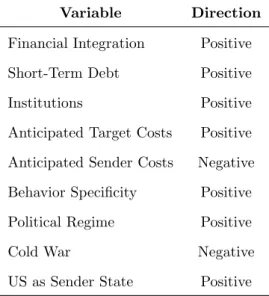
Table 1: Predicted Direction of Independent and Control Variables
Variable Direction
Financial Integration Positive Short-Term Debt Positive
Institutions Positive
Anticipated Target Costs Positive Anticipated Sender Costs Negative Behavior Specificity Positive Political Regime Positive
Cold War Negative
US as Sender State Positive
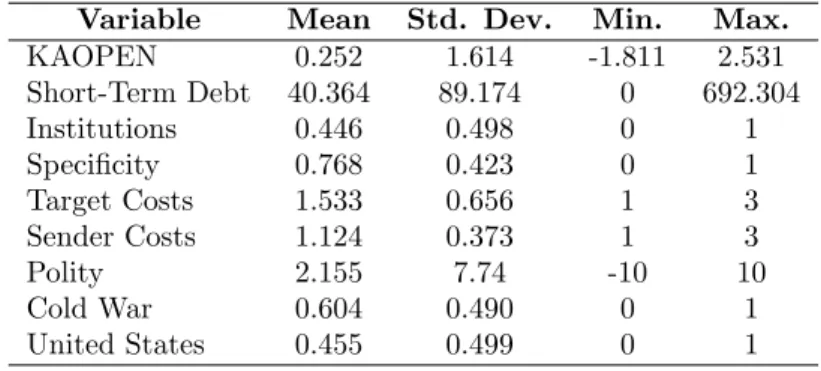
statistics for the wider sample which includes all traditionally defined high politics cases with the addition of human rights violations. The second table presents summary statistics for the narrower sample which only includes traditionally defined high politics cases and excludes human rights violations.
Table 2: Summary Statistics - High Politics Cases Including Human Rights Violations
Variable Mean Std. Dev. Min. Max.
KAOPEN 0.098 1.604 -1.811 2.531
Short-Term Debt 35.762 72.628 0 692.304
Institutions 0.426 0.496 0 1
Specificity 0.711 0.454 0 1
Target Costs 1.519 0.636 1 3
Sender Costs 1.096 0.330 1 3
Polity 1.035 7.702 -10 10
Cold War 0.628 0.484 0 1
United States 0.490 0.501 0 1
Table 3: Summary Statistics - High Politics Cases Excluding Human Rights Violations
Variable Mean Std. Dev. Min. Max.
KAOPEN 0.252 1.614 -1.811 2.531
Short-Term Debt 40.364 89.174 0 692.304
Institutions 0.446 0.498 0 1
Specificity 0.768 0.423 0 1
Target Costs 1.533 0.656 1 3
Sender Costs 1.124 0.373 1 3
Polity 2.155 7.74 -10 10
Cold War 0.604 0.490 0 1
United States 0.455 0.499 0 1
Results
The results presented in Table 4 provide strong initial support for the arguments made in this article.20 A target state’s degree of financial integration and level of short-term debt as a percentage of national income both appear to positively influence the success of economic sanctions in high politics cases. The coefficient estimate for financial integration is positive and highly statistically significant for both the broad and narrow definitions of episode success and in both samples. Sanctions episodes are more likely to succeed the more integrated the target state is with the international financial system. The coefficient estimate for short-term debt as a percentage of national income is also positive and highly statistically significant in three of the four models. The narrowly defined success model that includes human rights cases as well as all high politics cases is the only model in which this variable is not statistically significant. In 20The results are robust to the inclusion of decade dummies, year dummies, target dummies, past interaction
three of the four models, sanctions episodes are more likely to succeed the more dependent the target is on financial markets to continuously finance its short-term borrowing. These findings illustrate the effect of international finance on the outcome of sanctions episodes and show that even when controlling for anticipated target costs, political regimes and multilateralism through an international institution, international financial markets play a strong role in influencing government behavior when it comes to sanctionable activity.
Table 4: Results from Logistic Regression Models
D.V.: Broad, Narrow High Politics w/ Human Rights High Politics w/out Human Rights
Variable Broadβ (s.e.) Narrowβ (s.e.) Broadβ(s.e.) Narrowβ (s.e.)
Financial Integration .43 (.17)∗∗∗ .60 (.18)∗∗∗ .86 (.28)∗∗∗ .85 (.26)∗∗∗
Log (Short-Term Debt % GNI) .28 (.13)∗∗ .13(.13) .6 (.2)∗∗∗ .43 (.20)∗∗
Anticipated Target Costs 2.11 (.48)∗∗∗ 2.06 (.50)∗∗∗ 3.67(.86)∗∗∗ 2.45 (.69)∗∗∗
Anticipated Sender Costs -1.68 (.73)∗∗ -1.93 (.80)∗∗∗ -3.09 (1.04)∗∗∗ -2.47 (.98)∗∗
Behavioral Specificity 2.24 (.64)∗∗∗ 2.94(.88)∗∗∗ 2.48 (.88)∗∗∗ 2.26 (.97)∗∗
International Institution .05 (.49) .62 (.53) .51 (.65) -.88 (.63)
Cold War 1.82 (.61)∗∗∗ 1.11 (.60)∗ 3.08 (1.00)∗∗∗ 1.60 (.75)∗∗
US as Sender State 1.27 (.59)∗∗ -.13 (.60) 2.44 (.96)∗∗ .04 (.79)
Polity -.01 (.04) -.09 (.04)∗∗ .02 (.05) -.10 (.05)∗∗
Constant -5.52 (1.31)∗∗∗ -5.36 (1.51)∗∗∗ -8.23(2.12)∗∗∗ -5.51 (1.76)∗∗∗
N 139 139 104 104
Log Likelihood -62.92 -54.45 -37.02 -38.43
Pr> χ2 .00 .00 .00 .00
Statistical significance in two-tailed tests: ∗p < .1,∗∗p < .05,∗∗∗p < .01
The findings for the remaining control variables are mixed. Martin (1992) argued that threat-ening or imposing sanctions through international institutions should positively affect the out-come of sanctions episodes. However, the results do not support the argument that international institutions positively affect sanctions episode success. International institutions may not be needed to lend credibility to a sanctions threat or imposition. Support for the effect of political regimes on sanctions episode success is mixed and is the opposite of what was theoretically ex-pected. The political regime variable is only significant when the narrow definition of sanctions episode success (excluding negotiated settlements) is used in the analysis and is negatively asso-ciated with sanctions episode success. This finding provides evidence to support the argument that more democratic target regimes are less likely to acquiesce to sender demands, the exact opposite of what some of the work on democratic targets and sanctions has proposed. The Cold War dummy is statistically significant and positive in all four models, an effect that is contrary to what was theoretically expected. Sanctions episodes during the Cold War seem to have a higher probability of success than episodes after the Cold War. Finally, the United States as sender state dummy is statistically significant and positive only when the broader definition of episode success is used. Support for the argument that US-led sanctions efforts should be more likely to succeed seems to be mixed.
Table 5: Predicted Probabilities of Financial Integration and Short-Term Debt for Model 1
Variable Mean PP Mean Mean+SD PP Mean + SD % ∆
Financial Integration 0.098 0.058 1.259 0.0926 62.47
Log of Short-Term Debt 1.37 0.058 3.186 0.0929 62.43
The predicted probabilities in Table 5 depict how the the probability of sanctions success changes when values of the two key independent variables, financial integration and short-term debt, shift from their mean to one standard deviation above their mean. The results suggest that a one standard deviation increase in the target state’s degree of financial integration increases the probability of sanctions success by 62.47%. This effect is highly statistically significant in all four models. Similarly, a one-standard deviation increase in the target state’s short term debt as a percentage of national income increases the probability of sanctions success by 64.43%. This effect is statistically significant in three of the four models, including the one used when calculating the predicted probabilities.
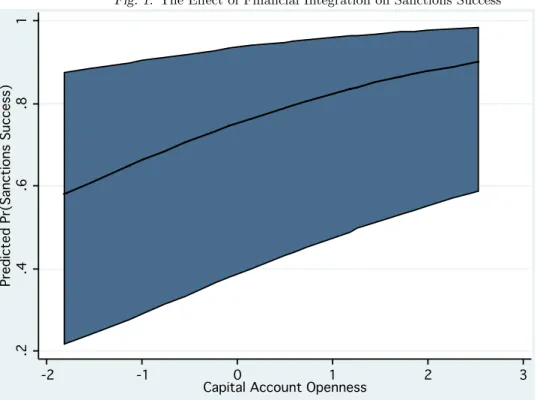
For additional support and visualization of the effect, I utilize out-of-sample predictions, holding continuous independent variables at their means and categorical variables at their modes, in order to visually examine the discrete change in the probability of sanctions success. The following two graphs illustrate the effect of financial integration and short-term debt on the probability of sanctions episode success using these out-of-sample predictions.
Fig. 1: The Effect of Financial Integration on Sanctions Success .2 .2 .2 .4 .4 .4 .6 .6 .6 .8 .8 .8 1 1 1
Predicted Pr(Sanctions Success)
Predicted Pr(Sanctions Success)
Predicted Pr(Sanctions Success) -2 -2 -2 -1 -1 -1 0 0 0 1 1 1 2 2 2 3 3 3
Capital Account Openness
The graph above shows the relationship between financial integration and sanctions success with the predicted values bound by a 95% confidence interval.
Fig. 2: The Effect of Short-Term Debt on Sanctions Success .3 .3 .3 .4 .4 .4 .5 .5 .5 .6 .6 .6 .7 .7 .7
Predicted Pr(Sanctions Success)
Predicted Pr(Sanctions Success)
Predicted Pr(Sanctions Success) 0 0 0 1 1 1 2 2 2 3 3 3 4 4 4 5 5 5
Log of Short-Term Debt as % of GNI
Log of Short-Term Debt as % of GNI Log of Short-Term Debt as % of GNI
The graph above shows the relationship between short-term debt and sanctions success with the predicted values bound by a 95% confidence interval. It is clear from analyzing the two graphs that as the degree of financial integration and ratio of short-term debt to national in-come increases, the probability of sanctions episode success also increases and that the effect is statistically significant and quite strong.
Conclusion
1971-2000. The results lend strong statistical support for the hypotheses and provide evidence to support the argument that higher levels of financial integration and short-term debt induce a target government to acquiesce to sender demands. The effects of the two primary independent variables are substantively strong, with a one-standard deviation increase in either variable increasing the probability of sanctions success by over 62%.
APPENDIX
This table presents the results for the same models presented in Table 4 using the non-transformed short-term debt variable.
Table 6: Results from Logistic Regression Models - Non-Logged Short-Term Debt
D.V.: Broad, Narrow High Politics w/ Human Rights High Politics w/out Human Rights
Variable Broadβ (s.e.) Narrowβ (s.e.) Broadβ (s.e.) Narrowβ (s.e.)
Capital Openness .41 (.16)∗∗ .59 (.18)∗∗∗ .82 (.27)∗∗∗ .78 (.25)∗∗∗
Short-Term Debt % GNI .02 (.01)∗∗ .01(.01) .06 (.02)∗∗∗ .03 (.02)∗
International Institution .04 (.49) .62 (.53) .47 (.65) -.88 (.62)
Behavioral Specificity 2.22 (.62)∗∗∗ 2.92(.88)∗∗∗ 2.49 (.88)∗∗∗ 2.30 (.97)∗∗
Anticipated Target Costs 2.09 (.48)∗∗∗ 2.06 (.50)∗∗∗ 3.65(.85)∗∗∗ 2.41 (.67)∗∗∗
Anticipated Sender Costs -1.71 (.73)∗∗ -1.97 (.80)∗∗∗ -3.10 (1.04)∗∗∗ -2.49 (.97)∗∗∗
Cold War 1.77 (.61)∗∗∗ 1.07 (.60)∗ 2.98 (1.00)∗∗∗ 1.48 (.74)∗∗
US as Sender State 1.21 (.58)∗∗ -.16 (.60) 2.43 (.97)∗∗ -.07 (.78)
Polity -.02 (.03) -.09 (.04)∗∗ .01 (.05) -.11 (.05)∗∗
Constant -5.28 (1.29)∗∗∗ -5.19 (1.48)∗∗∗ -8.05(2.12)∗∗∗ -5.19 (1.73)∗∗∗
N 139 139 104 104
Log Likelihood -62.92 -54.66 -36.84 -39.01
Pr> χ2 .00 .00 .00 .00
References
Allen, Susan. 2008. “The Domestic Political Costs of Economic Sanctions.”Journal of Conflict Resolution52(6):916–944.
Baldwin, David and Robert Pape. 1998. “Evaluating Economic Sanctions.”International Secu-rity23(2):189–198.
Bapat, Navin and T. Clifton Morgan. 2009. “Multilateral Versus Unilateral Sanctions Reconsid-ered: A Test Using New Data.”International Studies Quarterly53(4):1075–1094.
Bolks, Sean and Dina Al-Sowayel. 2000. “How Long Do Economic Sanctions Last? Examining the Sanctioning Process Through Duration.”Political Research Quarterly53(2):241–265.
Caruso, Raul. 2003. “The Impact of International Economic Sanctions in Trade: An Empirical Analysis.”Peace Economics, Peace Science and Public Policy9(2).
Cox, Dan and A. Cooper Drury. 2006. “Democratic Sanctions: Connecting the Democratic Peace and Economic Sanctions.”Journal of Peace Research43(6):709–722.
Dashti-Gibson, Jaleh, Patricia Davis and Benjamin Radcliff. 1997. “On the Determinants of the Success of Economic Sanctions: An Empirical Analysis.” American Journal of Political Science41(2):608–618.
Drezner, Daniel. 1998. “Conflict Expectations and the Paradox of Economic Coercion.” Inter-national Studies Quarterly42(4):709–731.
Drezner, Daniel. 1999.The Sanctions Paradox: Economic Statecraft and International Relations. Cambridge University Press.
Drezner, Daniel. 2000. “Bargaining, Enforcement and Multilateral Sanctions: When Is Cooper-ation Counterproductive?” International Organization54(1):73–102.
Drezner, Daniel. 2003. “The Hidden Hand of Economic Coercion.” International Organization 57:643–659.
Drury, A. Cooper. 1998. “Revisiting Economic Sanctions Reconsidered.”Journal of Peace Re-search35(4):497–509.
Early, Brian. 2009. “Sleeping With Your Friends’ Enemies: An Explanation of Sanctions-Busting Trade.”International Studies Quarterly 53(1):49–71.
Farmer, Richard. 2000. “Costs of Economic Sanctions to the Sender.” The World Economy 23(1):93–117.
Hafner-Burton, Emilie and Alexander Montgomery. 2008. “Power or Plenty: How Do In-ternational Trade Institutions Affect Economic Sanctions.” Journal of Conflict Resolution 52(2):213–242.
Hart, Robert. 2000. “Democracy and the Successful Use of Economic Sanctions.” Political Research Quarterly53(2):267–284.
Hovi, Jon, Robert Huseby and Detlef Sprinz. 2005. “When Do (Imposed) Economic Sanctions Work?” World Politics 57:479–499.
Hufbauer, Gary Clyde and Barbara Oegg. 2003a. “Beyond the Nation-State: Privatization of Economic Sanctions.”Middle East Policy10(2):126–134.
Hufbauer, Gary Clyde and Barbara Oegg. 2003b. “Economic Sanctions: Public Goals and Private Compensation.”Chicago Journal of International Law4(2):305–328.
Hufbauer, Gary Clyde, Jeffrey J. Schott and Kimberly Ann Elliot. 1990. Economic Sanctions Reconsidered: History and Current Policy. 2nd edition ed. Washington, D.C.: Institute for International Economics.
Kaempfer, William and Anton Lowenberg. 1988. “The Theory of International Economic Sanc-tions: A Public Choice Approach.”The American Economic Review78(4):786–793.
Kaempfer, William and Anton Lowenberg. 1992. International Economic Sanctions: A Public Choice Perspective. Westview Press.
Kaempfer, William and Anton Lowenberg. 1999. “Unilateral versus Multilateral Economic Sanc-tions: A Public Choice Perspective.”International Studies Quarterly43(1):37–58.
Kaempfer, William, James Lehman and Anton Lowenberg. 1987. “Divestment, Investment Sanc-tions and Disinvestment: An Evaluation of Anti-Apartheid Policy Instruments.”International Organization41(3):457–473.
Kirshner, Jonathan. 1997. “The Microfoundations of Economic Sanctions.” Security Studies 6(3):32–64.
Lacy, Dean and Emerson Niou. 2004. “A Theory of Economic Sanctions and Issue Linkage: The Roles of Preferences, Information and Threats.”Journal of Politics66(1):25–42.
Lektzian, David and Mark Souva. 2001. “Institutions and International Cooperation: An Event History Analysis of the Effects of Economic Sanctions.” Journal of Conflict Resolu-tion45(1):61–79.
Lektzian, David and Mark Souva. 2003. “The Economic Peace Between Democracies: Economic Sanctions and Domestic Institutions.”Journal of Peace Research40(6):641–660.
Lektzian, David and Mark Souva. 2007. “An Institutional Theory of Sanctions Onset and Suc-cess.”Journal of Conflict Resolution51(6):848–871.
Mansfield, Edward. 1995. “Review: International Institutions and Economic Sanctions.”World Politics47(4):575–605.
Marinov, Nikolay. 2005. “Do Economic Sanctions Destabilize Country Leaders?” American Journal of Political Science49(3):564–576.
Martin, Lisa. 1992. Coercive Cooperation: Explaining Multilateral Economic Sanctions. Prince-ton University Press.
Martin, Lisa. 1993. “Credibility, Costs and Institutions: Cooperation on Economic Sanctions.” World Politics45(3):406–432.
McGillivray, Fiona and Allan Stam. 2004. “Political Institutions, Coercive Diplomacy and the Duration of Economic Sanctions.”Journal of Conflict Resolution48(2):154–172.
Morgan, T. Clifton and Anne Miers. 1999. “When Threats Succeed: A Formal Model of the Threat and Use of Economic Sanctions.”Working Paper.
Morgan, T. Clifton and Navin Bapat. 2003. “Imposing Sanctions: States, Firms and Economic Coercion.”International Studies Review5(4):65–79.
Morgan, T. Clifton, Navin Bapat and Valentin Krustev. 2009. “The Threat and Imposition of Economic Sanctions: 1971-2000.”Conflict Management and Peace Science26(1):92–110.
Morgan, T. Clifton and Valerie Schwebach. 1997. “Fools Suffer Gladly: The Use of Economic Sanctions in International Crises.”International Studies Quarterly 41(1):27–50.
Mosley, Layna. 2003. Global Capital and National Governments. Cambridge University Press.
Pape, Robert. 1997. “Why Economic Sanctions Do Not Work.”International Security22(2):90– 136.
Porter, Richard. 1979. “International Trade and Investment Sanctions: Potential Impact on the South African Economy.”Journal of Conflict Resolution23(4):579–612.
Quinn, Dennis and A. Maria Toyoda. 2008. “Does Capital Account Liberalization Lead to Growth?” Review of Financial Studies21(3):1403–1449.
Rodrik, Dani. 1991. “Policy Uncertainty and Private Investment in Developing Countries.” Journal of Development Economics36:229–242.
Smith, Alastair. 1996. “The Success and Use of Economic Sanctions.”International Interactions 21(3):229–245.
Stone, Randall. 2004. “The Political Economy of IMF Lending in Africa.” American Political Science Review98:577–591.
Stone, Randall. 2008. “The Scope of IMF Conditionality.”International Organization62(4):589– 620.
Thacker, Strom. 1999. “The High Politics of IMF Lending.”World Politics52(1):38–75.
Tomz, Michael. 2007. Reputation and International Cooperation: Sovereign Debt Across Three Centuries. Princeton University Press.
Tsebelis, George. 1990. “Are Sanctions Effective? A Game-Theoretic Analysis.” Journal of Conflict Resolution34(1):3–28.
Wagner, R. Harrison. 1988. “Economic Interdependence, Bargaining Power, and Political Influ-ence.”International Organization42(3):461–483.