EXAMINING LEVERAGE IN CIVIL WAR MEDIATION: A DYNAMIC THEORY OF MEDIATOR LEVERAGE
Lindsay Reid
A thesis submitted to the faculty of the University of North Carolina at Chapel Hill in partial fulfillment of the requirements for the degree of Master of Arts in the Department of Political Science.
Chapel Hill 2013
ABSTRACT
LINDSAY REID: Examining Leverage in Civil War Mediation: A Dynamic Theory of Mediator Leverage
(Under the direction of Mark Crescenzi.)
TABLE OF CONTENTS
LIST OF TABLES . . . iv
LIST OF FIGURES . . . v
Introduction . . . 1
Leverage in Conflict Mediation . . . 2
Diverse Mediation Strategies . . . 3
Who Does What: Examining the Choice of Mediation Strategy . . . 5
Brushing Over Leverage . . . 6
A Dynamic Theory of Mediation Leverage . . . 7
Capability Leverage . . . 9
Credibility Leverage . . . 11
Applying Capability and Credibility Leverage to Civil War Mediation . 15 Data and Research Design . . . 20
Dependent Variables . . . 21
Explanatory Variables: Operationalizing Leverage . . . 23
Control Variables . . . 26
Results . . . 27
Conclusions . . . 34
APPENDIX . . . 36
LIST OF TABLES
Table
LIST OF FIGURES
Figure
Introduction
Civil wars are more deadly and more durable than interstate conflicts. Given their intensity, policymakers and scholars alike have been struggling to find ways to mitigate the deadly effects of civil war. A common strategy in the quest to resolve conflict is the use of third-party mediation. Mediation’s effects on civil conflict, however, have been mixed. Countless war torn countries, such as Sudan and Rwanda, have experi-enced numerous mediation attempts, only to see war resume soon after. To account for variations in mediation success, scholars such as Beardsley (2011) have considered the effects that different mediation strategies have on mediation outcomes. How do different mediators, and their respective mediation styles, influence the mediation pro-cess? More specifically, though, I seek to explore how leverage varies across different mediator types and what role this has on mediation outcomes.
Why is the study of mediation leverage important within the broader study of civil war resolution? First and foremost, scholars have glossed over the meaning of leverage within the mediation context, equating the concept with material power. By treating leverage as a fairly static concept, however, existing studies have not fully conceptu-alized the dynamic roles that different mediators might play in civil war mediation. Second, unpacking the meaning of leverage is important insofar as it will help the in-ternational community gain a better understanding of which strategies are and are not successful for reaching peaceful settlements. Not all mediators are created equally; each has a unique tool to bring to the mediation process. This study, then, builds a dynamic conception of leverage in order to capture more nuanced determinants of mediation success.
to which mediators can use economic and military strength to coerce a negotiated set-tlement. In other words, capability leverage involves the use of carrots and sticks to alter the bargaining range and overcome commitment problems. Credibility leverage, on the other hand, refers to a mediator’s historical, material, and cultural ties to the par-ties within a conflict. If a mediator has credibility leverage within a specific mediation attempt, they will tend to have a strong rapport with the actors involved. The medi-ator therefore will be able to use commitment and information mechanisms to shape the mediation process. I hypothesize that capability leverage increases the likelihood of achieving short-term success in the form of a negotiated settlement while credibility leverage leads to a more durable peace following a civil war.
In the following section, I discuss the role leverage has played in existing conflict mediation literature. Importantly, I highlight how leverage has been predominantly treated as a static concept. I then move to a presentation of my theory about the dynamic nature of leverage, and I consider the role that the components of leverage play on mediation outcomes. Then, I test my hypotheses using all civil war mediation attempts from 1989 through 2006 as reported in the Civil War Mediation dataset (DeRouen, Bercovitch and Pospieszna 2011). I find general support for my expectations; capability leverage increases the likelihood of achieving a settlement, while credibility leverage increases the duration of peace following a civil war. Finally, I conclude with a number of policy implications and ideas for future research.
Leverage in Conflict Mediation
success, then it is crucial to understand what leverage is and how mediators use it to alter the mediation process.
Below, I provide an overview of existing mediation research. Particularly, I focus on discussions of mediation strategies and mediator types. Mediation strategies and the actors involved in mediation are very diverse; a one-size-fits-all strategy for mediation success does not exist. Moreover, there has been a lack of adequate attention to mediator leverage within these works. Leverage is not a static measure of a mediator’s material or military might but rather, it is a dynamic concept that is comprised of a diverse array of mediator strategies. Giving attention to a discussion of mediation strategies and the ambiguous usage of leverage, then, serves as a foundation to the theoretical development of dynamic mediator leverage that follows.
Diverse Mediation Strategies
While mediation efforts include a broad spectrum of activities, mediation strategies can be divided into two broad categories. The first of these categories includes a range of low- or minimal-intervention strategies. The second category of mediation strategies involves a greater degree of intervention and force. Variation in mediation strategies is expected to have observable implications on the style and outcome of the mediation itself.
Beardsley (2009; 2011) categorizes mediators at the low-intervention end of the spectrum as “weak mediators.” Weak mediators are confined to light mediation, or me-diation without leverage. While this does not make the meme-diation ineffective per se, it greatly limits the range of the mediator’s actions (2011). Beardsley (2009) writes that weak mediators have “limited faculties” (274). This makes them an attractive op-tion for belligerent parties who want to stall the peace process; weak mediators, in this framework, have no means of pressuring combatants to come to an agreement.
In contrast to passive or low-intervention forms of mediation, mediation strategies at the other end of the spectrum utilize much more force. According to Bercovitch and Houston (2000), the highest form of intervention is that of directive strategies; these affect the content and substance of bargaining, often involve ultimatums, and directly alter the way issues are framed. Beardsley (2009; 2011) refers to directive or manipulative strategies as heavy mediation and states that only “strong” mediators are able to pursue such strategies. Strong mediators have leverage and are able to use carrots and sticks to directly alter the costs of conflict and benefits of cooperation.
In a similar vein, Svensson (2007b) dichotomizes mediation strategies as well. Power mediators have resources and/or interests that invest them more fully in the conflict. More specifically, a power mediator “uses its economic, military, and political resources to pull or push the parties in their preferred direction, takes measures in order to secure its own interests in the country of the conflict, and exercises its leverage over the parties in order to make them comply” (Svensson 2007b, 230). Again, within this framework mediators who are powerful or strong wield leverage and thus, they are able to coerce an agreement between the warring parties.
helps to overcome information asymmetries. The heavy mediation strategy, however, is based on the assumption that leverage and resources are virtually synonymous. Of course, Beardsley is not alone in equating leverage with resources. Nevertheless, a more nuanced conception of mediator leverage is needed to better understand what the term means, how mediators use it, and what benefits it carries. In the theoretical framework discussed later, I explicate why traditional uses of leverage are suboptimal and how they limit the understanding of conflict mediation.
Who Does What: Examining the Choice of Mediation Strategy
Mediators are a diverse crowd, ranging from great powers to international and non-governmental organizations to individuals. Each type of mediator brings a unique set of skills to the mediation process. How does mediator type influence mediation strategies? Svensson (2007b), for example, states that power mediators, or those with resources and leverage, are comprised of great powers, regional powers, colonial powers, and neigh-boring states. Pure mediators, or those without leverage or interests in the conflict, are assumed to be international, regional, and non-governmental organizations, individuals, and distant states. Svensson’s categorization of mediators and their respective strategies, however, is based on assumption rather than systematic empirical tests. Such assump-tions are endemic in extant literature. Bercovitch and Gartner (2006) write that larger states and the United Nations have leverage in mediation thus they are more effective at managing intense conflicts. Beardsley (2011) indicates, “individuals, NGOs, and small states are obvious examples of third parties that are typically unable to achieve enough leverage to make much of a difference in shaping incentives relative to the stakes of the conflict” (101).
weak or without leverage? Second, the existing categorizations are based on a thin con-ception of leverage. They are thus missing the dynamic dimensions of leverage and the ways in which different mediators may exert different types of leverage over the medi-ation process. By treating leverage as static, existing theories infer that large states, for example, have leverage over all conflicts and that organizations do not have leverage in any conflict. A dynamic theory of leverage, though, will create a more context-dependent theory about mediators and their effectiveness. I delve into this second idea in more detail in the theory section.
Brushing Over Leverage
The widespread assumption across the mediation and bargaining literature is that leverage is a function of resources and force or an actor’s ability to use carrots and sticks to coerce others. For example, Bercovitch, Anagnoson and Wille (1991) treat leverage as synonymous to resources and mediator power. Svensson (2007b) uses leverage to de-scribe the ability of power mediators, immediately equating leverage to the economic, military, and political resources that these mediators have. Kleiboer (1996) notes the ambiguity attached to the use of leverage in studies of mediation. She writes that lever-age makes for “fuzzy conceptualizations” and remains “one of the most elusive elements of mediation” (371). Kleiboer highlights that few researchers bother to define what they mean by leverage. The assumption is that leverage refers “to a mediator’s ability to put pressure on one or both of the conflicting parties” (371). Treating leverage as a uni-versally understood yet empirically undefined concept, however, risks ignoring crucial aspects of conflict mediation. If leverage is an instrumental variable in conflict media-tion yet its usage remains unclear, how can scholars really know how it influences the mediation process?
the belligerent parties need for a solution. In other words, “The greater the parties’ perceived need, the greater the mediator’s leverage” (41). Second, leverage depends on the warring parties’ susceptibility to the shifting weight that the mediator can apply. Lastly, leverage arises from the belligerents’ interest in side payments that the mediator can offer or withhold (carrots and sticks). While Zartman and Touval explore leverage more thoroughly than other mediation research, their analysis leaves many questions unanswered. How and why do certain mediators have leverage while others do not? Moreover, Zartman and Touval examine leverage from the demand side, or from the side of the belligerent parties. What attributes of the mediators themselves contribute to leverage?
Beardsley (2008) is the most recent to bring leverage back in to mediation research. He hints at a more complex vision of leverage in discussing tangible versus intangible leverage. Tangible leverage encompasses the assumed dimensions of leverage including resources and carrots and sticks. Intangible leverage, on the other hand, refers to a mediator’s ability to make promises or use prestige to mediate. Nevertheless, Beardsley (2009) slips back to the equation of leverage with resources. With that being said, little has been done to delve theoretically or empirically into the multiple dimensions of leverage. Brushing over leverage remains a problem because, as aforementioned, it ignores the contextual variations of leverage and prevents scholars from gaining a more nuanced understanding of what does and does not work in conflict mediation.
A Dynamic Theory of Mediation Leverage
they may reach an agreement. A mediator’s influence, though, cannot be assumed to correlate with resources only. Instead, a mediator’s influence is a function of a num-ber of properties of the mediator itself, both material and immaterial. Resources matter but they do not hold a monopoly on mediator leverage. Less tangible characteristics including but not limited to past interactions and personal ties give strength to a me-diator vis-`a-vis the mediation process as well. Thus, I contend that leverage can be conceptualized as an interaction between two different yet complimentary dimensions: capability and credibility. While each dimension contributes a unique set of skills that a mediator can use to help resolve a conflict, both play an important role in the hopes of achieving a lasting agreement.
Capability leverage corresponds closely with the traditional assumptions of lever-age. Thus, this first dimension includes measures of influence such as wealth, military strength, and other material forms of coercive power. Capability leverage, to use the words of Beardsley (2008), is the tangible dimension of leverage. Capability is essen-tial for a more nuanced notion of leverage for it captures what most scholars have been talking about with regards to leverage. Capability leverage contributes to a mediator’s overall influence by giving that mediator the power to push negotiations, alter incentives of negotiating parties, and add security guarantees to mediation efforts.
form. Studies, then, must account for both dimensions of leverage in order to fully comprehend the behavior of mediators and the effects their behavior has on mediation outcomes.
By giving distinct attention to both capability and credibility leverage, I am recog-nizing that there is no simple formula for leverage in mediation. Leverage is a dynamic concept and should be treated as such if it is to be used as a variable in studies of conflict mediation. I define each component of leverage below and further discuss why a more dynamic conceptualization of leverage is important for mediation research. Importantly, I consider which mediators are more likely to exert each dimension of leverage. I then move to a more substantively interesting discussion: how do capability and credibility leverage influence mediation outcomes?
Capability Leverage
Capability leverage is comprised of tangible dimensions that contribute to a media-tor’s power and strength. Similar to hard power (Nye 1990), capability leverage involves getting others to do what one wants through acts of coercion. In the context of media-tion, then, this would be the use of a “big stick” to get an agreement signed. Mediators with capability leverage coerce negotiating parties to sign an agreement; as is discussed more fully in later sections, this coercion is often a quick yet insufficient solution to a conflict. Nye (2004) argues that hard power grows out of a country’s military and eco-nomic might. Capability leverage, as conceptualized in this study, is also a function of economic and military power. I discuss each of these components of capability leverage in turn below.1
1In future extensions of this paper, I hope to include a political measure of capability leverage as well. At
Economic power, or wealth, contributes to a mediator’s capability leverage. Wealth bestows upon mediators a broader or fancier “toolbox” for mediation. With economic power, mediators are simply more capable of mediating conflicts in terms of funding the process and maintaining a presence in the country for the duration of the mediation. More importantly, though, mediators with economic might are able to use carrots and sticks to expedite the mediation process. In other words, economic strength gives par-ticular mediators the ability to shape the mediation process through their use of material incentives and/or sanctions.
The second dimension of capability leverage is comprised of a military dimension. Military strength is included under the broader category of capability leverage because it gives mediators the ability to enforce any agreement that is reached. In other words, military capability attaches a threat to mediation that alters incentives of belligerents to negotiate. A potential military presence will make an agreement more likely because it creates an environment where cheating will be less feasible and less likely. Mediators with military capability are able to use enforcement mechanisms to increase incentives for compliance and cooperation. Enforcement, as Beardsley writes, provides “another means of overcoming bargaining failures” (2011, 34). Attaching an enforcement mech-anism to mediation not only deters belligerents from cheating in the negotiation process, but it also gives them confidence that the post-agreement reality will more or less reflect the terms of the agreement.
Capability leverage in mediation, with its economic and military dimensions, alters the costs of non-agreement and expands the number of mutually acceptable alternatives to fighting (Beardsley 2011, 31). The economic and military capabilities of the media-tor, of course, are relative to those of the government participating in the civil conflict. Thus, capability leverage is not measured in absolute terms but is measured as a ratio of a mediator’s leverage to that of the government. As such, a mediator’s capability is not constant across time and space, but instead varies according to specific characteristics of the mediator itself. The contextual nature of capability leverage sets it apart from
traditional uses of leverage which treat the concept as static or constant.
Capability leverage, though, is merely one portion of the dynamic concept of lever-age. By itself, capability leverage facilitates conflict mediation and increases the likeli-hood of conflict resolution, but it does not capture the full potential of mediation. The next section considers how less tangible and less material forms of influence contribute to credibility leverage.
Credibility Leverage
even more weight to the dynamic conceptualization of leverage. Where previous stud-ies glossed over the leverage of diverse mediator types, credibility leverage will capture both the intangible and the context-specific components of leverage.
Before discussing the dimensions of credibility leverage, I first want to acknowl-edge the role of bias in conflict mediation. The dimensions of credibility leverage over-lap with proxies for bias, therefore one must consider how bias influences mediation. While there is an ongoing debate in existing literature, I argue that bias contributes to credibility leverage in that it gives mediators more influence over mediation outcomes. Kydd (2003) evaluates the role of bias in mediation, finding that biased mediators are more effective at conflict mediation than unbiased mediators. In his research, bias tributes to the credibility of a mediator insofar as a biased mediator is expected to con-tribute trustworthy information.2 Svensson (2007a) also highlights the role of bias in conflict mediation, disaggregating biased mediation attempts that are on behalf of the government versus those that are rebel-biased. He finds that government-biased medi-ators have a positive effect on conflict mediation, predominantly because they mitigate commitment problems. Rebel-biased mediators, on the other hand, do not have a statis-tically significant impact on mediation. Savun (2008) also finds that biased mediators are more likely to be successful than unbiased mediators. Importantly, Savun posits that biased mediators are more likely to be able to persuade disputants to settle their disagreements without the use of force by the mediators (44).
In the following paragraphs, I describe the dimensions of credibility leverage and the ways in which they contribute to the overall leverage of a mediator. As previously mentioned, a number of the components that contribute to credibility leverage refer to bias, namely historical ties (which include past material bias) and cultural bias. In the same vein as Kydd (2003), Svensson (2007a), and Savun (2008), however, I argue that these dimensions will have a positive impact on civil war mediation efforts by mitigating
2In a later study, Kydd (2006) refines his evaluation of bias, stating that moderate levels of bias only
commitment problems and communicating information to combatants. Moreover, the dimensions of credibility leverage capture a component of leverage that is not based in material strength but instead in the quality of the relationships between mediators and disputants.
Past historical ties to the belligerent parties come in several forms. Colonial legacies, previous intervention into the conflict, and/or the provision of prior material support to any of the parties create ties between the mediator and the conflict. These ties build a rapport through which mediators can influence belligerents and shape the mediation en-vironment. Specifically, having a history of interacting with a country, whether through colonial efforts or previous mediation attempts, serves as a signal that the mediator has an interest in the country. Similarly, past historical ties indicate that a mediator made some form of credible commitment to the country or group in question in the past. Given this past credible behavior, disputants can have a higher degree of confidence that the mediator will be more likely to be credible again in the future. Past historical commitments also increase the likelihood of providing information to the negotiating parties. Disputants can trust that mediators with past historical ties to their country, for better or worse, will be more likely to exert continued influence over mediation efforts than mediators with no historical ties.
Historical ties also involve the provision of material support to any of the belliger-ent groups prior to the conflict. This dimension is not the same as the material strength captured by capability leverage, because it does not involve the mediator using material might or carrots and sticks to influence the mediation efforts. Instead, past material support is an indicator of a form of bias. Again, bias increases the likelihood of suc-cessful mediation because it demonstrates a mediator who not only cares about ending hostilities but also about fully resolving the dispute in a way that matches the interests of one or more of the involved parties (Savun 2008).
in-formation and their perceived interest in the conflict. They will be able to alter the costs of settlement not through material means but through their cultural bias toward any of the belligerent groups. In other words, cultural bias is expected to make mediation more successful because belligerents will be able to trust that the mediator is both providing accurate information and genuinely committed to reaching a peaceful settlement. As such, mediators with cultural bias can be expected to exert credible influence over the mediation process.
The final dimension of credibility leverage focuses on the ability of a mediator to monitor and/or enforce an agreement. While some may say that monitoring and en-forcement capabilities straddle the line between capability and credibility leverage, I ar-gue that post-agreement assurances for involvement represent credibility leverage most fully. A mediator that holds the potential for continued monitoring following the signing of an agreement is a mediator that demonstrates commitment to the settlement and sig-nals its interests in a more durable peace. According to Hartzell, Hoddie and Rothchild, “The most effective means third parties can use to address the security fears of adver-saries in the short run, though, is likely to be to promise to intervene to provide for the safety of the parties” (2001, 193). Walter (1997) also emphasizes the indispensable role of monitoring for civil war settlement. Mediators that have the potential for monitoring, then, will exert credibility leverage and increase the likelihood of a peaceful resolution to a civil war.
Applying Capability and Credibility Leverage to Civil War Mediation
Capability leverage encompasses economic and military influence while credibil-ity leverage is a function of historical and cultural ties between the mediators and the disputants and the mediator’s ability to monitor an agreement. With a clear conceptu-alization of leverage now established, I shift focus to the more interesting substantive puzzles. Which mediators are more likely to have the different dimensions of lever-age, and more importantly, how does a dynamic conception of leverage influence the likelihood of mediation success?
Who has leverage?
Given the definitions of capability and credibility leverage, which mediators can be expected to exert leverage in conflict mediation efforts? The answer to this ques-tion is a bit more complex than earlier studies that equated material-based versions of leverage with great powers and other influential states and regarded all other mediators as having little to no leverage. I will take the components of leverage piece by piece to determine who has leverage in conflict mediation and what type of leverage they have. In particular, I fit great powers, regional powers, other states, international orga-nizations, non-governmental orgaorga-nizations, and individuals into the dynamic leverage framework.3
Capability leverage, as a function of economic and military influence, is exerted most fully by great power states.4 These states have the economic standing needed to both fund mediation and extend carrots and sticks to put pressure on the mediation pro-cess. Lastly, they have the military might necessary to deter cheating and to guarantee enforcement. On this last dimension, the mere existence of a strong military serves to bolster capability leverage; whether or not the mediator will actually use its military is
3My future research plans include verifying these assumptions using the available data on civil war
me-diation and my construction of leverage variables. At this point, the dimensions of leverage are too disaggregated to reach conclusions.
4In our data, we define major powers according to the Correlates of War State System Membership List
less important.
Other mediators that have access to capability leverage are, to a lesser extent, re-gional powers, neighboring states, and the United Nations. Rere-gional powers, for ex-ample, may still have the economic clout necessary to influence the mediation process. Neighboring states may be able to take advantage of their geographic proximity to the conflict to overcome a lesser level of capability leverage. Neighboring states may not inherently be wealthy or powerful in a material sense, but their accessibility to the con-flict will give them the ability to exert capability leverage over nearby concon-flicts. More-over, neighbors will tend to feel a sense of urgency to mediate the conflict and prevent spillover effects; thus, neighbors will exert coercive measures and carrots and sticks to facilitate a negotiated settlement. In certain cases, the United Nations has both the eco-nomic resources and military influence to exert capability leverage as well. By stating that the UN has military strength, I am merely implying that the UN has peacekeep-ing forces that permit the organization to exert additional leverage over the mediation process.5
Smaller states, intergovernmental organizations, non-governmental organizations and individuals are most likely to exert credibility leverage while mediating conflicts. These same actors, however, will not necessarily have access to capability leverage; their power is not tangible, yet it is still likely to contribute to mediation success. Cred-ibility leverage is more dependent than capability leverage. Again, by context-dependent I mean that the historical ties and cultural ties of any given mediator to the conflict will depend precisely on the identities of the mediator and of the belligerents. A mediator may have credibility leverage in one conflict, but not another one. In spite of the more context-based nature of this dimension of leverage, credibility leverage still holds important influence over mediation outcomes.
There additionally exists an intersection between capability and credibility leverage. Great powers and other mediators who have capability leverage may also have
credi-5Because peacekeeping forces vary in the size and strength, their contribution to capability leverage
bility leverage. For example, France would exert capability leverage as a great power and also exert credibility leverage when mediating disputes in former colonies. On the other hand, it is also possible for mediators to have neither capability nor credibility leverage. A small organization, for example, does not have capability leverage nor does it have credibility leverage in its first mediation attempt in a country with which it has no past interactions. Over time, however, repeated interactions may allow the small or-ganization to develop credibility leverage. The dynamic conceptualization of leverage put forth in this paper, then, captures not only the diverse ways in which mediators can influence the mediation process, but it also accounts for the development of leverage over time.
Leverage and Mediation Success
With the dynamic concept of leverage now defined, I explore the second, and more important theoretical question: how does leverage influence the likelihood of mediation success? In other words, in what ways do capability and credibility leverage affect mediation outcomes? For purposes of this paper, success is defined in two ways. First, short-term success is defined as the mediator’s ability to achieve an agreement. Second, success is defined in terms of the duration of peace following a civil war. Thus, success is more than just reaching an agreement but also finding a settlement that lasts. Below, I consider the ways in which mediators’ capability and credibility leverage alter both the likelihood of reaching an agreement and achieving a durable settlement.
The first causal mechanism that links capability leverage in mediation to negotiated settlements relates to bargaining in mediation. Capability leverage alters the bargaining range for negotiating parties, specifically by expanding the acceptable range of agree-ments. With capability leverage, mediators are able to use carrots and sticks to “increase the opportunity costs of conflict...the most intrusive mediators can expand the number of peaceful alternative outcomes that are mutually preferable to conflict” (Beardsley 2011, 32). As the bargaining range expands through the use of capability leverage, an agree-ment becomes more likely. The use of carrots and sticks, however, does not guarantee an increased likelihood of reaching an agreement that lasts.6
Second, capability leverage increases the likelihood of achieving an agreement fol-lowing a civil war by helping belligerents overcome commitment problems that tra-ditionally undermine negotiations and/or lead to the resumption of war. If mediators have capability leverage, they have the economic and military capabilities necessary to prevent cheating during negotiations and assure enforcement of agreement implementa-tion.7 As Beardsley (2011) writes, implementation assistance increases the costs of both cheating and reneging on an agreement. Moreover, capability leverage may assuage the vulnerability certain belligerents may feel in signing an agreement. Thus, capability leverage both increases the bargaining range and mitigates commitment problems. This reasoning leads to my first hypothesis:
Hypothesis 1: All else equal, capability leverage will render mediators
more likely to achieve short-term success in the form of a negotiated
settle-ment.
Credibility leverage is expected to affect the mediation process in different ways than capability leverage. Credibility leverage, being based upon historical and cultural ties and the possibility of monitoring, is lacking in the carrots and sticks or coercive
6Svensson (2007b) suggests this idea, stating that mediators who rely on coercion and carrots and sticks
“do not have the resources to address the root-causes of conflicts...” (233). Credibility leverage, on the other hand, fosters information and commitment in ways that facilitate more lasting agreements.
7Whether or not mediators with capability leverage actually enforce an agreement may not be important;
power that one sees with capability leverage. Nonetheless, credibility leverage is ex-pected to lead to more successful mediation outcomes. In other words, credibility lever-age is expected to lead to outcomes of more durable peace. Credibility leverlever-age influ-ences mediation outcomes by signaling a mediator’s commitment to long-term success and by facilitating an exchange of credible information.
Because credibility leverage captures a mediator’s specific historic and/or cultural ties to a conflict, disputants have reason to believe that the mediator’s motives are gen-uine. The mediator with credibility leverage is not merely trying to strike a bargain at any cost; rather, credibility leverage indicates vested interests in a conflict that allow the mediator to foster an environment of cooperation and demonstrate a commitment to a durable peace. In other words, credibility leverage signals that a mediator has interests in the country and is committed to maintaining a relationship with the country. The peacekeeping potential of certain mediators further bolsters this mechanism by offering assurances of longer-term support.
a positive effect on mediation success. Hypotheses 2a and 2b summarize the expected relationship:
Hypothesis 2a:A mediator with credibility leverage is expected to have no
effect on the initial signing of an agreement.
Hypothesis 2b: Credibility leverage, however, will render mediators more
likely to achieve a more durable peace following a settlement.
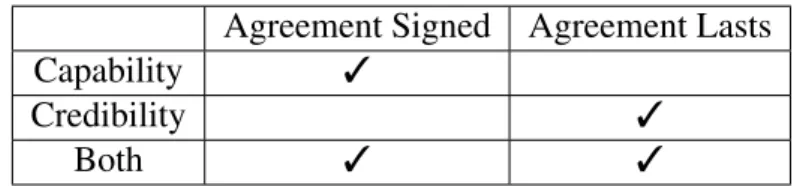
Thus far, I have treated capability and credibility leverage in isolation. A number of mediators, however, have both forms of leverage; the categories of leverage are not mutually exclusive. Given the previous theories and hypotheses, I argue that possessing both capability and credibility leverage will make a mediator more effective at conflict mediation than other mediators. In other words, a mediator with the entire leverage package will be more likely to both achieve a settlement and have that settlement last. Table 1 summarizes the hypothesized relationships between capability and credibility leverage and mediation outcomes.
TABLE1: The Effect of Leverage on Mediation
Agreement Signed Agreement Lasts
Capability 3
Credibility 3
Both 3 3
Data and Research Design
Bercovitch and Pospieszna 2011). The CWM data serves as a starting point for a larger data project on mediation leverage. For each mediator within the dataset, I add specific characteristics to capture leverage.8 The data is then aggregated at the mediation attempt level to assess the overall levels of leverage in each mediation attempt. My unit of analysis, then, is mediation attempt with a conflict dyad. A number of conflicts have multiple mediation attempts within a single year. For example, Rwanda experienced three distinct mediation attempts in 1991 and five attempts in 1992, as determined by the mediation start and end dates provided by the CWM dataset. 9
Dependent Variables
The dependent variable of interest in this study is mediation success. Success, how-ever, is a term with many meanings within the civil war resolution literature. For pur-poses of this study I operationalize mediation success in two specific ways. First, I consider whether or not an agreement was signed following mediation efforts and if so, which type of agreement was signed. Second, success is operationalized as the quality or duration of an agreement.
The first dimension of success refers to both the signing of an agreement and the level of the agreement. The mediation outcome is operationalized as an ordered variable with the following categories: (1) the mediation attempt failed and did not result in any agreement; (2) the parties signed either a ceasefire or a peace process agreement; (3) the parties reached a partial agreement; and (4) the mediation resulted in a full and comprehensive peace agreement. Data for this variable comes from the UCDP Peace Agreement Dataset version 2.0 (H¨ogbladh 2011). Using an ordered variable allows for a more nuanced understanding of the effects of certain types of mediation leverage. In
8The data for this paper is part of a broader project on leverage and bias in civil war mediation that I have
been working on with Elizabeth Menninga. I want to express my gratitude to her and my enthusiasm about being a part of this bigger project on leverage, bias, and mediation.
9The number of mediators per mediation attempt ranges from one to nine. The aggregation of mediator
this vein, the disaggregation of agreement types recognizes that not all agreements are equal; partial or process agreements should not be treated in the same outcome category as comprehensive peace agreements.
To assess the effects of mediator leverage on this first dimension of success, the occurrence and type of an agreement, I utilize an ordered logit model. An ordered logit model assesses the effects of explanatory variables across the ordered categories of the dependent variable, in this case the mediation outcome. Mediation outcome is an ordered dependent variable in the sense that the four outcome categories have a distinct hierarchy where a failed mediation attempt is the worst and comprehensive peace agreement is the best. Ordered logit models are restricted by the assumption that all predictors have a uniform effect on the outcome categories; I test for this assumption and consider its implications in the results section.
Second, mediation success is operationalized using a duration variable. Duration measures how long, in months, a negotiated settlement lasts. While signing an agree-ment is an important step, mediation truly becomes meaningful when it achieves a peace that lasts and facilitates an end to the conflict trap. The duration variable is also derived from UCDP’s Peace Agreement Dataset (H¨ogbladh 2011).
Explanatory Variables: Operationalizing Leverage
Staying true to the theoretical model outlined above, leverage is operationalized as a dynamic concept that is comprised of both capability dimensions and credibility dimensions. As such, different mediators bring different forms of leverage to the medi-ation table. Capability leverage, defined in terms of a mediator’s economic and military strength, allows a mediator to utilize carrots and sticks or coercion to achieve a set-tlement between warring factions. I operationalize capability leverage following two dimensions: economic and military capability.
First, capability leverage is measured in terms of economic power. As is mentioned earlier, wealth bestows upon mediators a broader “toolbox” for mediation, and it gives them the ability to utilize carrots and sticks to expedite and shape the mediation process. I operationalize the economic dimension of capability leverage using a country’s gross domestic product as derived from the Penn World Table (Heston, Summers and Aten 2002).10 In using GDP to measure capability leverage, I exclude non-country mediators from having this dimension of leverage. This decision, though, is warranted in the sense that non-state mediators will not have the economic capacity to shape the mediation process using material incentives and/or punishments. The exception to this exclusion is the United Nations. Given the size and scope of the UN, I have included their annual budget in constant 2005 US dollars to capture their economic capability in comparison to that of states (Hufner 2013).
The second dimension of capability leverage focuses on the military strength of a country. As the theoretical framework of this paper suggests, military might offers the potential for enforcement of any agreement that is reached. Moreover, military capa-bility strengthens a mediator’s coercive power.11This aspect of capability leverage is
10The GDP of mediators and states is measured in the mediation start year as purchasing power parity
converted GDP per capita in constant 2005 US dollars. GDP per capita is then multiplied by population to gain overall GDP measures for each country.
11It is important to note that leverage here is not tied to the use of military strength. Instead, if the
measured utilizing the Composite Index of National Capabilities (CINC) score from the Correlates of War National Material Capabilities dataset, version 3.02 (Singer, Bre-mer and Stuckey 1972). CINC is an index that captures a country’s total population, urban population, iron and steel production, energy consumption, military personnel, and military expenditure. Again, only country mediators have a CINC score, thus non-state mediators do not have access to this dimension of capability leverage. Certain non-state mediators do, however, have the capacity deploy peacekeepers or other mon-itoring forces; this is captured in measures of credibility leverage.
To deal with the contextual nature of capability leverage, I use relative scores of GDP and CINC. In other words, the covariates for GDP and CINC are relative measures of a mediator’s wealth and military capabilities in comparison to those of the govern-ment taking part in the negotiations. Using a relative measure for both dimensions of capability leverage recognizes that a mediator with a high GDP, for example, will not have as much leverage if it is mediating a conflict in a country that has a similarly high GDP.12
In contrast to capability leverage, credibility leverage represents the less tangible ways in which mediators alter incentives and generate peace agreements. Rather than relying on coercion, credibility leverage shapes the course of mediation efforts by sig-naling a mediator’s will or interest in achieving peace. Thus, credibility leverage fo-cuses more on communication and commitment than it does on carrots and sticks. As is aforementioned, a mediator wields this form of leverage if she has historical and/or cultural ties to the conflict at hand.
Historical ties to a conflict entail a number of dimensions. First, mediators have historical ties to a conflict if they have a colonial legacy in the country at war or if they
12The relative CINC score is measured by dividing the maximum CINC score of all mediators in the
have past interventions in the country at war. Historical ties is a dichotomous variable that is coded 1 if a mediator meets one or more of the following criteria: (1) previous mediation in the conflict; (2) colonial power in the country of the mediation attempt; (3) Russia mediating a conflict in a former Soviet state. Data for previous mediation attempts is provided by the CWM dataset, while data on colonial powers and Soviet states is derived from the CIA World Factbook (CIA 2013). To deal with the presence of multiple mediators in any given mediation attempt, the variable measures the combined or aggregate history of the mediators. Combined history is coded as 1 if any of the mediators present have a history with the conflict.
The second dimension of a mediator’s historical ties to a conflict is material in na-ture. Material bias influences mediation outcomes insofar as it indicates a mediator’s commitment to one or more sides in the conflict. Material bias is not a measure of the ability to offer carrots and sticks; instead, it captures a mediator’s interests and commit-ment. I operationalize material bias as a dichotomous measure. A mediator is coded as having material bias if she has given aid to the government prior to the commencement of mediation and/or given aid to the rebel group(s) prior to the mediation efforts.13 I use UCDP’s External Support dataset to determine whether or not material support was given to government and/or the rebels (H¨ogbladh, Pettersson and Themn´er 2011).14 Again, where multiple mediators are present in a single mediation attempt, the variable is coded as 1 as long as one mediator has provided material support to one or more of the negotiating parties.
Cultural bias is another dimension of credibility leverage that is used to capture a mediator’s potential influence over the settlement process. Cultural bias is defined by ethnic and/or religious ties and is expected to make mediation efforts more successful through commitment and credibility mechanisms. A mediator has cultural bias if he has
13In coding material bias, only aid to the specific rebel group(s) in the mediation attempt was recorded.
Aid to other rebel groups in the country is not coded as bias for the mediation attempt in question.
14UCDP disaggregates the type of external support and whether or not it was confirmed or alleged
any ethnic ties or shared religious identities with the disputants.15 In mediation attempts where at least one mediator has ties with any of the negotiating parties, the variable for cultural bias is coded as 1.
Finally, credibility leverage involves a mediator’s ability to monitor the implemen-tation of an agreement. As such, a peacekeeping variable is included in the models. This variable is operationalized according to a mediator’s potential to send a peace-keeping force. If a mediator has deployed peacekeepers in the past, then it is coded as having the ability to send them in the future. The ability to send peacekeeping forces underlines the commitment and thus the credibility leverage a mediator has over the mediation process. Again, peacekeeping potential is aggregated within each mediation attempt. Peacekeeping potential is coded 0 if no mediator in a mediation attempt has peacekeepers at its disposal and 1 if any mediator within an attempt has the potential to send either civilian forces, military observers, or military troops.16
Control Variables
The analysis includes a range of common control variables from the civil war reso-lution literature. I control for conflict duration as measured in years from the start of the conflict to the signing of an agreement. Conflict duration is expected to be positively correlated with the probability of a settlement (Mason and Fett 1996). Data on civil war duration comes from the UCDP Armed Conflict Dataset (Gleditsch et al. 2002; Themn´er and Wallensteen 2012). Conflict intensity serves as an additional control vari-able. Using the Uppsala Conflict Database Categorical Variables dataset (UCDP 2009), conflict intensity is operationalized as either a minor conflict (25 to 999 battle deaths) or a war (1000 or more battle deaths).17 The intensity of the conflict is determined
15Data for the cultural bias variables is derived from a number of sources. These include: the Minorities at
Risk Project (2009), the Minorities at Risk Organizational Behavior dataset (Asal, Pate and Wilkenfeld 2008), and the Ethnic Power Relations dataset (Cederman, Min and Wimmer 2009).
16Data for this variable is from the SIPRI Multilateral Peace Operations Database (Soder 2012).
17There is also a third category in our dataset, coded 0, that indicates no ongoing conflict in the year of
at the dyad level and measured in the start year of the mediation attempt. The litera-ture widely recognizes the relationship between conflict intensity and the likelihood of reaching a settlement, although the direction of this relationship remains uncertain.18 Zartman (2001) states that high intensity conflicts will create fear and animosity and thus reduce the likelihood of an agreement, while Mason and Fett (1996) assert that higher intensity conflicts should accelerate the signing of an agreement. Third, I control for the incompatibility driving the conflict. The incompatibility control records whether a conflict is over a territory, control of the government, or both, coded 1, 2, and 3 re-spectively (UCDP 2009).19 According to Toft (2004), territorial conflicts will be more difficult to settle. Finally, I control for the presence of peacekeepers in the country using a dichotomous variable which is coded 1 if there were peacekeepers present in a country during a mediation effort and 0 otherwise (Soder 2012). Importantly, this control is not measuring the presence of peacekeeping forces following an agreement, only those that were deployed before the mediation ended.
Results
I present the coefficients and their standard errors for the ordered logit models in Table 2. Because relative GDP and relative CINC scores are correlated (correlation = 0.672), the two variables are included in separate models to avoid multicollinearity problems. Model 1 reports the effects of the independent variables, excluding relative CINC scores, on mediation outcomes. The base category of the ordered outcome vari-able is mediation failure, the second represents a ceasefire or peace process agreement, the third indicates that the parties reached a partial agreement and finally, the fourth category is that the mediators facilitated a comprehensive peace agreement.
18This intensity variable is suboptimal to more nuanced intensity measures that use cumulative battle
deaths. Given current data availability, I would not be able to have data on cumulative battle deaths for conflicts beginning prior to 1989. Future extensions of this work will seek to ameliorate this deficiency.
19There are no occurrences of a conflict that is both territorial and over central control of the government
TABLE2: Ordered Logit: Leverage and Mediation Outcomes
Model 1 Model 2
Capability Leverage
Relative GDP 0.0002
(0.0002)
Relative CINC 0.002∗
(0.001)
Credibility Leverage
Material Bias -0.433 -0.444
(0.274) (0.274)
Cultural Bias 0.332 0.249
(0.326) (0.323)
Historical Ties 0.055 0.001
(0.250) (0.249)
PKO Potential -0.346 -0.380
(0.239) (0.241)
Controls
PKO during mediation 0.802∗∗∗ 0.768∗∗∗ (0.261) (0.261)
Intensity 0.072 0.113
(0.192) (0.190)
Incompatibility 0.702∗∗∗ 0.662∗∗∗
(0.238) (0.236) Conflict Duration -0.016∗∗ -0.012
(0.007) (0.007)
N 320 318
PseudoR2 0.037 0.034
logL -402.734 -403.098
Standard errors in parentheses
Significance levels:∗∗∗p < .01;∗∗p < .05;∗p < .1
Again, this relationship does not reach any level of statistical significance. Both cul-tural bias and historical ties, as dimensions of credibility leverage, are not expected to influence initial mediation outcomes in any significant way. While both variables have positive effects on reaching a more comprehensive agreement, they are not statistically significant.
With regards to the control variables in Model 1, mediation efforts with peacekeep-ers present experience a 0.802 unit increase in the ordered log-odds of achieving a more comprehensive settlement, while all other variables are held constant. This finding is significant at the p=.01 level. The type of incompatibility has a statistically significant and positive effect on mediation outcomes as well, while conflict duration renders a more comprehensive agreement less likely. Finally, intensity does not have a statisti-cally significant effect on the nature of a post-civil war settlement.20
Referring to Model 2 in Table 2, one can see that the relative CINC score, a proxy for capability leverage, has a positive and statistically significant effect on mediation outcomes. In other words, a one unit increase in the relative CINC score of a media-tor results in a 0.002 unit increase in the ordered log-odds of achieving a more com-prehensive peace agreement. In short, mediators with military capability increase the likelihood of moving from no agreement to more complete settlements. The remaining variables in the model maintain similar effects on mediation outcomes as they do in Model 1, with one exception. The control for conflict duration no longer attains statis-tical significance, though it has a negative effect on the achievement of an agreement following a civil war.
The marginal effects of capability leverage on agreement outcomes are given in Figures 1 and 2 in the appendix. Both figures reveal that, as relative CINC scores and relative GDP move from their minimum values to their maximum values, the probability of reaching a full settlement during a mediation attempt increases by approximately 0.5. The plots are substantively interesting in that they demonstrate a strong tendency
20This last finding is likely accounted for by the rudimentary measure of intensity being used. Future
of mediators with capability leverage to achieve a full agreement versus other types of agreements. This finding is promising for the initial establishment of peace following a civil war. Questions arise, however, regarding the durability of these full agreements.21
An ordered logit model operates under the assumption that all independent variables have a uniform effect across each response category. In the case of this paper, this re-quirement would mean that each predictor has the same coefficients for predicting failed agreements, ceasefire or process agreements, partial agreements, and full agreements. The proportional odds assumption, however, is frequently violated. Given the risk of violating the proportional odds assumption, I perform the Brant test following the or-dered logit regression. The Brant test is superior to standard post-estimation analyses of the proportional odds assumption in that it provides both an overall test of whether or not the model violates the assumption, and it also tests the assumption for each variable individually. Neither Model 1 nor Model 2 fulfills the proportional odds assumption, but upon closer inspection, the only individual variable in violation is incompatibility. Given the isolated nature of the violation, I remain inclined to report the ordered logit results with confidence.22
In sum, the results from the ordered logit models weakly support hypotheses 1 and 2a. Capability leverage, as measured by the relative CINC scores of the mediator ver-sus the government at the negotiating table, is the only one of the leverage variables to have a statistically significant effect on the signing of an agreement. While relative GDP is not significant, I can nevertheless conclude that capability leverage plays an im-portant role in making a peace agreement more likely. Hypothesis 2a suggests that the relationship between credibility leverage and reaching an agreement is null. Credibil-ity leverage, however, becomes important for ensuring the durabilCredibil-ity of an agreement. Again, the results of the ordered logit models support this null hypothesis as well.
21In calculating the marginal effects of relative GDP and relative CINC, material bias, cultural bias,
combined history, peacekeeping potential were held at their mode, current PKOs was held at 1, and all other variables were held at their means.
22I have run a number of alternative models to correct for the violation of the proportional odds
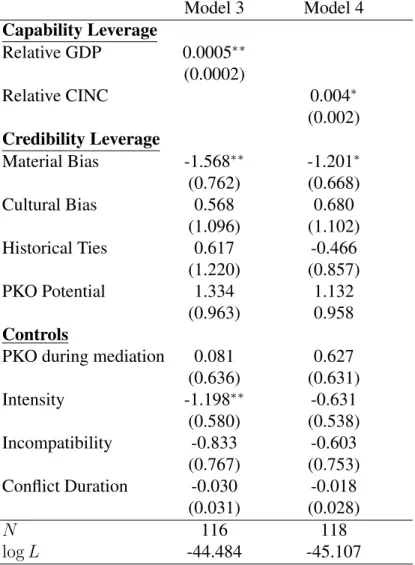
Table 3 presents the results for the survival analyses of mediator leverage and the duration of post-civil war settlements. The models report the coefficients for the Cox proportional hazards test. Positive values of a coefficient indicate a higher likelihood of failure, where failure in this case indicates war resumption. In other words, variables with a positive coefficient contribute to a higher likelihood that peace will fail following an agreement. Conversely, negative coefficients represent a lower likelihood of failure, or a more durable peace.23 24
TABLE3: Cox Proportional Hazards Models: Leverage and Duration of Settlements
Model 3 Model 4
Capability Leverage
Relative GDP 0.0005∗∗ (0.0002)
Relative CINC 0.004∗
(0.002)
Credibility Leverage
Material Bias -1.568∗∗ -1.201∗ (0.762) (0.668)
Cultural Bias 0.568 0.680
(1.096) (1.102)
Historical Ties 0.617 -0.466
(1.220) (0.857)
PKO Potential 1.334 1.132
(0.963) 0.958
Controls
PKO during mediation 0.081 0.627 (0.636) (0.631)
Intensity -1.198∗∗ -0.631
(0.580) (0.538)
Incompatibility -0.833 -0.603
(0.767) (0.753)
Conflict Duration -0.030 -0.018
(0.031) (0.028)
N 116 118
logL -44.484 -45.107
Coefficients for Cox model reported; standard errors in parentheses Significance levels:∗∗∗p < .01;∗∗p < .05;∗p < .1
23An alternative presentation of the results would show hazard rates, or the hazard of peace failure. Both
coefficients and hazard rates, while interpreted in different manners, yield the same results.
Model 3 tests the effects of mediation leverage on the peace duration following a civil war, including the relative GDP variable. Relative GDP has a positive and statisti-cally significant coefficient, thus a mediator’s economic capability is expected to render peace more likely to fail following an agreement. This finding supports the theoretical expectations in that capability leverage is mainly expected to facilitate the signing of an agreement, not the duration of peace following that agreement. Material bias, as a proxy for credibility leverage, has a coefficient of -1.568; this effect is statistically significant at the p=.05 level. Mediation attempts with material bias, then, will make peace endure longer than those without material bias, all else being equal.
While the result for material bias generates support for my hypotheses, the other dimensions of credibility leverage do not offer equally optimistic results. The coeffi-cients for cultural bias, historical ties, and peacekeeping potential are 0.568, 0.617, and 1.334, respectively. The positive coefficients, again, indicate that these variables reduce the duration of peace following a negotiated settlement. These results, however, are not statistically significant. For the control variables, only intensity attains statistical signif-icance; more intense civil conflicts are expected to have a more durable peace following an agreement, holding all other variables constant. Incompatibility and conflict duration also have negative coefficients, thus contributing to longer peace survival times. Peace-keeping presence during mediation does not increase the likelihood of peace survival. These three control variables, however, are not statistically significant.
excep-tion to this, however; historical ties within this model specificaexcep-tion have a coefficient of -0.466. In other words, historical ties between a mediator and a belligerent group increase the duration of peace, all else being equal. The effect does not attain statistical significance.
Figures 3 and 4 in the appendix graph the expected survival time of peace following a negotiated settlement. As the hypotheses state, credibility leverage is expected to have a positive effect on long-term success following mediation efforts. Figure 3, then, compares material bias, the statistically significant dimension of credibility leverage, to relative CINC. With these plots, I can assess the relative effects of the two variables on mediation success. The graph suggests that credibility leverage as measured by material bias leads to a longer duration of peace following settlement than the proxies of capability leverage. Moreover, there is a stark drop in peace survival time when relative CINC is at its maximum value. The same findings hold true in Figure 4 with regards to material bias and relative GDP. Material bias leads to longer survival times than both relative CINC and relative GDP. The expected survival times confirm that credibility leverage is indeed a powerful tool for mediators who hope to achieve lasting peace.
Conclusions
How do different mediator types influence mediation outcomes and the likelihood of a lasting peace following a negotiated settlement? In assessing the effects of mediators, it is crucial to acknowledge that not all mediators are created equally. The size, scope, strength, and resources of conflict mediators vary greatly. What Norway can do to mediate a conflict cannot be thought of as synonymous to what Jimmy Carter can do. In other words, different types of mediators wield different mediation “tools.” In spite of the variation in mediator types, the extant literature has done little to explore the diverse sources of leverage wielded by different mediators. This study has filled that blatant gap in existing research by seeking to investigate a dynamic notion of mediation leverage.
While the discussion of leverage in conflict mediation is not entirely novel, the dynamic model of leverage presented here strengthens existing work and will allow for the development of novel insights regarding mediator characteristics and mediation outcomes. The statistical analysis provides support for the idea that different types of leverage have different effects on mediation outcomes. Thus, scholarly work in civil war mediation can no longer discount the role of those “weak” mediators that do not hold the power of coercion. Each type of mediator has its own important role in civil war mediation.
Leverage, in its dynamic form, is a function of both capability and credibility. While capability involves economic and material measures of influence, credibility leverage captures the less tangible forms of influence such as historical ties, material and cultural bias, and the desire to offer monitoring following an agreement. Within this theoretical framework, mediators with capability leverage are expected to facilitate the signing of an agreement and mediators with credibility leverage are expected to facilitate a more durable peace following a settlement. Using the universe of mediation attempts from 1989 through 2006 as specified by DeRouen, Bercovitch and Pospieszna (2011), I found initial support for my theory of mediation leverage.
lever-age, both theoretically and empirically. While I have found support for my theory of leverage and civil war mediation, there remains much work to be done. First, I hope to incorporate a political dimension into capability leverage. A political capability mea-sure would strengthen the concept of capability leverage, and it would give due credit to those large intergovernmental organizations or regional powers that have the politi-cal know-how and ability to broker peace between belligerent groups. The second and larger task in ameliorating the dynamic theory of leverage is to consider how to aggre-gate the individual parts of capability and credibility leverage empirically. In its current form, the models treat each component as independent. I would like to explore how ma-terial bias, cultural bias, and historical ties, for example, can be aggregated using factor analysis to form one distinct measure of credibility leverage. This process would create more parsimonious measures of leverage that could then be used within other studies.
APPENDIX
0
.5
1
1.5
Pro
b
a
b
ili
ty
0 1000 2000 3000 4000 5000 6000 7000 8000 9000 10000 11000 Relative GDP
Failed mediation
Ceasefire/Process Agreement
Partial Agreement Full Agreement
Predicted Probability of Civil War Settlement
FIG. 1: Marginal Effects of Relative GDP on Civil War Settlement
0
.5
1
1.5
Pro
b
a
b
ili
ty
0 200 400 600 800
Relative CINC
Failed Mediation
Ceasefire/Process Agreement
Partial Agreement Full Agreement
Predicted Probability of Civil War Settlement
0
.2
.4
.6
.8
1
Su
rvi
va
l
R
a
te
0 50 100 150 200 250
Analysis Time in Months
Material Bias = 0 Material Bias = 1 Relative CINC Min. Relative CINC Max. Cox proportional hazards regression
FIG. 3: Expected Survival Time of Peace - Material Bias vs. Relative CINC
0
.2
.4
.6
.8
1
Su
rvi
va
l
R
a
te
0 50 100 150 200 250
Analysis Time in Months
Matieral Bias = 0 Material Bias = 1 Relative GDP Min. Relative GDP Max.
Cox proportional hazards regression
REFERENCES
Asal, Victor, Amy Pate and Jonathan Wilkenfeld. 2008. “Minorities at risk organiza-tional behavior data and codebook version 9–2008.”.
Beardsley, Kyle. 2008. “Agreement without peace? International mediation and time inconsistency problems.”American Journal of Political Science52(4):723–740.
Beardsley, Kyle. 2009. “Intervention Without Leverage: Explaining the Prevalence of Weak Mediators.”International Interactions35(3):272–297.
Beardsley, Kyle. 2011. The mediation dilemma. Cornell University Press.
Bercovitch, Jacob and Allison Houston. 2000. “Why do they do it like this? An analysis of the factors influencing mediation behavior in international conflicts.” Journal of Conflict Resolution44(2):170–202.
Bercovitch, Jacob, J Theodore Anagnoson and Donnette L Wille. 1991. “Some concep-tual issues and empirical trends in the study of successful mediation in international relations.”Journal of Peace Researchpp. 7–17.
Bercovitch, Jacob and Scott Gartner. 2006. “Empirical Studies in International Me-diation: Introduction to a Special Issue of International Interactions.”International Interactions32(4):319–328.
Box-Steffensmeier, Janet M and Bradford S Jones. 2004. Event history modeling: A guide for social scientists. Cambridge University Press.
Cederman, Lars-Erik, Brian Min and Andreas Wimmer. 2009. “Ethnic power relations dataset.”.
CIA. 2013. “CIA World Factbook.”.
URL:https://www.cia.gov/library/publications/the-world-factbook/
COW. 2011. “State System Membership List, v2011.” Online.
DeRouen, Karl, Jacob Bercovitch and Paulina Pospieszna. 2011. “Introducing the Civil Wars mediation (CWM) dataset.”Journal of Peace Research48(5):663–672.
H˚avard Strand. 2002. “Armed conflict 1946-2001: A new dataset.”Journal of peace research39(5):615–637.
Hartzell, Caroline, Matthew Hoddie and Donald Rothchild. 2001. “Stabilizing the peace after civil war: An investigation of some key variables.”International organization 55(01):183–208.
Heston, Alan, Robert Summers and Bettina Aten. 2002. “Penn world table.”Center for International Comparisons at the University of Pennsylvania.
H¨ogbladh, Stina. 2011. “Peace Agreements 1975-2011-Updating the UCDP Peace Agreement Dataset.”.
H¨ogbladh, Stina, Ther´ese Pettersson and Lotta Themn´er. 2011. External support in armed conflict 1975–2009presenting new data. InInternational Studies Association Annual Convention, Montreal, Canada.
Hufner, Klaus. 2013. “UN Regular Budget Expenditures.”.
URL: http://www.globalpolicy.org/un-finance/tables-and-charts-on-un-finance/the-un-regular-budget/27466.html
Kleiboer, M. 1996. “Understanding success and failure of international mediation.” Journal of Conflict Resolution40(2):360.
Kydd, Andrew. 2003. “Which side are you on? Bias, credibility, and mediation.” Amer-ican Journal of Political Science47(4):597–611.
Kydd, Andrew H. 2006. “When can mediators build trust?” American Political Science Review100(3):449.
MAR. 2009. “Minorities at Risk.”.
URL:http://www.cidcm.umd.edu/mar/
Mason, T David and Patrick J Fett. 1996. “How Civil Wars End A Rational Choice Approach.”Journal of Conflict Resolution40(4):546–568.
Nye, Joseph S. 1990. “Soft power.”Foreign policy80:153–171.
Rubin, Jeffrey Z, Dean G Pruitt and Sung Hee Kim. 1994. Social conflict: Escalation, stalemate, and settlement. McGraw-Hill New York.
Savun, Burcu. 2008. “Information, Bias, and Mediation Success*.”International stud-ies quarterly52(1):25–47.
Singer, J David, Stuart Bremer and John Stuckey. 1972. “Capability distribution, uncer-tainty, and major power war, 1820-1965.”Peace, war, and numberspp. 19–48.
Soder, K. 2012. “SIPRI Multilateral Peace Operations Database.”.
URL:http://www.sipri.org/research/conflict/pko/databases/pko
Svensson, Isak. 2007a. “Bargaining, bias and peace brokers: How rebels commit to peace.”Journal of Peace Research44(2):177–194.
Svensson, Isak. 2007b. “Mediation with muscles or minds? Exploring power mediators and pure mediators in civil wars.”International Negotiation12(2):229–248.
Themn´er, Lotta and Peter Wallensteen. 2012. “Armed Conflicts, 1946–2011.” Journal of Peace Research49(4):565–575.
Toft, Monica Duffy. 2004. The Geography of Ethnic Violence: Identity, Interests, and the Indivisibility of Territory. Princeton University Press.
UCDP. 2009. “UCDP Database Categorical Variables 1989-2008, Uppsala Data Pro-gram.”.
URL:www.ucdp.uu.se
Walter, Barbara F. 1997. “The critical barrier to civil war settlement.” International organization51(3):335–364.
Zartman, I William. 2001. “The timing of peace initiatives: Hurting stalemates and ripe moments.”The Global Review of Ethnopolitics1(1):8–18.