SUBSTANCE USE, RISKY SEXUAL BEHAVIOR, AND
EMPLOYMENT AMONG YOUNG PEOPLE
Courtney McCole Wicher Keeler
A dissertation submitted to the faculty of the University of North Carolina at Chapel Hill in partial fulfillment of the requirements for the degree of Doctor of Philosophy in the School of
Public Health.
Chapel Hill 2012
Approved by:
Marisa Domino, Ph.D.
Gary Cuddeback, M.S.W., M.P.H., Ph.D. Carolyn Halpern, Ph.D.
ii! © 2012
ABSTRACT
COURTNEY KEELER: Substance use, risky sexual behavior, and employment among young people
(Under the direction of Marisa Domino)
Using data from the National Longitudinal Study of Adolescent Health, this work
examines the impact of individual substance use, peer substance use, and depression on risky
sexual behaviors, rape victimization among women, and labor market outcomes. The data are
nationally representative of American youth. Although Fagan (1993) hypothesized that
substance use not only increases the probability of perpetrating violent crimes but also the
probability of becoming a victim of violent crime, the impact of substance use and
depression on rape victimization remains largely uninvestigated. Previous research often
neglects the concurrent impact of depression and the role of peer substance use in shaping the
outcomes of interest. I fill these gaps by controlling for individual and peer substance use as
well as depression. I use zero-inflated negative binomial, linear probability, and two-part
models to investigate these relationships. Given the endogeneity of depression and substance
use, analyses incorporate instrumental variable approaches. The results suggest that neither
substance use nor depression have a causal impact on the risky sexual behavior, rape, or
labor market outcomes. The analyses do indicate, however, that peer substance use
influences the observed health and employment outcomes. As a result, health providers may
want to consider a patient’s social environment when devising prevention and treatment
iv!
ACKNOWLEDGEMENTS
The dissertation process has been one of the most inspiring and difficult experiences
of my life, and I could not have done this alone. First and foremost, I would like to thank my
advisor, Dr. Marisa Domino. She has supported and nurtured my intellectual interests, read
countless drafts, and helped shape my initial idea into this final product. I came into the
Health Policy and Management Ph.D. program as a somewhat timid individual. Under
Marisa’s guidance, I have grown into a much stronger woman and finally found my own
voice. I would also like to thank Dr. Gary Cuddeback, Dr. Carolyn Halpern, Dr. James Porto,
Jr., and Dr. Sally Stearns who have guided me throughout this process and from whom I have
learned so much.
My friends and family have been so very supportive the last few years. Thank you for
giving me a better prospective on things and always reminding me that there is a light at the
end of the tunnel. Most importantly, I would like to thank my husband, Daniel, for
!
TABLE OF CONTENTS
LIST OF TABLES... VII
LIST OF FIGURES...X
CHAPTERS
I. INTRODUCTION ...1
II. BACKGROUND AND SIGNIFICANCE ...6
!
"#!$%&'"(&)*&!+,!-./-0")*&!.-&!1)!"2+(&-*&)0!!
")2!3+.)4!"2.(0!$+$.("01+)-######################################################### 5!
!
/#!*+6+**.%%&)*&!+,!-./-0")*&!.-&!")2!7&)0"(!! 8&"(08!*+)2101+)-!1)!"2+(&-*&)0!")2!3+.)4!!
"2.(0!$+$.("01+)-############################################################################### 9! !
*#!-./-0")*&!.-&!"-!"!*".-&!+,!7&)0"(!1(()&--############################### :!
!
2#!*+)-&;.&)*&-!+,!-./-0")*&!.-&################################################### <=!
!
&#!&*+)+71*!7+2&(-!%&("01)4!0+!-./-0")*&!.-&!! /&8"'1+%!>!%"01+)"(!"221*01+)!'&%-.-!-+*1"(!!
1)0&%"*01+)########################################################################################## ?@!
!
,#!*+)*(.-1+)-########################################################################################### A?!
III. CONCEPTUAL FRAMEWORK ...34
!
"#!/"*B4%+.)2!+)!*+)*&$0."(!,%"7&C+%B################################## A@!
!
/#!.01(103!,.)*01+)################################################################################# A:!
!
*#!/.24&0!*+)-0%"1)0############################################################################# D=!
!
vi!
IV. DATA...46
!
"#!2"0"!-+.%*&########################################################################################## D5!
!
/#!7&"-.%&-################################################################################################ D:!
!
*#!71--1)4!2"0"!")2!-"7$(&!-1E&-####################################################### 5=!
!
2#!-.77"%3!-0"01-01*-!/3!"17############################################################## 5?!
V. INSTRUMENTS ...65
!
"#!1)-0%.7&)0"(!'"%1"/(&-################################################################## 55!
!
VI. AIM ONE: IMPACT OF SUBSTANCE USE ON RISKY SEXUAL BEHAVIOR – METHODS,
RESULTS, AND DISCUSSION...72
!
"#!7&08+2-################################################################################################# 9?!
!
/#!%&-.(0-################################################################################################### 9:!
!
*#!21-*.--1+)############################################################################################## F?!
VII. AIM TWO: IMPACT OF SUBSTANCE USE ON THE PROBABILITY OF HAVING EVER BEEN RAPED – METHODS, RESULTS, AND
DISCUSSION...86
!
"#!7&08+2-################################################################################################# F5!
!
/#!%&-.(0-################################################################################################### F9!
!
*#!21-*.--1+)############################################################################################## FF!
VIII. AIM THREE: IMPACT OF SUBSTANCE USE ON LABOR MARKET OUTCOMES – METHODS,
RESULTS, AND DISCUSSION... 91
!
"#!7&08+2-############################################################################################# :<!
!
/#!%&-.(0-############################################################################################### :A!
*#!21-*.--1+)########################################################################################## :D!
IX. DISCUSSION...99
!
"#!-0.23!*+)0%1/.01+)-#######################################################################<==!
!
/#!(1710"01+)-##########################################################################################<=<!
!
*#!,.0.%&!%&-&"%*8###############################################################################<=A!
APPENDIX……….…...105
REFERENCES ... 144
viii
LIST OF TABLES
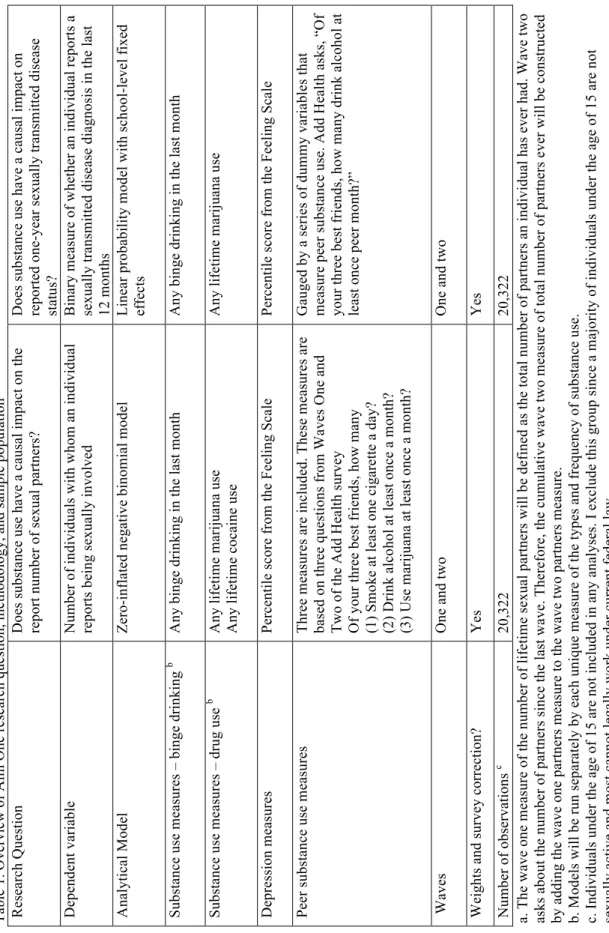
1. Overview of Aim One research question, methodology, and sample population……… 105
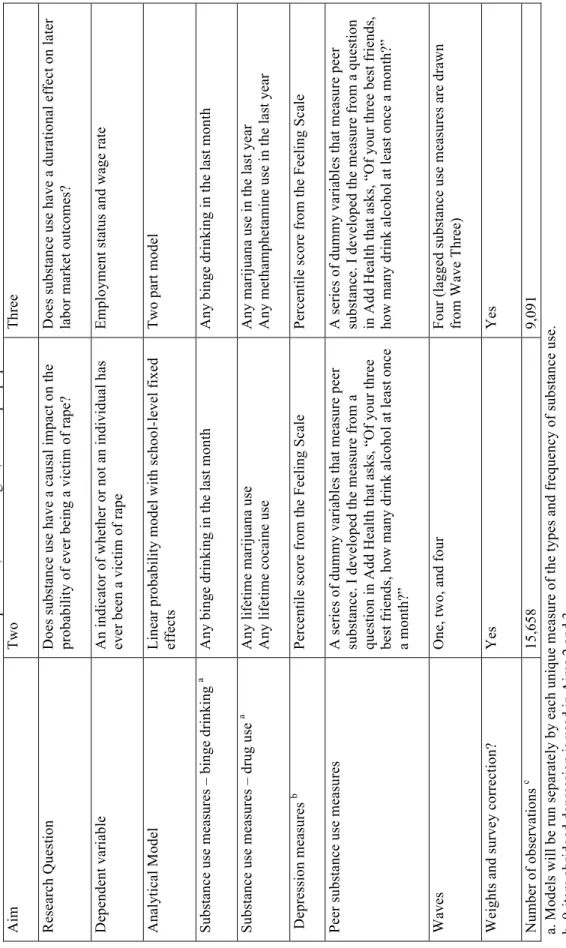
2. Overview of Aims Two and Three research questions, methodologies, and sample population……….. 106
3. Depression measures: 19-item Add Health Feeling Scale………..…..…………... 107
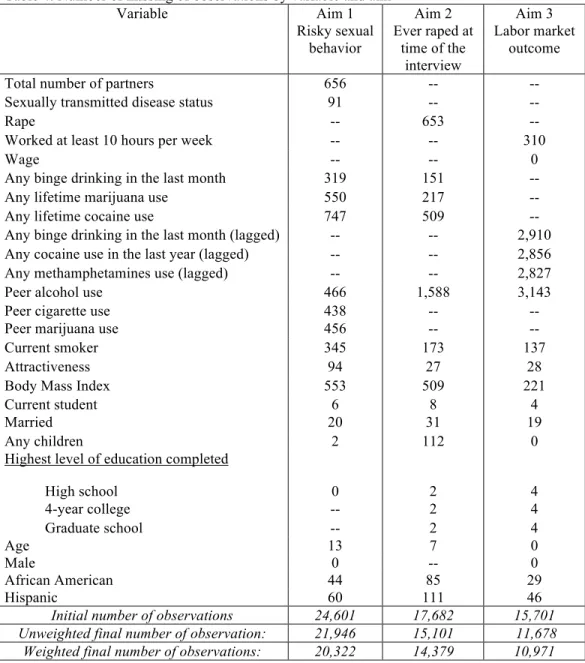
4. Number of missing of observations by variable and aim……….………... 108
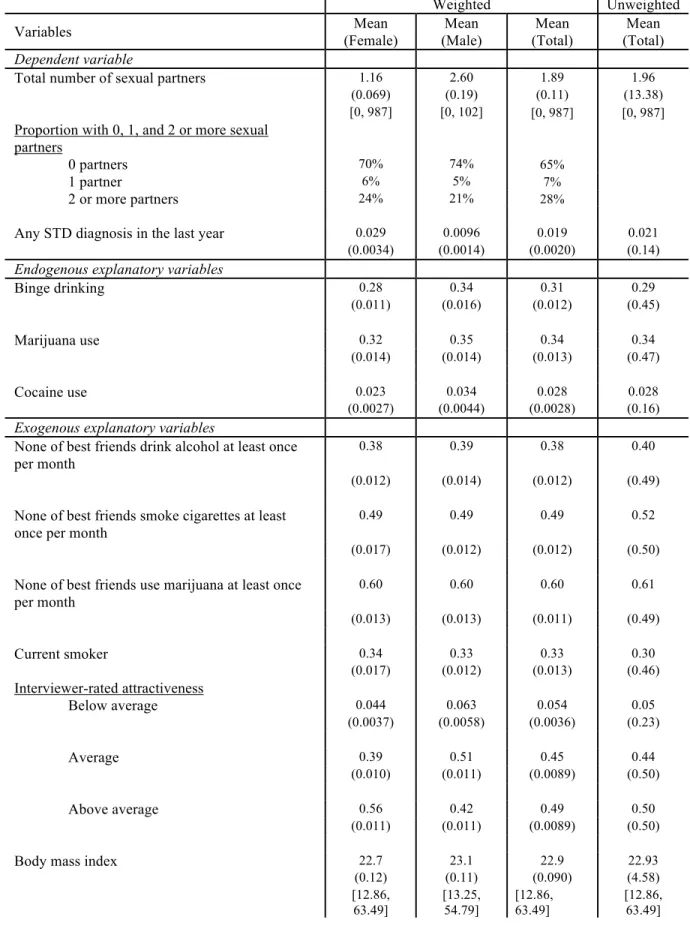
5. Aim one weighted descriptive statistics………..………. 109
6. Aim two weighted descriptive statistics……….……….. 111
7. Aim three weighted descriptive statistic……….……….. 113
8. Tests of instrument strength and exclusion restriction (first-stage equations are the same across all aims………... 115
9. Weighted descriptive statistics for instrumental variables (first-stage equations are the same across all aims)………... 116
10. First-stage regressions by substance-type and depression percentile……….. ………. 117
11. Impact of any binge drinking in the last month on the number of sexual partners – Results from naive and 2SRI ZINB models………. 121
12. Impact of any lifetime marijuana use on the number of sexual partners – Results from naive and 2SRI ZINB models……… 124
13. Impact of any lifetime cocaine use on the number of sexual partners – Results from naive and 2SRI ZINB models……… 127
14. Impact of substance use on the probability any that an individual reports being diagnosed with a STD diagnosis – Results from linear probability models with two-stage least squares……….………. 130
15. Impact of binge on the probability of ever being raped – Results from linear probability models with two-stage least squares………... 132
16. Impact of marijuana use on the probability of ever being raped – Results from linear probability models with two- stage least squares………..………… 134
18. Impact of lagged binge drinking on employment and wages –
Results from two-part model with two-stage least squares………..138 19. Impact of lagged marijuana use on employment and wages –
Results from two-part model with two-stage least squares……….. 140 20. Impact of lagged methamphetamine use on employment and
wages – Results from two-part model with two-stage least
x
LIST OF FIGURES
1. Arimstead, Klein, and Forehand’s schematic model of
I. INTRODUCTION
Many adolescents and young adults experiment with substances sometime during their youth. Data from the National Household Survey of Drug Abuse suggest that in 2001, substance use was widespread, with 20.8% of adolescents and 31.9% of young adults reporting some illicit drug use in the past year. Nevertheless, substance use, and
accompanying worries regarding self-medication and dependence, can be dangerous if not lethal during these formative years.
Peer substance use behavior closely interacts with an individual’s own health and employment outcomes. While substance use has physical effects on individuals, researchers and policymakers often overlook the externalities associated with the consumption of alcohol and drugs. Substance use not only directly and indirectly impacts a consumer’s health, but individual consumption potentially generates negative externalities that can affect the health of a third party. As a result, peer substance use potentially impacts individual health and other behavioral outcomes. The impact of peer substance use is central to these analyses.
2
Among young adults, sexual activity presents a major public health challenge.
Sexually transmitted diseases are particularly concerning, especially for younger age groups. The 2009 Sexually Transmitted Disease Surveillance 2009 report, published by the Division of STD Prevention within the Centers for Disease Control, details STD rates within the United States population. Although the overall rates of gonorrhea and syphilis continued to decline between 2005 and 2009, chlamydia rates increased during the same time period (37.6% for men and 20.3% for women); moreover, the report illustrates the relatively high risk of sexually transmitted disease facing adolescents and young adults compared to other groups. This risk is particularly acute for females. In 2009, the age-specific rates of
chlamydia and gonorrhea were highest among women aged 15–19 and 20–14 years and men aged 20–24 years. The age-specific rates of primary and secondary syphilis were also highest among individuals ages 20-24 and 24–29. These statistics suggest that sexual intercourse itself is a risky undertaking for adolescents and young adults, especially if individuals use no protective measures.
Rape also threatens health, placing individuals in danger of serious psychological distress and, for females, unplanned pregnancy. According to national statistics published by the Centers for Disease Control, 11% of high school females and 4% of high school males have reported being raped. Similar statistics suggest that roughly 20% to 25% of women are raped or experience a rape attempt during college (CDC, 2007).
At first blush, the link between sexual behavior and labor market experiences appears tenuous. Risky sexual behaviors are a health outcome; labor market behaviors are not.
adolescents and young adults. While risky sexual behavior is a major public health challenge for young people, adolescents and young adults also face issues of unemployment and underemployment as they progress into adulthood, particularly in tough economics conditions.
Substance use can also affect labor market outcomes. The Bureau of Labor Statistics reported in February 2010 that the national unemployment rate in the United States was 9.7%. Given the current recessionary atmosphere, predictors of positive labor market outcomes are important. What is more, unemployment itself may adversely affect health outcomes, as most individuals acquire health insurance through their employers, although this may become less of an issue under health care reform.
While researchers have explored the relationships among substance use, sexual behavior, and labor market outcomes in separate pieces, the findings from these studies are far from conclusive. While some researchers find evidence that substance use is significantly associated with sexual behavior and labor market outcomes, others do not. The direction of these relationships remains unclear. A fresh approach is needed.
Previous research has largely neglected the direct influence of depression and peer behavior in studies examining the impact of substance use on sexual risk-taking and employment; these studies also ignore the possible role that depression and peer behavior play in mediating the relationship between substance use and the outcomes of interest.
4
variable bias. As a result, the true relationship between substance use and the outcome of interest are partially masked in the existing work.
This work incorporates measures of depression and peer behavior. First, I control for depressive symptoms. Second, I control for individual (or own) substance use and peer substance use. While important, the impact of peer behavior is difficult to assess. To do so, I rely on social interaction theory (Akerlof, 1997) and models of status-seeking and conformist behavior (Akerlof, 1997).
Depression and individual substance use variables are potentially endogenous since the error term contains unobserved personal characteristics and other behaviors that are likely correlated with these variables. Endogeneity may also be driven by reverse causality (i.e., sexual risk-taking and observed labor market drive observed substance use or depression outcomes rather than the other way around). By identifying variation in the endogenous right-hand side variable separately from the error term, instrumental variable approaches help establish causality.
Three separate aims are addressed in this study. Crucially for all analyses, I control for depressive symptoms and peer substance use:
1. Estimate the causal effect of substance use on sexual activity. This aim uses two dependent variables: (a) reported number of sexual partners and (b) reported sexually transmitted disease status in the year prior;
2. Estimate the causal effect of substance use on the probability of a woman reporting having ever been raped at the time of the interview; and
3. Estimate the causal effect of substance use during early adulthood on later labor market outcomes.
II. BACKGROUND AND SIGNIFICANCE
I begin this section by discussing the prevalence of substance use and mental health conditions, depression in particular, among adolescents and young adults. Next, I survey the existing literature, investigating risky sexual behaviors, labor market outcomes, depression, and substance use. I end with a discussion of several economic models germane to this work, including rational addiction models and social interaction theory.
A. Prevalence of substance use in adolescent and young adult populations
Substance use has taken a backseat in public health research. As Steven Schroeder, a distinguished professor of Health and Health Care at the University of California at San Francisco, noted, “Despite their huge health toll, substance abuse disorders remain
underappreciated and underfunded.” (Schroeder, 2005) Nevertheless, this field of research is important, not only because of the direct effect of substance use on an individual’s health, but also because of the indirect and often ignored external consequences.
The National Survey on Drug Use and Health (NSDUH) allows researchers to examine the prevalence of substance use among adolescents and young adults. NSDUH is administered at the household level. Institutionalized youths in juvenile detention centers and other custodial settings are not interviewed. As a result, this survey does not represent
Data from the 2010 NSDUH confirm the relatively high risk of substance use and abuse among adolescents and young adults. NSDUH estimates that, in 2010, 22.6 million Americans could be identified as current illicit drug users.1 Marijuana was the most popular illicit drug. Rates of current illicit drug use are estimated to be highest among individuals 18 to 20 followed by individuals 21 to 25. Similar statistics relating to binge drinking suggest that heavy drinking rates are highest among individuals 21 to 25 (SAMHSA, 2011).
B. Co-occurrence of substance use and mental health conditions in adolescent and young adult populations
!
The prevalence of substance use and mental health disorders is high and often co-occurring. Depression is one of the most common mental health disorders in the United States. The National Co-morbidity Survey Replication (NCS-R), which is nationally representative of the U.S. population, found that the 12-month prevalence of major depressive disorder was 7%, surpassed only by specific and social phobias. The lifetime prevalence of mood disorders and substance disorders is also quite high, at 21% and 15%, respectively (NIMH).
Taking the findings from the NCS-R, the National Epidemiologic Study of Alcohol and Related Conditions, and the National Survey on Drug Use and Health together, a 2007 report by SAMHSA’S Co-Occurring Center for Excellence estimated that more than 9% of adults surveyed had a substance use disorder, 9% had a diagnosable mood disorder, and more than five million had a co-occurring substance use disorder and serious mental illness
(CSAT). Research shows that the co-occurring substance use disorder often results from an
!
8
existing mental disorder, often anxiety or bipolar mood disorders, which begins in adolescence (NIMH).
Substance use may function as a form of self-medication. The self-medication hypothesis suggests that individuals will use nicotine, alcohol, and other drugs to alleviate undesirable affect states (Khantzian, 1985; Khantzian 1997). The emotional and
psychological ramifications of depression predispose individuals towards substance use. According to Khantzian (1997), “clinical observations and empirical studies that focus on painful affect and subjective states of distress more consistently suggest that such states of suffering are important psychological determinants in using, becoming dependent upon, and relapsing to addictive substances.”
While the above statistics relate to adults, the association between substance abuse and mental health, and depression in particular, also holds for adolescents and young adults. In 2005, 8.8% of youths 12 to 17 in the National Survey of Drug Use and Health (NSDUH) had a major depressive episode (MDE) (SAMHSA, 2007a). The NSDUH shows that youths are twice as likely to initiate alcohol use if they had a MDE in the last year relative to youths who did not (29.2% versus 14.5%). These youths are also twice as likely to initiate illicit drug use (16.1% versus 6.9%).
The link between substance use and depression continues into adulthood. During 2005 and 2006, NSDUH data found that 33.7% of young adults aged 18 to 25 that experienced an MDE within the last year initiated alcohol use relative to 24.8% of young adults who did not experience such an episode. Twelve percent of young adults with a MDE initiated illicit drug use relative to 5.8% of other individuals. The most popular illicit
substantially higher in the MDE group (SAMHSA, 2007b). Related statistics suggest that young males aged 18 to 25 who experienced serious psychological distress over the past year are more likely to engage in binge drinking and illicit drug use (SAMHSA, 2006).
C. Substance use as a cause of mental illness
Although many articles discuss the association of alcohol and drug use with mental health disorders, the discussion about the directionality of this relationship is limited. Much of the existing literature surrounds cannabis use, schizophrenia, and psychosis in adolescents and young adults. Research suggests that cannabis use may be related to schizophrenia (Arseneault et al., 2004; Andreasson et al., 1987), poor mental health (van Ours and Williams, 2010; Fergusson and Horwood, 1997), and psychosis (Fergusson et al., 2005; Henquet et al., 2004). Moreover, results indicate a “dose-response relationship” among cannabis use and poor mental health (van Ours and Williams, 2010) and psychosis (Henquet et al., 2004).
!
10 D. Consequences of substance use
Research demonstrates the relationship between substance use and adverse sexual outcomes and other negative behaviors. As French and colleagues (2000) discuss, alcohol and illicit drug use have been linked to a series of undesired outcomes, such as unprotected sexual activity, needle exchange (Gunn et al. 1995; Chirgwin et al. 1991; Cottler et al., 1990; Rolfs et al., 1990) and sexually transmitted diseases (Cheeson et al., 2000), including HIV (Allen et al., 1992; Bruenau et al., 1997; Kral et al., 1998). Sexually transmitted disease presents a particular health risk for young people. For many sexually transmitted diseases, including chlamydia, gonorrhea, and syphilis, adolescents and young adults between the ages of 15 and 30 have the highest age-specific diagnosis rates compared to other age groups (CDC, 2010). The high prevalence of STDs within this age group enhances the relative risks associated with sexual activity.
Substance use has also been tied to aggressive and otherwise reckless behaviors, including abusive behaviors aimed at wives (Markowitz, 2000) and children (Markowitz and Grossman, 2000) and driving under the influence (Phelps, 1987). The relationship with driving under the influence has been found to be particularly strong for young people (Phelps, 1987; Peck et al., 2008).
In addition, researchers have observed a more general relationship between substance use and criminal behavior. The 1997 National Longitudinal Survey of Youth highlights the connection between delinquency and substance use. Substance users experience higher proportions of delinquent behavior, the sale of drugs, days of suspension, and vandalism. Similar statistics hold for more dramatic behaviors, including major theft, attack/assault, and carrying a handgun (McCurley and Snyder, 2008).
Finally, substance use has also been shown to increase health expenditures. French and colleagues (2000) find that chronic drug users and injecting drug users experience significantly more inpatient and emergency care and less outpatient care relative to non-drug users; however, the magnitude of the overall effect was small. Being a chronic drug user is associated with 0.08 more inpatient visits, 0.24 more emergency room visits, and 0.16 fewer outpatient visits compared to non-drug users over approximately a one-year period. Given the relative expense of emergency and inpatient care, it is not surprising that, on average, chronic and injecting drug users spend $1,000 more in total health care costs than non-drug users. The sample population for this study consists of 1,570 respondents who filled out a self-reported questionnaire collected between 1996 and 1997. While the data may be
nationally representative of low-income individuals with substance use disorders, the results may not be nationally representative of substance users as a whole.
D.1. The relationship between substance use and risky sexual behaviors
!
12
associated with sexual intercourse – namely sexually transmitted diseases, which are a central concern for this age group (CDC, 2010).
Substance use and poor mental health may instigate risky sexual behaviors. The current literature focuses almost exclusively on alcohol and marijuana use, leaving the impact of harder drug use on sexual risk-taking largely unknown. Mental health is often unaddressed by these analyses. Of the work described in the next section, only DeSimone (2010) incorporates any controls for mental health status. DeSimone uses measures of perceived weight and whether or not an individual planned a suicide in the past year as proxies for depression in examining the impact of binge drinking on risky sexual behavior among college students; nevertheless, his proxies lack a clinical foundation and may not even reflect depressive tendencies.
The debate continues as to whether a link between risky sexual behavior and substance use exists. While some researchers find evidence associating heavy alcohol and marijuana use with increased sexual activity among young adults (Cooper et al., 1994), others find little evidence of such a link (Rees et al., 2001). Given the high prevalence of sexually transmitted disease within this age group, an increase in sexual activity presents a risk in and of itself.
Investigating the impact of alcohol and marijuana use on a variety of risky sexual behaviors, some studies have concluded that a causal relationship between substance use and risky behaviors is unlikely (Grossman, Kaestner, and Markowitz, 2004; Grossman and Markowitz, 2005). Nevertheless, some literature suggests that the impact of alcohol use on the probability of engaging in sexual intercourse depends on how much alcohol one
measures of risky sexual behavior, including sex with multiple partners, both with and without a condom (DeSimone, 2010).
These studies are far from consistent in their definitions of substance use and sexual risk-taking. Researchers have relied on varying measures of “heavy” alcohol and marijuana use as well as different definitions of sexual activity and “unprotected” sexual intercourse.
Research in this area has also neglects the potential impact of substance use on the probability of being raped or the probability of raping someone else. Fagan (1993) argues that substance use increases an individual’s likelihood of being a victim of violent crime. Carpenter and Dobkin (2010) suggest that the pharmacological effects of alcohol may increase the likelihood of victimization, proposing that copious alcohol consumption produces sedative effects, making individuals at higher risk for attack.
D.1.a. Possible mechanisms through which substance use influences risky sexual behaviors
Several mechanisms linking substance use and risky behavior have been proposed. Some researchers hypothesize that alcohol and marijuana use may increase the likelihood of these risky behaviors by increasing sexual aggression, lowering inhibitions, and/or
diminishing an individual’s ability to assess risk (Rees et al., 2001).
!
14
Markowitz (2000) hypothesizes an alternative mechanism. Individuals may use alcohol or drugs to remove responsibility for otherwise unacceptable behavior (Markowitz, 2000). Carpenter and Dobkin (2010) refer to this as the “excuse motive.” Under this
hypothesis, substance use and risky behaviors are associated, but substance use does not cause risky sexual behaviors. Markowitz (2000) discusses how individuals may use alcohol consumption to diminish the personal blame incurred from spousal abuse.
Grossman, Kaestner, and Markowitz (2004) and Grossman and Markowitz (2005) argue that Jessor and Jessor’s (1977) problem behavior theory may be a key piece of the puzzle. The theory suggests that a common third variable causes both substance use and risky sexual behavior. Grossman and Markowitz (2005) give the example of the tendency towards thrill seeking as such a variable. From a statistical standpoint, excluding these variables from the analysis would produce omitted variable bias. This is one reason why Grossman,
Kaestner, and Markowitz (2004) as well as Grossman and Markowitz (2005) use person-level fixed effects analysis in their work.
In summary, the mechanism relating substance use and risky sexual behavior remains ambiguous. While researchers have developed several explanations linking substance use and sexual risk-taking, the precise mechanism by which alcohol and drug use influences riskiness remains uncertain and likely varies by individual.
D.1.b. Risky sexual behaviors and mental health
probability of having sex without a condom (Brown et al., 2006; Brooks et al., 2002). Emotional distress, including depression, may predispose an individual towards a variety of risky sexual behaviors, including unprotected sex and unplanned pregnancy (Kirby, 2002). In addition to unprotected sexual activity and unplanned pregnancy, the number of sexual partners is positively correlated with psychological disturbance (Tubman et al., 1996).
D.1.c. Rape and mental health
While research suggests that substance use and victimization are associated (Fagan, 1993), I have found no work suggesting that depression would lead to rape victimization. In fact, examining the timing of events, one would except that victimization would lead to depression, not the other way around. Frank and Stewart (1984) provide the following advice, “Clinicians and researchers as well should be alert to the presence of post-rape depression and tailor their interventions and research strategies accordingly.” Nevertheless, depression is likely correlated with substance use and other observable and unobservable factors that influence an individual’s likelihood of victimization. As a result, if depression does impact the incidence of rape, excluding it from an analysis of substance use and rape may generate omitted variable bias.
D.2. The relationship between substance use and labor market outcomes
Substance use during youth may have long-term consequences, potentially having a demonstrable effect on future labor market outcomes. Many researchers have analyzed this relationship, employing various definitions of substance use and labor market outcomes. Some researchers find evidence of a negative effect of substance use on labor market
!
16
The discrepancies in the direction of the association between substance use and labor market outcomes could result from several factors: differences in labor market outcomes studied, differences in instrumental variables used, age differences among sample
populations, confusion between substance use and substance abuse, varying definitions of substance use and the frequency/level of use, different lagged periods of substance use, the sporadic inclusion of gender and human capital measures, and the absence of indicators of mental health and peer behavior.
D.2.a. Differences in labor market outcomes studied
Different definitions of labor supply may result in inconsistent findings (MacDonald and Pundey, 2000). Labor market outcomes previously studied in the context of substance use include hours worked (Zarkin et al., 1998), unemployment (MacDonald and Pundey, 2000), productivity and workplace achievement as measured by occupational class (MacDonald and Pundey, 2000), labor force participation (French et al., 2001), and
employment. Employment classification spans a spectrum of values, from having worked at least one hour in the last year (DeSimone, 2002) to being employed at the time of the interview (French et al., 2001) to having a full-time job (van Ours, 2006).
D.2.b. Age differences in the sample population
Although the choice of age range may be arbitrary and determined by data
In most cases, substance use is defined as current substance use, meaning the
durational effects of substance use are under-investigated. Limited research investigates the impact of age of onset or the durational effects of substance use on employment outcomes (e.g., van Ours, 2006).
Studies of rational addiction demonstrate that younger and older individuals approach substance use quite differently.2 As a result, the effect of substance use on employment is likely to vary across age groups. Studies investigating the impact of current and, to a more limited extent, prior substance use on employment for younger populations may find differing results than studies investigating the same relationship in older populations. In studies relying on broad age ranges, the opposing effects of substance use for different age groups may cancel each other out completely.
Researchers have studied the relationship between substance use and employment for a variety of age groups. For instance, some of the previous age ranges studied include 14 to 22 (DeSimone, 2002), 18 to 24 (Zarkin et al., 1998), 26 to 50 (van Ours, 2006), and 26 to 59 (French et al., 2001).
Given that substance use is likely to have a distinctive impact on employment for different age groups, studies with smaller age ranges will likely paint a more realistic and accurate picture of the impact of substance use on employment for that particular group.
!
18 D.2.c. Varying definitions of substance use
Many researchers have relied on broad definitions of substance use.3 In this work, however, I chose to define substance use narrowly, within unique substance categories (e.g., marijuana use), rather than broad categories (e.g., “soft drugs” in general).
The pharmacological and behavioral effects of substance use vary by substance (Carpenter and Dobkin, 2010), suggesting that a one-size-fits-all approach may be
inappropriate. Surveying the literature describing the pharmacological and behavioral effects of substance use, Carpenter and Dobkin (2010) compare the effects of alcohol and illicit drugs. They conclude that the effects of alcohol are most similar to those of cocaine. Both increase aggression and irritability and decrease self-control. The authors discuss how amphetamines increase aggression and produce a paranoid psychotic state. Marijuana and opiate use are negatively associated with aggression/hostility; however, opiates, unlike marijuana, result in elevated levels of aggression during withdrawal. Given that the pharmacological and behavioral effects produced by substance use are likely to vary, the pathway by which use affects behavior will also likely differ.
D.2.d. Varying measures of the frequency and level of substance use
A limited number of studies analyze the frequency and level of substance use. In many cases, researchers rely on a binary measure of substance use (e.g., DeSimone, 2002; MacDonald and Pundey, 2000). The effect of any substance use on employment, however, is likely to be distinct from the level or frequency of substance use. For instance, the impact of marijuana use on employment may be minimal for recreational marijuana users. For daily users, however, the impact of marijuana use may be more pronounced. Binary measures of
!!!!!!!!!!!!!!!!!!!!!!!!!!!!!!!!!!!!!!!!!!!!!!!!!!!!!!!!
3 In the literature, substance use is often defined broadly as “illicit drug use” (e.g., Zarkin, 1998; French et al.,
drug use glaze over these nuances. Fortunately, some researchers measure the frequency of drug use, incorporating measures of “chronic” use (e.g., French et al., 2001; Buchmuellar and Zuvekas, 1998). Evidence suggests that chronic use impacts employment (e.g., French et al., 2001; Buchmuellar and Zuvekas, 1998).
D.2.e. Lagged effect of substance use
While studies have examined the lagged effect of substance use on employment, the lag period examined is often short. Although researchers examine the impact of lagged substance use over a single year period (Gills and Michaels, 1992; MacDonald and Pundey, 2000), alcohol and drug consumption may have a more long-term effect. Little evidence of an association between the age of onset of substance use and the probability of having a full time job has been found in the literature (van Ours, 2006), and more research is needed in the area, given the dearth of studies investigating the durational effects of substance use on employment.
D.2.f. Gender roles
Gender plays a crucial role in shaping both substance use and employment behaviors. The National Epidemiologic Survey on Alcohol and Related Conditions finds that 13.8% of men relative to 7.1% of women fit the DSM-IV criteria for any drug abuse disorder (Back et al., 2007). Men and women deviate in expected career trajectories as well. Not only are women less likely to participate in the labor force, but also a wage differential still exists between gender groups with similar levels of human capital attainment (Frank and Bernanke, 2004, pg. 334).
!
20
gender lines. Although French and colleagues (2001) find that chronic use negatively affects employment for both sexes, the magnitude of these effects differs across gender groups. DeSimone (2002) finds that cocaine and marijuana have a negative impact on the probability of employment for males but not for females. Kaestner’s (1994a) work further demonstrates that cocaine and marijuana affect men and women differently. Together, these results reinforce the importance of incorporating gender into analysis of substance use and employment.
D.2.g. Human capital
Human capital refers to the skills that an individual acquires through training, often through education. An employee brings human capital to a firm via her skill set; thus, human capital attainment directly influences current employment opportunities. Although substance use may affect labor market outcomes directly, alcohol and drug use may indirectly affect employment behaviors by altering the level of human capital attainment, especially in younger populations.
The majority of work finds evidence that drug use negatively impacts human capital attainment (van Ours and Williams, 2010; Chatterji, 2006; Yamada et al., 1996; Register and Williams, 1992). The impact of substance use on education may depend on how substance use is defined. For instance, Register and Williams (1992) find that frequency of drug use has an impact, while any use does not.
D.2.h. Mental health
898). In addition to substance use, mental health status may influence the desire and ability to hold a job or even affect hiring decisions. These factors may also influence job satisfaction, which, in turn, could alter productivity and potentially impact one’s physical health (Fischer and Sousa-Poza, 2009).
Some researchers have highlighted the impact of depression on employment. Lerner and colleagues (2004) investigate this relationship with patient data collected from
Massachusetts’s physician offices. The authors identify three groups of individuals: a treatment group consisting of individuals with depression, a control group consisting of healthy individuals, and an initial control group consisting of individuals with rheumatoid arthritis. At six months, individuals with depression experienced more new unemployment and more job turnover, conditional on employment, compared to both control groups. The results, therefore, provide some evidence of a positive association between unemployment and depression.
Some researchers have attempted to define the depression-employment relationship in the context of the drift hypothesis. Based on work by Goldberg and Morrison (1963), the drift hypothesis relates mental illness to social class and suggests that mental illness leads to a decline in one’s social standing. Goldberg and Morrison’s sample population draws from men aged 25 – 34, suggesting that this hypothesis is relevant to younger populations.
!
22
Although the current literature demonstrates an association between depression and employment, the directionality of this link is unclear. Dooley and colleagues (2000) also emphasize that the relationship between depression and employment may run in the both directions. While depression could result in poor employment outcomes, poor employment outcomes could lead to a depressed state. For individuals in their mid-20s, the authors suggest the uncertainty about employment and the establishment of one’s career is a source of anxiety and depression (American Psychiatric Association, 1994). Depression may also result from unemployment or the threat of unemployment (Kessler, Turner, and House 1988). Dooley and colleagues (2000) find further evidence of this link. Taken together, this body of work suggests that a depression variable in an employment model is likely endogenous, since reverse causality is likely present, especially for younger age groups.
Treatment may help improve both health and employment outcomes for depressed individuals. Drawing on a random sample of patients from managed care practices, several studies find that patients with appropriate care experienced both lower rates of depressive disorder and higher levels of employment compared to patients who did not receive care at six months (e.g. Schoenbaum et al., 2002; Miranda et al., 2004).4 The relative efficaciousness of treatment on employment may vary by race. While nonminority patients with appropriate care benefited from lower rates of unemployment, Miranda and colleagues (2004) find that
!!!!!!!!!!!!!!!!!!!!!!!!!!!!!!!!!!!!!!!!!!!!!!!!!!!!!!!!
D!Schoenbaum and colleagues (2002) define appropriate treatment as follows: “Appropriate treatment in the
first six-months of follow-up was measured by survey items that assessed whether the respondent had four or more specialty counseling visits or used antidepressant medication for any amount of time or above the minimum dosage recommended in the Agency for Health Care Policy and Research (AHCPR) practice guidelines (Depression Guidelines Panel 1993b), adapted to include newer antidepressant medications” (pg. 1149).
this effect does not translate to minority patients with depressive disorders who undergo similar treatment.
D.3. Other factors influencing substance use and related behaviors
An individual’s collective environment contextualizes the relative benefit of
substance use. Factors like taxes and regulations, prices, substance type, level/frequency of substance use, personal factors, and peer effects are important in shaping the relationship between substance use and related behaviors.
The cost of using substances may strongly influence the level of use. Local, state, and federal policy helps shape the total cost of substance use. Changes in policy have a direct impact on the price and accessibility of alcohol and drugs themselves (DiNardo and
Lemieux, 2001; Saffer and Chaloupka, 1999; Manning et al., 1995; Grossman, Chaloupka, Saffer, and Laixuthai, 1994; Becker, Grossman, and Murphy, 1991).
Taxes and other regulatory policies seeking to change the price of substances may have unanticipated consequences. When confronted with a change in alcohol or marijuana policy, individuals may trade one risky behavior for another. DiNardo and Lemieux (2001) find that an increase in the legal drinking age is associated with a decrease in alcohol consumption and an increase in the marijuana use among young people.
!
24
difficult to assess. The indirect cost includes the cost of punishment if caught, time and travel costs associated with obtaining the alcohol, as well as opportunity costs.
The frequency and level of substance use may mediate the impact of price on behavior. Manning and colleagues (1995) find that policy changes altering the full price of alcohol are more effective in changing the drinking habits of more moderate drinkers relative to light or heavy drinkers. In the same way, consumers may be more or less responsive to changes in the price of one substance relative to another. Saffer and Chaloupka (1999) find evidence that cocaine users are far less responsive to price than marijuana users.
Personal factors such as race, gender, and family background shape behavior as well. Cooper and colleagues’ (1994) work suggests that alcohol and marijuana use are more highly associated with sexual activity for Caucasian adolescents relative to African American adolescents.
In addition to personal factors, peer behavior also impacts substance use decisions, as well as other behaviors. Family expectations, the availability of role models, and peer
behavior help mold codes of conduct, influencing many personal choices, including decisions regarding substance use. More broadly, labor force participation rates, occupational choice, education rates, crime rates, and substance use rates within a community are important factors guiding an individual’s behavior (Akerlof, 1997). In this regard, own substance use generates externalities, which influence the uptake of substance use by peers. Likewise, peer substance use generates externalities that influence one’s own substance use. As a result, substance use is both an individual and social decision.
association is complex, involving a variety of personal, social, and community-level contextual factors.
E. Economic models relating to substance use behavior – rational addiction versus social interaction
!
Much of the recent economics research examines substance use, including cigarettes, alcohol, or drug use, in the context of the rational addiction framework (Becker and Murphy, 1988). Rational addiction theory hypothesizes that substance abuse is the result of a utility maximization process, in which current substance use enhances the value of future substance abuse. The specifics of the rational addiction model are discussed in more detail below. Although rational addiction has been and continues to be important in understanding addictive behaviors, it is not always applicable. The rational addiction model may be
inappropriate for adolescents and young adults, since they may not fit the clinical criteria for addiction. Younger individuals may also be more responsive to changes in price compared to older age groups. Akerlof’s model of social interaction provides an alternative, albeit not entirely separate, means of investigating patterns of substance use.
E.1. Rationality: A traditional economic perspective on substance abuse
!
26
considered addictive if past consumption raises current consumption. Thus, utility in the current period depends on past consumption of the addictive good.
Becker and Murphy predict that changes in past prices affect current consumption by changing the current stock of consumption capital. Changes in future consumption affect current consumption by changing the current full prices of a substance and by altering the future stock of consumption capital and, thus, future consumption.
How can future consumption affect past consumption? Suppose a state legislature passes a tax increase on all alcoholic beverages, which will be become law in exactly one year. The higher price may result in the consumer choosing to drink fewer alcoholic
beverages in a year’s time. Since future consumption will be lower under the new tax regime, the consumer may choose to consume less today. In this manner, future consumption affects current consumption.
This discussion leads directly into the concept of adjacent complementarity. Adjacent complementarity implies that past, current, and future consumption are complements. Along these lines, adjacent complementarily between periods fuels addiction. Adjacent
complementarity implies that greater current consumption of a good raises its future consumption. For example, an anticipated price increase should decrease consumption of addictive goods in the current period. This research suggests that a consumer rationally chooses to consume a substance in a given period based on her consumption capital and her knowledge of past, present, and anticipated future prices.
Researchers outside the field of economics often disagree with the claim that
to incorporate the less tangible and often unobserved components that shape decision-making. For instance, the decision to consume and continue to consume a substance may be largely shaped by an individual’s environment. If one’s peers are addicted to a substance, an individual’s decision to become involved in substance use may be in some part a response to this environment. In the Becker and Murphy framework. He or she acts independently. Becker and Murphy do not account for the externality created by the group influence on the individual action. What is more, this rationality, or lack thereof, is further mediated by an individual’s temporary and permanent mental state, both of which can be shaped by substance use itself.
E.1.a. Rational addiction model and substance use among young adults
The rational addiction model may not be applicable when analyzing the substance use behaviors of young adults. First, adolescents and young adults may not fit the clinical criteria for addiction, making the rational addiction model inappropriate. Second, young people are relatively more responsive to changes in the price of various substances, further suggesting that the rational addiction model is the incorrect approach. In part, responsiveness to price likely reflects more binding price constraints among younger individuals relative to older groups. I discuss both issues below. Genetic predisposition to addiction and dependence also counter the idea of rational addiction – among adolescents, inheritable traits and
environmental characteristics impact not only initiation into substance use but also the frequency of and ability to moderate substance use (Rhee et al., 2003).
Because the rational addiction model relies on the premise of addiction, the framework may not be applicable to young adults if this age group does not manifest
!
28
not suffer from problems of clinical addiction; rather, young people suffer from a problem of over consumption in a single sitting, such as binge drinking (Vaillant, 1995, pg. 309 - 310). The onset of addiction is gradual. Abuse and addiction stem from the social or otherwise recreational use of a substance over many years. For instance, heavy social drinking, the first stage of alcoholism, “can continue asymptomatically for a lifetime” (Vaillant, 1995, pg. 309 - 310).
In addition, the rational addiction theory may not hold for adolescents and young adults because this age group is highly sensitive to price or may have a harder time accurately predicting prices (the rational addiction model assumes that (1) consumption behavior is dependent on consumption capital not just price and (2) individuals can assess the relationship among past, current, and future prices). Young people are generally more
responsive to price changes than older individuals. In fact, Lewit and Coate (1982) conclude that price sensitivity and age are inversely related for cigarettes. Even Grossman and
Consumption capital, a term used by Becker and Murphy, captures an individual’s substance use history. An individual’s consumption stock increases over the consecutive periods in which she engages in substance use. As with any activity, individuals “learn by doing.” The more an individual engages in substance use, the higher her stock of
consumption capital. Consumption capital can be thought of as dependency – higher consumption capital is associated with higher degree of dependency. As a result, an
individual derives increasingly more utility from the consumption of alcohol and/or drugs the longer she engages in substance use (and increasingly more disutility when alcohol and/or drugs are not consumed).
Older individuals have often abused substances for a longer period. In the context of the rational addiction framework, older individuals, having abused a substance over many consecutive periods, amass a substantial amount of consumption capital. Comparatively, younger individuals, having abused a substance over fewer periods, have not had sufficient time to amass enough consumption capital to become addicted to a substance.
!
30
weight to the future ramifications of a current activity. While this argument has obvious implications for the volatility of price response, it also has implications for the relative risk aversion of young people – on average, one might expect a young person to be more willing to undertake risky behaviors than an older individual.
This literature leads to two conclusions: (1) adolescents and young adults may be too young to exhibit addictive behaviors manifested in adults; and (2) adolescents and young adults are relatively more responsive to prices than older ages groups. As result, the rational addiction framework may be an inappropriate theoretical foundation for understanding the substance use behavior of young people. For adolescents and young adults, substance use may be best modeled as a normal good.
E.2. Social interaction theory: the importance of individual, family, and community-level factors in mediating individual behavior
!
Becker and Murphy (1988) developed a theoretical economic model of substance use, emphasizing that potential users intrinsically, if unknowingly, measure the costs and benefits when deciding whether to consume a substance. Many important factors, however, are left unaccounted for in the authors’ model. One such factor is peer behavior.
Peer behavior may influence substance use by reinforcing certain behaviors.
Substance use is potentially “contagious,” in that an individual may be more likely to indulge in substance use if her peers engage in such behavior. Social interaction theory formulizes peer effects in an economic context.
interaction is a blend of economics, sociology, and the Newtonian theory of gravity. The expected value of trade between two individuals depends on the difference in agents’ initial positions. As a result, individuals are more likely to interact with those who are close to them on the social spectrum. For instance, individuals born into affluent communities are expected to interact more closely with and adopt similar behaviors of other individuals from their affluent community.
Following Akerlof’s logic, the individual and social decision-making processes shape an individual’s behavior. Externalities arise when individuals react positively or negatively to their place on the social spectrum. In a positive reaction, individuals engage in conformist behavior and adopt the accepted and expected behavior of their peers. Such behavior may perpetuate behavioral trends within a community. While some of these patterns can be positive, like going to college, others can be negative, like the use and sale of drugs.
Alternatively, an individual can engage in what Akerlof refers to as status-seeking behavior and try to distance himself from his peers. Again, the ramifications of such a move can be both positive and negative.
The models of social conformity and status-seeking are quite different, each modeling two separate behaviors. For instance, each model has different implications for individual steady states. The conformist model results in multiple steady states. Trapped in behavioral patterns, a coordinated breakout is needed to transform the actions of both the individual and the community. These differences arise from the varying construction of the indirect utility function.
!
32
behavior in the conformist case (i.e., she conforms to peer behavior) and negatively to peer behavior in the status-seeking case (i.e. she attempts to separate herself from her peers).
Very few researchers have examined the impact of peer substance use on individual risky behaviors. Pertold (2010) examines the impact of peer alcohol use on risky sexual behaviors. His sample population is drawn from the European School Survey of Alcohol and Other Drugs (ESPAD) and includes Czech teens roughly 18 years of age. Pertold’s findings vary by gender. Female alcohol consumption affects male propensity towards risky sexual behavior but male drinking does not influence female propensity towards risky sexual behavior. Although unmentioned, the results allude to a scenario in which predatory male peers take advantage of intoxicated females. Pertold’s work builds on Waddell (2010), who also found evidence of cross-gender peer effects of alcohol on risky sexual behavior.
F. Conclusions
This summary finds several key gaps in the literature. Existing work largely neglects the role of mental health and substance use. The peer effects of substance use also remain under-investigated within this framework. I fill these gaps by controlling for both individual and peer substance use as well as depression in all models. Researchers often ignore the endogeneity of substance use and mental health. Instrumental variable techniques help account for the endogeneity of these measures.
In my analyses, I draw from a broad definition of substance use and sexual behavior. I examine the impact of alcohol, marijuana, cocaine, and methamphetamines on the
III. CONCEPTUAL FRAMEWORK
In this section, I develop a theoretical model for understanding the interaction of risk-taking, substance use, and employment. I base the conceptual model on a utility
maximization framework. The choice variables in this analysis include the amount of market goods, alcohol/drugs, and hours of leisure consumed. In theory, each individual maximizes her utility, which is a function of the aforementioned factors, subject to several constraints. First, an individual is constrained by her budget – her spending on market goods, alcohol, and drugs can only be as large as her income. Second, an individual is constrained by the cost of risk-taking – if the perceived cost of a risk is larger than her reservation cost, an individual will choose not to engage in the risky behavior.
The neo-classical model of the labor-leisure tradeoff stipulates that an individual derives utility from both leisure and market goods. For our purposes, however, an individual’s utility is also influenced by the consumption of drugs and alcohol. Thus, the choice variables for this analysis are substance use (S), the peer effects on substance use ( ), market goods (X), and hours of leisure (L). Social distance is defined by the function , which characterizes the degree to which individual conformity to the peer behavior increases or decreases utility. The difference between own and average peer
substance use. Individual behavior is conditioned on predisposing characteristics (!) and
depression status (D).
A. Background on conceptual framework
Markowitz (2000) and Akerlof (1997) help shape this model. Markowitz argues that two possible alternatives link substance use and violent behavior. In the first case, alcohol has a physiological effect on an individual that produces violent outcomes. Thus, the alcohol consumption causes the behavior (Markowitz [2000] investigates the impact of alcohol consumption on spousal abuse). In the second case, Markowitz argues that an individual uses alcohol consumption as an excuse for a behavior (e.g., spousal abuse). In this scenario, alcohol consumption and the negative outcome are merely associated. I generalize
Markowitz’s work to examine the relationship of substance use and risk-taking within the context of a neo-classical model of the labor-leisure tradeoff. I also expand her framework to incorporate depression and peer behaviors.
As implied by the above discussion, Markowitz (2000) assumes each case is entirely separate; however, the two scenarios may not be distinct. An individual may, in part,
consume alcohol or drugs, knowing full well that she is going to engage in risky behavior. Once consumed, however, these substances may propagate and extenuate riskiness. Arguably, alcohol and drug use themselves qualify as risks, further substantiating the association of substance use with risk-taking. As a result, risky behavior is plausibly a function of substance use.
36
spurred by substance use. Thus, the constraint includes the costs associated with taking a risk.
In developing my conceptual model, I also draw on Akerlof’s discussion of social networks and the effect these social networks on the individual decision-making process. I apply Akerlof’s utility framework for status-seekers and conformists to help determine the impact of peer substance use on utility. Status-seekers consist of those individuals who try to distance themselves from their peers in social space. The opposite is true for conformists.
A.1. Status-seekers
A status-seeker attempts to distance herself from the behavior of her peers. In Aklerof’s model, a status-seeking individual chooses the level of substance use that
maximizes her indirect utility function. In maximizing her utility, a status-seeking individual attempts to gain status by distinguishing herself from her peers through markedly higher or lower levels of substance use. d in equation (1) reflects an individual’s taste for
non-conformity and is important because it measures the significance of peer behavior relative to the individual valuation of substance use. Therefore, if d is large relative to the combined effects of a, b, and c, peer effects will dominate personal factors in determining utility for individuals that seek to distance themselves from their peers, both positively or negatively.
(1)
!
U="d(S "S)"aS2
+bS+c
S denotes substance use – that is, the level of alcohol or drug consumed. signifies the
substance use, the utility function will reduce to U = –aS2 + bS + c. By design, the intrinsic value of substance use is assumed to be quadratic and is defined by the parameters a, b, and c.
Based on the definition of the utility function, an individual’s utility falls as either increases or S falls. Based on Akerlof’s specification of the utility function, the optimal level of substance use is (b+d)/2a, which is found by setting the first derivative of (1) equal to zero. Desire for nonconformity generates externalities that enter through the (d/2a) term.
For a status-seeking individual (assuming d > 0), Akerlof’s work implies that utility will increase as an individual’s substance use (S) deviates from the average level of substance use within that individual’s social network ( ). If, on average, her social network engages in heavy substance use, a status-seeking individual’s utility will increase as she decreases her alcohol or drug consumption.
Akerlof only presents one model for status seekers, the indirect utility function detailed in equation (1), suggesting that Akerlof means the equation to be symmetric (the same for positive and negative status seekers, depending on the sign of d).
Observable characteristics may also shape peer group. For instance, race, gender, and age likely influence the peers with whom an individual chooses to associate. As a result, these observable factors enter into my empirical models as control variables (see Data and Methods sections).
A.2. Conformists
38
chooses the amount of S that maximizes the following indirect utility (again, d can be positive or negative).
(2)
!
U="d|S"S |"aS2
+bS+c
Although Akerlof refers to equation (2) as the “twin model of conformity,” equation (2), by construction, differs from equation (1) in that equation (2) uses the absolute value of the deviation of individual behavior from mean peer behavior. Akerlof writes that conformists’ “tendency to mimic the status quo can result in the underproduction or overproduction of [S].” This suggests that multiple equilibria are possible – people will over use or under use alcohol and drugs in an attempt to mirror the substance behavior of their peers.
Mathematically, this effect is modeled through the use of the absolute value.
Utility increases as the distance between S and shrinks. The first order conditions from the conformist utility function result in multiple equilibria. An individual faces several optimal values of substance use. She will choose to consume an amount of a substance within the range of (b-d)/2d and (b+d)/2d. This range is heavily influenced by d, the degree to which an individual desires to conform to the behavior of her peers (high values of d are associated with a smaller range). Desire for conformity generates externalities, resulting in the overproduction or underproduction of S.
A.3. Endogeneity or exogeneity of peer group
An individual’s peer group is exogenous to the extent that the community she lives in, the school that she attends, and other factors shaping grouping are out of her control. Parents, not adolescents, make these decisions. On the other hand, an individual may select herself into a peer group that mirrors her preferences. In this case, an individual who enjoys frequent drug use may choose to consort with other drug users, suggesting that peer behavior is endogenous. It is difficult to assess an individual’s intentions. Regardless, Akerlof’s work underlines the importance of controlling for peer behavior. Observable, individual
characteristics may also shape one’s peer group. As a result, these factors must be controlled for in empirical models.
A.4 Additional factors shaping sexual and employment behaviors
Environmental factors, social factors, and individual factors, such as relative risk aversion, likely shape sexual partnering and employment as well as substance use choices. Identifying substance use separately from sexual partnering requires the independent identification of substance use from these other factors. As result, the coefficient on
substance use in naive models likely reflects the impact of these factors on sexual behavior.
B. Utility function
The utility function is defined in equation (3). (3)
!
U(S,d(S"S ),R,X,L|#,D)
Personal characteristics (!) determine an individual’s predisposition towards alcohol and
40
individual tendency towards depression (D) mediates employment and consumption decisions; depressed individuals are potentially more or less likely to use alcohol or drugs, take risks, and be employed. Peer behavior ( ) and peer effects on substance use ( ) reflect the spirit of Akerlof’s social interaction theory. If one is interested in the durational effects of substance use, one might make the assumption that S measures the cumulative impact of past, present, and future substance use at time t. Drawing on Becker and Murphy’s 1988 rational addiction model (see Background and Significance section), adjacent
complementarity implies that past, current, and future consumption are complements, so this assumption makes intuitive sense.
C. Budget constraint
In order to pay for the consumption of alcohol, drugs, and other market goods, an individual must work or rely on some form of household earnings. Individuals may also resort to black market sources of income, such as theft. Given the relative youth of the population of interest, I allow an individual to receive financial assistance from his or her family. Thus, the model incorporates for household endowments (HE): monetary gifts from family members to an adolescent or young adult. These gifts account for allowance, monthly financial transfers, or other pecuniary assistance.
(L) and the consumption of drugs and alcohol (S) as well as other market goods (X). The price of other consumption goods (Px) is normalized to one dollar.
(4)
!
HE+W(T"L)=Ps#S+X
Although not addressed in this conceptual framework, illegal income, such as the sale of illicit substances or stolen goods, could possibly supplement an individual’s finances. Within the context of Becker (1968), one might assume that a person’s motivation and probability of engaging in illegal activities, and thus acquiring “black market wages,” is in part dependent on her level of risk aversion, her education, legal ramifications, and the opportunity cost of other foregone employment. Illegal income is not available in the data, and therefore is not included in any empirical models.
An individual also maximizes utility, subject to the cost of the risky behavior. In accordance with Becker (1968), an individual assesses the cost of a behavior. For a given risk, an individual faces a cost C with probability ". This cost could include punishment from
parents, legal ramifications, retribution from peers, jail time, or other sanctions.
Imprisonment or other legal sanctions may in turn affect an individual’s labor earnings in the next period.
An individual will only engage in risky behavior if the estimated cost ("C) is below
some reservation cost (Co). Once this cost is too high, she will choose not to participate in a particular risky behavior. When the cost is too high, "C > Co. Because the cost of risky
behavior exceeds the reservation costs, an individual will not to engage in the risky behavior. Because the individual is not engaging in risky behavior, she does not incur the cost
associated with taking the risk. Therefore, when "C > Co, costs associated with punishment