EXPLAINING POSTWAR STRATEGIC COOPERATION BETWEEN THE UNITED STATES AND ITS FORMER ADVERSARIES
Christian Watt
A dissertation submitted to the faculty of the University of North Carolina at Chapel Hill in partial fulfillment of the requirements of the degree of Doctor of Philosophy in the
Department of Political Science.
Chapel Hill 2014
ii
iii ABSTRACT
CHRISTIAN WATT: Explaining Postwar Strategic Cooperation between the United States and Its Former Adversaries
(Under the direction of Mark Crescenzi)
I present a bargaining theory of strategic cooperation—which I define as voluntary, deep, and enduring cooperation—that focuses on the influence of credible commitment problems to explain variation in the qualities of strategic cooperation. I argue that variations in a relationship’s qualities of cooperation are primarily explained by credible commitment problems at the international and domestic levels. I identify three sources of credible commitment problems at the international level (spoiler problems, competitor problems, and other international conditions) and five sources of credible commitment problems at the domestic level (disinterest, trust, reconciliation, state capacity, and political unification problems) that might undermine a relationship’s qualities of cooperation. I test my theory against a restricted universe of cases that is comprised of the U.S. wars from World War II to present, arguing that the two most likely sources of domestic credible commitment problems in these U.S. postwar contexts are reconciliation problems and political unification problems within the former U.S. adversary. My case analyses largely support my theory. This has substantial policy implications. My theory should now be tested on a broader array of strategic cooperation contexts to improve its generalizability.
iv
TABLE OF CONTENTS
LIST OF FIGURES ...v
CHAPTER 1: INTRODUCTION ...1
CHAPTER 2: A THEORY OF STRATEGIC COOPERATION ...13
General Hypotheses ...61
CHAPTER 3: RESEARCH DESIGN ...79
CHAPTER 4: THE GERMAN CASE ...113
CHAPTER 5: THE IRAQ 1991 CASE ...166
CHAPTER 6: THE IRAQ 2003 CASE ...225
CHAPTER 7: CONCLUSION ...281
The Serbian Case ...285
Iraq 2003, Counterfactual ...295
APPENDIX A: U.S.-IRAQ STRATEGIC FRAMEWORK AGREEMENT ...310
APPENDIX B: U.S.-AFGHANISTAN STRATEGIC PARTNERSHIP AGREEMENT ...318
APPENDIX C: MAP OF OCCUPATION ZONES IN GERMANY, 1945 ...327
v
LIST OF FIGURES
Figure 1 - General Strategic Cooperation Framework ...22 Figure 2 - General Strategic Cooperation Framework with Credible
Commitment Problems ...34 Figure 3 - Case Selection Based on Permutations of International and
Domestic Conditions ...91 Figure 4 - Possible Case Permutations Based on Former Adversary
Reconciliation and Political Unification ...94 Figure 5 - Case Selection Based on Permutations of Former Adversary
1
CHAPTER 1: INTRODUCTION
“If you love someone, set them free. If they come back they're yours; if they don't they never were.”—Richard Bach
In All I Really Need to Know I Learned in Kindergarten, Robert Fulghum presents sixteen principles that describe how one should live and what one should do.1 Four of the most relevant to this study are: don't hit people; put things back where you found them; clean up your own mess; and say you're sorry when you hurt somebody. How many of these principles are violated when states war against each other? Reflect on Bach’s quote above. Considering the likely gross violations of Fulghum’s principles and the resultant lingering animosity that war often generates, if the victor sets the loser free, will the loser voluntarily “come back”?
Now consider this kindergarten scenario: imagine you are six years old and playing in your school sandbox when the biggest kid in class comes up to you, accuses you of doing
something terrible (which may or may not be true), beats you senseless, picks you up by your collar, wipes the tear- and blood-caked sand from your face, offers you a smile and a
lollipop, and proposes that the two of you immediately embark upon a long-term friendship. Under what conditions would such a friendship even be plausible? This mind experiment captures the essence of U.S. foreign policy at the nation-state level where, in certain
circumstances, the United States has reached out to its former war adversaries, sometimes at
2
great cost, in an attempt to establish an enduring, highly-cooperative, voluntary
relationship—the ideal so-called “strategic partnership” of recent policy vernacular.2 Those like me see this postwar objective as very ambitious, considering its intended polar change in the relationship between the former belligerents—from war adversaries to close partners— and wonder when it could have a reasonable chance for success. Under what conditions can the United States establish such enduring, highly-cooperative relationships with its recent war adversaries?
The Puzzle, Research Question, and Scope
Strategic partnership, as termed in contemporary policy circles, is one form of a broader set of highly cooperative ventures that I define as strategic cooperation. For the purposes of this study, I define strategic cooperation as voluntary, deep (non-trivial, important, intense), and enduring cooperation.
In the spectrum of postwar conflict resolution outcomes, war sometimes results in continued open hostility, rivalry, or a stable ceasefire. However, war sometimes results in a voluntary, highly-cooperative relationship as embodied in my definition of strategic cooperation. This is perhaps a counterintuitive postwar outcome—a voluntary, highly-cooperative relationship between former adversaries shortly after war. In the context of just U.S. wars, we see varied outcomes with regards to strategic cooperation. This is the heart of my puzzle. Sometimes postwar strategic cooperation between the United States and its former adversaries is nonexistent (e.g., as seen with Vietnam and Serbia). Sometimes postwar strategic cooperation between the United States and its former adversaries achieves
3
astonishingly high levels of cooperation (e.g., as seen with Germany and Japan). And sometimes strategic cooperation between the United States and its former adversaries struggles at best to achieve even modest levels of cooperation (e.g., as we are seeing with Iraq and Afghanistan). Strategic cooperation between former adversaries is often not attempted, and when it is attempted, it clearly varies in its ambition and realization of cooperation. Why? What explains this variation in postwar strategic cooperation outcomes between the United States and its former adversaries?
As have defined strategic cooperation, it includes two important qualities of cooperation—depth3 and endurance. Focusing on depth and endurance of cooperation, the primary aim of my dissertation, then, is to address my puzzle (the variation in postwar strategic cooperation outcomes between the United States and its former adversaries) by answering my more narrow empirical research question: what explains the variation in the qualities of cooperation between the United States and its former adversaries?
By addressing this puzzle, I hope to provide a predictive framework that illuminates the dynamics of strategic cooperation in general and, more specifically, predicts the qualities of postwar strategic cooperation between the United States and its former adversaries. This will enable U.S. policymakers to better assess the costs, benefits, and risks of this postwar strategy choice and thereby, ideally, reduce loss and suffering in the future for all parties. As a byproduct of this project, I hope to spark academic interest in this important national policy topic. Finally, I hope to generalize as much as possible with this project. That said, it is
4
beyond the scope of this project to generalize beyond U.S. postwar contexts. The United States is unique. It is an atypically wealthy world power with global reach—it has much to offer a former adversary vis-à-vis security and economics. Also, as a democratic superpower, the United States is perhaps atypically amenable to voluntary, cooperative relationships as compared to other world powers that have a higher tendency towards
realpolitik.
Why do these questions matter?
It is important to address these questions and achieve a better understanding of postwar strategic-cooperation dynamics for several reasons. First, these questions are highly policy relevant in the contemporary strategic environment. At this moment, the United States continues its attempts to establish effective postwar strategic “partnerships” with Iraq and Afghanistan. That is, this ambitious conflict resolution outcome, reminiscent of U.S. efforts with Germany and Japan after World War II, has reemerged as a contemporary and likely future U.S. postwar strategy.4 Also, this policy relevance rises to the highest levels of national command. For instance, U.S. President Barack Obama recently flew to Afghanistan to personally sign and announce the strategic partnership agreement between the United States and Afghanistan.5
Second, and more importantly, strategic cooperation in the postwar context is dangerous—it often puts former adversaries in close proximity to each other and requires them to cooperate in a non-trivial and enduring manner. In this way, the pursuit of postwar
4 See Gates 2010 and Panetta 2011.
5
strategic cooperation can cost lives and other resources (on both sides) more so than other postwar strategies that pursue abandonment, domination, or less-cooperative institutional arrangements.6
Third, we do not have a sufficient understanding of strategic-cooperation dynamics in these contexts. It is unclear when strategic cooperation is a viable postwar strategy— whether, in contemporary times, the conditions in Iraq and Afghanistan are even conducive to higher qualities of cooperation. We simply do not understand its dynamics nor could we adequately predict the success of future postwar strategic cooperation efforts.
We have given much attention to how wars start, and a bit to how wars end,7 but we have not yet given adequate attention to the conditions under which wars can resolve into voluntary, enduring, and deeply cooperative relationships. Regardless, our policymakers commit lives in attempt to achieve postwar strategic cooperation. In this respect, scholarship on this topic is overdue and could bring much needed insight into this re-emergent, costly, and risky U.S. foreign policy choice. Policymakers need to understand and consider the dynamics of postwar strategic cooperation before committing lives and resources in pursuit of postwar strategic cooperation, and the academy has a duty to enable this.
6
Such efforts can be extremely costly in terms of lives, dollars, and national attention. Consider U.S. partnership efforts in Afghanistan, for instance. 62 ISAF (International Security Assistance Forces) service members were killed in 2012 as a result of “insider attacks” by their Afghan “partners” (see Armed Forces Press Service, 2013). 35 of these dead were Americans, including several Special Forces troops. Many more were wounded in such attacks. This vulnerability of U.S. troops is in large part due the “partnership” mindset. If securing Afghanistan was the only objective, this could be done with much less risk to U.S. troops (i.e., U.S. troops could use a much more forceful and segregated posture with their Afghan trainees). Also, the United States is currently negotiating with Afghanistan in regards to its post-2014 force structure in Afghanistan. Some of the higher troop levels that have been considered as part of this potential partnership package exceed 20,000 personnel—no cheap endeavor.
6 My Argument
7
challenging sources of credible commitment problems for the United States to mitigate. They, in turn, are crucial domestic variables that U.S. policymakers should consider in their cost, benefit, and risk analyses before committing U.S. resources in attempt to pursue postwar cooperation with a former adversary, particularly when the vision for that relationship’s depth and endurance of cooperation is ambitious (i.e., strategic).
Relevant Literature
What is the current contribution of the literature in explaining variation in U.S. postwar strategic cooperation outcomes? Some studies help explain certain aspects of postwar conflict resolution outcomes, but all fall short in explaining the variation we see in strategic cooperation outcomes. Two of the most relevant theories to this study are John Ikenberry’s institutional theory on rebuilding after war and Charles Kupchan’s theory on state rapprochement. Ikenberry’s theory helps understand why states might desire a postwar institutional arrangement such as a strategic cooperation agreement—it explains incentive. It also highlights the importance of credible commitments to these bargained agreements. Kupchan’s theory helps explain how states reorient identities, for instance from enemy to partner—it explains process.
Institutional Theory on the Rebuilding of Order after War
8
weaker state and return home, or use its power to create a mutually acceptable postwar order with the weaker state. Success of the latter, more cooperative choice is contingent upon an institutional arrangement that provides the defeated state assurances that the victor will abide by its commitments.8
There are several reasons for the victor to prefer a cooperative postwar arrangement to the extent of being willing to exercise “strategic restraint” and thereby restrict itself with an institutional agreement. Such an arrangement might reduce the need for instruments of coercion, for example military force, and thus lower the costs to maintain order. Such an arrangement might also preserve for a longer time some of the victor’s current gains, assuming that the victor realizes it will not have an indefinite power advantage.9
If the victors are willing to exercise strategic restraint, there are also several reasons for the vanquished to prefer a cooperative postwar arrangement. Such an arrangement may improve the loser’s bargaining position, which would otherwise be based simply on power differentials that are currently in favor of the victor. The incentives of such bargains, financial or otherwise, may include temporal advantages that are critical for the vanquished—immediate gains in the midst of devastation may have higher appeal than future freedom of choice. Finally, such an agreement may assuage fears that the victor will abandon the vanquished to wallow in the chaos and despair of postwar catastrophe, or fears
8 Ikenberry 2001, 4, 50.
9
that the vanquished will be dominated by the victor or by another rival should the victor carry through with abandonment.10
Interestingly, the greater the power disparity between the victor and vanquished, the higher the incentive to institutionalize the arrangement. This is because victors can use their amplified power to create more advantageous arrangements and the increased disparity likewise increases the fear of abandonment and domination for the vanquished state. Such power disparities are influenced by the “extent to which the old order was destroyed by the war, the decisiveness of the victory, and the degree to which the winning state was responsible for winning the war.”11
Thus, there are several incentives for both the victor and the vanquished to establish an institutional arrangement after war, although clearly not all do. Also, while Ikenberry’s theory highlights the incentives for a basic institutional arrangement after war, it stops short of explaining the conditions under which states can achieve the most cooperative arrangements (e.g., strategic cooperation with high qualities of cooperation) and does not explain why such highly cooperative arrangements are seldom achieved. For example, the United States would often seem to support Ikenberry’s model of the victor with a high power advantage in pursuit of an institutional arrangement. However, the United States has frequently attempted a particularly ambitious and highly cooperative variant of institutional arrangement with its former adversaries after war—strategic cooperation—as seen in all
cases from World War II to present except Korea (which is technically an armistice), Vietnam, Serbia, Iraq 1991, and those under Soviet domination (e.g., Hungary, Romania, and
10
Bulgaria after World War II). The reasons for this U.S. preference could be numerous—for instance to create an ally to help maintain regional stability and to balance against other threats. At other times the United States has not attempted strategic cooperation with former adversaries, although it may have preferred it (e.g., the Eastern Bloc World War II cases). If the United States prefers postwar cooperation and is willing to exercise strategic restraint through a highly cooperative strategic cooperation arrangement (instead of, for instance, a more dominating arrangement), and former adversaries need help mitigating postwar economic and security deficits, what prevents a mutually-acceptable postwar strategic cooperation relationship? When strategic cooperation agreements are reached, what explains the variation in their outcomes? Ikenberry’s theory alone cannot solve my puzzle.
Theory on State Rapprochement
Theories on state rapprochement and reconciliation are also relevant to this study. In
11
the final phase, states generate new narratives of each other to change the identity of their former adversary from rival to friend. This begets a stable peace.12
While Kupchan offers a theory to articulate the phases of reconciliation between rival states (which might help explain the phases of reconciliation between war adversaries), he stops short of explaining the conditions under which states can achieve the most cooperative reconciliation outcomes (e.g., strategic cooperation agreements) and does not explain why such cooperative arrangements are seldom achieved. What conditions influence the rival state’s willingness to accept or reject the initiating state’s rapprochement offer, let alone a strategic cooperation offer? What happens to strategic cooperation outcomes if the citizens of a prospective partner state fail to “re-identify” a rival group (even at its government’s urging) from enemy to non-enemy, let alone to enduring partner? When does rapprochement lead to relationships with higher qualities of cooperation? Kupchan’s theory alone also cannot solve my puzzle.
Dissertation Flow
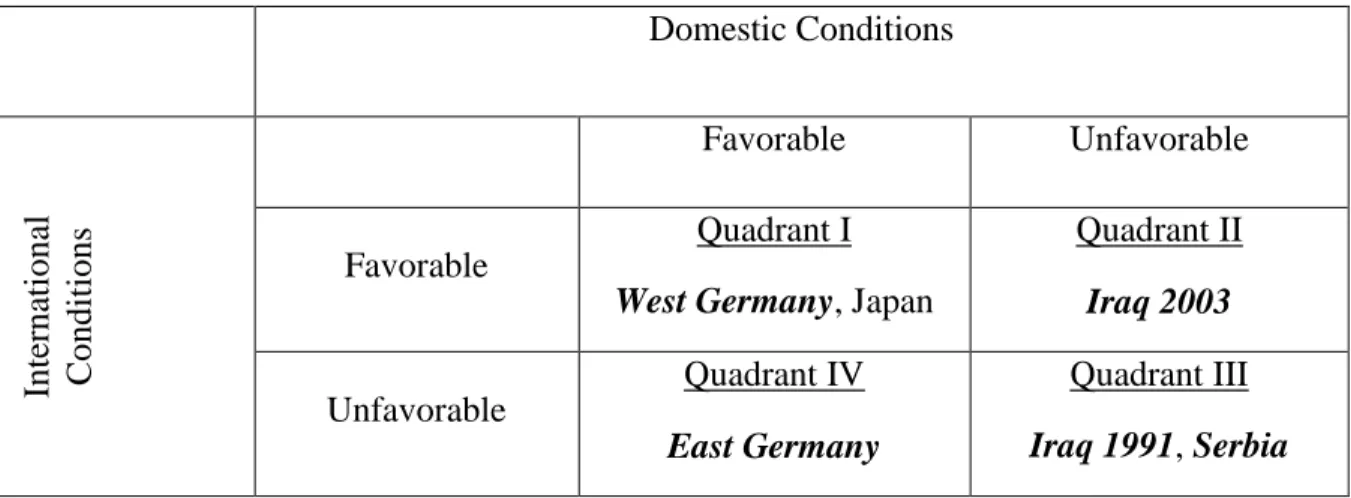
With this foundation to begin a study of strategic cooperation, the rest of this dissertation will flow as follows. In Chapter 2, I present my theory of strategic cooperation, to include theory and hypotheses dedicated to both general strategic cooperation and strategic cooperation specifically in the U.S. postwar context. In Chapter 3, I present my research design. In Chapter 4, I present my case study of the postwar relationship between the United States and Germany, which tests my theory against circumstances where both international and domestic conditions were favorable for higher qualities of cooperation (West Germany)
12
13
CHAPTER 2: A THEORY OF STRATEGIC COOPERATION
14
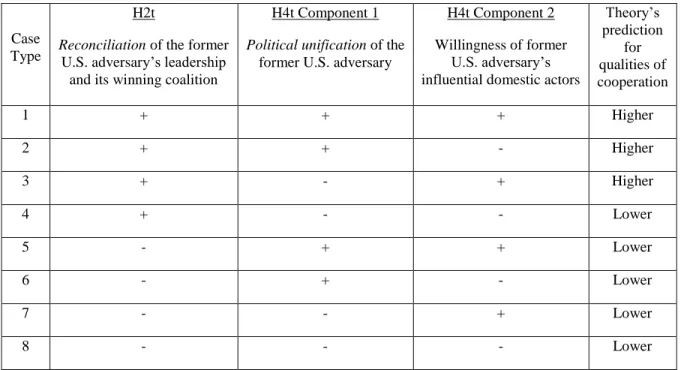
and influential domestic actors resist cooperation with the United States (likely the case), the qualities of cooperation will more likely be lower. From a policy perspective, former adversary reconciliation and political unification are the most challenging sources of credible commitment problems for the United States to mitigate. They, in turn, are crucial domestic variables that U.S. policymakers should consider in their cost, benefit, and risk analyses before committing U.S. resources in attempt to pursue postwar cooperation with a former adversary, particularly when the vision for that relationship’s depth and endurance of cooperation is ambitious (i.e., “strategic”).
In the remainder of this chapter, I first explain my theoretical perspective. I then theorize on how strategic cooperation works in general. Next, I identify several theoretical sources of credible commitment problems at the international and domestic levels that could influence a relationship’s qualities of cooperation. From this, I derive four testable and falsifiable general hypotheses about strategic cooperation. I then narrow in on strategic cooperation considerations that are specific to the context of this study—U.S. wars from World War II to present—and use this process to focus my general hypotheses to my interest area and assist with forthcoming case selection and policymaking recommendations.
Theoretical Perspective
The theory that I present in this chapter is pragmatic towards the “isms.” It is, at heart, a rationalist theory based upon the widely-proliferated bargaining framework. Thomas Schelling noted that “most conflict situations are essentially bargaining situations,” and this insight applies to my study of conflict that resolves to varied levels of cooperation.13 The
15
bargaining approach led me to consider problems of unenforceable commitments between states—that is, credible commitment problems. This inspired my commitment-based explanation of strategic cooperation outcomes that hinges on the insight that prospective partners who are fearful of credible commitment problems are less likely to enter into or follow through with strategic cooperation agreements.14 While this credible commitment construct may perhaps be an imperfect fit for some components of my theory,15 it is nonetheless a useful conceptual tool to help grapple with abstract phenomena and identify the potential problems that might undermine a bargain for cooperation. By proceeding with the premise that states must credibly commit to an agreement for cooperation in order to promote deep and enduring cooperation, we gain leverage on this puzzle, perfect fit or otherwise.
My theoretical perspective relies on a few important assumptions. First, states are important actors, but states are not the only important actors in this story. A state, corporately and through its government, declares war, commits to treaties, and importantly to my study, enters strategic cooperation agreements. However, subnational actors are also important in that they make strategic choices, sometimes on behalf of state interests and sometimes on behalf of their own interests, and this dynamic might have significant influence on a relationship’s qualities of cooperation.
14
See Reiter 2009, 5. This analytical approach is modeled upon Walter 2002 and Reiter 2009. 15
A purist might argue that a “credible commitment problem” requires the current conditions to support the honoring of commitments while a possible future condition may not support the honoring of commitments, thereby creating a time-inconsistency problem. I take a looser theoretical approach with the perspective that current conditions might support the affirmation (e.g., signing) of an agreement while future or current
16
Secondly, anarchy is unavoidable, and this necessarily creates a situation where state compliance with international agreements, such as a strategic cooperation agreement, is not automatic. There is no world government to enforce strategic cooperation promises. This creates uncertainty as to whether a pledge for strategic cooperation will be honored, even if made—that is, whether commitments to strategic cooperation are credible.16 This dynamic has an increased opportunity to affect a strategic cooperation arrangement’s qualities of cooperation because of the enduring nature of the intended relationship.
Third, state power certainly matters in postwar conflict resolution outcomes, especially when it comes to a state’s capacity to offer incentives for cooperation or a state’s need to seek external support through cooperation. However, power is not the only attribute that matters in this credible commitment story—other attributes could take precedence over actor preferences and decisions, especially over the course of an enduring relationship.
Institutions, for instance, may matter more or less to the credibility of commitments over the course of an enduring relationship. Recall that strategic cooperation, as I have defined it, is a voluntary arrangement—state actors eventually have substantive choices about how deeply and enduringly they will cooperate. Thus, institutions may be important to help resolve collaboration and distribution issues. Institutions can reduce transaction costs and thereby increase the payoff of cooperation. Institutions can help resolve problems of information deficits and asymmetries by enhancing transparency through monitoring and reporting. Institutions can facilitate cooperative reciprocity by discouraging backsliding when they have the ability to identify and punish defectors. Importantly, institutions can help
17
overcome certain time-inconsistency problems by insulating leaders from domestic pressures to renege on an agreement. All of these factors combine to help mitigate trust issues and institutionalize strategic cooperation arrangements so they can survive the inevitable “jostling” over the course of an enduring relationship.17
Identities may also matter to the credibility of commitments over the course of an enduring relationship. While I assume that states and actors are rational, their primary preferences may waver between material and ideational concerns at any given time. Materialism and ideation are both important and both are considered in my theory. One could envision circumstances where short-term preferences would favor material concerns but long-term preferences would bend towards ideational concerns—a Maslowian scenario of sorts where one does what one must in order to survive today in hopes that one might be able to improve one’s circumstances tomorrow. For example, a weak state might cooperate in the immediate aftermath of war to reap available benefits (e.g., material aid) to mitigate immediate security deficiencies. However, once that weak state is self-sufficient with respect to security (i.e., has regained enough power to neutralize an internal or external threat), ideational preferences over religion, ethnicity, culture, or regime-type, for instance, may inspire alteration to the status quo, thereby altering the qualities of cooperation. For some actors, ideational concerns may outweigh all others outright, regardless of immediate security or survival concerns. Importantly, as I will demonstrate later, the material benefits of strategic cooperation are often great, particularly after war. However, states do not always agree to such cooperation. Nor, when states do agree to cooperation, do states always “do
18
cooperation” well, even when there are obvious gains to be made. Materialism is clearly not the only driving factor of strategic cooperation outcomes!
A last assumption is that structural factors and actors are both important to strategic cooperation outcomes—both must be supportive to enable the highest qualities of cooperation. When able, I give privilege to structural factors and how structure influences an actor’s opportunity or willingness to commit to strategic cooperation. This is in hopes to improve the predictive power of my theory.
This pragmatic and somewhat eclectic theoretical perspective suggests that I should consider a great many conditions that could influence a relationship’s qualities of cooperation. Strategic cooperation agreements are intended to be enduring—a great many of these considerations might take primacy at one point or another and have a large influence on strategic cooperation outcomes.
How to Make Strategic Cooperation Work: the Ingredients
Cooperation between nations, especially the deep and enduring cooperation associated with a strategic cooperation agreement, takes effort—it is not without cost. Therefore, there must be some incentive to engage in strategic cooperation—something to gain. Further, since strategic cooperation is voluntary, both sides in a strategic cooperation arrangement have a vote on whether its intended cooperation will commence and whether it will continue.18
19
The Incentive for Strategic Cooperation
Accordingly, a strategic cooperation arrangement must generate what David Lake terms a “joint production economy”— an efficiency from cooperation that produces a net gain.19
This gain, however, could be material or otherwise. There are several potential benefits of strategic cooperation, including benefits to a state’s economy, security, and intangibles such as status and legitimacy.20 Using security as an example, Lake explains that:
“When joint production economies exist, the pooling of resources by two polities produces more security than the sum of their individual efforts; the two polities can thereby enjoy more security for the same cost or the prior level of security at less cost to themselves. Joint production economics are necessary for polities to cooperate at all: as cooperation is costly…there must be some benefit that is not available through unilateralism.”21
Importantly for this study, Lake finds in subsequent work that weaker (subordinate) states tend to spend less on their security than they would otherwise when they participate in security arrangements (often a component of strategic cooperation) with stronger states.22
Similarly, Alexander Cooley studies the politics of basing troops on foreign soil (which is also sometimes a component of strategic cooperation) and finds that “a foreign military presence can offer internal security and a guarantee that the host regime will survive an internal threat.”23
Aside from economic gains for certain domestic actors, Cooley finds that oversees U.S. basing arrangements (and I would argue strategic cooperation arrangements as
19 See Lake 1999.
20
See Lake 1999, Lake 2007, and Cooley 2008. 21 Lake 1999, 7.
20
well) “can also provide intangible benefits such as prestige, legitimacy, and association with the United States and the West.”24
These benefits are in addition to the benefits that an institutional agreement such as a strategic cooperation agreement can bring, specifically to the postwar environment. As noted previously, Ikenberry argues that a vanquished (weaker) state might improve its bargaining position, garner crucial immediate gains (e.g., reconstructive efforts), and assuage abandonment concerns (and thereby increase security) through such an arrangement. A victorious (stronger) state can reduce the need for costly coercive instruments and preserve gains for a longer period through such an arrangement. Theoretically, then, the spectrum of weak to strong states has potential gains from, and incentives for, strategic cooperation, and as we see often in the U.S. postwar context, even the most powerful state in the system has found incentive to pursue such cooperation.
Clearly not all strategic cooperation is of equal value to a given partner. For example, the robust U.S. strategic cooperation arrangement with Germany after World War II greatly increased U.S. economic influence in Europe at the expense of then-peer-rival Russia. This cooperative arrangement may well have greater utility to the United States than U.S. strategic cooperation arrangements with any number of Caribbean states that have produced more modest gains for U.S. influence at the expense of lesser-rival Cuba.25 As Lake explains, “The greater the gains from joint production, in turn, the more likely polities are to cooperate.”26
There may also be disincentives for cooperation that countermand the
21
incentives for cooperation, and I will discuss many of these disincentives later. But as long as there is a joint economy—as long as there is a net gain of some sort from cooperation— there is an incentive for strategic cooperation, and as I explained, there are numerous reasons for a joint production economy of some sort to exist.
The Mechanics of Strategic Cooperation: Commit, Cooperate, and Achieve
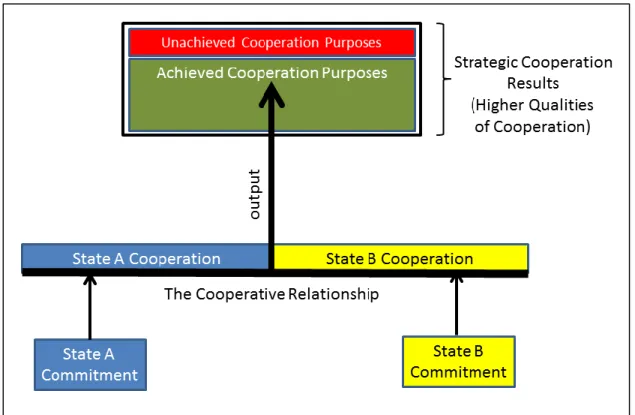
In accordance with bargaining theory, if prospective participants in strategic cooperation have something that they would like to gain from a strategic cooperation agreement, they must credibly commit to that agreement to signal to their own agents to cooperate with the other participant and to facilitate reciprocal cooperation from the other partner—states must credibly commit to the cooperative relationship to promote cooperation, let alone deep and enduring cooperation.27 This credible commitment is the foundation upon which the cooperation is built. Then, throughout the course of the enduring relationship, the states must “do” strategic cooperation—states must cooperate towards mutual interests in an enduring and non-trivial (deep, strategic) manner.28 These recurring demonstrations of cooperation serve two purposes. First, they serve to further their immediate arrangement objectives (e.g., build joint-use facilities). Second, they serve to signal continued commitment to the relationship. Ultimately, this cooperation yields the fruits of the arrangement—states, working together, achieve results. Depending on the success of the relationship, these results may be net gains or net losses, and may coincide more or less with each participant’s intended purpose for the arrangement. This relationship is graphically depicted in Figure 1 below.
27 For additional information on commitment theory, see Schelling 1960, Fearon 1995, Lake and Powell 1999, and Powell 2002.
22
Figure 1: General Strategic Cooperation Framework
In this study, as I have previously discussed, I focus on the ambition and realization of the depth and endurance of a relationship’s cooperation—its “qualities of cooperation”—as a tractable measure of these strategic cooperation results.29 These qualities of cooperation themselves reflect key cooperation purposes and are perhaps the most important aspect of a supposed strategic-cooperation relationship. Further, by utilizing these qualities of cooperation as my dependent variable, I am able to compare qualities of cooperation across cases, whether or not a strategic cooperation relationship was attempted.
As conceptualized in the simplified model in Figure 1, the cooperative relationship is like a beam held up by the credible commitment of the participating nations to their cooperative arrangement. The cooperative relationship itself is comprised of the cooperative
23
contributions of the participating states to the arrangement. That cooperation produces an output of results—the fruits of the cooperation—which is represented in the container above the output vector.30 This model represents a strategic cooperation relationship with higher qualities of cooperation. It is in balance. Both states have credibly demonstrated full commitment to the arrangement and are holding up their end of the beam. Both states are demonstrating full cooperation towards cooperative goals. The output signal is strong (thick), demonstrating that the sum of their joint efforts is greater than the sum of their individual efforts—synergy. The strategic cooperation arrangement is highly ambitious (the container above the output vector is large) and the strategic cooperation is yielding favorable results—a high proportion of these ambitious cooperative goals are being achieved. That is, this strategic cooperation arrangement has both a high level of cooperative ambition and a high level of cooperative realization.
To more practically illuminate the nuances of the linkage between commitment, cooperation, and strategic cooperation outcomes, consider this analogy of engaging in strategic cooperation with a specific state as compared to leasing a new car from a specific dealership. To achieve the ultimate purpose of the relationship—the lessee gets a new car and the dealership gets the lessee’s money—the lessee and the dealer must first obligate themselves by signing a legally-enforceable leasing agreement (i.e., both states must credibly commit to the strategic cooperation agreement). Then, both entities must do those things necessary to complete the transfer of the vehicle and maintain the vehicle warranty— registration, insurance, payments, oil changes, and so forth (i.e., agents of both states must
30
24
cooperate through continued action and, thereby, reinforce that credible commitment). Then, in all likelihood, the result will be a successful long-term lease (i.e., a strategic cooperation arrangement with higher levels of cooperation).
The credibility of commitments can vary and there are several mechanisms that can strengthen the credibility of commitments. Some of the possible mechanisms to strengthen credible commitments include costly signals, credible contracts, institutions, and third party guarantees.31
Costly signals send the message that one is “committed to the cooperative relationship”— the more costly the signal, the more credible the signal. Costly signals in more routine contexts might include an engagement ring in conjunction with a wedding proposal, earnest money for a home-purchase offer, or collateral for a loan. In the strategic cooperation context, irreversible investments can serve as a costly signal. For instance, if a prospective participant completes a high-value infrastructure project on the other’s territory, the resultant asset, which might be vulnerable to nationalization, can improve the credibility of the prospective participant’s commitment to the cooperative relationship. Additionally, in strategic cooperation contexts, costly signals often take the form of public pledges by state officials. For instance, the strategic cooperation agreement between the United States and Iraq is embodied in the Strategic Framework Agreement for a Relationship of Friendship and Cooperation between the United States of America and the Republic of Iraq (a.k.a., the SFA). U.S. Ambassador Ryan Crocker signed the SFA in 2008 and that SFA is available online to the public, along with updates to its implementation progress. Sending an even costlier
25
signal, President Obama recently traveled to a combat zone and addressed the United States (and, thereby, the world) on live television from Bagram Airbase, Afghanistan to announce his signing of the U.S.-Afghan Strategic Partnership Agreement.32 Such signals are costly because they are transparent and public (aside from being potentially dangerous, politically costly, and/or financially expensive). They announce to all interested parties that the cooperative relationship is “on.” This stakes the reputation of the sender (the individual and the state) on the conduct and success of the relationship. It also provides the receiver (the other participant) leverage—since the promises of relationship have been made public, others will know if the sender backslides on its promises. Backsliding, therefore, could be costly to the sender in other ventures and, accordingly, such costly signals provide reassurances to the receiver that the sender’s commitment to the relationship is credible.
A credible contract may or may not accompany the costly signal, and may or may not be backed by the strength of credible institutions or third party guarantees. A contract (e.g., a strategic cooperation agreement) with reasonably achievable aims reinforces the idea that the contract is feasible. This contract is more credible than a contract with impossible goals. For instance, a contract for a million-dollar home loan from a bank to a buyer would lack credibility if that buyer was broke, unemployed, undereducated, had a terrible credit rating, and had no prospects for future income. Even if both parties agreed to sign (commit) to the contract, there is little hope that the buyer would ever achieve the capacity to fulfill the contractual obligations (i.e., the loan payments). Additionally, a contract with enforcement mechanisms is more credible than a similar contract without such mechanisms. Credible institutions and third party guarantees can reinforce the idea that the contract is enforceable
26
and therefore protected. For instance, strong domestic institutions that respect the rule of contractual law might better protect the agreement in the future so that the contract will not be subject solely to the whim of an individual leader’s preferences.33 Institutional strategies like “cost-sharing” (splitting the cost of subcomponents of the contract so that those components fail without joint effort) and “tit-for-tat” (each participant gives a little at a time, waiting for reciprocation) can also help contractual credibility. Pertinent to my specific research question, credible U.S. commitment is more likely than credible former adversary commitment. This is because consolidated democracies, in general, offer the most credible contracts while states under transition are the most uncertain.34 While the United States is a consolidated democracy, its former adversaries almost never are. Rather, those former adversaries are often in political transition after war (e.g., democratizing like Germany, Japan, Iraq, and Afghanistan), which is the least favorable scenario for credible contracts.
Lastly, some strategic cooperation agreements are more loosely specified than others. Consider the differences in language between the renowned NATO Article 5 (invoked for the first and only time thus far after the terrorist attacks of September 11, 2001) and the sole paragraph on defense and security cooperation from the SFA between the United States and Iraq, as depicted below:
“The Parties agree that an armed attack against one or more of them in Europe or North America shall be considered an attack against them all and consequently they agree that, if such an armed attack occurs, each of them, in exercise of the right of individual or collective self-defence recognised by Article 51 of the Charter of the United Nations, will assist the Party or Parties so attacked by taking forthwith, individually and in concert with the other Parties, such action as it deems necessary, including the use of armed force, to
27
restore and maintain the security of the North Atlantic area.”—Excerpt from
North Atlantic Treaty Article 5 (emphasis mine)
“In order to strengthen security and stability in Iraq, and thereby contribute to international peace and stability, and to enhance the ability of the Republic of Iraq to deter all threats against its sovereignty, security, and territorial integrity, the Parties shall continue to foster close cooperation concerning defense and security arrangements without prejudice to Iraqi sovereignty over its land, sea, and air territory.”—Excerpt from SFA (emphasis mine)
As seen in this example, some strategic cooperation agreements may lack some of the binding language of other interstate contracts. Since some strategic cooperation agreements can be vague, open to wide interpretation, and therefore hard to enforce from a traditional credible contract perspective, credibly committing to strategic cooperation may be more heavily dependent on costly signals such as costly public affirmation of the relationship and recurring and enduring demonstrations of cooperation. When credible commitment to the relationship is in question, cost sharing and tit-for-tat strategies may help mitigate concerns.
Undermining Strategic Cooperation Outcomes: Credible Commitment Problems
While there are often joint economies to be gained from a strategic cooperation, cooperation is not always attempted. Nor, when strategic cooperation is attempted, do those cooperative relationships necessarily exhibit the same depth and endurance of cooperation, particularly in the postwar context. What explains these variations in strategic cooperation outcomes? I argue that variations in a relationship’s qualities of cooperation are primarily explained by credible commitment problems at the international and domestic levels.
28
strategic cooperation arrangement.35 While states might have much to gain from strategic cooperation, they must also have the opportunity and the willingness to credibly commit to a cooperative agreement. Else, their ability to send costly signals that they are committed to the cooperative relationship, initially and through recurring acts of cooperation, will be impaired. This will be perceived by the other participant and, in turn, decrease that participant’s willingness to contribute to the cooperative relationship. In such circumstances, a relationship’s depth and endurance of cooperation will suffer—one or both of the participants will backslide on the arrangement.36 As such, I consider in this study a great many potential variables from a wide range of literature that might affect the opportunity or willingness of a state to credibly commit to strategic cooperation.
Robert Putnam’s framework for two-level games, which analyzes the dynamics of international agreements at the international and domestic levels, is useful to this study as well.37 Reflecting on Putnam’s insights, one must consider the wider international audience (which might include a range of states from friendly to hostile towards the participants or the cooperative arrangement) and domestic audience (which might likewise include a range of populations from friendly to hostile towards the participants or the cooperative arrangement)
35 See Most and Starr 1989.
36 To demonstrate how these credible commitment problems manifest (play out) mechanically (as a causal mechanism), consider a hypothetical prospective strategic cooperation arrangement between two states— Partner A and Partner B. When Partner A’s opportunity or willingness to commit to the strategic cooperation arrangement is reduced, there will be a corresponding decrease in Partner A’s opportunity or willingness to send a costly signal to affirm its commitment to strategic cooperation. For example, Partner A’s leaders will struggle (or fail) to send a costly signal (i.e., publicly affirm the partnership as President Obama did in Afghanistan, approve a liberal status of forces agreement as Germany did, or allow robust basing as Japan did) to provide assurances to Partner B that commitment problems will not undermine Partner A’s ability to contribute to the cooperative arrangement now or in the future. In this case, Partner B will have less assurance that Partner A will have the opportunity and willingness to abide later by any promises it makes today. This creates a time inconsistency problem, a.k.a. a commitment problem. In such circumstances, the strategic cooperation outcome will suffer—one or both of the partners will backslide on the arrangement.
29
and how this dynamic might affect a state’s opportunity and willingness to credibly commit to a strategic cooperation agreement. A state’s agents (e.g., its leaders) might voluntarily defect from a cooperative relationship of their own accord (i.e., they lack willingness), or they might involuntary defect when they are unable to deliver on promises because of international or domestic forces (i.e., they lack the opportunity).38 Cooley observes this as well in his study on the politics of basing, explaining how this dynamic might affect a bargaining situation:
“rulers of host countries are involved in two sets of hierarchical political relationships, or nested hierarchies, in that they manage relations with the sending39 state while simultaneously providing public goods and selective incentives to their domestic political clients and supporters, who are also known as the ‘selectorate.’ These dual imperatives interact in a two-level game in which rulers use base-related [or, for this study, we could substitute “strategic-cooperation-related”] issues and resources for their domestic political purposes but can also invoke domestic constraints in their negotiations with the sender.”40
With all of this in mind, I consider variables that emanate from both the international and domestic levels that might affect the opportunity or willingness of a state to credibly commit to a strategic cooperation agreement.
Bruce Bueno de Mesquita et al.’s selectorate theory is also applicable to this study.41 Reflecting on the insights of selectorate theory, one must consider both the state leadership and other influential subnational entities as one considers the opportunity and willingness of a state government to credibly commit to a strategic cooperation agreement. Selectorate
38
Putnam 1988, 438.
39 The sender here is the state that is sending forces to base on the host country’s soil. 40 Cooley 2008, 11.
30
theory compliments Putnam’s theory in that it specifies several important types of actors at the domestic level that might influence a relationship’s qualities of cooperation. Importantly, it assumes, as do I in this study, that leaders want to stay in power.42 Strategic cooperation can provide a variety of benefits, resources, and opportunities to leaders in achieving those ends.43
The selectorate is the enfranchised portion of a state’s residents that has a formal role in selecting its government’s leadership. The selectorate can be large or small. For instance, in a consolidated democracy with widespread suffrage, the selectorate could be quite large in proportion to the resident population. In an autocracy, the selectorate may be quite small, perhaps just a few powerful elite. The winning coalition is the subset of the selectorate that controls whether a leader remains in power. The winning coalition may be large or small as well. For instance, in a consolidated two-party democracy, the winning coalition may be as large as the simple majority (i.e., 51%) of the voting population. In an autocracy, the winning coalition may be quite small, consisting of only a handful of powerful elite with the power to suppress the preferences of the masses. Large winning coalitions often encourage leaders to provide more public goods to stay in power, while small winning coalitions often encourage leaders to provide more private goods to their smaller pool of vital supporters to stay in power. Importantly for this study, selectorate theory draws one inward to look at leaders, those who keep leaders in power (i.e., the winning coalition), other influential
42 Following the approach of Cooley, I also assume that state leaders “value and pursue, above all else, their own domestic political survival. Rulers certainly value other things, such as following their political ideologies, improving domestic conditions, and securing the national interest, but rulers wield power in both the domestic and foreign policy arenas in order to maximize their own political benefit and maintain their office” (Cooley 2008, 10).
31
domestic actors who might challenge the leaders and winning coalition based on their own strategic cooperation preferences, and how all of these types of actors are rewarded or punished by a given strategic cooperation agreement.
Selectorate theory highlights the possibility that a strategic cooperation agreement could become politicized. As Cooley finds with respect to hosting foreign bases, strategic cooperation with a particular state might mean different things to different actors, and a single actor’s views might change considerably over time.44
A given strategic cooperation agreement might represent a welcomed opportunity for prosperity or security to some, while at the same time representing unwanted competition and meddling to others. In the postwar environment, a given strategic cooperation agreement might represent a welcomed linkage to a liberator from oppression to some, while at the same time representing an untoward, lingering tie to an oppressor to others. As a practical example from U.S. history, when basing presence is a security byproduct of a strategic cooperation agreement, that basing could be seen as an endorsement of a political regime to some, or a “symbol of violated national sovereignty, U.S. imperialism, and political struggle” to others.45
Other actors might be completely ambivalent to the cooperative relationship. This dynamic creates cleavages that can be exploited politically by actors who are in or out of the winning coalition or selectorate. Leaders, then, must be vigilant to appease their winning coalition or that winning coalition might defect and allow the selectorate to replace those leaders with others who match their strategic-cooperation-willingness level (e.g., pro-strategic cooperation or
44 Cooley 2008, xii.
32
otherwise). Leaders must also be mindful of other influential actors who might use a strategic cooperation issue as an opportunity or motive to challenge the leader.
Accordingly, while I consider state behavior, I also consider the behavior of several other important actors that matter to this story. As a review, external (international) actors that have the power to influence the cooperative relationship matter, and these actors can promote or undermine the relationship. Domestic leaders—those policymakers who make the decision to commit to the cooperative relationship (e.g., a president or parliament)—and their winning coalitions matter as well. For autocracies, the winning coalition could be a small group whose loyalty can be secured with private goods. For democracies, this is typically a large group that demands public goods. Other influential domestic actors that have the opportunity and willingness to influence the cooperative relationship also matter. They may have their own interests that conflict with those of the state, its leaders, or the winning coalition, and they may be able to challenge the government for the loyalty of the population and effectively undermine a strategic cooperation agreement. They might also resort to extra-legal means to intimidate or exploit, and in so doing, undermine the cooperative relationship. A recent example might be Muqtada al-Sadr in Iraq whose followers violently challenged both the Iraqi government and U.S. forces, and in doing so, the U.S.-Iraq cooperative relationship.
33
leaders, their winning coalition, and other influential domestic actors). I prioritize, narrow, and simplify those variables in a structured and methodical way using Most and Starr’s framework—what most affects a state’s opportunity and willingness to credibly commit to strategic cooperation agreements and, in turn, cooperate to achieve desired results?
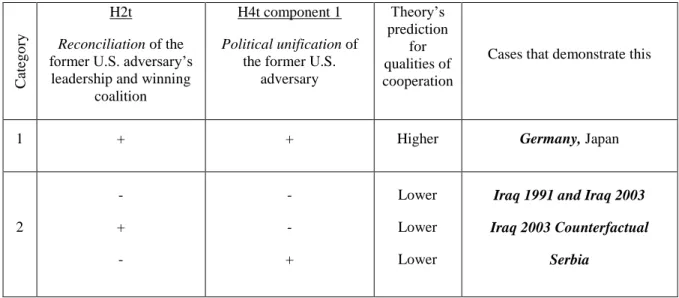
I identify eight sources of credible commitment problems at the international and domestic levels—my independent variables that affect my dependent variable of a relationship’s qualities of cooperation. At the international level, I find three potential sources of credible commitment problems: spoilers, competitors, and other international conditions. At the domestic level, I find five potential sources of credible commitment problems: disinterest, trust, reconciliation, state capacity, and political unification46 problems.
To avoid confusion, I caution the reader that these independent variables should not be assumed as “good” or “bad” for a relationship’s qualities of cooperation based on the normative connotation of their labels. Much of my terminology to label the sources of credible commitment problems was chosen to best match extant literature (which talks about reconciliation, not irreconcilation; trust issues, not mistrust issues; political unification, not political disunification, and so forth). “Trust” is normatively good. “Spoiler” is normatively bad. “Other international conditions” is normatively neutral. Yet problems in any of these “sources of credible commitment problems” would be “bad” for a relationship’s qualities of cooperation. For instance, the act of reconciliation may be normatively good for cooperation, but the related source of credible commitment problem is a lack of or a deficiency in
34
reconciliation that would undermine a relationship’s qualities of cooperation. The independent variable’s “reconciliation” label is simply used to identify the source-type for the credible commitment problem in a way that is parsimonious, natural, and familiar.
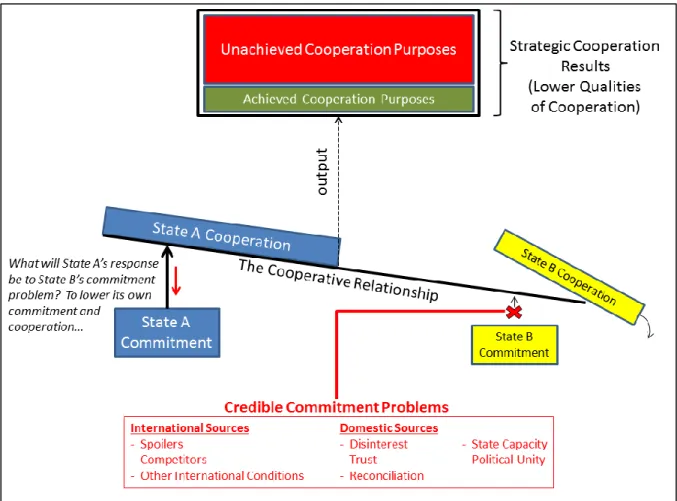
Figure 2 below graphically depicts the effects of these sources of credible commitment problems on my original model depicted in Figure 1.
Figure 2: General Strategic Cooperation Framework with Credible Commitment Problems
35
could undermine the relationship at its very foundation—the opportunity or willingness of one or both of the participants to credibly commit to the strategic cooperation relationship. This model represents a strategic cooperation relationship with lower qualities of cooperation. State B has credible commitment problems causing State B’s end of the beam (i.e., the cooperative relationship) to fall. State B’s deficiency in credible commitment causes State B’s cooperation to fall off—the progress towards achieving immediate cooperation objectives is faltering, and State B’s opportunity and willingness to recurrently signal credible commitment through cooperation towards the relationship is undermined. The strategic cooperation output signal is weak—the states are not achieving the desired joint economies. The cooperative relationship is highly ambitious (the container above the output vector is large) but is yielding unfavorable results—a high proportion of its ambitious cooperative goals are not being achieved. That is, this strategic cooperation arrangement has a high level of cooperative ambition but a low level of cooperative realization. Further, State B’s credible commitment problem is sensed by State A and, accordingly, State A feels the increasing burden of the relationship’s load. State A also observes State B’s commensurate drop-off in cooperation, the reduced output signal, and the unfavorable cooperation results. State A must decide how to respond to State B’s credible commitment problem. State A then reduces its own commitment and cooperation. The degenerative cycle might then repeat, depending on the circumstances, and further erode the relationship’s qualities of cooperation.
International sources of credible commitment problems
36
could significantly undermine strategic cooperation results or even preclude an attempt of strategic cooperation outright.
A spoiler is a state that has both the opportunity and the willingness to preclude the possibility of strategic cooperation by force or coercion. This creates an opportunity problem for both of the prospective strategic cooperation participants—even if they are willing to cooperate, a spoiler might preclude such cooperation at any time of its choosing. An example of this would be the Soviets in the aftermath of World War II and throughout the Cold War. The Soviets simply would not have allowed the United States and Eastern Bloc nations to engage in strategic cooperation at that time. A spoiler is not synonymous with threat, enemy, or nemesis. North Korea is currently an enemy of the United States and a threat to South Korea, but lacks the opportunity (power) to spoil the fruitful cooperation between Washington and Seoul. After World War II, the United States was neither enemy nor threat to Germany (quite the opposite), but was a spoiler to any potential strategic cooperation between the Russians and Germans in the Western zones it occupied.
37
renege on its promises in the future and involuntarily defect from the cooperative agreement due to interference from the spoiler (that is, if the spoiler allows the prospective participants to communicate and come to terms for a strategic cooperation agreement in the first place).
A competitor is a state that has the opportunity and the willingness to provide a more desirable outcome for one of the prospective strategic cooperation participants (I will call this participant the target state)—a better offer. This creates a willingness problem for the target state—even if it has the opportunity to engage in strategic cooperation with the other prospective participant, the target state might willingly succumb to a competitor’s higher bid at any time of the target state’s choosing. Importantly, there must be an element of exclusivity to the competitor’s offer—something that precludes the target state from strategic cooperation with both the competitor and the other prospective participant. The U.S. cooperative relationship with Germany after World War II was not entirely exclusive. Germany has enjoyed close cooperation with both the United States and the United Kingdom since that time. However, had West Germany pursued strategic cooperation with Russia after World War II, it is entirely conceivable that the United States would have forced West Germany to “choose sides” or lose U.S. support.
38
policymakers or members of the target state’s winning coalition (if that state’s laws allow or if there is corruption) that could not be equaled or exceeded by the other prospective participant and that would be forfeit if that strategic cooperation were to transpire. If State B from my model has a competitor as a source of credible commitment problems, State A has good cause to fear that State B would renege on its promises in the future and voluntarily defect from the strategic cooperation agreement to capture a higher payoff from the exclusive cooperation rents of the competitor.
39
State B would renege in the future on critical cooperation promises (such as not using the proceeds from the cooperative relationship to harm its residents or others). State B cannot credibly commit to being a non-pariah in the future and, therefore, cannot credibly commit to a strategic cooperation agreement with another state that is unwilling to closely cooperate with such types.
Domestic sources of credible commitment problems
I identify five sources of credible commitment problems at the domestic level that might undermine a relationship’s qualities of cooperation: disinterest, trust, reconciliation, state capacity, and political unification problems. As with credible commitment problems from international sources, credible commitment problems from any one of these domestic sources could significantly undermine strategic cooperation results or preclude an attempt of strategic cooperation outright.
40
problem actually has a different root cause. For instance, if a prospective participant is interested in the same net gain (the one unit of utility) from strategic cooperation with a different state, just not from strategic cooperation with the original state, this indicates a different root cause (source) for the credible commitment problems such as a trust problem or a reconciliation problem. If disinterest is because there is more to gain from another cooperative agreement and that other agreement is exclusive (one cannot have both), this also indicates a different root cause for the credible commitment problem such as a competitor problem.
Disinterest in the strategic cooperation gains on behalf of one or both of the prospective participants could be caused by complacency or pride—a prospective participant might feel that it can forego the benefits from any strategic cooperation and either live with its existing circumstances or achieve its goals unilaterally. In a wartime scenario, for instance, the damage that a nation incurs during a war may not create sufficient security challenges or economic strife as to warrant the complications of external commitments for states that traditionally prefer to avoid such entanglements.
41
powerful adversary to help with postwar reconstitution of the weaker adversary is insufficient and this leads to limited cooperative gains for both sides of a prospective relationship. Where there is less to gain from a strategic cooperation relationship, there will be less interest. Note, however, that when multiple cooperative relationships are possible, it would be rational to capture any available gains, even if those gains are very modest.
In some cases, there may actually be a net loss to a potential strategic cooperation relationship, and this may cause strong disinterest. At the macro level, for instance, the security gains from a cooperative relationship may be far outweighed by the domestic political losses or extralegal (e.g., terrorist) losses of a specific joint-security endeavor (e.g., host-basing for participant military forces). At the micro level, some actors might fear that a given cooperative relationship (say, with Japan) might precipitate unwanted competition to the domestic industry that supports their livelihood (say, auto manufacturing).47 Or perhaps the strategic cooperation arrangement would interfere with an actor’s ongoing rent-seeking (e.g., corruption). In such situations, affected actors might very well view the relationship as a threat. However, for these concerns to be causal in undermining the relationship, there must be insufficient means to mitigate them or alter the relationship to accommodate them (e.g., considering my examples, states could not exclude “auto imports” or “basing” from the strategic cooperation agreement for some reason).
Reflecting back on my model, if State B has a disinterest problem that State A cannot remedy (e.g., by increasing State B’s share of cooperation gains), State A has cause to fear that State B would voluntarily backslide in the future on its strategic cooperation promises
47
42
(provided that State B agrees to strategic cooperation in the first place) to forgo the cost of cooperation and forfeit the cooperative gains (or losses) that State B is insufficiently interested in to begin with. This serves to degrade a relationship’s qualities of cooperation.