285
STUDIES AND RESEARCH CONCERNING INDEPENDENT DISC
HARROWS
ALEXANDRU TUDOR, GLODEANU MIHNEA, VASILE CRISTIAN University of Craiova, Faculty of Agriculture
Keywords:independent disks, harrow, seedbed preparation
ABSTRACT
Equipments for seedbed preparation equipped with independent disks achieved qualitative indices that agro requirements imposed, especially for crops that are established in autumn. Independent disc harrows are simple in constructively and are safe in operation.
From arable land, about 37% is busy by crops that are established in summer-autumn, the rest arable land being for spring crops.
Seedbed preparation with light disc harrow leads to: higher fuel consumption, increasing of employment, increasing the duration of the campaign and the execution of an inadequate seedbed in conditions of low soil moisture.
INTRODUCTION
In this context, it promotes a disc harrow and organs (additional) for shredding, destinated for 120 -160 hp tractors, in order to improve stubble technology and seedbad preparation on the fresh plowing on which has been set up summer-autumn crops.
Soil works performed by independent disc harrows are characterized by good results of shredding, mixing and mobilization of soil, carried out under a low humidity of the soil (Cojocaru I. et al., 2000).
From constructive and functional point of view, disc harrows has the advantage of easily pass over any obstacles that appear in working process, and the spherical active disks, have a low degree of wear (due to the fact that the requests in the work process are distributed along the length of the cutting edge) (Alexandru T. and M. Glodeanu, 2009).
MATERIAL AND METHODS
Presentation of the experimental variant
Independent disc harrow TERRA DISC 300 manufactured by the company Vogel & Noot executed in a single pass, seedbed preparation in fresh plowing, or unploughed land, where crops are established (to sowing grain cereals and weeding plant, at depths ranging from 5 to 10 cm). Is used on fresh plowing in all types of soil found on flat land, or with a slope to 6 °.Plowing must harrowing as soon as they were made, because these became harden, can not be mince and increase water loss through evaporation.
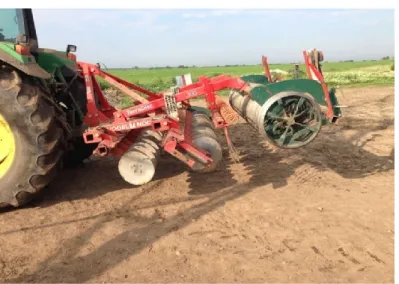
Independent disc harrow TERRADISC 300 (fig. 1) is a towed agricultural equipment at lateral thrusts (category II SR ISO 730-1 + C1: 2000) of tractors of 120-160 hp.
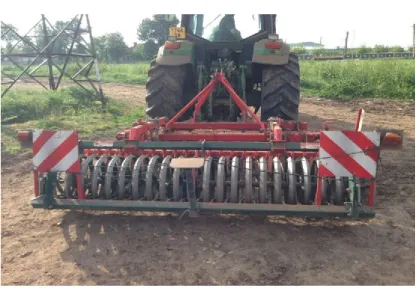
From the constructive point of view, harrow comprises a frame on which are mounted set of disks, the bar with elastic fingers and the roller for grinding and leveling the soil.
286
Fig.1. Independent disc harrow TERRADISC 300 manufactured by the company Vogel & Noot.
Battery with disks (front + rear) includes two batteries arranged in two rows with a angle of inclination to the direction of travel of 17 °, respectively 23 °. Batteries consist of flat disks, roller bearings, shaft mounting and boom support. The discs have an external diameter of 460 mm and are made of manganese sheet metal (fig. 2).
Fig. 2. The layout of the batteries with disks.
The attaching of disks on the frame is made through cylindrical roller rubber, which provides elasticity, but also a permanent vibration of disks (which contributes to reduction the tensile strength and fuel consumption reported to the area worked).In the same time is ensured crossing over any obstacles emerged during operation.
287
Fig. 3. Shredding and leveling roller.
Test method
In the tests were determined or calculated in accordance with the procedures in force, following indices(Alexandru T. and M. Glodeanu, 2009; Cojocaru I. et al., 2000; Glodeanu M., et al., 2015):
a) Qualitative indexes of work:
1) Averageworkingdepth (am) in cm. It iscalculatedwith the following relation:
n a
a n
i
m
1 [cm] (1) where: ai is the working depth, measured cm;
n - number of measurements performed. 2) Averagewidth (Bm) in cm, withaid of relation:
B
B
n
m
i n
1[ m ] (2)
where: Bi is the working width, measured in m;
n - number of measurements performed. 3) The shreddingsoildegree (Gms) in%.
The main indicator of the workqualityis the shreddingdegree of soil.For determinationswasdelimited a soilsamplewith size of 1m x 1m (usingmetric frame).From the samplewereseparatedsoil fractions with size of lessthan 50 mm, from the lumps with size largerthan 50 mm.
Shreddingsoildegreeis the proportion by weight of soil fractions with a satisfactoryshredding, respectively lumps with the size of maximum 50 mm (reported to the total weight of the soilsample) It iscalculatedusing the followingequation:
% 100 1
n M M
G n
ti ci
m (3)
288 n - number of measurements performed;
5) Soillooseningdegree in %. Is determinedwith relation:
100
1 2
2 1
n h
h h
G
n
as [%] (5)
where: h1 is the distance to the ground before disking, in cm;
h2-the distance to the ground after disking, in cm.
b)Energy indices:
1) Effective working speed (Ve) in km / h. It was calculated using the relation:
t s
Ve 3,6 [ km/h ] (6)
where: s is the covered linear space, in m; t - travel time of the covered space, in s;
2) Fuel consumption per hectare (q) in l / ha. It was calculated with the relation:
ef
W
Q
q
[ l/ha ] (7)where: Q - is the hourly fuel consumption in l/h; Wef - hourly work capacity at effective time, in ha/h.
3) Hourly work capacity at the effective time (Wef), in ha / h. It was calculated with the relationship:
Wef 0 1, B vm [ ha/h ] (8) where: Bm is the average working width, in m;
v – real working speed in km/h.
RESULTS AND DISCUSIONS
Tests under laboratory and field conditions-operation were carried out in aggregate with tractor JOHN DEERE, during April 2015- October 2016 in accordance with specific test procedures PSpI-01.10.29 "The test disc harrows" and PSpI-01.00.33 "Determination of energy indices for agricultural aggregates".
Field tests - lab were performed in the following conditions: - Soil type – mold;
- Previous culture; - wheat, beans, peas;
Autumn tests were performed with soil moisture in 0...10 cm layer of 12,9% (fg. 4). Spring tests were performed at a soil moisture of:
289
Fig. 4. Aspects during working with independent disc harrow TERRA DISC 300.
The main qualitative indices of work achieved are presented in table 1.
Table 1 Qualitative indices of work achieved by independent disc harrow TERRA DISC 300
Qualitative indices of work U.M. Autumn–ploughed field
Spring–ploughed field
Spring- unploughed field
Averagedepthworkamed cm 6,7 8,2 6,1
AverageworkingwidthBmed m 2,87 1,91 2,92 ShreddingsoildegreeGm % 85,6 92,7 90,3 Thedegree of incorporation in soil
of cropresiduesGv
% 95,3 96,7 97,8
SoillooseningdegreeGas % 18,7 24,5 20,7
Analyzingthe data fromtable 1 isfoundthattheachievedworkindices are: - averagedepthworkamed = 6,7...8,2 cm;
-averageworkingwidthBmed = 2,87...2,92 cm;
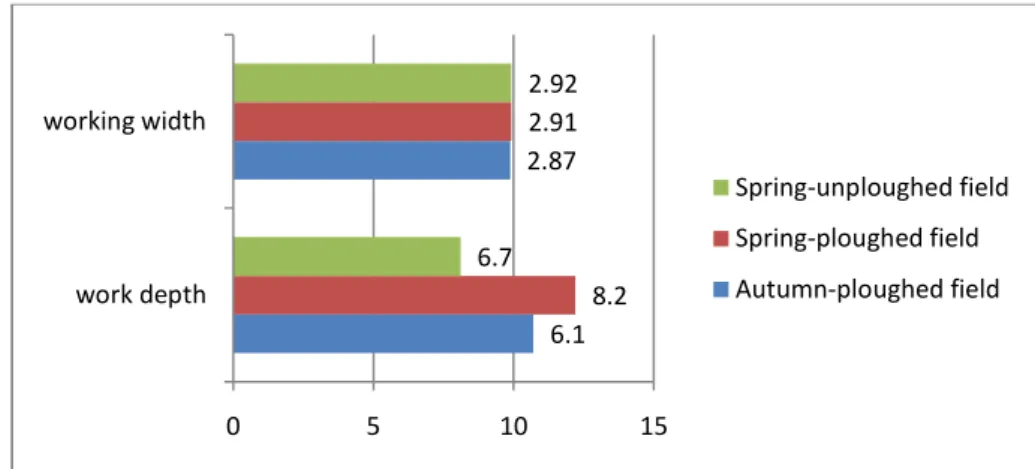
In figure 5 ispresented the graph of working variation indices of TERRADISC 300 harrow.
Fig. 5. Working variation indices of TERRADISC 300 harrow.
From the graph presented in figure 5, it can be observed that effective working width of the harrow has an insignificant reduction (0.8-1,13 %, ) of the theoretical value of 3 m.
Concerning the working depth is found that for unploughed field, we have the lowest value of 6.1 cm. The greater value of 8.2 cm is obtained for field plowed in autumn and processed with the disc harrow in the spring (when the soil is processed for establishment of the sunflower crop).
6.1 2.87
8.2 2.91
6.7 2.92
0 5 10 15 work depth
working width
Fig. 6. Working variation indices of TERRADISC 300 harrow.
Analyzing data recorded is found that, from the point of view of the
agro-technical conditions are fulfilled, the values being over 85%. The lowest value was recorded in autumn, when soil moisture was lower compared with levels achieved
when the values has been exceeding 90%.
The main energy indices achieved by the individual disc harrow TERRADISC 300 are presented in table 2.
Energy indices achieved by the individual disc harrow TERRADISC 300 Energy indices
Work speed vl
Workingcapacity at theeffectively time: Wef
Fuel consumption Q
Figure 7 present the graph of variation of disc harrow TERRADISC 300.
Fig. 7. The variation of energy indices achieved by the individual disc harrow TERRADISC 300.
78 80 82
Shredding soil degree
0 2 4 6 8 10 12 14 Work speed 11.17 12.4513.35 290
Fig. 6. Working variation indices of TERRADISC 300 harrow.
Analyzing data recorded is found that, from the point of view of the
technical conditions are fulfilled, the values being over 85%. The lowest value was recorded in autumn, when soil moisture was lower compared with levels achieved
when the values has been exceeding 90%.
The main energy indices achieved by the individual disc harrow TERRADISC 300 are
Energy indices achieved by the individual disc harrow TERRADISC 300 U.M. Autumn–
ploughed field
Spring–ploughed field
km/h 11,17 12,45
ha/h 2,12 2,7
l/ha 5,31 4,86
Figure 7 present the graph of variation of energy indices achieved by the individual
energy indices achieved by the individual disc harrow TERRADISC 300.
Shredding soil degree degree of incorporation in soil Spring-unploughed field Work capacity Fuel consumption 2,12 5.31 2.7 4.86 3.45 3.58 Autumn-ploughed field Spring-ploughed field Spring unploughed field
Fig. 6. Working variation indices of TERRADISC 300 harrow.
Analyzing data recorded is found that, from the point of view of the shredding of soil, technical conditions are fulfilled, the values being over 85%. The lowest value was recorded in autumn, when soil moisture was lower compared with levels achieved in spring,
The main energy indices achieved by the individual disc harrow TERRADISC 300 are
Table 2 Energy indices achieved by the individual disc harrow TERRADISC 300
Spring- unploughed field
13,35
3,45
3,58
energy indices achieved by the individual
energy indices achieved by the individual disc harrow TERRADISC 300.
unploughed field
291 Analyzing the data from table 2itfollowsthat: - work speed ve = 11,17...13,35 km/h;
-workingcapacity at theeffectively time: Wef= 2,12…3,45 ha/h; - fuel consumption Q = 3,58…5,31 l/ha.
The data presented in figure 7 shows that independent disc harrow ensures high working speeds compared with aggregates which equipping agricultural holdings in the area (which operate with Romanian machinery). Also we find that there is provided a high hourly productivity of 3,45 ha for a fuel consumption of 3,58 l/ha.
CONCLUSIONS
From the analysis of data obtained in the tests resulted the following conclusions: - Independent disc harrow TERRADISC 300 for 160 hp tractors tractor was performed with two batteries in parallel and with additional shredding organs, with working width of 3,0 m;
- Independent disc harrow TERRA DISC 300 is used in summer-autumn (spring in certain situations) on fresh plowing, in all types of soil located on the flat land, or slope to 6;
- Independent disc harrow TERRA DISC 300 is robust, simple in terms of construction and functionally, easy to handle, maintained and operated in the working process;
- This harrow is of the carried type, coupling operation being performed by the one man;
- Independent disc harrow TERRA DISC 300 performed quality work, with a high shredding degree of the soil and high values of thedegree of incorporation in soil of cropresidues;
-Regarding the energy point of view independent disc harrow TERRA DISC 300 achieve a equal fuel consumption (compared with GDU 3,4 harrow), considering that work capacity is two-fold.
BIBLIOGRAPHY
1. Alexandru T. și M. Glodeanu, 2009, „Exploatarea maşinilor agricole” , Editura Sitech, Craiova.
2. Cojocaru Iosif şi colab., 2000, “Noi soluţii tehnice în concepţia grapelor cu discuri”, Revista "Mecanizarea agriculturii", nr.7 Bucureşti.
3. Glodeanu M., Alexandru T., Boruz S., Sărăcin I.,2015 „Maşini agricole şi horticole I – Tipuri reprezentative,reglaje”, Editura Sitech, Craiova.