STATISTICAL ANALYSIS AND MODERN CONCEPTS
REGARDING THE BENEFITS OF USING COMPOUND FEED
CRISTIAN VASILE, MIHNEA GLODEANU, TUDOR ALEXANDRU
Faculty of Agronomy, University of Craiova, Romania
Keywords: animal feeding, productivity, statistical analysis, grain, compound feed
ABSTRACT
The activity of raising animals is one of the oldest occupation of humans, due to the fact that this way can be provided a very important source of food. Considering these facts, we can say that zootechny is a very important branch of agriculture and this is why the specialists from this field are making huge efforts to continously improve this field of activity. In this sense, ways of feeding animals as efficient as possible have been studied and factories of compound feed have been developed, equiped with modern technologies, with high degree of mechanization, automation and computerization, with high levels of productivity and with specific consumptions reduced.
In this article are presented some of the advantages of using compound feed for feeding the farm animals and also studies and statistical analysis regarding the efficiency of using different recipes of compound feed, created for every species of animal and also for every age categories.
INTRODUCTION
Our country aims as essential economical targets the development of all areas of activity and their full integration into EU structures. This involves, among other things, aligning both industry products and consumer products to the Community rules.[3, 4]
The zootechnics represents „the branch of continous fire” of the agriculture and also it is the real indicator of the overall economy with important repercussions on the living standard of the population reflected in consumption of products from the zootechnic sector.[1]
One of the most important ways which can contribute at the development of zootechnics is complete and complex mechanization, introduction of automation in the context of industrialization of the sector, in the purpose to optain flexible equipment, performance and adequate capacity to produce concentrated feeds in agriculture farms with zootechny profit. Such installations reduce the transport costs to maximum, ensure the consistent food, fresh and avoid losses of raw materials, at the same time creating the possibility that the, depending on the specific recipe, in the homogenization phase of the flours results to be able to introduce various ingredients (example: microelements, vitamins, animal flours, mineral salts etc).[6]
MATERIAL AND METHOD
Through the statistics and the analyses made in time by the specialists from zootechny domain were demonstrated the many advantages provided of using compound feeds for animal feeding, actually what has determined many farmers to use these compound feed. But, for obtaining high performances, every farmer must to know what kind of compound feed uses depending on the animal species exploited and the category of animals (age, weight) at which wants to distribute them.[1, 4, 6]
demands and changes which took place in Brazil and China in recent years (statistics show that during the last years these countries are world leaders regarding the increasing rate in producing combined forages).
In figure 1 it is presented a graphic statistics about the repartition of the fodders consumption combined at global level. So, it is seen that, on species of zootechnics-farm animals, the biggest combined-fodders demands were registered for fowls and porcine as the production of combined-fodders for taurines tends to diminish. Also, knowing the evolution from the last years, it can be said that the production of combined-fodders for aquaculture knew an important developments, specially due to the reduction of the oceanic fish stocks and the crisis on the meat-market generated by the bird flu and the swine flu.
In next years the production of combined feed is estimated to increase worldwide with an average of 1% and higher increases, over that average, are expected to be registered in countries of the South America due to the fact the price of the ingredients used in recipe of preparation increases in other areas of the world.
Figure 1: The distribution of feed consumption worldwide on animal species
As against the agricultural surface existing in UE, which represents 41% total surface of the Union, Romania is in advantage because it holds a proportion of agricultural surface much bigger, of about 62%. In this conditions, Romania has an essential advantage as against the other countries from UE, namely a much bigger proportion of the agricultural surface from the total surface of the country.
Given the current productions of grain and oleaginous, which show that Romania means for E.U. an important producer of corn and wheat, the cereals with the highest share in compound feed, and taking into account Romania’s agricultural potential, our country could be in the future one of the most important suppliers compound feed and meat default.[2, 5]
Also, from the present statistic information, it is observed that the date 1 January 2007 found Romania as the European country with the bigger number of farmers, approximately 37% from the total working population. These represent almost 40% from the number of farmers currently existing in UE, where the proportion of the population working in agriculture from the entire number of the working citizens is only 5,3%. The level of tehnical endowment in agriculture is precariously, returning only one tractor for every 60 ha, compared to 12.7 ha/tractor which is the European average. This and other causes led to lower average yield per hectare, representing less than 50% towards the main countries of the E.U.
According to studies conducted by specialists in this field it is estimated that, in the coming years, the compound feed industry in Romania will register a growth rate of 5-7% / year. These increases will take place amid financial support through the common agricultural policy in the countries of the European Union and due to productivity increases expected as a result of the zootechnical investments.
The positive development of animals husbandry activities is determined by population growth and the growing demand in the food market protein sources (meat, milk, eggs and fish) can be solved only through specialized livestock farms. Satisfaction of the consumers requirements must be accomplished in a profitable way and in secure conditions both from ecologically and also in terms of quality and quantity.
Success of intensive livestock farming is based on several aspects: high capacity species genetics, modern growing technology, veterinary conditions carefully controled and competent management.[2, 5]
Also, very important is the quality and cost of feeding animals with the best recipes of combined feed, which contain all the necessary ingredients (figure 2).
Figure 2: The elements of combined fodder recipes
As can be seen from figure 2, compound feed are mixtures of different ingredients very well portioned, depending on the desired recipe, containing vitamins, minerals, supplement of protein, amino acid and energy, indispensable for the development of animals, and as needed may also contain medications, substances to improve the yield, flavors and other additions.[6]
THE OBTAINED RESULTS
As shown, the combined fodder is a complex mixture, complete and homogeneous of raw materials of vegetable, animal, microorganic origin, vitamins, mineral salts and other fodder additives.
The farmer has to know what kind of combined fodder he uses depending on the exploited animal species and the age category he intends to administrate them.
The combined fodders contain all the nutrients for the requirements of the class of animal who receives them and they can form one ration needed. After species, depending on the time of use they may have different names or symbols.
Some of the recipes used in compound feed for pigs and poultry are: pigs (swine):
- prestarter - administered piglets feeding infants from 8-10 days until weaning; - starter - for youth swine from weaning up to 25 kg;
- grower - for fattening pigs 25 to 50 kg body weight; Compound
feed
Vitamins
Minerals
Antioxidants
Aromatics
Pigment substances
Amino acids
Other special additions
Coccidiostat Enzymes
Organic acids Additions with energy
- finisher - fattening pigs from 50 to 120 kg body weight; poultry (broiler):
- starter - chickens from 0 to 14 days; - grower - chickens from 15 to 35 days; - finisher - chickens from 36 to 42 days.
The ingredients that are used in most of the combined fodders recipes are: corn, wheat, meal, soy, sunflower, vegetable oil, monocalcium phosphate, calcium carbonate, salt, amino acids, vitamin-mineral premix. The most important parameters that every farmer must need to consider when choosing the type of the combined fodder are: the content of raw protein (RP) and the metabolizable energy (ME) brought as a contribution to the animal food.
Table 1 presents an analysis of the two parameters corresponding recipes combined feed produced some of the most prestigious mixed fodder in our country: Gornet Prahova, IBNA Baloteşti and G & M Group (Table 1).
Table 1
The content of raw protein and metabolizable energy corresponding compound feed analyzed
Specie animale
Tip nutreț combinat
Gornet IBNA G&M Grup
RP [%]
ME [kcal/Kg]
RP [%]
ME [kcal/Kg]
RP [%]
ME [kcal/Kg]
swine prestarter 20,85 3200 20,20 3400 20,50 3150
swine starter 19 3150 18 3214 19 3050
swine grower 16,90 3200 16 3080 15,50 3050
swine finisher 14,50 3100 14,10 3080 14,25 3200
poultry starter 23,20 3000 22,70 3050 20,50 2950
poultry grower 21,20 3100 21,50 3170 19,50 2900
poultry finisher 19,10 3230 19,80 3200 18,50 3050
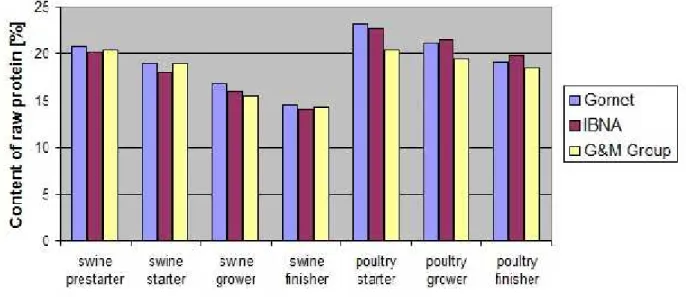
In figure 3 it can see the percentage of raw protein (RP) content of varieties of compound feed that have been analyzed in this article, depending on the species and age of animal with the highest share in livestock farms in Romania.
Figure 4 displays the value of metabolizable energy corresponding of the recipes of combined feed analyzed in this paper.
Figure 4: The metabolizable energy of compound feed
In zootechnical farms from our country are farmed more chiken species for meat, but from the statistic data that was analysed there are three most common species: Cobb 500; Ross 308; and Hubberd Flex. Table 2 shows the results of the statistical analyses about the necessary valuables of the raw protein (RP) and of the metabolizable energy (ME) for intensive growth of the three meat chiken species analysed.
Table 2
Necessary of raw protein and metabolizable energy for chicken species analyzed
Hybrid Cobb 500 Ross 308 Hubbard Flex
Recipe starter grower finisher starter grower finisher starter grower finisher
RP [%] 21-22,5 19-20,5 17,5-19 22-25 21-23 19-21 21-22 20 19
ME [kcal/kg]
2976-3150
3035-3200
3155-3250
3010 3175 3225
2900-3050
3100-3150
3100-3150
Based on these statistical information presented in Table 1 and Table 2 it can be seen that the combined fodder recipes analyzed are indicated for the optimal feeding of the different species of broilers, as they bring the necessary input of nutrients to increase the efficiency and productivity in this type of livestock farms. The same conclusions can be obtained if we analyze the statistical information regarding the species of pigs raised in intensive method in the livestock farms from Romania.
Also, based on the data provided by the National Association of Manufacturers of Combined Fodder, we can present other very interesting information, which support the idea of widespread use of combined fodder in this type of livestock farms from Romania:
the compound feed factories (CFF) that process agricultural raw materials are doing business by 700 milion euro per year, doubling the value of the 2,5 milion tons of grain that they are processing and send them in the form of feed to animal farms on the local market;
the largest producers of compound feed in our country are: Smithfield, the biggest producer of pig meat, Agricola Bacau and Transavia, the leaders of poultry meat market;
the poultry and pig market of meat, from various production of compound feed recipes or from meat processing.
CONCLUSIONS
The modern feeding can be done only with high quality compound feed, that have a high nutritional value. Also, it should be known that every animal, depending on the species and age group, needs a special feed.
From those presented in this article, can see a number of advantages of using of the combined fodder:
ensures an increased yield in the work of intensive breeding of animals from the farms profile
prevent the occurrence of diseases and ensures the maintenance of the health status of animals, reducing thus the actual losses
contributes at growth of labour productivity by mechanisation and automation of activity of feeding the animals from zootechnical farms
by the complete and balanced nutritional value, the combined fodder ensures a high conversion of feed
As can be seen, the use of combined fodder in the feeding of animals presents sufficient advantages to determine the farmers to use them.
“The market of compound feed production is increasing and the advance came along with the development of zootechnics farms”, says Joseph Pazuric, CEO and shareholder of the group of companies Nutrientul, a business with a turnover of over 50 million Euro/year (according www.zf.ro).
BIBLIOGRAPHY
1. Căproiu Magdalena, Chelemen I. ş.a., 1982 – Maşini şi instalaţii zootehnice, Editura Didactică şi Pedagogică, Bucureşti.
2.Glodeanu, M.,Alexandru, T., Vasile, C., 2014 – The Design and Realization of a Control Scheme of a Three-Section Conveyor Belts Used in the Food Industry, Annals of the University of Craiova - Agriculture, Montanology, Cadastre Series, Vol. XLIV, No.2, ISSN: 1841-8317, pag. 91-94.
3.Ionel, I., ş.a., 2002 – Protecţia mediului, obiect de cercetare si dezvoltare al laboratorului de analize de combustibili şi investigaţii ecologice, Revista AGIR, Nr. 1, ISSN 1224-7928, pag. 35-41
4. Popescu, C., 2008 – Ecopedologie, Editura Universitaria, Craiova, ISBN 978-973-742-912-4, pp 125-126.
5. Ţucu, D., 2007 – Sisteme tehnologice integrate pentru morărit şi panificaţie, Editura Orizonturi Universitare, Timişoara, pag. 71-82.