185
THE INFLUENCE OF NO TILLAGE TECHNOLOGY ON PLANT HEIGHT,
SOIL MOISTURE AND YIELD OF CORN
OSICEANU M., OSICEANU SILVIA, DOBRE M.
University of Craiova
Keywords: no till, mulch, soil moisure
ABSTRACT
No tillage technology is the future of field agriculture in the world. In our country, the spreading of this technology was impeded by the fact that researchers and farmers did not understand the role of the mulch layer on yield. Lot of researches unfolded in our country did not accounted this aspect. Our researches began in 2016 and they have emphasized the role of the mulch layer on the overall development of corn plants and, finally, on the yield. The data presented in this article represent determinations of the corn plant height and soil moisture at two dates, 1 of june and 10 of july. These results emphasize the importance of the mulch layer on plants height and on soil moisture. This way, the no till treatment with mulch layer consisting of pea debris has been superior to the classic technology based on plowing. The no till variant without mulch layer, practically, gave no yield.
INTRODUCTION
Water is the key element in the success of the no-tillage system. Lot of research effort is devoted nowadays for
reduced tillage. The new no-till
technology brings about changing and challenges. More and more farmers have been adopting it throughout the world (50 times increase in latest years in Latin America). Agronomists became aware of the benefits of this system and try to make it suitable for different soil-clime
conditions. Soil organic matter,
mineralization, erosion, compaction and last but not least, the high energy requirements are the main disadvantages of the plow-based agriculture. The no till system has disadvantages, too: soil temperature decreasing, higher leaching, difficult low soluble fertilizer incorporation but its advantages strongly overpass them. They can be summarized as follows: increasing soil organic matter
content reducing the fuel, labor
consumption and machinery
requirements, almost stopping the soil water erosion, increasing the yield by approx. 20%, increasing the surface that can be worked by a farmer and enhancing the benefit [2;3;4;5].
All aspects of the reduced tillage are related with the soil water keeping capacity. The more the soil can keep its water, the larger is the water quantity that is used by the plant roots instead to be lost by evaporation. More water into the soil means more diversity of soil life and fertility. With a certain soil, more water through the plant means more nutrients carried within.
186
MATERIAL AND METHOD
The experiment was located at the Botanic Garden of University of Craiova in 2018 year and comprised three variants of soil tillage in 3 replications.
The treatments were: v1= plowed soil in
autumn and drilled after seedbed
preparation by harrowing, v2= no till soil and drilling in the spring with seedbed preparation only on the row of plants without any mulch layer, v3= no till with mulch layer of pea cover crop. The tillage have been done manually as well as the sowing. There were planted no cover crops in autumn or in the spring. The plots with pea crop mulch layer used the mulch from previous year. This mulch layer is very rich in nitrogen and provides the corn plants with this important
nutrient. Moreover, during the
decomposition process it formed a layer of small debris that has large pores which
reduces the access of water from beneath to the soil surface where it will rapidly lost by evaporation. The seedbed was prepared only on the width of 10 cm and a depth of 10 cm. There was applied Adengo herbicide (isoxaflutol 225 g/l +
tiencarbazon-metil 90 g/l +
ciprosulfamide (safener) 150 g/l) when the corn plants reached 10 cm height. This herbicide did not controlled Digitaria sanguinalis weed. During the vegetation period there were made soil moisture determinations at two dates: 1 of june and 10 of july. There were, also, made soil bulk density determinations and. At harvest the corn plants were measured as height. The yield was weighted by
plots and the results have been
statistically interpreted by Fisher analysis of variance.
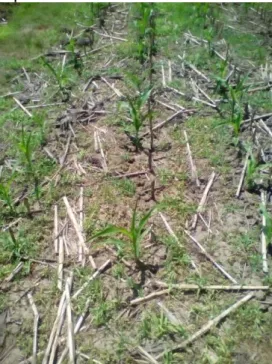
Figure 1. The no till with mulch variant at 1st of june
RESULTS AND DISCUSSIONS
The sowing operation was made manually, at 30 april. There were lots of rain in that period, so the corn plants emerged very soon and they developed well in the first two weeks. This year we applied Adengo herbicide during early
187
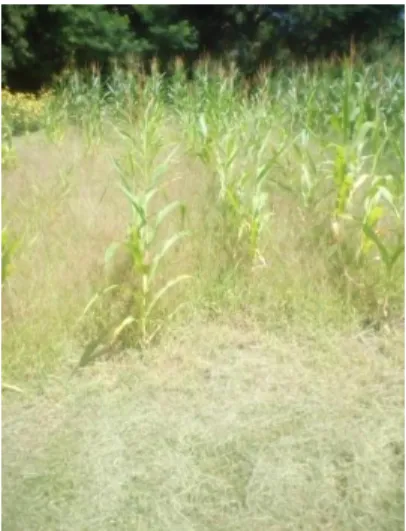
Figure 2. No till without mulch variant at 10 of july
The soil mosture was determined by direct method, using small aluminium recipients which were weighted before
and after drying into the oven. The soil moisture at two dates, in function of tillage are presented bellow.
Table 1 Soil moisture in function of tillage
Treatment Soil depth (cm) Soil moisture
At 1 st june At 10 July
V1 - plowed 0-10 12,5 14,4
10-20 12,9 14,8
V2 – no till without mulch
0-10 11,7 13,2
10-20 12,0 13,5
V3 – no till with pea mulch
0-10 13,4 15,4
10-20 14,2 16,3
From these data we can observe that the no till variant with pea mulch layer has kept the soil water best and the
second variant has recorded the lowest levels of soil moisture.
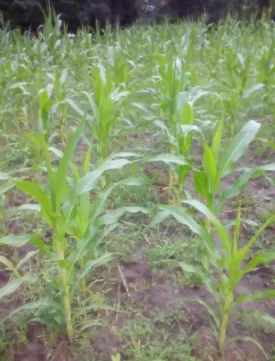
Figure 3. No till with pea mulch at 10 July
The tillage helps keeping the water into the soil by creating a layer of soil with larger pores than below the depth of tillage. This is the reason why the plowed
188
is explained by smaller pores into the shallow layer of 3-5 cm that extracts the water from below, where the soil pores are larger. This fact determines the rapid
loss of soil water, tough soil, poorly developed root system and reduced or no yield.
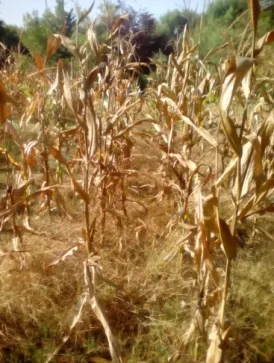
Figure 4. Plowed variant at 20 june.
At 14 September the experimental plots have been harvested and the yield has been weighted for each treatment. There also have been made height
measurements of the harvested corn plants. The results are presented in the table below.
Table 2 The corn yield and the plants height in function of tillage and the species of
cover crop at Botanic Garden of University of Craiova in 2017
Treatment Plant height,
cm
Yield, kg/ha % Difference,
kg/ha
Signification
V1 – plowed 210 6.845 100 Ctrl. -
V2 – no till without mulch
120 540
7.8 - 6305
000
V3 - no till with pea mulch
220 7.250
105 405
*
DL 5%= 225 kg/ha; DL 1%=480 kg/ha; DL 0.1%=680 kg/ha
189
From these results we can
conclude that no till with pea mulch layer gave the best results this year, better
than plowed variant. The no till without mulch variant almost gave no yield, this year.
Figure 6. No till with pea mulch at harvest.
CONCLUSIONS
1. Water plays the most important role in no till technology.
2. The variant with pea mulch layer from previous year gave better results as
plant height and yield than plowed variant.
3. No till without mulch layer almost gave no yield this year because of worst soil moisture condition.
BIBLIOGRAPHY
1. Dobre M., 2002 - Cercetari privind
aplicarea unor variante ale
sistemului de lucrari minime pentru porumb pe nisipurile irrigate din
Stanga Jiului. PhD thesis,
University of Agricultural Sciences
and Veterinary Medicine
Bucharest, Romania.
2. Swan J.B., Kaspar T.C. and Erbach D.C., 1996. Seed-row residue management for corn establishment in northern US Corn Belt. Soil & tillage research Journal, vol. 40, pag. 55-72.
3. Sprague M. and Triplett G.,1986. No tillage agriculture and surface tillage agriculture. Pag 150-165. Editure John Willey and sons. 4. Tolk J.A., Howell T.A., Evett
S.R., 1999. Effect of mulch, irrigation, and soil type on water use and yield of maize. Soil & tillage research Journal, vol. 50, pag. 137-147.