371
CONSIDERATIONS ON EQUIPMENT USED FOR MORE EFFICIENT USE
OF WATER IN PRECIPITATION
OPRESCU R1), VOICEA I.1), BIRIS SORIN2), VLADUT V.1), MATACHE M.1)
1)INMA Bucharest / Romania; 2)UPB Bucharest / Romania E-mail: [email protected]
Keywords: leakage, erosion, fingerprint.
ABSTRACT
Soil is the element that underlies the development of agricultural activities but also of other human activities.It is the source of water supply and nutrients necessary for the growth and development of crops. the entire period of vegetation. The present work
presents some of the most used equipment used in the technologies of crops of fodder plants and of grain crops. located on muddy or sloping grounds for the most efficient use of rainwater, preventing erosion and leakage. [8]
INTRODUCTION
In the last period, there was an important increase in the number of inhabitants of the planet which inevitably led to an increase in the quantity of food needed for consumption. The need for food in the larger quantity also implies the need for an adequate quantity of clean fresh water to keep us it produces food. Increasing the demand for water needed to carry out human activities on the one hand and producing climate change, on the other hand, has made many regions face difficulties in finding sufficient fresh water resources to meet their own needs.
Continuous food cultivation without
depletion of clean water resources of nature forces us to increase the efficiency of water use in agriculture
The water needed for the
development of the plants comes from the rains that fall on the cultivated land. Due to the fact that the rains do not fall permanently, it is necessary that the water from them be captured somewhere, from where it can be used by them. The place of capture is the soil, the soil. , and because of this the development of plants, agriculture and so human life is more prosperous as the earth is of better quality. The amounts of rainwater differ from region to region but also from year
to year in the same region. We have regions where it rains very little so agriculture without irrigation is not possible (compulsory irrigation) regions where it is raining but not enough so that agriculture can be done by supplementing the rainwater with the water from irrigation (irrigation of completion) thus obtaining production. better. We have the most profitable situation of areas where rainfall is sufficient for the optimal development of plants and irrigation is not necessary but also areas where rainfall is abundant, the soil is too wet cannot be worked, so ordinary plants do not grow and agriculture can only be done if the additional amount of water is removed by drying and drainage. [9]
In the southern area of Romania, characterized by a temperate continental climate, there is a need to conserve “in-situ” soil moisture due to insufficient
rainfall for agriculture. Rainwater
372
a) b)
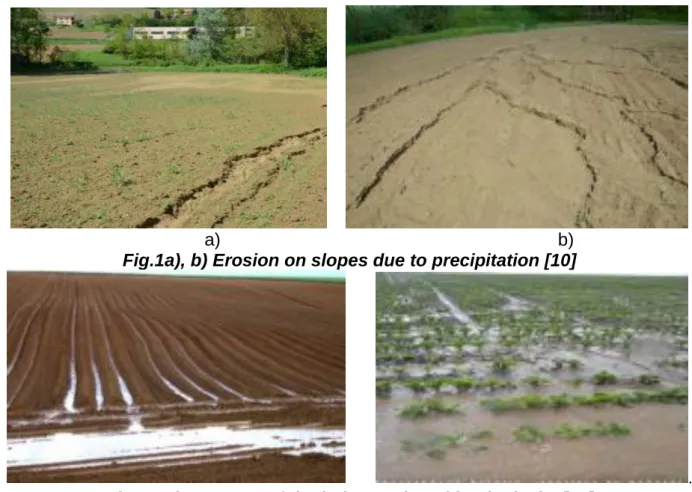
Fig.1a), b) Erosion on slopes due to precipitation [10]
.
Fig.2 .The woman of the balm produced by the leaks [10]
Fig. 3 shows how the printing of the soil influences the action of the three
373
Fig.3 The action of the decisive factors: soil, water, sun] in the case of compartmentalization [8]
Soil: it is consolidated by printing which facilitates the erosion phenomenon and improves soil-seed and soil-root contact.
Water: Fingerprints (reservoirs)
keep water with weak sides, reduce leakage and increase water seepage into the soil.
The sun: the surface of sun exposure of the soil increases and increases the
access of seeds and roots to oxygen. This principle of soil printing is based on the possibility of increasing the water storage capacity on the surface of the soil. It finds one of the most efficient means of controlling both the drainage and the erosion of the soil. Ponds or pits are created to maintain the water in place, allowing infiltration into the soil and
thus preventing leakage.
MATERIAL AND METHOD
The constructive and functional analysis of the equipments implies the necessity to study the constructive characteristics of these equipments, the operation and the work process executed by them, so that the best constructive solution that can be taken into account can be recommended.
Types of equipment used for printing:
1 The machine that produces grooves on the surface of the soil with the help of chains with buckets.
The machine is made of a metal frame that holds a chain on which are welded
pallets with special shapes. This
equipment forms pools for capturing water by turning the pallets. It is used for capturing surplus water in crops of forage
and forage plants.
a) b)
Fig.4 a) Machine that produces holes on the surface of the processed soil by rotating a chain with pallets b) The appearance of the land after passing the
374
Fig.5. Aspects of working with equipment equipped with TerraStar disks [8]
The soil structure and surface roughness are changed by applying an external force when TerraStar discs roll above the soil surface. The concept of a single wheel or wheel applies pressure to the free, machined soil to deform the soil and create mini reservoirs or fingerprints. the soil is not compacted, but rather strengthened given the cohesion forces that hold the soil grouped in the wheel-printed form. External force exerted on the ground by TerraStar discs leads to
soil consolidation that facilitates air and water movement by preventing surface runoff. A distinction must be made
between soil compaction and
consolidation. The term soil compaction is used to describe a negative impact produced on the soil, so on plant growth as a result of reducing the large pore space that restricts the movement of air and water in and through the soil
:
375
Fig.7 The way in which the processed land behaves as a result of precipitation
- Higher infiltration also means higher soil moisture content. Increasing the water content of the soil allows an optimal development of the plants.
3 The machine that processes water tanks using a profiled drum.
The machine is used for both forage crops and for cereal crops. Following the tests, it was found that the machine was
better used when processing the soil at a depth of 20 cm compared to a depth of 15 cm and at a speed of 15 cm. displacement of the machine between 0.7-1 m / s. In the case of wheat cultivation, the highest yields were made when the land was worked to a depth of 20 cm and the speed of movement of the machine was between 1-1, 2 m / s. [5]
Fig.9 Side view of the tank processing machine [7]
- Components of the tank processing machine:
-1.1 catching bracket, -2.the main frame, -3 sharp chisel, -4.toothbrush,
-5.5 copy wheel,
-6.measurement mechanism, -7 seed bunker,
376 secondary succession of plant types follows. The short-term annual plants first appear, and over time they tend towards
long-lasting perennials, the natural
process is found to be quite slow, taking place over a fairly long period of time depending on the degree of soil deterioration, of the type soil and climate. One of the ways to accelerate the secondary succession to a productive and sustainable ecosystem is the work of fingerprinting the land. By fingerprinting the process of infiltration is improved and the penetration of moisture is deeper.
which are not favorable to the
development of perennial species.
Sowing fingerprints are used to establish perennial grasses, to improve the ecosystem, to control erosion and to increase feed production.
The fingerprinting has the role of imprinting on the surface of the soil a geometrical configuration necessary to
with angular section. The basins are formed by compressing and shearing the soil and the adjacent ridges or ridges are formed by a wrapping (lifting) process. By creating a 5cm gap around each tooth,
the two interaction processes are
facilitated, with minimal soil disturbance and compaction.
The shape, size and model of the fingerprints are designed to maximize the amount of water stored.
The printing roller penetrates the ground to the depth at which the equal forces are balanced or balanced. To make a full-tooth impression these forces must balance when the teeth penetrate the ground up to half due to the winding effect. the soil load is too high or the soil is difficult to penetrate until half of the print teeth proceed to attach additional weights to the printer or to soften the soil. [13
a) b)
377
b)
Fig.12. Aspects during the transportation of the land imprinting equipment [13]
Usually to increase the printing force, the weight of the printer is increased, which is accomplished by filling the core of the printing roller with water and installing water tanks or boxes on the printer frame.
Tillage kills the existing vegetation, covers the vegetal debris, decomposes the soil structure and encourages weed growth.If the first printing has not reached the desired depth, a second printing can be performed, the printing teeth tend to copy the first fingerprints by digging deeper into the soil.
Dynamic printing pressures have been found to be much higher than static pressures. By measuring with the cone penetrometer a certain hardness of the ground it was found that the rotary printing roller impulse increases the printing force more than three times. Another explanation is the date that the printed soil weakens the unprinted soil
adjacent to it, thus decreasing the required printing force as the printer rolls.
Following the analyzes carried out after the application in the cultivation technology of soil printing works, it was found a high efficiency of this work conserving at the same time water and soil. reducing the sealing of the soil. Among the advantages obtained from the use of this technology we can list the following: increasing the humidity of the soil by reducing the flow of rain water, reducing the phenomenon of erosion, reducing the phenomenon of crusting and sealing of the soil, a better contact of the seeds with the soil favoring and the
emergence of plants, increasing
production by making the crop more profitable, healthier crops exceeding drought limits and making it possible to use more efficient equipment for water tank processing.
ACKNOWLEDGEMENT:
This work has been funded by the European Social Fund from the Sectoral Operational Programme Human Capital
2014-2020, through the Financial
Agreement with the title "Scholarships for
entrepreneurial education among doctoral students and postdoctoral researchers
(Be Antreprenor!)", Contract no.
51680/09.07.2019 - SMIS code: 124539
and through a grant on
Programme 1 – Development of the
national research-development system,
subprogramme 1.2 – Institutional
performance – Projects for financing
378 Rome.
[4].Hackwell, S.G., Rochester, E.W., Yoo, K.H., Burt, E.C., Monroe, G.E., (1991) - Impact o reservoir 657 tillage on water intake and soil erosion. Trans. Am. Soc. Agric. Eng. 34,436-442.
[5].Haytham M. Salema,b,,
Constantino Valero , Miguel Ángel Muñoz ,4 María Gil-Rodríguez (2015) -Effect of integrated reservoir tillage for in-situ rainwater harvesting and other tillage practices on soil physical Q1 properties.
Utilizarea_eficienta_a_apei_la_nivelul_fer mei.pdf
[10].
http://www.topps-life.org/uploads/8/0/0/3/8003583/bmp_run off_16_09_2015.pdf
[11].https://www.youtube.com/watch?v=p RCMC-O2DLs&feature=youtu.be
[12].http://oa.upm.es/34769/9/ViewPageP roof_STILL_3444.pdf