MEASURING THE CONCENTRATION OF POWDERS
RESULTING FROM FLUE GASES OF A CFF
CRISTIAN VASILE, MIHNEA GLODEANU, TUDOR ALEXANDRU Faculty of Agronomy, University of Craiova, Romania
Keywords: firing plant, temperature, granules, flue gases
ABSTRACT
The long term objective of Romanian economy is that of putting the bases of a real market economy, which will integrate in the structures of the European Union and will respect the Community provisions.
This way, even for the industry production sector from the zoo-technical domain, reaching of this objective means the endowment with modern, efficient equipment, with a higher level of mechanization, automation and computerization, with higher productivity and lower specific consumptions.
In this article is made an analysis of dust concentration in flue gases emitted of a Compound Feed Factory (CFF), regarding the conformity to European norms concerning the quality of the environment.
INTRODUCTION
In the firing equipment that produce the necessary steam at the homogenization in different forms of the pre-mixtures and in the cooling plants of the final product will be eliminated in the atmosphere both exhausts and dust or powder, which determinates the affecting of the environment and also is affecting the life and the surrounding nature.[3, 4]
The flying ash, eliminated through the smoke flue of burning installations, soft smoke dust driven by wind, the fine ash from the ash deposits and the coal dust, derived from the coal tailings or from its transport and preparation, together constitute a solid exhaust, that is found even as aerosols. The ashes contaminate and pull down the environment, deposits on the vegetation, buildings, and streets and give an unpleasant cast, in the end being inhalant by people [1, 2, 9].
Deleterious aerosols constitute the pollutants that give the most noxious effects for people. Happily, these ashes have a poor content of heavy metals (Cr, Ni, Cd, As, Pb) so that in most of the cases the formed aerosols are not noxious.
More important is the work of moving the noxious gases through powders and carrying out their hazardous effects at very large distances from emission location.[6, 8]
Therefore it is absolutely necessary to follow-up and rigorously to control the concentrations of dust in the exhaust gases at working plants that have engines with internal combustion or fans that collect different particles. This paper presents exactly such a methodology for measuring the dust concentrations resulting from the process of compound feeds obtaining.
MATERIAL AND METHOD
The steam produced in the firing plant with the aid of the steam generator has an important role for both the homogenization of the granules and their sterilization. Granules obtained in this way are then cooled by air in a cooling installation, and after cooling the granules are conveyed to the finished product storage hopper or directly to packing for delivery. [7]
Thereby, in the cooling process of the obtained product, the air used as a heat carrier grows hot due to the high temperatures of the granules, but at the same time it moves with it also the unstuck particles in the drying phase of relative compound feeds, forming thereby the dust.
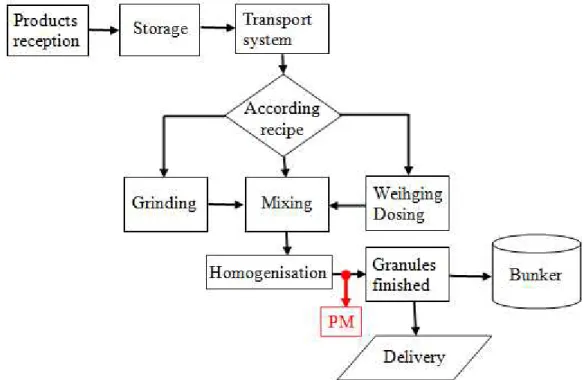
In the figure 1 it is shown the technological flow of CFF and indicates the working point for measurements on dust concentration (PM) in the exhaust gases from working plants.[8]
Figure 1: The diagram of operation in which is marked the point of analysis (PM)
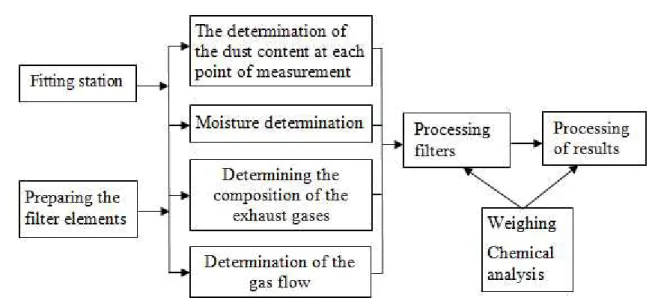
The measurement principle consists in analyzing a representative volume of the extracted effluent from the flue gases removal duct. As it is schematically shown in figure 2, there are made multiple simultaneous and successive heat engineering determinations.
The plant, whereby is realized the powder amount measuring of the flue gases from their exhaust ducts, is complex and basically consists of several independent parts.
After assembling the plant, this will be brought to the temperature of normal working condition and then the aspirant tube is brought to approximately 120°C, the tightness is checked by obstructing the well, operation followed by starting the drawing pump so that the drop pressure stays at 200 mbar, the debit that falls over through the installation must be lesser than 2% of the debit that falls over trough this during the measurements [1, 2, 9].
Figure 3: Flow chart of chaining procedures for the determination of the powders from flue gases
During the measurement, the settings of the emitted gases running are being observed (speed, debit) and data of the measured values are periodically marked.
Knowing that there is an irregular distribution of dust in the inflow section, measurements are made by the disposal of many more sampling points in the used well section, which will allow the right determination of medium density of the dust emitted on a section.
To assess the actual conditions in the operation of the firing plants that are serving the working process of obtaining compound feeds, it is necessary to measure the pressure, temperature, and density participation of the main components of exhaust gases carried out through firing plants by using gases analyzer TESTO 350 M/XL […] with the aim of calculating accurate density of exhaust gases.
The device for measuring the dust concentration of the emanated gases by furnacing, as STROHLEIN STE4 type, is shown in figure 3.
Figure 3: Wiring diagram STROHLEIN [119].
1-gas passage, 2-nozzle calibrated, 3-housing filter cartridge, 4-connectors, 5-socket electrical heating, 6-thermocouple, 7-tees, 8-tank condensate,
protect the active elements of the device, the gas is passed through a drying tower (9) with silica gel. It follows the flue gas passing through the unit itself where the flow meter determines the capacity (10), depression with pressure gauge (11), the temperature with a thermometer (12) and the sucked gas amount through the gas meter (13). The volume of gas which will be sucked it adjusts by R1 valve.
The speed of the current in the gases channel is determined by next equation:
s m p w gtc din c 2 (5.21) in which:
pdin– dynamic pressure, as measured by Pitot-Prandtl, [Pa];
gtc – the wet gas density from pressure and temperature of the composition in the channel, [kg/m³].
For exact knowledge of work conditions in the time of measurements, it determines the composed gases temperature tgc(°C) and static pressure pst[mbar] using the TESTO
device.
During the measurements are observed and marked at equal time intervals (at the beginning from 3 to 3 minutes, and then from 10 to 10 minutes) the values of flow parameters such as: the gases temperature in wells ts [°C]; gases temperature tk read on
the thermometer of the rate meter tc [°C]; gases depression pk read on the counters
manometer [mbar]; gas flow indicated by the tachometers [m3/h]; barometric pressure
[mbar]. On completion of the measurement in a certain point of gas issue the aspiration of eliminated gases, from the removed from studied firing plant, stops and at the same time the timer and power supply of the sleeve well stop and the induced gases flow is marked as well as the elapsed time for carrying out these analyzes.
To obtain the final results concerning the dust concentration in the analyzed flue gases there must also be followed the next steps: it dimensions the quantity of intercepted water in the condensate container and it measures the wet silica gel, and after the well is cooled, it carves the filter cell, then it stocks in a special prepared recipient and then are measured the filter unit as well as the plain filter.
THE OBTAINED RESULTS
During the analyses performed in the CFF, the dust concentrations were measured at the evacuation flue of the heat carrier. For the assortment of compound feed, named “Broiler Chicken - starter phase", tested in this operation, it will be applied the certainty of dust concentrations method, described in the previous paragraphs.
According to the measurement standard of dust concentrations, the minimum required volume of sampling under the isokinetic conditions, is 1 m3. Depending on the
speed of the effluent at flue, the sampling time can vary from minutes to hours. To take samples in isokinetic conditions, it is necessary to know some thermodynamic parameters of effluent.
Thus, for the pre-mixture feeds “Broiler Chicken – starter phase” the settled thermodynamic parameters of effluent are:
- ambient temperature tamb= 20 [°C];
- dynamic pressure pdin= 0.1 [mbar];
- effluent temperature tef= 48 [°C];
- humidity effluent Rh = 78 [%]; - speed effluent wef= 5.2 [m/s].
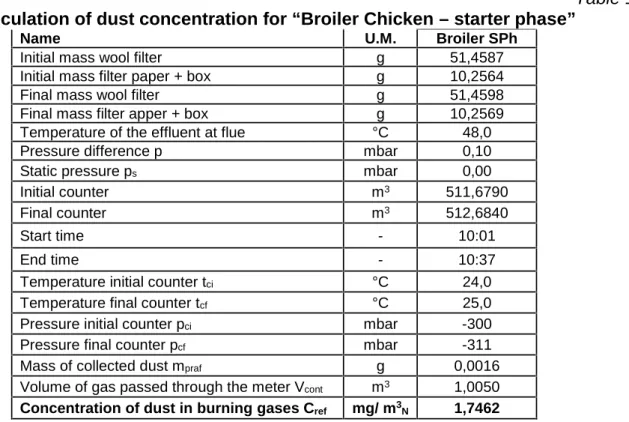
Table 1
Calculation of dust concentration for “Broiler Chicken – starter phase”
Name U.M. Broiler SPh
Initial mass wool filter g 51,4587
Initial mass filter paper + box g 10,2564
Final mass wool filter g 51,4598
Final mass filter apper + box g 10,2569
Temperature of the effluent at flue °C 48,0
Pressure difference p mbar 0,10
Static pressure ps mbar 0,00
Initial counter m3 511,6790
Final counter m3 512,6840
Start time - 10:01
End time - 10:37
Temperature initial counter tci °C 24,0
Temperature final counter tcf °C 25,0
Pressure initial counter pci mbar -300
Pressure final counter pcf mbar -311
Mass of collected dust mpraf g 0,0016
Volume of gas passed through the meter Vcont m3 1,0050
Concentration of dust in burning gases Cref mg/ m3N 1,7462
For the studied firing plant there have been carried out several measurements on different time intervals, and the results obtained for the dust concentrations are shown in table 2.
Table 2
Concentration of dust in burning gases Cref
Sample measurement 1 2 3 4 5
Time slot 10:01-10:37 11:05-11:42 12:02-12:39 13:09-13:46 14:01-14:40
Cref[mg/ m3N] 1,7462 1,7483 1,7395 1,7478 1,7448
DISCUSSIONS
To obtain accurate results for tests carried out for monitoring the working process in CFF the, dust concentrations were measured at the evacuation flue of the heat carrier.
We should be mentioned that the 462/1993 Order requires, besides the exhaust limits, also limits of dust concentration. Thus, dust emission limit for feed production plants and combined feeds is 5 mg/m3N.
A very important conclusion resulting from these determinations is that the firing plant, in terms of dust emissions, is within the normal limits set by laws in force.
Considering the importance of compliance to European standards on environmental protection it is necessary that the working plants in CFF to be upgraded and equipped with the most efficient automated and computerized control equipment of developed activities, as well as the existence of a strict control of pollutants and dust concentrations eliminated through flue gases.
BIBLIOGRAPHY
1.Ionel, I., ş.a., 2002 – Protecţia mediului, obiect de cercetare si dezvoltare al laboratorului
de analize de combustibili şi investigaţii ecologice, Revista AGIR, Nr. 1, ISSN 1224-7928, pag. 35-41
2. Ionel, I., ş. a., 1994 – Măsurarea emisiilor din gazele de ardere cu ajutorul senzorilor
electrolitici, Conferinţa naţională de termotehnică, Vol. I, Timişoara, pag. 231-235
3.Popescu, C., 2009 -Ecopedologie, Editura Universitaria Craiova, ISBN
978-973-742-984-1.
4.Popescu, C., 2009 -Research on the structure of the preluvosoils from the southern
part of the Getic Piemont that was used long term as arable, Buletin of University of Agricultural and Veterinay Medicine Cluj Napoca, Vol.66 (1), Issue 1/2009, ISSN 1843-5246, pag. 448-452
5. Săvescu, P., ș.a., 2013 -Organic Farming In Romania, Present And Prospects, Annals
of the University of Craiova - Agriculture, Montanology, Cadastre Series, Vol. XLIII/1, ISSN 1841-8317, ISSN CD-ROM 2066-950X, pp.302
6. Săvescu, P., ș.a., 2014 - The development of organic farming in the EU and Romania –
Big Opportunity for reducing the risks and the hazards that occur in the foods production, Annals of the University of Craiova - Agriculture, Montanology, Cadastre Series, Nr.1/2014, Vol. 44, ISSN 1841-8317, ISSN CD-ROM 2066-950X, pp.243-247
7. Vasile, C., 2011 – Analysis of the Correlations Between Fodder's Productions and
Dynamic Livestock Farms Activities of our Country, Annals of the University of Craiova – Agriculture, Montanology, Cadastre Series, Vol. XLI/2, pp. 403-410, ISSN: 1841-8317,
Conference ESNA, Craiova
8. Vasile, C., 2015 – Studies regarding pollutant emissions analysis from gases burnt in
the process of obtaining combined fodder, SGEM 2015 Conference Proceedings, ISBN 978-619-7105-38-4 / ISSN 1314-2704, Book4, pp.1097-1104