1360 | P a g e
Perceived Social Support among working women with
respect to various socio-demographic variables.
Saima Khursheed Beigh
1, Dr. Humera Shafi
21
Research Scholar, Department of Psychology, University of Kashmir.
2
Sr. Assistant Professor, Department of Psychology, University of Kashmir
ABSTRACT
The present study was aimed to explore the perceived social support with respect to various
socio demographic variables. The sample of the present study comprised of 500 working
women from different sectors of Srinagar district. The tool used was Multidimensional scale
of Perceived social support developed by Zimet, Dahlem, Zimet, and Farley (1988). Apart
from these tools personal data sheet was used to collect personal information from the
respondents like organization, marital status, etc. The collected data was analyzed by
statistical techniques like descriptive statistics and comparative analysis. The results of
comparative analysis revealed that unmarried women, women who hadn’t to perform
household chores, women who had assistance available scored significantly higher than their
counterparts.The ANOVA revealed that there is no significant difference among working
women in levels of qualification with respect to Perceived Social Support.
Keywords: Perceived Social Support, Working Women
I.INTRODUCTION
Albrecht and Adelman (1987) defined social support as “verbal and nonverbal
communication between recipients and providers that reduces uncertainty about the situation,
1361 | P a g e
control in one’s life experience”. In this definition, the key features of social support are: Communication
Uncertainty reduction Enhanced control
According to this definition, social support is any type of communication that helps
individuals feel more certain about a situation and therefore feel as if they have control over
the situation.
Social support is a concept recognizing that people exist to varying degrees in networks
through which they can receive and give aid, and in which they engage in interactions (Patel,
Peterson & Kimmel, 2005). In defining social support, we must differentiate in actual versus
perceived social support. Actual support is the support that an individual receives in terms of
what is said, what is given, and what is done for that individual. However, much more
significant than actual support is an individual’s perception of the availability of support.
Perceived support refers to an individual’s belief that social support is available, is generally
considered positive or negative, and provides what is considered needed by that individual
(Norris & Kaniasty, 1996; Sarason, Sarason, & Pierce, 1990). Perceived support refers to a
recipient’s subjective judgment that providers will offer (or have offered) effective help
during times of need. (Friedlander, Reid, Shupak, & Cribbie, 2007; Hobfoll & Vaux, 1993).
Received support (also called enacted support) refers to specific supportive actions (e.g.,
advice or reassurance) offered by providers during times of need. Women with higher
perceived role demands have more stress and role strain. Women with low social support are
indicated to have more stress, while those with stronger support from family and friends have
less. Social support at work place and home significantly influences a person’s wellbeing.
Spousal support is most effective in helping women deal with the demands of multiple roles
(Duxbury & Higgins, 1991; Eckenrode & Gore, 1990). Family members have the ability to
provide support to each other this is related reduced levels of stress and depression (Johnson,
Gans, Keer, & LaValle, 2010). Positive benefits of social support are highly interrelated with
fundamental interpersonal relationship qualities and processes, such as companionship,
intimacy, social skills and low conflict (Thompson, Flood & Goodvin, 2006). Social support
can play an important role in dealing with stressors. Specifically, social support is found to be
1362 | P a g e
Social support has been a powerful resource capable of inoculating people against the
deleterious effects of life stress (Geller & Hobfoll, 1993). Social support from co-worker
networks are such resources. Furthermore, research has found that perceived positive social
support from workplace network members is significantly related to employees' physical and
mental health (Greenhaus, Bedian, & Mossholder, 1987). Social support significantly impacts
the stress experienced by the individual at the work place (Viswesvaran, Sanchez & Fisher,
1999). Studies have indicated that receiving supportive behaviors from one’s spouse was
related to lower levels of distress (Schuster, Kessler, & Aseltine, 1990; Frazier, Davis-Ali, &
Dahl, 1995; Druley & Townsend, 1998). Interpersonal networks that provide emotional,
informational and practical support can be very important in managing stress and wellbeing
(Sonnentag & Frese, 2003).
II.OBJECTIVES
1.To assess perceived social support among Working Women.
2.To study the difference in perceived social support among working women with respect to
different socio- demographic characteristics.
III.METHODOLOGY
Research Instruments
For the assessment of Perceived Social Support, Multidimensional scale of Perceived social
support developed by Zimet, G. D., Dahlem, N. W., Zimet, S. G., & Farley, G. K. (1988) was
used. It is a 12 item instrument having 4 items in each of the three dimensions namely
Significant Others, Family & Friends. The items are measured on a 7 point Likert scale.
Sample
As the nature of the population was heterogeneous, proportionate stratified random sampling
technique was devised in order to carry out the study scientifically. From every organization
graduate females with at least two years of experience were considered. All the employees
included in the strata were working full-time basis at their respective organizations and from
each division sampling elements were selected randomly. The total population consisted of
1363 | P a g e
IV.RESULTS AND INTERPRETATION
Table 1.1 Presenting Scale Characteristics and Reliability Testing of Perceived social
support (MPSS)
Measure Dimensions Items Response
Range
N M SD Cronbach’s
alpha (ἀ)
Perceived
Social
Support
Significant
Others
4 1-7 500 21.54 4.87 .86
Family 4 1-7 500 20.86 4.49 .83
Friends 3 1-7 500 21.06 4.92 .84
Overall 12 1-7 500 76.20 11.49 .91
The reliability of the scale used in the present study was calculated using Cronbach’s Alpha
method. The tools showed good internal consistency. The alpha coefficients, for the
dimensions of Perceived Social Support were as follows: Significant Others, .86; Family, .83;
Friends, .84; overall, .91.
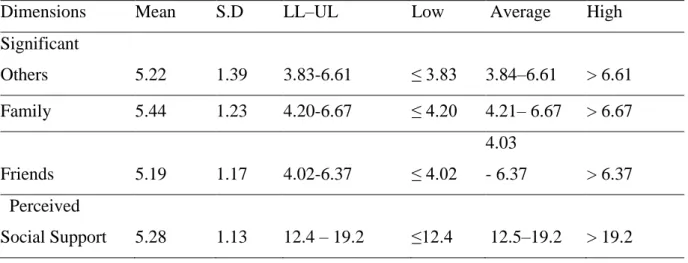
Table 2.1 Showing range of scores on different levels of dimensions of perceived social
support.
Dimensions Mean S.D LL–UL Low Average High
Significant
Others 5.22 1.39 3.83-6.61 ≤ 3.83 3.84–6.61 > 6.61
Family 5.44 1.23 4.20-6.67 ≤ 4.20 4.21– 6.67 > 6.67
Friends 5.19 1.17 4.02-6.37 ≤ 4.02
4.03
- 6.37 > 6.37
Perceived
1364 | P a g e Table 2.2 Showing frequency distribution of working women on different levels of
perceived social support.
Level Low Average High
Dimensions f %age f %age f %age
Significant
others 86 17.2% 339 67.8% 75 15%
Family 76 15.2% 345 69% 79 15.8%
Friends 84 16.8% 351 70.2% 65 13%
Perceived
Social support 84 16.8% 341 68.2% 75 15%
The above table indicates that of 17.2% working women have low level, 67.8% have average
level and 15% of working women have high level of support from significant others. 15.2%
of working women have low level, 69% have average level and 15.8% of working women
have high level of family support. 16.8% of working women have low level, 70.2% have
average level and 13% of working women have high level of friend’s support. 16.8% of
working women have low level, 68.2% have average level and 15% of working women have
1365 | P a g e Table 3.1 Showing comparison of Mean differences for the dimensions of perceived social
support in married & unmarried working women.
Dimensions Marital Status N Mean S.D df t-value
Significant others
Unmarried 250 5.31 1.54
498 1.49
Married 250 5.13 1.23
Family
Unmarried 250 5.66 1.30
498 4.11**
Married 250 5.21 1.11
Friends
Single 250 5.34 1.32
498 2.80*
Married 250 5.05 .982
Perceived Social Support
Single 250 5.44 1.19
498 3.08*
Married 250 5.13 1.04
** Significant at.001 level: * significantat.005level
The table indicates that among perceived social support facets, the calculated t-value in case
of significant others is insignificant but the calculated t-values in case of Family, Friends &
perceived social support are significant in working women (t= 4.11, p=.001; t=2.80, p=.005;
t=3.08, p=.005). Perceived Social support was significantly higher in Unmarried working
1366 | P a g e
Table 5.4 Showing comparison of Mean differences for the dimensions of perceived
social support in working women undertaking household tasks.
Dimensions
Household
Chores N M SD df t-value
Significant
Others
Yes 254 4.989 1.363
498 3.89**
No 246 5.469 1.393
Family
Yes 254 5.232 1.201
498 3.92**
No 246 5.659 1.231
Friends
Yes 254 4.984 1.090
498 4.22**
No 246 5.421 1.223
Perceived
social support
Yes 254 5.068 1.099
498 4.51**
No 246 5.516 1.120
** Significant at.001 level
The results displayed that among perceived social support facets, the calculated t-values in
case of significant others (t= 3.89, p=.001), family (t=3.92, p=.001), friends (t=4.22, p=.001)
are significant in working women with respect to undertaking household tasks. Women who
don’t undertake household tasks have better perceived social support (M=5.51) than those
1367 | P a g e
Table 5.7 Showing comparison of Mean differences for the dimensions of perceived
social support in working women undertaking household tasks with disposal of
assistance.
Dimensions Assistance N M SD df t-value
Significant
others
Help 398 5.32 1.39
489 3.28**
No-Help 93 4.79 1.38
Family
Help 398 5.58 1.21
489 5.22**
No-Help 93 4.86 1.18
Friends
Help 398 5.26 1.20
489 2.53*
No-Help 93 4.91 1.04
Perceived
social support
Help 398 5.39 1.11
489 4.12**
No-Help 93 4.85 1.13
** significant at.001 level: *significant at.005 level
The above table indicates that on the perceived social support facets, the calculated t-values
in case of significant others (t= 3.28, p=.001), family (t=5.22, p=.001), friends (t=2.53,
p=.005) are significant in working women with respect to undertaking household tasks with
disposal of assistance. Women who have assistance in household tasks (M= 5.39) differ
1368 | P a g e Table 6.1 showing one-way ANOVA whether Perceived Social Support facets of the sample
group differ with respect to qualification.
Dimensions Sum of squares df Mean square F
Significant
others
Between
groups
5.181 2 2.590
1.327 Within
groups
970.081 497 1.952
Total 975.262 499
Family
Between
groups
.736 2 .368
.241 Within
groups
758.673 497 1.527
Total 759.409 499
Friends
Between
groups
5.160 2 2.580
Within
groups
686.252 497 1.381
1.869
Total 691.412 499
Perceived
social
Between
Groups
1369 | P a g e
support Within
Groups
637.541 497 1.283
Total 638.532 499
The above table revealed that there is no significant difference among working women in
levels of qualification with respect to perceived social support.
V.DISCUSSION AND CONCLUSION
Findings revealed that 16.8% of working women have low level, 68.2% have average level
and 15% of working women are at high level of Perceived Social Support. The study found
that there is significant difference with respect to Marital Status. Perceived Social support
was significantly higher in Unmarried working women than Married working women. All
dimensions of perceived social support are significant in working women with respect to
Household tasks. Women who don’t rush to kitchen have better perceived social support than
those who have to. The results revealed that all dimensions of perceived social support are
significant in working women with respect to assistance. Women who have assistance
available differ significantly from those who don’t. ANOVA revealed that there is no
difference among working women in levels of qualification with respect to Perceived Social
Support.
REFERENCES
[1.] Albrecht, T. L., & Adelman, M. B. (1987). Communicating social support. Sage
Publications, Inc.
[2.] Druley, J. A., & Townsend, A. L. (1998). Self-esteem as a mediator between spousal
support and depressive symptoms: a comparison of healthy individuals and
individuals coping with arthritis. Health Psychology, 17(3), 255.
[3.] Duxbury, L. E., & Higgins, C. A. (1991). Gender differences in work-family conflict.
Journal of applied psychology, 76(1), 60.
1370 | P a g e
work and family (pp. 205-218). Springer, Boston, MA.
[5.] Frazier, P. A., Davis-Ali, S. H., & Dahl, K. E. (1995). Stressors, social support, and
adjustment in kidney transplant patients and their spouses. Social Work in Health
Care, 21(2), 93-108.
[6.] Friedlander, L. J., Reid, G. J., Shupak, N., & Cribbie, R. (2007). Social support,
self-esteem, and stress as predictors of adjustment to university among first-year
undergraduates. Journal of college student development, 48(3), 259-274.
[7.] Geller, P. A., & Hobfoll, S. E. (1993). Gender differences in preference to offer social
support to assertive men and women. Sex Roles, 28(7-8), 419-432.
[8.] Greenhaus, J. H., Bedian, A. G., & Mossholder, K. W. (1987). Work experiences, job
[9.] Hobfoll, S. E., & Vaux, A. (1993). Social support: Social resources and social
context.
[10.] Johnson, V. K., Gans, S. E., Kerr, S., & LaValle, W. (2010). Managing the transition
to college: Family functioning, emotion coping, and adjustment in emerging
adulthood. Journal of College Student Development, 51(6), 607-621.
[11.] Norris, F. H., & Kaniasty, K. (1996). Received and perceived social support in times
of stress: A test of the social support deterioration deterrence model. Journal of
personality and social psychology, 71(3), 498.
[12.] Patel, S. S., Peterson, R. A., & Kimmel, P. L. (2005, March). Psychosocial factors in
patients with chronic kidney disease: The impact of social support on end‐stage renal
disease. In Seminars in dialysis (Vol. 18, No. 2, pp. 98-102). Blackwell Science Inc.
[13.] Sarason, B. R., Sarason, I. G., & Pierce, G. R. (1990). Traditional views of social
support and their impact on assessment. John Wiley & Sons.
[14.] Schuster, T. L., Kessler, R. C., & Aseltine, R. H. (1990). Supportive interactions,
negative interactions, and depressed mood. American journal of community
psychology, 18(3), 423-438.
[15.] Sonnentag, S., & Frese, M. (2003). Stress in organizations. John Wiley & Sons, Inc..
[16.] Tao, S., Dong, Q., Pratt, M. W., Hunsberger, B., & Pancer, S. M. (2000). Social
support: Relations to coping and adjustment during the transition to university in the
People’s Republic of China. Journal of Adolescent research, 15(1), 123-144.
1371 | P a g e
Developmental psychopathology: Vol. 3. Risk, disorder, and adaptation.
[18.] Viswesvaran, C., Sanchez, J. I., & Fisher, J. (1999). The role of social support in the
process of work stress: A meta-analysis. Journal of vocational behavior, 54(2),
314-334.
[19.] Zimet, G. D., Dahlem, N. W., Zimet, S. G., & Farley, G. K. (1988). The
multidimensional scale of perceived social support. Journal of personality