A Study of the Electron Regeneration Efficiency of Solar Cells Fabricated Using
CMC/PVA-, Alginate-, and Xanthan-based Electrolytes
Nur Farha Shaafi
1, Saifful Kamaluddin Muzakir
1*, and Bouchta Sahraoui
21. Materia l Technology Progra m, Faculty of Industrial Sc iences & Technology, Universiti Malaysia Pahang, Lebuhraya Tun Ra za k, Ga mbang 26300, Kuantan, Pahang, Malaysia
2. University of Angers, UFR Sc iences, Institute of Sciences and Molecular Technologies of Angers MOLTECH Anjou-UM R CNRS 6200, 2 Bd Lavoisier 49045 ANGERS Cede x 2, France
*e-mail: [email protected]
Abstract
A photovoltaic (PV) mechanism consists of three important steps, i.e., (i) electron e xc itation upon absorption of photon with energy higher than the bandgap of fluorophore, (ii) e xc ited-state electron injection fro m the fluorophore to the pho-toelectrode, and (iii) electron regeneration fro m the electrolyte to the fluorophore. An efficient electron regeneration could be achieved upon fulfillment of the require ments of energy align ment, i.e., lo west unoccupied molecula r orb ital of fluorophore (LUM Ofluorophore) > redo x potential of electrolyte > highest occupied molecu lar orbita l of fluorophore
(HOMOfluorophore). This study investigated the electron regeneration effic iency of e xc itonic solar ce lls fabricated using
three polymer-based electrolytes, i.e., (i) 60% carbo xy methyl ce llulose (CM C) blended with 40% polyvinyl alcohol (PVA ), (ii) a lginate, and (iii) xanthan. The redo x potentials of the electro lytes (Eo) were ca lculated using quantum
chemical ca lculat ions under the frame work of density functional theory. The compatibility of fluorophore and electro-lyte was analyzed in terms of the energy level a lign ment. The ce lls fabricated using the three polymer-based electroelectro-lytes were analyzed, with the CMC/PVA -based cell yielding the highest efficiency, η, of 1.39% under the illu mination of the sun. The low η of the cells can be attributed to the incompatible Eo of the electrolytes, which exh ibited a higher energy
level than the LUM Ofluorophore. The alginate- and xanthan-based cells exh ibited inferior PV propert ies (i.e., open circuit
voltage, short circuit current, fill factor, and η) to that of the CMC/PVA-based cell. This finding can be attributed to the incre ment of energy offset between Eo and HOMOfluorophore.
Abstract
Sebuah Studi Te ntang Efisiensi Regenerasi Elektron Sel Surya yang Di buat Menggunakan CMC/PVA-, Alginat-, dan Elektrolit Ber basis Xanthan. Mekanis ma fotovoltaik (PV) terdiri daripada tiga langkah penting iaitu (i) pengu-jaan elektron apabila penyerapan foton dengan tenaga yang lebih tinggi daripada jurang jalur fluorofora, (ii) suntikan elektron yang teruja dari fluorofora kepada fotoelektrod, dan (iii) pengenerasian semula e lektron daripada elektro lit ke fluorofora. Pengenerasian semula ele ktron yang efisien dapat dicapai apabila me menuhi keperluan penjajaran tenaga iaitu, LUM Ofluorofora > potensi redoks elekt rolit > HOMOfluorofore. Kertas kerja in i me mbentangkan kajian kece kapan
pengenerasian semula sel suria eksitonik yang dibentuk menggunakan tiga ele ktrolit berasaskan polimer ia itu, (i) 60% karboksimet il selu losa (CMC) yang dica mpur dengan 40% alkohol poliv inil (PVA), (ii) alginate dan (iii) xanthan. Po-tensi redoks elektrolit (Eo) dihitung menggunakan pengiraan kimia kuantum di bawah rangka density functional theory
(DFT). Analisis fluorofora dan ele ktrolit adalah sesuai berdasarkan kepada penjajaran tahap tenaga. Setiap sel yang dibina dengan menggunakan tiga jenis elektrolit telah dianalisis; CM C/PVA menghasilkan kecekapan tertinggi, 1.39% di bawah pencahayaan yang bersamaan dengan satu Matahari. Nila i keberkesanan setiap sel adalah rendah kerana Eo
elektro lit tidak bersesuaian kerana menunjukkan tahap tenaga yang lebih tinggi daripada LUM Ofluorophora. Sel berasaskan
alginate dan xanthan menunjukkan sifat photovoltaik yang lebih rendah (ia itu, voltan litar terbuka , arus lita r pintas, faktor pengisi dan) daripada sel berasaskan CMC/PVA. Hipotesis daripada pemerhatian tersebut adalah kerana penamba-han tenaga di antara Eo dan HOMOfluorophora.
1.
Introduction
Electron regeneration in the highest occupied molecular orbital of fluorophore (HOMOfluorophore) is a crucial
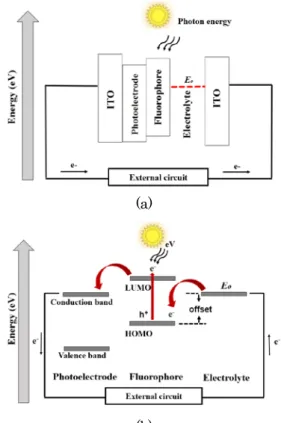
process that ensures a complete photovoltaic (PV) cycle. A complete device structure and an ideal working me-chanism of an e xc itonic solar ce ll are illustrated in Fig-ure 1(a) and 1(b), respectively. The main components of the exc itonic solar ce ll are the (i) fluorophore, (ii) pho-toelectrode, and (iii) electro lyte, which function as the med iu m for e lectron e xc itation, transportation, and re-generation, respectively [1–3]. The fluorophore acts as a light absorber, which exc ites an electron from the HO-MOfluorophore to the lowest unoccupied molecular orbital
of fluorophore (LUMOfluorophore) upon absorption of
photon with suffic ient energy (Ephoton > bandgap, E g-fluorophore). A vacancy (hole) is formed in the HOM O fluo-rophore during this stage [4]. Subsequently, the e xcited
electron undergoes an injection process from LUM O fluo-rophore to LUMOphotoelectrode. A typical photoelectrode
used in the excitonic solar cell is TiO2, which functions
as a mediu m for the transportation of the excited-state electron to the externa l c ircuit.
The electron vacancy in the HOMOfluorophore could be
replenished using electrolyte during the electron regene-ration mechanis m. Therefore , Eo is highlighted as the
key toward an effic ient regeneration process; thus, the require ments of LUMOfluorophore > Eo > HOMOfluorophore
should be fulfilled [5–8]. The redox process, which occurs in the electrolytes, involves (i) reduction (the electron is received fro m the e xternal c ircuit to the electrolyte) and (ii) o xidation (the electron is injected from the electro-lyte to the fluorophore). However, this study focused on the oxidation potential of the electrolytes, which is closely related to the regeneration process.
Quantum che mica l ca lculations under the density functional theory (DFT) fra me work could be used to calculate Eo of the polyme r-based electrolyte with high
accuracy [9–12]. The standard calculations could be performed in three main stages, i.e., (i) geometrical optimization of the o xidized and reduced states of elec-trolytes (in the gas and solvated phases), (ii) ca lculations of the Gibbs free energies in the gas and solvated phas-es, and (iii) calcu lations of the redox potential. The stated polymer-based electrolytes are preferred because of three factors, i.e ., (i) considerable attention focused on biodegradable polymer e lectrolytes because of their application in electrochemica l devices, including solar cells; (ii) low cost and abundance of natural polyme rs; and (iii) optimu m ionic conductivity of polymer electro-lytes, i.e., σCMC/P VA = 7.93 × 10⁻⁵ S/c m [13], σalginate =
10−6 S/c m, and σxanthan = 9.12 × 10⁻⁶ S/c m [14].
Furthermore, the e xpe rimental and theoretical values of the redox potential of the electrolytes have not been established. Therefore, this study further investigated the
(a)
(b)
Figure 1. (a) Device S tructure and (b) Working Mechanism of an Excitonic S olar Cell
detrimental effect on electron regeneration, wh ich is hypothesized to be rooted from an offset between Eo
and HOMOfluorophore.
2.
Experime ntal
Materials. Materials used in the experiment were xanthan powder (Sigma Aldrich), carboxymethyl cellulose (CMC), polyvinyl alcohol (PVA ), alg inate powder (Sig ma Aldrich), lead (II) sulfide (Sig ma Aldrich; 99.9% ), n itric acid (American Chemical Society reagent; 37%), titanium dio xide (R&M Che micals), absolute ethanol (Merck; 99.5% ), and indiu m tin oxide (ITO; Sig ma Aldrich), with the following properties: (i) size of 0.7 mm (height), 355 mm (width), and 406 mm (length), (ii) thickness of 150 ± 20 n m, (iii) sheet resistance of 8 Ω/sq, and (iv) transmittance of 80%.
Sample Pre par ati ons. The working electrode of the solar cells was prepared using the following techniques. Titaniu m d io xide paste was prepared by dissolving 1.5 g TiO2 powder in 1 mL concentrated nitric acid and 2 mL
ethanol. The photoelectrode layer (TiO2) was fabricated
using stencil printing technique on an active area of 1 cm × 1 c m and heated at 100 °C for 10 min. The lead sulfide (0.24 g) layer was fabricated on the TiO2 layer
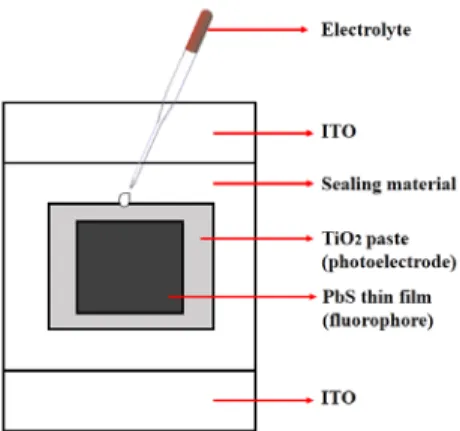
Figure 2. S chematic Diagram of a Solar Cell Fabricated Using Polymer-based Electrolytes
and current of 1.5 × 10⁻³ Torr, 1.53 V, and 65 A, respectively, to obtain good adsorption of the fluorophore (PbS) on the photoelectrode. The schematic d iagra m of the fabricated solar cell using polymer-based electrolytes is illustrated in Figure 2. Three polymer-based electrolytes were prepared in this work. The polymer-based electrolyte was made by dissolving 2.0 g CM C/PVA in 100 mL distilled water. The mixture was continuously stirred for approximately 24 h to form a homogenous solution. The alginate- and xanthan-based polymer electro lytes were prepared by dissolving 2.0 g alginate and xanthan powder, respectively, in 100 mL distilled water using the same procedure. A working solar cell was completed by layering a fe w drops of the polymer-based electrolytes in between a working electrode and a blank ITO.
Realistic Electrol yte Modelling. The structure of the electrolytes was optimized to the lowest energy structure through quantum chemica l calculat ions conducted using the Gaussian 09W software package at the b3lyp/lanl2dz level of theory [15]. The models we re evaluated and established as realistic using harmonic frequency calculations, thereby obtaining positive frequencies. Models with negative frequencies were discarded because of the nonrealistic vibrational mode. The ground- and e xcited-state energy levels of the rea listic c lusters were calculated using time-dependent DFT. The standard one-electron redox potential of the three polymer electrolytes was calculated by simulating negatively charged, positively charged, and neutral-state molecules of electrolytes to mimic the reduction and oxidation processes [16–20]. Nu me rous methods have been established to calculate the Eo potentials of electrolytes
[21–23].
In this study, the Born–Haber cycle was used to calcu-late Eo, which utilized six para meters, i.e., (i) enthalpy
of electron attachment in the gas phase (ESCF I(gas)), (ii)
free energy of electron attachment in the gas phase (G
I(gas)), (iii) Gibbs energy therma l co rrection in the gas
phase (Gcorr), (iv) d iffe rence of solvent free energy (∆G
I(solv)), (v) enthalpy of electron attachment in the solvent
phase (ESCF I(solv)), and (vi) free energy of electron
attachment in the solvent phase (G I(solv)). The negatively
charged (anion-state) models of the electro lyte we re selected upon convergence of the require ments of the calculations, i.e., ma ximu m force (0.00045 Hartree/Bohr), root mean square force (0.00030 Hartree/Bohr), ma ximum displacement (0.00180 Bohr), and root mean square displacement (0.00120 Bohr). The positively charged (cation-state) models were discarded because of conver-gence failure , which resulted in nonrealistic models.
ESCF I(gas) and GCorr were obtained fro m geo metry
op-timizat ion and harmonic frequency calculations in the gas phase, respectively. The ESCF I(solv) energy value
was obtained from energy calcu lations in solvent (wa-ter). G I(gas), G I(solv), and ∆G (solv) I was calculated using the following equations, respectively:
G
I(gas) =
E
SCFI(gas) +
G
Corr (1)G
I(solv) =
E
SCFI(solv) +
G
Corr (2)∆
G
(solv) I =
E
SCFI(solv) −
E
SCFI(gas)
(3)The calculations of ESCF II(gas), Gcorr, ESCF II(solv), G
II(gas), G II(solv), and ∆G (solv) II in the neutral state were obtained using the same procedure. The difference in the solvation phase free energy of the electron in the anion and neutral states, ∆Gox(solv), was calculated
using the following equation:
G I(gas) = E
SCFI(gas) + G
Corr(4)
The standard one-electron redox potential, Eo,was
cal-culated using the follo wing equation:
(5)
where F is the Faraday constant (23.06 kcal/ mo l V), yielding a value of −2.013770507 V vs standard hydro-gen electrode equivalent to −2.42623 eV vs vacuum.
3.
Results and Discussion
Energy Le vel Alignme nt Anal ysis. The calculated energy levels of the redox potentials of polymer electrolytes, HOM O and LUM O of fluorophore, and photoelectrode are presented in Figure 3(a) to 3(c). The established report has showed that the minimu m conduction band (-4.1 e V) and ma ximu m va lence band (-7.2 e V) energ ies of TiO2 (photoelectrode) [24].
Notably, the excited-state electron could be injected efficiently fro m the LUM OP bS to the LUM OTiO2
be-cause of the fulfillment of the require ments of LU-MOPbS (−4.0 eV) > LUMOTiO2 (−4.1 eV). Energy loss
Despite the efficient inject ion, efficient electron regene-ration fro m the electrolytes to the HOMOPbS was
inhi-bited because the value of Eo of the electrolytes is
high-er than that of LUMOP bS and HOMOP bS, i.e., Eo xanthan
(−1.605 eV) > Eo alginate (−1.908 eV) > Eo CMC/P VA
(−3.144 eV) > LUMOPbS (−4.0 eV) > HOMOP bS (−5.1
eV). Two detrimental factors could be inferred fro m energy level align ment analysis, i.e., (i) inefficient elec-tron injection fro m Eo to HOM OP bS because of the large
energy offset and (ii) unnecessary injection from Eo electroly-tes to LUMOPbS. A large energy offset between Eo and
HOM OP bS was observed, i.e., offsetCMC/P VA (1.956 e V),
offsetalginate (3.192 e V), and offsetxanthan (3.495 e V), which
would promote the unnecessary injection fro m Eo to
LUMOP bS [25, 26].
The calculated Eo was hypothesized to be unsuitable for
align ment with PbS as it is unable to fulfill the require-ments of LUMOP bS > Eo > HOMOP bS for an efficient
electron regeneration. Therefore, further analysis or replace ment of the fluorophore is needed.
(a)
(b)
(c)
Figure 3. Energy Level Alignment of Solar Cells Fabri-cated using (a) CMC/PVA-based, (b) Alginate-based, and (c) Xanthan-based Electrolytes
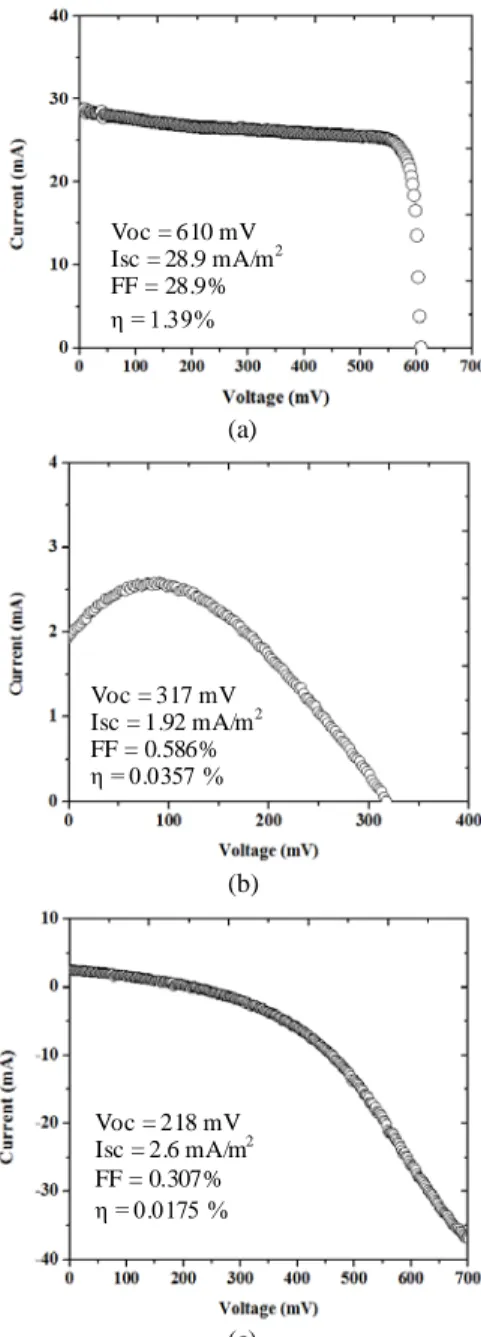
Photovoltaic Studies. The PV parameters of the fabricated solar cells are shown in Figure 4. The calculated parameters of the CMC/PVA-based solar cell, i.e., η = 1.39% , open circuit voltage (Voc) = 610 mV, short
circuit current (Isc) = 28.9 mA/ m2, ma ximu m power
(Pmax) = 13.9 W/m2, and fill factor (FF) = 28.9%, under
the illu mination of the sun, are indicated in Figure 4(a ).
The calculated PV para meters of the a lginate- and xanthan-based cells presented in Figure 4(b) and 4(c), respectively, yielded a low η. Th is finding can be attri-buted to the observation that electron regeneration is hindered by the high value of Eo, which promotes the two
detrimental factors mentioned in the previous section [27].
(a)
(b)
(c)
Figure 4. Current–Voltage Curves of S olar Cells Fabri-cated using (a) CMC/PVA-based, (b) Alginate-based, and (c) Xanthan-based Electrolytes
Voc = 610 mV Isc = 28.9 mA/m2 FF = 28.9% η = 1.39%
Voc = 317 mV Isc = 1.92 mA/m2 FF = 0.586% η = 0.0357 %
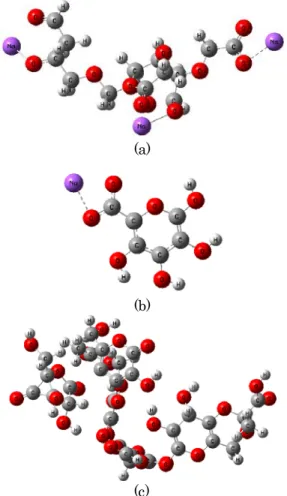
Structur al Analysis. The optimized structure of polymer-based electrolytes is illustrated in Figure 5. The CM C/PVA, a lginate, and xanthan molecules consist of three, one, and three carboxyl groups (–COO−), respectively. The carboxyl group attached to the branch of the electrolytes was speculated to be able to increase the structural interaction. The CM C/PVA- and xanthan-based electrolytes are speculated to have more structural interaction than the alginate-based electrolyte. Therefore, the number of carboxyl groups in the electrolyte structure would increase the ion mobility during the interaction. The rate of ion mobility is directly proportional to the conductivity of electrolytes, enhancing the short circuit current, Isc, which pro motes the incre ment of η of the
solar cell.
Therefore, electro lytes that yield a high-Isc PbS/TiO2
-based solar cell could be speculated to be -based on the number of carbo xy l groups existing in the structure and the energy offset (discussed in the previous section). The performance of the electrolytes can be ranked (fro m high to low) as follo ws: CM C/PVA (three carbo xyl groups, 1.956 e V offset), xanthan (three carboxyl groups, 3.495 e V o ffset), and alginate (one carboxyl group, 3.192 e V offset). Despite the re markable findings
(a)
(b)
(c)
Figure 5. Optimized S tructures of (a) CMC/PVA-based, (b) Alginate-based, and (c) Xanthan-based Elec-trolytes
on electrolytes, low η of the fabricated solar cells was reported. Low penetration of the polymer-based electro-lytes into the mesopores of TiO2, which can be
attri-buted to the large radius size of the polyme r chain com-pared with the pore size of the mesoporous TiO2, is
speculated to be the hindering factor [28–33].
4.
Conclusions
The CM C/PVA -, a lginate-, and xanthan-based electro-lytes cannot be paired with PbS as fluorophore because the value of Eo is higher than that of LUM OP bS and
HOM OP bS. The stated energy alignment is unable to
fulfill the require ments of an efficient electron regenera-tion, i.e., LUMOfluorophore > Eo > HOM Ofluorophore, which
would promote the unnecessary electron injection from the electrolytes to the LUM OP bS. Furthermore, the
ener-gy offset between Eo and HOMOP bS is large, i.e., o
ff-setCMC/P VA-PbS = 1.956 e V, offsetalginate-PbS = 3.192 e V,
and offsetxanthan-P bS = 3.495 e V, wh ich would promote
the unnecessary electron injection to the LUMOP bS and
suppress the electron regeneration in the HOMOP bS.
Acknowledge ments
This work is funded by the Research & Innovation De-partment of Unive rsiti Ma laysia Pahang and the Minis-try of Education of Malaysia through the Fundamental Research Grant Sche me (RDU 150111).
References
[1] D. Zhou, T. Zhou, Y. Tian, X. Zhu, Y. Tu, J. Na-nomater. 2018 (2018) 1.
[2] N.A. Chuchvaga, D.V. Zhilina, S.R. Zhantuarov, S.Z. Tokmo ldin, E.I. Teru kov, J. Phys.: Conf. Ser. 993/1 (2018) 012039.
[3] A.A. Baloch, S.P. Aly, M.I. Hossain, F. El-Mellouhi, N. Tabet, F.H. Alharbi, Sc ientific Re-ports. 7/1 (2017) 11984.
[4] S. Bernacchi, Y. Mély, Nucle ic Acids Res. 13 (2000) 29.
[5] W. Feng, A.S. Wan, E. Ga rfunke l, J. Phys. Che m. C. 19 (2003) 117.
[6] W. Feng, S. Rangan, Y. Cao, E. Ga loppini, R.A. Bartynski, E. Ga rfunke l, J. Mater. Che m. 19 (2014) 2.
[7] D.P. Hagberg, T. Marinado, K.M. Ka rlsson, K. Nonomura, P. Qin, G. Boschloo, L. Sun, J. Org. Che m. 25 (2007) 72.
[8] H. Ishii, K. Sugiya ma, E. Ito, K. Se ki, Adv. Mater. 8 (1999) 11.
[9] P. Gu, D. Yang, X. Zhu, H. Sun, P. Wangyang, J. Li, H. Tian, AIP Advances. 7/10 (2017) 105219. [10]M. Uudsemaa, T. Ta mm, J. Phys. Chem. A. 46
(2003) 107.
[12]L. Yan, Y. Lu, X. Li, Phys. Chem. Che m. Phys. 7 (2016) 18.
[13]Y.O. Iwaki, M.H. Escalona, Briones, A. Pawlic ka, Mol. Cryst. Liq. Cryst. 554 (2012) 221.
[14]F.C. Tavares, D.S. Dörr, A. Pawlicka , C. Oropesa Avellaneda, J. App. Po ly m. Sci. 135 (2018) 46229. [15]M.J. Frisch, G.W. Trucks, H.B. Schlegel, G.E.
Scuseria, M.A. Robb, J.R. Cheeseman, G. Scalma-ni, V. Barone, B. Mennucci, G.A. Petersson, et al., Gaussian 09, R.A. 1, Gaussian. Inc., Wallingford CT. 121 (2009) 150.
[16]M.H. Ba ik, R.A. Friesner, J. Phys. Che m. A. 32 (2002) 106.
[17]L.E. Roy, E. Jakubikova, M.G. Guthrie, E.R. Batista, J. Phys. Che m. A. 24 (2009) 113.
[18]S. Raja man i, T. Ghosh, S. Ga rde, J. Che m. Phys. 9 (2004) 120.
[19]M.T. McDonnell, D.A. Greeley, K.M. Kit, & D.J. Keffe r. J. Phys. Che m. B. 34 (2016) 120.
[20]S.K. Muzakir, Malaysia University Conference Engineering Technology, 2014. p. 79.
[21]M.Brandbyge, J.L. Mozos, P. Ordejón, J. Tay lor, K. Stokbro, Phys. Rev. B. 16 (2002) 65.
[22]M. Liu, S.M. Han, X.W. Zheng, L.L. Han, T. Liu, Z.Y. Yu, Int. J. Electroche m. Sc i. Be lgrade. 10 (2015) 235.
[23]K. Aru muga m, U. Becke r, M iner. 4 (2014) 345. [24]Z. Zhang, Y. Yu, P. Wang, ACS Appl. Mater.
Interfaces. 4 (2002) 990.
[25]S.K. Kim, P. Ho, J.W. Lee, S.Y. Jeon, S. Thogiti, R. Cheru ku, J.H. Kim, Mo l. Cryst. Liq. Cryst. 1 (2017) 653.
[26]P. Pe ljo, H.H. Girault, Energy Environ. Sci. 11 (2018) 2306.
[27]S. K. Mu za kir, N. Alias, M.M. Yusoff, R. Jose, Phys. Chem. Che m. Phys. 15 (2013) 16275. [28]J. N. D. Fre itas, A. F. Nogueira, M. A. Pao li, J.
Mater. Che m. 19 (2009) 5279.
[29]J. Y. Kim, T. H. Kim, D. Y. Kim, N.G. Park, K.D. Ahn, Power Sources 175 (2008) 692.
[30]L. Jin, Z. Wu, T. Wei, J. Zhai, X. Zhang, Che m. Co mmun. 47 (2011) 997.
[31]Y. Wang, Sol. Energy Mater. So l. Ce lls, 93 (2009) 1167.
[32]M.A. Saadiah, A.S. Sa msudin, IOP Conf. Ser.: Mater. Sci. Eng. IOP Publishing. 342/1 (2018) 012045.