BENCHMARKING KITCHEN AND DINING OPERATIONS
Edgar Allan Dela Cruz Mendoza, Dr. Nimrod Carpio. Far Eastern University Manila, De La Salle University [email protected], , [email protected]
Abstract
Food service industry around the world is obviously producing volume of both food and non-food products, not to mention the usage of water and energy. This industry consumes huge quantities of resources and produces diverse rates of waste. Green practices have been defined as the implementation of environment friendly activities in all areas including the procurement of green food (Harris, L.C., & Crane, A., 2002). In this study, the term was used as procurement of locally and organically grown foods as well as the efficient and effective use of resources to reduce waste and recycling (Harris, et al., 2002). During the data gathering, experts recommended several international food related organizations which endorse green practices. These organizations cited different areas that are being affected by green practices if will be applied. Several green practices were presented in this study for kitchen and dining operations from water & energy usage, sustainable purchasing, preparation, & packaging, effective disposal and pollution reduction, sustainable fixtures & furniture, and lastly staffs’ education and training. These practices were used to identify the different barriers in adapting green practices in kitchen and dining operations in the Philippines.
Keywords: green practices, kitchen, dining, challenges,
benchmarking
INTRODUCTION
The restaurant industry in global perspective is still considered as one of the fastest growing industries due to its dynamic characteristic. Developments penetrated the industry particularly the kitchen and dining operations (KDO). As a general knowledge, any development has its drawback and a great example of this is the development of the food sector wherein waste-overflow exists.
Since 1960s, development has been the trend all over the world. The most accepted definition used was with the United Nations World Commission on Environment and Development (1987) were it coins sustainable development as:
“Development that meets the needs of the present without compromising the ability of future generations to meet their own needs.”
In the Philippines, the earliest policy concerning environment was framed by the Philippine Strategy for Sustainable Development (PSSD) which was agreed and approved by the Philippine Cabinet last October 1989. This resulted for the adaptation of Agenda 21 that stressed out the fact that the tourism industry, were the food sector is included, relies on the quality of the environment for its survival (Tzschentke, et al. 2008).
In KDO, going green is not just about saving the planet or looking eco-chic. It also means new customers, money saving through reducing the energy consumption even the water usage, and the amount of revenue from recycling activities. But in Asia, including Philippines, going green is not as common as other countries like USA because of the barriers presently existing. (Dempsey 2011).
In line with the above notions the researchers tried to identify different international food related organizations endorsing green practices related to KDO; identify different areas in KDO that can be affected by different green practices; cite green practices that can serve as basis in tracing different barriers in KDO; lastly, to identify barriers of adapting green practices in KDO in the Philippines as stated by selected stakeholders.
MATERIALS AND METHODS
The study pursued to explore the various barriers that KDO faces in adapting green practices in the Philippines. The study involved a qualitative method and descriptive research design. Thematic technique was applied as a qualitative analysis. Thematic analysis identifies, analyses and reports patterns, hereinafter called themes, within the data (Braun and Clarke, 2006).
Researchers’ investigation focused on experts from industry and academe who had previously agreed to participate in this study. The population has an inherent selection bias. It therefore cannot be assumed that responses of the selected experts reflect the majority of KDO practices and barriers. This bias was intentional, however, as research aimed to examine the barriers that KDO face when adapting green practices, not whether there is a general willingness to become environmentally sustainable.
RESULTS ANDDISCUSSION
For the purposes of this study, the researchers identified different food related organizations endorsing green practices for different KDO. The following are the results.
Table 1. Profile of Selected Food Related Establishments and Organizations
Name Origin Classification
GCRC Chicago, USA Restaurant Group
Energy Star Washington , USA US EPA
GRA Boston, USA Accrediting Org.
Food Alliance Portland, USA Accrediting Org. Green Seal Washington, USA Accrediting Org.
NRA Washington,USA Accrediting Org.
SFC USA Consulting Firm
U.S. DA Washington ,USA Government
VDEQ Richmond, USA Government
BPI Inc. New York, USA Research Institute Table 1 shows that majority or four (4) organizations are classified under Accrediting Organizations namely: Green Restaurant Association, Food Alliance, Green Seal, and National Restaurant Association. California Department of Resource Recycling and Recovery, US Department of Agriculture, and the Virginia Department of Environmental Quality are classified as Government Agencies. WhileGreen Chicago Restaurant Coalition is classified as a Restaurant Group, andEnergy Star is classified as US EPA. Lastly,Sustainable Foodservice Consulting, and Biodegradable Products Institute Inc. are classified as Consulting Firm and Research Institute respectively.
One of the limitations of this research is that all of the organizations are based from USA. This is one of the constraints of the paper even though the researchers tried to seek organizations that strongly promote green practices and have their own established standards.
There were various KDO areas cited by selected international food related organizations. To maximize the information gathered, the researchers created a diagram to summarize the five (5) cited areas. The areas mentioned are the following: Water & Energy Usage, Sustainable Purchasing, Preparation, & Packaging, Effective Disposal and Pollution Reduction, Sustainable Fixtures & Furniture, and Staffs’ Education and Training.
Figure 1.KDO areas cited by different International Organizations According to the research of Chan (2008), a successful environmental management system requires time, money, and people. The above diagram shows that the five (5) areas are the factors in considering if KDO adapts green practices. These areas were designed with specific accreditation requirements just like what have been done by GRA, Food Alliance, Green Seal, and NRA. These accrediting organizations serve as standards for different KDO in applying green practices.
practices were presented in the following tables and divided according to respective KDO areas.
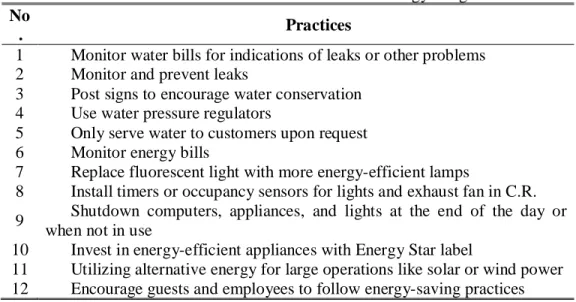
Table 2. Green Practices in Water & Energy Usage No
. Practices
1 Monitor water bills for indications of leaks or other problems 2 Monitor and prevent leaks
3 Post signs to encourage water conservation 4 Use water pressure regulators
5 Only serve water to customers upon request 6 Monitor energy bills
7 Replace fluorescent light with more energy-efficient lamps
8 Install timers or occupancy sensors for lights and exhaust fan in C.R. 9 Shutdown computers, appliances, and lights at the end of the day or
when not in use
10 Invest in energy-efficient appliances with Energy Star label
11 Utilizing alternative energy for large operations like solar or wind power 12 Encourage guests and employees to follow energy-saving practices
Water and energy saving practices has been considered as one of the most significant areas of environmental management in KDO because it consume considerable amount of electricity, fossil fuel energy, and water sources in various operational areas.
Table 2 presented preventive practices that might help KDO to save both water and energy while some practices are concern with the initiative of both management and guests. Other practices are promoting new equipment investments that will save energy in the long run.
Table 3. Green Practices in Sustainable Purchasing, Preparation, & Packaging No
. Practices
1 Purchase reusable items 2 Purchase organic ingredients 3 Free of polystyrene foam
4 Eliminate individually wrapped items during purchasing 5 Avoid products with excess packaging
6 Buy products in returnable, reusable or recyclable containers 7 Local sources purchasing
8 Awareness of transparent and traceable supply chains
9 Avoid GMOs
10 Build organic herb garden 11 Bulk packaging
12 Usage of take-out containers that can be composted or recycled
difference of the two. Green purchasing is the main point of Table 3 wherein participation of the whole supply chain needs to be achieved.
It is very evident that supporting local suppliers as well as the usage of organic ingredients or the non-GMO products can be considered as green practices. According to NRA’s Culinary Forecast (2016) “What’s Hot- Top 20 Food Trends” four (4) trends out of twenty (20) are emphasizing the local sourcing of ingredients together with the usage of organic raw materials.
Table 4. Green Practices in Effective Disposal and Waste & Pollution Reduction
No. Practices
1 Reuse back pages of printed paper 2 Removing paper table and tray mats 3 Paperless billing for suppliers 4 Paperless payroll for employees 5 Paperless submission of orders 6 Junk mail reduction
7 Usage of washable utensils and dishes 8 Reusable mug program
9 Reusable bag programs 10 Delimit usage of straws 11 No bottled water served onsite 12 Replace paper towels with hand dryer 13 No table covering for upscale dining
14 Bike delivery and/or offering bike racks for customers 15 Use biodegradable cleaning agents
16 Presence of recycling bins
17 Regular cleaning of grease trap or interceptor 18 Appliance or Furniture donation
19 Donations to food bank or shelter
20 Stressing portion size to guest to avoid leftovers 21 Send food waste to farms for composting 22 Compostable label program
23 Limit usage of disposable items
According to Arvanitoyannis (2007), aside from the growing population that leads to increasing pollution, food industry contributed to the large demand of processed and packaged food or materials.
Table 5. Green Practices in Sustainable Fixtures & Furniture No
. Practices
1 Minimize usage of trays of customers
2 Limiting usage of disposable menu boards or tarpaulins
3 Using low or no VOC (volatile organic compound) paint
4 Double windows and doors 5 Use renewable counter tops
6 Buy furniture made from salvaged wood
Table 5 presented practices related to efficient use and construction of fixtures and furniture (FF). It is important that KDO stakeholders be educated that even FF can be used to practice green initiatives.
Table 6. Green Practices in Staffs’ Education and Training No
. Practices
1 Start 3Rs culture in the business
2 Ahead staff planning to avoid thawing food in water 3 Support safe and fair working conditions
4 Train staffs on how to recycle
5 Encourage staff to become involved in volunteer eco-projects
Employees or staffs’ involvement is essential for the full success of environmental programs and their involvement through educational opportunities encourage employees to become part of KDO’s green initiatives. Appropriate and thorough education of staff is essential for improving a company’s overall sustainability performances. (Willard, 2009)
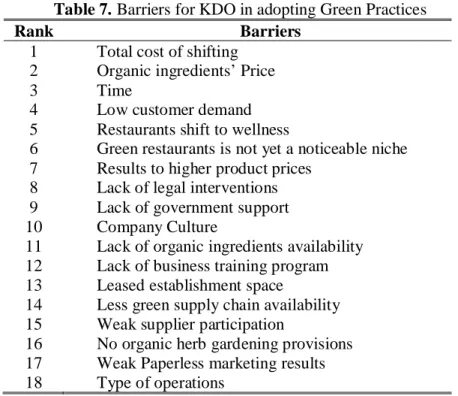
Table 7. Barriers for KDO in adopting Green Practices
Rank Barriers
1 Total cost of shifting 2 Organic ingredients’ Price
3 Time
4 Low customer demand 5 Restaurants shift to wellness
6 Green restaurants is not yet a noticeable niche 7 Results to higher product prices
8 Lack of legal interventions 9 Lack of government support 10 Company Culture
11 Lack of organic ingredients availability 12 Lack of business training program 13 Leased establishment space
14 Less green supply chain availability 15 Weak supplier participation
16 No organic herb gardening provisions 17 Weak Paperless marketing results 18 Type of operations
Most of the participants interviewed responded that cost or financial barrier is the most common barrier why KDO found difficulty in adapting green practices which is also similar to the previous research of Revell (2009) and Taylor (2003) that even the inclusions of organic ingredients to recipes are very obvious to be barrier.
Majority of the respondents also mentioned that lack of time is a barrier due to different factors such as limited number of staffs’ availability together with their managers and even the owners in shifting to green practices. One of the participants also commented that he even don’t have enough time to conduct research into what kind of green practices their KDO can adapt.
Another remarkable barrier is low customer demand to shift in green practices. According to Tan (2012), there is a very low implementation of restaurant green practices among Asian KDO. This barrier was also mentioned by the respondents that will be supported by another barrier which is that in Asia, green restaurants is not yet a prominent niche in the market.
Table 7 presented other barriers mentioned by different stakeholders that have close connection with KDO.
CONCLUSION ANDRECOMMENDATION
Experts form the industry and academe assisted the study to identify several barriers adapting KDO. The most common barriers are cost, price, time, lack of demand, and lack of knowledge. As the study identified these barriers, it came up that this study needs for more detailed research into green practices barriers in the Philippines, as well as barriers specifically related to ownership and management structure. As more detailed information may be collected and synthesized, national to local government and KDO managements can better tailor programs to suit the needs of adapting green practices in KDO in the Philippines and to delimit the barriers identified.
REFERENCES
Biodegradable Products Institute Inc (2015). The Science of Biodegradation.
Retrieved from http://www.bpiworld.org
Braun, V. and V. Clarke (2006). Using Thematic Analysis in Psychology. Qualitative Research in Psychology
California Department of Resource Recycling and Recovery (2016). Recycle by City’s mission to promote consumer education, one city at a time. Retrieved from http://www. wastedive. com/ news/recycle-by-citys-mission-to-promote-consumer-education-one-city-at-a-time/412767/
Chan, E. (2008). The compelling “Hard Case” for Green Hotel Development.
Cornell Hospitality Quarterly, p.234-244
Dempsey, J. (2011). Siemens abandoning power business. Retrieved from http://www. nytimes.com/2011/09/19/business/global/19iht-siemens 19.html, Sept., 2013
Energy Star (2016). The simple choice for energy sufficiency. Retrieved from http://www. energystar.gov/
Food Alliance (2015). Sustainability for Food and Agriculture. Retrieved from http:// foodalliance. org/
Fraenkel, J.R., and N.E. Wallen (2010). How to Design and Evaluate Research in Education 7th ed. McGraw Hill: Manila
Green Chicago Restaurant Coalition (2015). Guaranteed Green. Retrieved from http://greenchicago.org/
Green Seal (2016). Green Business. Retrieved from http://www.greenseal.org/GreenBusiness/Certification/WhyCertification.asp x
Harris, L.C., & Crane, A., (2002). The greening of organizing culture: Management views on the depth, degree and diffusion of change. Journal of Organizational Change Management
Lund Research Ltd (2012). Purposive sampling. Retrieved from http://dissertation. laerd.com/purposive-sampling.php
National Restaurant Association (2013). Restaurant Advocacy Fund. Retrieved from http://www. restaurant.org/advocacy/Get-Involved/Restau rant-Advocacy-Fund
National Restaurant Association (2016). What’s Hot Culinary Forecast. Retrieved from http://www. restaurant.org/News Research/ Research/What-s-Hot Nunan, D., and C.M. Bailey (2009). Exploring Second Language Classroom
Research: A Comprehensive Guide. Cengage Learning, Inc: Philippines Revell A, Stokes D, Chen H. (2009). Small businesses and the environment:
Turning over a new leaf?Business Strategy and the Environment.
Sustainable Business Associates (2008). Best Environmental Practices for the Hotel Industry.
Sustainable Foodservice Consulting (2013). Green Cleaning for Restaurant and Food Service Operations. Retrieved from http://www. sustainablefoodservice.com/cat/green-cleaning.htm
Tan (2012). How to Enhance Green Practices Among Asian Restaurants?.
Retrieved from http://www.brandattachment.com
Taylor N, Barker K, Simpson M. (2003). Achieving sustainable business, a study of perceptions of environmental best practice by SMEs in South Yorkshire.
Environment and Planning C: Government and Policy
Tzschentke, N. A., Kirk, D., & Lynch, P.A. (2008). Going green: Decisional factors in small hospitality operations. International Journal of Hospitality Management
United Nations World Commission on Environment and Development (1987).
Our Common Future. Brundtland Report.
Opinions/Responses of the Consumer. Retrieved from http://portal.nifa.usda.gov
United States Environmental Protection Agency (2013). Energy Efficiency in Water and Wastewater Facilities A Guide to Developing and Implementing Greenhouse Gas Reduction Programs. Local Government Climate & Energy Strategy Series
Virginia Department of Environmental Quality (2015). Pollution prevention report focus on minimizing footprint. Retrieved from http://deq.virginia.gov Willard B. (2009). Environmental management. Philadelphia: W.B. Saunders