www.ijtes.net
Flexibility
Processes
of
Pre-service
Teachers in Problem Solving with
Technology
Wajeeh Daher1, Ahlam Anabousy2
1
An-Najah National University, Israel
2
Tel-Aviv University, Israel
To cite this article:
Daher, W., & Anabousy, A. (2020). Flexibility processes of pre-service teachers in problem
solving with technology.
International Journal of Technology in Education and Science
(IJTES), 4(3), 247-255.
Volume 4, Issue 3, Summer 2020
ISSN: 2651-5369
Flexibility Processes of Pre-service Teachers in Problem Solving with
Technology
Wajeeh Daher, Ahlam Anabousy
Article Info
Abstract
Article History
Received: 08 March 2020
Researchers point at the need to study the creative processes of students in problem solving, as these may indicate how to encourage creative problem solving. The present research attempts to study, based on the heuristic framework of Polya, pre-service teachers' flexibility processes when they solve a mathematical problem with technology. The research was held in a teacher college, where two second-year classes of 49 mathematics pre-service teachers (24 in the academic year 2017-2018 and 25 in the academic year 2018-2019) participated in the research. The pre-service teachers were requested to solve the halving-the-rectangle problem with technology, specifically with the GeoGebra software. The research results indicated that generally the participants, who performed flexibility processes, used a sequence of creativity processes: conjecturing, specialization, verifying consequences with technology and generalization. The conjecturing process utilized mathematical relationship or inference from analogy, where the inference from analogy advanced gradually through solution modifications.
Accepted: 16 June 2020
Keywords
Creativity processes Preservice teachers Technology Flexibility Heuristics Problem solving
Introduction
Researchers have been interested in students' problem solving for a long time, especially in students' processes and heuristics in engaging with this solving. Polya (1954, v. II, p. 120) observed, regarding the mathematician's processes and heuristics of doing mathematics that in „„trying to solve a problem, we consider different aspects of it in turn, we roll it over and over in our minds; variation of the problem is essential to our work‟‟. Freiman and Sriraman (2007, p. 24) claim that “heuristics can be viewed as a decision-making mechanism, which lead the mathematician down a certain path, the outcome of which may or may not be fruitful”. This could also be claimed for the fruitfulness of the work of the mathematics student whose decision-making concerns creative doing. In addition, Chernoff and Sriraman (2015) argue, agreeing with Polya (1954), that in verifying conjectures and looking for patterns, mathematicians use a variety of heuristics such as (1) verifying consequences, (2) successively verifying several consequences, (3) verifying an improbable consequence, (4) inferring from analogy, (5) deepening the analogy. The present study utilizes the previous heuristics framework to study the creative problem solving processes carried out by pre-service teachers when they solve a mathematical problem that requests to halve a rectangle.
Mathematical Creativity
248 Daher & Anabousy
motivation and persistence, and it takes place over either a considerable time or at high intensity; and (4) the problem as initially posed is vague or ill-defined. Newell, Shaw and Simon (1962) further argue that the processes involved in creative and non-creative problem solving do not show particular differences between the two. In the present research, we adopt this approach to study pre-service teachers‟ creative processes in problem solving with technology, which enables us to base our study on the problem solving heuristics described by Polya (1954) and lately by Chernoff and Sriraman (2015).
Mathematical Problem Solving and Mathematical Creativity with Technology
Researchers have also been interested in contexts that encourage students‟ creativity. Karademir (2016) argued that project-based activities allow students to imagine the scientific relationship in the topic that they learn which affects their scientific thinking and creativity levels. Admiraal et al. (2019) emphasized that studies in the contribution of remote labs to students‟ learning mentioned the positive impact of these labs on students‟ creativity. Daher and Anabousy (2018a, 2018b) found that what-if-not strategy context enrich students‟ creativity in mathematics. Daher, Tabaja-Kidan and Gierdien, (2017) found that the Cognitive Research Trust (CoRT) thinking program influenced significantly grade six students‟ creativity in mathematics. Technology has been suggested as a tool for mathematics teaching and learning (Daher, Baya'a & Anabousy, 2018; Serhan & Almeqdadi, 2020). The National Council of Mathematics Teachers (NCTM) (2008) says that mathematics students at different levels, in a well-articulated mathematics program and with the guidance from effective mathematics teachers, can use technological tools to gain access to problem-solving contexts, to explore problems and to identify them. Limjap (2002) describes technology as lessening the cognitive load of working with a mathematical problem by helping the learner acquire a problem schema. Furthermore, researchers reported how technology assists students in their problem solving. Specifically, Daher (2009) reported that the participating college students considered applets as tools that helped them understand the problem, re-construct it with technology, and thus have ideas how to solve it.
As to the contribution of technology to creativity, Clements (1995) argues that educational research indicates no single effect of technology on creativity, because it can function as supporting either uncreative drill or creative production. Nevertheless, Clements claims that the technology-based curriculum and the teacher who integrates it in the mathematics classroom are essential elements in realizing the curriculum full potential. Furthermore, Idris and Nor (2010) agree with Clements (1995) in highlighting the significant role of the teacher, saying that technological tools, under the guidance of a skillful teacher, create a rich mathematical learning environment that helps expose students for diversified experiences, which nurtures their general mathematical creativity. Sophocleous and Pitta-Pantazi (2011) report that though sixth grade students' creative abilities in three-dimensional (3D) geometry were very low in two studies that they conducted, an interactive 3D geometry software environment enhanced the creativity abilities of the participating students by offering them opportunities to imagine, synthesize and elaborate, which enhanced the students‟ creative abilities. Daher and Anabousy (2018a, 2018b) found that technology assists students in their fluency, flexibility, originality and overall creativity. Rohaeti, Bernard and Primandhika (2019) found that students‟ creativity in creating interactive learning media increased when using open-ended Visual Basic Application for Excel. The present research attempts to understand the processes aspect of creativity, when the learner engages in problem solving with technology. It does that, based on the heuristics framework described by Polya (1954).
The Heuristics Framework
Regarding inferring from analogy, Polya considers analogy a „sort of similarity‟ and “Similar objects agree with each other in some aspect. If you intend to reduce the aspect in which they agree to definite concepts you regard those similar objects as analogous” (v. I, p. 13). Moreover, he describes the clarification of an analogy as “getting down to clear concepts” regarding the aspects of analogy (v. I, p. 13). Furthermore, Polya claims “A conjecture becomes more credible when an analogous conjecture turns out to be true” (v. II, p. 10). In addition, deepening the analogy entails verifying different analogies of a claim (pp. 10-11). Furthermore, Mazur (2014) describes a special type of analogy „Analogy by expansion‟ which occurs when the learner has a concept, and intends to expand this concept, keeping its structure. In addition to the above components of the heuristics framework, Polya (1954) describes problem solving processes, such as generalization, specialization and analogy. He describes generalization as "passing from the consideration of a given set of objects to that of a larger set, containing the given set" (v. I, p. 12). Specialization is "passing from the consideration of a given set of objects to that of a smaller set, contained in the given set" (v. II, p. 13). Polya (1954), as described above, also states that “analogy is a sort of similarity” (v. II, p. 13).
Research Goals and Rationale
The present research intends to utilize the heuristics framework of Polya (1954) to analyze pre-service teachers‟ processes in creative problem solving. It meets the call of mathematics education researchers to conduct research on students' processes in solving mathematical problems creatively (Sriraman, 2005; Sriraman, Yaftian & Lee, 2011). The need for research on students‟ creativity processes is especially true when these processes are performed in a technological environment; an environment shown to be productive to problem solving in general (Barrera-Mora & Reyes-Rodríguez, 2013). Utilization of Polya‟s heuristics framework would contribute to deeper understanding of students‟ creative processes; here their flexibility ones.
Methods
Research Context and Participants
The research was held in a teacher college, where two second-year classes of 49 mathematics pre-service teachers (24 in the academic year 2016-2017 and 25 in the academic year 2017-2018) participated in the research. The pre-service teachers were requested to solve the halving-the-rectangle problem with technology, specifically with the GeoGebra software. The pre-service teachers did not work with GeoGebra before, and were introduced to it in two-lesson time; each lesson lasted for two hours. They experimented during these lessons, drawing geometric shapes without and with conditions, and measuring the edges and angles of the shapes.
Data Collection and Analysis Tools
The participating pre-service teachers in the two classes were requested to solve halving-the-rectangle task with GeoGebra, and the data was collected from their answers that were of two types: (1) Geogebra files that included the products of students‟ work and Word files that included descriptions of the processes that the students performed to solve the halving-the-rectangle task. Following is the statement of the task. We want to divide a rectangle into two equal parts in as many ways as possible. How can we do that? We want to draw all the possible ways. We want to describe and reflect how we solved the problem and how we found different ways of solution. In addition, we want to reflect about the role of technology in our solution of the problem. In the present research, we refer to the task as halving-the-rectangle task.
250 Daher & Anabousy
teacher kept changing the same one condition, two condition, etc., we considered this process, to be a fluency process.
Two experienced coders coded the participants‟ processes. The agreement between the coders (Cohen‟s Kappa coefficient) gave: 0.98 for the fluency processes and 0.97 for the flexibility processes. These results ensured the reliability of the qualitative coding. In addition to the previous computations, to validate our analysis methods, we triangulated our methods with those of Leikin and Kloss (2011). In more detail, we compared the products of these processes with those obtained by following Leikin and Kloss (2011). The fluency processes, as described above, yielded the same solutions considered to belong to fluency by Leikin and Kloss (2011). The flexibility processes, as described above, yielded solutions that belong to different groups of solutions in the solution space, as suggested by Leikin and Kloss (2011).
Findings
Generally, the participants, who arrived at flexibility processes, used one main sequence of heuristics to solve creatively halving-the-rectangle task. This sequence consisted of the following heuristics: Conjecturing using mathematical relationships, making specializations that included a specific conjecture, verifying the consequence of the specific conjecture with technology, making appropriate generalizations, conjecturing through the inference/deepening the inference from analogy by changing one or more of the conditions of the problem, making specializations/successive specializations with technology, making an appropriate generalization. An example of the above sequence of processes is the following:
(1) Conjecturing, through using mathematical relationships: “The rectangle can be halved by dividing it into two congruent shapes and choosing one of them to be the half”.
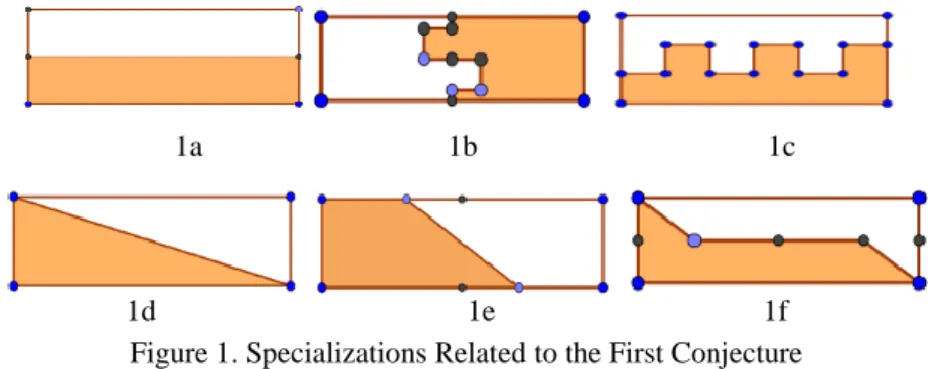
(2) The previous conjecture was followed by performing specializations related to it. Each specialization included a specific conjecture as "the congruent shapes could be rectangles/triangles/trapeziums, etc." and, at the same time, it included verifying the consequences of it.
Figure 1 shows solutions that could have resulted from the specialization, including the specific conjecture and its verification.
Figure 1. Specializations Related to the First Conjecture
In the above solutions, every solution is the first solution that could have developed according to the sequence that will be described below:
(3) The verification was followed by an appropriate generalization: 'the rectangle can be halved by partitioning it into two congruent shapes which could be rectangles/triangles/trapeziums/etc. Parallel to this generalization, and as a result of verifying an improbable consequence, the students generalized that 'a rectangle could not be halved into two congruent parallelograms that are not rectangles or into two congruent circles'.
(4) The sequence of the above four heuristics was recurred after choosing a specific case of getting two congruent shapes (e.g., the congruent shape could be a rectangle). This time it started by conjecturing through inferring from analogy: "Changing one condition of the previous solution could result in another solution". This conjecturing was followed, as before, by a specialization which included two processes as above. First, it included a related conjecture involving changing a specific condition of the previous solution (e.g., the number of equal parts, on condition that it stays even), and second, it included the verification of the consequence of the related conjecture with technology. In the previous inferring, the analogy of the second solution to the first one was in the congruence/similarity of the shapes of parts (rectangles were used to partition the original rectangle) and in the feature that each pair of these adjacent rectangles had one rectangle in each half.
1a 1b 1c
Solutions obtained by the above described heuristics started by changing the number of parts, for example into 10, and then into 20 as in Figure 2, to obtain different new solutions. The previous process was, at the beginning, a flexibility process because it involved changing one feature of the first solution – the number of parts, on condition that it stays even. This process was followed by fluency processes involving additional changes of the same condition. This resulted in new solutions that differed from the upper left shape in Figure 1 in the number of parts. The new solutions that followed the upper left one in Figure 1 are considered successively verifying consequences of the inferring from analogy.
Figure 2. Changing the „Number of Parts‟ Condition
(5) The successive consequences were obtained through performing specializations and resulted in a strategy-generalization "changing the number of rectangular parts and keeping the rest of the conditions results in halving the rectangle", which was accompanied with a solution-generalization "The rectangle could be halved by partitioning it into an even number of equal - area rectangles and choosing one of every two adjacent parts".
(6) The previous sequence of processes recurred, but this time the first conjecturing was done through deepening the inference from analogy. The sequence progressed by successively making specializations through related conjectures and verification of these conjectures with the help of technology. This progress constituted successive verification of consequences.
The deepening of inference was done by changing at least two features of the first solution. The products of the sequences of creativity processes are described below, where the number of changed features starting from the first solution is denoted by NCF (Note that NCF above, in the case of inferring from analogy, is 1). The first product/solution, in all the following sequences of creativity processes, is a flexibility product/solution, while the second is a fluency product/solution. In each of these sequences, the first product is a result of changing a new condition, while the second is a result of changing the same new condition.
NCF= 2
The changed features: Number of parts – that stays even, adjacency of parts Examples on products:
Figure 3. Changing Two Conditions; the New Changed Condition Is the Adjacency of Parts
NCF= 3
The changed features: The previous two features & the even/odd property of the number of parts. Examples on products:
Figure 4. Changing Three Conditions; Where the New Changed Condition Is the Even/Odd Property of the Number Of Parts. The Fluency Process Is Related to the Number of Odd Parts
4a 4b
2a 2b
252 Daher & Anabousy
NCF=4
The changed features: The previous three features & the width of parts. Examples on products:
Figure 5. Changing Four Conditions; The New Changed Condition Is the Width of Parts. The Fluency Process Is Related To the Number of Parts Having Different Width
NCF=5
The changed features: The previous four features & the shape of the part. Examples on products:
In Figure 6a, the part has been changed into a triangle, while in Figure 6b it has changed into a parallelogram.
Figure 6. Changing Five Conditions; the New Condition Is the Shape of the Part
In Figure 7a, there are two types of parts in addition to the rectangle; a triangle and a circle. Note that in Figure 6a, for example, there is one type of parts in addition to the rectangle: the triangle.
NCF=6
The changed features: The previous five features & the sameness of the parts. Examples on products:
Figure 7. Changing Five Conditions; the New Condition Is the Sameness of Parts
The changed features: The previous six features & the equality of areas of the coloured and uncoloured parts that constitute the rectangular part.
Examples on products:
In Figure 8a, the colored part of the rectangular part is sometimes not equal in area to the uncolored part in the same rectangular part.
Figure 8. Changing Five Conditions; the New Condition Is the Equality of Areas of the Colored and Uncolored Parts of Which the Rectangular PartIs Constituted
Every sequence of creativity processes above, for NCF=2 or more, resulted in an appropriate strategy-generalization and solution-strategy-generalization as in the case of NCF=1 above. In addition, when NCF=6, or 7, the first product/solution is a flexibility one, and the next are fluency ones. Two further remarks: First, not all the participants advanced to NCF=6, or 7, where some of them stopped at NCF=2, 3, 4, or 5. Second, the first
6a 6b
7a 7b
8a 8b
conjecture differed between the participants. Two examples on such conjectures are: “the rectangle can be halved by dividing it into two congruent shapes and colouring one of them" and "the rectangle can be divided by using a specific shape and colouring half of them.”
Discussion
In the present research, we utilized the heuristics of Polya (Chernoff & Sriraman, 2015; Polya, 1954) to describe pre-service teachers' creative processes in halving the rectangle using technology. The research results indicated that generally the participants, who arrived at advanced flexibility processes (NCF=6 or 7), used one main sequence of creativity processes, where this sequence consisted of: conjecturing, specialization, verifying consequences with technology and generalization. The first process in the sequence involved using mathematical relationship or inference from analogy, while the second process, which involved “making specializations”, constituted of two processes: conjecturing utilizing specific cases of the first conjecture and verifying the consequences of the specific conjecture with technology. In addition, the first process proceeded according to the sequence: 'using inference from analogy through changing one condition of the solution', “deepening the inference from analogy by changing two or more conditions”. This proceeding of the sequence led into creative products/solutions that included fluency and flexibility products. These results indicate that Polya's heuristics could be used by learners to arrive at different types of creative solutions of mathematical problems.
In addition to the above, the inference and deepening the inference from analogy were done through applying the strategy of changing/modifying at least one feature of the previous product/solution, a strategy that was found to facilitate students' mathematical creativity (Voica & Singer, 2013). This potential of the activity modification to encourage students‟ creativity in general has long been acknowledged by Newell, Shaw and Simon (1962) who claimed that problem solving becomes creative when the student‟s thinking of a problem solution focuses on modification or rejection of previously accepted ideas. The contribution of the problem modification to students' creativity helps the learner overcome the fixation that could occur in problem solving (Haylock, 1997). Furthermore, the problem solution‟s modification, as could be concluded from the description above, proceeded from simple to more complex modification of the solution, which would support problem solvers in their movement into advanced flexibility processes. In addition, the specialization process, which was performed after each modification, included conjecturing and verifying consequences with technology, where the modification resulted in analogies of a solution/product. Here the 'conjecturing by analogy'-verification pair of the specialization were intertwined, pointing at analogy by expansion (Mazur, 2014) in which the pre-service teachers expanded the solution/product by flexibility processes and accompanying fluency processes.
Technology, as described above, supported principally the successive verification of several consequences of a conjecture. This support was achieved through the facilitation of primarily the measurement of areas related to a specific consequence. This facilitation enabled the comparison between the areas of the parts and thus the verification if there are two sets of shapes of which the rectangle is constituted and which the two sums of their areas are equal. We argue that technology in the case that we report helped the smooth movement from a generalization into its specializations. The first specialization led into flexibility solution, while the successive ones led into fluency ones. Specifically, technology helped the smooth movement to fluency solutions, for it facilitated the repetitive modification of a specific condition. As described above, the creativity of the participating pre-service teachers advanced through repetitive modifications, which led to advanced flexible processes, where advanced flexibility processes here are related to the number of conditions/features that the solver changes starting from his/her first solution. More research is needed for studying these advanced flexibility processes as they develop from solution modification.
254 Daher & Anabousy
encouragement of creativity processes could happen when using open-ended problems (Daher & Anabousy, 2018a), as halving-the-rectangle described in the present research.
Conclusions
The present research intended to study, by utilizing the heuristics of Polya pre-service teachers' creative processes in halving the rectangle using technology. The modification of the previous solution enabled the participants to arrive at new and different solutions; i.e. creative ones. A sequence of creativity processes was identified, where this sequence consisted of: conjecturing, specialization, verifying consequences with technology and generalization. This sequence could be utilized by mathematics teachers to encourage the creativity of their students. Teachers who use open teaching could utilize the modification strategy to encourage the creativity of their students, especially their flexibility. The present research‟s results indicated that technology was used by the pre-service teachers to verify the consequence of their conjecturing. This indicates that technology has different roles in students‟ learning of mathematics which indicates the need to utilize it as dynamic tool that helps the student to verify her or his conjectures, which would make the afterwards justification process more approachable. The present research was interested in the contribution of modifications that follow Polya‟s heuristics to pre-service teachers‟ flexibility. More research is needed to verify how modifications that utilize the heuristics of Polya could contribute to school students‟ flexibility, especially in the presence of technology.
References
Admiraal, W., Post, L., Guo, P., Saab, N., Makinen, S., Rainio, O., Vuori, J., Bourgeois, J., Kortuem, G., & Danford, G. (2019). Students as future workers: Cross-border multidisciplinary learning labs in higher education. International Journal of Technology in Education and Science (IJTES), 3(2), 85-94.
Barrera-Mora, F. & Reyes-Rodríguez, A. (2013). Cognitive processes developed by students when solving mathematical problems within technological environments. Mathematics Enthusiast, 10 (1&2), 109-136. Clements, D. H. (1995). Teaching creativity with computers. Educational Psychology Review, 7 (2), 141-161. Chamberlin, S. A., & Moon, S. M. (2005). Model-eliciting activities as tool to develop and identify creativity
gifted mathematicians. Journal of Secondary Gifted Education, 17(1), 37–47.
Chernoff, E. J., & Sriraman, B. (2015). The teaching and learning of probabilistic thinking: Heuristic, informal and fallacious reasoning. In R. Wegerif, L. Li & J. Kaufman (Eds.), The Routledge International Handbook of Research on Teaching Thinking (pp. 369-377). New York: Routledge, Taylor & Francis. Daher, W. (2009). Students‟ Perceptions of Learning Mathematics with Cellular Phones and Applets.
International Journal of Emerging Technologies in Learning, 4(1), 23-28.
Daher, W., & Anabousy, A. (2018a). Creativity of pre-service teachers in problem posing. Eurasia Journal of Mathematics, Science and Technology Education, 14(7), 2929–2945.
Daher, W., & Anabousy, A. (2018b). Flexibility of pre-services teachers in problem posing in different environments. In F. Singer (ed.), Mathematical Creativity and Mathematical Giftedness. ICME-13 Monographs. Cham: Springer,
Daher, W., Baya'a, N., & Anabousy, R. (2018). In-service mathematics teachers' integration of ICT as innovative practice. International Journal of Research in Education and Science (IJRES), 4(2), 534-543. Daher, W., Tabaja-Kidan, A., & Gierdien, F. (2017). Educating Grade 6 students for higher-order thinking and
its influence on creativity. Pythagoras, 38(1), a350.
Freiman, V. & Sriraman, B. (2007). Does mathematics gifted education need a working philosophy of creativity? Mediterranean Journal for Research in Mathematics Education, 6(1-2), 23-46.
Harris, L. R., & Brown, G. T. L. (2010). Mixing interview and questionnaire methods: Practical problems in aligning data. Practical Assessment, Research & Evaluation, 15(1), 1-19.
Haylock, D. (1997). Recognizing mathematical creativity in school children. ZDM, 29(3), 68-74.
Idris, N. & Nor, N.M. (2010). Mathematical Creativity: Usage of Technology. Procedia- Social and behavioral Sciences, 2, 1963–1967.
Isaksen, S.G. (1995). CPS: Linking creativity and problem solving. In G. Kaufmann, T. Helstrup, & K.H. Teigen (Eds), Problem solving and cognitive processes: A festschrift in honor of KjellRaaheim (pp. 67-81). BergenSandviken, Norway: FogbokforlagetVigmostad and Bjorke AS.
James, V., Lederman-Gerard, R., & Vagt-Traore , B. (2010).Creativity. In M. Orey (ed.), Emerging Perspectives on Learning, Teaching and Technology (pp.104-114).
Karademir, E. (2016). Investigation the scientific creativity of gifted students through project-based activities.
Landis J. R., & Koch G. G. (1977). The measurement of observer agreement for categorical data. Biometrics, 33(1), 159–174.
Leikin, R. (2009). Exploring mathematical creativity using multiple solution tasks. In R. Leikin, A. Berman, & B. Koichu (Eds.), Creativity in Mathematics and the Education of Gifted Students (pp. 129-145). Leikin, R. & Kloss, Y. (2011). Mathematical creativity in 8th and 10th grades. Proceedings of the the Seventh
Conference of the European Society for Research in Mathematics Education - CERME-7,
Limjap, A.A., (2002). Issues on Problem Solving: Drawing Implications for a Techno-Mathematics Curriculum at the Collegiate Level. TanglaW, 8, 55-85.
Mann, E. L. (2006). Creativity: The essence of mathematics. Journal for the Education of the Gifted, 30(2), 236–260.
Mazur. B. (2014). Is it plausible? Mathematical Intelligencer, 36 (1), 25–33.
National Council of Teachers of Mathematics (NCTM) (2008). The role of technology in the teaching and learning of mathematics: A position of the National Council of Teachers of Mathematics. http://www.nctm.org/uploadedFiles/About_NCTM/Position_Statements/Technology%20final.pdf Newell, A., Shaw J. C., & Simon H. A. (1962). The process of creative thinking. In H. Gruber, G. Terrell, & M.
Wertheimer (Eds.), Contemporary approaches to creative thinking (pp. 63-119). New York Atherton Press.
Polya, G. (1954). Mathematics and Plausible Reasoning. Princeton, New Jersey: Princeton University Press. Rohaeti, E. E., Bernard, M., & Primandhika, R. B. (2019). Developing interactive learning media for school
level mathematics through open-ended approach aided by visual basic application for Excel. Journal on Mathematics Education, 10, 59-68.
Serhan, D. & Almeqdadi, F. (2020). Students‟ perceptions of using MyMathLab and WebAssign in mathematics classroom. International Journal of Technology in Education and Science (IJTES), 4(1), 12-17.
Singh, B. (1988). Teaching-learning strategies and mathematical creativity. Delhi, India: Mittal Publications. Sophocleous, P. & Pitta-Pantazi, D. (2011). Creativity in three-dimensional geometry: how can an interactive
3d-geometry software environment enhance it? In M. Pytlak, Ewa Swoboda,&T. Rowland (eds.),
Proceedings of the Seventh European Congress for Research in Mathematics Education (CERME7), Rzeszów, Poland, 3-13 February, 2011 (1531-1540). Rzeszów: University of Rzeszów, Poland.
Sriraman, B. (2005). Are giftedness and creativity synonyms in mathematics? Journal of Secondary Gifted Education, 17(1), 20-36.
Sriraman, B. (2009). The characteristics of mathematical creativity. ZDM Mathematics Education, 41, 13–27. Sriraman, B., Yaftian, N., & Lee, K. H., (2011). Mathematical Creativity and Mathematics Education. In:
Sriraman B., Lee K.H. (eds), The Elements of Creativity and Giftedness in Mathematics. Advances in Creativity and Giftedness (pp. 119-130). Rotterdam, The Netherlands: Sense Publishers.
Voica, C., & Singer, F. M. (2013). Problem modification as a tool for detecting cognitive flexibility in school children. ZDM, 45(2), 267–279.
Yerushalmy, M. (2009). Educational technology and curricular design: promoting mathematical creativity for all students. In R. Leikin, A. Berman and B. Koichu (eds.), Creativity in Mathematics and the Education of Gifted Students (pp. 101–113). Rotterdam: Sense Publishers.
Author Information
Wajeeh Daher
An-Najah National University & Al-Qasemic Academic College of Education
Israel
Contact e-mail: [email protected]
Ahlam Anabousy