89
PSAMMOPHILOUS PLANT ASSOCIATIONS FROM THE COASTAL AREA
OF THE BLACK SEABETWEEN PERIBOINA AND PERITEAȘCA
(DANUBE DELTA BIOSPHERE RESERVE)
MARIUS FĂGĂRAȘ
Ovidius University of Constanta, Faculty of Natural and Agricultural Sciences, Aleea Universitatii, Nr. 1, corp B, Constanţa, [email protected]
Keywords: psammophilous plant associations, new subassociation, marine sands, Black Sea littoral
ABSTRACT
The coastal area between Periboina and Periteaşca channel is a narrow littoral belt which separates the Black Sea and the Razelm-Sinoe lagoon complex.On the sandy belt, less tall sand dunes(1-2 m) occur, bordered to the west by puddles and swamps more or less salted.
There are four psammophilous plant communities on the embryonic sand dunes of the littoral belt and on the low surfaces of the dunes, in the frame of the habitats 2110 and 1210: Elymetum gigantei and Secali sylvestris-Brometum tectorum, respectively Cakilo euxinae-Salsoletum ruthenicae and Lactuco tataricae-Glaucietum flavae.
A detailed description of these plant communities, inclusively of a new subassociation (Elymetum gigantei Morariu 1957 subass. crambetosum maritimae subass. nova) have been made in the paper. Information regarding the rare species from the psammophilous plant communities, conservation status of the habitats, anthropogenic pressures, risk factors as well as evolution tendencies of the dune habitats will be alsogiven in the paper.
INTRODUCTION
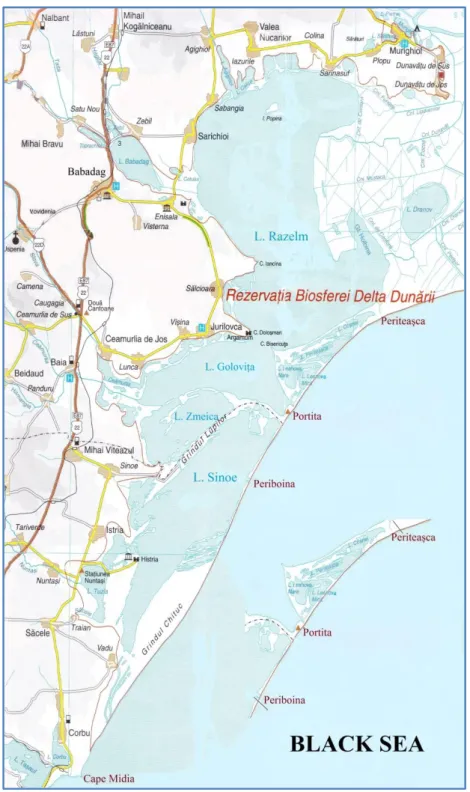
The coastal zone between Periboina and Periteaşca channel is the main segment of the narrow littoral belt which separates the Black Sea and the Razelm-Sinoe lagoon complex which is part of the Danube Delta Biosphere Reserve(Fig. 1).
The littoral belt formed in the time by the sands and alluvial deposits brought by the sea and the Danube closed the old golf Halmyris turning it into a freshwater lagoon complex of which the most important lakes are Razelm and Sinoe (Petrescu, 1960).
In the most narrow zones of the littoral belt, the lake Sinoe comunicate with the Black Sea by two breaks (at Edighiol and Periboina) which are currently arranged and provided with gates.
The studied area has a length of about 25 km and is bordered to the south by the Periboina break and at the north by Periteaşca channel, a short channel which does not comunicate in present with the sea. The easiest route towards Portiţa is by boat from Jurilovca. Portița also knownas Gura Portiţei is a sand strip arranged as a small resort between Lake Goloviţa and the Black Sea. Other access roads but less facile (only by bike) are from localities Vadu (through Chituc sandbank) and from Sinoe (through Lupilor sandbank).
Even if the area has the status of protected area as part of the Natura 2000 site ROSCI 0065 Danube Delta, the coastal one from Periboina to Periteaşca is vulnerable at some natural and anthropogenic risk factors: grazing, strong waves, invasive species, extension of touristic facilities outside of Portiţa resort.
90
Fig. 1 – The Razelm-Sinoe lagoon complex and the littoral belt between Periboina and Periteașca
The area between Periboina and Periteaşca channel was less studied in the past probably because it is less accessible than other coastal areas of the Danube Delta. Contributions to the knowledge of the area have come from more general articles that targeted floristic and phytocoenological aspects of the Danube Delta Biosphere Reserve:Dihoru & Negrean, 1976 a, b; Popescu & Sanda, 1976; Roman, 1992; Ciocârlan, 1994; Popescu et al, 1997; Oprea, 2005; Doroftei et al. 2011; Făgăraş, 2012, 2013.
91
MATERIAL AND METHOD
The name of the plant associations are in according with the book of Sanda et al., 2008. The subassociation has been defined according to Cristea et al., 2004.
Phytosociological surveys were conducted according to the methodology of the Zürich-Montpellier school (Braun-Blanquet, 1964). In each relevé the following data were recorded: species composition, total coverage (%), plant species abundance-dominance (AD) and the number of taxa. After processing the recorded releves through the tabular method, a new subassociation was described. The name of the plant associations and of subassociation are concordant with the International Code of Phytosociological Nomenclature (Weber et al., 2000).
The nomenclature of the higher plant taxa is according to Sârbu et al., 2013; Ciocârlan, 2009; Tutin et al., 1964-1980 and Tutin et al., 1993. The floristic rarities are considered bythe Red Book of Vascular Plants from Romania (Dihoru & Negrean, 2009).
The sand dune habitats have been recognized on the base of typical plant associations (Gafta, Mountford et al., 2008).
The conservation status of habitats was assessed on the base of the following scale: favourable, inadequate, unfavorable and unknown. According to the EU Habitats Directive (http://eur-lex.europa.eu), the conservation status of a natural habitat will be considered as „favorable” when the natural range and areas it covers is stable or increasing and the specific structure and functions which are necessary for its long-term maintenance exist and are likely to continue to exist for the foreseeable future.
Pressures which may threaten the conservation status of the habitats are rated as major (if significantly changes occur in habitats structure), moderate (if does not produce major changes upon the habitats) or insignificant (if it has only a negligible effects upon habitats structure). Evolution trend of the habitats is considered as stable (if the current status of habitat does not change significantly), increasing (if the current status of habitat is improving) or decreasing (if the current status of habitat is damaged).
RESULTS AND DISCUSSION
The narrow littoral belt between Periboina and Periteaşca is bordered to the east by the Black Sea and to the west by the Razelm Sinoe lagoon complex.Between the sand dunes and the lakes of the lagoon complex there are more or less salty puddles and swamps. The vegetation of the dunes is bordered to the west by reeds and halophilous vegetation and therefore it is formed by an interesting mix of psammophilous, halophilous and hygrophile species, less common in the other areas of the Romanian littoral.
Two psammophilous plant associations were observed on the embryonic sand dunes, in the frame of the habitat 2110: Elymetum gigantei Morariu 1957 andSecali sylvestris-Brometum tectorum Harghitai 1940. Other two plant associationsof the habitat 1210,Cakilo euxinae-Salsoletum ruthenicae Vicherek 1971 and Lactuco tataricae-Glaucietum flavae Dihoru et Negrean 1976,occupy lower surfaces from the base of the sand dunes,inthe proximity of the sea and nearby some coastal salty puddles.
92
Table 1 – Characteristics of the habitats from the sandy belt between Portița and Periteașca (CR-Critically endangered, EN-Endangered, VU-vulnerable)
Habitat/ code Natura 2000 habitat Characteristic plant associations Conservation status Anthropogenic presures/ Risk factors
Vulnerable and endangered plants from studied habitats (according to Dihoru & Negrean, 2009)
The habitat 1210 – Annual vegetation of drift-lines
- Cakilo euxinae-Salsoletum
ruthenicae Vicherek 1971;
- Lactuco tataricae-Glaucietum flavae Dihoru et Negrean 1976
Favorable/ Inadequate only close to Portița resort
Generally low and moderate only close to Portița resort/ Strong waves, floods, invasive species, touristic facilities (only in
Portița resort)
Argusia sibirica (CR) Limonium meyeri (CR)
Cakile maritima subsp. euxina (EN) Euphorbia peplis (EN)
Crambe maritima (EN)
Eryngium maritimum (VU) Polygonum oxyspermum subsp. raii (VU)
Polygonum maritimum (VU) Gypsophila perfoliata (VU)
The habitat 2110 - Embryonic shifting dunes
- Elymetum gigantei Morariu 1957;
- Secali sylvestris-Brometum tectorum Hargitai 1940;
Favorable/ Inadequate only close to Portița resort
Generally low and moderate only close to Portița resort/ Strong waves,
floods, grazing,invasive species, touristic facilities (only in
Portița resort)
Artemisia tschernieviana(EN)
Elymus farctus subsp. bessarabicus(CR) Stachys maritima (CR)
Cakile maritima subsp. euxina (EN) Argusia sibirica (CR)
Dianthus bessarabicus (EN) Astrodaucus littoralis (EN) Syrenia montana (EN) Crambe maritima (EN) Silene exaltata (EN)
Eryngium maritimum (VU)Gypsophila perfoliata (VU)
Astragalus varius (VU)
Polygonum oxyspermum subsp. raii(VU)
Both associations of the habitat 1210 belong to the alliance Euphorbion peplis R. Tüxen 1950 of the class Cakiletea maritimae R. Tüxen et Preising 1950 and they have great conservation value due to the limited distribution at the national level and because they have numerous floristic rarities (Table 1).
The association Cakilo euxinae-Salsoletum ruthenicae Vicherek 1971 was recorded for the first time from the Bulgarian seacoast by Vicherek and Tzonev (Vicherek, 1971; Tzonev et al., 2005, 2009). This association represents the first stage of development of psammophitic vegetation in most of the coastal area of the Danube Delta Biosphere Reserve.Despite this, the association is not mentioned in the Romanian classification system (Sanda et al., 2008), even though it is present in the frame of the habitat 1210 (Annual vegetation of drift-lines).Atripliceto hastatae-Cakiletum euxinae Sanda et Popescu 1999 is the vicariant association mentioned in the Romanian phytosociological bibliography (Făgăraș, 2013).
On the sandy strip between Periboina and Periteașca, the association can be find on fine or coarse sands rich in nitrates and organic matter, at the base of the eastern slope of the dunes, not very far (5-10 meters) from the shoreline. Other phytocoenoses have been observed on the western side of the dunes, on lowersurfaces in the proximityof some more or less salted puddles.
The characteristic species – Cakile maritima subsp. euxina and Salsola kali subsp. ruthenica are most abundant andthey cover 50-70% of the sandy substrate together with the accompanying species. The plant species which belong to coenotaxons Cakiletalia maritimae,Festucetalia vaginataeand Elymion giganteiare the best represented in the floristic composition of the association: Argusia sibirica, Lactuca tatarica, Crambe
maritima, Gypsophyla perfoliata, Polygonum oxyspermum subsp. raii, Eryngium
maritimum, Leymus racemosus subsp. sabulosus, Polygonum maritimum, Corispermum
93
Some species of the order Puccinellietalia(Aeluropus littoralis, Bassia hirsuta, Lepidium latifolium) occur in the proximity of salty areas(Table 2, releveé 6).
Of the 24 species that make up the association, the floristic rarities represent a high value (41,66%). The most valuable species from conservation point of view (according to Dihoru and Negrean, 2009)are the following: Argusia sibirica (CR), Cakile maritima subsp. euxina (EN), Euphorbia peplis (EN), Crambe maritima (EN), Artemisia tschernieviana (EN), Eryngium maritimum (VU), Polygonum oxyspermum subsp. raii (VU), Polygonum maritimum (VU), Gypsophyla perfoliata (VU).
Table 2 - The plant associations of the alliance Euphorbion peplis R. Tüxen 1950 – Association Cakilo euxinae-Salsoletum ruthenicae Vicherek 1971(R1-6); Association Lactuco tataricae-Glaucietum flavae Dihoru et Negrean 1976 (R7-10);
Releves R1 R2 R3 R4 R5 R6 R7 R8 R9 R10 K
Surfaces (m2) 25 25 25 25 25 25 25 25 25 25
Coverage (%) 50 60 50 60 70 60 60 60 80 60
Number of taxa 11 9 9 10 7 11 10 9 12 9
Cakiletalia maritimae
Lactuca tatarica + - + + - - 1 1 1 2 IV
Crambe maritima + - + + - + + - 2 1 IV
Cakile maritima subsp. euxina 1 1 + 1 1 1 - - - - III
Argusia sibirica - + 1 - 2 - - 1 1 + III
Euphorbia peplis + - - - I
Festucetalia vaginatae
Salsola kali subsp. ruthenica 3 3 3 3 3 3 - - - - III
Gypsophyla perfoliata + + - + - - + + - 1 III
Polygonum oxyspermum subsp. raii - + - + - + - - - - II
Corispermum nitidum 1 - + - - - I
Secale sylvestre - + + - - - I
Bromus tectorum - - - + - - - + I
Alyssum hirsutum - - - - + - - - I
Melilotus arenarius - - - + - - - - I
Festucetalia valesiacae
Glaucium flavum - - - + 3 3 3 2 III
Elymion gigantei
Eryngium maritimum + - + - + - + + + - III
Leymus racemosus subsp. sabulosus + + - 1 - - + - + - III
Artemisia tschernieviana - - + - 1 - - - I
Polygonum maritimum + - + - - - I
Medicago falcata - - - + - - - I
Cynodon dactylon - - - 1 I
Puccinellietalia limosae
Lepidium latifolium - - - + 1 + 1 - III
Artemisia santonicum subsp. santonicum
- - - + 1 + II
Limonium meyeri - - - + + - I
Atriplex prostrata - - - + - + - I
Aeluropus littoralis - - - + - - - - I
Bassia hirsuta - - - 1 - - - - I
Other species
Xanthium italicum + + - + 1 - 1 - 1 - III
Phragmites australis - - - + - - + - I
Tamarix ramosissima - - - 1 - + I
Senecio vernalis + - - - I
Elaeagnus angustifolia - - - + - - - I
Localities and dates of releves: Portița-Periboina – 14.06.2014 (R5, 6 ); 22.07.2013 (R7); Portița-Periteașca - 14.06.2014 (R1, 2); 22.07.2014 (R3, 4);
94
flavumoccupy small surfaces and are less spread in comparison with phytocoenoses with
Cakile maritima subsp. euxina and Salsola kali subsp. ruthenica.
The characteristic species of the association, Lactuca tatarica and Glaucium flavum, have higher values of abundance-dominance index [AD=2-3] compared with the other psammophilous species from the phytocoenoses structure (Table 2, releves 7-10).Accompanying species which belong to orders Cakiletalia maritimae and Puccinellietalia limosae are the best represented within the plant community.
The phytocoenoses between Portiţa and Periteaşca are different compared with those from other coastal areas of the Black Sea (Sârbu et al., 2000) due to the presence of some halophilic species typical for order Puccinellietalia limosae.
Many species from the floristic composition of this association are rarities (37,5%): Crambe maritima (EN), Argusia sibirica (CR), Gypsophyla perfoliata (VU), Eryngium maritimum (VU), Polygonum oxyspermum subsp. raii (VU), Limonium meyeri(CR).
Elymetum gigantei Morariu 1957 is the most common plant association on the fine, dry and slightly salted sands of the first two rows of embryonic dunes between Periboina and Periteaşca. The phytocoenoses with Leymus racemosus subsp. sabulosus have a medium coverage (50-80%).
The typical phytocoenoses of the association (Table 3, releves 1-15 ) are easily recognizeddue to the high value of the abundance-dominance index of the characteristic taxa - Leymus racemosus subsp.sabulosus[AD = 3-4] (Fig. 1).Other phytocoenoses are distinguished from those typical through the low covering index of the taxa Leymus racemosus subsp. sabulosus [AD =+, 2] and the high value of abundance-dominance index in case of the taxaCrambe maritima [AD = 3-4]. Crambe maritima(sea cabbage) can be considered as differential species for a new reported subassociation called Elymetum gigantei Morariu 1957 subass. crambetosum maritimae subass. nova (Table 3, relevés 16-24, holotypus relevé № hoc loco) (Fig. 2). The subassociation is widespread on the sand dunes between Portița and Periboina but can also be observed sporadically north of Portița.
Fig. 1 – Elymetum gigantei typicumFig.2–Elymetum gigantei subass. crambetosummaritimae
95
The plant species which have a high value of the presence and abundance-dominance index in phytocoenoses composition are the following:Leymus racemosus subsp. sabulosus, Eryngium maritimum, Cakile maritima subsp. euxina, Lactuca tatarica, Gypsophyla perfoliata, Salsola kali subsp. ruthenica, Glaucium flavum, Medicago falcata (Table 3).Psammophilous species which belong to the alliance Elymion gigantei and the orders Cakiletalia maritimae and Festucetalia vaginatae are very well represented in the plant association structure. Invazive species as Xanthium italicum have a low abundance within phytocoenoses.
Many species from the association composition (4,5%) are rarities (Table 3): Stachys maritima (CR), Argusia sibirica (CR), Astrodaucus littoralis (EN), Elymus farctus subsp. bessarabicus (CR), Crambe maritima (EN),Silene exaltata (EN),Artemisia tschernieviana (EN), Cakile maritima subsp. euxina (EN), Polygonum oxyspermum subsp. raii (VU), Eryngium maritimum (VU),Gypsophila perfoliata (VU).One of the most rare species is Astrodaucus littoralis which has the biggest local population on the Romanian Black Sea coast between Portița and Periboina (60-100 individuals). Stachys maritima is another very rare species with sporadically distribution and very few individuals (10-20 individuals) between Portița and Periboina and generally on the Romanian seacoast.
The association Secali sylvestris-Brometum tectorum Hargitai 1940 was recorded in the northern part of the littoral belt between Portița and Periteașca, on the lower sand dunes situated behind embryonic dunes with Leymus racemosus subsp. sabulosus. The psammophitic and steppic plants belonging to the orders Festucetalia vaginatae and Festucetalia valesiacae are well represented in the floristic composition of the association (Table 4). The high number of steppe species indicates a more pronounced steppic characteristic of this association compared with Elymetum gigantei.
Eight taxa (5.8%) from the floristic composition of the association are rarities at national level as follows:Dianthus bessarabicus (EN), Silene exaltata (EN), Syrenia montana (EN), Crambe maritima (EN), Astragalus varius (VU), Gypsophila perfoliata (VU), Polygonum oxyspermum subsp. raii (VU), Eryngium maritimum (VU)(Table 4).
CONCLUSIONS
Four plant communities have been identified on the littoral belt between Portiţa and Periboina, in the frame of two habitats with conservation significance: Annual vegetation along drift-lines (the habitat 1210) and Embryonic shifting dunes (the habitat 2110).
Two psammophilousplant communities of the habitat 2110 occupy the embryonic sand dunes between Periboina and Periteaşca.Elymetum gigantei is present on the entire length of the shoreline between Periboina and Periteaşca while the association Secali silvestris-Brometum tectorumis present only north of Periteaşca, in the wider areas of the littoral belt.
Some of phytocoenoses with Elymus sabulosus are typical on the embryonic sand dunesbetween Periboina and Periteașca; other phytocoenoses belong to some subassociations: Elymetum gigantei subass. crambetosum maritimae subass. nova and Elymetum gigantei subass. eryngietosum maritimae.
Within psammophilous plant associations numerous rarities occur, some of which are very rare along the Romanian Black Sea coast (Astrodaucus littoralis, Stachys maritima, Euphorbia peplis, Syrenia montana, Dianthus bessarabicus, Cakile maritima subsp. euxina).
96
Lactuco tataricae-Glaucietum flavae. The rare species within these plant communities are numerous (32,25%).
The conservation status of the habitats is in general favorable, inadequate only close to Portiţa mainly due to occasional grazing. Other risk factors that may affect psammophilous vegetation are strong waves, floods, invasive species, extension of touristic facilities outside of Portiţa resort.
The evolution tendencies of the habitats 2110 and 1210 are generally stable along the littoral belt and are decreasing near of Portiţa due to the anthropogenic factors.
Improving of conservation measures of dune habitats and a better control of some activities such as grazing (by Administration of Danube Delta Biosphere Reserve) should be immediatelly done for the preservation of rare species and psammophilous plant communities with conservation significance on the littoral belt between Periboina and Periteaşca.
ACKNOWLEDGEMENTS
This work was supported by a grant of the Romanian Ministry of National Education, PN-II-PT-PCCA-2011-3.2-1427 contract nr.69/2012 (project acronym: ECOMAGIS).
BIBLIOGRAPHY
1. Braun Blanquet, J., 1964 - Pflanzensoziologie. Ed. 3, Springer Verlag. Vienna, New York.
2. Ciocârlan, V., 1994 - Flora Deltei Dunării, Edit. Ceres, București.
3. Ciocârlan, V., 2009 -Flora ilustrată a României. Pteridophyta et Spermatophyta, Edit. Ceres, Bucureşti.
4. Cristea, V., Gafta, D., Pedrotti, F., 2004 - Fitosociologie, Edit. Presa Universitară Clujeană, Cluj- Napoca.
5. Doroftei, M., Oprea, A., Stefan, N., Sarbu, I., 2011 - Vascular wild flora of Danube Delta Biosphere Reserve. Sc. Annals of the Danube Delta Institute, Tulcea, 1-37.
6. Dihoru, Gh., Negrean, G., 1976 a - Sintaxoni specifici Deltei Dunării, Peuce, Muzeul Deltei Dunării, Tulcea, 5: 101-118.
7. Dihoru, Gh., Negrean, G., 1976 b - Flora of the Danube Delta. Peuce, Muz. Deltei Dunării, Tulcea, 5: 217-251.
8. Dihoru, Gh., Negrean, G., 2009 - Cartea Roşie a plantelor vasculare din România, Edit. Academiei Române, Bucureşti.
9. Făgăraş, M., 2012 -Habitats of conservative interest and plant communities in the sandy Black Sea coast area of Romania and Bulgaria, Journal of Environmental Protection and Ecology, edited by Scientific Bulgarian Communications, 13 (3A): 1688-1694.
10. Făgăraș, M., 2013 – Habitats with conservation significance and psammophilous plant associations from Sulina beach (Danube Delta Biosphere Reserve). Analele Ştiinţifice ale Universităţii „Al. I. Cuza” Iaşi, s. II a. Biologie vegetală, 59, 2: 85-98.
11.Gafta, D., Mountford, O. (eds), Alexiu, V., Anastasiu, P., Bărbos, M., Burescu, P.,
Coldea, Gh., Drăgulescu, C., Făgăraș, M., Goia, I., Groza, Gh., Micu, D., Mihăilescu, S., Moldovan, O., Nicolin, A., Niculescu, M., Oprea, A., Oroian, S., Paucă-Comănescu, M., Sârbu, I., Șuteu, A., 2008 - Manual de interpretare a habitatelor Natura 2000 din România, Edit. Risoprint, Cluj-Napoca.
12. Oprea, A., 2005 - Lista critică a plantelor vasculare din România, Edit. Univ. Al. I. Cuza Iași.
13. Petrescu, I. Gh., 1960 – Țărmul dintre Gura Sulina și Capul Midia din punct de vedere
97
14. Popescu, A., Sanda, V., 1976 - Contribuții la cunoașterea vegetației psamofile din Delta Dunării. Peuce, Muz. Deltei Dunării, Tulcea, 5: 193-216.
15. Popescu, A., Sanda, V., Oroian, S., 1997 - Vegetația Deltei Dunării. Marisia. Studii și
Materiale. XXV. Supliment., Muzeul Județean Mureș, Tîrgu-Mureș.
17. Roman, N., 1992 - Contribuții la cunoașterea florei Rezervației Biosferei Delta Dunării,
Analele Șt. ale Inst. Delta Dunării, Tulcea, 51-56.
18. Sanda, V., Őllerer, K., Burescu, P., 2008 - Fitocenozele din România. Sintaxonomie, structură, dinamică și evoluție, Edit. Ars Docendi, Universitatea din București.
19. Sârbu, I., Ştefan, N., Oprea, A., Zamfirescu, O., 2000– Flora şi vegetaţia Rezervaţiei Naturale Grindul Lupilor (Rezervaţia Biosferei Delta Dunării), Bul. Grăd. Bot. Iaşi, 9: 91-124.
20.Sârbu, I., Ştefan, N., Oprea, A., 2013 - Plante vasculare din Romania. Determinator ilustrat de teren, Edit. Victor B Victor, Bucureşti.
21. Tutin, T.G. Heywood, V.H., Burges, N.A., Moore, D.M., Valentine, D.H., Walters, S.M. & Webb, D.A. (eds), 1964-1980 - Flora Europaea, Vols. 1-5, Cambridge, Cambridge University Press.
22. Tutin, T.G. Heywood, V.H., Burges, N.A., Moore, D.M., Valentine, D.H., Walters, S.M. & Webb, D.A. (eds., assist. by Akeroyd, J.R & Newton, M.E.; appendices ed. by Mill, R.R.), 1993 (reprinted 1996) - Flora Europaea, 2nd ed., Vol. 1, Cambridge, Cambridge University Press.
23. Tzonev, R., Dimitrov, M., Roussakova, V., 2005- Dune vegetation on the Bulgarian Black Sea coast, Hacquetia, 4, 1: 7-32.
24. Tzonev, R., Dimitrov, M., Roussakova, V., 2009 - Syntaxa according to the Braun Blanquet approach in Bulgaria, Phytologia Balcanica, Sophia, 15, 2: 209-233.
25. Vicherek, J, 1971 - Grundrisseiner Systematik der Strandgesellschaften des Schwarzen Meeres. Folia Geobotanica. Phytotaxonomy, 6: 127-147.
26. Weber, H.E., Moravec, J., Theurillat, J.P., 2000 - International Code of Phytosociological Nomenclature, 3rd Ed, J. Veg. Sci., 11: 739-768.
98
Table 3 - Association Elymetum gigantei Morariu 1957 typicum (R1-15); Association Elymetum gigantei Morariu 1957 subass. crambetosum maritimae subass. nova holotypus relevé (R16-24)and subass. eryngietosum maritimae (R25-28)
Releves R1 R2 R3 R4 R5 R6 R7 R8 R9 R
10 R 11 R 12 R 13 R 14 R 15 R 16 R 17 R 18 R 19 R 20 R 21 R 22 R 23 R 24 R 25 R 26 R 27 R 28 K
Surfaces (m2) 50 50 50 50 50 25 50 50 25 25 50 50 50 50 25 50 50 25 50 50 25 25 50 50 25 50 50 25
Coverage (%) 60 70 70 70 80 60 70 60 80 80 70 80 80 70 80 70 80 50 60 80 80 70 80 50 70 60 60 70
Number of taxa 10 8 13 7 9 9 9 15 13 9 13 14 10 12 14 11 8 11 11 16 10 13 9 11 13 9 8 11
Elymion gigantei Leymus racemosus subsp. sabulosus
3 4 4 3 3 3 3 3 4 4 3 4 4 3 4 2 2 + 2 3 2 + 3 1 2 2 1 2 V
Eryngium maritimum + + + 1 - 1 2 + + + + + - 1 1 + - - - + + + 1 - 3 3 3 3 IV
Artemisia tschernieviana - - - 1 - + - - - + - - - 1 - I
Elymus farctus subsp. bessarabicus
- - 1 - - - I
Cakiletalia maritimae
Crambe maritima 2 + 1 2 2 1 - 1 2 1 + 2 2 2 2 3 3 3 3 3 4 4 3 3 1 1 + + V
Cakile maritima subsp. euxina
- - + - + - + - + + 1 + 1 1 + + 1 - + + + + - + 1 - - - IV
Lactuca tatarica + - - 1 2 + - + + - + - + + + 1 - + + 1 - + + - - - - + IV
Astrodaucus littoralis - - + - + - - - + - + + - - - + + - + + + - - - II
Argusia sibirica - - - 1 - - - + - - - - + - + I
Festucetalia vaginatae
Gypsophyla perfoliata + - + - - + 2 + 1 + + + - + - 1 - - + + - - + + 1 - 1 1 IV
Salsola kali subsp. ruthenica
- - - + + - + + - + - - - + + - - - + - - + - - + + - - III
Centaurea arenaria subsp. borysthenica
+ + - - - - + - + - - + - + - - - + + - - + - - + - - + II
Melilotus arenarius - - + 1 + - - - + - + - - - 2 - + + - - - II
Alyssum hirsutum - + - - - - + - - + - - - + + - - - + - - - - + - - II
Euphorbia segueriana - - + - - - - 1 - - - + + - + - I
Bromus tectorum - - - + - - - - + - - + - 1 - - - + - - - I
Silene conica - - - + - + - - - + - - - + I
Corispermum nitidum - - + - - - + - - - + - - - I
Stachys maritima - - - + - - - + - - + - - - I
Onosma arenaria - - - + - - - + - - - I
Secale sylvestre - + - - - + - - - I
Polygonum oxyspermum subsp. raii
- - - + - - - I
Festucetalia valesiacae
Glaucium flavum - - + - - + - + + - + + - - - + - + 1 + + + + + - - III
Medicago falcata + - - - + - - - + - - - - + + - - - - + - - + II
Cerastium semidecandrum
- - - + - - - + - - - + - - - + - - I
Vincetoxicum hirundinaria - - - + - - - + - - - - I
Cynodon dactylon - - - + - - - + - - - I
Linaria euxina - - - + - - - + - - - I
Verbascum banaticum - - - + - - - I
Chondrilla juncea - - - + - - - I
99 subsp.rhoeadifolia
Puccinellietalia limosae Artemisia santonicum subsp. santonicum
- + - - - + + 1 - + + - - - + - + + - + - II
Lepidium latifolium + - + - - + - - - + - - + - - - - + + + + - - - II
Atriplex prostrata - - - + - - - - + - - - I
Aeluropus littoralis - - - + - - I
Bassia hirsuta + - - - I
Other species
Xanthium italicum - - - + - - - - + + + - + + - - - - + + - - - + II
Elaeagnus angustifolia + - - - + - - - - + - - - - + - - - + + - - - 1 II
Phragmites australis - 1 - 1 + - - - - + 2 - - - + - - - - 1 - - - II
Rumex crispus - - + - - - + + - + - - + - - - I
Tamarix ramosissima - - - + - - - 1 - - - - + - - - I
Carduus acanthoides - - - + - - - + + - - - I
Galium humifusum - - - + - - - + - - - I
Senecio vernalis - - - + - I
Carduus nutans subsp. nutans
- - - + - - - I
Vitis vinifera - - - + - - - I
100
Table 4 - Association Secali sylvestris-Brometum tectorum Hargitai 1940
Releves R1 R2 R3 R4 R5 R6 R7 K
Surfaces (m2) 100 100 100 100 100 100 100
Coverage (%) 70 70 60 70 80 80 70
Number of taxa 22 20 26 22 21 23 22
Festucetalia vaginatae
Secale sylvestre 2 3 2 3 3 3 2 V
Bromus tectorum 1 1 2 1 2 1 1 V
Euphorbia segueriana 3 2 + 1 2 1 3 V
Gypsophyla perfoliata - + + 1 + - + IV
Apera spica-venti subsp. maritima + 1 - 1 1 - - III
Alyssum hirsutum + + + - - + - III
Centaurea arenaria subsp. borysthenica - - 1 - + + + III
Dianthus bessarabicus + + - + - - + III
Silene conica + - - + + - - III
Plantago arenaria - - + + - - + III
Silene exaltata + - - + - - 1 III
Melilotus arenarius - - + - - + - II
Bassia laniflora - + - + - - - II
Onosma arenaria - - - - + + - II
Polygonum arenarium subsp. arenarium + - - - + - - II
Seseli tortuosum - - - + - - + II
Stachys atherocalyx + - - - - + - II
Alyssum desertorum - + - - - - + II
Scirpoides holoschoenus - - - 1 - I
Salsola kali subsp. ruthenica - - - - + - - I
Astragalus varius - - - + - - - I
Polygonum oxyspermum subsp. raii + - - - I
Scabiosion argenteae
Carex colchica + - + - - + - III
Scabiosa argentea - - - - + + - II
Syrenia montana - - - + - - - I
Elymion gigantei
Eryngium maritimum + - + - - + + III
Leymus racemosus subsp. sabulosus - - 1 1 - - + III
Festucetalia valesiacae
Medicago falcata + + + + - + - IV
Teucrium chamaedrys + + 1 - 1 - + IV
Linum austriacum - + + + + - + IV
Glaucium flavum + + - - + - + III
Linaria euxina + - + - + + - III
Cynodon dactylon - - 1 - - 1 + III
Crepis foetida subsp. rhoeadifolia - - + + - - + III
Verbascum banaticum + + - + - - + III
Chondrilla juncea + + + - - - + III
Cerastium semidecandrum - - + + - - - II
Daucus guttatus subsp. zahariadi - - + - - - + II
Galium humifusum - - + - - + - II
Bromus squarrosus - - 1 - + - - II
Bromus hordeaceus - - + - - - - I
Cakiletea maritimae
Crambe maritima - - + - - + - II
Lactuca tatarica - - - + - - - I
Other species
Artemisia santonicum subsp. santonicum - - + + + - - III
Carduus acanthoides - - + - + - + III
Erysimum repandum - + - - - + - II
Senecio vernalis - + - - + - - II
Rumex crispus + - - - - + - II
Daucus carota subsp. carota - - - + + - - II
Elaeagnus angustifolia - + - - - 2 - II
Xanthium italicum - - - + I
Parapholis incurva + - - - I
Carduus nutans subsp. nutans - + - - - I
Cichorium intybus - - - + - I
Conyza canadensis - - - - + - - I
Sisymbrium orientale - - - + - I