A Comparative Study Of Effect Of Silica Fume As Partial Replacement
On two Different Types Of Cement On Fiber Reinforced Concrete
1D.Siva Ram,2B.Ganesh,3Ch.Bhaskara Rao
PGscholar, Department of Civil Engineering, Lenora College Of Engineering, Rampachodavaram, A.P., India,
Assistant Professor, Department of Civil Engineering, Lenora College Of Engineering, Guntur, A.P., India.
Department of Civil Engineering, Aditya College of Engineering& Technology, Kakinada, A.P., India.
ABSTRACT
High-quality cement is constantly superior cement, yet elite cement isn't generally high-quality cement. Strong cement Specified high quality cement can't guarantee the acknowledgment of tough cement. It is extremely hard to get an item that meets every one of the traits in the meantime. Thus, unique pozzolanic materials, for example, ground impact heater slag (GGBS), silica rage, rice husk cinder, fly powder, and profoundly receptive Metakaolin, are some volcanic fiery debris materials that can be utilized as solid contrasting options to concrete for elite the fundamental organization of cement. Thusly, we have the above materials were XRD test to comprehend the distinctive segments of the progressions. What's more, it is additionally imperative to keep the bond proportion in the base, since we should utilize a water lessening specialist, the plasticizer, which assumes a critical part in the generation of elite cement. So we have tried distinctive materials in this task, for example, rice husk fiery remains, ground impact heater slag and silicon powder to get the required request. In this paper the work is done on M30 Grade concrete. We utilize diverse rates of engineered strands (i.e., Recron filaments), i.e. 0.0%, 0.1%, 0.2%, 0.3% of the aggregate weight of cement, and cast. At long last, we utilize distinctive rates of silicon powder rather than bond to keep the fiber content steady and pour the solid. In our investigation, we utilized two sorts of bond, Portland slag concrete and standard Portland concrete. We arranged mortar, 3D square, chamber, crystal, lastly
pressure test, split test, Flexural Strength tests were performed.
Key words:High Strength concrete, Compressive strength,Flexural quality, split elasticity.
1. INTRODUCTION
Concrete is the most generally utilized man-made development material on the planet. It is acquired by blending cementitious materials, water, total and now and then admixtures in required extents. Crisp concrete or plastic cement is naturally blended material which can be formed into any shape solidifies into a stone like mass known as concrete. The solidifying is a direct result of concoction response amongst water and concrete, which proceeds for long stretch prompting more grounded with age. The utility and tastefulness and also the toughness of solid structures, worked amid the main portion of the most recent century with normal Portland bond (OPC) and plain round bars of gentle steel, the simple accessibility of the constituent materials (whatever might be their characteristics) of cement and the information that basically any blend of the constituents prompts a mass of cement have reproduced disdain. Quality was accentuated without an idea on the sturdiness of structures. As an outcome of the freedoms taken, the sturdiness of concrete and solid structures is on a southward trip; an adventure that appears to have picked up energy on its way to self– annihilation. This is especially valid for solid structures which were built since 1970 or something like that by which time (a) the utilization of high quality rebar's with surface disfigurements (HSD) began getting to be normal, (b) noteworthy changes
A Comparative Study Of Effect Of Silica Fume As Partial Replacement
On two Different Types Of Cement On Fiber Reinforced Concrete
1D.Siva Ram,2B.Ganesh,3Ch.Bhaskara Rao
PGscholar, Department of Civil Engineering, Lenora College Of Engineering, Rampachodavaram, A.P., India,
Assistant Professor, Department of Civil Engineering, Lenora College Of Engineering, Guntur, A.P., India.
Department of Civil Engineering, Aditya College of Engineering& Technology, Kakinada, A.P., India.
ABSTRACT
High-quality cement is constantly superior cement, yet elite cement isn't generally high-quality cement. Strong cement Specified high quality cement can't guarantee the acknowledgment of tough cement. It is extremely hard to get an item that meets every one of the traits in the meantime. Thus, unique pozzolanic materials, for example, ground impact heater slag (GGBS), silica rage, rice husk cinder, fly powder, and profoundly receptive Metakaolin, are some volcanic fiery debris materials that can be utilized as solid contrasting options to concrete for elite the fundamental organization of cement. Thusly, we have the above materials were XRD test to comprehend the distinctive segments of the progressions. What's more, it is additionally imperative to keep the bond proportion in the base, since we should utilize a water lessening specialist, the plasticizer, which assumes a critical part in the generation of elite cement. So we have tried distinctive materials in this task, for example, rice husk fiery remains, ground impact heater slag and silicon powder to get the required request. In this paper the work is done on M30 Grade concrete. We utilize diverse rates of engineered strands (i.e., Recron filaments), i.e. 0.0%, 0.1%, 0.2%, 0.3% of the aggregate weight of cement, and cast. At long last, we utilize distinctive rates of silicon powder rather than bond to keep the fiber content steady and pour the solid. In our investigation, we utilized two sorts of bond, Portland slag concrete and standard Portland concrete. We arranged mortar, 3D square, chamber, crystal, lastly
pressure test, split test, Flexural Strength tests were performed.
Key words:High Strength concrete, Compressive strength,Flexural quality, split elasticity.
1. INTRODUCTION
Concrete is the most generally utilized man-made development material on the planet. It is acquired by blending cementitious materials, water, total and now and then admixtures in required extents. Crisp concrete or plastic cement is naturally blended material which can be formed into any shape solidifies into a stone like mass known as concrete. The solidifying is a direct result of concoction response amongst water and concrete, which proceeds for long stretch prompting more grounded with age. The utility and tastefulness and also the toughness of solid structures, worked amid the main portion of the most recent century with normal Portland bond (OPC) and plain round bars of gentle steel, the simple accessibility of the constituent materials (whatever might be their characteristics) of cement and the information that basically any blend of the constituents prompts a mass of cement have reproduced disdain. Quality was accentuated without an idea on the sturdiness of structures. As an outcome of the freedoms taken, the sturdiness of concrete and solid structures is on a southward trip; an adventure that appears to have picked up energy on its way to self– annihilation. This is especially valid for solid structures which were built since 1970 or something like that by which time (a) the utilization of high quality rebar's with surface disfigurements (HSD) began getting to be normal, (b) noteworthy changes
A Comparative Study Of Effect Of Silica Fume As Partial Replacement
On two Different Types Of Cement On Fiber Reinforced Concrete
1D.Siva Ram,2B.Ganesh,3Ch.Bhaskara Rao
PGscholar, Department of Civil Engineering, Lenora College Of Engineering, Rampachodavaram, A.P., India,
Assistant Professor, Department of Civil Engineering, Lenora College Of Engineering, Guntur, A.P., India.
Department of Civil Engineering, Aditya College of Engineering& Technology, Kakinada, A.P., India.
ABSTRACT
High-quality cement is constantly superior cement, yet elite cement isn't generally high-quality cement. Strong cement Specified high quality cement can't guarantee the acknowledgment of tough cement. It is extremely hard to get an item that meets every one of the traits in the meantime. Thus, unique pozzolanic materials, for example, ground impact heater slag (GGBS), silica rage, rice husk cinder, fly powder, and profoundly receptive Metakaolin, are some volcanic fiery debris materials that can be utilized as solid contrasting options to concrete for elite the fundamental organization of cement. Thusly, we have the above materials were XRD test to comprehend the distinctive segments of the progressions. What's more, it is additionally imperative to keep the bond proportion in the base, since we should utilize a water lessening specialist, the plasticizer, which assumes a critical part in the generation of elite cement. So we have tried distinctive materials in this task, for example, rice husk fiery remains, ground impact heater slag and silicon powder to get the required request. In this paper the work is done on M30 Grade concrete. We utilize diverse rates of engineered strands (i.e., Recron filaments), i.e. 0.0%, 0.1%, 0.2%, 0.3% of the aggregate weight of cement, and cast. At long last, we utilize distinctive rates of silicon powder rather than bond to keep the fiber content steady and pour the solid. In our investigation, we utilized two sorts of bond, Portland slag concrete and standard Portland concrete. We arranged mortar, 3D square, chamber, crystal, lastly
pressure test, split test, Flexural Strength tests were performed.
Key words:High Strength concrete, Compressive strength,Flexural quality, split elasticity.
1. INTRODUCTION
in the constituents and properties of bond were started, and (c) engineers began utilizing supplementary cementitious materials and admixtures in concrete, frequently without sufficient thought.
The Ordinary Portland Cement (OPC) is one of the principle fixings utilized for the generation of cement and has no option in the common development industry. Sadly, creation of concrete includes outflow of a lot of carbon-dioxide gas into the environment, a noteworthy supporter for nursery impact and the a dangerous atmospheric devation, henceforth it is unavoidable either to scan for another material or mostly supplant it by some other material. The scan for any such material, which can be utilized as an option or as a supplementary for bond should prompt worldwide reasonable improvement and most minimal conceivable ecological effect.
Fly powder, Ground Granulated Blast heater Slag, Rice husk fiery remains, High Reactive Metakaolin, silica rage are a portion of the pozzolanic materials which can be utilized as a part of concrete as incomplete substitution of bond. Various investigations are going ahead in India and in addition abroad to think about the effect of utilization of these pozzolanic materials as bond substitutions and the outcomes are empowering. The quality, sturdiness and other normal for concrete relies upon the properties of its fixings, extent of blend, strategy for compaction and different controls amid putting and curing.
As our point is to create solid which does not just worry on the quality of solid, it additionally having numerous different angles to be fulfilled like less permeable, narrow ingestion, strength. So for this we have to go for the expansion of pozzolanic materials alongside superplasticizer with having low water concrete proportion. The utilization of silica smolder is many, which is having great pozzolanic action and is a decent material for the generation superior cement. Additionally now a the very beginning's of the immense application in different basic field is fiber strengthened solid, which is getting fame due to its beneficial outcome on different properties of cement.
2. LITERATURE REVIEW
Aitcin[1] (1995) refered to on improvement in the use of elite cement. In the course of the most recent couple of years, the compressive quality of a portion
of the solid utilized has expanded significantly. In 1988, a 120 MPa concrete was conveyed nearby, while, until moderately as of late, 40 MPa was viewed as characteristic of high quality. The tremendous increment in compressive quality is straightforwardly identified with various late innovative improvements, specifically the disclosure of the uncommon scattering activity of superplasticizers with which streaming cements can be made with about a similar blending water that is really required to hydrate all the concrete particles or even less. The diminishment in water/bond proportion brings about a hydrated bond glue with a microstructure so thick and solid that coarse total can turn into the solid's weakest constituent. Silica smolder, an exceptionally receptive pozzolana, impressively upgrades the glue/total interface and limits debonding. Finally, the utilization of supplementary cementitious materials, for example, fly powder and particularly slag, takes care of droop misfortune issues which wind up basic at low w/c proportions.
and 40 % separately. Likewise he discovered higher the rate or RHA, higher is the volume change trademark relating to plain mortar.
Ismail and waliuddin[3] (1996) had dealt with impact of rice husk fiery remains on high quality cement. They examined the impact of rice husk fiery remains (RHA) passing 200 and 325 micron strainers with l0-30% substitution of concrete on the quality of HSC. The RHA was acquired by consuming rice husk, an agro-squander material which is richly accessible in the creating nations. A sum of 200 test examples threw and tried at 3,7,28 and 150 days. Compressive and split rigid qualities of the test examples. Shape quality more than 70 MPa was acquired with no substitution of concrete by RHA. Test outcomes showed that quality of HSC diminished when concrete was somewhat substituted by RHA for keeping up same level of workability. They watched that ideal substitution of concrete by RHA was 10-20%, and even from crystalline type of RHA great outcome might be gotten by fine granulating.
De Sensale [4] (2006) considered on quality improvement of solid utilizing rice husk fiery remains. This paper introduces an investigation on the advancement of compressive quality up to 91 days of cements with rice-husk cinder (RHA), in which leftover RHA from a rice paddy processing industry in Uruguay and RHA delivered by controlled cremation from the USA were utilized for correlation. Two diverse substitution rates of concrete by RHA, 10% and 20%, and three distinctive water/cementitious material proportions (0.50, 0.40 and 0.32), were utilized. The outcomes are contrasted and those of the solid without RHA, with part rigidity and air porousness. It is reasoned that leftover RHA gives a beneficial outcome on the compressive quality at early ages, however the long haul conduct of the cements with RHA delivered by controlled cremation was more critical. Consequences of part ductile and air penetrability uncover the importance of the filler and pozzolanic impact for the cements with lingering RHA and RHA delivered by controlled cremation.
Oner An and Akyuz S [5] (2007) considered on ideal level of ground granulated impact heater slag (GGBS) on compressive quality of cement. In their examination GGBS was added by the halfway substitution technique in all blends. An aggregate of 32 blends were set up in four gatherings as indicated by their fastener content. Eight blends were set up as control blends with 175, 210, 245 and 280 kg/m3
bond content keeping in mind the end goal to figure the Bolomey and Feret coefficients (KB, KF). For each gathering 175, 210, 245 and 280 kg/m3 measurements were resolved as starting doses, which were gotten by expelling 30 percent of the bond substance of control cements with 250, 300, 350, and 400 kg/m3 doses. Test cements were acquired by adding GGBS to cements in a sum identical to roughly 0%, 15%, 30%, half, 70%, 90% and 110% of bond substance of control cements with 250, 300, 350 and 400 kg/m3 measurements. All examples were wet cured for 7, 14, 28, 63, 119, 180 and 365 days before compressive quality testing. The test outcomes demonstrated that the compressive quality of solid blends containing GGBS increments as the measure of GGBS increment. After an ideal point, at around 55% of the aggregate fastener content, the expansion of GGBS does not enhance the compressive quality. This can be clarified by the nearness of unreacted GGBS, going about as a filler material in the glue.
Qian Jueshi and Shi Caijun [6] (2000) contemplated on elite solidifying materials from modern slag. They discovered most mechanical slags are being utilized without taking full preferred standpoint of their properties or arranged as opposed to utilized. The modern slags, which have cementitious or pozzolanic properties, ought to be utilized as incomplete or full swap for Portland concrete instead of as mass totals or weights due to the high cost of Portland bond, which is owing to the high vitality utilization for the creation of Portland bond. The customary method to use metallurgical slags in solidifying materials is to incompletely supplant Portland bond, which more often than not brings about a lower early quality and longer setting circumstances. Nearness of activator(s) can quicken the separation of structure and hydration of slags. Numerous examination comes about have demonstrated that clinkerless antacid enacted slags even display higher qualities, denser structure and better toughness contrasted and Portland bond. In this paper, the current accomplishments in the improvement of elite solidifying materials in view of actuated slags, for example, impact heater slag, steel slag, copper slag and phosphorus slag are checked on.
4. EXPERIMENTAL PROGRAMME 4.1: MIX PROPORTIONS:
natural sand and coarse aggregate, is being used. The experimental work was used to study the compression strength test, Split tensile strength test, Flexural strength test, of concrete with the replacement of cement with silica fume for concrete grade M30.
4.2: COMPRESSIVE STRENGTH
.
Using two different types of cement, Portland slag cement & Ordinary Portland cement on concrete grade of M30 and, silica fume replacement rates range from 0 to 30%. The concrete was tested for 7 days and 28 days after casting mold. Compressive strength of the above grade concrete was observed to increase.
Fiber
content
(%)
7 days
compressive
strength
(N/mm
2)
28 days
compressive
strength
(N/mm
2)
0.0
29.036
37.770
0.1
24.630
27.406
0.2
26.430
32.148
0.3
17.200
25.480
TABLE 1: COMPRESSIVE STRENGTH FOR 7 &28 DAYS OF CURING FOR M30 GRADE CONCRETE WITH ADDITION OF ONLY RECRON FIBRE CONTAINING PSC
GRAPH 1.0: SHOWING THE EFFECT OF ONLY RECRON FIBER ON COMPRESSIVE STRENGTH OF M30 GRADE
CONCRETE CONTAINING PSC
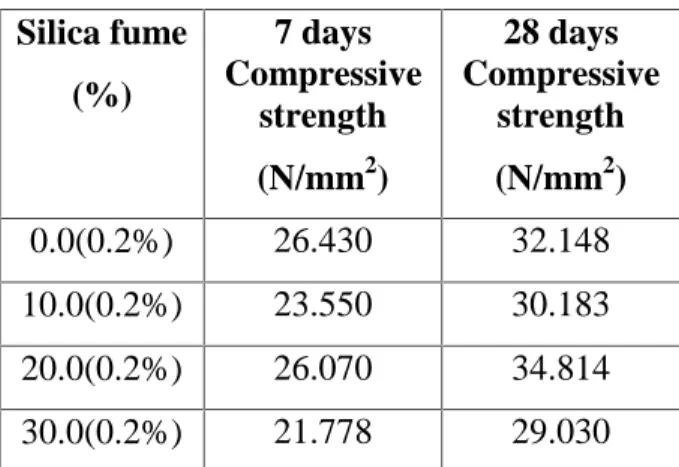
Silica fume
(%)
7 days
Compressive
strength
(N/mm
2)
28 days
Compressive
strength
(N/mm
2)
0.0(0.2%)
26.430
32.148
10.0(0.2%)
23.550
30.183
20.0(0.2%)
26.070
34.814
30.0(0.2%)
21.778
29.030
TABLE 2: COMPRESSION STRENGTH FOR 7 &28 DAYS OF CURING FOR M30 GRADE CONCRETE WITH
ADDITION OF SILICA FUME & RECRON FIBRE CONTAINING PSC
0 20 40
0.00% 0.10% 0.20% 0.30%
Effect of Recron fiber on
Compressive Strength
GRAPH 2.0: SHOWING THE EFFECT OF ONLY RECRON FIBER ON COMPRESSION STRENGTH OF M30 GRADE
CONCRETE WITH SILICA FUME & RECRON FIBRE CONTAINING PSC
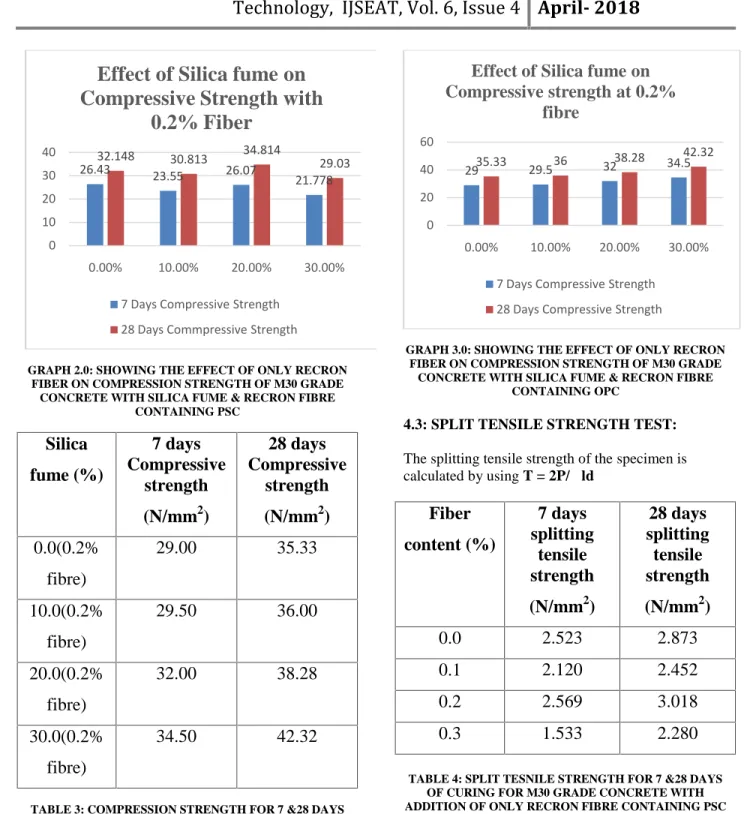
Silica
fume (%)
7 days
Compressive
strength
(N/mm
2)
28 days
Compressive
strength
(N/mm
2)
0.0(0.2%
fibre)
29.00
35.33
10.0(0.2%
fibre)
29.50
36.00
20.0(0.2%
fibre)
32.00
38.28
30.0(0.2%
fibre)
34.50
42.32
TABLE 3: COMPRESSION STRENGTH FOR 7 &28 DAYS OF CURING FOR M30 GRADE CONCRETE WITH
ADDITION OF SILICA FUME & RECRON FIBRE CONTAINING OPC
GRAPH 3.0: SHOWING THE EFFECT OF ONLY RECRON FIBER ON COMPRESSION STRENGTH OF M30 GRADE
CONCRETE WITH SILICA FUME & RECRON FIBRE CONTAINING OPC
4.3: SPLIT TENSILE STRENGTH TEST:
The splitting tensile strength of the specimen is calculated by using T = 2P/Πld
Fiber
content (%)
7 days
splitting
tensile
strength
(N/mm
2)
28 days
splitting
tensile
strength
(N/mm
2)
0.0
2.523
2.873
0.1
2.120
2.452
0.2
2.569
3.018
0.3
1.533
2.280
TABLE 4: SPLIT TESNILE STRENGTH FOR 7 &28 DAYS OF CURING FOR M30 GRADE CONCRETE WITH ADDITION OF ONLY RECRON FIBRE CONTAINING PSC
26.43 23.55 26.07
21.778 32.148 30.813 34.814 29.03
0 10 20 30 40
0.00% 10.00% 20.00% 30.00%
Effect of Silica fume on
Compressive Strength with
0.2% Fiber
7 Days Compressive Strength 28 Days Commpressive Strength
2935.33 29.536 3238.28 34.5 42.32
0 20 40 60
0.00% 10.00% 20.00% 30.00%
Effect of Silica fume on
Compressive strength at 0.2%
fibre
GRAPH 4.0: SHOWING THE EFFECT OF ONLY RECRON FIBER ON SPLIT TENSILE STRENGTH OF M30 GRADE
CONCRETE CONTAINING PSC
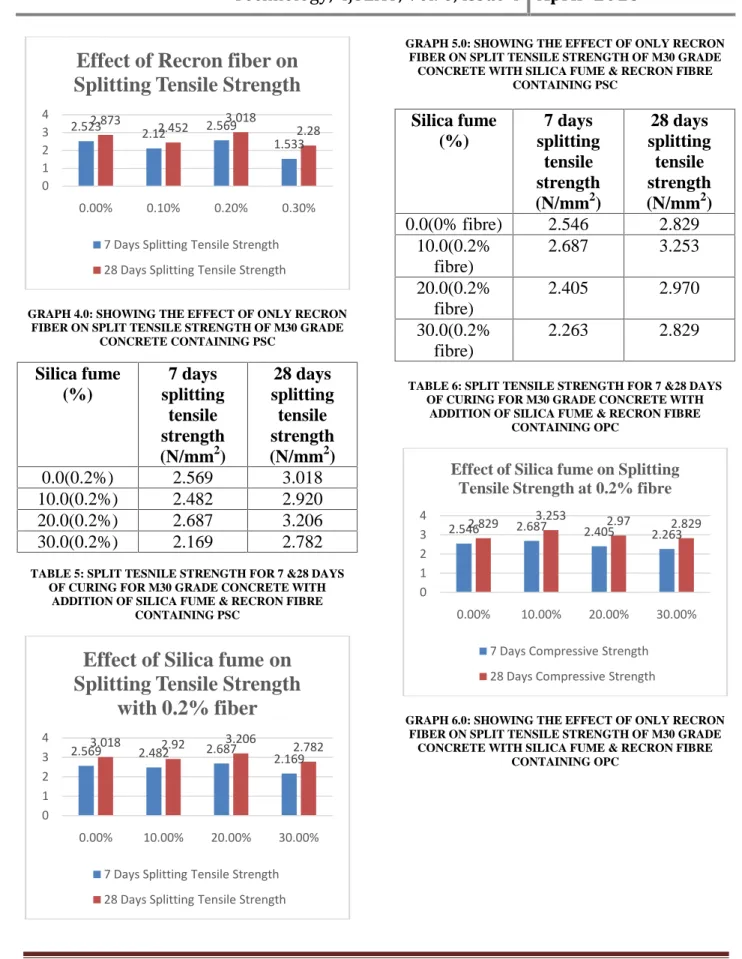
Silica fume
(%)
7 days
splitting
tensile
strength
(N/mm
2)
28 days
splitting
tensile
strength
(N/mm
2)
0.0(0.2%)
2.569
3.018
10.0(0.2%)
2.482
2.920
20.0(0.2%)
2.687
3.206
30.0(0.2%)
2.169
2.782
TABLE 5: SPLIT TESNILE STRENGTH FOR 7 &28 DAYS OF CURING FOR M30 GRADE CONCRETE WITH
ADDITION OF SILICA FUME & RECRON FIBRE CONTAINING PSC
GRAPH 5.0: SHOWING THE EFFECT OF ONLY RECRON FIBER ON SPLIT TENSILE STRENGTH OF M30 GRADE
CONCRETE WITH SILICA FUME & RECRON FIBRE CONTAINING PSC
Silica fume
(%)
7 days
splitting
tensile
strength
(N/mm
2)
28 days
splitting
tensile
strength
(N/mm
2)
0.0(0% fibre)
2.546
2.829
10.0(0.2%
fibre)
2.687
3.253
20.0(0.2%
fibre)
2.405
2.970
30.0(0.2%
fibre)
2.263
2.829
TABLE 6: SPLIT TENSILE STRENGTH FOR 7 &28 DAYS OF CURING FOR M30 GRADE CONCRETE WITH
ADDITION OF SILICA FUME & RECRON FIBRE CONTAINING OPC
GRAPH 6.0: SHOWING THE EFFECT OF ONLY RECRON FIBER ON SPLIT TENSILE STRENGTH OF M30 GRADE
CONCRETE WITH SILICA FUME & RECRON FIBRE CONTAINING OPC
2.523 2.12 2.569
1.533 2.873 2.452 3.018
2.28
0 1 2 3 4
0.00% 0.10% 0.20% 0.30%
Effect of Recron fiber on
Splitting Tensile Strength
7 Days Splitting Tensile Strength 28 Days Splitting Tensile Strength
2.5693.018 2.4822.92 2.6873.206 2.1692.782
0 1 2 3 4
0.00% 10.00% 20.00% 30.00%
Effect of Silica fume on
Splitting Tensile Strength
with 0.2% fiber
7 Days Splitting Tensile Strength 28 Days Splitting Tensile Strength
2.5462.829 2.6873.253 2.4052.97 2.2632.829
0 1 2 3 4
0.00% 10.00% 20.00% 30.00%
Effect of Silica fume on Splitting
Tensile Strength at 0.2% fibre
4.3: FLEXURAL STRENGTH TEST:
Fiber
content (%)
7 days
flexural
strength
(N/mm
2)
28 days
flexural
strength
(N/mm
2)
0.0
5.750
7.750
0.1
5.875
6.330
0.2
6.560
8.040
0.3
4.501
6.040
TABLE 7:FLEXURAL STRENGTH FOR 7 &28 DAYS OF CURING FOR M30 GRADE CONCRETE WITH ADDITION
OF ONLY RECRON FIBRE CONTAINING PSC
GRAPH 7.0: SHOWING THE EFFECT OF ONLY RECRON FIBER ON FLEXURAL STRENGTH OF M30 GRADE
CONCRETE CONTAINING PSC
Silica fume
(%)
7 days
flexural
strength
(N/mm
2)
28 days
flexural
strength
(N/mm
2)
0.0
6.560
8.040
10.0
6.500
8.000
20.0
6.625
8.458
30.0
6.040
7.875
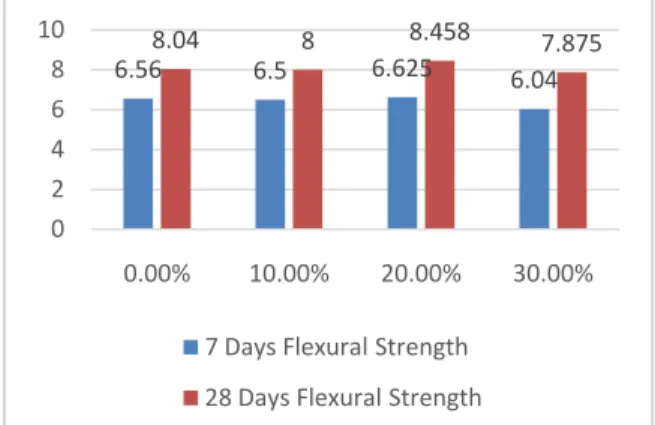
TABLE 8: FLEXURAL STRENGTH FOR 7 &28 DAYS OF CURING FOR M30 GRADE CONCRETE WITH ADDITION
OF SILICA FUME & RECRON FIBRE CONTAINING PSC
GRAPH 8.0: SHOWING THE EFFECT OF ONLY RECRON FIBER ON FLEXURAL STRENGTH OF M30 GRADE CONCRETE WITH SILICA FUME & RECRON FIBRE
CONTAINING PSC
Silica fume
(%)
7 days
flexural
strength
(N/mm
2)
28 days
flexural
strength
(N/mm
2)
0.0(0% fibre)
9.50
11.125
10.0(0.2%
fibre)
7.875
9.000
20.00(0.2%
fibre)
6.750
8.250
30.00(0.2%
fibre)
6.040
6.875
TABLE 9: FLEXURAL STRENGTHFOR 7 &28 DAYS OF CURING FOR M30 GRADE CONCRETE WITH ADDITION
OF SILICA FUME & RECRON FIBRE CONTAINING OPC
5.75 5.875 6.56
4.501 7.75
6.33
8.04
6.04
0 1 2 3 4 5 6 7 8 9
0.00% 0.10% 0.20% 0.30%
Efeect of Recron fiber on
Flexural Strength
7 Days Flexural Strength 28 Days Flexural Strength
6.568.04 6.5 8 6.625 6.04 8.458 7.875
0 2 4 6 8 10
0.00% 10.00% 20.00% 30.00%
GRAPH 9.0: SHOWING THE EFFECT OF ONLY RECRON FIBER ON FLEXURAL STRENGTH OF M30 GRADE CONCRETE WITH SILICA FUME & RECRON FIBRE
CONTAINING OPC
CONCLUSIONS:
From the results and discussion, we draw the following conclusions.
1) In case of Portland slag cement with the use of Recron fiber, the 28 days compressive strength at 0.2% fiber content the result obtained is maximum. The 28 days splitting tensile and flexural strength also increases about 5% at 0.2% fiber content to that of normal concrete. Further if fiber percentage increases then it was seen a great loss in the strength.
2) As the replacement of cement with different percentages with Silica fume increases the consistency increases.
3) With Portland slag cement keeping 0.2% Recron fiber constant and varying silica fume percentage the compressive, splitting tensile, flexural strength affected remarkably. Using 20% silica fume with 0.2% fiber percentage the 28 days compressive strength increases 7% more than concrete with 0.2% fiber only. 28days split tensile and flexural strength increases further, about 12% and 10% that of normal concrete.
4)So it is inculcated that 0.2% Recron fiber and 20% SF is the optimum combination to achieve the desired need.
5) In case of OPC the compressive strength is increasing as the percentage of silica fume increases from 0-30% and 0.2% Recron fiber and it is about
20% more than strength of normal concrete with OPC.
6) The splitting tensile strength increases about 15% at 10% SF and constant 0.2% Recron fiber, then decreases with increasing the SF percentage. Flexural strength is not giving good indication and goes on decreasing and it is about 40% decrement as the SF percentage increases to 30%.
7) Ordinary Portland cement gives good compressive strength result as compared to Portland slag cement in case of mix with SF and 0.2% Recron.
REFERENCES:
1. Pierre-Claude Aitcin, “Developement in the application of high performance concrete”, Construction and Building Material, Vol. 9. No. 1, 1995, 13-17.
2. Andrzej Ajdukiewicz and Wojciech Radomski, “Trends in the Polish research on high performance concrete”, Cement and Concrete Composite, Vol. 24, 2002, 243-251.
3. Pierre-Claude Aitcin, “The durability characteristics of high performance concrete”, Cement & Concrete Composite, Vol. 25, 2003, 409-420.
4. Moayad N Al-Khalaf and Hana A Yousif, “Use of Rice husk ash in concrete”, The International Journal of Cement Composites and Lightweight Concrete, Vol. 6, November 4 1984.
5. Muhammad Soaib Ismail and A. M. Waliuddin, “Effect of rice husk ash on high strength concrete”, Construction and Building Material, Vol. 10. No. 7, 1996, 521-526.
6.Gemma Rodriguez de Sensale, “Strength development of concrete with rice-husk ash”, Cement & Concrete Composite, Vol. 28, 2006,158-160. 7. A Oner & S Akyuz, “An experimental study on optimum usage of GGBS for the compressive strength of concrete”, Cement & Concrete Composite, Vol. 29, 2007, 505 514.
9.5
7.875 6.75
6.04 11.125
9 8.25
6.875
0 2 4 6 8 10 12
0.00% 10.00% 20.00% 30.00%
Effect of Silica fume on
Flexural Strength at 0.2%
fibre
8. Caijun Shi and Jueshi Qian, “High performance cementing materials from industrial slags”, Resourses Conservation & Recyclin, Vol. 29, 2000, 195-207. 9. K Ganesh Babu and V. Sree Rama Kumar, “Efficiency of GGBS in Concrete”, Cement and Concrete Research, Vol. 30, 2000, 1031-1036. 10.M. Collepardi, “Admixtures used to enhance placing characteristics of concrete”, Cement & Concrete Composite, Vol. 20, 1998, 103-112. 12. Shetty M.S., “Concrete Technology Theory and Practice”, S. Chand & Company, New Delhi.
13. IS: 383-1970, Specification for coarse and fine aggregates from natural sources for concrete
14. IS: 10262-2009, Recommended Guidelines for Concrete Mix Design, Bureau of Indian Standards, New Delhi, India.