Code Subsidiary Document
No. 0007:
Business Continuity Management
Document reference CSD 0007 Business Continuity Management
Version 20150930 Page 2 of 31
Change History
Version Number Date of Issue Reason For Change Change Control Reference Sections Affected 20150511 11 May 2015 For industryconsultation 20150714 14 July 2015 For pre-vendor
MAP ICP Housekeeping 25 August 2015 Non -material housekeeping changes
ICP/WRC/CP001 All
ICP Quality Assurance 22 September 2015 Clarificatory and syntax changes following review of the texts
ICP/WRC009 Definitions, 4.2.16, 4.2.21
20150930 30
September 2015
For post-vendor MAP
As per Quality Assurance version
Document reference CSD 0007 Business Continuity Management
Version 20150930 Page 3 of 31
Table of Contents
1.
Introduction ... 9
1.1 Purpose and scope ... 9
1.2 Scope ... 9
1.3 Structure of this CSD ... 9
2.
Standards ... 11
2.1 Market Operator and Trading Party requirements ... 11
3.
Business Continuity Management Framework ... 13
3.1 Overview ... 13
3.2 Market Incident Management Plan ... 14
3.3 Market Operator Business Continuity Management System ... 14
3.4 Trading Party Business Continuity Management Systems ... 15
4.
Market Operator and Trading Party requirements ... 17
4.1 Market Operator requirements ... 17
4.2 Market Operator System requirements ... 18
4.3 Trading Party requirements ... 22
5.
Plan Invocations ... 25
5.1 Market Operator ... 25
5.2 Trading Parties ... 27
6.
Plan maintenance ... 29
6.1 Plan review ... 29
6.2 Planned exercises ... 30
Document reference CSD 0007 Business Continuity Management
Version 20150930 Page 4 of 31
Definitions
Unless expressly stated otherwise, for the purposes of this CSD:
(a) terms defined in the Wholesale-Retail Code Part 1 (Objectives, Principles and Definitions) shall apply; and
(b) capitalised terms relating to the titles of Data Items or Data Transactions described in CSD 0301 (Data Catalogue) shall have the meaning attributed therein.
For the purposes of this CSD only, the following capitalised terms shall have the following meaning:
Definitions
Term Definition
"Backlog of Transactions" the effect on the Market Operator and/or a Trading Party where a system or process is unavailable for an
unacceptable period of time and neither Data Transactions nor non-transactional Data Items can be processed; "Backup" the process by which data is copied so as to be available
and used if the original data is lost, destroyed or corrupted; "Business Continuity" the strategic and tactical capability to plan for and respond
to Incidents, Disruptions and Significant Disruptions in order to continue operations at an acceptable predefined level; "Business Continuity
Management"
the holistic management process that identifies potential threats and the impacts on defined Market Operator and/or Trading Party activities that those threats (if they occur) might cause, and the framework for building resilience with the capability for an effective response that safeguards the interests of all the market;
"Business Continuity Management Framework"
the hierarchical Business Continuity Management structure within which individual Business Continuity Management Systems across the market are established, maintained, invoked and the way in which a return to Normal Operations is achieved in accordance with the over-arching Market Incident Management Plan;
Document reference CSD 0007 Business Continuity Management
Version 20150930 Page 5 of 31
Definitions
Term Definition
"Business Continuity Management System"
the structured management framework within which the Market Operator and each individual Trading Party
implement, operate, monitor, review, maintain, and improve their Business Continuity arrangements on an on-going basis;
"Business Continuity Plan" a collection of documented procedures and information that is developed, compiled, and maintained in readiness for use on the occurrence of an Incident to enable the Market Operator and/or a Trading Party to continue to deliver its Critical Activities at an acceptable predefined level;
"Business Impact Analysis" the analysis of Market Operator or Trading Party functions and the effect that a Disruption might have upon them; "Consequence" the evaluated outcome of an event or set of circumstances
including, but not limited to the Market Operator Systems being unavailable or a Trading Party being unable to interact with the Market Operator for an extended period of time; "Continual Improvement" the on-going process of enhancing the Business Continuity
arrangements for both the Market Operator and Trading Parties in order to achieve improvements to the overall Business Continuity Management Market Framework between the Market Operator and Trading Parties;
"Critical Activities" the actions that must be performed by the Market Operator and/or individual Trading Parties to deliver their most important and time-sensitive activities;
"Critical Functions" the pre-defined functions without which the Market Operator and/or Trading Party will lose their ability to effectively operate;
"Disaster Recovery" the predefined strategy and plans for recovering and restoring the technical infrastructure and capabilities by which the Market Operator and Trading Parties
communicate following a Significant Disruption;
"Disaster Recovery Plan" the activities associated with the continuing availability and restoration of Market Operator Systems and or a Trading Party's ability to interact with the Market Operator Systems;
Document reference CSD 0007 Business Continuity Management
Version 20150930 Page 6 of 31
Definitions
Term Definition
"Disruption" an interruption to the Market Operator or an individual Trading Party's normal functions, operations, or processes, whether anticipated or unanticipated which has an Impact on their market operations;
"Downtime" the period of time over which a Disruption to the Market Operator Systems and/or a Trading Party's systems continues;
"Impact Assessment" a predefined set of procedures within each Business Continuity Plan, Disaster Recovery Plan or Market Incident Management Plan to determine the Impact of a Disruption or Significant Disruption;
"Impact" the evaluated outcome of an Incident, Disruption or Significant Disruption, including, but not limited to, the Market Operator Systems being unavailable or a Trading Party being unable to interact with the Market Operator for an extended period of time;
"Incident" an event that has the capacity to lead to a Disruption to the Market Operator's and/or a Trading Party's operations and functions;
"Invocation" the declaration that either:
(a) the Market Operator or a Trading Party's Business Continuity Plans needs to be put into effect in order to allow the Market Operator and/or a Trading Party to continue to operate; or
(b) an Incident that is deemed to be sufficiently material (e.g. the Market Operator and multiple Trading Parties are affected and Business Continuity arrangements have been formally invoked) that the Market Incident Management Plan needs to be implemented;
"Invoke" or "Invoking" may also be used where appropriate; "ISO 22301" the international standard for Business Continuity
Management (as amended or replaced from time to time); "Market Incident
Management Plan Committee"
has the meaning as set out in the Market Arrangements Code;
Document reference CSD 0007 Business Continuity Management
Version 20150930 Page 7 of 31
Definitions
Term Definition
"Market Incident Management Plan"
a clearly defined and documented plan of action for use at the time of an incident which affects, or has the potential to affect, the overall market functioning and covers the key personnel, resources, services and actions needed to implement the incident management process;
"Maximum Tolerable Data Loss"
the maximum loss of data by the Market Operator which can be tolerated by Trading Parties;
"Maximum Tolerable Period of Disruption"
the duration after which market operations will be threatened if the Market Operator's functions cannot be resumed; "Normal Operations" a predefined measure of what is deemed to be the Market
Operator and/or a Trading Party functioning normally. This can also be a position agreed during a Disruption or
Significant Disruption that the Market Operator and/or Trading Parties will recover to in order to resume market operations, but may be different to the definition before the Disruption or Significant Disruption occurred;
"Plan Rehearsal" the exercise of Business Continuity arrangements and testing the recovery or continuity of the Market Operator Systems and/or Trading Party systems to demonstrate Business Continuity Management Systems remain fit for purpose;
"Recovery Point Objective" the precise time at which data held within the Market Operator Systems has to be restored as determined by performing a formal Business Impact Analysis;
"Recovery Time Objective" the target time within which the Market Operator functions or a Trading Party's ability to interact with the Market Operator is resumed following a Disruption;
"Resilience" the ability of the Market Operator or a Trading Party to resist being affected by an Incident;
"Significant Disruption" a Disruption to Market Operator Systems or services where the Market Operator is unable to or unlikely to meet its predetermined Recovery Time Objectives;
"Stand Down" the controlled transition to an agreed position of Normal Operations and Business Continuity Plan and Disaster Recovery Plans are concluded.
Document reference CSD 0007 Business Continuity Management
Version 20150930 Page 8 of 31
Definitions
Term Definition
"System Redundancy" the capability within the Market Operator Systems to respond to peak market demands;
"Transaction Recovery Plan" a plan agreed between the Market Operator and each individual Trading Party in the event of data needing to be resubmitted to the Market Operator Systems.
Transaction Recovery Plans are only relevant to transactional processing through the:
(a) Transactional Interface for high volumes of
Transactions - CSD 0401 (Transactional Interface for Trading Parties having a high volumes of Data Transactions);
(b) Transactional Interface for low volumes of
Transactions - CSD 0402 (Transactional Interface for Trading Parties having a low volume of Data
Transactions); and
(c) Interface for the provision of non-transactional Data Items - CSD 0404 (Interface for the provision of non-transactional Data Items from Trading Parties); "Unplanned Outage" the unavailability of the Market Operator Systems which has
Document reference CSD 0007 Business Continuity Management
Version 20150930 Page 9 of 31
1.
Introduction
1.1
Purpose and scope
1.1.1 This CSD sets out the Business Continuity Management Market Framework within which the Market Operator and Trading Parties will establish and maintain their Business Continuity Plans and Disaster Recovery Plans on an on-going basis. The Business Continuity Management Framework will ensure an on-going acceptable and proportionate level of resilience across the market.
1.2
Scope
1.2.1 The scope of this CSD is limited to the Market Operator Systems as defined in Part 1 of the Wholesale-Retail Code and does not extend to the entirety of the Market Operator's functions as an organisation and their associated supporting systems and processes. However, the requirements set out within this CSD will form a part of the Market Operator's total Business Continuity arrangements. 1.2.2 Likewise, the scope of this CSD is limited to those functions and processes
whereby a Trading Party interacts with the Market Operator and the necessary Market Assurance required by CSD 0001 (Market Entry Assurance and Market Re-Assurance).
1.3
Structure of this CSD
1.3.1 This CSD is structured as follows:
(a) Section 1: Purpose and scope – this section;
(b) Section 2: Standards – describes the standards that both the Market Operator and Trading Party Business Continuity Management Systems must meet;
(c) Section 3: Business Continuity Management Framework – describes the framework within which Business Continuity arrangements applying to the Market Operator and Trading Parties will be established and maintained on an on-going basis;
Document reference CSD 0007 Business Continuity Management
Version 20150930 Page 10 of 31
(d) Section 4: Key requirements – describes the requirements for establishing, implementing and maintaining Business Continuity and Disaster Recovery arrangements;
(e) Section 5: Business Continuity Management Invocations – describes the activities leading up to in Business Continuity and/or Disaster Recovery Invocation and the return to Normal Operations; and
(f) Section 6: Maintenance – describes the arrangements measures by which the Market Operator and Trading Parties will maintain their Business Continuity and Disaster Recovery arrangements.
Document reference CSD 0007 Business Continuity Management
Version 20150930 Page 11 of 31
2.
Standards
2.1
Market Operator and Trading Party requirements
2.1.1 The Market Operator will establish a Business Continuity Management System and work towards achieving formal certification to the Business Continuity Management standard ISO 22301 within six (6) months of the Market Operator Go Live Date.
2.1.2 The Market Operator will ensure that its Business Continuity Management System remains certified to ISO 22301 and will include on-going assurance by an appropriately qualified third-party.
2.1.3 The Market Operator will be cognisant of other best practice measures and as appropriate apply them to their Normal Operations and Business Continuity Management arrangements.
2.1.4 The Market Operator will provide Business Continuity Management assurance reports to the Panel on an on-going basis.
2.1.5 Trading Party Business Continuity Management Systems are a mandatory requirement of initial Market Entry Assurance as set out in CSD 0001 (Market Entry Assurance and Market Re-assurance).
2.1.6 Each Trading Party will establish a Business Continuity Management System which:
(a) is proportionate to their organisation size and market activities;
(b) is compliant with the relevant requirements set out in this CSD 0007 (Business Continuity Management);
(c) takes account of the Business Continuity Management System established and maintained on an on-going basis by the Market Operator; and
Document reference CSD 0007 Business Continuity Management
Version 20150930 Page 12 of 31
(d) accommodates the need to actively support the Market Operator in maintaining and enhancing Business Continuity arrangements for the orderly functioning of the market.
Document reference CSD 0007 Business Continuity Management
Version 20150930 Page 13 of 31
3.
Business Continuity Management Framework
3.1
Overview
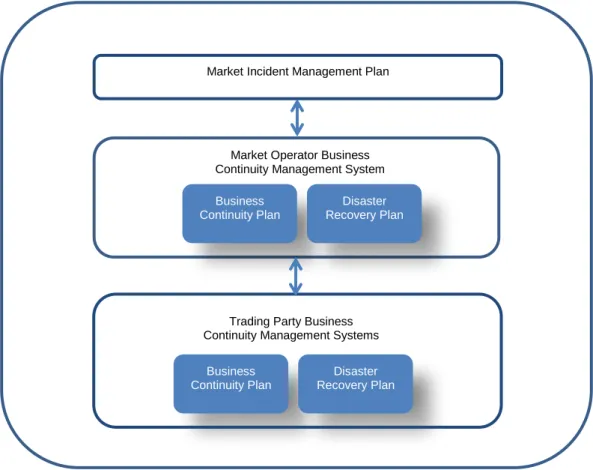
3.1.1 The Business Continuity Management Framework will be established and maintained as three (3) distinct components, as set out in Figure 1 below, to ensure that there are appropriate controls, governance and escalation mechanisms to protect the Resilience, and if necessary, the recovery of the market to Normal Operations. It is the responsibility of the Market Operator and Trading Parties to ensure that as and when necessary these Business Continuity arrangements can successfully interact.
3.1.2 The Market Operator and all Trading Parties will maintain their Business Continuity and Disaster Recovery arrangements on an on-going basis within the scope set out in Section 1.2 of this CSD.
Figure 1: Business Continuity Management Framework Business Continuity Management Framework
Business Continuity Plan
Trading Party Business Continuity Management Systems
Disaster Recovery Plan
Market Incident Management Plan
Business Continuity Plan
Market Operator Business Continuity Management System
Disaster Recovery Plan
Document reference CSD 0007 Business Continuity Management
Version 20150930 Page 14 of 31
3.2
Market Incident Management Plan
3.2.1 The Market Incident Management Plan will only be Invoked where it is determined that:
(a) the Market Operator can no longer contain or recover from a Significant Incident having Invoked its Business Continuity arrangements; or
(b) the Market Operator has determined that at a future point it will be unable to contain an Incident within the Business Continuity arrangements it has Invoked or is about to Invoke.
3.2.2 The Market Incident Management Plan will be maintained by the Market Operator and subject to the same maintenance requirements as set out elsewhere within this CSD.
3.2.3 The Market Incident Management Plan will include the necessary steps to Invoke the plan; notify affected parties and include explicit steps to return to agreed Normal Operations, or the necessary steps that need to be taken should a different measure of Normal Operations be required.
3.2.4 To the extent that any urgent Change Proposals may need to be proposed in respect of the Wholesale-Retail Code, the change process as set out in Section 6 of the Market Arrangements Code will be followed as appropriate.
3.3
Market Operator Business Continuity Management
System
3.3.1 The Market Operator will establish a Business Continuity Management System which includes a Business Continuity Plan and a Disaster Recovery Plan. The plans will contain the appropriate measures as set out in the best practice Business Continuity Management standard ISO 22301 and consider any other best practice measures which may be appropriate.
Document reference CSD 0007 Business Continuity Management
Version 20150930 Page 15 of 31
3.3.2 The Market Operator will ensure that its Business Continuity Management System and the steps set out within align to both:
(a) the Market Incident Management Plan; and
(b) individual Trading Party Business Continuity Management Systems, in terms of notifying affected Trading Parties that the Market Operator Business Continuity Plan and Disaster Recovery Plans have been Invoked and equally, that such plans have been Stood Down where an agreed position of Normal Operations has been achieved.
3.3.3 The Market Operator's Business Continuity Management system will remain compliant with the relevant requirements set out in Section 4 of this CSD.
3.4
Trading Party Business Continuity Management
Systems
3.4.1 Trading Parties will establish a Business Continuity Management System which includes appropriate Business Continuity Management and Disaster Recovery arrangements. Each Trading Party will develop a Business Continuity Plan and Disaster Recovery Plans that will contain the necessary Business Continuity and Disaster Recovery measures as required by this CSD.
3.4.2 Trading Parties will ensure that their Business Continuity Management System and the steps set out within, align to the Market Operator's Business Continuity arrangements in terms of:
(a) being notified by the Market Operator that the Market Operator's Business Continuity and/or Disaster Recovery plans have or will be Invoked;
(b) being notified by the Market Operator that the Market Incident Management Plan has or will be Invoked;
Document reference CSD 0007 Business Continuity Management
Version 20150930 Page 16 of 31
(d) Stand Down of Invoked plans once an agreed position of Normal Operations has been reached.
3.4.3 Trading Party Business Continuity Management Systems will remain compliant with the relevant requirements set out in Section 4 of this CSD.
Document reference CSD 0007 Business Continuity Management
Version 20150930 Page 17 of 31
4.
Market Operator and Trading Party requirements
4.1
Market Operator requirements
4.1.1 The Market Operator will make all relevant elements of the Business Continuity Management System available to Trading Parties to ensure the Business Continuity Management Framework as set out in Section 4 of this CSD remains fit for purpose.
4.1.2 The Market Operator will:
(a) achieve certification to the Business Continuity Management Standard ISO 22301 within six (6) months of the Go Live Date; and
(b) retain certification to the ISO 22301 standard on an on-going basis undergoing the necessary re-assurance by an appropriately qualified third-party as and when is required by the standard.
4.1.3 The Market Operator's Business Continuity arrangements will include:
(a) the initial steps that will be taken to assess the level of Impact associated with an Incident;
(b) alternative processes that will be adopted in the event of a Disruption or Significant Disruption as far as they can be prescriptive;
(c) a comprehensive communications plan which covers all potentially affected parties;
(d) the steps if necessary to Invoke the Market Incident Management Plan; and
(e) the steps that will be taken upon resumption of affected services in order to recover to pre-defined Normal Operations.
Document reference CSD 0007 Business Continuity Management
Version 20150930 Page 18 of 31
4.1.4 The Market Operator will ensure that the implemented Business Continuity Management System will continue to meet the following requirements set out in Section 4.2 in this CSD:
(a) Recovery Time Objectives; and (b) Recovery Point Objectives.
4.1.5 The Market Operator will ensure that the Market Operator Business Impact Analysis and derived Recovery Time Objective considers the requirements of the Market Terms, Market Arrangements Code and all CSDs.
4.1.6 As and when necessary, the Market Operator will engage Trading Parties in order to verify Business Impact Analysis that are being conducted as part of their on-going Business Continuity Management System maintenance programme. 4.1.7 The Market Operator Business Impact Analysis will take into account market
requirements in terms of:
(a) times within a Business Day when the ability to submit data (e.g. meter reads) is more critical for Trading Parties;
(b) times within a month when Market Operator services are more critical to Trading Parties, e.g. monthly settlement runs and market reports; and (c) times within a year when Market Operator services are more critical than
at other times – e.g. submission of Wholesaler Tariff Data.
4.2
Market Operator System requirements
4.2.1 The Market Operator will have sufficient system monitoring capabilities so that in most cases any issues in terms of Market Operator System performance will be immediately detected.
4.2.2 Should the Market Operator identify that Resilience of the Market Operator Systems cannot be maintained within the required tolerances, technical and security standards set out within this CSD then it shall Invoke the Market Incident Management Plan.
Document reference CSD 0007 Business Continuity Management
Version 20150930 Page 19 of 31
4.2.3 The Market Operator System architecture shall be designed and maintained in such a way that Trading Parties will be able to continue to perform transactional processes whilst the Central Systems are experiencing or recovering from a Disruption or Unplanned Outage.
4.2.4 The Market Operator will ensure that there is sufficient System Redundancy to avoid any Incident or Unplanned Outage occurring as a result of either the number of concurrent Trading Party users logged on to Market Operator Interfaces or the volume of Data Transactions and other data exchange being undertaken.
4.2.5 The Market Operator will have in place appropriate technical capabilities that any failover of Market Operator Systems will have no or little impact on Trading Parties including the continued use of the interfaces.
4.2.6 In the event that the Market Operator identifies that a Significant Disruption has been experienced and failover cannot be executed without impacting Trading Parties it will issue an immediate communication and Invoke the Market Incident Management Plan.
4.2.7 Interfaces to the Market Operator Systems will be available during a Business Day and Extended Hours unless otherwise notified. In the event of the Central Systems being unavailable, the Market Operator will continue to provide a synchronous response to Trading Party submissions through the interfaces. The Market Operator, if necessary, will buffer data and subsequently process data in the sequence that it was submitted once the Disruption has been addressed. 4.2.8 In situations where it is known that the submitted data will need to be buffered by
the Market Operator beyond the close of the Business Day, the Market Operator will notify affected Trading Parties that asynchronous responses relating to data validation processing may be delayed.
4.2.9 The Market Operator Systems will remain compliant at all times with the technical requirements set out in CSD 0400 (Common interface technical requirements). This shall include preserving the integrity of all data held within Market Operator Systems.
Document reference CSD 0007 Business Continuity Management
Version 20150930 Page 20 of 31
4.2.10 In the event of an Incident which results in a Disruption or Significant Disruption and requires Business Continuity arrangements to be Invoked, the Market Operator will ensure that appropriate Disaster Recovery measures mean that there is minimal loss of data held within the Market Operator Systems.
4.2.11 The Maximum Tolerable Period of Disruption for Market Operator Systems is one (1) Business Day. Beyond this, the Market Operator will Invoke the Market Incident Management Plan.
4.2.12 Recovery Point Objectives, Recovery Time Objectives and the Maximum Tolerable Period of Disruption will consider:
(a) the point during a Business Day where peak Trading Party submissions are undertaken, e.g. towards the end of a Business Day;
(b) the point during a calendar month when the Settlement Process is being undertaken; and
(c) the point in the calendar year when Tariff data is submitted in volume based on a pre-defined submission timetable.
4.2.13 Specific Market Operator services may afford a greater Maximum Tolerable Period of Disruption value, for example the performing of queries through the data query Interface CSD 0405 (Data Query Interface) or access to specific reports accessed through the report interface CSD 0403 (Interface for the provision of reports from the Market Operator to Trading Parties). However such measures will be assessed and agreed with all affected parties whilst undertaking an initial Impact Assessment.
4.2.14 Where the Market Operator determines that the Maximum Tolerable Period of Disruption set out in Section 4.2.11 is identified as being unachievable, a Change Proposal may be made in accordance with the change process set out in Section 6 of the Market Arrangements Code to change this CSD accordingly. 4.2.15 Where the Maximum Tolerable Period of Disruption for any specific services of
Document reference CSD 0007 Business Continuity Management
Version 20150930 Page 21 of 31
Market Operator following discussion with the Market Incident Management Plan Committee may raise a Change Proposal.
4.2.16 The Market Operator's Disaster Recovery arrangements will include replication configuration of 15 minutes for Central Systems in order to ensure that in the event of a Disruption or Significant Disruption, the recovery requirement for potential loss/recovery of data held within the Central Systems is minimised. 4.2.17 In the event of a Significant Disruption to the Central Systems the Maximum
Tolerable Data Loss will not exceed one (1) Business Day.
4.2.18 Where a significant data loss is identified, the Market Incident Management Plan will be immediately Invoked.
(a) Under these arrangements the Market Operator may require Trading Parties to resubmit, up to a maximum, all submissions to the Market Operator from the beginning of the previous Business Day (Business Day minus 1).
(b) Where a Trading Party has submitted Transactions through the high volume transaction interface outside Extended Hours, and depending on when the data was processed by the Central Systems, the Market Operator may request the resubmission of data up to the end of Extended Hours (Business Day minus 2).
4.2.19 In the event that the Market Operator cannot achieve the requirements set out in Section 4.2.11, it will become responsible for recovering any missing data and reprocessing in the correct sequence without requiring a system outage during Extended Hours.
4.2.20 It is the responsibility of the Market Operator to have in place the necessary steps to co-ordinate the resubmission of data from Trading Parties using the same interfaces through which the data was originally submitted.
4.2.21 Where a Trading Party is unable to transact with the Market Operator for an extended period of time and has a Backlog of Transactions, which exceeds its
Document reference CSD 0007 Business Continuity Management
Version 20150930 Page 22 of 31
normal transaction volumes, the Market Operator will agree a Transaction Recovery Plan with that Trading Party.
4.2.22 Where a Significant Disruption has occurred to the Market Operator Systems and the Market Operator enforces a restriction on the data that Trading Parties are permitted to submit, the maximum Backlog will not exceed one (1) Business Day. Under such circumstances where Trading Party submission Backlogs are created the Market Operator will agree individual Transaction Recovery Plans with the affected Trading Parties.
4.2.23 The Market Operator's Business Continuity arrangements will include appropriate measures to ensure continuing compliance with the security standards set out in CSD 0400 (Common interface technical specifications) at all times during a period of Disruption or Significant Disruption.
4.3
Trading Party requirements
4.3.1 Establishing a robust Business Continuity Management System forms part of a Trading Party's initial Market Entry Assurance and will remain an on-going requirement whilst operating in the market thereafter, as defined in CSD 0001 (Market Entry Assurance and Market Re-assurance).
4.3.2 Each Trading Party will establish and maintain a robust Business Continuity Management System which will remain proportionate to the organisation size and its activities within the market.
4.3.3 It is the responsibility of the Trading Party to ensure its Business Continuity arrangements remain compliant with the requirements set out in this CSD applying best practice measures wherever practicable. Business Continuity Plans and Disaster Recovery Plans will take into account:
(a) the necessary steps to perform a timely Impact Assessment in terms of on-going interaction with the Market Operator Systems;
(b) the Recovery Time Objectives and Recovery Point Objectives set out in Section 4.2 and establish appropriate processes and procedures around these;
Document reference CSD 0007 Business Continuity Management
Version 20150930 Page 23 of 31
(c) measures to ensure continuing compliance with the applicable security requirements set out in CSD 0400 (Common interface technical specifications) in the event of an Incident occurring;
(d) the required steps should the Market Operator Invoke its Business Continuity arrangements following a Disruption or Significant Disruption to the Market Operator Systems;
(e) the required steps should the Market Incident Management Plan be Invoked; and
(f) the necessary steps to return to Normal Operations.
4.3.4 Trading Party Business Continuity Management Systems will clearly set out the circumstances under which Business Continuity arrangements will be Invoked, including the procedures to notify the Market Operator where an Incident impacts a Trading Party's ability to Transact with the Market Operator Systems. 4.3.5 Trading Party Business Continuity arrangements will include failover
mechanisms which enable reconnection to the Market Operator interfaces. Following an Incident, should a Trading Party find that it is unable to connect to the Market Operator interfaces it will notify the Market Operator by raising a service management incident through the service management interface CSD 0406 (Service Management Interface).
4.3.6 Where a Trading Party is unable to transact with the Market Operator Systems for an extended period of time, and as a result has a Backlog of Transactions which will exceed normal transaction volumes:
(a) the Market Operator will be notified immediately by the Trading Party; (b) a Transaction Recovery Plan will be agreed between the Market
Operator and the relevant Trading Party; and
(c) the Trading Party will be responsible for ensuring that all Transactions are submitted in the correct sequence.
Document reference CSD 0007 Business Continuity Management
Version 20150930 Page 24 of 31
4.3.7 Where Trading Parties are requested to resubmit data by the Market Operator, Trading Party systems will be able to resend the required data without having to fully recreate the associated Data Transactions. Any recreation of Data Transactions risks unique reference numbers being incremented which may create a subsequent data processing exception within the Central Systems.
Document reference CSD 0007 Business Continuity Management
Version 20150930 Page 25 of 31
5.
Plan Invocations
5.1
Market Operator
5.1.1 The Market Operator will have the capability to identify potential Incidents by: (a) proactively monitoring the Market Operator Systems;
(b) proactively monitoring the Incidents raised by individual Trading Parties through the service management interface as described in CSD 0406 (Service Management Interface); and
(c) undertaking regular operational assessments as described in CSD 0006 (Trading Party Administration and Notifications) which may result in the decision to Invoke Business Continuity Management arrangements. 5.1.2 The general operational status of the Market Operator Systems will be reported
through the service management dashboard which is accessible to all Trading Parties through the service management interface described in CSD 0406 (Service Management Interface).
5.1.3 If the Market Operator identifies a potential Disruption to the Central Systems, or depending on the criticality of activities being undertaken by Trading Parties within the scope of the Market Operator Systems, the Market Operator will Invoke its Business Continuity Plan and Disaster Recovery Plan.
5.1.4 The Market Operator will perform an initial assessment as set out in its Business Continuity Plan to determine the scale, or potential scale of Disruption. If it is determined that the Disruption, or Significant Disruption cannot be contained and the Market Operator is in breach or cannot avoid becoming in breach of agreed Recovery Point Objectives and Recovery Time Objectives, the Market Operator will Invoke the Market Incident Management Plan.
5.1.5 Upon Invoking its Business Continuity Plan, Disaster Recovery Plan, or the Market Incident Management Plan, all affected parties listed in the predefined communications plan will be notified with immediate effect.
Document reference CSD 0007 Business Continuity Management
Version 20150930 Page 26 of 31
5.1.6 During a Significant Disruption, in order to establish controlled and timely recovery, the Market Operator may be required to enforce specific restrictions, whereby Trading Parties are limited to:
(a) Critical Activities using the transactional interfaces;
(b) reduced access or no access to non-transactional interfaces if it is deemed that they are not critical to the overall recovery; and
(c) the resubmission of data based on an agreed Transaction Recovery Plan.
5.1.7 In the event of a Significant Disruption to the Market Operator Systems, and associated services, the following high level principles will be observed by both the Market Operator and Trading Parties;
(a) all transactions and the systems that validate and process the Transactions will have equal criticality; any sub-prioritisation will need to be a specific step in the Market Operator and Trading Party Business Continuity Plans based on an Impact Assessment of the specific Disruption that is being experienced;
(b) the ability of the Market Operator Systems to calculate settlements on a monthly basis and publish associated reports in accordance with the timetable set out in CSD 0201 (Creation and update of Wholesaler Tariff Data) is a critical market function;
(c) Wholesaler Tariff Data and supporting processes may be of a lesser criticality at certain points of the year based on the annual calendar set out in CSD 0208 (Submission and Validation of Wholesaler Tariff Data); (d) query facilities may be of a lesser priority in terms of priority in which
Market Operator Systems and supporting services are recovered; and (e) the availability of the Service Management Interface set out in CSD 0406
(Service Management Interface) will remain critical in terms of Trading Parties being able to view the Market Operator service dashboard and to
Document reference CSD 0007 Business Continuity Management
Version 20150930 Page 27 of 31
obtain updates on outages / updates on progress to recovery in addition to out of band communications with affected Trading Party Contract Managers.
5.1.8 During situations as described in Sections 5.1.6 and 5.1.7 of this CSD, it will be the Market Operator's responsibility to manage all subsequent processing Backlogs that may occur. This may include additional over-night processing to ensure alignment by the start of the next Business Day and to not exceed the Maximum Tolerable Period of Disruption (where it has not already been exceeded).
5.1.9 Upon reaching a pre-defined point of Normal Operations, the Market Operator will ensure that it notifies all affected parties that it is no longer in a period of Invocation and that plans will be Stood Down.
5.1.10 The Market Operator will undertake a full lessons learned assessment following any Invocation which may require observational evidence-based input from affected Trading Parties.
5.2
Trading Parties
5.2.1 Trading Parties will manage their own Business Continuity and Disaster Recovery arrangements in accordance with the requirements set out within this CSD.
5.2.2 Where a Trading Party Invokes its Business Continuity arrangements and determines that it is unable to perform Critical Activities (including transacting with the Central Systems) it will notify the Market Operator immediately and maintain regular communications in terms of status updates.
5.2.3 Where a Disruption or Significant Disruption to a Trading Party results in a Backlog of transactions which exceeds their normal daily volumes, a Transaction Recovery Plan will be agreed between the affected Trading Party and the Market Operator.
5.2.4 If a Trading Party attempts to submit increased volumes of transactions through any of the transactional interfaces this may lead to subsequent Impacts within
Document reference CSD 0007 Business Continuity Management
Version 20150930 Page 28 of 31
the Central Systems. Where a Trading Party attempts to undertake an increased volume of Transactions through the Transactional Interface as described in CSD 0401 (Transactional interface for Trading Parties having a high volume of Transactions), in an attempt to recover Critical Activities without having first notified the Market Operator, this may result in anomaly detection measures being triggered.
5.2.5 Where the Market Operator has Invoked its Business Continuity arrangements or the Market Incident Management Plan has been Invoked, all affected Trading Parties will co-operate fully and action all instructions that it receives from the Market Operator or where the Market Incident Management Plan has been Invoked, all instructions of the Market Incident Management Plan Committee. 5.2.6 Upon reaching a point of Normal Operations predefined within the Market
Operator's Business Continuity Plan or a revised measure of Normal Operations agreed with the Market Incident Management Plan Committee, the Market Operator will ensure that it notifies all affected parties that it is no longer in a period of Invocation.
Document reference CSD 0007 Business Continuity Management
Version 20150930 Page 29 of 31
6.
Plan maintenance
6.1
Plan review
6.1.1 The Market Operator and each Trading Party will ensure that Business Continuity Plan and Disaster Recovery Plan reviews are undertaken on at least an annual basis in accordance with best practice guidelines.
6.1.2 Plan reviews will include a full review of the current Business Impact Analysis to ensure that established measures such as Recovery Point Objectives and Recovery Time Objective remain fit for purpose and achievable.
6.1.3 As part of the annual review, Market Operator plans may be formally audited by a suitably qualified third-party indicating that remain fit for purpose, fully certified to the ISO 22301 standard and that they continue to meet the requirements set out within this CSD.
6.1.4 Trading Parties will review the relevant elements of their Business Continuity Management System in terms of the interfaces and associated processes used for interacting with the Market Operator.
6.1.5 Should the Market Operator and/or a Trading Party be required to Invoke their Business Continuity arrangements, a full review will be undertaken once agreed Normal Operations has been achieved.
6.1.6 Plan Rehearsals will require mutual arrangements to be established between the Market Operator and Trading Parties where respective plans can be rehearsed in as near realistic environment as is possible. This includes active failover to demonstrate on-going connectivity between Trading Parties and the Market Operator and the ability to operate in accordance with this CSD.
6.1.7 Where Trading Parties are requested to support Market Operator Business Continuity testing, they will do so on the basis of proving end-to-end market Resilience.
6.1.8 The Market Operator will establish a rolling annual Business Continuity Management maintenance schedule which will be made available to all Trading
Document reference CSD 0007 Business Continuity Management
Version 20150930 Page 30 of 31
Parties. Where support is required in executing specific test criteria, the Market Operator will notify all affected Trading Parties. Upon reasonable notice, Trading Parties will support the Market Operator in accordance with Sections 2.1.2(a) and 3.1.2(a) of the Market Terms.
6.1.9 The Market Operator will ensure that any scheduled Business Continuity activities do not impact day-to-day operation of the market. If for any reason it is identified that a planned Business Continuity exercise is impacting market operations, the exercise will be stopped in a controlled manner. A lessons learned review will then be undertaken.
6.2
Planned exercises
6.2.1 The Market Operator's Business Continuity Plan and Disaster Recovery Plans will be exercised on at least an annual basis and may require Trading Party input. Upon reasonable notice, Trading Parties will support the Market Operator in accordance with Sections 2.1.2(a) and 3.1.2(a) of the Market Terms. This will include lessons learned reviews, especially where end to end service continuity is tested.
6.2.2 Trading Parties will schedule Plan Rehearsals with the Market Operator as part of their annual Business Continuity maintenance plan and in accordance with on-going Market Assurance requirements as set out in CSD 0001 (Market Entry Assurance and Market Re-assurance).
6.3
Lessons learned
6.3.1 Following any plan Invocation the Market Operator and/or any affected Trading Parties will ensure that a full review of the Business Continuity Plan, Disaster Recovery Plan or the Market Incident Management Plan is undertaken.
6.3.2 It is the responsibility of the Market Operator and each Trading Party to ensure that any valid lessons learned are shared as appropriate and incorporated into their respective Business Continuity Plan and Disaster Recovery Plan. This serves to ensure that the risk of a similar repeat Incident is mitigated as much as
Document reference CSD 0007 Business Continuity Management
Version 20150930 Page 31 of 31
possible and Continual Improvement continues to be promoted across the market.
6.3.3 Upon completion of a lessons learned review, a report will be produced by the Market Operator and issued to Market Operator Board, Market Incident Management Plan Committee and Panel members.
6.3.4 The Market Operator will ensure that lessons learned are shared with all Trading Parties as appropriate.