Changes in source-sink relationships during grain-filling and its effects on
sunflower root system viability and canopy functionality
Sebastian Lisanti, Juan Manuel Cabarcos, Antonio J. Hall and Claudio Chimenti. IFEVA (FAUBA/CONICET). Avda. San Martín 4453. Ciudad Autónoma de Buenos Aires. C1417DSE,
Argentina. [email protected]
ABSTRACT
After flowering, grains become the main sink for carbohydrates (C) derived from current photosynthesis or from temporary storage, reducing the amount of (C) partitioned to the root system. During grain filling in intact plants, size and functionality of the root system are reduced. This suggests a trade-off between grain formation and root viability, but other effects of grain formation also need to be considered (e.g., altered leaf senescence, changes in leaf photosynthetic capacity). Here we report results from an experiment that aimed to document root and leaf responses to a severe reduction in demand for (C) for grain formation.
Source-sink relationships during grain-filling were manipulated by removal of all floral primordia at the beginning of anthesis in crops of two sunflower (Helianthus annuus L.) commercial hybrids of contrasting leaf senescence dynamics (Aguará 6 “stay-green” (SG, lower leaf senescence rate) and CF 101 “fast dry down” (FDD, higher leaf senescence rate)); resulting in a factorial experiment (repeated in two successive years) of 4 treatments: 1) SG Control: 2) SG F-; 3) FDD Control; 4) FDD F-, distributed in randomized complete blocks (n=3). During the grain-filling phase of the control plants, the dynamics of leaf photosynthetic capacity (Pmax, measured at 2.000 μmol/m2.s PAR on the uppermost expanded
leaf)), LAI, organ biomass and root viability (capacity to reduce tri-phenyl tetrazolium) in the 0-40 cm soil stratum were followed in all treatments.
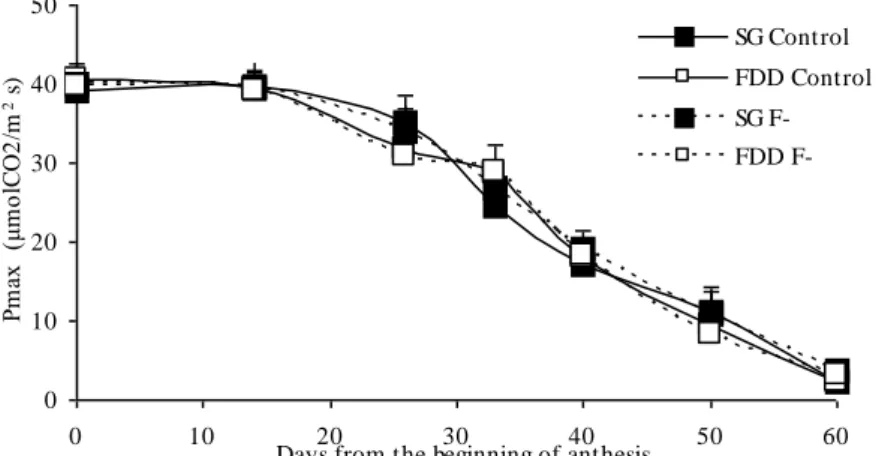
In both years Pmax remained stable (average value: 39.6 μmolCO2/m 2
.s) for 14 days after the beginning of anthesis (DAA), and showed no significant differences (p>0.10) between the four treatments. Pmax
declined linearly as from 14 DAA at rates (average slope = -0.84 μmolCO2/m2.s.day), which were
statistically indistinguishable between treatments.
LAI values at anthesis were statistically indistinguishable between treatments (4.0 SG control, 4.0 FDD control, 4.2 SG F- y 3.9 FDD F-). The SG (F-) treatment maintained the initial LAI value until 35 DAA, while the FDD (F-) treatment did so until 43 DAA, but this difference between hybrids was not significant (p>0.10). In the control treatment both hybrids maintained their initial LAI until 15 DAA, after which LAI declined linearly at rates of -0.11 IAF/day in SG and -0.14 IAF/day in FDD, which differed significantly (p < 0.05) between hybrids. The hastening of the initiation of LAI loss in the controls with respect to the (–F) treatments was significant (p = 0.05).
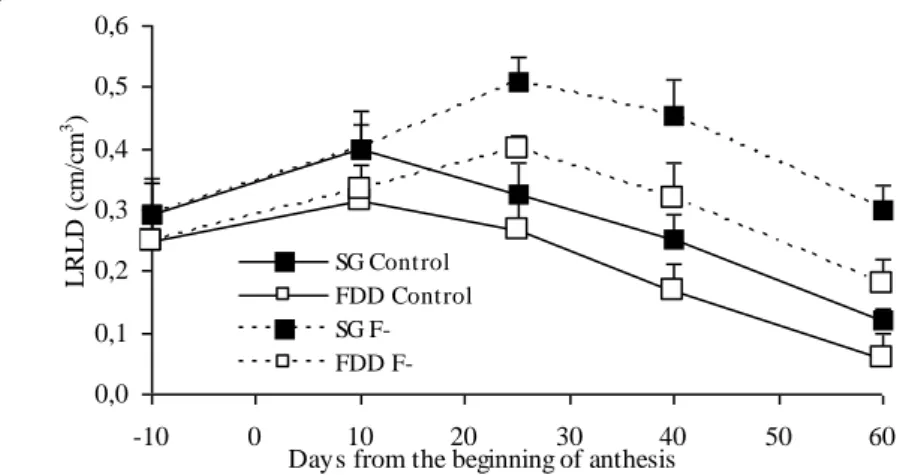
Both hybrids attained, in the control treatment, their maximum values of live root length density (LRLD) at 10 DAA, with SG reaching a significantly (p=0.05) greater value than FDD (0.40 vs. 0.32 cm root/cm3 soil). In the (F-) treatments LRLD increased continuously until 25 DAA in both hybrids, achieving LRLD values significantly (p=0.05) greater than those of the (F) treatments ( + 28% greater in SG hybrid, and + 21% in FDD), but this difference between hybrids was not significant (p>0.10).
At the end of the experiment, root dry weight (the only organ to show major and significant responses to treatment) in the (F-) treatment showed a 175% increase (in relation to control) in FDD and a 350% one in SG.
We conclude that flower primordium removal at anthesis produces complex responses during grain filling. These clearly included increased LRLD and root dry weight, as well as delayed loss of LAI in the (F-) treatments. In contrast, Pmax of the uppermost expanded leaves was not altered in these treatments.
Intrinsic canopy senescence patterns (i.e., SG vs. FDD) modulated these responses to some degree, but this was not generalized across variables.
For the first time, in sunflower and many other crops, this study shows how the root system is strongly affected by (C) reductions supply during grain-filling phase. It is a starting point to achieve a better understanding and quantification of the potential trade-offs (in carbohydrates and other plant resources) between grains and roots. Future studies will require the development of quantitative response functions to floral primordium ablation for the variables studied in these experiments as well as for additional ones. Key words: sunflower – root viability – source/sink relationship
INTRODUCTION
During the grain-filling phase, grain weight is set, and any decrease in root system functionality during this period will affect grain yield. The objective of this study was to improve current knowledge about the relations between grain growth and root system functionality. Richards et al. (2007) have observed in wheat that a greater root growth results when the ear is removed.
It is known that after flowering, fruits become the priority sink for carbohydrates (C) synthesized by leaves or those which are temporarily stored in other organs. Therefore, the (C) partitioned toward the other organs during grain-filling is reduced (Hall et al., 1989), potentially altering root system structure and functionality. This implies that at some time during the reproductive phase, a complex root senescence process starts to develop. Indications of physiological alterations in sunflower (Helianthus annuus L.) root functionality during grain filling are loss of root biomass (Sadras et al., 1989) and reductions in root system respiratory rate (Hall et al., 1990).
The present study aimed at carrying out a spatial and temporal monitoring of root system functionality during the grain-filling phase in normal plants and ones in which grain formation had been blocked. Documenting the interactions between processes linked to grain formation and root system maintenance could be the first step in optimizing trade-offs between the two functions. The hypothesis tested was that reduction of (C) assigned to grain could increase (C) apportioned to roots, resulting in an extension of the period during which roots remain functional.
MATERIALS AND METHODS
Experiments were carried out at the Facultad de Agronomía, Universidad de Buenos Aires (34º35´S, 58º29´W) during two growing seasons (2009/2010 and 2010/2011). Two sunflower hybrids of contrasting intrinsic canopy senescence dynamics were used, namely: Aguará 6, identified as “stay-green” (SG) and CF 101, identified as “fast-dry-down” (FDD).
Removal of all florets (F-) at the beginning of anthesis was used to block fruit formation, in the expectation that this would alter the amount of (C) partitioned to the roots and affect root system structure and functionality. Crops were sown at 7.5 pl/m2, resulting in a factorial experiment with 4 treatments: 1) SG Control: 2) SG F-; 3) FDD Control; 4) FDD F-, distributed in randomized complete blocks (n=3). Measured variables were:
A) Photosynthesis (Pmax): Maximum photosynthetic capacity of the uppermost expanded leaf was measured using a portable gas analyzer (LI-COR 6200, LI-COR, Lincoln, Nebraska, USA).
Measurements were taken on sunny days at a PPFD of 2.000 µmoles m-2 s-1. Leaves of 3 plants per treatment were measured every 10 days.
B)Live root length density (LRLD): From the beginning of anthesis until physiological maturity of the grain, samples of soil from the 0-40 cm layer [i.e., layers containing ca. 90% of the root system (Sadras et al., 1989, Angadi and Entz, 2002)] were extracted and roots washed free of soil. To distinguish between live and dead roots, roots were incubated in 2,3,5 triphenyl tetrazolium chloride (TTC), which produces a red stain if root mitochondrial respiration is operative (Sturite et al. ,2005). Treated roots were scanned and analyzed with WinRHIZO software (Winrhizo version Pro V 2008, Regent Instruments INC, Canada) to measure lengths of red (live) and other (dead) roots present in each sample. Samples (3 replicates for each sampling) were taken every 10 days between immediately prior to the beginning of anthesis (BA) through to grain physiological maturity.
C) Biomass: 9 plants per treatment (i.e., 3 contiguous plants per plot) were harvested every 15 days and the dry weight of each organ was determined. Roots were extracted from a volume of soil 20 cm. in diameter and 20 cm in depth.
D) Leaf area: During the whole growing season, leaf area per plant was estimated from leaf width measurements (Pereyra et al., 1982). A leaf was considered senescent when at least 50% or its area was yellow. 9 plants per treatment were weekly measured.
E) Development: Phenological stages were recorded weekly for 9 plants per treatment following the Schneiter and Miller scale (1981).
RESULTS
There were no significant difference, between hybrids, for the timing of beginning of anthesis (BA) and the duration of anthesis (12 days) was also similar in both hybrids. Hence, all four treatments can be taken to have been exposed to the same environmental conditions during the experiment.
Between (BA) and 14 days thereafter, the greatest values of (Pmax) were achieved (Fig. 1) and did not differ significantly (p>0.10) between the 4 treatments (average value: 39.6 μmolCO2/m2 s).
Between 14 days after (BA) and physiological maturity, (Pmax) declined linearly at rates (average slope = -0.84 μmolCO2/m2 s day) which did not differ significantly (p>0.10) between the four treatments. In
none of the measurements did Pmax values differ significantly (p<0.10) between the treatments. Differences in Pmax on successive measurement dates as from the 14 days after (BA) were significant (p<0.01).
At (BA), LAI values (4.0, SG-control; 4.0, FDD-control; 4.2, SG-F-; and 3.9, FDD-F-, respectively) did not differ significantly (p>0.10) between treatments. (Fig.2), nor were we able to detect differences prior to flowering (data not shown). We infer from this that treatment effects observed during the grain-filling phase were not biased by differences in LAI established during the vegetative phase. In control treatments, initial LAI values remained constant until approximately 15 days after (BA). From that time, significant (p<0.05) differences between treatments started to emerge. Control SG and control FDD treatments decreased linearly at rates of -0.11 LAI/day and -0.14 LAI/day respectively (Fig. 2). A very different pattern was observed under (F-) treatments, in which the start of the decrease in LAI was delayed in both hybrids, not commencing until 35 and 43 days after (BA) in SG and FDD, respectively. This difference in 8 days between hybrids was not, however, significant (p>0.10).
0 1 2 3 4 5
0 10 20 30 40 50 60
Days from the beginning of anthesis
L
A
I
FDD Control FDD Control SG FDD
F-º
Fig. 2: Dynamics of LAI in all treatments. Values are means and bars indicate +/- 1 SE (n=6).
Fig. 1: Dynamics of Pmax in all four treatments. Values are means and bars indicate +/- 1 SE (n=6) and are not shown when smaller than the symbols.
0 10 20 30 40 50
0 10 20 30 40 50 60
Days from the beginning of anthesis
Pm
ax
(
μm
ol
C
O
2/
m
2 s
)
SG Control FDD Control SG FDD
F-Control live root length density (LRLD) showed a pattern similar to that of LAI (Fig. 3) and in control treatments, both hybrids attained their maximum values at 10 days after (BA). However, and in contrast to what was found for LAI, values for SG LRLD were significantly (p>0.05) greater than those for FDD (0.40 vs. 0.32 cm root/cm3 soil, respectively). Floret removal produced significant (p<0.05) differences in LRLD during the whole of the effective grain-filling phase (Fig. 3). This treatment increased LRLD continuously until 25 days after (BA) in both hybrids, at which time the greatest values were achieved. In comparison to the greatest values reached under control treatments, (F-) increased them significantly (p<0.05) by 28% in SG and 21% in FDD. As from 25 days after (BA), LRLD decrease rates did not differ significantly (p>0.10) between the four treatments.
.
The organ which exhibited the greatest changes in dry weight in response to floret removal was the root (Fig. 4). The root dry weights in control treatments of both hybrids did not vary during the measurement period and differences between hybrids were not significant (p>0.10). By 30 days after (BA), floret removal produced significant differences (p<0.01) respect to controls in both hybrids and root dry weight in the (F-) treatments increased continuously until physiological maturity. At that time, the (F-) treatment showed a 175% increase (in relation to control) in the FDD hybrid and a 350% one in the SG hybrid.
0,0 0,1 0,2 0,3 0,4 0,5 0,6
-10 0 10 20 30 40 50 60
Days from the beginning of anthesis
L
RL
D
(c
m
/c
m
3 )
SG Control FDD Control SG FDD
F-Fig. 3: Dynamics of LRLD in all four treatments. Values are means and bars indicate +/- 1 SE (n=6).
Fig. 4: Dynamics of root dry weight in all four treatments. Values are means and the bars indicate +/- 1 SE (n = 6) .
0 20 40 60 80 100
0 10 20 30 40 50 60
Days from the beginning of anthesis
D
ry w
e
ight
(gr
s
.)
SG Control FDD Control SG FDD
F-DISCUSSION
These results indicate that floret removal (total inhibition of grain formation) produces complex responses which include greater root growth, the prolongation of root functionality and a marked delay in the post-anthesis loss of LAI. Intrinsic canopy senescence pattern (i.e., SG or FDD) affected LRLD dynamics, but did not produce significant alteration in the other response variables measured in these experiments. The invariance of Pmax dynamics across treatments was unexpected, but the results here might have been different if we had followed Pmax in the basal leaves of the crops. Our results for Pmax of the uppermost expanded leaf , partially matches the observations of Sadras et al. (2000), who only found differences between treatments (measured at 3 different leaf positions ) at 35 days after (BA). Our results have served to confirm and deepen previous observations of the delay in leaf senescence in the (F-) treatments (Sadras et al., 2000; Valentin et al., 1998; Srivlli et al., 2009). Finally, our results also highlight the trade-off between the maintenance of root growth and functionality and grain formation and point to possible effects, on this trade-off, of the intrinsic leaf senescence patterns.
It has been suggested that the delay in leaf senescence induced by floret removal could be related to the capacity of leaves to maintain their assimilate content above a minimum threshold (Sadras et al., 2000) and/or to avoid loss of N to the grains (Sinclair and de Wit, 1976). However, greater root biomass increase and functionality observed in the (F-) treatments suggest another possible explanation, namely the continuation, in this treatment, of root cytokinin synthesis. It is known that citokinins may delay leaf senescence (Carimi et al., 2004), and this growth regulator is synthesised in the roots and is transported from there to the leaves.
Further studies on this issue should attempt to determine the optimum balance point for the root/grain trade-off, and be aimed at investigating the possible involvement of the plant nitrogen and cytokinin balances in determining the observed response patterns in both SG- and FDD-type hybrids.
REFERENCES
Angadi, S.V. and Entz, M.H. 2002. Root system and water use patterns of different height sunflower cultivars. Agronomy Journal. 94:136-145.
Carimi, F., Terzi, M., De Michele, R., Zottini, M. and Lo Schiavo, F. 2004. High levels of the cytokinin BAP induce PCD by accelerating senescence. Plant Science. 166: 963-969.
Hall, A.J., Connor, D.J., Whitfield, D.M. 1989. Contribution of pre-anthesis assimilates to grain filling in irrigated and water-stressed sunflower crops. I. Estimates using labelled carbon. Field Crops Research 20:95-112.
Hall, A. J., Connor, D.J. and Whitfield, D.W. 1990. Root respiration during grain filling in sunflower: The effects of water stress. Plant and Soil. 121: 57-66.
Pereyra, V.R., Farizo, C. and Cardinali, F. 1982. Estimation of leaf area onsun¯ower plants. Proceedings of the 10th International Sunfower Conference. Surfers Paradise, Qld, Australian Sunflower Association, Toowoomba Qld, 21-23.
Richards, RA., Watt, M and Rebetzke, G.J. 2007. Physiological traits and cereal germplasm for sustainable agricultural systems. Euphytica.154: 409–425.
Sadras, V.O., Hall, A.J., Trapani, N.T. and Vilella, F. 1989. Dynamics of rooting and root length:leaf area relationships as affected by plant population in sunflower crops. Field Crops Research. 22: 45-57.
Sadras, V.O., Echarte, L. and Andrade, F.H. 2000. Profiles of Leaf Senescence During Reproductive Growth of Sunflower and Maize. Annals of Botany. 85: 187:195
Schneiter, A.A. and Miller,J. F. 1981.Description of sunflower growth stages. Crop Science. 21:901-903
Sinclair, T. R. and de Wit, C. T. 1976. Analysis of the carbon and nitrogen limitations to soybean yield. Agronomy Journal. 68: 319-324.
Srivalli, S. and Khanna-Chopra, R. 2009. Delayed wheat flag leaf senescence due to removal of spikelets is associated with increased activities of leaf antioxidant enzymes, reduced glutathione/oxidized glutathione ratio and oxidative damage to mitochondrial proteins. Plant Physiology and Biochemistry. 47: 663–670.
Sturite, L., Henriksen, T.M. and Breland T.A. 2005. Distinguishing between metabolically active and inactive roots by combined staining with 2,3,5-triphenyltetrazolium chloride and image colour analysis. Plant and Soil. 271: 75-82.
Valantin, M., Gary, C., Vaissiere, B.E., Tchamitchian, M and Bruneli, B.1998. Changing sink demand affects the area but not the specific activity of assimilate sources in cantaloupe (Cucumis melo L.). Annals of Botany. 82: 711–719.