Throughput Improvement of STS-Based MC DS-CDMA
System with Variable Spreading Factor
V. Vakil
*
and H. Aghaeinia
*
Abstract: The throughput enhancement of Space-Time Spreading (STS)-based Multicarrier Direct Sequence Code Division Multiple Access (MC DS-CDMA) system is investigated in this paper. Variable Spreading Factor (VSF) is utilized to improve the data throughput of the system. In this contribution, an analytical approach is proposed to compute a new expression for the Bit Error Rate (BER) performance of the STS-based MC DS-CDMA system against pre-dispreading Signal-to-Noise Ratio (SNR) for different values of spreading factor (SF). The other contribution of the paper is deriving a new closed form expression for computing the throughput enhancement and the BER performance of the VSF STS-based MC DS-CDMA system over Rayleigh fading channel.It is demonstrated that using VSF method in STS-based MC DS-CDMA system improves the throughput of the system by keeping the BER performance at the target level.
Keywords: Frequency diversity, MC DS-CDMA, Space-Time Spreading, Spreading Factor, Throughput, Variable.
1 Introduction
Recent studies in wireless communication attempt to increase the capacity, data rate and performance of the systems. Diversity is a technique that provides several replicas of the transmitted signal in independent fading channels. In this paper, space diversity and frequency diversity are considered for CDMA system. The Space-Time Spreading method [1] is used as the transmit diversity technique for MC DS-CDMA system. In MC DS-CDMA system, multicarrier modulation is combined with time domain spreading, where DS spreading is performed to spread subcarriers’ signals [2-6]. In [2] the BER performance of the multiantenna MC DS-CDMA system is investigated, when communicating over correlated time-selective Rayleigh fading channels. [3] introduces a multicarrier modulation scheme for wideband CDMA systems that performs the spreading in the time and frequency domain simultaneously. In [4-6] MC DS-CDMA using STS-assisted transmit diversity is investigated in the context of broadband communications over frequency-selective Rayleigh-fading channels. Multicarrier
Iranian Journal of Electrical & Electronic Engineering, 2009. Paper first received 11 Dec. 2007 and in revised form 22 Nov. 2008.
* The Authors are with the Department of Electrical Engineering, Amirkabir University of Technology, Tehran, Iran.
modulation makes it possible to achieve frequency diversity through performing S-depth interleaving.
In addition, variable rate transmission techniques have been proposed to improve the performance of wireless systems in supporting several services. Adaptive rate transmission is a technique in which the information rate varies according to the quality of the channel [7-12]. In [7] the multi processing-gain, multi-channel, multi-modulation and multi-chip rate schemes are studied and compared. The error performances of multicode and variable spreading gain schemes are analyzed and compared in W-CDMA in [8]. In [9], a generic performance analysis for the multicode and variable spreading factor multirate schemes in MC-CDMA is presented. In [10, 11] adaptive rate transmissions are investigated in the context of CDMA system using variable spreading factors (VSF). In these works, the transmission rate is adapted in response to the multiuser interference (MUI) level. In [12] the throughput maximization problem for CDMA uplink is formulated as an optimization problem in terms of the spreading gain and transmit power of the users, and is solved using a nonlinear programming approach.
Using diversity techniques results in increasing the capacity of CDMA system and applying adaptive rate transmission to this system enhances the data throughput of each user. Using both techniques,
supporting high data services [13-21]. In [13] a closed form expression of the average BER is derived for a Rake receiver based adaptive-modulation scheme over frequency selective slow Rayleigh fading channels. In [14], the average bit error rate and the average throughput for adaptive modulation/transmit diversity combined schemes are derived for the CDMA system over frequency-selective Rayleigh fading channels. The average throughput of W-CDMA systems with Multiple-input-multiple-output and adaptive modulation and coding is evaluated in [15] by simulation and theoretical analysis.
In our previous works, STS as the space-time diversity technique is used for CDMA system with adaptive rate transmission techniques, in different fading channels [16-21]. The throughput improvement of Adaptive Modulated STS-based CDMA system is investigated in [16-18]. Variable spreading factor is used to improve the throughput of the same system in [19, 20]. In [21], the combination of these adaptive rate methods is proposed for throughput enhancing of the STS-based CDMA system.
Future mobile radio systems require multirate transmission capability to efficiently support various services with wide range of data rates. Our contribution in this paper is using Variabale Spreading Factor, as an efficient adaptive rate technique in combination with space-time diversity and frequency diversity to increase the throughput and performance of the system. Further more, from the BER curves of the STS-based MC DS-CDMA system versus pre-dispreading SNR some critical thresholds are obtained which are used in rate adaptation procedure. Hence, an expression is proposed for calculating the BER performance of the system for different values of spreading factor. The other contribution of the paper is deriving a new closed form expression for computing the throughput enhancement and the BER performance of VSF STS-based MC DS-CDMA system.
The rest of paper is organized as follows. Section 2 describes the applied STS scheme for data transmission over frequency selective Rayleigh fading channel. In section 3, Variable Spreading Factor method is described. The BER performance of STS-based MC DS-CDMA system as well as the average pre-dispreading SNR of the system is calculated in section 4. Then in section 5, an analytical approach is proposed to compute the throughput and BER performance of VSF system. Section 6 contains numerical results and discussions. Finally, section 7 concludes the paper.
2 Data Transmission in STS-based MC DS-CDMA System
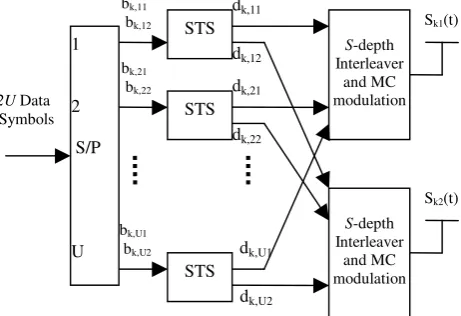
The system considered in this paper is an orthogonal MC DS-CDMA scheme [2, 4-6] using U.S number of subcarriers, two transmitter antennas and one receiver antenna. The transmitter schematic due to kth user is shown in Fig. 1. As shown in this figure, a block of 2U data symbols is serial-to-parallel converted to U parallel sub-blocks. The symbols in each sub-block are space-time spread using the STS method of [1]. Each STS block generates 2 parallel signals to be mapped to the 2 transmitter antennas. The U STS output signals which will be transmitted using the same antenna are then interleaved by an S-depth interleaver, so that each STS signal is transmitted on S subcarriers. The interleaver guarantees that the same STS signal is transmitted by the specific S subcarriers having the maximum possible frequency spacing, so that they experience independent fading and hence achieve maximum frequency diversity. Finally as shown in the figure, the Inverse Fast Fourier Transform (IFFT) is invoked to carry out multicarrier modulation, and each IFFT block’s output signal is transmitted through one of the transmitter antennas. The kth user's transmitted signal is:
k θ j u 1)U (s
U
1 u
S
1
s k,2
* u1 k, k,1 u2 k,
k,2 *
u2 k, k,1 u1 k, k
t)e exp(j2πx
c b c b
c b c b
2US P (t) S
+ −
= =
×
− +
=
∑∑
(1)
where bk,u1 and
b
k,u2 are the data symbols in the uth sub-block due to kth user, andc
k,1,c
k,2 are the kthuser's 2N×1 orthogonal unit-norm spreading codes. One possible choice of the code-vectors
c
k,1 andc
k,2is:
Sk2(t)
Sk1(t)
bk,21
bk,22
bk,11
bk,12
bk,U1
bk,U2 dk,U1
dk,21
dk,22
dk,U2
dk,12
dk,11
STS
STS
STS
S-depth Interleaver
and MC modulation
S-depth Interleaver
and MC modulation
2U Data Symbols
Fig. 1. The transmitter schematic of the STS-based MC DS-CDMA
1
2
S/P
U
T T k,0 T
k,0 k,2
T T k,0 T k,0 k,1
]
c
c
[
c
]
c
c
[
c
−
=
=
(2)
where ck,0 is an N×1 spreading code, specified to kth
user. P is the transmitted power and
θ
k is the carrier phase containing modulation phase.The channel is assumed to be slowly varying frequency-selective fading, which can be modeled as a tapped delay line as represented in [22]. The channel model between the ith transmitter antenna and the kth user's receiver antenna is given in Fig. 2. The MC DS-CDMA system is designed such that the U.S subcarrier signals each experiences flat fading and the subcarrier signals conveying the same symbol will experience independent fading [4-6].
The subchannel response due to subcarrier specified with frequency f(s−1)U+u is:
S 1,2,..., s
U 1,2,..., u
) exp(jξ h
(t)
h(us)i,k (us)i,k (us)i,k
= =
=
(3) where h(us)i,k and ξ(us)i,k are the amplitude and phase of
each sub-channel, respectively. The coefficients
{
h(us)i,k}
are independent i.i.d. random variables obeying the Rayleigh distribution with probability density function as equation (4).
) /(2α α 2 0
2 0 2
e
α
α
)
(
f
αα
=
− (4)The phase variables
{
ξ(us)i,k}
are i.i.d. random variables with uniform distribution in[
0,2π)
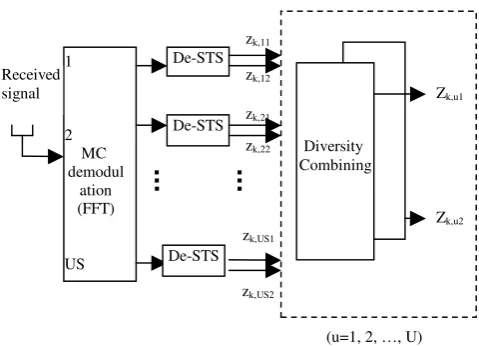
.The receiver schematic of the kth user is shown in Fig. 3. If the total number of K user signals is transmitted synchronously over Rayleigh fading channels, the received signal at the given mobile station can be expressed as:
N(t)
t) f )]exp(j2 exp(jψ
h
) c b c (b ) exp(jψ
h
) c b c [(b 2US
P R(t)
u 1)U -(s k
(us)2, k
(us)2,
k,2 *
u1 k, k,1 u2 k, k (us)1, k
(us)1, K
1 k
U
1 u
S
1 s
k,2 *
u2 k, k,1 u1 k,
+ ×
− +
×
+ =
+ = = =
∑∑∑
π
(5)
in which ψ(us)i,k =ξ(us)i,k +θ(us)i,k is uniformly distributed
in
[
0,2π)
[23].Let the first user be the user-of-interest, the subscript of the reference user is omitted for notational convenience. We also change the subscripts u ,
s
for1,2,...U
u= and s=1,2,...S to u′ for u′=1,2,...US. At the receiver side, in order to detect the transmitted data symbol, the FFT based multicarrier demodulation and Space-Time dispreading should be performed. Equation
∫
′′ =
S
2UT
0 i u
i
u R(t)c (t)exp(-j2 f )dt
d π (6)
where T is the symbol duration of transmitted symbols. S
When substituting (5) into above equation, it can be shown that:
2 u 2 u 2 u *
1 u
1 u 1 u *
2 u S 2
u
1 u 2 u 2 u 2 u
1 u 1 u 1 u S 1
u
J )]
exp(jψ
h b
)
exp(jψ
h [b T S 2UP d
J )]
exp(jψ
h b
)
exp(jψ
h [b T S 2UP d
′ ′ ′
′
′ ′
′ ′
′ ′ ′
′
′ ′
′ ′
+ −
=
+ +
=
(7)
h(us)i,k(t)
Transmitted signal
Fig. 2. The tapped delay-line model of frequency-selective channel
τ
τ
τ
Σ
×
×
×
×
zk,US1
zk,21
zk,22
zk,US2
zk,12
zk,11
1
2 MC demodul
ation (FFT)
US
De-STS
De-STS
Diversity Combining
Zk,u1
Received signal
Zk,u2
(u=1, 2, …, U) De-STS
Fig. 3. The receiver schematic of the STS-based MC DS-CDMA
where Ju′i contains all type of interference signals. By assuming orthogonal multicarrier signals, orthogonal STS codes, synchronous transmission of all users and slow flat fading of each subcarrier, no other interference signal is considered except Gaussian noise. Therefore, regarding the approach proposed in [1], if we define:
=
′ ′
′ *
2 u
1 u u
d
d
d
and
− =
′ ′
′ ′
− ′ −
′
′ ′
′
1 u 2
u
2 u 1
u
jψ *
1 u jψ *
2 u
jψ 2 u jψ
1 u u
e h e
h
e h e
h
H , the
dispread signal of each subcarrier can be expressed as:
u u S
u TH b N
S 2UP
d ′= ′ + ′ (8)
where
N
u′=
[
N
u′1N
*u′2]
T is the noise vector and:∫
−= 2UTS
0 1,i u
i
u,(t) N(t)c (t)exp( j2 f t)dt
N
π
(9)It is a complex Gaussian distributed variable having zero mean and a variance of 4UN0TS.
Regarding the method proposed in [1] for detecting complex data symbols, by multiplying equation (8) by
H u
H′ the decision variable zu′ is calculated as equation
(10), in which H u
H′ is the complex conjugate transpose of
u
H ′
.
u H u u H u S 2
u 1 u
u TH H b H N
S 2UP z
z
z ′ ′ ′ ′
′ ′
′ = +
= (10)
Letting hu′i denote the ith column of matrix Hu′, zu′i can be formulated as:
u H
i u 2
1 i
2 i u i S i
u T b h h N
S 2UP
z ′ ′
= ′
′ =
∑
+ (11)After combining the replicas of the same signal transmitted on S subcarriers, the decision variable for detecting data sequence at the receiver is:
U
1,2,...,
u
;
z
Z
S1 s
u)i 1)U ((s
ui
=
∑
=
=
+
− (12)
3 Variable Spreading Factor
Variable Spreading Factor is a technique used for increasing the average throughput of the system. Regarding the quality of channel, it uses several spreading codes with different spreading factors [6, 10-12, 19, 20]. In VSF system, the chip rate of the CDMA users is kept constant throughout the transmission, while bit rate is varied by using spreading codes with different Spreading Factors (SF). When the channel quality is high, a low SF is used in order to increase the throughput and conversely, when the channel is hostile, a high SF is employed for maintaining a target BER
In all adaptive rate transmission techniques, a metric corresponding to near-instantaneous channel quality is required. When the instantaneous channel gain is known, the transmitter can adapt the rate and/or power relative to the instantaneous channel state. The quality metric is compared with the pre-determined thresholds. The transmitter utilizes the result of this comparison to choose the appropriate spreading code for the next symbol.
In this paper, we use the instantaneous output SNR (
γ
)as the adaptation metric. When BER curves versus output SNR are plotted for different SFs, it is observed that the curves are completely overlapped. Hence, the required thresholds cannot be distinguished. This phenomenon is mentioned in [6] with the explanation that SNR varies proportionally to SF. Therefore, similar to [6, 12, 19, 20] we use the BER curves versus pre-dispreading SNR to determine the switching thresholds. Pre-dispreading SNR (γ
p) is the SNR before dispreading the received sequence. Dispreading leads to noise power reduction by the factor of SF, soγ
p is related to γ via γ=SF×γP.4 BER Analysis of STS-based MC DS-CDMA System
The first important step in improving the throughput of the system is to determine the thresholds by which the selected metric would be compared. Therefore, the BER performance of the STS-based MC DS-CDMA system against pre-dispreading SNR should be initially computed for different values of SF. In order to compute the BER performance of a system in fading channels, it should be considered that fading impacts are reflected in the variations of the instantaneous SNR. The average probability of error in terms of pre-dispreading SNR is then calculated as:
∫
∞′
=
0
P p γ p
b
P(
γ
)
f
(
γ
)d
γ
P
p (13), in which P(γp) is the probability of error of the performed modulation in AWGN channel. γp is the pre-dispreading SNR per bit and fγ′p(γp) is the probability density function of γp
.
Therefore, to analyze the STS-based MC DS-CDMA system fγ′p(γp) should be computed. In the same method as proposed in [6] and based on Gaussian estimation stated in [24], the instantaneous output SNR is calculated as:
[ ]
[ ]
ui2 ui
Z var
Z E
γ= (14)
for a given set of complex channel transfer factor estimates. The instantaneous pre-dispreading SNR then could be calculated as
γ
SF 1
γp = . Also,
Z
ui has a mean value given by:[ ]
2 S 1 s 2 1 i 2 u)i 1)U ((s S S 2ui E T h
S 2U Z E =
∑∑
= = + − (15)where ES=PTS is the symbol energy. The variance of ui
Z can be written as:
[ ]
] N h N h E[ Z var * S 1 s u)i 1)U ((s H u)i 1)U ((s S 1 s u)i 1)U ((s H u)i 1)U ((s ui × =∑
∑
= + − + − = + − + − (16)Based on the assumption that the interference imposed by the AWGN constitutes independent random variables, the above equation can be expressed as:
[ ]
[
]
∑∑
∑∑
= = + − = = + − + − = = S 1 s 2 1 i 2 u)i 1)U ((s S 0 S 1 s 2 1 i u)i 1)U ((s 2 u)i 1)U ((s ui h T 4UN N var h Z var (17)The ratio
[ ]
[ ]
ui 2 uiZ var
Z
E for QPSK data symbol is the
output SNR per symbol, which can now be expressed as:
∑∑
= = + − = S 1 s 2 1 i 2 u)i 1)U ((s 0 S perSym h 2SN E γ (18)The output SNR per bit is given as
(M) log γ γ 2 perSym
= after
replacing
0 S N
E by
0 b 2 N E (M)
log in equation (18). M is 4
for QPSK modulation. Defining
0 b si N E 2S Ω
γ = and
Ω h γ γ 2 i u), 1)U ((s si si + −
= where Ω=E
[
h2((s−1)U+u)i]
, theinstantaneous SNR per bit is expressed as
∑∑
= = = S 1 s 2 1 i si γ γ .
Hence, the instantaneous pre-dispreading SNR per bit
can be computed as
∑∑
= = = S 1 s 2 1 i psi p γ
γ in which
Ω h γ γ 2 i u), 1)U ((s psi psi + −
= and
si
psi γ
SF 1
γ = . Therefore, the
average output SNR can be calculated as:
si S 1 s 2 1 i
si
2S
γ
γ
γ
=
∑ ∑
=
= =
(19)
The BER performance of the system is calculated as
∫
∞ ′ = 0 p p γ pb P(γ )f (γ )dγ
P p where
∑∑
= = = S 1 s 2 1 i psi p γ
γ . The BER
performance of QPSK modulations in AWGN channel is expressed in the form of Q-functions as
)
2(SF)
γ
Q(
p . If the alternative representation of∫
− = 2 π 0 2 2 )dθ θ 2sin x exp( π 1Q(x) which simplifies the
analysis is considered, it can be shown that:
∫ ∫
∏∏
∫ ∫
∑ ∑
∫
∑ ∑
∞ = = ∞ = = ∞ = = ′ − = ′ − = ′ =0 γ p p
2 π 0 S 1 s 2 1 i 2 psi
0 γ p p
2 π 0 2 S 1 s 2 1 i psi
0 γ p p
S 1 s 2 1 i psi b )dγ (γ f )dθ θ sin γ SF exp( π 1 )dγ (γ f )dθ θ 2sin γ 2SF exp( π 1 )dγ (γ f ) γ 2SF Q( P p p p (20)
Based on the fact of independency, if the following equation is considered:
pS2 pS2 γ p11 p11 γ pS2 p11 pS2 p11 ,...γ γ p p γ
)d
γ
(
γ
f
...
)d
γ
(
γ
f
...d
γ
)d
γ
,...
γ
(
γ
f
)d
γ
(
γ
f
pS2 p11 pS2 p11 p′
′
=
′
=
′
(21)If fγ′p(γp) in expression (20) is replaced with above
equation, it can now be written as equation (22).
∫
∏ ∏
∫
∫ ∫ ∫
∫
∏∏
= = ∞ ∞ ∞ ∞ = = ′ − = ′ ′ × − = 2 π 0 S 1 s 2 1 i 0 psi psi γ 2 psi0 0 0 γ p11 p11 γ pS2 pS2 2 π 0 S 1 s 2 1 i 2 psi b dθ )dγ (γ f ) θ sin γ SF exp( π 1 )dγ (γ f ... )dγ (γ f ... )dθ θ sin γ SF exp( π 1 P psi pS2 p11 (22)
In order to compute this expression, the Moment Generating Function (MGF) method is used. The MGF is associated with the fading PDF and is defined by
∫
∞=
0 γ
pγ
γ
(p)
e
f
(
γ
)
d
γ
M
[25, 26]. Since the MGF ofγ
is the Laplace transform of fγ(γ) and Laplace
transform is available in closed form, this representation allows evaluation of the above equation in the simplest possible way.
The BER expression of (22) can be represented as
equation (23), by defining )
θ sin SF ( M 2
γpsi −
as
∫
∞ − ′0 2 γ psi psi
psi )dγ (γ f ) θ sin γ SF exp( psi .
∫
∏∏
− = 2π S 2
2 γ
b )dθ
SF ( M π 1 P (23)
As all sub-channels are considered to be Rayleigh distributed, using [25] the PDF of their corresponding
output SNRs can be expressed as
)
γ γ
exp(
γ
1 ) (γ
f
si si
si si
γsi = −
with the MGF of
si
γ
γ
s 1
1 (s) M
si = − . Since fγ′psi(γpsi) is the PDF of each
sub-channel's pre-dispreading SNR, it could be computed using the probability density function of the corresponding output SINR;
f
γ(
γ
si)
si . It is performed
due to the linear relation of
si
psi γ
SF 1
γ = . This leads to
calculate the desired PDF as )
γ γ
exp(
γ
1 ) (γ
f
psi psi
psi psi
γ′psi = −
. Therefore, it can be shown that
1
psi 2 2
γ γ
θ
sin SF 1 )
θ
sin SF ( Mpsi
−
+ =
− . If this expression is
replaced in equation (23), it now can be expressed as expression (24) which proposes a new closed form for computing the BER performance of STS-based MC DS-CDMA system in frequency selective Rayleigh fading channel.
∫
+
= 2
π
0
2S
2 psi
2
b dθ
θ sin γ
(SF) θ sin π
1
P (24)
The above equation demonstrates that the BER performance of the system depends on the number transmitted antennas, which is equal to 2, and the total number of subcarriers used to extract frequency diversity. This expression can be used to evaluate the BER of the system against pre-dispreading SNR for different values of spreading factor. The resultant curves are essential to determine the thresholds by which the selected metric would be compared in VSF procedure.
5 Throughput Analysis of VSF STS-based MC DS-CDMA system
In this section, the average throughput of VSF STS-based MC DS-CDMA system is computed over Rayleigh fading channel.
Using what proposed in [6] and used in [19, 20], it could be stated that in a triple-mode VSF scheme at a specific value of γ when SF is switched between 256, 128 and 64, γp is the lowest when SF=256 is employed.
Hence, in VSF CDMA scheme γp is maintained at the
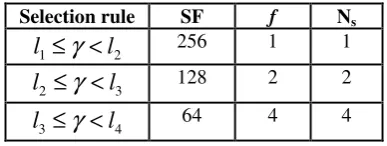
value associated with the highest spreading factor of SF=256. The transmitted power is multiplied by a factor of 1/f for the two other cases; in which f is 2 for SF=128 and 4 for SF=64. Therefore, in VSF system the SNR associated with the highest SF is used in SF adaptation procedure, which is performed as Table 1. In this table,
N
is the number of transmitted symbols in eachtransmission course,
{ }
lip are the predetermined thresholds achieved by using the BER curves andip
i 256 l
l = × .
Considering the SF adaptation procedure as described in table 1, it is apparent that the number of transmitted bits is dependent on the probability of selecting the appropriate SF. Therefore, the average throughput of the system as the average number of transmitted bits in each transmission course, when QPSK modulation is used, can be computed as follows.
{
}
∫
=
+ +
=
β
α γ
4 3 3
2 2
1 4
3 2 1
γ)dγ
( f ) , F(
) l , 8F(l ) l , 4F(l ) l , 2F(l ) l , l , l , l ,
γ
B(
β
α (25)
In order to compute the above equation fγ(γ) should be calculated as a closed form expression and the equation (21) and the MGF method is not functional anymore. The SNR expression due to our STS MC
DS-CDMA system is
∑∑
= =
=
S
1 s
2
1 i
si
γ
γ . Since
Ω h γ γ
2 i u), 1)U ((s si si
+ −
= and
h
((s−1)U+u),i is Rayleighdistributed, 2 i u), 1)U ((s
h − + is a Chi-square distributed
random variable [22]. Therefore γsi has a Chi-square
probability function with the characteristic function of )
γ
jω
(1 1 )
jω
(
φ
si
γ
−
= where
γ
si is identical for allvalues of s and i. On the other hand, the summation of 2S statistically independent Chi-square distributed random variables has a Chi-square probability function with 4S degrees of freedom with characteristic function of
2S si
γ
)
γ
jω
(1 1 )
jω
(
φ
−
= [22]. Therefore, the probability density function of
f
γ(
γ
)
due to our STS MC DS-CDMA system could be computed as expression (26).si γ γ/ 1) (2S 2S si
γ
γ
e
γ
1)!
(2S
1
γ
)
(
f
− −−
=
(26)In equation (25)
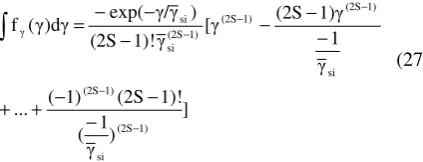
∫
fγ(γ)dγ can now be computed as:Table 1. SF adaptation procedure
Selection rule SF f Ns
2
1
l
l
≤
γ
<
256 1 13
2
l
l
≤
γ
<
128 2 24
3
l
l
≤
γ
<
64 4 4] )
γ
1 (
1)! (2S 1) ( ...
γ
1 1)γ
(2S [γ
γ
1)! (2S
)
γ γ/ exp( dγ
)
γ
( f
1) (2S
si 1) (2S
si 1) (2S 1)
(2S 1) (2S si
si
γ
− −
− −
−
− − −
+ +
− − − −
− − =
∫
(27)
If the above equation is replaced in expression (25), the average throughput of the system can be calculated.
To compute the BER of the VSF system, it should be considered that it depends on the number of transmitting bits and the probability of selecting the appropriate SF. Therefore, the BER performance of the system can be expressed in a closed form analogous to what has been performed in [17, 18] for adaptive modulation method:
∫
∫
∫
′ +
′ +
′ =
4p
3p
p 3p
2p
p 2p
1p
p
l
l
p p γ p QPSK l
l
p p γ p QPSK
l
l
p p γ p QPSK i
e
)dγ (γ f ) (γ P 8 )dγ (γ f ) (γ P 4
)dγ (γ f ) (γ P (2 }) {l , γ B(
1 ) γ ( P
(28)
To propose the above expression as a closed form equation, let define:
{
}
=∫
′β
α
p p γ p QPSK p
QPSK
r, (γ ; α,β ) P (γ )f (γ )dγ
P
p
(29)
) (γ
fγ′p p can be calculated as equation (30) if the relation
γ
SF 1
γp = and equation (26) is considered.
psi p p
γ / γ 1) (2S p 2S psi p
γ
γ
e
γ
1)!
(2S
1
)
(
γ
f
− −−
=
′
(30)To compute the BER of the system,
{ }
α
,
β
)
;
γ
(
P
r,QPSK p is calculated as below:{
}
∫
∫
− − −
−
−
= −
×
=
β
α
p
γ
/
γ
1) (2S p p 2S
psi
p
γ
/
γ
1) (2S p 2S psi
β
α
p p
QPSK r,
dγ e
)γ
2(SF)γ
Q( γ 1)! (2S
1
dγ e
γ γ 1)! (2S
1
)
2(SF)γ
Q( ) β α, ; γ ( P
psi p psi
p
(31)
After replacing this equation in (25), the BER performance of the VSF MC DS-CDMA system can be calculated.
6 Numerical Results and Discussion
In this section, some analytical results due to numerical computing the proposed expressions are provided. Fig. 4 shows the BER performance of the STS-based MC DS-CDMA system due to equation (24) for SF=64. QPSK modulation is assumed in frequency-selective Rayleigh fading channel with α0=0.5. In this
figure, the influence of frequency diversity order through performing interleaving with different depths is considered. As it is apparent in the figure, the performance of the system is improved for higher frequency diversity orders. Regarding these results, the interleaver's depth is considered 3, for investigating the VSF system.
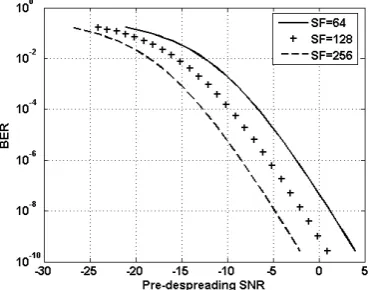
Fig. 5 shows the BER curves of the STS-based MC DS-CDMA system versus output SNR for different SFs. As declared in section III, it is observed that the curves are completely overlapped. Therefore, we use the BER curves versus pre-dispreading SNR to determine the switching thresholds. In Fig. 6, the analytical results due to calculation of expression (24) versus the average pre-dispreading SNR are presented. These curves are used to determine the threshold levels for VSF procedure. The thresholds are selected so that the BER of the system remains below 0.1%. The resultant thresholds
are
{ }
lip ={
−27.09, −12.08, −9.072, ∞}
. Using thesevalues, the VSF procedure is performed as described in Table 1. The average throughput of the VSF STS-based MC DS-CDMA system is given in figure 7 through simulation and numerical computation of equation (25). BPS represents the average number of the transmitted bits per symbol and is a measure of throughput [6]. This figure shows that using VSF method in STS-based MC DS-CDMA system improves the throughput of the system. The matching of the simulation and analytical results is apparent in this figure. It proves that the analytical expression proposed in this paper can be used to evaluate the throughput of the VSF STS-based MC DS-CDMA system in frequency-selective Rayleigh channel. The BER performance of the system due to numerical computation of equation (28) is shown in Fig. 8 in comparison with the non-VSF system with SF=64. The BER curves in this figure are nearly the same, since the BER performance of the system versus output SNR -as shown in Fig. 5- is not affected by the SF value.
7 Conclusions
In this paper, the application of Variable Spreading Factor is investigated for STS-based MC DS-CDMA system to improve the data throughput of the system over frequency selective Rayleigh fading channel. In this contribution, an analytical approach is proposed to compute a new expression for the BER performance of the system with respect to pre-dispreading SNR for different values of spreading factor. The resultant BER curves are necessary for determining the required switching thresholds for VSF part. Using the thresholds obtained in this way, Variable Spreading Factor method was performed on STS-based MC DS-CDMA system to enhance the average throughput of the system. An analytical approach was then proposed to compute the throughput enhancement and the BER of the VSF system. The novel expressions presented in this paper simplify the evaluation of the proposed system with no
Fig. 6. BER performance of STS-based MC DS-CDMA system, against pre-dispreading SNR, in Rayleigh fading channelfor S=3 and α0=0.5 (comparing different values of SF).
Fig. 5. BER performance of STS-based MC DS-CDMA system in Rayleigh fading channel for S=3 and α 0.5
0=
(comparing different values of SF).
Fig. 7. The average throughput (BPS) of the VSF STS-based MC DS-CDMA system in Rayleigh fading channelfor S=3 and α0 =0.5.
Fig. 4. BER performance of STS-based MC DS-CDMA system in Rayleigh channel for SF=64 and α0=0.5
(considering the influence of frequency diversity order).
Fig. 8. The BER performance of the VSF STS-based MC DS-CDMA system in Rayleigh fading channelfor S=3 and
0.5
α0 = .
parameters in these expressions leads to easier analysis of the VSF STS-based MC DS-CDMA system, in a flexible manner with less complexity.
Acknowledgement
The authors would like to acknowledge Iran Telecommunication Research Center (ITRC) for their support for this work.
References
[1] Hochwald B., Marzetta T. and C. Papadias, “A transmitter diversity scheme for wideband CDMA systems based on space-time spreading, ” IEEE J. Select. Areas Com., Vol. 19, No. 1, pp. 48-60, 2001.
[2] Yang L.-L., “Performance of multiantenna multicarrier direct-sequence code division multiple access using orthogonal variable spreading factor codes-assisted space-time spreading in time-selective fading channels,” IET Communications, Vol. 2, Issue 5, pp. 708–719, May 2008.
[3] Cheolwoo W. Y. and Daesik S. H., “Multicarrier CDMA systems using time-domain and frequency-domain spreading codes,” IEEE Trans. on Communications, Vol. 51, No. 1, pp. 17-21, Jan. 2003.
[4] Yang L-L. and Hanzo L., “Space-Time Spreading Assisted Broadband MC DS-CDMA,” Proceedings of IEEE VTC 2002, Vol. 4, pp. 1881-1885, 2002.
[5] Yang L-L. and Hanzo L., “Performance of Broadband Multicarrier DS-CDMA Using Space– Time Spreading-Assisted Transmit Diversity,” IEEE Trans. on Wireless Communication, Vol. 4, No.3, pp. 885-894, May 2005.
[6] Yang L-L., Hanzo L., Kuan E-L. and Yen K., “Single and Multi-Carrier DS-CDMA”, John-Wiley IEEE Press, 2003.
[7] Ottosson T. and Svensson A., “On schemes for multirate support in DS-CDMA systems,” Wireless Personal Communications (Kluwer), Vol. 6, pp. 265-87, 1998.
[8] Fan M., Minn T. and Siu Kai-Y., “Performance of Multirate tachniques in WCDMA,” Proceedings of IEEE VTC 2001, Vol. 4, pp. 2262-6, 2001. [9] Kunnari E. and Iinatti J., “Performance of
multirate MC-CDMA in Rayleigh-fading channels with delay power spectrum exceeding the guard interval,” IEEE J. Select. Areas Commun., Vol. 24, Issue 3, pp. 542-53, 2006. [10] Yang L-L. and Hanzo L., “Improving the
Spreading Factors,” in Proc. IEEE VTC 2002, Vol. 3, pp. 1816-1820, Sept. 2002.
[11] Yang L-L. and Hanzo L., “Adaptive rate DS-CDMA systems using variable spreading factors,” IEEE trans. on Vehicular technology, Vol. 53, pp. 72-81, Jan. 2004.
[12] Ulukus S. and Greenstein L. J., “Throughput maximization in CDMA uplink using adaptive spreading and power control,” IEEE 6th Symp. On Spread Spectrum Tech. & Appli., pp. 565-569, USA, Sep. 2000.
[13] Choi B.J., Munster M., Yang L.-L., and Hanzo L., “Performance of RAKE receiver adaptive-modulation based CDMA over frequency-selective slow Rayleigh fading channels,” Elect. Letters, Vol. 37, No. 4, pp. 247-9, 2001.
[14] Kim J., Ro S., Hwang I., Hong D., and Kang C., “Performance of adaptive modulation with transmit diversity over frequency-selective Rayleigh fading channels,” Elect. Letters, Vol. 38, No. 19, pp. 1136-7, 2002.
[15] Lao D., Horng J. H. and Zhang J., “Throughput Analysis for W-CDMA System with MIMO and AMC,” Proceedings of IEEE PIMRC 2003, Vol. 3, pp. 2276-80, 2003.
[16] Vakil V., Mohammadi A., and Aghaeinia H., “Throughput Improvement Using Adaptive Modulation in STS-based CDMA Systems,” in Proc. of IEEE WOCN 2005, Dubai, March 2005. [17] Vakil V. and Aghaeinia H., “Throughput
computation of Adaptive-Modulated STS-based CDMA system in non-frequency-selective Rayleigh fading channel,” Proceedings of ICEE 2006, Tehran, May 2006.
[18] Vakil V., and Aghaeinia H., “Throughput Analysis of Adaptive Modulated STS-based CDMA system over Multipath fading Channel,” Wireless Personal Communication, in press, DOI: 10.1007/s11277-008-9582-2.
[19] Vakil V., and Aghaeinia H., “Throughput analysis of STS-based CDMA system with Variable Spreading Factor in non-frequency-selective Rayleigh fading channel,” in Proc. of IEEEGCC 2007, Manama, Nov. 2007.
[20] Vakil V., and Aghaeinia H., “Throughput analysis of STS-based CDMA system with Variable Spreading Factor in non-frequency-selective Rayleigh fading channel,” Computers and Electrical Engineeering, in press, DOI: 10.1016/j.compeleceng.2008.08.001.
[21] Vakil V., and Aghaeinia H., “Throughput Analysis of STS-based CDMA System with
Adaptive Modulation,” in Proc. of ICEE 2008, Tehran, May 2008.
[22] Proakis J. G. and Salehi M., Digital Communication, 5th edition, Mc Graw Hill, 2008. [23] Eng T., and Milstein L. B., “Coherent DS-CDMA
Performance in Nakagami Multipath Fading,” IEEE Trans. On Comm., Vol. 43, pp. 1134-1143, 1995.
[24] Pursley M. B., “Performance Evaluation for Phase-Coded Spread-Spectrum Multiple-Access Communication – Part I: System Analysis,” IEEE Trans. Communications, Vol. Com-25, No. 8, pp. 795-9, 1977.
[25] Simon M. K., and Alouini M. S., Digital Communication Over Fading Channels, 2nd ed. John Wiley, 2005.
[26] Alouini M.-S. and Goldsmith A. J., “A Unified Approach for Calculating Error Rates of Linearly Modulated Signals over Generalized Fading Channels,” IEEE Trans. On Com., Vol. 47, No. 9, pp. 1324-1334, Sep. 1999.
Vahideh Vakil graduated in
communication engineering from Ferdowsi University of Mashad, Iran, in 2000. In 2003, she received her M.Sc. from Ferdowsi University of Mashad, Iran. She finished her Ph.D. in Communication System engineering in Amirkabir University of Technology, in 2008. From 2007 until present, she is a faculty member in Bahar institute of higher education of Mashad, where she is an assistant professor. Her research interests include work in CDMA systems, diversity techniques, adaptive rate transmission, and OFDM systems.
Hassan Aghaeinia received his B.Sc. degree from Amirkabir University of Technology (Tehran Polytechnic) in electronic engineering, in 1987. In 1989 he finished his M.Sc. in Amirkabir University of Technology. Then, in 1992 he received the M.Sc. from Valenciennes University (UVHC), Valenciennes, France. Then he continued his studies towards Ph.D. in UVHC in electronic engineering. He finished his Ph.D. in 1996. From 1996 till present, he is a faculty member in Amirkabir University of Technology, where he is an assistant professor in Communication Engineering Group. His research includes work in digital communications & spread spectrum systems, advanced communication systems, and digital image processing & image communication.