A Monthly Double-Blind Peer Reviewed (Refereed/Juried) Open Access International e-Journal - Included in the International Serial Directories Indexed & Listed at:
Ulrich's Periodicals Directory ©, ProQuest, U.S.A., EBSCO Publishing, U.S.A., Cabell’s Directories of Publishing Opportunities, U.S.A., Open J-Gage, India [link of the same is duly available at Inflibnet of University Grants Commission (U.G.C.)],
VOLUME NO.3(2013),ISSUE NO.06(JUNE) ISSN 2231-5756
INTERNATIONAL JOURNAL OF RESEARCH IN COMMERCE, IT & MANAGEMENT
CONTENTS
CONTENTS
CONTENTS
CONTENTS
Sr.
No.
TITLE & NAME OF THE AUTHOR (S)
Page No. 1. ISSUES AND SUGGESTIONS FOR THE IMPLEMENTATION OF THE INDIA’S RIGHT TO INFORMATION ACT 2005 IN LIGHT OF THE LATIN AMERICAN
COUNTRIES’ EXPERIENCE DR. PRATIBHA J.MISHRA
1
2. AN EMPIRICAL STUDY ON JOB STRESS IN PRIVATE SECTOR BANKS OF UTTARAKHAND REGION MEERA SHARMA & LT. COL. DR. R. L. RAINA
7
3. FOREIGN DIRECT INVESTMENT IN INDIA: AN OVERVIEW DR. MOHAMMAD SAIF AHMAD
14
4. REFLECTIONS ON VILLAGE PEOPLE’S SOCIO - ECONOMIC CONDITIONS BEFORE AND AFTER NREGS: A DETAILED STUDY OF ARIYALUR DISTRICT, TAMIL NADU
DR. P. ILANGO & G. SUNDHARAMOORTHI
19
5. THE CAUSAL EFFECTS OF EDUCATION ON TECHNOLOGY IMPLEMENTATION – EVIDENCE FROM INDIAN IT INDUSTRY S.M.LALITHA & DR. A. SATYA NANDINI
25
6. A STUDY ON ONLINE SHOPPING BEHAVIOUR OF TEACHERS WORKING IN SELF-FINANCING COLLEGES IN NAMAKKAL DISTRICT WITH SPECIAL REFERENCE TO K.S.R COLLEGE OF ARTS AND SCIENCE, TIRUCHENGODE, NAMAKKAL DISTRICT
SARAVANAN. R., YOGANANDAN. G. & RUBY. N
31
7. AN OVERVIEW OF RESEARCH IN COMMERCE AND MANAGEMENT IN SHIVAJI UNIVERSITY DR. GURUNATH J. FAGARE & DR. PRAVEEN CHOUGALE
38
8. VARIABLE SELECTION IN REGRESSION MODELS
M.SUDARSANA RAO, M.SUNITHA & M.VENKATARAMANAIH
46
9. CUSTOMER ATTITUDE TOWARDS SERVICES AND AMENITIES PROVIDED BY STAR HOTELS: A STUDY WITH REFERENCE TO MADURAI CITY DR. JACQUELINE GIGI VIJAYAKUMAR
50
10. QUALITY AND SUSTAINABILITY OF JOINT LIABILITY GROUPS AND MICROFINANCE INSTITUTIONS: A CASE STUDY OF CASHPOR MICROCREDIT SERVICES
DR. MANESH CHOUBEY
56
11. INDIAN MUTUAL FUND MARKET: AN OVERVIEW JITENDRA KUMAR & DR. ANINDITA ADHIKARY
63
12. SMART APPROACHES FOR PROVIDING THE SPD’S (SECURITY, PRIVACY & DATA INTEGRITY) SERVICE IN CLOUD COMPUTING M.SRINIVASAN & J.SUJATHA
67
13. A COMPARATIVE STUDY ON ETHICAL DECISION-MAKING OF PURCHASING PROFESSIONALS IN TAIWAN AND CHINA YI-HUI HO
70
14. THE INTERNAL AUDIT FUNCTION EFFECTIVENESS IN THE JORDANIAN INDUSTRIAL SECTOR DR. YUSUF ALI KHALAF AL-HROOT
75
15. STUDY ON ROLE OF EFFECTIVE LEADERSHIP ON SELLING VARIOUS INSURANCE POLICIES OF ICICI PRUDENTIAL: A CASE STUDY OF SUBHASH MARG BRANCH, DARYAGANJ
SUBHRANSU SEKHAR JENA
80
16. AN EMPIRICAL STUDY ON WEAK-FORM OF MARKET EFFICIENCY OF NATIONAL STOCK EXCHANGE DR. VIJAY GONDALIYA
89
17. THE GOLDEN ROUTE TO LIQUIDITY: A PERFORMANCE ANALYSIS OF GOLD LOAN COMPANIES DR. NIBEDITA ROY
94
18. STUDY ON THE MANAGEMENT OF CURRENT LIABILITIES OF NEPA LIMITED DR. ADARSH ARORA
99
19. QUALITY OF MEDICAL SERVICES: A COMPARATIVE STUDY OF PRIVATE AND GOVERNMENT HOSPITALS IN SANGLI DISTRICT SACHIN H.LAD
105
20. DIVIDEND POLICY AND BANK PERFORMANCE: THE CASE OF ETHIOPIAN PRIVATE COMMERCIAL BANKS NEBYU ADAMU ABEBE & TILAHUN AEMIRO TEHULU
109
21. CUSTOMER KNOWLEDGE: A TOOL FOR THE GROWTH OF E-LEARNING INDUSTRY DR. MERAJ NAEM, MOHD TARIQUE KHAN & ZEEBA KAMIL
115
22. THE EFFECTS OF ORGANIZED RETAIL SECTOR ON CONSUMER SATISFACTION: A CASE STUDY IN MYSORE CITY ASHWINI.K.J & DR. NAVITHA THIMMAIAH
122
23. PERCEIVED BENEFITS AND RISKS OF ELECTRONIC DIVIDEND AS A PAYMENT MEDIUM IN THE NIGERIA COMMERCIAL BANKS OLADEJO, MORUF. O & FASINA, H T
127
24. INDO - CANADIAN TRADE RELATION IN THE MATH OF POST REFORM PERIOD ANITHA C.V & DR. NAVITHA THIMMAIAH
133
25. IMPACT OF BOARD STRUCTURE ON CORPORATE FINANCIAL PERFORMANCE AKINYOMI OLADELE JOHN
140
26. WORK LIFE BALANCE: A SOURCE OF JOB SATISFACTION: A STUDY ON THE VIEW OF WOMEN EMPLOYEES IN INFORMATION TECHNOLOGY (IT) SECTOR
NIRMALA.N
145
27. SCHOOL LEADERSHIP DEVELOPMENT PRACTICES: FOCUS ON SECONDARY SCHOOL PRINCIPALS IN EAST SHOWA, ETHIOPIA FEKADU CHERINET ABIE
148
28. EMOTIONAL INTELLIGENCE OF THE MANAGERS IN THE BANKING SECTOR IN SRI LANKA U.W.M.R. SAMPATH KAPPAGODA
153
29. IMPACT OF CORPORATE SOCIAL RESPONSIBILITY PRACTICES ON MEDIUM SCALE ENTERPRISES RAJESH MEENA
157
30. IMPACT OF CASHLITE POLICY ON ECONOMIC ACTIVITIES IN NIGERIAN ECONOMY: AN EMPIRICAL ANALYSIS DR. A. P. OLANNYE & A.O ODITA
162
INTERNATIONAL JOURNAL OF RESEARCH IN COMMERCE, IT & MANAGEMENT
CHIEF PATRON
CHIEF PATRON
CHIEF PATRON
CHIEF PATRON
PROF. K. K. AGGARWAL
Chairman, Malaviya National Institute of Technology, Jaipur
(An institute of National Importance & fully funded by Ministry of Human Resource Development, Government of India)
Chancellor, K. R. Mangalam University, Gurgaon
Chancellor, Lingaya’s University, Faridabad
Founder Vice-Chancellor (1998-2008), Guru Gobind Singh Indraprastha University, Delhi
Ex. Pro Vice-Chancellor, Guru Jambheshwar University, Hisar
FOUNDER
FOUNDER
FOUNDER
FOUNDER PATRON
PATRON
PATRON
PATRON
LATE SH. RAM BHAJAN AGGARWAL
Former State Minister for Home & Tourism, Government of Haryana
Former Vice-President, Dadri Education Society, Charkhi Dadri
Former President, Chinar Syntex Ltd. (Textile Mills), Bhiwani
CO
CO
CO
CO----ORDINATOR
ORDINATOR
ORDINATOR
ORDINATOR
AMITA
Faculty, Government M. S., Mohali
ADVISORS
ADVISORS
ADVISORS
ADVISORS
DR. PRIYA RANJAN TRIVEDI
Chancellor, The Global Open University, Nagaland
PROF. M. S. SENAM RAJU
Director A. C. D., School of Management Studies, I.G.N.O.U., New Delhi
PROF. M. N. SHARMA
Chairman, M.B.A., Haryana College of Technology & Management, Kaithal
PROF. S. L. MAHANDRU
Principal (Retd.), Maharaja Agrasen College, Jagadhri
EDITOR
EDITOR
EDITOR
EDITOR
PROF. R. K. SHARMA
Professor, Bharti Vidyapeeth University Institute of Management & Research, New Delhi
CO
CO
CO
CO----EDITOR
EDITOR
EDITOR
EDITOR
DR. BHAVET
Faculty, Shree Ram Institute of Business & Management, Urjani
EDITORIAL ADVISORY BOARD
EDITORIAL ADVISORY BOARD
EDITORIAL ADVISORY BOARD
EDITORIAL ADVISORY BOARD
DR. RAJESH MODI
Faculty, Yanbu Industrial College, Kingdom of Saudi Arabia
PROF. SANJIV MITTAL
University School of Management Studies, Guru Gobind Singh I. P. University, Delhi
PROF. ANIL K. SAINI
VOLUME NO.3(2013),ISSUE NO.06(JUNE) ISSN 2231-5756
INTERNATIONAL JOURNAL OF RESEARCH IN COMMERCE, IT & MANAGEMENT
DR. SAMBHAVNA
Faculty, I.I.T.M., Delhi
DR. MOHENDER KUMAR GUPTA
Associate Professor, P. J. L. N. Government College, Faridabad
DR. SHIVAKUMAR DEENE
Asst. Professor, Dept. of Commerce, School of Business Studies, Central University of Karnataka, Gulbarga
ASSOCIATE EDITORS
ASSOCIATE EDITORS
ASSOCIATE EDITORS
ASSOCIATE EDITORS
PROF. NAWAB ALI KHAN
Department of Commerce, Aligarh Muslim University, Aligarh, U.P.
PROF. ABHAY BANSAL
Head, Department of Information Technology, Amity School of Engineering & Technology, Amity
University, Noida
PROF. A. SURYANARAYANA
Department of Business Management, Osmania University, Hyderabad
DR. SAMBHAV GARG
Faculty, Shree Ram Institute of Business & Management, Urjani
PROF. V. SELVAM
SSL, VIT University, Vellore
DR. PARDEEP AHLAWAT
Associate Professor, Institute of Management Studies & Research, Maharshi Dayanand University, Rohtak
DR. S. TABASSUM SULTANA
Associate Professor, Department of Business Management, Matrusri Institute of P.G. Studies, Hyderabad
SURJEET SINGH
Asst. Professor, Department of Computer Science, G. M. N. (P.G.) College, Ambala Cantt.
TECHNICAL ADVISOR
TECHNICAL ADVISOR
TECHNICAL ADVISOR
TECHNICAL ADVISOR
AMITA
Faculty, Government M. S., Mohali
FINANCIAL ADVISORS
FINANCIAL ADVISORS
FINANCIAL ADVISORS
FINANCIAL ADVISORS
DICKIN GOYAL
Advocate & Tax Adviser, Panchkula
NEENA
Investment Consultant, Chambaghat, Solan, Himachal Pradesh
LEGAL ADVISORS
LEGAL ADVISORS
LEGAL ADVISORS
LEGAL ADVISORS
JITENDER S. CHAHAL
Advocate, Punjab & Haryana High Court, Chandigarh U.T.
CHANDER BHUSHAN SHARMA
Advocate & Consultant, District Courts, Yamunanagar at Jagadhri
SUPERINTENDENT
SUPERINTENDENT
SUPERINTENDENT
SUPERINTENDENT
INTERNATIONAL JOURNAL OF RESEARCH IN COMMERCE, IT & MANAGEMENT
CALL FOR MANUSCRIPTS
CALL FOR MANUSCRIPTS
CALL FOR MANUSCRIPTS
CALL FOR MANUSCRIPTS
We invite unpublished novel, original, empirical and high quality research work pertaining to recent developments & practices in the areas of Computer Science & Applications; Commerce; Business; Finance; Marketing; Human Resource Management; General Management; Banking; Economics; Tourism Administration & Management; Education; Law; Library & Information Science; Defence & Strategic Studies; Electronic Science; Corporate Governance; Industrial Relations; and emerging paradigms in allied subjects like Accounting; Accounting Information Systems; Accounting Theory & Practice; Auditing; Behavioral Accounting; Behavioral Economics; Corporate Finance; Cost Accounting; Econometrics; Economic Development; Economic History; Financial Institutions & Markets; Financial Services; Fiscal Policy; Government & Non Profit Accounting; Industrial Organization; International Economics & Trade; International Finance; Macro Economics; Micro Economics; Rural Economics; Co-operation; Demography: Development Planning; Development Studies; Econometrics; Applied Economics; Development Economics; Business Economics; Monetary Policy; Public Policy Economics; Real Estate; Regional Economics; Political Science; Continuing Education; Labour Welfare; Philosophy; Psychology; Sociology; Tax Accounting; Advertising & Promotion Management; Management Information Systems (MIS); Business Law; Public Responsibility & Ethics; Communication; Direct Marketing; E-Commerce; Global Business; Health Care Administration; Labour Relations & Human Resource Management; Marketing Research; Marketing Theory & Applications; Non-Profit Organizations; Office Administration/Management; Operations Research/Statistics; Organizational Behavior & Theory; Organizational Development; Production/Operations; International Relations; Human Rights & Duties; Public Administration; Population Studies; Purchasing/Materials Management; Retailing; Sales/Selling; Services; Small Business Entrepreneurship; Strategic Management Policy; Technology/Innovation; Tourism & Hospitality; Transportation Distribution; Algorithms; Artificial Intelligence; Compilers & Translation; Computer Aided Design (CAD); Computer Aided Manufacturing; Computer Graphics; Computer Organization & Architecture; Database Structures & Systems; Discrete Structures; Internet; Management Information Systems; Modeling & Simulation; Neural Systems/Neural Networks; Numerical Analysis/Scientific Computing; Object Oriented Programming; Operating Systems; Programming Languages; Robotics; Symbolic & Formal Logic; Web Design and emerging paradigms in allied subjects.
Anybody can submit the soft copy of unpublished novel; original; empirical and high quality research work/manuscriptanytime in M.S. Word format
after preparing the same as per our GUIDELINES FOR SUBMISSION; at our email address i.e. [email protected] or online by clicking the link online submission as given on our website (FOR ONLINE SUBMISSION, CLICK HERE).
GUIDELINES FOR SUBMISSION OF MANUSCRIPT
GUIDELINES FOR SUBMISSION OF MANUSCRIPT
GUIDELINES FOR SUBMISSION OF MANUSCRIPT
GUIDELINES FOR SUBMISSION OF MANUSCRIPT
1. COVERING LETTER FOR SUBMISSION:
DATED: _____________ THE EDITOR
IJRCM
Subject: SUBMISSION OF MANUSCRIPT IN THE AREA OF.
(e.g. Finance/Marketing/HRM/General Management/Economics/Psychology/Law/Computer/IT/Engineering/Mathematics/other, please specify)
DEAR SIR/MADAM
Please find my submission of manuscript entitled ‘___________________________________________’ for possible publication in your journals.
I hereby affirm that the contents of this manuscript are original. Furthermore, it has neither been published elsewhere in any language fully or partly, nor is it under review for publication elsewhere.
I affirm that all the author (s) have seen and agreed to the submitted version of the manuscript and their inclusion of name (s) as co-author (s).
Also, if my/our manuscript is accepted, I/We agree to comply with the formalities as given on the website of the journal & you are free to publish our contribution in any of your journals.
NAME OF CORRESPONDING AUTHOR: Designation:
Affiliation with full address, contact numbers & Pin Code: Residential address with Pin Code:
Mobile Number (s): Landline Number (s): E-mail Address: Alternate E-mail Address:
NOTES:
a) The whole manuscript is required to be in ONE MS WORD FILE only (pdf. version is liable to be rejected without any consideration), which will start from the covering letter, inside the manuscript.
b) The sender is required to mentionthe following in the SUBJECT COLUMN of the mail:
New Manuscript for Review in the area of (Finance/Marketing/HRM/General Management/Economics/Psychology/Law/Computer/IT/ Engineering/Mathematics/other, please specify)
c) There is no need to give any text in the body of mail, except the cases where the author wishes to give any specific message w.r.t. to the manuscript. d) The total size of the file containing the manuscript is required to be below 500 KB.
e) Abstract alone will not be considered for review, and the author is required to submit the complete manuscript in the first instance.
f) The journal gives acknowledgement w.r.t. the receipt of every email and in case of non-receipt of acknowledgment from the journal, w.r.t. the submission of manuscript, within two days of submission, the corresponding author is required to demand for the same by sending separate mail to the journal.
2. MANUSCRIPT TITLE: The title of the paper should be in a 12 point Calibri Font. It should be bold typed, centered and fully capitalised.
3. AUTHOR NAME (S) & AFFILIATIONS: The author (s) full name, designation, affiliation (s), address, mobile/landline numbers, and email/alternate email address should be in italic & 11-point Calibri Font. It must be centered underneath the title.
VOLUME NO.3(2013),ISSUE NO.06(JUNE) ISSN 2231-5756
INTERNATIONAL JOURNAL OF RESEARCH IN COMMERCE, IT & MANAGEMENT
5. KEYWORDS: Abstract must be followed by a list of keywords, subject to the maximum of five. These should be arranged in alphabetic order separated by commas and full stops at the end.
6. MANUSCRIPT: Manuscript must be in BRITISH ENGLISH prepared on a standard A4 size PORTRAIT SETTING PAPER. It must be prepared on a single space and single column with 1” margin set for top, bottom, left and right. It should be typed in 8 point Calibri Font with page numbers at the bottom and centre of every page. It should be free from grammatical, spelling and punctuation errors and must be thoroughly edited.
7. HEADINGS: All the headings should be in a 10 point Calibri Font. These must be bold-faced, aligned left and fully capitalised. Leave a blank line before each heading.
8. SUB-HEADINGS: All the sub-headings should be in a 8 point Calibri Font. These must be bold-faced, aligned left and fully capitalised.
9. MAIN TEXT: The main text should follow the following sequence:
INTRODUCTION
REVIEW OF LITERATURE
NEED/IMPORTANCE OF THE STUDY
STATEMENT OF THE PROBLEM
OBJECTIVES
HYPOTHESES
RESEARCH METHODOLOGY
RESULTS & DISCUSSION
FINDINGS
RECOMMENDATIONS/SUGGESTIONS
CONCLUSIONS
SCOPE FOR FURTHER RESEARCH
ACKNOWLEDGMENTS
REFERENCES
APPENDIX/ANNEXURE
It should be in a 8 point Calibri Font, single spaced and justified. The manuscript should preferably not exceed 5000 WORDS.
10. FIGURES &TABLES: These should be simple, crystal clear, centered, separately numbered & self explained, and titles must be above the table/figure. Sources of data should be mentioned below the table/figure. It should be ensured that the tables/figures are referred to from the main text.
11. EQUATIONS:These should be consecutively numbered in parentheses, horizontally centered with equation number placed at the right.
12. REFERENCES: The list of all references should be alphabetically arranged. The author (s) should mention only the actually utilised references in the preparation of manuscript and they are supposed to follow Harvard Style of Referencing. The author (s) are supposed to follow the references as per the following:
•
All works cited in the text (including sources for tables and figures) should be listed alphabetically.•
Use (ed.) for one editor, and (ed.s) for multiple editors.•
When listing two or more works by one author, use --- (20xx), such as after Kohl (1997), use --- (2001), etc, in chronologically ascending order.•
Indicate (opening and closing) page numbers for articles in journals and for chapters in books.•
The title of books and journals should be in italics. Double quotation marks are used for titles of journal articles, book chapters, dissertations, reports, working papers, unpublished material, etc.•
For titles in a language other than English, provide an English translation in parentheses.•
The location of endnotes within the text should be indicated by superscript numbers.PLEASE USE THE FOLLOWING FOR STYLE AND PUNCTUATION IN REFERENCES: BOOKS
•
Bowersox, Donald J., Closs, David J., (1996), "Logistical Management." Tata McGraw, Hill, New Delhi.•
Hunker, H.L. and A.J. Wright (1963), "Factors of Industrial Location in Ohio" Ohio State University, Nigeria. CONTRIBUTIONS TO BOOKS•
Sharma T., Kwatra, G. (2008) Effectiveness of Social Advertising: A Study of Selected Campaigns, Corporate Social Responsibility, Edited by David Crowther & Nicholas Capaldi, Ashgate Research Companion to Corporate Social Responsibility, Chapter 15, pp 287-303.JOURNAL AND OTHER ARTICLES
•
Schemenner, R.W., Huber, J.C. and Cook, R.L. (1987), "Geographic Differences and the Location of New Manufacturing Facilities," Journal of Urban Economics, Vol. 21, No. 1, pp. 83-104.CONFERENCE PAPERS
•
Garg, Sambhav (2011): "Business Ethics" Paper presented at the Annual International Conference for the All India Management Association, New Delhi, India, 19–22 June.UNPUBLISHED DISSERTATIONS AND THESES
•
Kumar S. (2011): "Customer Value: A Comparative Study of Rural and Urban Customers," Thesis, Kurukshetra University, Kurukshetra. ONLINE RESOURCES•
Always indicate the date that the source was accessed, as online resources are frequently updated or removed. WEBSITESINTERNATIONAL JOURNAL OF RESEARCH IN COMMERCE, IT & MANAGEMENT
STUDY ON THE MANAGEMENT OF CURRENT LIABILITIES OF NEPA LIMITED
DR. ADARSH ARORA
ASST. PROFESSOR
AMITY COLLEGE OF COMMERCE & FINANCE
AMITY UNIVERSITY
NOIDA
ABSTRACT
The prosperity, civilization and culture of a country depend upon its paper industry. A country which uses the maximum paper, is known highly civilized, developed and educated .The consumption of paper in India is increasing day by day due to the increase in literacy. The “National Newsprint & Paper Mills Limited” was floated by M/s Nair Press Syndicate Limited, as a private entrepreneur, on 25th January 1947, It was the first Newsprint Mill in the country. The management of
NEPA was taken by the Madhya Pradesh Government in 1949 and it became a Govt. company in 1959. It is the first indigenous newsprint manufacturing unit in the country. A company’s profit, assets and other financial indicators are key information for investors, when deciding whether to buy or sell a company’s stock. Lying about those numbers can be an appealing way to keep a company riding high, when they are not actually performing well. The objective of this research is to study & analyze the Current Liabilities of NEPA Limited for the duration of 15 Years from 1987-88 to 2001-02. Index Numbers have been used to analyze and observe the fluctuations in the Current Liabilities of NEPA Limited. The conclusion of this research is that the Creditors and other Current Liabilities of the company have shown drastic increase in their values, therefore a policy has to be made by the company to payback the creditors and other liabilities as soon as possible.
KEYWORDS
Absolute Change, Current Liabilities, Index Number, Newspaper, NEPA Limited.
INTRODUCTION
he paper industries in India play a very important role in fulfilling the huge requirement of paper in different fields and purposes. The consumption of paper in India is increasing day by day due to the increase in literacy.
Paper Industry in India is the 15th largest paper Industry in the world. Paper Industry is primarily dependent upon forest based raw materials. The paper in India began from Muslim time.
The actual theory of paper making started in year 1870 when “Beli”, near Kolkata the Royal paper mills was established. In 1925, Punjab Paper Mills was started with an annual capacity of 6000 tons. By 1930-1931, the total capacity of paper production in India was increased to 45600 tons as against 33000 tons in 1925. The share of indigenous production in national consumption was 71% as against 54% in 1925. This research paper focuses on the study of current liabilities of one of the paper mill in i.e. NEPA Limited for a period of fifteen years starting from 1987-88.
The production of individual paper mills in India during 1947 is shown in Table 1 below:-.
TABLE-1: PRODUCTION OF INDIVIDUAL PAPER MILLS IN 1947
S. No. Year of Incorporation Name and location Production (In Tons) 1 1881 Upper India Cooper Paper Mills, Lucknow 20302
2 1882 Titagrah Paper Mills Titagarh and Kankinara 38550 3 1887 Bengal Paper Mills, Raniganj 11760 4 1887 Deccan Paper Mills, Hadaspur 3090 5 1918 India Paper Pulp, Naihati 6040 6 1925 Andhra Paper Mills, Rajahmudry 1630 7 1925 Shree Gopal Paper Mills, Yamuna Nagar 10360 8 1931 Punalur Paper Mills, Punalur 4120 9 1933 Gujarat Paper Mills, Barejadi 1500 10 1935 F. Pudumjee, Bombay 1120 11 1936 Star Paper Mills, Saharanpur 4250 12 1936 Orient Paper Mills Brajrajnagar 27310 13 1937 Mysore Paper Mills, Bhadravati 3990 14 1938 Sirpur Paper Mills, Sirpur Kaghaznagar 5480 15 1939 Rohtas Industries, Dalmianagar 12860
Source: Bansal and Kumar. 2001 Paper Making. In History of Technology in India. Pp. 723.
At present there are 515 units which are engaged in the manufacture of paper, paper boards and news print in India, in the private sector with installed capacity of 51 lakh tons, these units are of diverse size, type and magnitude, there are about 30 large integrated mills, well organized and well equipped and there are about 270 small units which, are too small and too moderately equipped. As many as 194 paper mills, particularly small mills are either sick or lying close. It is also to be noted down here that NEPA Limited which commenced production in 1955, was the only unit in the country manufacturing newsprint.
LITERATURE REVIEW
This section covers the reviews of literature of some of the important studies, research papers, projects, books, etc. on the various aspects of this topic.
Hiller(1990) In his paper “The politics of News Print – The New Foundland Pulp and Paper Industry (1915-1939)” founded that in 1930s the industry employed not more than 10% of the labour force and even less Perhaps half on a full time basis.* It was dominated by two major pulp and paper companies with mills of grand falls and corner brook, which together held leases to almost all the island’s productive forest on generous terms.
Hameri and Lehtonen (2001) revealed in his study that, the traditional production management strategy in paper manufacturing is based on a volume – intensive approach. This involves the measurement of overall performance or productivity, while aiming at a high level of capacity utilization and minimum waste levels. This approach has proved successful in mills producing high volumes with a limited and
standardized products range. He also said that this situation changes radically when paper and board products are being tailored to customer specified dimensions and quantities.
J.D.Sutherland “A Social History of Pulpwood Logging in Newfoundland during the great depression”, M.A. thesis, Memorial University, 1988, PP. 2-4, 29.
Subburaj (2006) in his paper he explored that until 1981, national Newsprint and Paper Mills, which is known as NEPA Limited and which commenced its production in 1955, was the only unit in the country manufacturing newsprint. He also explored that the import of paper and paper products was 1.62 lakh tones in 2001-02.
His research also tells that from 1997 the Government has delicensed the paper industry.
VOLUME NO.3(2013),ISSUE NO.06(JUNE) ISSN 2231-5756
INTERNATIONAL JOURNAL OF RESEARCH IN COMMERCE, IT & MANAGEMENT
Mehta (2009) he studied about paper and newsprint in India, where he reveals that for expansion of newspaper in the country there is a need for substantial increase in indigenous production of newsprint. Limited annual availability of such newsprint is a serious bottleneck to the growth of newspaper. He also found that India is a deficit country in respect of newsprint production. He pointed out that only after independence National Newsprint and Paper Mills Limited, NEPA Nagar, Madhya Pradesh, emerged as a newsprint producer. The domestic production of newsprint increased from 1.02 lakh metric tones in 1981-82 to 2.72 lakh metric tones during 1989. The total newsprint requirement for 1988-89 was of the order of 5.40 lakh metric tones.
Singh (2011) In his research he found that paper industry is generally define as a forest based industry. He revealed that there are currently 64 newsprint mills with an installed capacity of 12 lakh tones. He also said that until 1981, there was just one newsprint producing unit in the country, the National Newsprint 7 Paper Mills (NEPA).
STATEMENT OF PROBLEM
As the use of every kind of paper is increasing day by day the more and more pressure on the manufacturing units is also increasing. The manufacturing units which are in the private sector are doing well but few of the manufacturing units of paper specially the Newspaper in Public Sector are running in losses and therefore not able to meet out the demand of the country for the same. NEPA Limited is one of such Newsprint manufacturing unit in Public Sector among the all Newspaper producing unit which is running in losses and not able to pay back its debts. In this paper the focus is on the Current Liabilities of NEPA Limited so that it can be understood and analyzed its performance and accordingly remedial solutions can be suggested not only to the Company but also to the Government for improvement.
RESEARCH METHODOLOGY
The Methodology & Approach followed in this study has naturally been to remain very close to the data available and to analyses them to test the various hypotheses based on theoretical and imperial evidences. To analyze the data various statistical techniques such as absolute percentage change, index numbers, trend values, and ratio techniques have been used in this research work. The secondary data has been used in this research project which had been collected with the help of the various annual reports of NEPA Limited & Various information have been collected from valuable books, articles, bulletins and news papers also. For collecting the data, the web site of the paper making units have also been used.
OBJECTIVE OF STUDY
• Paper is a vital core industry for any country and for capital consumption can be taken as a measure of growth and progress in areas of industrial, cultural & educational activities. The first objective of this paper is to find out the core importance of Paper, Newspaper and Newspaper Mills and their performance in India with reference to National Newsprint and Paper Mills Limited.
• The economic and social development of any country depends on the paper industry. So one of the objective here is to study how NEPA has contributed for the economic and social development of the economy of India.
• Due to the increase in the educational standard among the people, the consumption of paper is increasing continuously in the country. Here keeping in mind this point, an effort has been put to reveal that weather Newspaper Mills(NEPA) are able to fulfill the required demand in the country.
• In the whole research only Current Liabilities of NEPA Limited have been focused. Therefore the main objective this research is to study and analyze the Current Liabilities of NEPA Limited for a duration of fifteen years starting from 1987-88 to 2001-02.
ANALYSIS AND INTERPRETATIONS
The research has been imposed on the Current Liabilities of NEPA Limited for the duration of fifteen years commencing from 1987-88. In this research all kinds of Current Liabilities of the company have been taken in to account. Balance sheet is an indicator of the financial position of a business concern in terms of assets and liabilities. Balance sheet is always prepared in such a way that the true and fair financial position of a business is revealed, which will be easily readable and more quickly understood form.
Just like other manufacturing organizations and institutions NEPA Limited is also liable to pay its liabilities within a span of one year. Long term liabilities will be paid after a certain period but the current liabilities or short term liabilities will be paid with in one year, otherwise the goodwill of this organization will be affected.
STUDY OF CURRENT LIABILITIES OF NEPA LIMITED
The Current Liabilities of NEPA Limited includes the following-
1. SUNDRY CREDITORS
In the table 1.1 an attempt has been made to analyze the Sundry Creditors of NEPA Limited during the fifteen years period of study commencing from 1987-88 to 2001-02.
TABLE 1.1: SUNDRY CREDITORS OF NEPA LIMITED (Rs. in lakhs)
Year Amount (in Rs.) Absolute Change Percentage Change Index Number 1987-88 356.49 - - 100
1988-89 256.65 (-) 99.84 (-) 28.01 71.99 1989-90 294.03 37.38 14.56 82.48 1990-91 302.77 8.74 2.97 84.93 1991-92 1147.72 844.95 279.07 321.95 Changes From (A) Absolute Terms Rs. 791.23
(1987-88 to 1991-92) (B) Percentage 44.39%
1992-93 2827.42 1679.70 146.35 793.13 1993-94 3362.97 535.55 18.94 943.36 1994-95 2925.65 (-) 437.32 (-) 13.00 820.68 1995-96 2300.32 (-) 625.33 (-) 21.37 645.27 1996-97 4624.20 2323.88 101.02 1297.15 Changes From (A) Absolute Terms Rs. 1796.78
(1992-93 to 1996-97) (B) Percentage 12.71%
1997-98 5420.12 795.92 17.21 1520.41 1998-99 5246.29 (-)173.83 (-)3.21 1471.65 1999-00 6423.17 1176.88 22.43 1801.78 2000-01 6892.79 469.62 7.31 1933.52 2001-02 8235.75 1342.96 19.48 2310.23 Changes From (A) Absolute Terms Rs. 2815.63
(1997-98 to 2001-02) (B) Percentage 10.39% Changes From (A) Absolute Terms Rs. 7879.26 (1987-88 to 2001-02) (B) Percentage 147.35%
INTERNATIONAL JOURNAL OF RESEARCH IN COMMERCE, IT & MANAGEMENT
Conclusively we can say that the Sundry Creditors of NEPA Limited during the year 1987-88 to 2001-02 has shown an increasing trend, this has increased the liability of the company. So the management of the company should make a policy to pay the creditors as soon as possible.
2. DEPOSITS FROM CONTRACTORS ETC.
Deposits from Contractors etc. is that portion of current liability which was taken by the firm from them for the shorter period of time. It should be paid with in the shorter period of time. NEPA Limited has deposited from its contractors and other persons, which are for the shorter duration of time.
Table 1.2 indicates the Deposits from Contractors etc. of NEPA Limited during its fifteen years of operation commencing from 1987-88 to 2001-02.
TABLE-1.2: DEPOSITS FROM CONTRACTORS ETC. OF NEPA LIMITED (Rs. in lakhs) Year Amount (in Rs.) Absolute Change Percentage Change Index Number 1987-88 267.81 - - 100
1988-89 309.68 41.87 15.63 115.63 1989-90 186.96 (-)122.72 (-)39.63 69.81 1990-91 188.82 1.86 0.99 70.51 1991-92 198.53 9.71 5.14 74.13 Changes From (A) Absolute Terms Rs. (-) 69.28
(1987-88 to 1991-92) (B) Percentage (-) 5.17%
1992-93 221.43 22.90 11.53 82.68 1993-94 165.48 (-)55.95 (-)25.27 61.79 1994-95 157.19 (-) 8.29 (-)5.01 58.69 1995-96 168.11 10.92 6.95 62.77 1996-97 210.39 42.28 25.15 78.56 Changes From (A) Absolute Terms Rs. (-) 11.04
(1992-93 to 1996-97) (B) Percentage (-) 1.00%
1997-98 274.04 63.65 30.25 102.33 1998-99 317.01 42.97 15.68 118.37 1999-00 309.89 (-)7.12 (-)2.25 115.71 2000-01 292.77 (-)17.12 (-)5.52 109.32 2001-02 326.13 33.36 11.39 121.78 Changes From (A) Absolute Terms Rs. 52.09
(1997-98 to 2001-02) (B) Percentage 3.80% Changes From (A) Absolute Terms Rs. 58.32
(1987-88 to 2001-02) (B) Percentage 1.45% Source: Annual Reports of NEPA Limited from 1987-88 to 2001-02.
It can be summarized that the Deposits from Contractors etc. of NEPA Limited has shown an increasing trend during the fifteen years of study. For the better management of the company, the Deposits from Contractors should increase in the coming years.
3. ADVANCED FROM AGENTS, CUSTOMERS ETC.
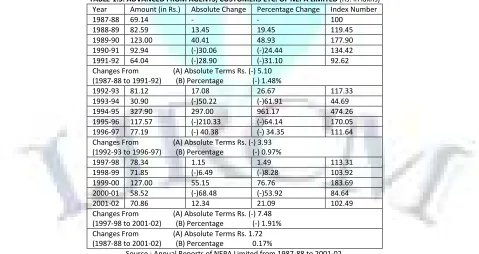
It is the amount of advance money which has been received from our Agents and Customers in advance for the delivery of goods in future. We have to deliver the goods to them during the shorter period of time. The Advanced from Agents, Customers etc. of NEPA Limited have been recorded and analyzed during the fifteen years of the study commencing from 1987-88 to 2001-02.
TABLE-1.3: ADVANCED FROM AGENTS, CUSTOMERS ETC. OF NEPA LIMITED (Rs. in lakhs) Year Amount (in Rs.) Absolute Change Percentage Change Index Number 1987-88 69.14 - - 100
1988-89 82.59 13.45 19.45 119.45 1989-90 123.00 40.41 48.93 177.90 1990-91 92.94 (-)30.06 (-)24.44 134.42 1991-92 64.04 (-)28.90 (-)31.10 92.62 Changes From (A) Absolute Terms Rs. (-) 5.10
(1987-88 to 1991-92) (B) Percentage (-) 1.48%
1992-93 81.12 17.08 26.67 117.33 1993-94 30.90 (-)50.22 (-)61.91 44.69 1994-95 327.90 297.00 961.17 474.26 1995-96 117.57 (-)210.33 (-)64.14 170.05 1996-97 77.19 (-) 40.38 (-) 34.35 111.64 Changes From (A) Absolute Terms Rs. (-) 3.93
(1992-93 to 1996-97) (B) Percentage (-) 0.97%
1997-98 78.34 1.15 1.49 113.31 1998-99 71.85 (-)6.49 (-)8.28 103.92 1999-00 127.00 55.15 76.76 183.69 2000-01 58.52 (-)68.48 (-)53.92 84.64 2001-02 70.86 12.34 21.09 102.49 Changes From (A) Absolute Terms Rs. (-) 7.48
(1997-98 to 2001-02) (B) Percentage (-) 1.91% Changes From (A) Absolute Terms Rs. 1.72 (1987-88 to 2001-02) (B) Percentage 0.17%
Source : Annual Reports of NEPA Limited from 1987-88 to 2001-02.
We can summarize that the Advanced from Agents, Customers etc. of NEPA Limited has shown many ups and down. It was maximum during the year 1994-95. Increase in the value of Advanced from Agents, Customers proves that the customers have strong faith on the company.
4. STAFF WELFARE SCHEME
VOLUME NO.3(2013),ISSUE NO.06(JUNE) ISSN 2231-5756
INTERNATIONAL JOURNAL OF RESEARCH IN COMMERCE, IT & MANAGEMENT
TABLE 1.4: STAFF WELFARE SCHEME OF NEPA LIMITED (Rs. in lakhs) Year Amount (in Rs.) Absolute Change Percentage Change Index Number 1987-88 2.31 - - 100
1988-89 2.45 0.14 6.06 106.06 1989-90 2.74 0.29 11.84 118.61 1990-91 2.93 0.19 6.93 126.84 1991-92 7.17 4.24 144.71 310.39 Changes From (A) Absolute Terms Rs. 4.86
(1987-88 to 1991-92) (B) Percentage 42.08%
1992-93 8.51 1.34 18.69 368.40 1993-94 8.82 0.31 3.64 381.82 1994-95 9.72 0.90 10.20 420.78 1995-96 10.44 0.72 7.41 451.95 1996-97 11.79 1.35 12.93 510.39 Changes From (A) Absolute Terms Rs. 3.28
(1992-93 to 1996-97) (B) Percentage 7.71%
1997-98 11.93 0.14 1.19 516.45 1998-99 11.34 (-)0.59 (-)4.95 490.91 1999-00 11.10 (-)0.24 (-)2.12 480.52 2000-01 10.96 (-)0.14 (-)1.26 474.46 2001-02 10.95 (-) 0.01 (-) 0.09 474.03 Changes From (A) Absolute Terms Rs. (-)0.98
(1997-98 to 2001-02) (B) Percentage (-)1.64% Changes From (A) Absolute Terms Rs. 8.64 (1987-88 to 2001-02) (B) Percentage 24.94%
Source : Annual Reports of NEPA Limited from 1987-88 to 2001-02.
We can say the NEPA Limited has continuously increased the contribution in Staff Welfare Scheme, which is good indication for the staff members of the company. It proves that the company is very sincere for its staff members because adequate funds have been maintained by NEPA Limited.
5. STATUTORY DUES
Many types of taxes are paid by the business to the government, which include direct taxes and indirect taxes. It is payable to the government with in the shorter duration of time. The Statutory Dues of NEPA Limited came in to existence from the year 1992-93. Before 1992-93 no provision was made by this organization regarding the Statutory Dues. So the Statutory Dues of NEPA Limited has been analyzed since 1992-93 to 2001-02.
TABLE 1.5: STATUTORY DUES OF NEPA LIMITED (Rs. in lakhs)
Year Amount (in Rs.) Absolute Change Percentage Change Index Number 1992-93 144.67 - - 100
1993-94 215.31 70.64 48.83 148.83 1994-95 353.78 138.47 64.31 244.54 1995-96 782.44 428.66 121.17 540.84 1996-97 895.37 112.93 14.43 618.91 Changes From (A) Absolute Terms Rs. 750.70
(1992-93 to 1996-97) (B) Percentage 103.78%
1997-98 924.93 29.56 3.30 639.34 1998-99 792.80 (-)132.13 (-)14.29 548.01 1999-00 913.23 120.43 15.19 631.25 2000-01 856.22 (-)57.01 (-)6.24 591.84 2001-02 907.15 50.93 5.95 627.05 Changes From (A) Absolute Terms Rs. (-)17.78
(1997-98 to 2001-02) (B) Percentage (-)0.38% Changes From (A) Absolute Terms Rs. 762.48 (1992-93 to 2001-02) (B) Percentage 52.70%
Source: Annual Reports of NEPA Limited from 1992-93 to 2001-02.
Finally we can say, that the Statutory Dues of NEPA Limited has gone up very quickly, which ultimately resulted in increasing the liabilities of the company. So for the better and efficient management the company should try to pay the Statutory Dues with in the shorter duration of time.
6. GRANT FOR VOLUNTARY RETIREMENT SCHEME
INTERNATIONAL JOURNAL OF RESEARCH IN COMMERCE, IT & MANAGEMENT
TABLE 1.6: GRANT FOR VOLUNTARY RETIREMENT SCHEME OF NEPA LIMITED (Rs. in lakhs) Year Amount (in Rs.) Absolute Change Percentage Change Index Number 1992-93 94.01 - - 100
1993-94 78.02 (-)15.99 (-)17.01 82.99 1994-95 119.53 41.51 53.20 127.15 1995-96 72.74 (-)46.79 (-)39.14 77.37 1996-97 124.03 51.29 70.51 131.93 Changes From (A) Absolute Terms Rs. 30.02
(1992-93 to 1996-97) (B) Percentage 6.39%
1997-98 0.94 (-)123.09 (-)99.24 1.00 1998-99 (-)1.22 (-)2.16 (-)229.79 (-)1.30 1999-00 18.30 19.52 (-)1600.00 19.47 2000-01 34.52 16.22 88.63 36.72 2001-02 - (-) 34.52 (-) 100.00 - Changes From (A) Absolute Terms Rs. (-) 0.94
(1997-98 to 2001-02) (B) Percentage (-) 20.00% Changes From (A) Absolute Terms Rs. (-) 94.01 (1992-93 to 2001-02) (B) Percentage (-) 10.00%
Source : Annual Reports of NEPA Limited from 1992-93 to 2001-02.
The contribution in Voluntary Retirement Scheme by NEPA Limited was more which shows the ineffectiveness of the company.
7. INTEREST ACCRUED
Interest is generally due and paid on loan which are taken by the firm or organization. Apart from that the interest can be due by some other reasons also. Interest Accrued is the Current Liability of the company, so it should be paid with in the short duration of time i.e. one year. NEPA Limited has also Interest Accrued, which has been shown in the head of Current Liabilities.
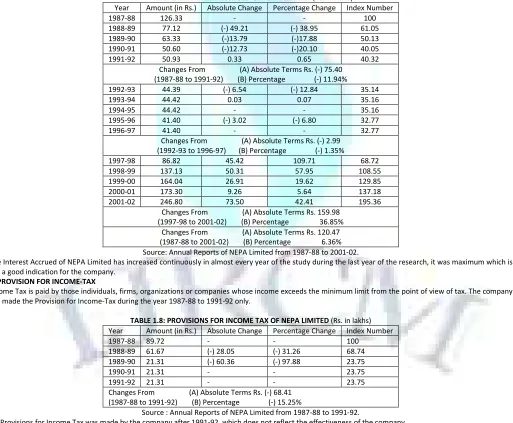
TABLE 1.7: INTEREST ACCRUED OF NEPA LIMITED (Rs. in lakhs)
Year Amount (in Rs.) Absolute Change Percentage Change Index Number 1987-88 126.33 - - 100 1988-89 77.12 (-) 49.21 (-) 38.95 61.05 1989-90 63.33 (-)13.79 (-)17.88 50.13 1990-91 50.60 (-)12.73 (-)20.10 40.05 1991-92 50.93 0.33 0.65 40.32
Changes From (A) Absolute Terms Rs. (-) 75.40 (1987-88 to 1991-92) (B) Percentage (-) 11.94% 1992-93 44.39 (-) 6.54 (-) 12.84 35.14 1993-94 44.42 0.03 0.07 35.16 1994-95 44.42 - - 35.16 1995-96 41.40 (-) 3.02 (-) 6.80 32.77 1996-97 41.40 - - 32.77
Changes From (A) Absolute Terms Rs. (-) 2.99 (1992-93 to 1996-97) (B) Percentage (-) 1.35%
1997-98 86.82 45.42 109.71 68.72 1998-99 137.13 50.31 57.95 108.55 1999-00 164.04 26.91 19.62 129.85 2000-01 173.30 9.26 5.64 137.18 2001-02 246.80 73.50 42.41 195.36
Changes From (A) Absolute Terms Rs. 159.98 (1997-98 to 2001-02) (B) Percentage 36.85%
Changes From (A) Absolute Terms Rs. 120.47 (1987-88 to 2001-02) (B) Percentage 6.36% Source: Annual Reports of NEPA Limited from 1987-88 to 2001-02.
The Interest Accrued of NEPA Limited has increased continuously in almost every year of the study during the last year of the research, it was maximum which is not a good indication for the company.
8. PROVISION FOR INCOME-TAX
Income Tax is paid by those individuals, firms, organizations or companies whose income exceeds the minimum limit from the point of view of tax. The company has made the Provision for Income-Tax during the year 1987-88 to 1991-92 only.
TABLE 1.8: PROVISIONS FOR INCOME TAX OF NEPA LIMITED (Rs. in lakhs) Year Amount (in Rs.) Absolute Change Percentage Change Index Number 1987-88 89.72 - - 100
1988-89 61.67 (-) 28.05 (-) 31.26 68.74 1989-90 21.31 (-) 60.36 (-) 97.88 23.75 1990-91 21.31 - - 23.75 1991-92 21.31 - - 23.75 Changes From (A) Absolute Terms Rs. (-) 68.41
(1987-88 to 1991-92) (B) Percentage (-) 15.25%
Source : Annual Reports of NEPA Limited from 1987-88 to 1991-92.
No Provisions for Income Tax was made by the company after 1991-92, which does not reflect the effectiveness of the company.
9. OTHER CURRENT LIABILITIES
VOLUME NO.3(2013),ISSUE NO.06(JUNE) ISSN 2231-5756
INTERNATIONAL JOURNAL OF RESEARCH IN COMMERCE, IT & MANAGEMENT
TABLE 1.9: OTHER CURRENT LIABILITIES OF NEPA LIMITED (Rs. in lakhs) Year Amount (in Rs.) Absolute Change Percentage Change Index Number 1987-88 559.82 - - 100
1988-89 794.54 234.72 41.93 141.93 1989-90 829.41 34.87 4.39 148.16 1990-91 863.48 34.07 4.11 154.24 1991-92 120.43 (-)743.05 (-)86.05 21.51 Changes From (A) Absolute Terms Rs. (-) 439.39
(1987-88 to 1991-92) (B) Percentage (-) 15.70%
1992-93 - (-)120.43 (-)100.00 - 1993-94 24.59 24.59 - 4.39 1994-95 41.84 17.25 70.15 7.47 1995-96 14.75 (-)27.09 (-)64.75 2.63 1996-97 4.55 (-)10.20 (-)69.15 0.81 Changes From (A) Absolute Terms Rs. 4.55
(1992-93 to 1996-97) (B) Percentage 0.00%
1997-98 4.52 (-)0.03 0.66 0.81 1998-99 4.52 - - 0.81 1999-00 4.52 - - 0.81 2000-01 - (-)4.52 (-)100.00 - 2001-02 - - - - Changes From (A) Absolute Terms Rs. (-) 4.52
(1997-98 to 2001-02) (B) Percentage (-) 20.00% Changes From (A) Absolute Terms Rs. (-) 559.82 (1987-88 to 2001-02) (B) Percentage (-) 6.67%
Source: Annual Reports of NEPA Limited from 1987-88 to 2001-02.
So the Other Current Liabilities of NEPA Limited has shown the decreasing trend in it, which means that the company has paid off its other current liabilities. This is a very positive sign for the company which will create a good impression in the minds of its creditors.
SUMMARY & FINDINGS
• In this analysis we have emphasized on the Current Liabilities of NEPA Limited during the fifteen years of the study from year 1987-88 to 2001-02.
• During the fifteen years of the study we have studied and analyzed different Other Current Liabilities of NEPA Limited, which was classified as Sundry Creditors, Deposits from Contractors etc, Advanced from Agents, Customers, etc, Staff Welfare Scheme, Statutory Dues, Grant for Voluntary Retirement Scheme, Interest Accrued, Provisions for Income-Tax, Other Current Liabilities.
• The study of it reveals that the Current Liabilities of NEPA Limited have played a very important role in the management of the company. Some times the Current Liabilities of NEPA Limited has shown the increase and some times it has shown the decrease in its value.
• The Sundry Creditors of NEPA Limited has raised up from 356.49 lakh in the year 1987-88, to Rs. 8235.75 lakh in the years 2001-02, indicating an increase of Rs. 7879.26 lakh, where as the percentage increased being 147.35. The index number which was 100 during the year 1987-88 has also stood up at 2310.23 in the year 2001-02, showed an increase by 2210.23.
• The company has made provisions for the Income tax, for Statutory Dues, which are very important for any business or organization.
• On the other hand the company has also made many provisions for its employees, because the employees are always the backbone for the business.
• The contribution made by the company for the betterment of its employees was in Staff Welfare Scheme, Grants for Voluntary Retirement Scheme.
PROBLEMS AND SUGGESTIONS
• The main problem of the company is the unavailability of adequate raw material used for producing the paper and newsprint.
• Present age is the age of Computer. The success of any business and organization largely depends upon Computer. Being a public company most of the work is done here manually which does not prove much effective and takes too time and money. So NEPA Limited should install advanced Computer system with advanced technology to improve its work.
• For the betterment and effective planning different committees can be formed by any business or organization. So a committee should be established by the company for the improvement, progress and look in to the Current Liabilities of NEPA Limited.
• The Central and State Government should provide adequate grants to the Company so that the financial requirements can be fulfilled.
REFERENCES
1. Annual Reports of NEPA Limited for 15 Years from 1987-88 to 2001-02.
2. Bansal and Kumar, (2001), “Paper Making”, in History of Technology in India, Munshiram Manoharlal Publishers Pvt. Ltd., New Delhi pp. 723. 3. Chandra, Prasanna, (1999), “Management of Current Liabilities”, in Financial Management, Tata McGraw-Hill Education, New Delhi, pp.87. 4. Garg, A. K., (2000), “Management of Current Liabilities”, in Elements of Financial Management, Swati prakashan, New Delhi pp.23. 5. Maheshwari, S.N.,(2000), Elements of Financial Management, Vikas Publishing House, New Delhi. pp.47.
6. Mehta, D. S., (1992), Mass Communication and Journalism in India, Allied Publisher, pp.7,8, ISBN 9788170233534. 7. Sharma, R, (2000), Management of Public Enterprises, pp:33.
8. Singh, Surender, (2011), “Paper Mills in India”, in Geography, Tata Mc Graw Hill Education, 2011, pp. 15.71,15.72. ISBN 0071074805. 9. Subburaj, V.V.K., (2006), Sura’s Year Book, Sura Books 2006, pp. 537. ISBN 9788172541248.
WEBSITES
10. http://www.nepamills.co.in/profile.htm, (Accessed as on 10th May, 2013)
INTERNATIONAL JOURNAL OF RESEARCH IN COMMERCE, IT & MANAGEMENT
REQUEST FOR FEEDBACK
Dear Readers
At the very outset, International Journal of Research in Commerce, IT and Management (IJRCM)
acknowledges & appreciates your efforts in showing interest in our present issue under your kind perusal.
I would like to request you to supply your critical comments and suggestions about the material published
in this issue as well as on the journal as a whole, on our E-mail i.e.
for further
improvements in the interest of research.
If you have any queries please feel free to contact us on our E-mail
.
I am sure that your feedback and deliberations would make future issues better – a result of our joint
effort.
Looking forward an appropriate consideration.
With sincere regards
Thanking you profoundly
Academically yours
Sd/-
VOLUME NO.3(2013),ISSUE NO.06(JUNE) ISSN 2231-5756