VOLUME NO. 4 (2014), ISSUE NO. 10 (OCTOBER) ISSN 2231-5756
A Monthly Double-Blind Peer Reviewed (Refereed/Juried) Open Access International e-Journal - Included in the International Serial Directories
VOLUME NO. 4 (2014), ISSUE NO. 10 (OCTOBER) ISSN 2231-5756
CONTENTS
Sr.
No.
TITLE & NAME OF THE AUTHOR (S)
Page
No.
1
.
BRAND PRIDE AS A CONSTRUCT CONTRIBUTING TO RETAINING MISSION CRITICAL TALENT OF THE
ORGANIZATION: A COMPARATIVE STUDY OF SELECTED ORGANIZATIONS
DR. GEETA BANSAL & DR. PARUL PANDEY
1
2
.
CONSUMER ATTITUDE AND PERCEPTION TOWARD BRANDS OF EDIBLE OIL: AN EMPIRICAL STUDY
AMITA SHARMA & DR. D. S. CHAUBEY
8
3
.
CAPITAL STRUCTURE AND ITS IMPACT ON PROFITABILITY OF AUTOMOTIVE INDUSTRY: THE INDIAN CASE
SANJAY HIRAN & DR. MAHENDRA SOJATIA
14
4
.
MERGERS AND ACQUISITIONS IN INDIAN BANKING SECTOR: AN IMPACT ANALYSIS WITH SPECIAL
REFERENCE TO SELECT SURVIVING COMMERCIAL BANKS (INDIAN OVERSEAS BANK AND FEDERAL BANK
LIMITED)
DR. WAGHAMARE.SHIVAJI & VEERESHA
21
5
.
EXAMINING WEAK FORM EFFICIENCIES IN STOCK MARKETS OF INDIA AND CHINA
PRASHANT JOSHI
26
6
.
THE MARKET FOR GREEN BUILDINGS IN EMERGING INDIA: A LITERATURE REVIEW AND RESEARCH
AGENDA
SUNITHA LIZZIE PEREIRA & MUSTIARY BEGUM
29
7
.
COMPARATIVE STUDY ON AMWAY & AVON ON THE BASIS OF MLM
DR. MEGHA SHARMA & GURPREET KAUR
33
8
.
CREDIT RISK MANAGEMENT IN SMALL INDUSTRIES DEVELOPMENT BANK OF INDIA (SIDBI)
DR. P. AMIRTHA GOWRI & T. RENUHA
37
9
.
OBSTACLES FOR AGRICULTURAL COOPERATIVES DEVELOPMENT IN AMBO ZURIA WOREDA/DISTRICT/,
OROMIYA REGION, ETHIOPIA
ASSEFA GEBRE HABTE WOLD
41
10
.
ESTIMATION OF PARAMETERS OF STRUCTURAL CHANGE UNDER SMALL SIGMA APPR0XIMATION THEORY
R. K. GUPTA
51
11
.
ROLE OF NGOS FOR SOCIO-ECONOMIC DEVELOPMENT IN RURAL AREAS THROUGH ICT: AN EMPIRICAL
STUDY
DR. A. KUMUDHA
57
12
.
MICRO FINANCE AND WOMEN EMPOWERMENT: AN INDIAN PERSPECTIVE
DR. P. AMARJOTHI & DR. S. GANAPATHY
65
13
.
CONSUMER DEMOGRAPHICS AND ITS INFLUENCE ON THEIR CAR PREFERENCES IN INDIAN FOUR WHEELER
MARKET
PRASHANT PATIL, SANJAY HANJI & DR. M.M.MUNSHI
68
14
.
ANALYSIS OF WORKING CAPITAL MANAGEMENT IN INDIAN INDUSTRY: A COMPARATIVE STUDY OF
SELECTED INDUSTRIES
DR. T. MADHU SUDANA
76
15
.
DISCIPLINARY ACTION TAKEN ON EMPLOYEES AND ITS IMPACT ON THE MORALE OF THE EMPLOYEES: A
STUDY
AMBUJAKSHI
83
16
.
INFORMATION TECHNOLOGY IN BANKING SECTOR
SHIKHA BATRA & DR. AMBIKA BHATIA
88
17
.
NON-GOVERNMENTAL ORGANIZATIONS AND THEIR ACCOUNTABILITY
NARESH KUMAR
94
18
.
LEGAL FRAMEWORK OF ENVIRONMENTAL ACCOUNTING IN INDIA
KARAMJIT KAUR & RAJNEESH
98
19
.
CORPORATE SOCIAL RESPONSIBILITY: AN INDIAN PERSPECTIVE
GUNJAN KHANNA
102
20
.
PONZI SCHEMES: A FRAUDULENT BITE
PRIYANKA MEHTANI
105
VOLUME NO. 4 (2014), ISSUE NO. 10 (OCTOBER) ISSN 2231-5756
CHIEF PATRON
PROF. K. K. AGGARWAL
Chairman, Malaviya National Institute of Technology, Jaipur
(An institute of National Importance & fully funded by Ministry of Human Resource Development, Government of India)
Chancellor, K. R. Mangalam University, Gurgaon
Chancellor, Lingaya’s University, Faridabad
Founder Vice-Chancellor (1998-2008), Guru Gobind Singh Indraprastha University, Delhi
Ex. Pro Vice-Chancellor, Guru Jambheshwar University, Hisar
FOUNDER PATRON
LATE SH. RAM BHAJAN AGGARWAL
Former State Minister for Home & Tourism, Government of Haryana
Former Vice-President, Dadri Education Society, Charkhi Dadri
Former President, Chinar Syntex Ltd. (Textile Mills), Bhiwani
CO-ORDINATOR
AMITA
Faculty, Government M. S., Mohali
ADVISORS
DR. PRIYA RANJAN TRIVEDI
Chancellor, The Global Open University, Nagaland
PROF. M. S. SENAM RAJU
Director A. C. D., School of Management Studies, I.G.N.O.U., New Delhi
PROF. M. N. SHARMA
Chairman, M.B.A., Haryana College of Technology & Management, Kaithal
PROF. S. L. MAHANDRU
Principal (Retd.), Maharaja Agrasen College, Jagadhri
EDITOR
PROF. R. K. SHARMA
Professor, Bharti Vidyapeeth University Institute of Management & Research, New Delhi
CO-EDITOR
DR. BHAVET
Faculty, Shree Ram Institute of Business & Management, Urjani
EDITORIAL ADVISORY BOARD
DR. RAJESH MODI
Faculty, Yanbu Industrial College, Kingdom of Saudi Arabia
PROF. SANJIV MITTAL
University School of Management Studies, Guru Gobind Singh I. P. University, Delhi
VOLUME NO. 4 (2014), ISSUE NO. 10 (OCTOBER) ISSN 2231-5756
DR. SAMBHAVNA
Faculty, I.I.T.M., Delhi
DR. MOHENDER KUMAR GUPTA
Associate Professor, P. J. L. N. Government College, Faridabad
DR. SHIVAKUMAR DEENE
Asst. Professor, Dept. of Commerce, School of Business Studies, Central University of Karnataka, Gulbarga
ASSOCIATE EDITORS
PROF. NAWAB ALI KHAN
Department of Commerce, Aligarh Muslim University, Aligarh, U.P.
PROF. ABHAY BANSAL
Head, Department of Information Technology, Amity School of Engineering & Technology, Amity
University, Noida
PROF. A. SURYANARAYANA
Department of Business Management, Osmania University, Hyderabad
DR. SAMBHAV GARG
Faculty, Shree Ram Institute of Business & Management, Urjani
PROF. V. SELVAM
SSL, VIT University, Vellore
DR. PARDEEP AHLAWAT
Associate Professor, Institute of Management Studies & Research, Maharshi Dayanand University, Rohtak
DR. S. TABASSUM SULTANA
Associate Professor, Department of Business Management, Matrusri Institute of P.G. Studies, Hyderabad
SURJEET SINGH
Asst. Professor, Department of Computer Science, G. M. N. (P.G.) College, Ambala Cantt.
TECHNICAL ADVISOR
AMITA
Faculty, Government M. S., Mohali
FINANCIAL ADVISORS
DICKIN GOYAL
Advocate & Tax Adviser, Panchkula
NEENA
Investment Consultant, Chambaghat, Solan, Himachal Pradesh
LEGAL ADVISORS
JITENDER S. CHAHAL
Advocate, Punjab & Haryana High Court, Chandigarh U.T.
CHANDER BHUSHAN SHARMA
Advocate & Consultant, District Courts, Yamunanagar at Jagadhri
SUPERINTENDENT
VOLUME NO. 4 (2014), ISSUE NO. 10 (OCTOBER) ISSN 2231-5756
CALL FOR MANUSCRIPTS
We invite unpublished novel, original, empirical and high quality research work pertaining to recent developments & practices in the areas of Computer Science & Applications; Commerce; Business; Finance; Marketing; Human Resource Management; General Management; Banking; Economics; Tourism Administration & Management; Education; Law; Library & Information Science; Defence & Strategic Studies; Electronic Science; Corporate Governance; Industrial Relations; and emerging paradigms in allied subjects like Accounting; Accounting Information Systems; Accounting Theory & Practice; Auditing; Behavioral Accounting; Behavioral Economics; Corporate Finance; Cost Accounting; Econometrics; Economic Development; Economic History; Financial Institutions & Markets; Financial Services; Fiscal Policy; Government & Non Profit Accounting; Industrial Organization; International Economics & Trade; International Finance; Macro Economics; Micro Economics; Rural Economics; Co-operation; Demography: Development Planning; Development Studies; Applied Economics; Development Economics; Business Economics; Monetary Policy; Public Policy Economics; Real Estate; Regional Economics; Political Science; Continuing Education; Labour Welfare; Philosophy; Psychology; Sociology; Tax Accounting; Advertising & Promotion Management; Management Information Systems (MIS); Business Law; Public Responsibility & Ethics; Communication; Direct Marketing; E-Commerce; Global Business; Health Care Administration; Labour Relations & Human Resource Management; Marketing Research; Marketing Theory & Applications; Non-Profit Organizations; Office Administration/Management; Operations Research/Statistics; Organizational Behavior & Theory; Organizational Development; Production/Operations; International Relations; Human Rights & Duties; Public Administration; Population Studies; Purchasing/Materials Management; Retailing; Sales/Selling; Services; Small Business Entrepreneurship; Strategic Management Policy; Technology/Innovation; Tourism & Hospitality; Transportation Distribution; Algorithms; Artificial Intelligence; Compilers & Translation; Computer Aided Design (CAD); Computer Aided Manufacturing; Computer Graphics; Computer Organization & Architecture; Database Structures & Systems; Discrete Structures; Internet; Management Information Systems; Modeling & Simulation; Neural Systems/Neural Networks; Numerical Analysis/Scientific Computing; Object Oriented Programming; Operating Systems; Programming Languages; Robotics; Symbolic & Formal Logic; Web Design and emerging paradigms in allied subjects.
Anybody can submit the soft copy of unpublished novel; original; empirical and high quality research work/manuscriptanytime in M.S. Word format
after preparing the same as per our GUIDELINES FOR SUBMISSION; at our email address i.e. [email protected] or online by clicking the link online submission as given on our website (FOR ONLINE SUBMISSION, CLICK HERE).
GUIDELINES FOR SUBMISSION OF MANUSCRIPT
1. COVERING LETTER FOR SUBMISSION:
DATED: _____________
THE EDITOR
IJRCM
Subject: SUBMISSION OF MANUSCRIPT IN THE AREA OF.
(e.g. Finance/Marketing/HRM/General Management/Economics/Psychology/Law/Computer/IT/Engineering/Mathematics/other, please specify)
DEAR SIR/MADAM
Please find my submission of manuscript entitled ‘___________________________________________’ for possible publication in your journals.
I hereby affirm that the contents of this manuscript are original. Furthermore, it has neither been published elsewhere in any language fully or partly, nor is it under review for publication elsewhere.
I affirm that all the author (s) have seen and agreed to the submitted version of the manuscript and their inclusion of name (s) as co-author (s).
Also, if my/our manuscript is accepted, I/We agree to comply with the formalities as given on the website of the journal & you are free to publish our contribution in any of your journals.
NAME OF CORRESPONDING AUTHOR: Designation:
Affiliation with full address, contact numbers & Pin Code: Residential address with Pin Code:
Mobile Number (s): Landline Number (s): E-mail Address: Alternate E-mail Address:
NOTES:
a) The whole manuscript is required to be in ONE MS WORD FILE only (pdf. version is liable to be rejected without any consideration), which will start from the covering letter, inside the manuscript.
b) The sender is required to mentionthe following in the SUBJECT COLUMN of the mail:
New Manuscript for Review in the area of (Finance/Marketing/HRM/General Management/Economics/Psychology/Law/Computer/IT/ Engineering/Mathematics/other, please specify)
c) There is no need to give any text in the body of mail, except the cases where the author wishes to give any specific message w.r.t. to the manuscript. d) The total size of the file containing the manuscript is required to be below 500 KB.
e) Abstract alone will not be considered for review, and the author is required to submit the complete manuscript in the first instance.
f) The journal gives acknowledgement w.r.t. the receipt of every email and in case of non-receipt of acknowledgment from the journal, w.r.t. the submission of manuscript, within two days of submission, the corresponding author is required to demand for the same by sending separate mail to the journal.
2. MANUSCRIPT TITLE: The title of the paper should be in a 12 point Calibri Font. It should be bold typed, centered and fully capitalised.
3. AUTHOR NAME (S) & AFFILIATIONS: The author (s) full name, designation, affiliation (s), address, mobile/landline numbers, and email/alternate email address should be in italic & 11-point Calibri Font. It must be centered underneath the title.
4. ABSTRACT: Abstract should be in fully italicized text, not exceeding 250 words. The abstract must be informative and explain the background, aims, methods,
VOLUME NO. 4 (2014), ISSUE NO. 10 (OCTOBER) ISSN 2231-5756
5. KEYWORDS: Abstract must be followed by a list of keywords, subject to the maximum of five. These should be arranged in alphabetic order separated by commas and full stops at the end.
6. MANUSCRIPT: Manuscript must be in BRITISH ENGLISH prepared on a standard A4 size PORTRAIT SETTING PAPER. It must be prepared on a single space and
single column with 1” margin set for top, bottom, left and right. It should be typed in 8 point Calibri Font with page numbers at the bottom and centre of every page. It should be free from grammatical, spelling and punctuation errors and must be thoroughly edited.
7. HEADINGS: All the headings should be in a 10 point Calibri Font. These must be bold-faced, aligned left and fully capitalised. Leave a blank line before each
heading.
8. SUB-HEADINGS: All the sub-headings should be in a 8 point Calibri Font. These must be bold-faced, aligned left and fully capitalised.
9. MAIN TEXT: The main text should follow the following sequence:
INTRODUCTION REVIEW OF LITERATURE
NEED/IMPORTANCE OF THE STUDY STATEMENT OF THE PROBLEM OBJECTIVES
HYPOTHESES
RESEARCH METHODOLOGY RESULTS & DISCUSSION FINDINGS
RECOMMENDATIONS/SUGGESTIONS CONCLUSIONS
SCOPE FOR FURTHER RESEARCH ACKNOWLEDGMENTS REFERENCES APPENDIX/ANNEXURE
It should be in a 8 point Calibri Font, single spaced and justified. The manuscript should preferably not exceed 5000 WORDS.
10. FIGURES &TABLES: These should be simple, crystal clear, centered, separately numbered & self explained, and titles must be above the table/figure. Sources
of data should be mentioned below the table/figure. It should be ensured that the tables/figures are referred to from the main text.
11. EQUATIONS:These should be consecutively numbered in parentheses, horizontally centered with equation number placed at the right.
12. REFERENCES: The list of all references should be alphabetically arranged. The author (s) should mention only the actually utilised references in the preparation
of manuscript and they are supposed to follow Harvard Style of Referencing. The author (s) are supposed to follow the references as per the following:
All works cited in the text (including sources for tables and figures) should be listed alphabetically.
Use (ed.) for one editor, and (ed.s) for multiple editors.
When listing two or more works by one author, use --- (20xx), such as after Kohl (1997), use --- (2001), etc, in chronologically ascending order.
Indicate (opening and closing) page numbers for articles in journals and for chapters in books.
The title of books and journals should be in italics. Double quotation marks are used for titles of journal articles, book chapters, dissertations, reports, working papers, unpublished material, etc.
For titles in a language other than English, provide an English translation in parentheses.
The location of endnotes within the text should be indicated by superscript numbers.PLEASE USE THE FOLLOWING FOR STYLE AND PUNCTUATION IN REFERENCES: BOOKS
Bowersox, Donald J., Closs, David J., (1996), "Logistical Management." Tata McGraw, Hill, New Delhi.
Hunker, H.L. and A.J. Wright (1963), "Factors of Industrial Location in Ohio" Ohio State University, Nigeria. CONTRIBUTIONS TO BOOKS
Sharma T., Kwatra, G. (2008) Effectiveness of Social Advertising: A Study of Selected Campaigns, Corporate Social Responsibility, Edited by David Crowther & Nicholas Capaldi, Ashgate Research Companion to Corporate Social Responsibility, Chapter 15, pp 287-303.JOURNAL AND OTHER ARTICLES
Schemenner, R.W., Huber, J.C. and Cook, R.L. (1987), "Geographic Differences and the Location of New Manufacturing Facilities," Journal of Urban Economics, Vol. 21, No. 1, pp. 83-104.CONFERENCE PAPERS
Garg, Sambhav (2011): "Business Ethics" Paper presented at the Annual International Conference for the All India Management Association, New Delhi, India, 19–22 June.UNPUBLISHED DISSERTATIONS AND THESES
Kumar S. (2011): "Customer Value: A Comparative Study of Rural and Urban Customers," Thesis, Kurukshetra University, Kurukshetra. ONLINE RESOURCES
Always indicate the date that the source was accessed, as online resources are frequently updated or removed. WEBSITESVOLUME NO. 4 (2014), ISSUE NO. 10 (OCTOBER) ISSN 2231-5756
BRAND PRIDE AS A CONSTRUCT CONTRIBUTING TO RETAINING MISSION CRITICAL TALENT OF THE
ORGANIZATION: A COMPARATIVE STUDY OF SELECTED ORGANIZATIONS
DR. GEETA BANSAL
ASSOCIATE PROFESSOR
UNIVERSITY SCHOOL OF OPEN LEARNING
FACULTY OF COMMERCE AND MANAGEMENT
PANJAB UNIVERSITY
CHANDIGARH
DR. PARUL PANDEY
VICE PRESIDENT, INDIA & HEAD, TALENT AND DEVELOPMENT
DEUTSCHE BANK
BANGALORE
ABSTRACT
The present study is an endeavor to find out the significance of brand pride as a major construct which plays a tremendous role in retaining what we call the star performers of the organization, which is a result of multiple organizational practices to create an employer brand image & to ensure the delivery of the brand promise to the employees, leading to the creation of stable organizations . In this quest a comparative study of the selected organizations in the IT sector was conducted .The study followed the grounded theory methodology wherein the raw qualitative data was chunked under the one critical antecedent dimension of organizational people practices ; i.e the brand pride. The sampled organizations; Genpact, Infosys and Google were finalized through incidental sampling within theoretical sampling. The qualitative data was collected through 95 long interviews, participant observation and secondary data .The software, Atlas. ti was used to content analyze the data . The main findings of the qualitative study showed that retaining the star performers of the organization is a function of creating a brand pride amongst the executives at all levels in the organization which manifests itself in the brand delivery and the brand image of the organization. The sub-constructs that evolved under brand delivery were: I. Employee care (1) first experiences, (2) experience of exceptional employee care through life cycle in the job, (3) experiences of infrastructural & recreational facilities, (4) Employee friendly policies & processes (‘Rigorous’ in the context of ITES & ‘Flexible’ in the context of IT product companies) . II. Perceived fairness (5) Equal opportunity, (6) Transparent processes. III. Opportunities for learning & Development IV. Growth path for each performer through seamless opportunities for growth & advancement.
JEL CODE
M51, M52, M53.
KEYWORDS
brand pride, brand image, brand delivery, grounded theory methodology.
1. INTRODUCTION
etaining the star performers of the organization in today’s competitive business scenario is indeed quite challenging. It is in this environment that the organizations are continuously on the prowl to outline the strategies to retain the best of the talent available which is the need of the hour. This could be attributed to a number of reasons, the prime being the paucity of the really talented people around in the face of phenomenal demand or due to the reverse trend of business causing a large number of professionals to be on the bench. In either case the onus of retaining the existing supply of the talented people lies on the organizations only. This calls upon the organizations to build up extremely strong muscle to keep up the motivation, commitment and the engagement of the people at an all time high to save the organizations from the so called‘ Executive Exodus’. The present study was conducted to explore the significance of creating brand pride as an organizational people practice for executive retention.
2. REVIEW OF LITERATURE
Brand Pride: Thisis a term given to the positive emotion that an employee feels as a result of being a part of the organization. Brand Image: it has come out as one of the most grounded constructs encompassing the following sub constructs: (1) brand social visibility, (2) perceived value attributed to products, services or work ethics, (3) size of the operation and stature in comparison to competition, (4) starting salary package (5) perceived culture on employee care (6) comfortable infrastructural & recreational facilities (7) perceived inspirational leadership (8) contribution to society. Brand Delivery: has also come out as a critical factor which states that most of the image elements are experienced by the employees on their job. For example employees see policies that are sensitive to their life outside office, or they see that there is actually a shared respect for the top leadership, or they experience great infrastructure (hygiene factors). Brand delivery starts at the time of an individual joining and has a significant impact at that time on whether the employee would feel high brand pride. Here is where best practices like ‘giving a feel of the job before joining’ or ‘assigning a buddy to find your feet’ etc. ensure that the new employee faces no dramatic surprises & experiences a soft landing. Additionally, the induction period or technically initial socialization goes a long way in instilling brand pride. EXTANT LITERATURE FOR BRAND PRIDE
Brand Image: Browne and Golembiewski (1974) explained organizational image as a comparative structural frame that each individual develops to rate his organization in comparison with others. Riordan et al. (1997) suggest that organizational image reflects individual’s perceptions of the actions, activities and the accomplishments of the organization and it ranks the organization in comparison with other organizations. Dukerich et al. (2000) have differentiated between the reputation of the organization and its external image wherein the former represents outsider’s views of the organization, whereas the latter represents how organizational members think outsiders view the organization.
Researchers show how positive organizational image extrapolates to self esteem, power etc. leading to loyalty or cooperation or a negative image leads to decreased identification (Brown & Golembiewski, 1974; Sutton and Callahan, 1987;). On building an attractive image, Post & Griffin (1997) emphasize the role of corporate communications department and there have been studies on how a good organizational image attracts good people and vice- versa (Highhouse et al., 1999; Arnold et al., 2003). On brand image leading to commitment or loyalty or intention to quit, Arnett et al. (2002) enumerate benefits of branding as (1) Low employee turnover (2) An increase in service quality (3) high level of employee satisfaction (4) an improved ability to implement change in the organization. Gadot & Zion (2004) showed how relative brand image was an important criterion for intention to quit and join another organization. There have also been
VOLUME NO. 4 (2014), ISSUE NO. 10 (OCTOBER) ISSN 2231-5756
There have also been researches showing how communication & language go a long way in building an organizational brand image (Duimering and Safayeni, 1998; Rafaeli, 2000; Schuler, 2004).Finally there have been references to leadership of the organization being an important element of the brand image Arlington, 2002; Gorman, 2007.
Brand Delivery: included delivery of all the expectation both expressed or implicit of the employees from the organization in order to ensure that they are proud to belong to the organization. Heger’s (2007) construct of Employee Value Proposition (EVP), comes closest. His article addresses an important business concept called Employment Value Proposition (EVP), which describes the value or benefit an employee derives from his or her membership in an organization. The EVP has been suggested to be a determinant of employee engagement and retention, both of which have an impact on critical business outcomes.
Moving on the area of psychological contract, implicit understanding (Argyris, 1960) or unsaid expectations (Levinson et al.,1962) promises, the literature saw in the recent past critical contribution by Robinson & Rousseau (1994). In their view, “contemporary employment relations are in transition… psychological contracts can, when violated, generate distrust, dissatisfaction, and possibly the dissolution of the relationship itself. Rousseau’s (1990, 2001) view has evolved and finally gave a comprehensive process on development of a psychological contract.
The antecedents of psychological contract & breach and outcomes of the same have been studied by many researchers. Robinson (1996) studied outcomes like performance, civic virtue behavior & intentions to remain with the organization. McGovern, Stiles & Hope (1996) studied impact on employee attitudes, in the face of lay offs and found that employees neither expect nor commit a long term association. Dyne and Ang (1998), saw the same phenomenon in the context of contingency workers. Turnley and Feldman (1999) studied outcomes like employee’s exit, voice, loyalty and neglected behavior. Smithson & Lewis (2000) show how the expectation of the young adults from their employers is undergoing a sea change. Outcomes like trust loyalty & commitment were studied by Pate & Malone (2000).
Recent studies on antecedents of perceived breach & its impact on attitudes, OCB, intention to quit have been studied by Kickul (2001); Kickull, Neuman, Parker & Finkl (2001); Kickul & Lester (2001) Shapiro (2002) where they saw a direct relationship between breach of psychological contract and negative outcomes. Other individual constructs like employee care, fairness, learning & growth within brand delivery were also reviewed. Bernstein Arron (1998); Michaud Laura (2002); Leigh Branham (2005); Somaya (2008) have all set the stage for importance of initiatives like training and growth within the organizations in the context of turbulence in the environment.
3. NEED & SIGNIFICANCE OF THE STUDY
The main reason for undertaking this research was that ‘executive retention’ is on top of the agenda of the organizations, especially in today’s knowledge economy. Looking at the other dimensions of how professionals in ITES viewed this scenario, according to ‘Hansa Research’, the ITES/ BPO employees look at their jobs as a stop gap before they get into a proper career or further studies. It is a good way of earning while having fun. While there was shortage of professionals, the ones that were there added to the instability by considering their current jobs to move out from in about a year or so.
While on one hand, organizations and the government were taking steps to curtail this huge gap between the demand and the supply of qualified and talented professionals, on the other hand all the organizations in this sector were making extra effort in retaining their professionals. Organizational branding as the ‘Best Employers’, ‘Great Place to work’ etc. are nothing but by- products of the high need of organizations to attract and retain their best people. Further ,
the absence of any previous research on ‘the chosen aspect of brand pride as a construct to ensure executive retention ,makes this research all the more significant.
4. STATEMENT OF THE PROBLEM
In the light of the globalized Indian economy, it becomes all the more imperative to find out how are the knowledge based IT & ITES companies coping with the trickling down of the talent from their doors . What are their strategies? What do they need to do to bring about stability in their set up? While there are a lot of surveys being conducted in India like “The Best Employer Survey” by Hewitt Associates, “Best Companies to work for” by Mercer, “Great Places to Work” by Grow Talent etc, it is yet to be seen if the same factors that make them best employers actually maintain a consistent low attrition rate. The organizations are thus making earnest efforts to check this executive exodus by creating brand pride amongst its executives which helps them in retaining the best people .Hence, this research endeavor aims at finding out the role of the organizational people practices encompassing brand pride as a major construct in retaining the star performers of the organization.
5. OBJECTIVE OF THE STUDY
To find out the role of the organizational people practices, encompassing creating brand pride amongst executives in retaining the individuals in the organization.
6. RESEARCH DESIGN
Since Brand pride, as a comprehensive construct in creating stable organizations has not been explored by the researchers so far, The Grounded Theory & Case Study methodology was chosen .The current research initiative is exploratory in nature .
POPULATION & SAMPLE
The researcher chose the best known organizations in the knowledge domain operating in India; Infosys Technologies, Google India and Genpact. Theoretical sampling method was used whereby the sample was selected at two levels: first at the Organization level and the second at the Employees level.
PROCEDURE ADOPTED FOR DATA COLLECTION
Participant observation notes and other documents handed over by the HR & Corporate communications department were collected. Individual one hour interviews were scheduled by HR with vintage employees across locations like Hyderabad, Chandigarh, Gurgaon, Bangalore and Jaipur. Data was collected in the form of digital audio files from interviews, and all the other data was collected again in digital word or PDF files.
TOOLS USED FOR DATA ANALYSIS
The qualitative data was analyzed by using ‘content analysis software’: Atlas.ti. This facilitated in analysis from the constant comparison of events.
Stage one was to use free codes, then these were clubbed together to form categories, and concepts. These concepts were then put together as construct families. Each construct was accompanied with a groundedness score and a density score. Only the highly grounded ones were included in the theoretical model.
7. RESULTS AND DISCUSSION
“For no matter what we achieve, if we don’t spend the vast majority of our time with people we love and respect, we cannot possibly have a great life. But if we spend the vast majority of our time with people we love and respect – people we really enjoy being on the bus with and who will never disappoint us – then we will almost certainly have a great life, no matter where the bus goes. The people we interviewed from the good-to-great companies clearly loved what they did, largely because they loved who they did it with.”
… Jim Collins Organizational Practices leading to people stability that emerged as the most grounded were: 1) Brand Pride as a result of multiple practices to create an employer brand image & to ensure the delivery of the brand promise to the employees 2) Mission Resonance 3) Mentoring Supervisors 4) Friendships at work 5) Availability of Knowledge & Information when needed (to ensure success) 6) Opportunity to solve real problems & make a contribution 7) Nipping the negative energy at the bud.
VOLUME NO. 4 (2014), ISSUE NO. 10 (OCTOBER) ISSN 2231-5756
BRAND PRIDE
Brand Prideis a term given to the positive emotion that an employee feels as a result of being a part of the organization. This emotion could be due to two main reasons; due to simply belonging to the best organization in a particular field or due to working with the best people in the industry; or due to conscious organizational practices like brand image building and keeping up the delivery of the brand promise to the employees.
Brand Pride is a positive emotion that each individual belonging to the organization feels as a result of all the formal people processes (run by HR department & corporate communications department). This construct came out as the single most important factor in contributing to organizational people stability. Cumulative groundedness of this construct is 435, far surpassing any other. Though brand pride emerged as an independent sub construct as well, it has been used as a main construct label also. The meaning of the two is the same; however, the scope (sub constructs & related codes) differs making this higher in hierarchy as compared to the sub construct. Fig. 7(i) depicts the main construct Brand pride is a family with 3 sub-constructs.
The subsequent figures depict the three main sub constructs: 1) Brand Pride 2) Brand Image 3) Brand Delivery. FIG. 7 (i): BRAND PRIDE (BP)
Source: Network view of construct family, Brand Pride, Atlas.ti
The sub- construct Brand Pride is a positive emotion felt by an employee by simply belonging to the best organization in the industry or working with the best people available in the field. The code |Brand Pride| was used where employees directly referred to their feeling proud of belonging to the organization they worked for. The following fig. 7(ii) depicts this construct Brand Pride.
FIG. 7 (ii): BRAND PRIDE (SUB CONSTRUCT)
Source: Network view Brand Pride, Atlas.ti
The constructfamily Brand Pridehas been seen to have a large number of codes clubbed within two sub-constructs. Brand Image & Brand Delivery.
Brand Image is a reputation or image that results from of conscious efforts & practices within the organization. Brand image has a cumulative groundedness score of 160; i.e. it came as a significantly strong factor leading to people stability and retention. The key sub constructs that evolved were, size & stature of the organization as compared to the competition, social visibility, perceived employee care through luxurious infrastructural & recreational facilities & employee sensitive policies, contribution of value to customer or society & large, Inspirational leadership and starting salary package illustrated in fig. 7(iii)
CF:Brand Pride
Brand Image {0-9} Brand Delivery {0-5}
Brand Pride {43-2}
[] []
Brand Social Visibility {28-2} Working with the
best {14-3}
Brand Pride {43-2}
Isa Is a
<> contradicts
=> Is a cause of
[ ] Is a part of
= = Is associated with
Family
{--, --} {Groundedness, Density}
Isa Is a
<> contradicts
=> Is a cause of
[ ] Is a part of
= = Is associated with
Family
VOLUME NO. 4 (2014), ISSUE NO. 10 (OCTOBER) ISSN 2231-5756
FIG. 7 (iii): BRAND IMAGE
Source: Network view of Brand Image, Atlas.ti
The above figure 7(iii) depicts the family of the construct brand image as evolved from multiple source data collection. The most grounded & dense is the size & stature of the company. During the interview probes, the researcher asked a hypothetical question ‘if another organization were to pay double the salary, what all would occur to you?’ The answers or counter questions to this gave a clue to how important the size & social stature of the organization was. Directly linked to size, were issues like growth & learning, which formed important construct under brand delivery. The code |Social Visibility| was given to statements like ‘somebody in family or friends knew about the company and highly recommended joining it. Another related term that came was |Leadership|; most people were attracted to Genpact (erstwhile GE) because of Jack Welch, or to Infosys because of Narayan Murthy. Here leadership just connotes the reputation & visibility of the learder/ founder team. As this construct came as a strongly grounded construct in the Organizational Strategic Factors, it has been described in detail there.
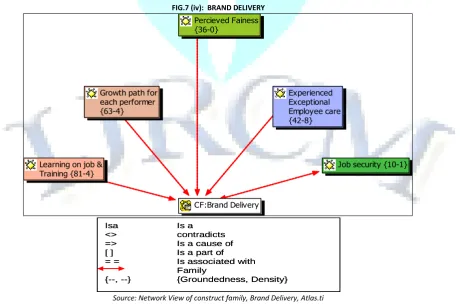
Brand Delivery essentially means delivering to the employee all that the brand promises.It starts at the time of an individual joining and has a significant impact at that time on whether the employee would feel high brand pride. Here is where best practices like ‘giving a feel of the job before joining’ or ‘assigning a buddy to find your feet’ etc. ensure that the new employee faces no dramatic surprises & experiences a soft landing. Additionally, the induction period or technically initial socialization goes a long way in instilling brand pride. Fig 7(iv) shows all the sub- constructs in the family of brand delivery.
FIG.7 (iv): BRAND DELIVERY
Source: Network View of construct family, Brand Delivery, Atlas.ti ==
CF:Brand Image
Size & Stature of the company as compared to competetion {39-1} inspirational
leadership {20-1}
Contribution to society {5-2} Brand Social
Visibility {28-2}
Starting salary package {4-1}
Customer centricity {23-2}
Value of Product, Service Quality & Ethics {11-1}
Percieved employee care {15-1} Infrastructural
recreational facilities {15-4}
Isa Is a
<> contradicts => Is a cause of [ ] Is a part of = = Is associated with
Family
{--, --} {Groundedness, Density}
Isa Is a
<> contradicts => Is a cause of [ ] Is a part of = = Is associated with
Family
{--, --} {Groundedness, Density}
CF:Brand Delivery Percieved Fainess {36-0}
Experienced Exceptional Employee care {42-8} Growth path for
each performer {63-4}
Job security {10-1} Learning on job &
Training {81-4}
Isa Is a
<> contradicts
=> Is a cause of
[ ] Is a part of
= = Is associated with
Family
{--, --} {Groundedness, Density}
Isa Is a
<> contradicts
=> Is a cause of
[ ] Is a part of
= = Is associated with
Family
VOLUME NO. 4 (2014), ISSUE NO. 10 (OCTOBER) ISSN 2231-5756
The sub-constructs that evolved under brand delivery were: I. Employee care (1) experience of exceptional employee care through life cycle in the job, (2) experiences of infrastructural & recreational facilities, (3) Employee friendly policies & processes (‘Rigorous’ in the context of ITES & ‘Flexible’ in the context of IT product companies) (4) Variety of rewards & recognition . II. Perceived fairness (5) Equal opportunity, (6) Transparent processes. III. Opportunities for learning & Development IV. Growth path for each performer through seamless opportunities for growth & advancement. As clear from the fig. 7(iv), the cumulative grounded ness score of brand delivery is 232, with learning & development and growth opportunities being large sub-constructs.
8. FINDINGS OF THE STUDY
This research study endeavors at finding out the role of the organizational people practices encompassing brand pride as a major construct in retaining the star performers of the organization.
The study was carried on in the selected organizations in the IT & ITES sector to explore what these knowledge based companies are doing to retain their mission critical talent. And it was found out that creating brand pride amongst the executives was a sure shot recipe for retaining people in the organizations. T he grounded theory and case study methodology was adopted to sail through the process of data collection in the selected organizations.
All the constructs within organizational practices were fairly well grounded and had reached theoretical saturation before they got included in the theory. The groundedness & density scores are shared in the output charts for each construct from Atlas.ti. According to this theory, the most highly grounded construct was brand bride, with cumulative groundedness score as 532. The sub- constructs for this are brand pride, brand image & brand delivery. Organizational practices on various fronts leading to building a great brand & delivering all that is promised, enabling pride in employees for belonging to that particular organization are part of this construct. Three main codes under the brand delivery also find special mention as they are amongst the highest grounded, generalized learning opportunities, growth for each performer, experienced exceptional employee care.
9. RECOMMENDATIONS AND SUGGESTIONS
SYSTEMATICALLY BUILD THE BRAND PRIDE
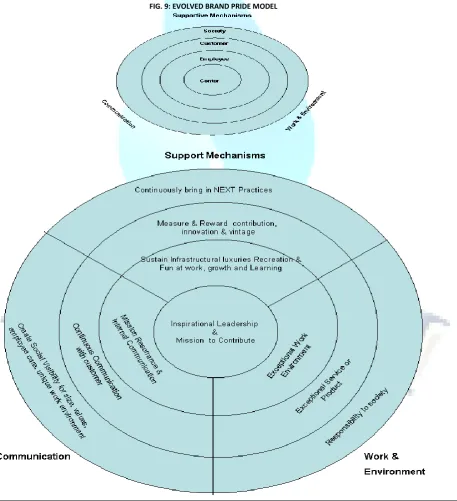
The research threw up that the most critical aspect of people stability in terms of people practices was ‘Brand Pride’. Most people were stable within the organization because they were proud to be there. This pride was related to multiple aspects of a brand image (built through various communication initiatives) and brand delivery (cemented through systematic employee care and development). The following model, fig. 9 is suggested to build Brand Pride.
VOLUME NO. 4 (2014), ISSUE NO. 10 (OCTOBER) ISSN 2231-5756
At the center of building Brand Pride is “A Mission to contribute” and “Inspirational Leadership”. Inspirational leadership need not be confused with charismatic leadership. A leader inspires by sharing a strong mission to make a contribution; she is inclusive in her approach; finally she is has a clear focus on growth and regeneration. Secondly, mission to contribute also need not be confused with ‘social entrepreneurship’. Contribution can be in multiple ways like providing easy and free access to all information or creating thousands of jobs or in some way making life easier for a particular segment of people. Once the critical contribution is articulated and continuously shared, it provides a direction and a glue to the core team. Finally, create social visibility for the values held by the organization or the significant contribution it is making for the customers.
Success should be defined and shared with passion amongst all the stake holders not merely in terms of size, stature or turnover of the organization vis-à-vis competition; it is defined in terms of the best contribution to the customer or community or society. For example, Genpact envisaged the number of jobs it could create while pioneering ITES in India; Infosys envisioned taking India on the Global IT platform and Google embarked upon free and easy access to unlimited knowledge to every individual seeking it.
Organizations can leverage the corporate communications function and systematically devise communications within the organizations as well as to the outside world, to build the brand image. People feel immense pride in working with the ‘best brains in the world’, communications on how they hire only the best in the bracket goes a long way in creating brand pride.
The organizations should set extremely high standards of delivery for both; the employees as well as the customers and then continuously beat their own standards. Right from physical environment management to the service delivery management, every thing needs to match the same quality standards; internal processes and mechanisms should be devised to ensure the same.
Finally, while measuring and tracking performance on each element of building brand is important, benchmarking for best practices is critical; the most important element is the continuous innovation of the ‘Next Practices’. With the customer and the employee at the center, the organization can form multiple think tanks for bringing out the next practices and staying ahead of times.
10. CONCLUSION AND IMPLICATIONS OF THE STUDY
In today’s information age it is very important for an organization to build brand pride amongst its people because that is one of the significant factors which can help the organizations in retaining their people , which is of course beneficial for both the organizations as well as the executives.
As evolved in the theory, Brand Image of an organization as a result of conscious practices of the organization is one of the most critical elements in retaining executives. Brand image encompasses, various competencies of the organization like; social visibility, size & stature as compared to similar other organizations, customer centricity & contribution to society, perceived employee care & infrastructural & recreational facilities for employees and inspirational leadership. . The review of extant literature, showed a lot of overlap between, the constructs of corporate image, brand image, employer brand and reputation. The corporate image basically encompasses an emotive reaction of employee or potential employee to the signals/ messages from the organizational system. The messages could be about the leadership reputation, the product or service quality or employee care. The image is usually a shared ‘sense making’ or meaning converted into a visual of ‘great place to work’ or ‘not a great place to work’. Empirical research shows that a good brand image does go a long way in attracting & retaining talent within the organization. Since the importance of brand image has been realized by the corporate world, a whole strategy of employer brand building both within and outside the company has gained significance.
However, one very critical dimension that evolved was that, the brand image was very important before joining an organization. Brand image was important during the tenure also to derive social pride, however, during the tenure brand delivery became very critical to keep employees motivated and equally engaged. The construct of brand delivery encompassed essentials that the employee came in taking for granted or rather hygiene factors of Herzber’s two factor theory of motivation. If these factors exceeded the expectations, then they had a significant contribution to the brand pride. On the contrary if these factors did not meet the competition benchmarks, they became sore points in the minds of people and lead to dissatisfaction and disengagement.
As clearly seen the construct brand delivery, practically encompasses everything that is there in an organization’s retention strategies. What makes it different is that the focus here is not merely strategy; it is a well engrained construct of meeting or keeping the promise made to any body as a potential employee or a current employee. The organization as a whole devises processes and systems that communicate the same in various ways to the employee.
Thus the findings of this study can be used by organizations facing the problem of executive retention by devising complete strategies to instill brand pride in the executives.
11. LIMITATIONS OF THE STUDY
One of the major limitations of the study is that it is limited to one representative sample for each IT ITES: Indian origin, MNC and Foreign origin MNC’s operating in India only. Organizational Practices leading to people stability that emerged as the most grounded were: 1) Brand Pride as a result of multiple practices to create an employer brand image & to ensure the delivery of the brand promise to the employees 2) Mission Resonance 3) Mentoring Supervisors 4) Friendships at work 5) Availability of Knowledge & Information when needed (to ensure success) 6) Opportunity to solve real problems & make a contribution 7) Nipping the negative energy at the bud .but in the present paper only brand pride as a construct in retaining the mission critical talent has been explored due to paucity of time constraint.
12. SCOPE FOR FUTURE RESEARCH
The scope of the research can be widened to more organizations to get better results. The other factors contributing to executive retention like Mission Resonance , Mentoring Supervisors , Friendships at work , Availability of Knowledge & Information when needed (to ensure success), Opportunity to solve real problems & make a contribution , Nipping the negative energy at the bud can be explored in detail as the current paper has examined only brand pride as a construct in retaining mission critical talent for the organization.
REFERENCES
1. Argyris, C. (1960). Understanding Organizational Behaviour. Dorsey Press, Inc. Homewood III.
2. Arlington, & Cunha, M. P. (2002). The best place to be: Managing control and employee loyalty in a knowledge-intensive company. The Journal of Applied Behavioral Science,38(4), 481-495.
3. Arnett, D. B., Laverie, D. A. & McLane, C. (2002). Using job satisfaction and pride as internal-marketing tools.Cornell Hotel and Restaurant Administration Quarterly, 43(2), 87-96.
4. Arnold, J., Coombs, C., Wilkinson, A., & Clarke, J. L. (2003). Corporate images of the United Kingdom National Health Service: Implications for the recruitment and retention of nursing and allied health profession staffet al. Corporate Reputation Review, 6(3), 223- 238.
5. Bernstein, A. (1998). We want you to stay, really.Business Week, 3583. 67-72.
6. Branham, L. (2004). 7 Hidden Reasons Employees Leave, the: How to Recognize the Subtle Signs and Act before It's Too Late.New York: American Management Association, 1.
7. Brown, P. A. & Golembiewski, R. T. (1974). The line-staff concept revisited: An empirical study of organizational images. Academy of Management Journal (pre-1986), 17(000003), 406-417.
8. Buchanan, I. (2009). Instilling a big company culture in a small enterprise.Strategic HR Review, 8(1), 47.
VOLUME NO. 4 (2014), ISSUE NO. 10 (OCTOBER) ISSN 2231-5756
10. Dukerich, J. M., Carter, S. M., Schultz, M., Hatch, M. J., & Larsen, M. H. (2000). Distorted images and reputation repair' in The Expressive Organization, Linking Identity, Reputation and the Corporate Brand. Oxford University Press, Oxford, UK.
11. Dyne, L. V. & Ang, S. (1998). Organizational citizenship behavior of contingent workers in Singapore. Academy of Management Journal, 41(6), 692-703. 12. Gadot, E. V. & Zion, E. B. (2004). Bright Shining Stars: The Mediating Effect of organizational image on the relationship between work variables and army
officers’ intentions to leave the service for a job in High-Tech industry. Public Personnel Management, 33(2), 201-223.
13. Gorman, B. (2007). Building the buzz, the brand and the business at Motorola. Strategic Communication Management, Chicago: 11(4), 24-27.
14. Heger, B. K. (2007). Linking the Employment Value Proposition (EVP) to Employee Engagement and Business Outcomes: Preliminary Findings from a Linkage Research Pilot Study.Organization Development Journal, Chesterland, 25(2), 121-132.
15. Highhouse, S., Zickar, M. J., Thorsteinson, T. J., Stierwalt, S. L. & Slaughter, J. E. (1999). Assessing company employment image: An example in the fast food industry. Personnel Psychology, Durham: 52(1), 151-172.
16. Kickul, J. & Lester, S. W. (2001). Broken Promises: Equity Sensitivity as a Moderator Between Psychological Contract Breach and Employee Attitudes and Behavior.Journal of Business and Psychology, New York, 16(2), 191.
17. Kickul, J. (2001). When organizations break their promises: Employee reactions to unfair processes and treatment.Journal of Business Ethics, Dordrecht, 29(4), 289-307.
18. Kickul, J. R., Neuman, G., Parker, C. & Fink, J. (2001), Settling the Score: The Role of Organizational Justice in the Relationship Between Psychological Contract Breach and Anticitizenship Behavior.Employee Responsibilities and Rights Journal, New York, 13(2), 77.
19. Levinson, H., Price, C., Munden, K., Mandl, H. & Solley, C. (1962). Men, management, and mental health., Harvard University Press. Cambridge, MA 20. McGovern, P., Stiles, P. & Hope, V. (1996). The flexible psychological contract: Career management in an era of insecurity. Management Research News,
Patrington, 19(4/5), 81-84.
21. Michaud, L.(2002). 5 Keys To Maximize Employee Retention.Source National Public Accountant, 47(1), 36
22. Pate, J. & Malone, C. (2000). Post- "psychological contract" violation: the durability and transferability of employee perceptions:the case of Time Tec. Journal of European Industrial Training, Bradford, 24(2/3/4), 158-166.
23. Post, J. E. & Griffin, J. J. (1997), The State of Corporate Public affairs, Result of the 1996 survey. Foundation for Public Affairs, Washington DC.
24. Rafaeli, A. (2000) Projecting an Organizational Identity: Lessons from Employment Advertisements. Corporate Reputation Review, London, 3(3), 218-239. 25. Riordan, M. R., Gatewood, R. D. & Bill, J. B. (1997). Corporate image: Employee reaction and implications for managing corporate social performance.
Journal of Business Ethics, 16, 401-412.
26. Robinson, & Sandra, L. (1996). Trust and breach of the psychological contract. Administrative Science Quarterly, Ithaca, 41(4), 574-599.
27. Robinson, Sandra, L., Kraatz, Matthew, S., Rousseau, & Denise, M. (1994). Changing obligations and the psychological contract: A longitudinal study, Academy of Management Journal, Briarcliff Manor, 37(1), 137.
28. Rousseau, D. M. (2001). Schema, promise and mutuality: The building blocks of the psychological contract. Journal of Occupational and Organizational Psychology, 74, 511-541.
29. Rousseau, D. M. :(1990). New hire perceptions of their own and their employer's obligations: A study of psychological contracts. Journal of Organizational Behavior, Chichester, 11(5), 389
30. Schuler, M. (2004). Management of the Organizational Image: A Method for Organizational Image Configuration. Corporate Reputation Review, London, 7(1), 37-53
31. Shapiro, Jacqueline, A. M & Coyle, (2002). A psychological contract perspective on organizational citizenship behavior. Journal of Organizational Behavior, Chichesterm,23(8), 927-946.
32. Smithson, J. & Lewis, S. (2000). Job insecurity changing the psychological contract?. Personnel Review, Farnborough, 29(6), 680-702. 33. Somaya, D. & Williamson, I. O. (2008). Rethinking the 'War for Talent. MIT Sloan Management Review, Cambridge 49(4), 29-34.
34. Sutton, Robert, I., Callahan, & Anita, L. (1987). The Stigma of Bankruptcy: Spoiled Organizational Image and Its Management. Academy of Management Journal, Briarcliff Manor, 30(3), 405
35. Thorsteinson, T. J., Palmer, E. M., Wulff, C. & Anderson, A. (2004). Too Good to Be True? Using Realism to Enhance Applicant Attraction. Journal of Business and Psychology,New York: Fall, 19(1), 125-137
VOLUME NO. 4 (2014), ISSUE NO. 10 (OCTOBER) ISSN 2231-5756
CONSUMER ATTITUDE AND PERCEPTION TOWARD BRANDS OF EDIBLE OIL: AN EMPIRICAL STUDY
AMITA SHARMA
ASST. PROFESSOR
COLLEGE OF MANAGEMENT & BUSINESS STUDIES
UTTARANCHAL UNIVERSITY
DEHRADUN
DR. D. S. CHAUBEY
DEAN
RESEARCH & STUDIES
UTTARANCHAL UNIVERSITY
DEHRADUN
ABSTRACT
Opening of Indian economy has enhanced the brand consciousness of customers. Today different brands of edible oil are available in the market. Consumers have specific preferences & choice & they evaluate them on the basis of aspects like price, quality, health & packaging etc. The present study undertaken to examine the consumer attitude and perception toward brands of edible oil. Researcher has tried to establish relationship between product quality with consumer satisfaction and brand loyalty. Data was collected from 323 customers in Dehradun city to analyse the demographic profile of customer and its relationship with brand preferences. It was found that quality is the main consideration in selecting the brand of edible oil. It is also seen that quality leads to satisfaction and further enhances the brand loyalty.
KEYWORDS
Edible Oil, Perception, Consumption pattern, preferences, Choice of Brand.
INTRODUCTION
dible oils constitute an important component of food expenditure in Indian households. Historically, India has been a major importer of edible oils with almost 30-40% of its requirements being imported till 1980s. In 1986, the Government of India established the Technology Mission on Oilseeds and Pulses (TMOP) in order to enhance the production of oilseeds in the country. The TMOP launched special initiatives on several critical fronts such as improvement of oilseed production and processing technology, additional support to oilseed farmers and processors besides enhanced customs duty on the import of edible oils. Consequently, there was a significant increase in oilseeds area, production, and yields until the late-1990s.
Today India is one of the largest producers of oilseeds in the world and this sector occupies an important position in the agricultural economy. The oilseeds area and output is concentrated in Central and southern parts of India, mainly in Madhya Pradesh, Gujarat, Rajasthan, Andhra Pradesh and Karnataka. Edible Oil is purified fat of plant or animal origin, which is liquid at room temperature.
Awareness, knowledge & exposure among consumer towards edible oil are also increasing, because of the level of education, urbanization and also the vast development in communication facilities. Packaging has become appropriate selling proposition now days, although edible oil industry is very competitive and consumers are numerously price conscious but still packaging make an impact on the consumer brand preference.
In edible oil industry, brand preference are more sensitive as compare to any other related industry. Health consciousness among consumer are increasing day by day. Because of these reasons, industry is becoming health sensitive and quality conscious. The edible oil industry is changing because today’s eating habits are shifting and creating new markets. While vegetable oils are becoming increasingly valuable in biofuels production, high energy prices and low margins put pressure on balance sheets in the edible oil industry.
An important characteristic of the Indian edible oil consumption pattern is the variation in preferences across regions, driven by taste and availability. The edible oil industry in India is characterized by intense competition and fragmentation ,with the presence of a large number of units attributable to low entry barriers such as low capital and low technical requirements of the business and a liberal policy regime (SSI reservation for traditional oilseeds and sales tax incentives by various state governments). Companies are trying to build up the brand using these elements into their marketing program. The growing health consciousness among the target market forces consumers not to compromise on its preferred brand.
LITERATURE REVIEW
Dr. J.H.Vyas, Imran N. Siddiqu ,Jay K. Dewangan (April 2013) study suggests that when the consumer purchase cooking oil higher importance is given to safety aspects, and the brand image of the cooking oil than the sales promotional schemes offered by the companies. Cooking oil marketers could take maximum efforts in designing the advertisements in such a way that the advertisements provide reliable and maximum information about the nutrition and health aspects, price of the oil.
Dhinesh babu & Venkateshwaran stated that the owners of the edible oil units should be trained to get more marketing knowledge to market their products. They should think global and act local. It implies that their product should be highly qualitative and also suitable to the local consumers. The attractive packaging plays an important role in the marketing of edible oils. All types of manufacturers should realize this fact and try to sell their products in attractive packets. It is not only attractive but also is reachable to all customers’ segments.
R Prerna (2013) in their study says that Quality is always important for any production. But it is more important in case of edible oil for reason that it is more related to health. Consumers analyze the price, quality, packaging aspects etc. before they buy the product and hence, it is up to the different brands of sunflower and groundnut oil manufacturers to concentrate on those aspects and workout better strategy to attract more consumers for their brands.
Syed Akif Hasan and Muhammad Zeeshan Khan stated that packaging characteristics influences the consumer brand preference in edible oil. whereas packaging characteristics has eight different dimensions i.e. various sizes of Package, different shapes Package, safety, shelf life, convenience of storage, convenience of use, extra use of package and package attractiveness. Study is also helpful to conclude the factors which are responsible for the increment of market share in edible oil industry by changing or modifying the packaging of product in competitive market.
Butz and Goodstein, (2006) found that demographic variables are the most popular bases for segments the customer groups, One reason is that consumer needs, wants, preferences and usage rates are often highly associated with demographic variables. Another is that demographic variables are easier to measure (Kotler, Philip, and Gary Armstrong, 2006).
N. Rajaveni & Dr. M. Ramasamy study suggests that strongly packaged brand should offer protection and carve out for a point of difference that can protect the brand against competitor activity through trade marking. It is also important to remember that the world is full of cultural and linguistic difference. What works
VOLUME NO. 4 (2014), ISSUE NO. 10 (OCTOBER) ISSN 2231-5756
in one market doesn’t always work in another. The bottom line for business is that packaging design will almost always have an effect on a company’s profit and loss.
OBJECTIVES OF THE STUDY
This study has following objectives:
To analyse the demographic profile of customer and its relationship with brand preferences.
To identify the factors influencing customers in building their preferences from normal product to branded products.
To identify the factors of brand switching.
To draw conclusions and suggestions on the basis of study.
RESEARCH METHODOLOGY
To complete this study primary as well as secondary source of information is used. To study the consumer attitude & brand preferences of edible oils, primary datais collected by using a detailed structured questionnaire which was administered to a sample of 323 selected on the basis of convenience sampling method. The study has been carried out in Dehradun city. The secondary data is collected from published thesis, reputed journals, magazines and related websites. The data so collected is scrutinized, tabulated, analyzed and finally used for the study purpose. For the calculation and analysis of data statistical tools 9Mean, SD, ANOVA and other statistical techniques are used.
HYPOTHESIS
H0: Consumers attitude and perception toward edible oil does not differs significantly across the level of income and education . H1: Consumers attitude and perception toward edible oil does not differs significantly across the level of income and education .
FINDING & DISCUSSION
TABLE 1: DEMOGRAPHIC CHARACTERISTICS OF RESPONDENTS
Category Count Percentage
Gender Male Female
214 109
66.3 33.7 Marital Status Married
Unmarried 183 140 56.7 43.3 Age
Less than 20 years From 21-30 Years From 31-40 Years Above 40 Years
5 190 82 46 1.5 58.8 25.4 14.2 Family Size Up to 3 Members
4-5 members 6-8 members 9-10 members More than10 members
201 64 22 1 35 62.2 19.8 6.8 0.3 10.8 Education Level
Matric & below Under Graduate Graduate Post Graduate
Professional qualification, if any 1 74 25 153 70 .3 22.9 7.7 47.4 21.7 Income Level Below 15000 PM
15,000 to 30,000 PM 30,000 to 50,000 PM 80,000 and above PM
91 223 8 1 28.2 69.0 2.5 .3
Total 323 100
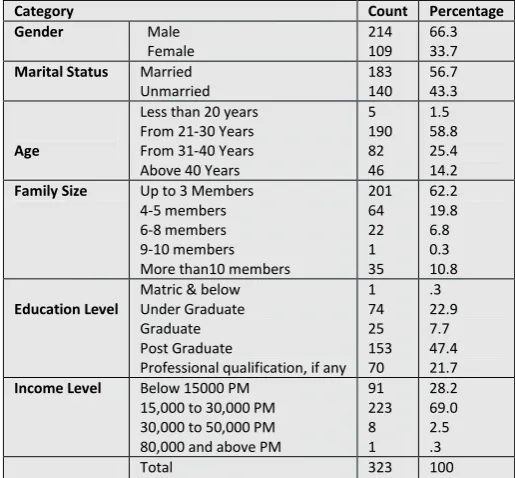
The information presented in the above table no 1 shows that out of 323 respondents, 66% are males and only 34% are females which implies that males where more than the females in the gender category of respondents. Majority of the respondents (57% ) are married and only 43% are unmarried which reveals that majority of respondents are married. Age wise classification is considered to be an attribute of demographic profile, the analysis presented in the above table reveals that sample is dominated by the young category of respondent ranging in the age group of 21-30 years as it contributes 58.8% in the sample while least number of respondents are less than 20 years of age. Almost 62% of the people having a small family of upto 3 member as no of family members describe the consumption pattern of households. Majority that is 62% of respondents are post graduates. With regards to employment status majority that is 69% have income between 15,000-30,000.
TABLE 2: MOST PREFERRED BRAND
Sl .NO Description Number of Respondents Percentage
a Suffola 99 30.7
b Fortune 167 51.7
c Sundrop 20 6.2
d Dalda 35 10.8
e Other, Please specify 2 .6
Total 323 100
Today there is stiff competition among the edible oil industries. Companies are trying their best to build up the brand for differentiating the product. Brand Preferences represents which brands are preferred under assumptions of equality in price and availability. As seen in table 2 out of total 323 respondents almost 51.7% people prefer Fortune,30.7% people prefer Suffola oil & only 10.8% people prefer Dalda ,maximum percentage of people prefer Fortune brand.
TABLE 3: SOURCE OF INFORMATION
Sl NO Description Number of Respondents Percentage
a Family 113 35.0
b Friend 77 23.8
VOLUME NO. 4 (2014), ISSUE NO. 10 (OCTOBER) ISSN 2231-5756
Media plays a major role in a consumer’s buying decision-making process. There are many ways for customer to get information about various brand of edible oil. Advertising is used through various media to generate brand awareness within consumers. They can be aired as radio ads, television commercials, internet etc. As per the above table 3 out of 323 respondents maximum percentage that is 40% of respondents gets the information about the brand through Advertisement, 35% knows about the brand through family members,23% gets information from friends & only 0.3% gets information from retailers.
TABLE 4: MONTHLY SPENDING PATTERN ON EDIBLE OIL Sl NO Description Number of Respondents Percentage a Less than Rs. 500 97 30.0 b From 500 to 1000 198 61.3 c From Rs. 1000 to 1500 5 1.5 d Rs 1500 & above 23 7.1
Total 323 100.0
The above table shows that 61.3% of respondents spend 500 to 1000 rupee on monthly basis on edible oil, 30% spend less that 500 rupee per month,7.1% spend 1500 and above & only 1.5 % people spend Rs 1000 -1500 on edible oil.
TABLE 5: FREQUENCY OF PURCHASE
Sl NO Description Number of Respondents Percentage a Once in a month 89 27.6
b 2-3 times 198 61.3
c 4-5 times 1 .3
d More than 5 times 35 10.8
Total 323 100.0
The information presented in the table 5 reveils that maximum percentage ( 61.3% ) of respondents purchase edible oil 2-3 times in a month. Buying oil is not a daily affair, hence the production and stocking needs to be aligned with this behaviour.
TABLE 6: DURATION OF USING SINGLE BRAND OF EDIBLE OIL Sl NO Description Number of Respondents Percentage a Less than 3 months 90 27.9
b Upto 6 months 57 17.6
c Upto 1 year 42 13.0
d Always using Single brand 134 41.5
Total 323 100.0
Brand loyalty, in marketing, consists of consumer resistance to change the brand or a consumer's commitment to repurchase or other positive behaviors such as word of mouth advocacy infavour of brand . As seen in Table.6 almost 41.5% of the respondents always prefer single brand, that means consumers are satisfied with their existing brands, Fortune & they don’t want to switch to another brand of edible oil.
TABLE 7: AMOUNT OF MONTHLY CONSUMPTION Sl NO Description Number of Respondents Percentage
a 1 ltr 107 33.1
b 5 ltr 213 65.9
c 10 ltr 3 .9
Total 323 100.0
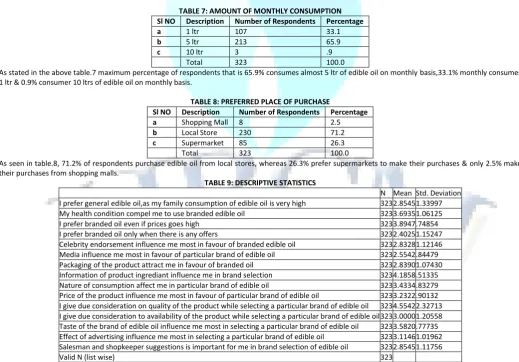
As stated in the above table.7 maximum percentage of respondents that is 65.9% consumes almost 5 ltr of edible oil on monthly basis,33.1% monthly consumes 1 ltr & 0.9% consumer 10 ltrs of edible oil on monthly basis.
TABLE 8: PREFERRED PLACE OF PURCHASE
Sl NO Description Number of Respondents Percentage a Shopping Mall 8 2.5 b Local Store 230 71.2 c Supermarket 85 26.3
Total 323 100.0
As seen in table.8, 71.2% of respondents purchase edible oil from local stores, whereas 26.3% prefer supermarkets to make their purchases & only 2.5% make their purchases from shopping malls.
TABLE 9: DESCRIPTIVE STATISTICS
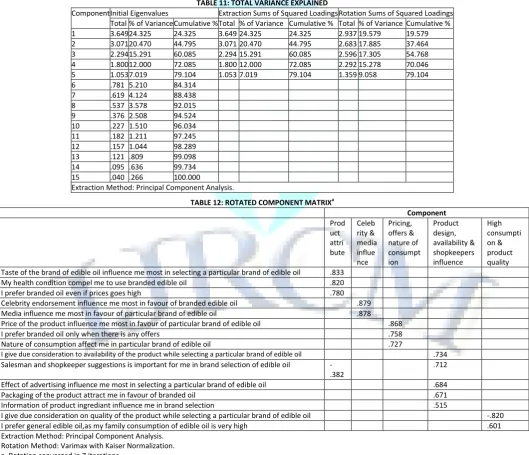
N Mean Std. Deviation I prefer general edible oil,as my family consumption of edible oil is very high 323 2.8545 1.33997 My health condition compel me to use branded edible oil 323 3.6935 1.06125 I prefer branded oil even if prices goes high 323 3.8947 .74854 I prefer branded oil only when there is any offers 323 2.4025 1.15247 Celebrity endorsement influence me most in favour of branded edible oil 323 2.8328 1.12146 Media influence me most in favour of particular brand of edible oil 323 2.5542 .84479 Packaging of the product attract me in favour of branded oil 323 2.8390 1.07430 Information of product ingrediant influence me in brand selection 323 4.1858 .51335 Nature of consumption affect me in particular brand of edible oil 323 3.4334 .83279 Price of the product influence me most in favour of particular brand of edible oil 323 3.2322 .90132 I give due consideration on quality of the product while selecting a particular brand of edible oil 323 4.5542 2.32713 I give due consideration to availability of the product while selecting a par