CONCENTRATION VARIATIONS OF MAJOR AND
MINOR ELEMENTS ACROSS VARIOUS
ALTERATION ZONES IN PORPHYRY COPPER
DEPOSIT AT SUNGUN, EAST AZARBAIDJAN, IRAN
A.A. Calagari
*Department of Geology, Faculty of Natural Sciences, Tabriz University, Tabriz 51664, Islamic Republic of Iran
Abstract
The porphyry copper deposit at Sungun is located in East Azarbaidjan, NW of
Iran. The Sungun porphyries (Oligo-Miocene) occur as stocks and dikes and intruded
a series of Oligocene pyroclastics and lavas, Eocene arenaceous-argillaceous rocks,
and Upper Cretaceous carbonates. The porphyry stocks are divided into two groups,
1) porphyry stocks I (quartz monzo-diorite) and 2) porphyry stock II (quartz
monzonite, granodiorite, and granite). Porphyry stock II hosts the copper and
molybdenum ores. Numerous and various cross-cutting veinlets and micro-veinlets of
quartz, sulfides, sericite, carbonates, and sulfates were developed in porphyry stock
II. Three distinct types of hydrothermal alterations and sulfide mineralizations are
recognized at Sungun; 1) hypogene, 2) contact metasomatic, and 3) supergene. The
vertical variations in concentration of 12 elements (S, Cu, Mo, K, Rb, Ca, Sr, Na, Mg,
Fe, Al, and Si) across various hypogene alteration zones at Sungun demonstrate that
S, Cu, Mo, Fe, K, and Rb are mainly concentrated in the phyllic and potassic-phyllic
zones where the abundance of Ca, Sr, Mg, and Na are appreciably low relative to the
potassic zone. The values of Al and Si are relatively high in the supergene zones and
their abundance gradually decrease downward toward the potassic zone. The copper
and molybdenum are substantially localized in the phyllic and potassic-phyllic zones
particularly in the central part of the mineralized porphyry stock where the rocks
underwent severe stockwork-type fracturing and micro-fracturing. Their
concentrations are relatively low in the potassic zone.
Keywords: Porphyry copper; Veinlets and micro-veinlets; Concentration variation; Hypogene alterations; Major and trace elements
* E-mail: [email protected] Introduction
The earliest work on geochemistry (fluid inclusions) of the porphyry copper deposit (PCD) at Sungun was
aspects including petrology, alteration, mineralization, and geochemistry at Sungun. In 1994, over 100 diamond drill holes (DDH) in a grid pattern were dug at Sungun main ore body. Calagari [1], based upon systematic subsurface data, carried out relatively more detailed studies on various geological features at Sungun. Additional studies on “controls of alteration and mineralization” and “factors controlling copper stability on Sungun PCD” were presented by Hezarkhani and William-Jones [6] and Hezarkhani et al. [7], respectively. The following study considers the migration, concentration, and re-distribution of major and some minor elements (e.g., Rb, Sr, S, Cu, and Mo) in relation to the alteration and mineralization processes at Sungun.
Geology (background)
The Sungun PCD is located ~100 km NE of Tabriz in East Azarbaidjan, NW of Iran (see inset in Fig. 1). The Sungun porphyries are of Oligo-Miocene age, and intruded Upper Cretaceous carbonate rocks, a series of Eocene arenaceous-argillaceous rocks, and a series of Oligocene pyroclastics and lavas (Fig. 2; [3,8]). The Sungun hypabyssal intrusives, calc-alkaline in character, occur as stocks and dikes. The stocks are divided into two groups, 1) porphyry stocks I (principally quartz monzo-diorite) and 2) porphyry stock II (quartz monzonite through granodiorite to granite) which hosts the Sungun PCD. Dikes are categorized into four series (DK1, DK2, DK3, and DK4)
varying in composition from quartz monzonite to granodiorite [1]. Late Tertiary-Quaternary volcanic rocks ranging in composition from latite to andesite cover some parts of Sungun porphyries (Fig. 2; [3,8]).
Three distinct types of hydrothermal alterations and sulfide mineralizations occurred at Sungun, 1) hypogene, 2) contact metasomatic, and 3) supergene [1]. The development of pervasive hypogene alteration and sulfide mineralization were intimately associated with intense stockwork-type hydro-fracturing manifested by numerous cross-cutting veinlets and micro-veinlets of quartz, sulfides, sericite, carbonates, and sulfates [2]. The hypogene alterations are divided into four types, 1) potassic, 2) potassic-phyllic, 3) phyllic, and 4) propylitic. The types 1, 2, and 3 were mainly developed within porphyry stock II, whereas the propylitic is present chiefly in peripheral porphyry stocks I and some dike series (e.g., DK2 and DK3). Contact metasomatic
(skarn) occurred as patches along the contact of porphyry stock II with the Upper Cretaceous carbonates. Two distinct supergene alteration zones were recognized at Sungun, 1) oxidized and leached zone and
2) supergene sulfide zone. Hypogene mineralization occurred primarily as disseminations and as fillings in the fractures and micro-fractures. The sulfide minerals (mainly pyrite, chalcopyrite, and molybdenite) are principally concentrated in the phyllic and potassic-phyllic alteration zones.
Method of Investigation
To investigate the chemical variations of the rocks associated with hydrothermal alteration and mineralization along B-B′ direction in the porphyry stock II (Fig. 1), 15 samples from surface and 70 from diamond drill cores were chosen for chemical analysis (Fig. 2). The pulverized samples were chemically analyzed for 12 major and minor elements using X-ray fluorescence (XRF) technique at the department of Earth Sciences, Manchester University. Dike series were excluded in this study.
Geochemistry
Vertical Concentration Variations
The concentration variations of 12 elements (S, Cu, Mo, Rb, K, Sr, Ca, Na, Mg, Fe, Al, and Si) in samples from three DDH (B99, B7, and B13) along the B-B′
direction against elevations (from sea level) were studied (Fig. 3). The distribution of these elements were affected primarily by hypogene alterations, supergene processes, and local shear and fault zones.
DDH B99
Two thin skarn patches are present in DDH B99 (Fig.
3a). The sample from the skarn zone (at elevation ~1800 m) shows a sudden increase in S, Cu, Fe, Ca, and Mg, and a decrease in K, Al, and Si.
The sulfur concentration curve shows two conspicuous peaks at elevations ~1800m (~11.2%) near the skarn zone and 1760m (~8.5%) in the phyllic zone which are due to the high sulfides (principally pyrite) content. The samples below the elevation 1760m have sulfur content within the range of 2.7% to 5.6%.
Disregarding the very low concentration (<0.1%) at elevation 1760m in the phyllic zone and the anomalous peak (~1.4%) within the elevations 1795-1815m in the skarn and supergene sulfide zones, the copper concentration in the rest of the samples in this DDH varies from ~0.25% to ~0.6%.
The overall concentration of Mo remains relatively low (<90 ppm) across the various alteration zones.
The Rb and K2O curves typically match one another.
The K2O content in the skarn (~0.06%) and kaolinized
Figure 1. A modified and simplified geologic map (after Mehrpartou, 1993) and a cross section along A-A′
profile in the Sungun area. The dashed rectangle at the top shows the area where over 100 DDHs were dug. The
filled circles on the B-B′ and C-C′ cross lines are the locations of the studied DDHs. The inset is an index map of
Figure 2. An E-W profile along B-B′ direction in porphyry stock II showing the locations of surface and sub-surface samples from
which XRF data were acquired. Shown on this figure are also the positions of the 13 diamond drill holes, various hypogene and supergene alteration zones, and hydrothermally developed stockwork-type breccia zone.
remains high (~3.5-5.5%) across phyllic and potassic-phyllic zones.
The Sr abundance is low in the supergene sulfide, skarn, and phyllic zones, and displays sudden increase in the potassic-phyllic zone.
Irrespective of the skarn zone, the Ca abundance is low (<0.2%) in the supergene sulfide and phyllic zones, and shows an increase in the potassic-phyllic zone. Its abrupt increase at elevation 1545m in the potassic-phyllic zone is due to the presence of gypsum veinlets which also caused a corresponding increase in sulfur content at this level.
The Na abundance in the skarn, supergene sulfide, and phyllic zones is low (<0.5%) with no noticeable variation. However, its concentration shows an increase in the potassic-phyllic zone.
The MgO content of the rocks in the supergene
sulfide (~9.75%) and skarn (~5.35%) zones is relatively high which is due to the high chlorite content in the former and presence of considerable amounts of Mg-bearing silicates (e.g., chlorite and diopside) in the latter. Its concentration is low (<1.35%) in the phyllic zone, but shows an overall increase toward the potassic-phyllic zone.
The high amounts of pyrite and chalcopyrite in the supergene sulfide zone and considerable amounts of pyrite and Fe-bearing silicates in the skarn zone account for the high Fe2O3 content in these alteration zones. The
Fe concentration in the phyllic zone is relatively high and shows a decrease toward the potassic-phyllic zone.
DDH B7
This DDH is located within the intense stockwork-type brecciation zone in porphyry stock II (see Fig. 2). The rocks were heavily hydro-fractured and contain high density of the veinlets and micro-veinlets.
Except the sample taken from the surface, almost all the subsurface ones from the hypogene and supergene alteration zones in this DDH (Fig. 3b) show sulfur content >2%. The sulfur curve displays two conspicuous positive anomalies at elevations ~2070 m (~6%) in the supergene sulfide zone (where the sulfide content is very high), and at 1700 m (~7.6%) in the potassic-phyllic zone (where the gypsum veinlets and micro-veinlets are present).
The abundance of copper is relatively high in the phyllic and potassic-phyllic zones. Its curve shows two positive peaks (~2%) in the supergene sulfide zone (where supergene Cu-bearing sulfides such as covellite and chalcocite are present) and at the contact of potassic-phyllic and phyllic zones (where the chalcopyrite content is high).
The Mo curve features relatively two striking anomalies (>1100 ppm) in the middle of the oxidized and leached zone and at elevation ~2025 m in the lower part of supergene sulfide zone.
The amounts of K2O, in general, is high (>5%) and
show minor local fluctuations. Rb curve well mimics the K2O curve.
Disregarding the effect of gypsum veinlets and micro-veinlets in the potassic-phyllic zone, the CaO curve remains almost flat across alteration assemblages.
The Na2O content is generally low (<1%) and the
majority of the samples show Na2O <0.5%.
Except a few samples at elevations ~1840 m (~6%), ~1790m (~3.4%), and ~1720m (~3%), almost all samples show the MgO content <2.5%.
The Fe2O3 curve shows iron enrichment in the
middle of the oxidized and leached zone where considerable amounts of jarosite and minor amounts of Fe-oxides are present. However, the highest Fe2O3 value
(6.5%) belongs to the heavily fractured rocks at elevation ~2000 m where they contain high amounts of sulfides (principally pyrite and chalcopyrite) and minor amounts of Fe-oxides (goethite).
Although displaying minor fluctuations, the Al2O3
content of the rocks remain within the range of 17.5-19.5%. Its concentration is also relatively high (19.5-21%) in the oxidized and leached zone, and increases up to ~25.5% in the upper part of the supergene sulfide zone where the rocks suffered intense kaolinization. The kaolinized rocks in the oxidized and leached zone contain relatively high SiO2 (~65-70%). Except minor
variations, the SiO2 content in the supergene sulfide and
phyllic zones ranges from 62-66%, however, its concentration shows a decrease in the potassic-phyllic zone.
DDH B13
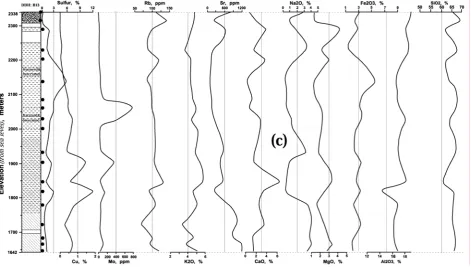
There is no noticeable variations in concentration of the elements at the border of the phyllic and potassic-phyllic zones in DDH B13 (Fig. 3c). However, at the
border of the potassic and the potassic-phyllic zones, the abundance of S, Cu, Sr, Na2O, and MgO displays a
shift.
The abundance of sulfur in the oxidized and leached zone is negligible (<0.1%). Its overall concentration in the phyllic, potassic-phyllic, and potassic zones is low (<2.5%), and its local anomalies are due to the realtively high sulfide (mainly pyrite and chalcopyrite) content of the samples.
The copper concentration in the supergene zone is very low (<0.1%), and gradually increases downward toward the phyllic and potassic-phyllic zones. Its curve shows two local anomalies at elevations ~1905 m (~1.4%) and ~1820 m (~1.8%) in the potassic-phyllic zone where the Cu-bearing sulfides (chiefly chalcopyrite) are relatively high. Its abundance decreases in the potassic zone.
The Mo curve exhibits a peak (670 ppm) in the lower part of the phyllic zone (at elevation around 2050 m) where the rocks were severely fractured and contain molybdenite and quartz-molybdenite micro-veinlets. Besides the peak (~340 ppm) at elevation ~1905 m, the Mo content in the rest of the samples is <130 ppm.
The K2O content of the rocks in all supergene and
hypogene alteration zones ranges from 3.7% to 5.65%. Its curve mimics very well the Rb one.
Disregarding the sample from surface outcrop, almost all samples in the supergene, phyllic, and potassic-phyllic zones show Sr content <600ppm, however, its concentration increases toward the potassic zone.
The CaO and MgO curves at elevations ~2290 m, ~2200 m, and ~1850 m show positive peaks which are due to the presence of calcite-dolomite content of the rocks. Apart from these peaks, their concentrations in the supergene and hypogene alteration zones remain low and almost constant. However, the MgO curve shows an overallincrease toward the potassic zone.
Besides three peaks belonging to the rocks from the surface (~2.9%) and elevations ~2230 m (~3.15%) and ~1930 m (~3%), the Na2O content of the rest of the
Figure 3. (a). Explanation on next page.
Figure 3. Vertical concentration variations (wt%) of 12 elements across various hypogene and supergene alteration zones in three
diamond drill holes along B-B′ direction in porphyry stock II; a) in DDH B7, b) in DDH B13, and c) in DDH B16. The filled circles on
the right side of the alteration column are the locations of the analyzed samples.
The Fe2O3 curve features one conspicuous positive
peak (~5.5%) at elevation ~2140 m in the phyllic zone where the sulfide content (particularly pyrite) is high. The Fe2O3 concentration, in general, is relatively low
with minor fluctuations across the alteration assemblages.
The Al2O3 and SiO2 curves do not show discernible
variations in various alteration zones, however, samples showing relatively low values of Al and Si, contain higher amounts of sulfides and carbonates instead.
Two-Dimensional Vertical Variations of Cu and Mo
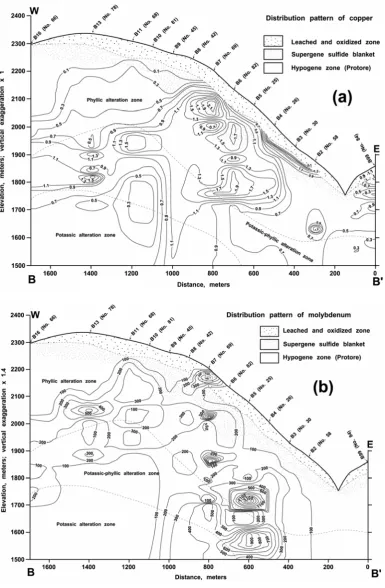
The abundance variations of copper and molybdenum along B-B′ profile are presented in the form of contoured 2-dimensional patterns.
The distribution pattern of copper (Fig. 4a) demonstrates that it is entirely depleted in the leached and oxidized zone, and shows an abrupt increase in abu-ndance in the supergene sulfide zone. In the hypogene alteration zones, it is mainly concentrated in the phyllic and potassic-phyllic zones and its abundance decreases downward toward the center of the potassic zone.
The distribution pattern of molybdenum (Fig. 4b)
also exhibits enrichment mainly in the phyllic and potassic-phyllic zones. The density of Mo contours of equal concentration in DDH BB7, B6, and B5 clearly indicates that Mo is mainly localized in the intensely hydro-fractured zone where relatively high density of molybdenite and quartz-molybdenite micro-veinlets exists. Its abundance decreases toward the center of the potassic zone. It is depleted in the upper parts of the phyllic zone as well as in the supergene zones. However, It shows an anomalous site in the oxidized and leached zone in DDH B7 which may be due to the
presence of ferrimolybdite [Fe2(MoO4)3.15H2O].
Summary and Conclusions
Figure 4. Contoured 2-dimensional pattern of concentration variations for a) copper (wt%) and b)
molybdenum (ppm) along B-B′ direction in porphyry stock II. The locations of diamond drill holes and the
The sulfur is strongly leached out from the leached and oxidized zone, however, some (<2%) was fixed locally (e.g., in DDH B7) as jarosite. Its local anomalies
in the phyllic and potassic-phyllic zones are due to the presence of anomalous amounts of sulfides (mainly pyrite) and/or gypsum. Its overall concentration, which is intimately affiliated with sulfide content of the rocks, is greater in the east (DDH BB99) and middle (DDH B7) of the porphyry stock II, and gradually decreases toward the west (DDH B13).
The copper is concentrated highly in the phyllic and potassic-phyllic, and moderately in the potassic zones where Cu-bearing sulfides (mainly chalcopyrite) are present. It was almost entirely leached out from the oxidized and leached zone, but remarkably enriched in the supergene sulfide zone (particularly in the DDH B7,
BB6, B5, B4, B3, B2, and B99.) where it was fixed as covellite and chalcocite.
The overall concentration of the Mo in the supergene zone is very low, however, the local anomaly in this zone may be due to the presence of ferrimolybdite, though it was not microscopically detected. It also shows low abundance in the potassic zone. It is mainly concentrated within the phyllic and the potassic-phyllic zones. Its abundance is relatively greater in the DDH B7, B6, and B5 where the rocks
suffered intense stockwork-type brecciation and contain high density of molybdenite and quartz-molybdenite micro-veinlets.
The K2O is mainly enriched in the phyllic and
potassic-phyllic zones and its abundance decreases toward the potassic zone. The Rb distribution pattern strikingly mimics that of the K2O. Due to similarity of
ionic radii, electronegativity, and ionization potential, Rb and K are intimately associated. Thus, Rb is preferentially incorporated in K-bearing minerals and any variation in concentration values of K will show a corresponding change in Rb values. This accounts well for the similarity of their abundance variations.
The overall abundance of CaO, Sr, MgO, and Na2O
in the phyllic, potassic-phyllic, and supergene zones are low and their abundance relatively increases toward the potassic zone.
Strontium is geochemically associated with Ca in igneous rocks, and its abundance variations are normally dependant on the Ca content of the rocks. This relationship is more pronounced in samples having relatively higher amounts of Ca-bearing silicates.
Sodium and calcium are the major components of plagioclase which was altered almost entirely (in the phyllic and potassic-phyllic zones) to moderately (In the potassic zone) to sericite. Sericitization caused extensive removal of Na and Ca from silicates and
fixation of K in sericite. Weathering brought about further removal of Na and Ca from the supergene alteration zones. The local anomalies of CaO pertain to the presence of carbonates (calcite and dolomite) and sulfates (gypsum) veinlets. These veinlets caused the distribution pattern of CaO and Sr not to match one another in these localities.
The relatively low Na2O content of the rocks (<2%)
in the phyllic, potassic-phyllic, and supergene alteration zones indicates its substantial removal from Na-bearing silicates in these zones. Its abundance, however, exhibits a sharp increase in the potassic zone.
The Mg concentration in the supergene, phyllic, and potassic-phyllic zones remains low and almost constant which indicates that it was significantly removed during hypogene alterations, and the supergene processes did not play an effective role in its re-distribution. Its abundance increases toward the potassic zone where the primary and secondary biotites are present. Its local anomalous concentrations are due to the high content of Mg-bearing silicates (e.g., chlorite and/ or diopside) and/or dolomite.
The iron is relatively enriched in the phyllic zone where the amount of pyrite is relatively high, and its abundance gradually decreases downward toward the potassic-phyllic and potassic zones. Its local anomalies (Fig.3c) also pertain principally to the high pyrite content in the sample. The relatively high abundance of Fe2O3 (~2.5-5%) in the oxidized and leached zone (Fig.
3, b and c) is due to the presence of Fe-oxides (hematite, goethite, and limonite) and jarosite.
The Al2O3 and SiO2 are relatively more abundant in
the supergene zones (Fig. 3, b and c) where the rocks underwent supergene kaolinization process. Their concentrations in the hypogene alteration zones remain nearly constant. However, samples containing relatively high density of quartz veinlets and micro-veinlets display greater SiO2 values. On the other hand, samples
possessing substantial amounts of sulfides (mainly pyrite) and/or carbonates show lower amounts of Al and Si.
Acknowledgements
References
1. Calagari A.A. Geochemical, stable isotope, noble gas,
and fluid inclusion studies of mineralization and alteration at Sungun porphyry copper deposit, East Azarbaidjan, Iran: Implication for genesis. Ph.D. thesis, Manchester University, Manchester, p. 537 (1997).
2. Calagari A.A., Pattrick R.A.D. and Polya D.A. Veinlets
and micro-veinlets studies in Sungun porphyry copper
deposit, East Azarbaidjan, Iran. Quarterly Journal of
Geosciences, Geological Survey of Iran, 10:(39-40): 70-79 (2001).
3. Emami M.H. and Babakhani A.R. Studies of geology,
petrology, and litho-geochemistry of Sungun Cu-Mo deposit. Iranian Ministry of Mines and Metals, p. 61 (1991).
4. Etminan H. The Discovery of Porphyry
Copper-Molybdenum Mineralization adjacent to Sungun Village in the northwest of Ahar and a proposed program for its
detailed exploration. Confidential Report, Geological
Report, Geological Survey of Iran, p. 26 (1977).
5. Ghaderi M.. Consideration of economic geology of the
Sungun copper deposit, Ahar. M.Sc. thesis. Geology department, Shahid Beheshti University, Tehran (1991).
6. Hezarkhani A. and Williams-Jones A.E.. Controls of
alteration and mineralization in the Sungun porphyry copper deposit, Iran: Evidence from fluid inclusions and
stable isotopes. Econ. Geol., 93: 651-670 (1998).
7. Hezarkhani A., Williams-Jones A.E. and Gammons C.H..
Factors controlling copper solubility and chalcopyrite deposition in the Sungun porphyry copper deposit, Iran. Mineralium Deposita, 34: 770-783 (1999).
8. Mehrpartou M.. Contributions to the geology,
geochemistry, Ore genesis and fluid inclusion investigations on Sungun Cu-Mo porphyry deposit, northwest of Iran. Ph.D. dissertation, University of
Hamburg, Germany, p. 245 (1993).
9. Momenzadeh M., Akrami M. and Arabiah H. Alteration