The last music on earth: Prehistory and the function of music in The Road
Henry Dale
Email: [email protected]
Abstract
The Road by Cormac McCarthy is a novel that has been the subject of much critical success and debate, perhaps to the point of saturation. The Road tells the story of an unnamed man and boy as they travel south in a post-apocalyptic wasteland, empty of nature, life and safety. It is a struggle not only for their survival but also for what remains of, or what is meant by, humanity.
This paper discusses the function of music in The Road based upon the twice-occurring mention of a flute, extrapolating on Randall Wilhelm’s concept of still life in The Road to provide a detailed close reading of this image. The flute is a remnant of the human and humanity, and it is also a link to our prehistoric ancestors. While it may initially appear to be an item of superficial insignificance, this paper will argue that the flute is not only central to understanding the text, but also located structurally within cave imagery present throughout The Road.
Despite the amount of literature already produced on The Road, it remains a prescient work, tapping into contemporary fears of nuclear war or environmental disaster. The Road will not disappear, and this article serves to discuss new territory in the form of the flute and music.
Introduction
In the introduction to his essay ‘“Golden chalice, good to house a god”: Still life in The Road’, Randall Wilhelm remarks that Cormac McCarthy is notable as an author for his inclusion of ‘visual structures and tropes’, using them to structure narratives of good opposing evil, acting as
explanatory images of this divide for the reader (Wilhelm, 2007, p. 1). Stemming from ancient Egyptian and Hebrew cultures, still life has ‘always encoded its object as metaphorical
transactions‘, that is, an object is never an object, but what the object represents (Wilhelm, 2007, p. 3). To quote Wilhelm once more (p. 3):
Many of these textual images can be read through a variety of critical lens [sic] that imbue the scenes with a multi-voiced presence depending on how we look at them[.]
By providing a definition of still life that can be applied to texts, Wilhelm is creating a base from which to analyse objects within The Road. Although the presentation of the flute is not strictly inside the realms of still life, those being inanimate objects laid upon a table, Wilhelm’s base does provide a framework within which to study the flute and its possible connections.
Within The Road, an understanding of still life becomes a crucial aspect to any reading, as The Road and its geographical counterpart are so wholly devoid of discernible imagery that even the smallest man-made article serves to speak for a deeper meaning. Wilhelm notes, for example, that a tin of pears the man and boy find in an untouched, secure bunker relates to a biblical tradition of the pear being symbolic of redemption. The bunker provides them with a brief respite from the horrors of the world. Wilhelm remarks that, in contrast to the pears, the apples that the man finds shortly after this scene are representative of ‘the Fall’, the expulsion of Adam and Eve from the Garden of Eden (Wilhelm, 2007). While the apple is a recognisable trope in our culture and while there are specific items in the novel which have incited much debate, such as the can of Coke, Wilhelm does not make mention of the flute, the article of discussion in this essay.
In an essay on the disintegration of language in The Road, Saliba does make reference to the flute, referring to it as a ‘wonderful trope for sound, beauty, nature and language’ (Saliba, 2012, p. 145). This does not cover the possible meanings attached to sound or language, and it does not refer to their combination, music. The flute itself is a fascinating object, and the paragraph under scrutiny demonstrates a relation between the flute and storytelling, folklore, and, perhaps, the traveller. It is the intention of this essay to further explore the image of the flute, drawing on Saliba’s and Wilhelm’s research as focal points from which to form an analysis.
In the morning they came up out of the ravine and took to the road again. He’d carved the boy a flute from a piece of roadside cane and he took it from his coat and gave it to him. The boy took it wordlessly. After a while he fell back and after a while the man could hear him playing. A formless music for the age to come. Or perhaps the last music on earth called up from out of the ashes of its ruin. The man turned and looked back at him. He was lost in concentration. The man thought he seemed some sad and solitary changeling child announcing the arrival of a traveling spectacle in shire and village who does not know that behind him the players have all been carried off by wolves. (McCarthy, 2007, p. 81)
Prehistory and the flute
In 2008, in the south-western German sites of Hohle-Fels and Vogelherd, archaeologists
discovered the remains of a complete bone flute carved from the wing radius of a griffon vulture, alongside which they discovered fragments of three ivory flutes and the earliest representation of a human, the Hohle-Fels Venus. This was the second such major discovery of prehistoric flutes, the first being in 1990 in Geißenklösterle. Considering that contemporary music, both classical and popular, is part of a tradition coming out of the Renaissance, it is a revelation to discover that these flutes are between 35,000 and 42,000 years old; uncontested as flutes and uncontested in terms of their age, they add to an archaeological record of prehistoric flutes1 (Conard, 2009. Adler, 2009).
As an image encompassing the prehistoric and the contemporary human, the flute forms a bridge between the recognisable and the primitive.
This connection to the primitive is implicit in McCarthy’s creation of The Road; it draws its strength from the loving bond between father and son when faced with a rapidly degenerating society. The prehistoric hunter-gatherer has returned and the man and boy find hope in the mythical, rather than the concrete. With nothing physical remaining, salvation could be found in the boy as a messiah-like figure.
Is it real? The fire Yes it is.
Where is it? I don’t know where it is.
Yes you do. It’s inside you. (McCarthy, 2007, p. 298)
The fire does not exist but it represents the man’s belief that the boy is carrying the future of
humanity. This quasi-religious view is supported by the line ‘if he is not the word of God, God never spoke’, as God’s word created the universe (McCarthy, 2007, p. 3). If the child is the embodiment of the word, then he must be a god himself. Without faith, there is no hope. While a primitive society could be associated with mysticism and spirituality (Palacio-Perez & Redondo , 2014), it is also a society that is recognised as tribal and violent (David, 1951), and indeed The Road is a desperately violent book, where power seems to be held by cannibalistic tribes. For the man, the boy and the reader, the only trust must be found in the familial.
This relation to the primitive is an extension of the flute’s archaeological record and its potential symbolism within the text; however, the flute is firstly a symbol for music. Nicholas Conard suggests that the flute coincides with the emergence of the modern human, a human that is recognisable as us and may have had the same culture of art, music and language, though they would not have been termed as such (Conard, 2009). Music in particular has a phenomenal social aspect to it; it is ‘universal’ (Jackendoff, 2006; Peretz, 2006). Conard argues that music is partially responsible for the maintenance of gradually larger tribal groups and, although it may seem a leap, music may have contributed to a cohesion that permitted the territorial expansion of modern humans. The suggestion is that social activities, such as music, increased the value of social connections, enabling tribes to achieve common goals. Although this cannot be evidenced, it should be noted that in contemporary culture, music is shared in live environments and on social platforms such as YouTube and Facebook. It is listened to, watched and discussed by millions, if not billions, of people under the mutual agreement that music is pleasurable.
Isabelle Peretz has expanded on the work of ethnomusicologists by suggesting that music has a biological function, a function that is innate, and that this, therefore, explains the universal quality of music.
In a paper discussing a theoretical link between music and evolution, Ben Huron lists eight potential theories that may have influenced the development of music, a handful of which seem pertinent to The Road: social cohesion; group effort; conflict reduction; and transgenerational communication (Huron, 2001, p. 47). Social cohesion would appear to be a necessary tool in the fragmented society of The Road and one that the boy should find desirable. Further to this, although the studies are still relatively small, music can impact health and well-being through physically innate channels. Playing music in a group releases into the brain the hormone oxytocin (Chanda & Levitin, 2013), a chemical responsible for pair bonding and trust that plays a necessary role in maintaining the family unit (DeAngelis, 2008). In a silent landscape, the flute could act as a tool of binding between the father and son.
To return to the point of an innate function to music, the flute as a symbol represents the emerging modern human. It represents those charitable social networks that define us as human and, in a setting where literacy has been all but lost, the flute has the potential to fulfil the vision the man has of the ‘solitary changeling child announcing the arrival of a traveling spectacle’ (McCarthy, 2007, p81), that is, the flute as transgenerational communication, the passing on of knowledge through the use of music, as theorised by Huron (2001). Unlike music, writing is not innate, it must be learnt (Peretz, 2006). Literacy did not occur until recently in human history, before which we can assume that most cultures would have been oral. Again, concurrent with the prehistoric, the flute represents a return to oral culture, reinforcing the narrative of the text, a text which is, at times, about
storytelling.
Throughout the novel the boy asks the man to read him stories, ‘You can read me a story. Can’t you papa?’ (McCarthy, 2007, p. 6), a small reassurance that allows the boy to be a boy. The man also makes reference to their own journey as being part of a divine narrative: ‘Golden chalice, good to house a god. Please don’t tell me how the story ends’ (McCarthy, 2007, p. 78). In addition, with the erasure of culture, facts have become works of fiction and the job of teaching the boy imparts fantasy. Dreams form a narrative of their own, the man and the boy wandering in a cave of the man’s creation. McCarthy also employs the trope of ‘once upon a time’ at the end of the novel, perhaps as a reminder of what is being lost, both literary and physical: ‘once there were brook trout in the streams in the mountains’ (McCarthy, 2007, p. 306). Yet while the flute maintains and
supports these traits of storytelling within the novel, it coincides with their loss.
The cave
An overarching theme in The Road is that of the cave, and it could be suggested that this idea of the prehistoric flute, and of storytelling and perhaps of ritual (bathing the boy like some ‘ancient anointing’), can lead the reader from McCarthy’s metaphorical cave into a physical one. Returning to the flute and to Hohle-Fels or Geißenklösterle, it is of importance that these flutes were found in caves, in light of evidence to suggest that caves are deeply entwined with the ritualistic or spiritual (Conard, 2009; Whitehouse, 2014).
The Road is, in fact, written between two caves: the opening dream sequence and the man’s final vision that encroaches on reality are both set within caves. Further to this, the man and the boy move in a perpetual darkness caused by a thick cover of cloud, ash and soot that is, at times, reminiscent of the cave, of which there is evidence in abundance (McCarthy, 2007): ‘the shape of a city stood in the grayness like a charcoal drawing’ (p. 7); ‘bedrock, … the ashes … in the void’ (p. 10); ‘the rain of drifting soot’ (p. 14). The blackness inherent in charcoal, the void, the falling soot, and the man’s false thought that he is standing on bedrock give the impression of walking within a cave. It is from this darkness that some academics, such as Carol Juge, have connected The Road to Plato’s ‘Allegory of the Cave’.
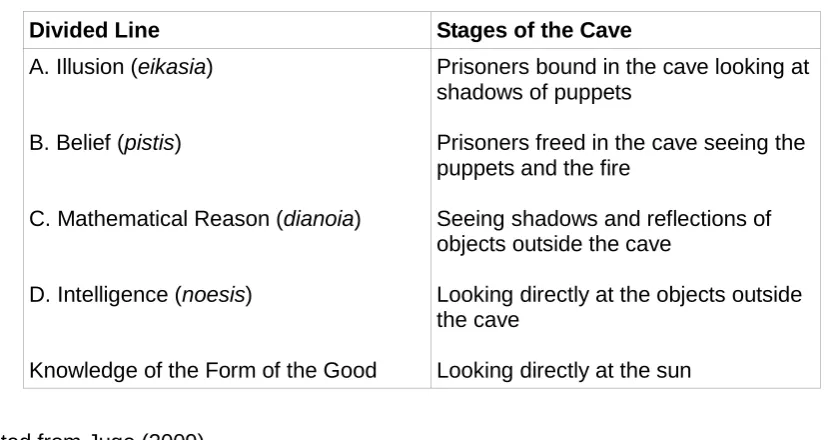
and knowledge, intelligence and reason (stages C and D), which must be developed through learning and exploration. Juge, among others, applies this formula of the two allegories to The Road in an attempt to distil a definitive answer from the text.
A point of agreement between this paper and Juge’s is that the Platonic ideal of gradual illumination has been inverted. Globally, the earth – humanity – is witnessing a de-lumination (Juge, 2009). However, Juge writes that the man and the boy are in stage B with the intention of finding the sun, which has been lost, stage D. Similarly, Alex Hunt and Martin Jacobsen trace a parallel journey ending in the failure of the Platonic ideal, as in the man’s final dream the man and the boy reach the centre of the cave, the point of no return. The finite light of the candle fading, the ending for them is, therefore, hollow or fated to be doomed (Hunt & Jacobsen, 2008).
Table 1: Stages of Plato's 'Divided Line' and 'Allegory of the Cave.'
Divided Line Stages of the Cave
A. Illusion (eikasia)
B. Belief (pistis)
C. Mathematical Reason (dianoia)
D. Intelligence (noesis)
Knowledge of the Form of the Good
Prisoners bound in the cave looking at shadows of puppets
Prisoners freed in the cave seeing the puppets and the fire
Seeing shadows and reflections of objects outside the cave
Looking directly at the objects outside the cave
Looking directly at the sun
Adapted from Juge (2009).
I would argue, instead, that the man is in stage B, carrying his child back to stage A. The true illumination of knowledge is not the sun, it is likely to be a nuclear warhead, the ‘long shear of light’, the ‘dull rose glow’ (McCarthy, 2007, p. 54), the culmination of human ingenuity and Thanatos. The man spent his prior life in stage C, viewing an unreal world. If he had stared at the long shear of light he would have been blinded, but by glimpsing it and catching the glow, he has perceived and been burdened with the true knowledge of the world, that humankind is inherently corrupted. The centre of the cave represents an opportunity for the boy to be innocent, naïve and protected. The family unit that appears in the closing of the novel is the centre, and by returning to this point, the process of gradual illumination can return. The ‘maps and mazes’ (McCarthy, 2007, p. 307) of a world in its becoming provide the potential for once more exiting the labyrinthine cave, for the boy to discover a new world with the fire he has carried throughout the novel.
To reconnect this with the image of the flute, the flute is, to a certain extent, a symbol not only of the human, but also of procreation. The flute has a maker in an otherwise ‘barren, godless’ world, and through the meeting of two bodies – the boy, the flute – a third form is created. The boy is ripe with potential. As mentioned, though, The Road is a horribly violent, bleak book, and this is an optimistic analysis.
The loss of the flute
therefore, a keening for the loss of music, not the birth of a new one, and here is the first example of a reading that deconstructs the potential narrative created in this essay thus far.
He stopped. What happened to your flute? I threw it away.
You threw it away? Yes.
Okay.
Okay. (McCarthy, 2007, pp. 168-169)
The loss of the flute serves both a specific and a broad role in the text. Specifically, it exemplifies the loss of the phrase ‘as the crow flies’, the loss of crows and perhaps the coming loss of maps, as the mention of the flute being lost finishes a conversation started by the boy, beginning: ‘There’s not any crows. Are there?’ (McCarthy, 2007, p. 167). Both the crows and the flute are gone, their disappearance bookending the conversation and contributing to a wider debate on the loss of language, referring back to the oft-quoted line ‘the sacred idiom shorn of its referents’ (McCarthy, 2007, p. 93). While the idiom ‘as the crow flies’ relies on a knowledge of crows that no longer exists, the flute is not connected to an idiom. Rather, it is one link in a chain of meanings that no longer exist. The pure note must survive, but it could not be subjected to any theoretical
understanding of major or minor, happy or sad. Nor are there roles of performer and audience, without which the flute has no context and, perhaps, no beauty. The flute embodies music, culture, humanity and meanings that lead the reader from the prehistoric human to the contemporary. By rejecting this image and the potential function of music, there is the suggestion of a regression to a pre-human condition.
The flute again returns us to the cave and, outside of the Platonic reading, the cave has a spiritual function that further disrupts an optimistic or hopeful reading of the text. In her review of Holley Moyes’ work determining the ‘ritual use of caves’, Ruth Whitehouse describes a single failing of Moyes’ research, namely that it does not consider the experience of entering a cave, visual or sonic (Whitehouse, 2014). Yulia Ustinova relates the experience of the cave to the experience of sensory deprivation, the removal of external stimuli (Ustinova, 2013). The pitch black of an unlit cave in some individuals can cause an altered state of consciousness. Without external visual and perhaps auditory stimuli, the subjective-self becomes a false objective reality, a hallucination. Indeed, the man experiences a dreamlike state early in the novel as he wakes to a darkness that is ‘sightless and impenetrable’ (McCarthy, 2007, p. 14). He asks himself ‘upright to what?’ (p. 14), the darkness so intense that he feels he is not actually standing up, though the question becomes more philosophical as he speculates that he and every star must be upright, attracted to, some celestial lodestone.
Pilch actually suggests that the sound of ancient flutes in the biblical mourning ceremony could have induced an altered state of consciousness (Pilch, 2007). While this cannot be proven, there are composers who believe that music can be used as an aid to reaching higher consciousness. Notable among these is La Monte Young, who has dedicated his mature life to creating sonic environments built out of specific frequencies, frequencies which he believes can alter mood or consciousness, particularly when paired with the magenta light installations of his wife, Marian Zazeela (Tenzer, 1993).
The prophetic reading of the boy is a falsehood constructed by the man in his self-belief and determination to create a meaning in this post-apocalyptic wasteland. This would, in fact, explain the spontaneous ‘verdant’ (Saliba, 2012, p. 148) prose, sudden outbursts of description or
incongruous words, and it might suggest that the ‘changeling child’ the man witnesses is, indeed, what he sees, a hallucination brought on by the deprivation of visual stimuli and the sudden appearance of music in a silent world (McCarthy, 2007). The man and his experiences, his insistence on carrying the fire, cannot be trusted. The boy is therefore only a boy.
Conclusion
The loss of the flute prefigures the gradual coming loss of language. Its existence in the novel suggested a deeper grace to the boy beyond his fantastical divinity, yet by thoughtlessly discarding the flute, he also rejects the positive social aspects of music it embodies. The first section of this paper attempted to form a link between the flute, prehistory, and the values shared by the contemporary and the prehistoric human. Almost certainly, it can now be argued that The Road confronts the reader with a diminished humanity, impoverished in terms of culture and meaning. Although it is a sombre thought, this is a novel about the failure of history, the failure of culture; it could not or would not have been written if social forces were such that an apocalyptic narrative did not loom over us.
Endnote
1 The flute discovered in Geißenklösterle is dated 42,000BP and the oldest Hohle-Fels flute
References
Adler, D. S. A. (2009). Archaeology: The earliest musical tradition. Nature, 460(7256), 695-696.
doi:10.1038/460695a
Boer, D. B., & Fischer, R. F. (2010). Towards a holistic model of functions of music listening across
cultures: A culturally decentred qualitative approach. Psychology of Music, 40(2), 179-200.
doi:10.1177/0305735610381885
Chanda, M. L. C., & Levitin, D. J. L. (2013). The neurochemistry of music. Trends in Cognitive
Sciences, 17(4), 179-193. Retrieved from
http://daniellevitin.com/levitinlab/articles/2013-TICS_1180.pdf
Conard, N. C. (2009). New flutes document the earliest musical tradition in Southwestern
Germany. Nature, 460(7256), 737-740. doi:10.1038/nature08169
David, H. T. D. (1951). The cultural functions of music. Journal of the History of Ideas, 12(3),
423-439. doi:10.2307/2707753
DeAngelis, T.D.A. (2008).The two faces of Oxytocin. Retrieved from
http://www.apa.org/monitor/feb08/oxytocin.aspx.
Hunt, A. H., & Jacobsen, M. M. J. (2008). Cormac McCarthy’s The Road and Plato’s Simile of the Sun. The Explicator, 66(3), 155-158. doi:10.3200/EXPL.66.3
Huron, D. H. (2001). Is Music an Evolutionary Adaptation? Retrieved from
http://www.chialvo.net/Curso/UNR2010/Modulo%201%20Musica%20Y%20Neurociencia/Publicaci
ones/Huron.pdf
Jackendoff, R. J., & Lerdahl, F. L. (2006). The capacity for music: What is it, and what’s special about it? Cognition, 100, 33-72. Retrieved from
http://ase.tufts.edu/cogstud/jackendoff/papers/CapacityforMusic.pdf
Juge, C. (2009). The Road to the Sun They Cannot See: Plato's Allegory of the Cave, Oblivion, and Guidance in Cormac McCarthy's "The Road"The Cormac McCarthy Journal,7(1), 16-30.
Retrieved from http://www.jstor.org/stable/42909396
McCarthy, C. M. (2007). The Road. New York: Picador.
Palacio-Perez, E.P.P. & Redondo, A.R.R. (2014). Imaginary creatures in Palaeolithic art: Prehistoric dreams or prehistorians’ dreams?. Antiquity, 88 (339), 259-266. doi:
Peretz, I.P. (2006). The nature of music from a biological perspective. Cognition, 100(1), 1-32. doi:
10.1177/0305735610381885.
Pilch, J. J .P. (2007). Flute players, death, and music in the afterlife. Biblical Theology Bulletin:
Journal of Bible and Culture, 37(1), 12-19. doi:10.1177/01461079070370010301
Saliba, D.A. (2012). Linguistic Disintegration in Cormac McCarthy's The Road. In C. Baratta (Ed.) Environmentalism in the Realm of Science Fiction and Fantasy Literature (pp. 143-157). UK:
Cambridge Scholars.
Tenzer, M. T. (1993). Western Music in the Context of World Music. In R. P. M. Morgan (Ed.), Modern Times (pp. 388-409). London: The Macmillan Press Ltd.
Ustinova, Y. U. (2013). Cave experiences and ancient Greek oracles. Time and Mind, 2(3),
265-286. doi: 10.2752/175169609X12464529903092.
Whitehouse, R. W. (2014). Sacred darkness: A global perspective on the ritual use of caves.
American Anthropologist, 116(3), 691-692. doi:10.1111/aman.12136_18
Wielenberg, E. (2010). God, Morality, and Meaning in Cormac McCarthy's "The Road" The Cormac McCarthy Journal, 8(1), 1-19. Retrieved from http://www.jstor.org/stable/42909407