International Journal of Engineering
J o u r n a l H o m e p a g e : w w w . i j e . i rReliability Analysis of Three Elements in Series and Parallel Systems under
Time-varying Fuzzy Failure Rate
M. El-Damcese a*, F. Abbas b, E. El-Ghamry c
a Department of Mathematics (Section of Statistics), Faculty of Science, Tanta University, 31521, Tanta, Egypt b Department of Mathematics, Umm Al-Qura University, 2064, Makka, Kingdom of Saudi Arabia
c Department of Engineering Physics and Mathematics, Faculty of Engineering, Tanta University, 31521, Tanta, Egypt
P A P E R I N F O
Paper history:
Received 02 June 2013
Received in revised form 02 September 2013 Accepted 14 September 2013
Keywords:
Reliability Analysis Mean Time to Failure
Time-varying Fuzzy Failure Rates Parallel System
Series System
A B S T R A C T
Reliability is the most important performance issue in engineering design process but in the real world problems, there are limitations for using conventional reliability. Fuzzy logic has proved to be effective in expressing uncertainties in different fields, including engineering reliability. In this paper, for both series and parallel systems composed of three identical or different elements, the reliability has been analyzed using the fuzzy concepts and some characteristics such as the mean time to failure have been evaluated, taking in our account that all the operating units have increasable time varying failure rates with fuzzy triangular membership functions. This paper includes a numerical example to illustrate the model and validate the analytical results.
doi:10.5829/idosi.ije.2014.27.04a.06
1. INTRODUCTION1
System reliability occupies important and significant role in design of power plants, manufacturing systems, industrial systems, standby systems, etc. By the reliability analysis, a manager can decide the optimal strategy, by setting the range of Mean Time to Failur (MTTF) to reflect the desired failure rates and this in turn will minimize the total cost involved. The reliability of an item is the probability that the item will perform a required function during a given interval of time under specified conditions. The system reliability depends on the reliability of its components, configuration of the system, and the system failure criteria. During the study of the reliability of any system, the goal is predicting the suitable system reliability features based on the component failure data and the system design. Series or parallel systems or both of them can represent the large engineering system with similar or different components having constant [1-4], or time-varying failure rates. Many studies handled the problem of time-varying failure and repair rates [5, 6].
*Corresponding Author Email: [email protected] (M.
El-Damcese)
In the real world applications as sensor information, data are vaguely specified so fuzzy theory can handle such vagueness using membership function. The fuzzy set theory has a realistic and practical means to describe the real world. It has been introduced firstly by Lotfi zadah [7] and many researcher [8-10] who used the fuzzy sets in the reliability analysis to get some reliability characteristics. But the system parameters are often imprecise due to incomplete and accurate information, so failure and repair rates may be expressed with some uncertainty by experiences of experts. In fact, the fuzzy sets make descriptions of the objective world more realistic, practical, and accurate so they have been widely applied in decision-making and logic programming. Sharma et al. [11] used a system containing three elements established with constant and increasable fuzzy failure rates in real time situations and Jiang et al.[12] constructd an algorithm to get the fuzzy reliability. Wang [13] made the analysis with fuzzy random variables. Mishra et al. and Krishnan et al. [14, 15] presented the real time study of a k-out-of-n system having n identical elements with constant fuzzy failure rates. In this paper, both series and parallel system composite of three similar or different components are analyzed when the failure distribution of each operating
component has an increasable failure rate. We can’t expect the exact value of the failure rate of each unit due to the lack of sufficient data to demonstrate the uncertainty in the calculations. This parameter can be expressed using triangular fuzzy numbers which are estimated using chi-square distribution with (1−β)100%
confidence interval . Then, we describe the reliability of the two systems in the fuzzy sense. At the end, we give numerical example and by comparing the driven results with the crisp model, fuzzy models indicate more realistic and practical results than the crisp one. Moreover, we can construct another un-repairable system and analyze it to get the reliability function and the mean time to failure under fuzzy assumptions.
2. NOTATIONS
λi: Failure rate of the ith element.
Li: Lower limit of the triangular fuzzy number related to the failure rate of the ithelement.
Mi : Medium of the triangular fuzzy number related to the failure rate of the ithelement.
Ui : Upper limit of the triangular fuzzy number related to the failure rate of the ith element.
Pi (t): Probability that the system at the t moment to be in condition i .
Rs(t): Probability of the functionality of the series system.
Rp(t): Probability of the functionality of the parallel system.
MTTF: Mean time to failure.
3. SYSTEM RELIABILITY
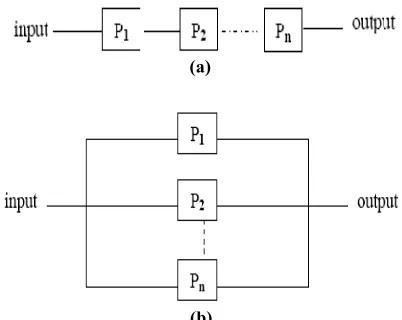
3. 1. System Reliability in Crisp Case In this section, we discuss the reliability of the general unrepairable series system and parallel system in the crisp case, Figure 1 represents the configuration of the series and the parallel systems, with components P1, P2,
…, Pn, assuming their reliabilities are R1, R2, …, Rn (0 ≤ Ri ≤ 1; i = 1, 2, …, n), respectively. For each
component, the failure rate is not constant but linearly changes with time and equals (λit), then:
(t) = ∫ λ = λ (1)
Then for the series system of three omponents we can get:
Rs(t) =∏ ( )= (λ λ λ) (2)
(a)
(b)
Figure 1. (a) Series system configuration and (b) parallel system configuration
MTTFs =∫ (t) dt = π
(λ λ λ)
∞
(3)
and for the parallel system
Rp(t) = 1−(1− λ )(1− λ )(1− λ ) (4)
MTTFp=∫ ∞ (t) dt = πλ + πλ + πλ −
π
(λ λ)−
π
(λ λ)−
π
(λ λ)+
π
(λ λ λ)
(5)
3. 2. System Reliability under Fuzzy Failure Rates
Most important consideration is that the values of the failure rates λi ; i =1, 2, 3 are not fixed, since they are
driven from collected data or the opinions of the experts, uncertainty of these values is an undeniable fact. Most of the times, these failure rates are considered as known values or have known distribution function. In this paper, we assume that failure rates, λi; i =1, 2, 3 in
the form of triangular fuzzy numbers are as follows:
̅ = (Li /Mi /Ui) ; i =1, 2, 3 (6)
in which Mi is the point estimation and Li, Ui are the
lower and the upper limits of (1−β)100 % confidence interval of ̅ where the α-cuts of these failure rates can be calculated as follows:
̅[α]=[λiL(α ), λiU(α )] = [Li + α (Mi−Li), Ui− α(Ui−Mi )]
; i=1,2,3 (7)
By using the extension principle, the reliability function and MTTF can be calculated in each case as follows:
[ , ] = [ ( , ) , ( , )] ( , ) =
( )
( , ) =
( ) (8.2)
[ ] = [ ( ) , (, )]
MTTFs (α) =∫ Rs (t) dt =
( ) v (9.1)
MTTFs (α) =∫ Rs (t) dt =
( ) (9.2)
[ , ] = [ (, ), (, )]
(, ) = 1−(1− ( ) )(1−
( ) )(1− ( ) ) (10.1)
( , ) = 1−(1− ( ) )(1−
( ) )(1− ( ) ) (10.2)
[ ] = [ ( ), ( , )]
( ) =∫∞ ( ) = ( ) +
( ) + ( ) −
( ( )−
( ( )−
( ( ) +
( ( )
(11.1)
( ) =∫∞ ( ) = ( ( ))+
( ( ))+ ( ( ))−
( ( )−
( ( )−
( ( ) +
( ( )
(11.2)
Because the fuzzy rate of each component linearly changes with time ( ) and has exponential distribution with unknown fuzzy parameter ( ) which can be calculated, see [17], using the point estimation and (1−β
)100% confidence intervals (two ways) of this parameter as:
=∑ (12.1)
= ,( ⁄)
∑ (12.2)
= ,( ⁄)
∑ (12.3)
where the data is synthesized for each component i ;
i=1, 2, 3 in two statistics: a total test time is denoted as
∑ and a sample size is denoted as ni .
4. NUMERICAL AND GRAPHICAL EXAMPLE
The Maple software is used to analysis the reliability and MTTF of the series and parallel systems.
4. 1. For Three Different Components Assume a system consisting of three major units. These are continuously monitored by a failure detection device. For efficiency, the manager wants to analysis the system and get fuzzy reliability and MTTF. Due to uncertainity or the imprecision of data, the failure rates of the three operating units can be represented by triangular fuzzy numbers.
Assume each unit is tested with a sample size 25, 35, 30 and total failure test times are 920, 700, 1200. Based on that statistical data with a confidence level 95%, the values of the medium, lower and upper limits of these three triangular fuzzy numbers related to failure rates
, , are calculated according to Equation (12) as follows:
= (0.0176/ 0.0272/ 0.03882)
= (0.0231/ 0.05/ 0.051)
= (0.01348/ 0.025/ 0.02975)
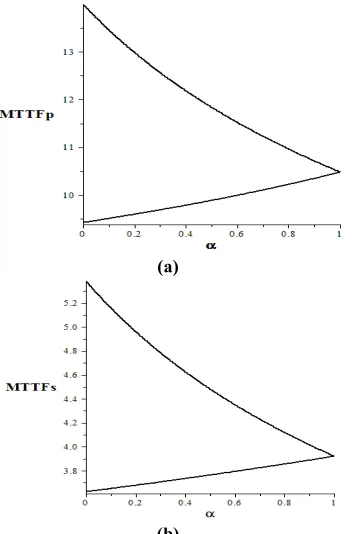
It is easy to find that the fuzzy reliability function for both the series and parallel systems using Equations (8) and (10) and represent them graphically at different values of α as shown in Figure 2 and according to Equations (9) and (11), we can get the crisp intervals of the failuer rates of the three operating units and the mean-time to failure of both series and parallel systems at different possibility α levels as shown in Table 1 and their overall shapes are represented in Figure 3.
4. 2. For Three Identical Components If each component has the same fuzzy failure rate = =
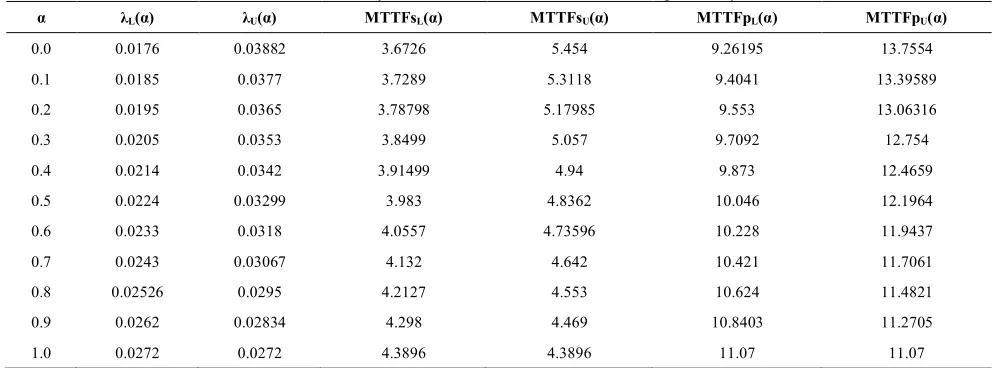
= , we test with a sample size of 25 and a total test time of 920. Based on that statistical data with a confidence level 95%, the triangular fuzzy number related to that failure rate is ̅= (0.0176/ 0.0272/ 0.03882). The fuzzy reliability function for both the series and parallel systems can be represented graphically at different values of α as shown in Figure 4
mean-time to failure of both series and parallel systems at different α-cuts are shown in Table 2 and their overall shapes are represented in Figure 5.
(a)
(b)
Figure 2. (a) Fuzzy reliability of parallel system and (b) Fuzzy reliability of series system with different three units
(a)
(b)
Figure 3. (a) Fuzzy MTTF of parallel system and (b) Fuzzy MTTF of series system with different three units
(a)
(b)
Figure 4. (a) Fuzzy reliability of parallel system and (b) Fuzzy reliability of series system with similar units
(a)
(b)
TABLE 1. α-cuts of the failure rates, the fuzzy mean-time to failure of the series and parallel system with different three units
α λ1L(α) λ1U(α) λ2L(α) λ2U(α) λ3L(α) λ3U(α) MTTFsL(α) MTTFsU(α) MTTFpL(α) MTTFpU(α)
0.0 0.0176 0.03882 0.0231 0.051 0.01348 0.02976 3.6244 5.3843 9.42249 13.997
0.1 0.0185 0.0377 0.0258 0.051 0.0146 0.02928 3.651 5.1606 9.50717 13.461
0.2 0.0195 0.0365 0.0285 0.0508 0.01578 0.0288 3.678 4.9626 9.5955 12.9877
0.3 0.0205 0.0353 0.0312 0.0507 0.01694 0.0283 3.706 4.7859 9.6879 12.565
0.4 0.0214 0.0342 0.03386 0.0506 0.0181 0.02785 3.7347 4.6267 9.875 12.1843
0.5 0.0224 0.03299 0.0365 0.0505 0.0192 0.02738 3.7639 4.4825 9.886 11.8384
0.6 0.0233 0.0318 0.0392 0.0504 0.0204 0.0269 3.7938 4.351 9.993 11.522
0.7 0.0243 0.03067 0.04193 0.0503 0.0215 0.0264 3.8244 4.23 10.1047 11.2313
0.8 0.02526 0.0295 0.04462 0.0502 0.0227 0.02595 3.8558 4.1192 10.223 10.9625
0.9 0.0262 0.02834 0.0473 0.0501 0.02385 0.0255 3.888 4.0164 10.348 10.7131
1.0 0.0272 0.0272 0.05 0.05 0.025 0.025 3.9209 3.9209 10.4806 10.4806
TABLE 2. α-cuts of the failure rate, the fuzzy mean-time to failure of the series and parallel system with similar three units
α λL(α) λU(α) MTTFsL(α) MTTFsU(α) MTTFpL(α) MTTFpU(α)
0.0 0.0176 0.03882 3.6726 5.454 9.26195 13.7554
0.1 0.0185 0.0377 3.7289 5.3118 9.4041 13.39589
0.2 0.0195 0.0365 3.78798 5.17985 9.553 13.06316
0.3 0.0205 0.0353 3.8499 5.057 9.7092 12.754
0.4 0.0214 0.0342 3.91499 4.94 9.873 12.4659
0.5 0.0224 0.03299 3.983 4.8362 10.046 12.1964
0.6 0.0233 0.0318 4.0557 4.73596 10.228 11.9437
0.7 0.0243 0.03067 4.132 4.642 10.421 11.7061
0.8 0.02526 0.0295 4.2127 4.553 10.624 11.4821
0.9 0.0262 0.02834 4.298 4.469 10.8403 11.2705
1.0 0.0272 0.0272 4.3896 4.3896 11.07 11.07
5. RESULTS AND DISCUSSIONS
From the numerical example that introduced for analyzing a model for three items un-repairable system, as shown in Table 1, if the items have different triangular shaped fuzzy parameters, it is impossible for the value of the fuzzy mean-time to failure to fall below 3.6244 or exceed 5.3843 in the series connection and its most possible value is 3.9209. In the parallel connection, it can’t fall below 9.42249 or exceed 13.997 and the most possible value is 10.4806. As shown in Table 2, if we have similar triangular shaped fuzzy parameters, the value of the fuzzy mean-time to failure in the series connection falls in the interval [3.6726, 5.454] and the most possible value is 4.3896. In the parallel connection, it falls in [9.26195, 13.7554] with the most possible value 11.07. After drawing the results using MAPLE software program, we find that the
MTTF in all cases can be approximated to be a triangular shaped fuzzy number too and the fuzzy reliability for each value of α has a two reliability curves which represent the lower and the upper bounded curves. These are around the main reliability curve in the crisp case evaluated at α= 1 and all those curves are bounded by the lower and upper limit curves at α= 0.
6. CONCLUSION
through triangular fuzzy numbers. In this paper, we establish a model for a system consisting of three independent units connected in parallel or in series. We introduce a reliability analysis for the series and the parallel systems in the presence of fuzziness and model the uncertainty of their parameters values. For the three operating units having time-varying failure rates, we use triangular fuzzy numbers which are estimated using random samples to represent their parameters. In addition, we introduce a procedure to estimate the fuzzy reliability and the mean-time to failure. This procedure can be applied to similar reliability models. Finally, we introduce a numerical example for illustration and we use MAPLE program to show the results graphically. Further researches can focus on other un-repairable systems as parallel-series systems, series-parallel systems , k-out of n systems or standby systems to evaluate the reliability and mean time of failure.
7. ACKNOWLEDGMENTS
The authors are grateful to the editor and the referees for their valuable comments and helpful suggestions that have much improved the presentation.
8. REFERENCES
1. Trivedi, K. S., "Probability & statistics with reliability, queuing and computer science applications", John Wiley & Sons, (2008).
2. Jain, M. and Singh, C. J., "Reliability of repairable multi-component redundant system", International Journal of Engineering, Vol. 3, No., (2000), 107-114.
3. Moghaddass, R., Zuo, M. J. and Qu, J., "Reliability and availability analysis of a repairable", Reliability, IEEE Transactions on, Vol. 60, No. 3, (2011), 658-666.
4. Jain, M., Maheshwari, R. and Maheshwari, S., "Reliability analysis of redundant repairable system with degraded failure", International Journal of Engineering-Transactions B: Applications, Vol. 17, No. 2, (2004), 171.
5. Zhang, T. and Horigome, M., "Availability and reliability of system with dependent components and time-varying failure and repair rates", Reliability, IEEE Transactions on, Vol. 50, No. 2, (2001), 151-158.
6. Hassett, T. F., Dietrich, D. L. and Szidarovszky, F., "Time-varying failure rates in the availability and reliability analysis of repairable systems", Reliability, IEEE Transactions on, Vol. 44, No. 1, (1995), 155-160.
7. Zadeh, L. A., "Fuzzy sets", Information and Control, Vol. 8, No. 3, (1965), 338-353.
8. Singh, S., Ram, M. and Chaube, S., "Analysis of the reliability of a three-component", (2011).
9. Khanduja, R., Tewari, P. and Kumar, D., "Mathematical modeling and performance optimization for the digesting system of a paper plant", International Journal of Engineering-Transactions A: Basics, Vol. 23, No. 3&4, (2010), 215. 10. Kulshrestha, D. K., "Reliability of a repairable multicomponent
system with redundancy in parallel", Reliability, IEEE Transactions on, Vol. 19, No. 2, (1970), 50-52.
11. Sharma, M. K. and Pandey, D., "Fuzzy reliability and fuzzy availability of a three unit degraded systems", International Journal of Mathematical Sciences and Engineering Applications (IJMSEA), Vol. 3, No. 2, (2009), 199-213. 12. Jiang, Q. and Chen, C.-H., "A numerical algorithm of fuzzy
reliability", Reliability Engineering & System Safety, Vol. 80, No. 3, (2003), 299-307.
13. Wang, Z., Huang, H.-Z., Li, Y., Pang, Y. and Xiao, N.-C., "An approach to system reliability analysis with fuzzy random variables", Mechanism and Machine Theory, Vol. 52, No., (2012), 35-46.
14. Krishnan, R. and Somasundaram, S., "Reliability & profit analysis of repairable k-out-of-n system with sensor", European Journal of Scientific Research, Vol. 67, No. 2, (2012), 215-222.
Reliability Analysis of Three Elements Series and Parallel Systems under
Time-varying Fuzzy Failure Rate
M. El-Damcese a, F. Abbas b, E. El-Ghamry c
a Department of Mathematics (Section of Statistics), Faculty of Science, Tanta University, 31521, Tanta, Egypt b Department of Mathematics, Umm Al-Qura University, 2064, Makka, Kingdom of Saudi Arabia
c Department of Engineering physics and Mathematics, Faculty of Engineering, Tanta University, 31521, Tanta, Egypt
P A P E R I N F O
Paper history:
Received 02 June 2013
Received in revised form 02 September 2013 Accepted 14 September 2013
Keywords:
Reliability Analysis Mean Time to Failure
Time-varying Fuzzy Failure Rates Parallel System
Series System
هﺪﯿﮑﭼ
،ﺖﺳاﯽﺳﺪﻨﻬﻣ وﯽﺣاﺮﻃﺪﻨﯾآﺮﻓ رد دﺮﮑﻠﻤﻋﻪﻠﺌﺴﻣﻦﯾﺮﺗﻢﻬﻣ نﺎﻨﯿﻤﻃاﺖﯿﻠﺑﺎﻗ وﻞﺋﺎﺴﻣرد ﺎﻣا
،ﯽﻌﻗاويﺎﯿﻧدتﻼﮑﺸﻣ
زاهدﺎﻔﺘﺳاياﺮﺑﺖﯾدوﺪﺤﻣ دراددﻮﺟوفرﺎﻌﺘﻣنﺎﻨﯿﻤﻃاﺖﯿﻠﺑﺎﻗ
.
ردﺖﯿﻌﻄﻗمﺪﻋنﺎﯿﺑردﻪﮐﺖﺳاهﺪﺷﺖﺑﺎﺛيزﺎﻓﻖﻄﻨﻣ
يﺎﻫﻪﻨﯿﻣز ﺖﺳاﺮﺛﻮﻣنﺎﻨﯿﻤﻃاﺖﯿﻠﺑﺎﻗﯽﺳﺪﻨﻬﻣﻪﻠﻤﺟزا،ﻒﻠﺘﺨﻣ
.
يزاﻮﻣيﺎﻫﻢﺘﺴﯿﺳويﺮﺳودﺮﻫياﺮﺑ ،ﻪﻟﺎﻘﻣﻦﯾارد
نﺎﻣزﻞﯿﺒﻗزايﺎﻫﯽﮔﮋﯾوزاﯽﺧﺮﺑويزﺎﻓﻢﯿﻫﺎﻔﻣزاهدﺎﻔﺘﺳاﺎﺑنﺎﻨﯿﻤﻃاﺖﯿﻠﺑﺎﻗ،توﺎﻔﺘﻣﺎﯾنﺎﺴﮑﯾﺮﺼﻨﻋﻪﺳزاﻞﮑﺸﺘﻣ فﺮﺼﻣ،هﺪﺷﻞﯿﻠﺤﺗوﻪﯾﺰﺠﺗﺖﺳاهﺪﺷﯽﺑﺎﯾزراﺖﺴﮑﺷياﺮﺑﻂﺳﻮﺘﻣ ﻞﻣﺎﻋﻪﻤﻫﻪﮐﺎﻣبﺎﺴﺣردهﺪﺷ
ﺶﯾاﺰﻓانﺎﻣزﺪﺣاو
يزﺎﻓﯽﺜﻠﺜﻣﺖﯾﻮﻀﻋﻊﺑاﻮﺗﺎﺑﺖﺴﮑﺷﻒﻠﺘﺨﻣخﺮﻧ
.
ﺞﯾﺎﺘﻧرﺎﺒﺘﻋاولﺪﻣندادنﺎﺸﻧياﺮﺑيدﺪﻋلﺎﺜﻣﮏﯾﻞﻣﺎﺷﻪﻟﺎﻘﻣﻦﯾا
ﯽﻠﯿﻠﺤﺗ ﺖﺳا
.