MULTI-OBJECTIVE UNRELATED PARALLEL MACHINES
SCHEDULING WITH SEQUENCE-DEPENDENT SETUP TIMES
AND PRECEDENCE CONSTRAINTS
R. Tavakkoli-Moghaddam*
Department of Industrial Engineering and Engineering Optimization Research Group College of Engineering, University of Tehran
P.O. Box 11155/4563, Tehran, Iran [email protected]
F. Taheri and M. Bazzazi
Department of Industrial Engineering, Mazandaran University of Science and Technology P.O. Box 734, Bobol, Iran
[email protected] - [email protected]
*Corresponding Author
(Received: December 25, 2007 – Accepted in Revised Form: May 9, 2008)
Abstract This paper presents a novel, multi-objective model of a parallel machines scheduling problem that minimizes the number of tardy jobs and total completion time of all jobs. In this model, machines are considered as unrelated parallel units with different speeds. In addition, there is some precedence, relating the jobs with non-identical due dates and their ready times. Sequence-dependent setup times embedded in the proposed model may vary in different machines based on their characteristics. This paper proposes a two-level mixed-integer programming for the given problem. By solving the presented model, the associated promising results show the effectiveness of this model for small and medium-sized problems, respectively.
Keywords Unrelated Parallel Machine Scheduling, Multi-Objective Model, Sequence-Dependent Setup Times, Precedence Constraints
ﻩﺪﻴﻜﭼ
ﺭﺩ
ﻥﺎﻣﺯ ﻪﻟﺎﺴﻣ ﻱﺍﺮﺑ ﺪﻳﺪﺟ ﻪﻓﺪﻫ ﺪﻨﭼ ﻲﺿﺎﻳﺭ ﻝﺪﻣ ﻚﻳ ،ٍﻪﻟﺎﻘﻣ ﻦﻳﺍ ﻦﻴﺷﺎﻣ ﻱﺪﻨﺑ
ﻪﺋﺍﺭﺍ ﻱﺯﺍﻮﻣ ﻱﺎﻫ
ﻲﻣ ﺩﺩﺮﮔﻪﻨﻴﻤﻛ ﺎﻫﺭﺎﻛﻞﻴﻤﻜﺗﻥﺎﻣﺯﺕﺪﻣﻉﻮﻤﺠﻣﻭﺩﺮﻛﺮﻳﺩﻱﺍﺭﺍﺩﻱﺎﻫﺭﺎﻛﺩﺍﺪﻌﺗﻪﻛﻱﻮﺤﻧﻪﺑﺩﻮﺷ
.
ﻝﺪﻣﻦﻳﺍﺭﺩ
ﻦﻴﺷﺎﻣ ﺖﻋﺮﺳ ﻱﺍﺭﺍﺩ ﻂﺒﺗﺮﻣﺎﻧ ﻱﺎﻫ ﻲﻣ ﻪﺘﻓﺮﮔ ﺮﻈﻧ ﺭﺩ ﺕﻭﺎﻔﺘﻣ ﻱﺎﻫ
ﻮﺷ ﻧﺪ
.
ﻫ ﻥﺎﻣﺯ ﻉﻭﺮﺷ ﻪﻈﺤﻟ ﺭﺩ ﺎﻫﺭﺎﻛ ﻦﻴﻨﭽﻤ
ﻱﺪﻨﺑ ، ﻥﺎﻣﺯ ﻅﺎﺤﻟ ﺯﺍ ﺎﻫﺭﺎﻛ ﺯﺍ ﻲﺧﺮﺑ ﻦﻴﺑ ﻭ ﻩﺩﻮﺒﻧ ﻲﻧﺎﺴﮑﻳ ﻂﻳﺍﺮﺷ ﻱﺍﺭﺍﺩ ﻞﻳﻮﺤﺗ ﺪﻋﻮﻣ ﻭ ﻲﺳﺮﺘﺳﺩ ﻱﺎﻫ
ﺖﻳﺩﻭﺪﺤﻣ ﺵﺯﺍﺩﺮﭘ ﺭﺩ ﻲﻣﺪﻘﺗ ﻱﺎﻫ
ﻦﻴﺷﺎﻣ ﺎﻫ ﺩﺭﺍﺩ ﺩﻮﺟﻭ
.
ﻥﺎﻣﺯ ،ﻪﻟﺎﺴﻣﻦﻳﺍ ﺭﺩ ﻩﺩﺎﻣﺁ ﻱﺎﻫ
ﺵﺯﺍﺩﺮﭘ ﺯﺍ ﻞﺒﻗ ﻱﺯﺎﺳ
ﻥﺎﻣﺯ ﻦﻳﺍ ﻪﻛ ﺖﺳﺍ ﻩﺪﺷ ﻪﺘﻓﺮﮔ ﺮﻈﻧ ﺭﺩ ﺎﻫﺭﺎﻛ ﺎﻫ
ﺭﺍﺮﻗ ﻥﺁ ﻱﻭﺭ ﺮﺑ ﻪﻛ ﻲﻨﻴﺷﺎﻣ ﻉﻮﻧ ﻦﻴﻨﭽﻤﻫﻭ ﺎﻫﺭﺎﻛ ﻲﻟﺍﻮﺗ ﻪﺑ
ﻲﻣ ﻲﻣﻪﺘﺴﺑﺍﻭ،ﺪﻧﺮﻴﮔ ﺪﻨﺷﺎﺑ
.
ﺭﺩ ﻪﻣﺎﻧﺮﺑﻚﻳ ٍﻪﻟﺎﻘﻣﻦﻳﺍ ﺮﻈﻧ ﺩﺭﻮﻣﻪﻟﺎﺴﻣﻱﺍﺮﺑﻲﺤﻄﺳﻭﺩ ﻂﻠﺘﺨﻣﺢﻴﺤﺻﺩﺪﻋﻱﺰﻳﺭ
ﻲﻣﻪﺋﺍﺭﺍ ﺩﺩﺮﮔ
.
ﻩﺭﺍﺪﻧﺍﺎﺑﻞﺋﺎﺴﻣﻱﺍﺮﺑﻱﺩﺎﻬﻨﺸﻴﭘ ﻝﺪﻣﻲﻳﺍﺭﺎﮐﺯﺍﻲﮐﺎﺣ ﻞﺣﺞﻳﺎﺘﻧ ،ﻝﺪﻣﻦﻳﺍ ﻞﺣﺎﺑ ﻭﻚﭼﻮﻛﻱﺎﻫ
ﻂﺳﻮﺘﻣ ﻲﻣ ﺪﺷﺎﺑ
.
1. INTRODUCTION
A classical parallel machine problem can be stated as a set of independent jobs to be processed on a number of available identical parallel machines. Each machine can process only one job at a specific time, and each job can be processed only on one machine. Each job is ready at the beginning of the scheduling horizon and has a distinct processing time and due date [1].
real environments.
In several cases due to the difference between technologies in utilized machines, the machines work with different speeds, therefore processing times for the jobs that must be scheduled on these machines are not the same. In addition, maybe all jobs are not available at the beginning of scheduling and they arrive in a dynamic manner also each job may be considered to have its own due date.
In a manufacturing environment, setup times consist of all activities done on material in order to prepare machines and situations in a process phase. Production problems related to setup times are divided in two important Sections 1 dependent setup times; and 2 Sequence-independent setup times. For instance, at a production facility where paint is manufactured, a setup time is incurred for cleaning the machine whenever a color change is required. The thoroughness required in cleaning the machine depends on both the color being removed and the color for which it is being prepared. Similarly, in the plastic industry, items of different colors are typically assigned to different extrusion machines. When a color change is required, a certain amount of time is taken until the extruded plastic reaches the desired color. Such problems are also common in a glass manufacturing industry as well, in which molten glass is held in huge vats before the actual glass blowing process. The vats have to be changed for different colors and properties of the glass. This changeover process incurs major setup times. Similarly, in a soft beverage industry, the manufacturing lines have to go through major setups while changing over from filling glass bottles to soda cans. Other similar examples can be found in chemical and paper manufacturing industries [2].
In almost all real industrial environments, precedence constraints are very important for sequencing and jobs scheduling. In most real situations, some cases occurred in which the beginning of a job is required, to complete another job, while the preceding job which is not a completed job, cannot be started.
Scheduling all jobs on parallel machines, with all the above-mentioned constraints, decreases the solution space; however, it does not mean that the optimal solution will be achieved easily for this given problem. But rather accessibility to
the optimal solution has been hard by adding constraints to the model.
During the last decades, many researchers investigated multi-criteria parallel machines scheduling problems with two or more criteria that appear simultaneously or hierarchy in the objective function. Minimizing the number of tardy jobs is one of the objectives that researchers paid less attention to. However in many situations, we are confronted with conditions that delay in delivering orders, could cause costumers to cancel their orders. Therefore, in these situations we want to have a scheduling problem that minimizes the number of tardy jobs.
On the other hand, minimization of the total completion time of all jobs is ever applied in scheduling problems, by a number of researchers using many different methods to minimize this criterion. Decreasing the completion times is effective in decreasing the amount of job delay from its due dates which causes the reduction in the number of tardy jobs. Also, decreasing the completion times causes decrease in the number of total works-in-process (WIP) inventories, and minimizes irregularities and inordinate crowd due to uncompleted jobs in a shop floor. Therefore, decreasing the completion times is one of the most significant criteria for manufacturing and service organizations.
The extended parallel machine can be formulated as a generalized parallel machine problem and therefore it belongs to a class of NP-hard problems. Thus in this paper, a genetic algorithm (GA) is proposed to solve the extended model, for the real-sized instances.
The rest of this paper is organized as follows: a brief overview of the extended model and related literature is presented in Section 2. The new multi-objective model of a unrelated parallel machines scheduling problem is formulated in Section 3. The related computational results are reported in Section 4 and finally Section 5 covers the conclusion.
2. LITERATURE REVIEW
problem in [3,4]. Different methods for solving this problem exist. Some researchers reach the optimal or the near-optimal solution by using the mathematical programming models [2,5,6], meta-heuristics, such as genetic algorithm, and heuristic method based on list scheduling [7-9].
Monma, et al [10] considered the complex computing of scheduling parallel machine with sequence dependent set up cost. Balakrishnam, et al [11] considered this problem to minimize the total earliest and tardiness cost in just in time production environments and solves them with genetic algorithm and mixed integer programming,. Blidgue, et al [1] solved this problem considering minimization of total tardiness by tabu search and then compared with Serifoglu’s problem and earned a better result than GA with TS. Other researches with different objectives were presented by Vinegar, et al [12] and Flower, et al [13]. Tavakkoli-Moghaddam, et al [14] presented a new integer-linear programming (ILP) model for an identical parallel-machine scheduling problem with family setup times that minimizes the total weighted flow time (TWFT). They proposed genetic algorithms to solve this model for the given problem. Tavakkoli-Moghaddam, et al [15] presented a new mathematical model for a multi-criteria parallel machine scheduling problem, minimizing the total earliness and tardiness penalties as well as machine costs. Machines are defined as unrelated parallel machines with different speeds. They proposed genetic algorithms to solve such a NP-hard problem. Javadin, et al [16] presented a mathematical model for a uniform parallel machine scheduling problem minimizing total costs of earliness/tardiness penalties. In this model, there are a few triangular fuzzy parameters, such as processing times, due dates, and unit cost of earliness/tardiness penalties. They proposed a novel interactive approach by the use of a strategy of minimizing the most possible value of the imprecise total costs, maximizing the possibility of obtaining lower total costs, and minimizing the risk of obtaining higher total costs simultaneously.
Jolai, et al [17] considered a parallel machines scheduling problem with split jobs to minimize the total tardiness. They proposed a new approach to solve the given problem and proved a number of theorems regarding resource planning and job sequencing. Torabi, et al [18] considered an
economic lot sizing and scheduling problem in flexible flow lines with unrelated parallel machines over a finite planning horizon. They developed a new mixed zero-one nonlinear mathematical program for this problem, and proposed an efficient constructive heuristic (SCD) consisting of two phases, called assigning and sequencing. Tavakkoli-Moghaddam, et al [19] presented a new mixed-integer goal programming (MIGP) model for a parallel machine scheduling problem with sequence-dependent setup times and release dates under the hypothesis of fuzzy processing time’s knowledge. They considered a bi-objective model that minimizes the total weighted flow time and total weighted tardiness.
So far, Uzsoyet, et al [20] discussed minimizing the maximum lateness in the presence of precedence constraints and sequence dependency of jobs. Each job was considered to have its own due date. A neighborhood search algorithm obtained a local optimal solution, was presented along with a branch-and-bound algorithm to obtain optimal solutions. Hurink, et al [21] presented scheduling P/Sij,Prec/Cmax as an NP-hard problem.
In this paper, they dealt with the question whether it is possible to design an efficient list scheduling algorithm for this problem, which produces a dominant set of list schedules if it is applied to all sequences of jobs which are compatible with the given precedence (i.e. are linear extensions of the partial order induced by the precedence). A positive answer to this question could lead to a solution approach for the considered problem by using a set of all possible job sequences as solution space and the developed method to generate corresponding schedules. However, they shown that a positive answer to this question is very unlikely. Huo, et al [22] presented multi-objective parallel machines scheduling to minimize a number of tardy jobs and maximum weighted lateness. Prankish, et al [23] studied a comprehensive survey on bi-criteria parallel machines scheduling problems and presented several heuristic algorithms to solve them.
3. PROPOSED MODEL
scheduling where some machines operate with different speed and all of them are available at the beginning of the scheduling. Jobs are not independent and there is some precedence relations between them and all jobs are not available at the beginning of the scheduling, each of them has its own due date. We know that setup times are depended on a job sequence and machine type. The objectives are to minimize a number of tardy jobs and total completion times. In this paper, we present an integer-goal programming for solving the problem.
3.1. Input Parameters
M Total number of machines
N Total number of jobs for processing
UB Maximum number of situations on each
machine that jobs are placed on them is:
UB = N + M-1
Pim Processing time of job i on machine m (i = 1, 2,…,N; m=1, 2, …, M)
di Due date of job i
ri Time at which job i is available for
processing (i.e., ready time)
Sijm Setup time to switch from job i to job j on machine m (j = 1, 2, ..., N)
L An arbitrary positive large number
3.2. Decision Variables
Ci Completion time of job i
Ui 1, if job i is tardy; 0, otherwise.
Xikm 1, if job i is assigned on situation k at
machine m; 0, otherwise (k = 1, 2,…,UB)
3.3. Mathematical Model for Phase 1
1
min
N ii
U
=
∑
(1)s.t.
1 1
1 , M UB
ikm m k
X i
= =
= ∀
∑∑
(2)1
1 ,
,
N
ikm i
X
k m
=
≤
∀
∑
(3), 1,
1 1
0
, 2,...,
N N
ikm j k m
i j
X X
m k UB
− = =
− ≤
∀ =
∑
∑
(4)( 1 )
(2 )
2,..., , , , ( )
j i jkm i k m jm ijm
C C L X X P S
k UB i j m i j
−
− + − − ≥ +
= ∀ ≠ (5)
1
*
,
,
UB
i i im ikm
k
C
r
P
X
i m
=
≥ +
∑
∀
(6)j i X
P C
C jkm
M
m UB
k jm i
j − ≥
∑∑
<= =
,
1 1
(7)
(
C
i−
d
i)
−
LU
i≤
0
,
∀
i
(8){ }
0
,
1
,
0
,
i∈
i≥
ikm
U
C
X
(9)Equation 1 minimizes the total number of tardy jobs. Constraint (2) ensures that each job is assigned to one of the existing positions on the machines. Constraint (3) guarantees that on each existing positions, at most one job can be assigned. Constraint (4) ensures that until one position on a machine is empty, jobs is not assigned to subsequent positions and jobs assigned to empty positions on each machines, respectively. Constraint set (5) ensures that the completion time of a real job in a sequence on a machine is at least equal to the sum of the completion time of the preceding job, the sequence-dependent set-up time, and the processing time of the present job. Constraint (6) measures the completion time for each job on each machine. Constraint (7) observes precedence relationships. Constraint (8) specifies the tardy jobs. Constraint (9) defines the type of decision variables.
3.4. Mathematical Model for Phase 2
Aftersolving the proposed mathematical model for Phase 1, the optimal solution obtained for solving the minimization of the number of tardy jobs is added as a constraint to the second phase that is called minimization of the total completion time
for all jobs. We assume that U is a solution that
1
min
N ii
C
=
∑
(10)s.t.
Constraints 1 to 9,
1 N
i i
U
U
=
=
∑
(11)Equation 10 minimizes the total completion time of all jobs. Equation 11 guarantees that the number of tardy jobs obtained at the first phase remains at its optimal amount. The solution results at the second phase, is the final solution for minimization of the number of tardy jobs and the total completion times problem by priority of the number of tardy jobs.
4. COMPUTATIONAL RESULTS
To solve the proposed model, a number of test problems are randomly generated in small and medium sizes. To generate the model’s data, such as processing times, set up times, ready time, and due dates, we use the methods presented by Balakrishnan, et al [11] and Radhakrishnan, et al [2].
To produce processing times and setup times, we use uniform distribution [1,20] and [1,7], respectively. Then the amount of the setup times is corrected based on inequality Sijm + Sjkm ≥Sikm. The random number generation for the due dates obtained by Equation 12 that is the extension of the work presented by Radhakrishnan, et al [2].
= [( / 2 )(1- - / 2),
( / 2 )(1- / 2)]
i i
d r SUMP M F RD
SUMP M F RD
+
+ (12)
∑∑
= =
= M
m N
i im
P SUMP
1 1
F = Coefficient delay set to 0.5
RD = Relative range of due date set to 0.1
To produce the precedence relations, we use an N
-dimensional square matrix (Prec), in which its arrays consist of 0 and 1 generated at random. If Prec (i, j) = 1, it means that job i precedes job j.
When prec(i, j) = prec(j, i) = 1, then we set one of
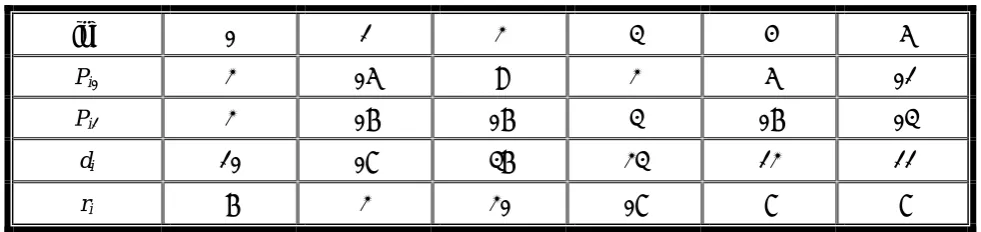
them to zero randomly. Table 1 shows an example for a problem with 6 jobs and 2 machines, and 3 precedence constraints.
Considered precedence constraints are as follows: 4 < 2, 1 < 5 and 2 < 3. The computational results of the given test problem are shown in Table 2. These results contain the completion time for all jobs (i.e., Ci), assigned situation to each job (i.e., Xikm) and the objective values in Phases 1 and 2 of the proposed model.
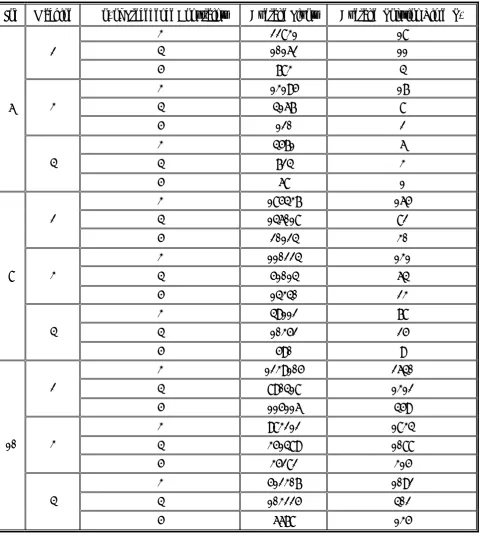
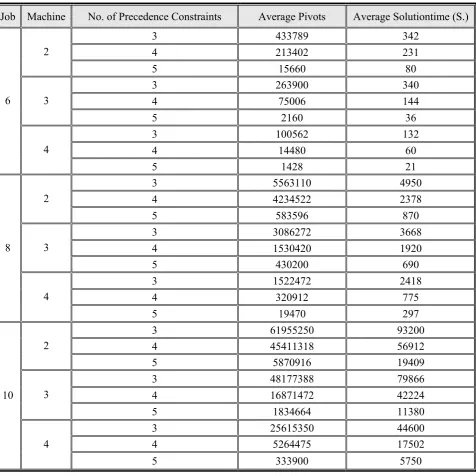
For small-sized problems, we consider 27 different test problems and by using the proposed method, we produce 15 sample data for each of them. These problems are optimally solved by a branch-and-bound (B and B) method under the LINGO 8.0 software on a Personal Computer including two Intel® CoreTM2 [email protected] GHz processors and 512 GB RAM. The principle criterion to evaluate the performance of the proposed model is the number of iterations. The average number of iterations and average of the solution time for two objectives of the proposed models are shown in Tables 3 and 4. In these tables, for each test problem this information is shown: the number of jobs and machines, precedence constraints, number of iterations until achieving the optimal solution and averages of the solution times. It is worthy noting that increasing the number of jobs increase the number of iterations. Also, increasing the number of machines is effective in decreasing the number of iterations until receiving the optimal solution. Increasing the number of precedence constraints because of decreasing the solution space has the same effect in the number of iterations.
TABLE 1. Sample Problem Data. 6 5 4 3 2 1 job 12 6 3 9 16 3
Pi1
14 17 4 17 17 3
Pi2
22 23 34 47 18 21 di 8 8 18 31 3 7 ri
Number of Jobs = 6; Number of Machines = 2
Setup Times on Machine 1 (m = 1) Setup Times on Machine 2 (m = 2)
6 5 4 3 2 1 From/to 6 5 4 3 2 1 From/to 5 4 5 4 6 0 1 3 4 4 4 4 0 1 3 4 2 6 0 2 2 4 2 5 4 0 3 2 2 5 2 0 3 4 3 5 4 3 0 7 6 3 6 3 0 5 5 5 4 4 6 0 6 4 6 4 6 0 5 4 6 5 5 4 0 5 7 4 6 5 0 6 5 ٧ 4 3 6 0 3 1 7 5 2 6
TABLE 2. Results for the Given Problems.
Xikm=1
Ci Job X111 10 1 X241 48 2 X322 57 3 X431 28 4 X521 20 5 X612 22 6
∑Ui = 2 ∑Ci = 185
mutual effect of the number of jobs and precedence constraints are effective on the number of iterations; thus increasing and decreasing of these
TABLE 3. Test Results for the Primary Model with the Objective Function Of ∑Ui.
Average Solution Time (S.) Average Pivots
No. of Precedence Constraints Machine
Job
18 22831
3
11 10162
4
4 783
5 2
17 13195
3
8 4167
4
2 120
5 3
6 4571
3
3 724
4
1 68
5 4
6
165 185437
3
82 146018
4
30 20124
5 2
131 110224
3
64 51014
4
23 14340
5 3
78 49112
3
25 10352
4
9 590
5 4
8
2640 1239105
3
1312 890418
4
459 115116
5 2
1834 983212
3
1088 351489
4
315 35282
5 3
1092 512307
3
402 103225
4
135 6678
5 4
10
5. CONCLUSION
In this paper, a parallel machine scheduling was
TABLE 4. Test Results for the Secondary Model with the Objective Function of ∑Ci.
Average Solutiontime (S.) Average Pivots
No. of Precedence Constraints Machine
Job
342 433789
3
231 213402
4
80 15660
5 2
340 263900
3
144 75006
4
36 2160
5 3
132 100562
3
60 14480
4
21 1428
5 4
6
4950 5563110
3
2378 4234522
4
870 583596
5 2
3668 3086272
3
1920 1530420
4
690 430200
5 3
2418 1522472
3
775 320912
4
297 19470
5 4
8
93200 61955250
3
56912 45411318
4
19409 5870916
5 2
79866 48177388
3
42224 16871472
4
11380 1834664
5 3
44600 25615350
3
17502 5264475
4
5750 333900
5 4
10
machine operated with different speed and all of them are available at the beginning of the scheduling and jobs are not independent and precedence constraints at machines exists between the jobs and all the jobs are not available at the beginning of scheduling, and each of them have non common due date, our
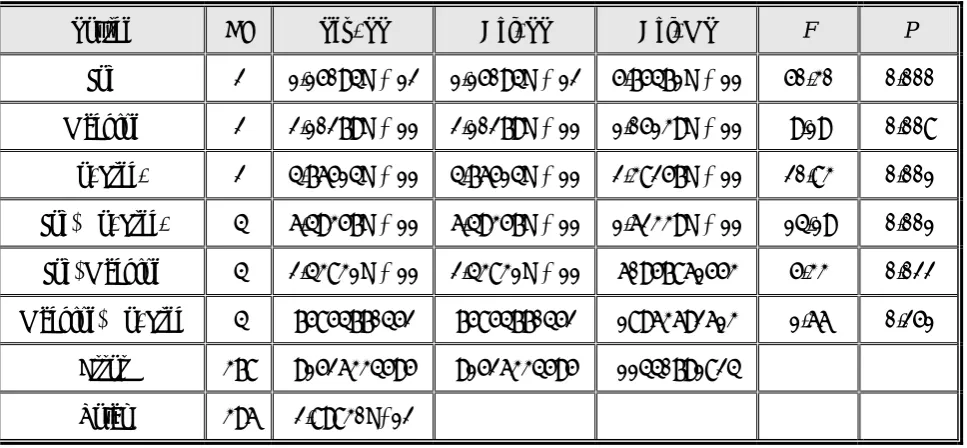
TABLE 5. General Linear Model: Ave. Pivot Versus Job; No. of Prec.
Factor Type Levels Values
Job Fixed 3 6 8 10
Machine Fixed 3 2 3 4
No. of Prec. Fixed 3 3 4 5
TABLE 6. ANOVA for Pivot 2, using Adjusted SS for Tests.
Source DF Seq. SS Adj. SS Adj. MS F P
Job 2 1.15094E + 12 1.15094E + 12 5.75471E + 11 50.30 0.000
Machine 2 2.10279E + 11 2.10279E + 11 1.05139E + 11 9.19 0.008
No. Prec. 2 4.76514E + 11 4.76514E + 11 2.38257E + 11 20.83 0.001
Job*No. Prec. 4 6.49357E + 11 6.49357E + 11 1.62339E + 11 14.19 0.001
Job*Machine 4 2.43831E + 11 2.43831E + 11 60957861553 5.33 0.022
Machine*No. Prec 4 75854770452 75854770452 18963692613 1.66 0.251
Error 378 91526334595 91526334595 11440791824
Total 396 2.89830E+12
6. ACKNOWLGEMENT
This study was supported partially by the University of Tehran under the research grant No. 8106043/1/06. The first author is grateful for this financial support.
7. REFERENCES
1. Blidgue, U., Kirac, F., Kurtulan, M. and Pekgun, P., “A Tabu Search Algorithm for Parallel Machine Total
Tardiness Problem”, Computers and Operation
Research, Vol. 31, No. 3, (2004), 397-414.
2. Radhakrishnan, S. and Ventura, J. A., “Simulated
Annealing for Parallel Machine Scheduling with Earliness/Tardiness Penalties and Sequence-Dependent Setup Times”, In. J. of Production Research, Vol. 38, No. 10, (2000), 2233-2252.
3. Sivrikaya-Şerifoğlu, F. and Ulusoy, G., “Parallel
Machine Scheduling with Earliness Tardiness Penalties”, Computers and Operation Research, Vol. 26, (1999), 773-787.
4. Sumichrast, R. T. and Frendewey, J. O., “Scheduling
Parallel Processors with Setup Cost and Resource Limitations”, Decision Science, Vol. 19, (1988), 138-146.
5. Frederickson, G., Hecht, M. S. and Kim, C. E.,
“Approximation Algorithm for Some Routing
Problems”, SIAM Journal of Computing, Vol. 7,
(1978), 178-193.
6. Sumichrast, R. T., “Scheduling Parallel Processors to
Minimize Setup Times”, Computers and Operations
7. Weng, M. X., Lu, J. and Ren, H., “Unrelated Parallel Machine Scheduling with Setup Consideration and a Total Weighted Completion Time Objective”, Int. J. of Production Economics, Vol. 70, No. 3, (2001), 215-226.
8. Ovacik, I. M. and Uzsoy, R., “Worst-Case Error Bounds for Parallel Machine Scheduling Problems with Bounded Sequence-Dependent Setup Times” Operations Research Letters, Vol. 14, No. 5, (1993), 251-256.
9. Sameh, T. A. and Rajan, V. N., “Reduction of Total
Weighted Tardiness on Uniform Machines with
Sequence Dependent Setups”, 6t h Industrial
Engineering Research Conference Proceedings, IIE, Norcross, GA, (1997), 181-185.
10. Monma, C. L. and Potts, C. N., “On the Complexity of
Scheduling with Batch Setup Times”, Operations
Research, Vol. 37, (1989), 798-804.
11. Balakrishnan, N., Kanet, J. J. and Sridharan, Sir V., “Early/Tardy Scheduling with Sequence Dependent Setup on Uniform Parallel Machines”, Computers and Operation Research, Vol. 26, (1999), 127-141.
12. Vignier, A., Sonntag, B. and Portmann, M. C., “Hybrid Method for a Parallel-Machine Scheduling Problem”, IEEE Symposium on Emerging Technologies and Factory Automation, ETFA, Vol. 1, (1999), 671-678.
13. Flower, J. W., Horng, S. M. and Cochran, J. K., “A
Hybridized Genetic Algorithm to Solve Parallel Machine Scheduling Problem with Sequence Dependent Setups”, Int. J. of Industrial Engineering, Vol. 10, No. 3, (2003), 232-243.
14. Tavakkoli-Moghaddam, R. and Mehdizadeh, E., “A
New ILP Model for Identical Parallel-Machines Scheduling with Family Setup Times Minimizing the Total Weighted Flow Time by a Genetic Algorithm”, Int. J. of Engineering, Transaction A: Basic, Vol. 20, No. 2, (2007), 183-194.
15. Tavakkoli-Moghaddam, R., Jolai, F., Khodadadeghan,
Y. and Haghnevis, M., “A Mathematical Model of a Multi-Criteria Parallel Machine Scheduling Problem:
A Genetic Algorithm”, Int. J. of Engineering,
Transactions A: Basic, Vol. 19, No. 1, (2006), 79-86.
16. Javadian, N., Javadi, B., Tavakkoli-Moghaddam, R. and Safaei, N., “Possibility Linear Programming to Uniform Parallel Machines Scheduling with Sequence-Dependent Setup Times: Early/Tardy Penalties”, Proceeding of the 36th Int. Conf. on Computers and Industrial Engineering, Taipei, Taiwan, (June 20-23, 2006), 3488-3497.
17. Jolai, F., Tavakkoli-Moghaddam, R. and Azadian, F., “Parallel Machine Scheduling for Split Able Jobs with Sequence Dependent Setup Times”, J. of Faculty of Engineering, University of Tehran, Vol. 40, No .4, (2006), 495-506.
18. Torabi, S. A., Jenabi, M., Fatemi Ghomi, S. M. T., Jolai, F. and Tavakkoli-Moghaddam, R., “Finite Horizon ELSP in Flexible Flow Lines with Unrelated Parallel
Machines”, Proceeding of the 12th IFAC Symposium
on Information Control problems in Manufacturing, Saint Etienne, France, (May 15-19, 2006), Vol. 4, 137-142.
19. Tavakkoli-Moghaddam, R., Gharehgozli, A. H.,
Rabbani, M. and Zaerpour, N., “A Fuzzy Mixed-Integer Goal Programming Model for a parallel Machine Scheduling Problem”, Proceeding of the 8th WSEAS
Int. Conf. on Fuzzy Systems (FS '07), Vancouver,
Canada, (June 19-21, 2007), 196-201.
20. Uzsoy, R., Vega, M., Lee, C. Y. and Leonard, P. A., “Production Algorithms for Semiconductor Test
Facility”, IEEE Transactions on Semiconductor
Manufacturing, Vol. 4, (1991), 270-280.
21. Hurink, J. and Knust, S., “List Scheduling in a Parallel Machine Environment with Precedence Constraints and Setup Times”, Operations Research Letters, Vol. 29, (2001), 231-239.
22. Huo, Y., Leung, J. Y. T. and Zhao, H., “Bi-Criteria Scheduling Problems: Number of Tardy Jobs and
Maximum Weighted Tardiness”, European Journal of
Operational Research, Vol. 177, No. 1, (2007), 116-134.
23. Prakash, D., “Bi-Criteria Scheduling Problems on