RESEARCH NOTE
A COMPUTATIONAL APPROACH TO THE FLOW OF
WALTER’S LIQUID B
′
THROUGH ANNULUS OF COAXIAL
POROUS CIRCULAR CYLINDERS FOR HIGH
SUCTION PARAMETER
N. Kumar*
Department of Mathematics, IcfaiTech, ICFAI University Dehradun, India
A. Pant
Department of Mathematics, Govt. Polytechnique College Nainital, (GPCN) Uttranchal India
*Corresponding Author
(Received: October 9, 2007 – Accepted in Revised Form: December 11, 2008)
Abstract The present investigation studies the behavior of steady flow of visco-elastic liquid between two porous coaxial circular cylinders, where both the cylinders are rotating with different uniform angular velocities about the common axis. In addition, the inner cylinder has uniform velocity along the axis and the visco-elastic fluid, which is a Walters liquid B′, is allowed to flow in the annulus. The investigation deals with high order suction parameter. The problem is to be used in the chemical industry. Higher Reynolds numbers, visco-elastic parameters and suction parameter have also been considered in the study. A numerical approach has been used to demonstrate out the results and present them graphically.
Keywords Walters Liquid B′, Reynolds Number, Toroidal Motion
ﭼ
ﻩﺪﻴﮑ
ﺍﺭﺩ ﻳ ﺮﺟﺭﺎﺘﻓﺭﻪﻟﺎﻘﻣﻦ ﻳ
ﺎﭘﻥﺎ ﻳ ﺭﺍﺪ ﻳ ﺳﮏ ﻴ ﻭﻝﺎ ﻳ ﺘﺳﻻﺍﻮﮑﺴ ﻴ ﺑﮏ ﻴ ﺳﻭﺩﻦ ﻴ ﺍﺩﺭﺪﻨﻠ ﻳ ﻩﺮ ﺍ ﻱ ﺳﺭﺮﺑﻞﺨﻠﺨﺘﻣ ﻲ
ﻣ ﻲ ﺩﻮﺷ
.
ﺳ ﻭﺩ ﺮﻫ ﻴ ﻢﻫ ﺭﺪﻨﻠ ﻭﺍﺯ ﺖﻋﺮﺳ ﺎﺑ ﺭﻮﺤﻣ ﻳﻪ
ﺍ ﻱ ﮐﺮﺘﺸﻣﺭﻮﺤﻣ ﻝﻮﺣ ﺖﺑﺎﺛ ﻲ
ﻣ ﻲ ﺪﻨﺧﺮﭼ
.
ﻪﺑ ﺳ ﻩﻭﻼﻋ ﻴ ﺭﺪﻨﻠ
ﻠﺧﺍﺩ ﻲ ﺖﻋﺮﺳ ﻳ ﺘﺧﺍﻮﻨﮑ ﻲ ﺍ ﺩﺍﺪﺘﻣﺍ ﺭﺩ ﻳ
ﺳ ﻭ ﺩﺭﺍﺩ ﺭﻮﺤﻣ ﻦ ﻴ
ﻭ ﻝﺎ ﻳ ﺘﺳﻻﺍﻮﮑﺴ ﻴ ﻪﮐ ﮏ ﺳ ﻉﻮﻧﺯﺍ ﻴ ﺍﻭ ﻝﺎ ﻟ ﺮﺘ
B′
،ﺖﺳﺍ
ﻣ ﻲ ﺎﻀﻓﺭﺩﺪﻧﺍﻮﺗ ﻱ
ﺎﻣ ﺑﻴ ﺍﻦ ﻳ ﺳﻭﺩﻦ ﻴ ﺮﺟﺭﺪﻨﻠ ﻳ ﺪﺷﺎﺑﻪﺘﺷﺍﺩﻥﺎ
.
ﺍﻳ ﻧﺍﺭﻻﺎﺑﻪﺒﺗﺮﻣﺯﺍﺶﮑﻣﺮﺘﻣﺍﺭﺎﭘﺶﻫﻭﮋﭘﻦ ﻴ
ﺭﺩﺰ ﺮﻈﻧ
ﻣ ﻲ ﮔﻴ ﺎﻨﺻﺭﺩﻪﮐﺩﺮ ﻳ
ﺷﻊ ﻴﻤ ﻴﺎ ﻲﻳ ﺩﺭﺍﺩﺩﺮﺑﺭﺎﮐ
.
ﺭﺩﺍﺪﻋﺍ ﻳ ﺎﻫﺮﺘﻣﺍﺭﺎﭘ،ﻻﺎﺑﺯﺪﻟﻮﻨ ﻱ
ﻭ ﻳ ﺘﺳﻻﺍﻮﮑﺴ ﻴ ﺴ ﻴ ﻧﺶﮑﻣﺮﺘﻣﺍﺭﺎﭘﻭﻪﺘ ﻴ
ﺰ
ﺍ ﺭﺩ ﻳ ﺩﺭﻮﻣ ﻪﻠﺌﺴﻣ ﻦ ﺖﺳﺍ ﻪﺟﻮﺗ
.
ﻨﭽﻤﻫ ﻴ ﻫﺭ ﺯﺍ ﻦ ﻴ ﺘﻓﺎ ﻲ ﺩﺪﻋ ﻱ ﺍﺮﺑ ﻱ ﻥﺎﺸﻧ ﺎﺘﻧ ﻥﺩﺍﺩ ﻳ ﻪﺑ ﺎﻬﻧﺁ ﻪﺿﺮﻋ ﻭ ﺞ ﺕﺭﻮﺻ
ﺳﺮﺗ ﻴﻤ ﻲ ﺖﺳﺍﻩﺪﺷﻩﺩﺎﻔﺘﺳﺍ
.
1. INTRODUCTION
The flow through porous boundaries is of great importance both in technological as well as biophysical fields, example of which is soil mechanics, transpiration cooling, food preservation, cosmetic industry, blood flow and artificial dialysis. In recent years the problems of fluid flow past porous media or in channels with heat transfer,
Singh, et al [3] have considered the steady problems of porous cylinder where both cylinders are rotating with different velocities about a common axis and the cylinders are in relative motion along the axis. The visco-elastic fluid which is a second order fluid is allowed to flow in the annulus under constant axial pressure gradient. Choudhury, et al [4] considered the steady flow of visco-elastic fluid in an annulus of two porous coaxial cylinders rotating with different uniform angular velocities, together with translatory motion of an inner cylinder along the axis of rotation. The analytical expression for toroidal and axial component has been obtained using a series solution for small values of suction parameter.
In most of the earlier problems, in general series solution have been taken to find the velocity function where one is restricted to take only a finite number of terms which puts a limitations on the values of the parameters involved. In this particular paper, the Gauss Elimination method has been used to find the velocity functions. The beauty of technique lies in that (i) solution is valid for a large range of value of the parameter (ii) The original basic equation can be used without much elaboration. The striking feature of the solutions to follow is that they are valid for all values of K (positive, negative, small and large) and few more new results have also been obtained.
The present paper is concerned with a visco-elastic fluid characterized by Walters liquid [5] (Model B′) in the annulus of two porous coaxial circular cylinders when both boundaries are rotating with different angular velocities at a high injection in inner cylinder and high suction in the outer cylinder. The constitutive equation of Walters liquid (Model B′) is:
, ik e 0 k 2 ik e 0 2 ik
ik ik pg ik
′ − η = σ
′ σ + − = σ
(1)
Where σik s the stress tensor, p is the isotropic pressure, gik the metric tensor of fixed coordinate system xi ,vi the velocity vector and e′ik in the
contravariant form is:
ik e i
j , v ij e k
j , v ik
j , e j v t ik e
ik + − −
∂ ∂ =
σ′ (2)
The convected derivative of the deformation rate tensor eik is defined by:
, i , k v k ,i v 2 1 ik
e ⎟
⎠ ⎞ ⎜
⎝
⎛ +
= (3)
Here, η0 is thelimiting viscosity at a small rate of shear given by,
τ ∫∞τ τ =
∫∞ τ τ
=
η0 0 N( )d and K0 0 N( )d (4)
) (
N τ being the relaxation spectrum as introduced by Walters. This idealized model is a valid approximation of Walters’s liquid (Model B′) taking very short memories into account so that terms involving,
2 n , d ) ( N
0 n τ τ ≥
∫∞ τ (5)
Have been neglected.
2. GOVERNING EQUATIONS
Let us assume that the fluid is flowing in an annulus of coaxial circular cylinders whose radii are a1,b1,
(
a1<b1)
. Both inner and outer cylinders are rotating about a common axis with angular velocities w1 and w2 respectively while the innercylinder is also rotating with uniform velocity W*
along its axis. There is suction in one of the cylinders and injection in the other one. The formulation of the problem has been done using the cylindrical coordinates
(
r,θ,z)
, where z-axis is considered as the common axis. The velocity components depend only on the radial distance r due to the symmetry about the axis. Hence,), r ( u
u= v=v(r), w=w(r), (6)
Where v and w are angular and axial velocities, respectively. The boundary conditions are,
1 a r at * W w , 1 w 1 a v , 1 a U
1 b r at 0 w , 1 w 1 b v , 1 b U
u= = = = (7)
Where w1,w2 are the angular velocities 1
a U and
1
b
U are the uniform injection and suction velocities.
Now introduce the non-dimensional quantities:
0 U
u
u= ,
0 U
v
v= ,
0 U
w
w= ,
2 0 U P P ρ = , L 0 0 U 0 K η = α , 0 L 0 U R η ρ = , L r
r= ,
L z
z= ,
L1 a
a= , ,
0 U L 1 w 1 , L1 b
b= Ω =
0 U1 b U b U , 0 U1 a U a U , 0 U * W H , 0 U L 2 w
2= = = =
Ω (8)
Where L and U0 are the characteristic length and characteristic velocity respectively, α is a non-dimensional visco-elastic parameter.
Under these considerations, the governing equations in dimensionless form are:
0 r u dr du+ =
(9) ⎥ ⎥ ⎦ ⎤ ⎢ ⎢ ⎣ ⎡ + + ⎟ ⎠ ⎞ ⎜ ⎝ ⎛ + + − α − ∂ ∂ − = ⎥ ⎥ ⎦ ⎤ ⎢ ⎢ ⎣ ⎡ + − 5 r 2 K 4 3 r 2 u 2 dr du r 1 dr du r 1 dr du 2 r u 3 2 dr u 2 d r u 2 r p R r 2 u 3 r 2 K R (10) ⎥ ⎥ ⎦ ⎤ ⎢ ⎢ ⎣ ⎡ − + + α − − + = ⎥⎦ ⎤ ⎢⎣ ⎡ + 3 r v 3 dr dv 2 r 3 2 dr v 2 d r 2 3 dr v 3 d r K 2 r v dr dv r 1 2 dr v 2 d r v dr dv r RK (11) ⎥ ⎥ ⎦ ⎤ ⎢ ⎢ ⎣ ⎡ − + α − + + ∂ ∂ − = dr dw 2 r 3 2 dr w 2 d r 3 3 dr w 3 d r K 2 dr w 2 d dr dw r 1 z P R dr dw r RK (12)
3. SOLUTION OF THE PROBLEM
Equation 9 on integration yields,
, r K u=
Where K is the non-dimensional constant related to injection and suction velocities as,
, b . b U a . a U
K= = (13)
Where K is positive for injection on the inner cylinder and suction on the outer cylinder and negative for the reverse order.
From Equations 10 and 11 we infer that the pressure should be a function of r and z only which is the form,
) r ( g z
P=λ +
− (14)
Where λ is constant and g(r), an arbitrary function of r.
Equations 10 and 11 are linear homogeneous in v and w respectively. The finite difference approximations scheme for the first, second and third order derivatives have been used to discretize these differential equations.
Using these approximations in Equation 10 and 11, we obtain:
0 3 h K 2 i v 3 r K 3 r 1 r K R h 2 1 1 2 r K 2 2 h 1 3 rh K 3 1 i v 3 r K r 1 2 r K R 1 2 r K 2 2 h 2 3 rh K 3 i v 3 r K 3 r 1 r K R h 2 1 1 2 r K 2 2 h 1 3 rh K 1 i v = ⎥ ⎥ ⎦ ⎤ ⎢ ⎢ ⎣ ⎡α + + ⎥ ⎥ ⎦ ⎤ ⎢ ⎢ ⎣ ⎡ ⎟ ⎟ ⎠ ⎞ ⎜ ⎜ ⎝ ⎛ α + − + ⎥ ⎥ ⎦ ⎤ ⎢ ⎢ ⎣ ⎡ ⎟ ⎟ ⎠ ⎞ ⎜ ⎜ ⎝ ⎛ − α + α − + + ⎥ ⎥ ⎦ ⎤ ⎢ ⎢ ⎣ ⎡ ⎟ ⎟ ⎠ ⎞ ⎜ ⎜ ⎝ ⎛ α − + + ⎟ ⎟ ⎠ ⎞ ⎜ ⎜ ⎝ ⎛ − α − α + ⎥ ⎥ ⎦ ⎤ ⎢ ⎢ ⎣ ⎡ ⎟ ⎟ ⎠ ⎞ ⎜ ⎜ ⎝
⎛ − + α
− ⎟ ⎟ ⎠ ⎞ ⎜ ⎜ ⎝ ⎛ − α + α − − (15) + ⎥ ⎥ ⎦ ⎤ ⎢ ⎢ ⎣ ⎡ ⎟ ⎟ ⎠ ⎞ ⎜ ⎜ ⎝ ⎛ − α − ⎟ ⎠ ⎞ ⎜ ⎝ ⎛ α + ⎥ ⎥ ⎦ ⎤ ⎢ ⎢ ⎣ ⎡ ⎟ ⎟ ⎠ ⎞ ⎜ ⎜ ⎝
⎛ − − α
0 R 3 rh
K 2 i w
3 r
K 3 r 1 r RK h 2
1 1 2 r
k 3 2 h
1 2 r
K 3 1 i w
= λ − ⎥ ⎥ ⎦ ⎤ ⎢ ⎢ ⎣ ⎡α +
+ ⎥ ⎥ ⎦ ⎤ ⎢
⎢ ⎣ ⎡
⎟ ⎟ ⎠ ⎞ ⎜
⎜ ⎝
⎛ α
− − −
⎟ ⎟ ⎠ ⎞ ⎜ ⎜ ⎝ ⎛
− α + α − +
(16) All vi's and wi's are functions of r. We divide r
[1,6] into hundred equal parts each one of length 0.001.The boundary conditions can be written as:
, 1 r at H 1 w , 1 a 1 v , a U
u= = Ω = =
2 r at 0 101 w , 2 b 100 v , b U
u= = Ω = = . (17)
Equation 15 and 16 have been represented in the matrix form independently to solve them numerically using Gauss-eliminating technique.
4. DISCUSSION
We have taken into consideration the boundary layer near the inner cylinder as well as the outer cylinder. We will discuss the effect of various parameters α, visco-elastic parameter, K, the suction parameter and R, Reynolds number. The following conclusions are arrived at as a result of the present investigations:
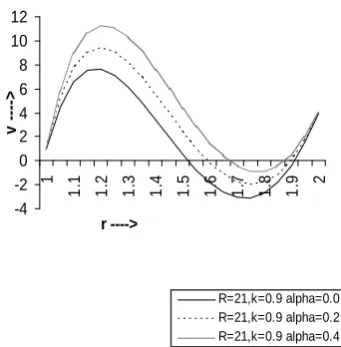
The Figure 1 and 2 represent the graph between angular velocity v against radial distance r for fixed value of suction parameter K and Reynolds number R but different values of α. It is evident that when
K > 0, the angular velocity v increases with the increase in visco-elastic parameter α, throughout the gap length and the maxima shifts towards the outer boundary. For a large value of Reynolds number, angular velocity increases with the increase in visco-elastic parameter but it becomes negative after increment in Reynolds number ≥ 10. The corresponding results for Newtonian fluid can be deduced from the above results by setting α = 0 and it is worth mentioning here that these results coincide with that of Choudhury, et al [4].
It is further evident that if α = 2, the angular velocity increases in comparison to Newtonian fluid and the maxima shift towards midway of the gap length (Figure 3).
1 1.5 2 2.5 3 3.5 4 4.5
1
1.
1
1.
2
1.
3
1.
4
1.
5
1.
6
1.
7
1.
8
1.
9 2
r ---->
v
-
--->
R=1,k=0.9 alpha=0.0 R=1,k=0.9 alpha=0.2 R=1,k=0.9 alpha=0.4
Figure 1. variation between angular velocity and radial distance.
-4 -2 0 2 4 6 8 10 12
1
1.
1
1.
2
1.
3
1.
4
1.
5
1.
6
1.
7
1.
8
1.
9 2
r ---->
v
---->
R=21,k=0.9 alpha=0.0 R=21,k=0.9 alpha=0.2 R=21,k=0.9 alpha=0.4
Figure 2. Variation between angular velocity and radial distance.
1 3 5 7 9 11 13 15 17
1
1.
1
1.
2
1.
3
1.
4
1.
5
1.
6
1.
7
1.
8
1.
9 2
r ---->
v
---->
R=21,k=-0.7 alpha=0.0 R=21,k=-0.7 alpha=0.2 R=21,k=-0.7 alpha=0.4
1 1.5 2 2.5 3 3.5 4 4.5
1
1.1 1.2 1.3 1.4 1.5 1.6 1.7 1.8 1.9 2 r ---->
v
---->
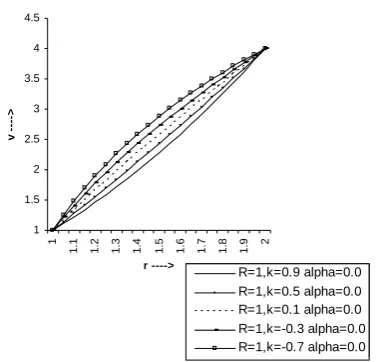
R=1,k=0.9 alpha=0.0 R=1,k=0.5 alpha=0.0 R=1,k=0.1 alpha=0.0 R=1,k=-0.3 alpha=0.0 R=1,k=-0.7 alpha=0.0
Figure 4. Reynolds number and fixed visco-elastic-parameter.
0 0.5 1 1.5 2 2.5 3 3.5
1
1.
1
1.
2
1.
3
1.
4
1.
5
1.
6
1.
7
1.
8
1.
9 2
r ---->
w
-->
R=1.0,k=0.1 alpha=0.2 R=5.0,k=0.1 alpha=0.2 R=9.0,k=0.1 alpha=0.2 R=13,k=0.1 alpha=0.2 R=17,k=0.1 alpha=0.2 R=21,k=0.1 alpha=0.2
Figure 5. Axial velocity w increases with the increasing value of R.
-14 -12 -10 -8 -6 -4 -2 0 2 4 6
1
1.
1
1.
2
1.
3
1.
4
1.
5
1.
6
1.
7
1.
8
1.
9 2
r ---->
w
---->
R=1.0,k=0.9 alpha=0.2 R=5,k=0.9 alpha=0.2 R=9,k=0.9 alpha=0.2 R=13,k=0.9 alpha=0.2 R=17,k=0.9 alpha=0.2 R=21,k=0.9 alpha=0.2
Figure 6. Axial velocity profile.
The study for Reynolds number and fixed visco-elastic-parameter α has also been made and it is shown through Figure 4. It has been noticed that the velocity increases with the decrease in suction parameter.
From Figure 5, fixing α = 0.2 and k = 0.1 axial velocity w increases with the increasing value of R. In Figure 6 axial velocity profile have been plotted for K = 0.9, α = 0.2 and different values of Reynolds number. It is seen that the increase in Reynolds number changes the flow pattern considerably. It is observed that for large values of K, the flow becomes dramatically distorted on increasing R i.e. the axial velocity becomes very much negative at R = 13 but becomes less negative on further increase in the value of R. Hence, one can’t take the fluids whose Reynolds number as well as suction parameter is very large.
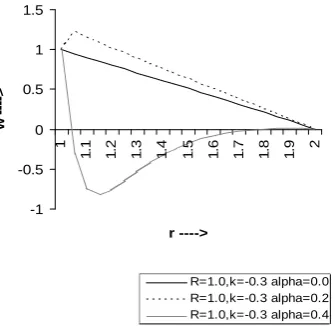
It has been observed and concluded from Figures 7 and 8 that for a fixed K, for a particular value of R, the axial velocity of the fluid increases with the increase in α. If K becomes very large (very small) and R is also very large, the axial velocity has a negative sign, i.e. the liquid comes out of the cylinder. The professional from the chemical industry may be interested to find this limit of K and R for the fluid they are using these values depends on the characteristics of the fluid.
5. REFERENCES
1. Sinha, K.D. and Chaudhary, R.C., “Flow of Viscous Incompressible Fluid Between Two Parallel Plates, one In Uniform Motion and Other at Rest With Suction at the Stationary Plate”, Proc. Indian Acad. Sc., Vol. 64,
(1965), 308-318.
2. Gupta, R.K. and Gupta, K., “Steady Flow of an Elastico Viscous Fluid in Porous Coaxial Cylinder”, Indian J. Pure and Appl. Math., Vol. 27, (1996), 423-434.
3. Singh, T. and Gupta, R.K., “Steady Flow of Elastico-Viscous Fluid through the Porous Circular Cylinders”,
Indian J. Pure and Appl. Math., Vol. 6, (1975), 494-503.
4. Choudhury, R. and Das, A., “Steady Flow of Walters Liquid B’ through the Annulus of Porous Coaxial Circular Cylinder”, Indian J. Pure and Appl. Math., Vol. 33, (2002), 807-817.
5. Kumar, S. and Kumar, N. “A Computational Study of Oxygen Transport in the Body of Living Organism”,
International Journal of Engineering, Vol. 18, No. 4,
(2005), 351-359.
-1 0 1 2 3 4 5
1
1.1 1.2 1.3 1.4 1.5 1.6 1.7 1.8 1.9 2
r
w
R=9,k=0.9 alpha=0.0 R=9,k=0.9 alpha=0.2 R=9,k=0.9 alpha=0.4
Figure 7. Axial velocity of the fluid increases with the increase in α.
-1 -0.5 0 0.5 1 1.5
1
1.
1
1.
2
1.
3
1.
4
1.
5
1.
6
1.
7
1.
8
1.
9 2
r ---->
w
---->
R=1.0,k=-0.3 alpha=0.0 R=1.0,k=-0.3 alpha=0.2 R=1.0,k=-0.3 alpha=0.4
Figure 8. Axial velocity of the fluid increases with the increase in α.
Steady Motion of Second Order Fluid Past a Porous Circular Cylinder”, Indian J. of Technology, Vol. 17, (1986), 783-786.
7. Kumar, P. and Lal, R., “On the Stability of Two Superposed Viscous-Viscoelastic (Walters B’) Fluid”,
Journal of Fluid Engineering, Vol. 29, (2007),
116-119.
8. Walters, K., “Some Results on B Fluids”, J. Mecanique,
Vol. 1, (1962), 474-478.
9. Sharma, R.C. and Suresh Chand, S., “The Instabilty of Streaming Walters Viscoelastic Fluid B’ in Porous Medium”, Czechoslovak Journal of Physics, Vol. 49,
No. 2, (1999), 189-195.
10. Pedley, T.J., “Mathematical Modelling of Arterial Fluid
Dynamics”, J. Eng. Math., Vol. 47, No. 3-4, (2003),
419-444.
11. Bayanov, I.V., Khamidullin, I.R. and Shagapov, V.Sh., “The Self-Similar Problem of the Diffusion Mixing of Vapour-Gas-Condensate Systems”, Journal of Applied Mathematics and Mechanics, Vol. 72, (2008), 437-445.