VOLUME NO.4(2014),ISSUE NO.01(JANUARY) ISSN2231-5756
A Monthly Double-Blind Peer Reviewed (Refereed/Juried) Open Access International e-Journal - Included in the International Serial Directories
Indexed & Listed at:
Ulrich's Periodicals Directory ©, ProQuest, U.S.A., EBSCO Publishing, U.S.A., Cabell’s Directories of Publishing Opportunities, U.S.A., Open J-Gage, India [link of the same is duly available at Inflibnet of University Grants Commission (U.G.C.)],
VOLUME NO.4(2014),ISSUE NO.01(JANUARY) ISSN2231-5756
INTERNATIONAL JOURNAL OF RESEARCH IN COMMERCE, IT & MANAGEMENT
CONTENTS
Sr.
No.
TITLE & NAME OF THE AUTHOR (S)
Page
No.
1
.
DETERMINANTS OF REAL ESTATE MARKETING: AN EMPIRICAL STUDY ON SELECTED REAL
ESTATE MARKETERS IN ADDIS ABABA, ETHIOPIA
DR. GETIE ANDUALEM IMIRU
1
2
.
A STUDY ON PROBLEMS AND PROSPECTS OF TEA GROWERS WITH PARTICULAR
REFERENCE TO NILGIRIS DISTRICT (TN) IN INDIA
DR. G. KAVITHA & M. JAMUNA RANI
7
3
.
A STUDY ON THE CHALLENGE FOR ARTISANS OF CONCH SHELL INDUSTRY IN WEST
BENGAL
ANAMITRA PAUL & SEBAK KUMAR JANA
11
4
.
A CHRONOLOGICAL STUDY ON EMERGENCE OF PRIVATE LABEL BRANDS IN INDIAN
ORGANIZED RETAIL
AJAY SINGH & DR. NRIPENDRA SINGH
15
5
.
MUTUAL FUNDS IN INDIA-RECENT ISSUES, OPPORTUNITIES AND CHALLENGES
M.NAGABHASKAR & M.RAMU
20
6
.
GREEN MARKETING AND THEIR IMPACT ON ENVIRONMENT: A STUDY
SUSHEELA RATHEE & AMIT RATHEE
23
7
.
ASSESSING QUALITY OF WEBSITES THROUGH OBSERVATION
DR. HEERA BARPUJARY
28
8
.
ANALYSIS ON THE CASH MANAGEMENT OF NEPA LIMITED
DR. ADARSH ARORA
34
9
.
DESTINATION BRANDING AS A MARKETING TOOL FOR DEVELOPING COUNTRIES: A
COMPARATIVE ANALYSIS BETWEEN INDIA & SPAIN
SWATI SHARMA & MAHESH UNIYAL
39
10
.
FINANCIAL LITERACY AND ITS’ INFLUENCING FACTORS: AN EMPIRICAL STUDY OF INDIAN
INVESTORS
DR. BIDYUT JYOTI BHATTACHARJEE
43
11
.
STUDYING THE RELATIONSHIP BETWEEN CORPORATE GOVERNANCE AND FINANCING
THROUGH THE TWO PERSPECTIVES OF BALANCE SHEET AND CASH FLOW STATEMENT IN
FIRMS ACCEPTED IN STOCK EXCHANGE TEHRAN (IRAN)
NASRIN DADASHI & EBRAHIM CHEIRANI
47
12
.
POVERTY: TROUBLESOME THE PROBLEM & OVERCOME (AN INDIAN CONTEXT)
DR. MANOJ KUMAR SHARMA & SUTHAR AAVANTI ASHOK
53
13
.
ENFORCEMENT OF LAWS TOWARDS HAZARDOUS CHILD LABOR: A STUDY ON WELDING
WORKSHOPS AT SYLHET CITY IN BANGLADESH
A.K.M. SOHEL HABIB NOWROZ & KOWSER JANNAT
57
14
.
MODEL OF INTEGRATION OF SPIRITUALITY TOWARDS THE WORK BEHAVIOUR AND
EMOTIONAL INTELLIGENCE AS MEDIATING VARIABLE: AN APPROACH OF STRUCTURAL
EQUATION MODELING (SEM)
ACHMAD CHOERUDIN
62
15
.
MACROECONOMIC VARIABLES AND STOCK PRICES: A STUDY OF COLOMBO STOCK
EXCHANGE (CSE) IN SRI LANKA
P.ELANGKUMARAN & J.N.JENITTA
71
VOLUME NO.4(2014),ISSUE NO.01(JANUARY) ISSN2231-5756
INTERNATIONAL JOURNAL OF RESEARCH IN COMMERCE, IT & MANAGEMENT
CHIEF PATRON
PROF. K. K. AGGARWAL
Chairman, Malaviya National Institute of Technology, Jaipur
(An institute of National Importance & fully funded by Ministry of Human Resource Development, Government of India)
Chancellor, K. R. Mangalam University, Gurgaon
Chancellor, Lingaya’s University, Faridabad
Founder Vice-Chancellor (1998-2008), Guru Gobind Singh Indraprastha University, Delhi
Ex. Pro Vice-Chancellor, Guru Jambheshwar University, Hisar
FOUNDER PATRON
LATE SH. RAM BHAJAN AGGARWAL
Former State Minister for Home & Tourism, Government of Haryana
Former Vice-President, Dadri Education Society, Charkhi Dadri
Former President, Chinar Syntex Ltd. (Textile Mills), Bhiwani
CO-ORDINATOR
AMITA
Faculty, Government M. S., Mohali
ADVISORS
DR. PRIYA RANJAN TRIVEDI
Chancellor, The Global Open University, Nagaland
PROF. M. S. SENAM RAJU
Director A. C. D., School of Management Studies, I.G.N.O.U., New Delhi
PROF. M. N. SHARMA
Chairman, M.B.A., Haryana College of Technology & Management, Kaithal
PROF. S. L. MAHANDRU
Principal (Retd.), Maharaja Agrasen College, Jagadhri
EDITOR
PROF. R. K. SHARMA
Professor, Bharti Vidyapeeth University Institute of Management & Research, New Delhi
CO-EDITOR
DR. BHAVET
Faculty, Shree Ram Institute of Business & Management, Urjani
EDITORIAL ADVISORY BOARD
DR. RAJESH MODI
Faculty, Yanbu Industrial College, Kingdom of Saudi Arabia
PROF. SANJIV MITTAL
University School of Management Studies, Guru Gobind Singh I. P. University, Delhi
PROF. ANIL K. SAINI
VOLUME NO.4(2014),ISSUE NO.01(JANUARY) ISSN2231-5756
INTERNATIONAL JOURNAL OF RESEARCH IN COMMERCE, IT & MANAGEMENT
DR. SAMBHAVNA
Faculty, I.I.T.M., Delhi
DR. MOHENDER KUMAR GUPTA
Associate Professor, P. J. L. N. Government College, Faridabad
DR. SHIVAKUMAR DEENE
Asst. Professor, Dept. of Commerce, School of Business Studies, Central University of Karnataka, Gulbarga
ASSOCIATE EDITORS
PROF. NAWAB ALI KHAN
Department of Commerce, Aligarh Muslim University, Aligarh, U.P.
PROF. ABHAY BANSAL
Head, Department of Information Technology, Amity School of Engineering & Technology, Amity
University, Noida
PROF. A. SURYANARAYANA
Department of Business Management, Osmania University, Hyderabad
DR. SAMBHAV GARG
Faculty, Shree Ram Institute of Business & Management, Urjani
PROF. V. SELVAM
SSL, VIT University, Vellore
DR. PARDEEP AHLAWAT
Associate Professor, Institute of Management Studies & Research, Maharshi Dayanand University, Rohtak
DR. S. TABASSUM SULTANA
Associate Professor, Department of Business Management, Matrusri Institute of P.G. Studies, Hyderabad
SURJEET SINGH
Asst. Professor, Department of Computer Science, G. M. N. (P.G.) College, Ambala Cantt.
TECHNICAL ADVISOR
AMITA
Faculty, Government M. S., Mohali
FINANCIAL ADVISORS
DICKIN GOYAL
Advocate & Tax Adviser, Panchkula
NEENA
Investment Consultant, Chambaghat, Solan, Himachal Pradesh
LEGAL ADVISORS
JITENDER S. CHAHAL
Advocate, Punjab & Haryana High Court, Chandigarh U.T.
CHANDER BHUSHAN SHARMA
Advocate & Consultant, District Courts, Yamunanagar at Jagadhri
SUPERINTENDENT
VOLUME NO.4(2014),ISSUE NO.01(JANUARY) ISSN2231-5756
INTERNATIONAL JOURNAL OF RESEARCH IN COMMERCE, IT & MANAGEMENT
CALL FOR MANUSCRIPTS
We invite unpublished novel, original, empirical and high quality research work pertaining to recent developments & practices in the areas of Computer Science & Applications; Commerce; Business; Finance; Marketing; Human Resource Management; General Management; Banking; Economics; Tourism Administration & Management; Education; Law; Library & Information Science; Defence & Strategic Studies; Electronic Science; Corporate Governance; Industrial Relations; and emerging paradigms in allied subjects like Accounting; Accounting Information Systems; Accounting Theory & Practice; Auditing; Behavioral Accounting; Behavioral Economics; Corporate Finance; Cost Accounting; Econometrics; Economic Development; Economic History; Financial Institutions & Markets; Financial Services; Fiscal Policy; Government & Non Profit Accounting; Industrial Organization; International Economics & Trade; International Finance; Macro Economics; Micro Economics; Rural Economics; Co-operation; Demography: Development Planning; Development Studies; Applied Economics; Development Economics; Business Economics; Monetary Policy; Public Policy Economics; Real Estate; Regional Economics; Political Science; Continuing Education; Labour Welfare; Philosophy; Psychology; Sociology; Tax Accounting; Advertising & Promotion Management; Management Information Systems (MIS); Business Law; Public Responsibility & Ethics; Communication; Direct Marketing; E-Commerce; Global Business; Health Care Administration; Labour Relations & Human Resource Management; Marketing Research; Marketing Theory & Applications; Non-Profit Organizations; Office Administration/Management; Operations Research/Statistics; Organizational Behavior & Theory; Organizational Development; Production/Operations; International Relations; Human Rights & Duties; Public Administration; Population Studies; Purchasing/Materials Management; Retailing; Sales/Selling; Services; Small Business Entrepreneurship; Strategic Management Policy; Technology/Innovation; Tourism & Hospitality; Transportation Distribution; Algorithms; Artificial Intelligence; Compilers & Translation; Computer Aided Design (CAD); Computer Aided Manufacturing; Computer Graphics; Computer Organization & Architecture; Database Structures & Systems; Discrete Structures; Internet; Management Information Systems; Modeling & Simulation; Neural Systems/Neural Networks; Numerical Analysis/Scientific Computing; Object Oriented Programming; Operating Systems; Programming Languages; Robotics; Symbolic & Formal Logic; Web Design and emerging paradigms in allied subjects.
Anybody can submit the soft copy of unpublished novel; original; empirical and high quality research work/manuscriptanytime in M.S. Word format
after preparing the same as per our GUIDELINES FOR SUBMISSION; at our email address i.e. [email protected] or online by clicking the link online submission as given on our website (FOR ONLINE SUBMISSION, CLICK HERE).
GUIDELINES FOR SUBMISSION OF MANUSCRIPT
1. COVERING LETTER FOR SUBMISSION:
DATED: _____________ THE EDITOR
IJRCM
Subject: SUBMISSION OF MANUSCRIPT IN THE AREA OF.
(e.g. Finance/Marketing/HRM/General Management/Economics/Psychology/Law/Computer/IT/Engineering/Mathematics/other, please specify)
DEAR SIR/MADAM
Please find my submission of manuscript entitled ‘___________________________________________’ for possible publication in your journals.
I hereby affirm that the contents of this manuscript are original. Furthermore, it has neither been published elsewhere in any language fully or partly, nor is it under review for publication elsewhere.
I affirm that all the author (s) have seen and agreed to the submitted version of the manuscript and their inclusion of name (s) as co-author (s).
Also, if my/our manuscript is accepted, I/We agree to comply with the formalities as given on the website of the journal & you are free to publish our contribution in any of your journals.
NAME OF CORRESPONDING AUTHOR:
Designation:
Affiliation with full address, contact numbers & Pin Code: Residential address with Pin Code:
Mobile Number (s): Landline Number (s): E-mail Address: Alternate E-mail Address:
NOTES:
a) The whole manuscript is required to be in ONE MS WORD FILE only (pdf. version is liable to be rejected without any consideration), which will start from the covering letter, inside the manuscript.
b) The sender is required to mentionthe following in the SUBJECT COLUMN of the mail:
New Manuscript for Review in the area of (Finance/Marketing/HRM/General Management/Economics/Psychology/Law/Computer/IT/
Engineering/Mathematics/other, please specify)
c) There is no need to give any text in the body of mail, except the cases where the author wishes to give any specific message w.r.t. to the manuscript. d) The total size of the file containing the manuscript is required to be below 500 KB.
e) Abstract alone will not be considered for review, and the author is required to submit the complete manuscript in the first instance.
f) The journal gives acknowledgement w.r.t. the receipt of every email and in case of non-receipt of acknowledgment from the journal, w.r.t. the submission of manuscript, within two days of submission, the corresponding author is required to demand for the same by sending separate mail to the journal.
2. MANUSCRIPT TITLE: The title of the paper should be in a 12 point Calibri Font. It should be bold typed, centered and fully capitalised.
3. AUTHOR NAME (S) & AFFILIATIONS: The author (s) full name, designation, affiliation (s), address, mobile/landline numbers, and email/alternate email address should be in italic & 11-point Calibri Font. It must be centered underneath the title.
4. ABSTRACT: Abstract should be in fully italicized text, not exceeding 250 words. The abstract must be informative and explain the background, aims, methods,
VOLUME NO.4(2014),ISSUE NO.01(JANUARY) ISSN2231-5756
INTERNATIONAL JOURNAL OF RESEARCH IN COMMERCE, IT & MANAGEMENT
5. KEYWORDS: Abstract must be followed by a list of keywords, subject to the maximum of five. These should be arranged in alphabetic order separated by commas and full stops at the end.
6. MANUSCRIPT: Manuscript must be in BRITISH ENGLISH prepared on a standard A4 size PORTRAIT SETTING PAPER. It must be prepared on a single space and
single column with 1” margin set for top, bottom, left and right. It should be typed in 8 point Calibri Font with page numbers at the bottom and centre of every page. It should be free from grammatical, spelling and punctuation errors and must be thoroughly edited.
7. HEADINGS: All the headings should be in a 10 point Calibri Font. These must be bold-faced, aligned left and fully capitalised. Leave a blank line before each
heading.
8. SUB-HEADINGS: All the sub-headings should be in a 8 point Calibri Font. These must be bold-faced, aligned left and fully capitalised.
9. MAIN TEXT: The main text should follow the following sequence:
INTRODUCTION
REVIEW OF LITERATURE
NEED/IMPORTANCE OF THE STUDY
STATEMENT OF THE PROBLEM
OBJECTIVES
HYPOTHESES
RESEARCH METHODOLOGY
RESULTS & DISCUSSION
FINDINGS
RECOMMENDATIONS/SUGGESTIONS
CONCLUSIONS
SCOPE FOR FURTHER RESEARCH
ACKNOWLEDGMENTS
REFERENCES
APPENDIX/ANNEXURE
It should be in a 8 point Calibri Font, single spaced and justified. The manuscript should preferably not exceed 5000 WORDS.
10. FIGURES &TABLES: These should be simple, crystal clear, centered, separately numbered & self explained, and titles must be above the table/figure. Sources of data should be mentioned below the table/figure. It should be ensured that the tables/figures are referred to from the main text.
11. EQUATIONS:These should be consecutively numbered in parentheses, horizontally centered with equation number placed at the right.
12. REFERENCES: The list of all references should be alphabetically arranged. The author (s) should mention only the actually utilised references in the preparation
of manuscript and they are supposed to follow Harvard Style of Referencing. The author (s) are supposed to follow the references as per the following:
•
All works cited in the text (including sources for tables and figures) should be listed alphabetically.•
Use (ed.) for one editor, and (ed.s) for multiple editors.•
When listing two or more works by one author, use --- (20xx), such as after Kohl (1997), use --- (2001), etc, in chronologically ascending order.•
Indicate (opening and closing) page numbers for articles in journals and for chapters in books.•
The title of books and journals should be in italics. Double quotation marks are used for titles of journal articles, book chapters, dissertations, reports, working papers, unpublished material, etc.•
For titles in a language other than English, provide an English translation in parentheses.•
The location of endnotes within the text should be indicated by superscript numbers.PLEASE USE THE FOLLOWING FOR STYLE AND PUNCTUATION IN REFERENCES: BOOKS
•
Bowersox, Donald J., Closs, David J., (1996), "Logistical Management." Tata McGraw, Hill, New Delhi.•
Hunker, H.L. and A.J. Wright (1963), "Factors of Industrial Location in Ohio" Ohio State University, Nigeria.CONTRIBUTIONS TO BOOKS
•
Sharma T., Kwatra, G. (2008) Effectiveness of Social Advertising: A Study of Selected Campaigns, Corporate Social Responsibility, Edited by David Crowther & Nicholas Capaldi, Ashgate Research Companion to Corporate Social Responsibility, Chapter 15, pp 287-303.JOURNAL AND OTHER ARTICLES
•
Schemenner, R.W., Huber, J.C. and Cook, R.L. (1987), "Geographic Differences and the Location of New Manufacturing Facilities," Journal of Urban Economics, Vol. 21, No. 1, pp. 83-104.CONFERENCE PAPERS
•
Garg, Sambhav (2011): "Business Ethics" Paper presented at the Annual International Conference for the All India Management Association, New Delhi, India, 19–22 June.UNPUBLISHED DISSERTATIONS AND THESES
•
Kumar S. (2011): "Customer Value: A Comparative Study of Rural and Urban Customers," Thesis, Kurukshetra University, Kurukshetra.ONLINE RESOURCES
•
Always indicate the date that the source was accessed, as online resources are frequently updated or removed.WEBSITES
VOLUME NO.4(2014),ISSUE NO.01(JANUARY) ISSN2231-5756
INTERNATIONAL JOURNAL OF RESEARCH IN COMMERCE, IT & MANAGEMENT
MODEL OF INTEGRATION OF SPIRITUALITY TOWARDS THE WORK BEHAVIOUR AND EMOTIONAL
INTELLIGENCE AS MEDIATING VARIABLE: AN APPROACH OF STRUCTURAL EQUATION MODELING (SEM)
ACHMAD CHOERUDIN
STUDENT
FACULTY OF ECONOMICS & BUSINESS
SEBELAS MARET UNIVERSITY OF SURAKARTA
CENTRAL JAVA, INDONESIA
ABSTRACT
This study aims to investigate the relationship between spirituality, emotional intelligence, and work behaviour (job satisfaction, job performance and turnover intention). Conducted in one of the Islamic banks in Surakarta, Central Java, this study involved 120 employees as the respondents. For data analysis, Structural Equation Modelling (SEM) was used in this study. The results show the acceptance for three hypotheses showing a positive relationship between spirituality and emotional intelligence, spirituality and job satisfaction and spirituality and job performance. While, the fourth hypothesis cannot be accepted as a negative relationship was found in the relationship between spirituality and turnover intention, emotional intelligence and job performance, emotional intelligence and job satisfaction, emotional intelligence and turnover intention and job satisfaction and job performance.
KEYWORDS
Spirituality, emotional intelligence, job satisfaction, job performance, turnover intention.
INTRODUCTION
pirituality is a process in an individual life concerning with meaning and objective influencing individuals and environment including organization (King, 2007). It is essential in decision-making, behavioural change, and comprehending individual relationship of individuals and emergence of sense of responsibilities in togetherness in organization (Koenig, 2000). Stark and Finke (2000) stated that spirituality can act in social relationship among employees and among other. It also can create an inner awareness for identifying the job roles internally and externally to achieve the organization effectiveness (Podaskoff et al., 2000). The spirituality development in work environment reflects certain benefits brought by spirituality in organization for employees like integrity, honesty, spirit, idea and initiative, high motivation, wisdom and encouragement in making decision in working (Lynton and Thogersen, 2009; Fry, 2003).
The only financial matter-oriented organization usually tends to ignore the role of work behaviour of employees - soon becoming a serious problem for the organization. Spirituality has a tight relationship to work behaviour as a psychological state defining work as a systematic procedure framed as responses towards a specific motivation done with desired or undesired consequence (Oluoju, 2012). Work behaviour is framed as job satisfaction, attitude, work ethics, morality and management behaviour (Ali and Ellahi, 2012; Javanmard, 2012; Hutson, 2000).
The problem emerging in work behaviour in an organization commonly deals with human resources capability, as occurred in Syariah bank in Indonesia (Antonio, 2001). Haryoko (2005) mentions several efforts for management improvement and human resources in Syariah banking including (1) physicality - related to the academic and technical capacity to fulfil the task based on the rules related to the capacity in science and technology, (2) emotionality - dealing with the quality of the individual conception in taking an action based on the situation affecting the capacity in exploring self-potential, fast and accurate self-adaptation towards the change and good communication skill and (3) spirituality in work ethic and high spirit in handling any issue, diligence and loyalty.
Human resources limitation has caused a quiet high turnover among banks – indicating that only can the banks having competent human resources give much higher incentives or have the human resources development program independently (Bank Indonesia, 2011). The issue in turnover in the national banking sector averagely reaches 10 – 11 %/year, lower than the one in oil and gas industry reaching 12% but higher than the manufacturing sector reaching around 8% (Hidayat, 2012).
Spirituality will help someone to realize the significance of social relationship and the role aspect in organization to achieve job satisfaction that furthermore can bring a good or a bad effect to work performance related to the endeavour to create the organization effectiveness in a tight competition. The role of spirituality can give self-experience of someone who will have a better motivation to improve capability and emotional intelligence (Fry, 2003).
Madlin (1986) explained about the relationship between the spirituality level of someone in organization based on his or her religion, values and work behaviour. Job satisfaction and good work performance in an individual can minimize the level of turnover in organization (Chawda and Guda, 2010). Commonly, an increasing behaviour of employees will face some constraints particularly in human resources capability. To anticipate this, the improvement of spirituality level, capability and emotion of employees, fulfilment of work satisfaction, good work performance, and the decrease of turnover in organization is necessary. Here, spirituality will lead someone to realize the significance of social relationship and role aspect in organization to achieve job satisfaction. In this research, the work behaviour as a dependent variable includes job satisfaction (Shore and Martin, 1989; Huiras, Uggen, and McMorris, 2000; Kulas, McInnerry, De Muth and Jadwinski, 2007 and Kumar and Singh, 2012), work performance, and turnover intention (Islam, Rahman Khan, Aamir and Ungku Ahmad, 2012; Mossholder, Bedeian, Norris, Gilles and Feild, 1988; Maqbool, Murtaza, and Rechman, 2012; Aydogdu and Asikgil, 2011 and Randhawa, 2007). This research was conducted in one Syariah bank in Surakarta, Central Java, Indonesia. The choice of the research object is based on the capability of professional human resources, and the implementation of spirituality in an organization level. Moreover, this organization significantly grows and nationally has some branches. Hence, some work supports of all components such as spirituality, emotional intelligence towards the work performance of employees, work satisfaction, and turnover intention to the employees of the organization is deemed necessary.
Based on the background, one research problem is taken about how the model of integration between spirituality, mediated by emotional intelligence, and work behaviour including work satisfaction, and turnover intention occurred in an organization. Additionally, it is not found so far for the model of integration of spirituality and emotional intelligence towards the work behaviour of employees using Structural Equation Model approach with second order analysis for using dimensions in each research variable.
REVIEW OF LITERATURE
Spirituality is a personal search to understand about life, meaning and relationship to purity that will cause or emerge from the development of religious ritual and the formation of community (Azimi et al., 2006). It is a way related to certain emotion and behaviour of individual (Tischler et al., 2002). Ashmos and Duchon (2000) define spirituality in workplace as an introduction that employee has a deep life to maintain and to be maintained by a meaningful job and to have a place in a community.
Emotional intelligence, meanwhile, refers to a typical thought or feeling, biological and psychological state and a series of tendencies to act and add using capability to understand his or her feeling and other people feeling, to motivate himself or herself and to be capable of controlling emotion well both for himself or herself and relationship with other (Goleman, 2000). Patton (1998), furthermore, defines it as a capability to use emotion effectively in achieving a goal. Similarly, Cooper and Sawaf (1997) define emotional intelligence as a capability in sensing, understanding and implementing the strength and sharpness of emotion as the source of energy, information, connection and natural influence.
VOLUME NO.4(2014),ISSUE NO.01(JANUARY) ISSN2231-5756
INTERNATIONAL JOURNAL OF RESEARCH IN COMMERCE, IT & MANAGEMENT
Job satisfaction concerns with the affective reaction from the employees to work in to what extent someone desires to achieve a satisfying work that will be compared to the actual result (Cranny et al., 1992). It is also related to what extent someone loves his or her job (Spector, 1999). This is tightly related to the emotional of someone with his or her job (Tett and Meyer, 1993).Work performance is an essential part of the form between organization and management of human resource (Campbell, 1990; Jon Springer, 2011). It is a theoretical construct, an abstract idea commonly used as the criteria in job. Jamal (2007) explains that work performance is a function of a successful individual between framework and the capability he or she has. Furthermore, work performance can be considered as a function of capability and willingness. Thus, what makes work performance different is in capability, skill, motivation and the influence in workplace.
Turnover intention is essentially about the work in organization; meanwhile emotional intelligence refers to an essential point in minimizing the high rate of turnover in job (Jang and George, 2011). Robbins (2006) defines turnover as a permanent dismissal of employees from an organization either voluntarily done by the employees or by the organization itself. Werther and Keith (1993) said turnover as a willingness of employees to leave an organization to move to other one.
IMPORTANCE OF STUDY
This research contributes to the human resource management, particularly related to the use of quantitative models and empirical test on human behaviour for spirituality in emotional intelligence towards work satisfaction. Work performance and turnover in Syariah banking will contribute to the future research through the proposed theoretical construction with the limitation that have not been empirically tested yet and contribute to the thoughts for the managerial practices in an organization and provides the result of the research for a new discourse for the development of human resource management.
PROBLEM STATEMENT
1. Does spirituality have a direct relationship with emotional intelligence and work behaviour? 2. Does emotional intelligence have a direct relationship with work behaviour?
3. Does spirituality have indirect relationship with work behaviour mediated by emotional intelligence? 4. Does job satisfaction have a direct relationship with work performance?
OBJECTIVES OF STUDY
1. To test and analyze the direct relationship between spirituality and emotional intelligence and work behaviour. 2. To test and analyze a direct relationship between emotional intelligence and work behaviour.
3. To test and analyze an indirect relationship between spirituality towards behaviour mediated by emotional intelligence. 4. To test and analyze a direct relationship between job satisfaction and work performance.
HYPOTHESIS
SPIRITUALITY AND EMOTIONAL INTELLIGENCE
Spirituality is a universal phenomenon in experience and can give higher influence for constructing an experience of someone than the emotional intelligence. It is proved that the employee having spirituality has an intrinsic motivation (Fry, 2003). Spirituality essentially provides organization and employees a distinctive way from the understanding and work experience (Zohar and Marshall, 2000). Emotional intelligence and spirituality can give an inner awareness for identifying and reaching the role aspect and extra work in daily activity aggregately promoting the function of effective organization (Podaskoff et al, 2000).
H1: Spirituality has a positive relationship with emotional intelligence SPIRITUALITY AND JOB SATISFACTION
Zohar and Marshall (2000) explain that high spirituality will give an intellectual capability and accurate behaviour. Contrastively, low spirituality tends to have a problematic behaviour. Individual with high spirituality will show job satisfaction and higher work performance. Spirituality will lead an individual to experience a deeper awareness enabling to increase an intuitive capability (Vaughan, 1989). Nur (2003) explains that the level of spirituality in self-capability in an organization can emerge the high level of work satisfaction. Yahyazadeh-Jeloudar and Lotfi-Goodarsi (2012) show a significant relationship between spiritual intelligence and work satisfaction.
H2: Spirituality has a positive relationship with job satisfaction. SPIRITUALITY AND WORK PERFORMANCE
Neck and Milliman (1994) explain that spirituality in organization will influence the employees and organization performance. It can improve work performance (Ayranci, 2011) and, framed as praying and productivity, will improve the work performance and job satisfaction (Alexander et al., 1993). The employees with positive spirituality show higher work performance (Isen and Baron, 1991; Shaw, 1999). Spirituality is important for the organization learning (Kunde, 2000; Bolman and Deal, 2001). As stated by Lynton and Thogersen (2009), spirituality can be characterized by working hard, love, energy, understanding and values, and a good awareness and respect to culture and good deed.
H3: Spirituality has a positive relationship with work performance SPIRITUALITY AND TURNOVER INTENTION
Turnover intention is consternation to whether someone is considering leaving organization and alternative for work prospect (Martin, 1979; Mobley, 1982; Moore, 2000). It refers to an intention of someone to quit working, and the desire to leave organization (Thoresen et al., 2003). Turnover intention is as an antecedent or strong cognitive in an actual individual behaviour (Lee and Mowday, 1987; Tett and Meyer, 1993; Moore, 2000).
Research on the relationship between spirituality and turnover intention in workplace is still limited in number. Trott (1996) explains that spirituality covers to the sense of community positively related to the cooperation and negatively related to the rotation and absence. Milliman,Czaplewski and Ferguson (2003) state that togetherness and alignment to the organization values are significantly related to turnover intention negatively. Chawla and Guda (2010), meanwhile, indicate a strongly negative relationship between spirituality and turnover intention in workplace.
H4: Spirituality has a negative relationship to turnover intention. EMOTIONAL INTELLIGENCE AND JOB SATISFACTION
Relationship between emotional intelligence and job satisfaction in workplace is significant towards work performance (Sy et.al, 2006; Wong and Law, 2002). The research proves that the employees with emotional intelligence will have satisfaction, influenced satisfaction and productivity - comprehensively causing management and organization development efficiency (Patra, 2004).
The research shows that the higher level of emotional intelligence deals with a more flexible manager to know the reasons of the work pressure and to have a way to avoid the effect of the unconstructiveness of using skill to promote a constructive interaction that is useful to improve the pride, community pride and to add the positive value towards job satisfaction (Shimazu, Shimazu and Odahara, 2004). Contrastively, someone with low emotional intelligence lacks of realizing emotion and cannot control emotion in a difficult situation, emerging the stressfulness to the employees and reducing work satisfaction. Afolabi (2010) explains a higher emotional intelligence can give more satisfaction and better action. The respondents with high emotional intelligence does the work better and is more satisfied with the work.
H5: Emotional Intelligence has a positive relationship with job satisfaction EMOTIONAL INTELLIGENCE AND WORK PERFORMANCE
VOLUME NO.4(2014),ISSUE NO.01(JANUARY) ISSN2231-5756
INTERNATIONAL JOURNAL OF RESEARCH IN COMMERCE, IT & MANAGEMENT
performance is positive and significant (O’Boyle, 2006). Four components of emotional intelligence (self-awareness, self-management and relational management) significantly are correlated to work performance (Bradberry, 2006).Ngah (2009) stated that negative correlation between emotion and work performance indicates that someone experiencing negative affective will feel guilty for not being able to do a better performance. To illustrate, emotion like anger and jealousy will eliminate logic and rationality. Myers and Tucker (2005) explain that emotional intelligence promote the capability of communication both between intrapersonal and interpersonal to understand the emotion role at workplace.
H6: Emotional intelligence has a positive relationship with work performance EMOTIONAL INTELLIGENCE AND TURNOVER INTENTION
Employees with a higher intelligence emotion tend to be glad to be seen and concerns with the position with a perception at their workplace. The social awareness is needed in understanding the work environment with a perception of being capable of controlling emotion and loving a job. Fatima et al. (2010) said that this condition can minimize the number of employees trying to quit from their job. Carmelli (2003) indicates that the emotional intelligence has a negative effect on turnover intention.
H7: Emotional intelligence has a positive relationship with turnover intention. WORK PERFORMANCE AND JOB SATISFACTION
According to Organ (1988), work performance and relationship of job satisfaction based on the theory of social exchange, and employee performance is to give back to the organization from which the employees obtain job satisfaction. The relationship between job satisfaction and job achievement for one-direction relationship will cause job satisfaction or vice versa (Law et al., 2001). Jayan (2006) states that the correlation between work performance and job satisfaction will be complexly higher than that of a complex job in a larger autonomy. This then can create a freedom to act based on their satisfaction and thus the work behaviour and job satisfaction can emerge for a work performance prediction.
H8: Work performance has a positive relationship with job satisfaction
RESEARCH METHODOLOGY
POPULATION AND SAMPLES
This research is a survey conducted to 230 employees of Syariah Bank in Surakarta, Central Java. According to Guilford and Flruchter (1973) the number of sample allowed is 114 employees by referring to Ferdinand (2005) in which the size of 100-200 samples for the technique of maximum likelihood estimation, a technique of taking sample using the method of simple random sampling. Meanwhile, the data collection was done using observation and the distribution of questionnaires at Syariah Bank.
MEASUREMENTS AND TESTING RESEARCH VARIABLES
Spirituality is a capability of someone to implement and realize the spiritual sources, values and qualities through the ways of improving the daily functions and prosperity (Amran and Dryer, 2008). It can be measured using Integrated Spiritual Intelligence Scale (ISIS) consisting of 44 items of question with the Likert Scale 1 to 5 including awareness, truth, meaning, gift and transcendental.
Emotional intelligence is a capability to use emotion effectively in self-control and influences a relationship to other positively. It can be measured using the development of Emotional Intelligence Competence - Goleman (2000) consisting of 39 items of question using the Likert Scale 1 to 5 including 4 dimensions: self-awareness, self-management, social awareness and relational management.
Job satisfaction is about the degree to love job (Spector, 1999). A research using Job Satisfaction Scale was developed by Weiss, Dawis, England and Lofquist (1967) covering 18 items of question using Likert Scale 1 to 5, consisting of 2 dimensions: Intrinsic job satisfaction and extrinsic job satisfaction.
Work performance is to measure an achievement in a job. This consists of 2 dimensions: task performance developed by Wayne et al. (1997) and Hochwarter et al. (2006) and contextual performance developed by Witt and Carlson (2006), Van Scotter and Motowidlo (1996) using LIkert Scale 1 to 5. Turnover Intentions meanwhile is an intention to quit from an organization using Turnover Intentions Scaledeveloped by Mobley, Horner and Hollingsworth(1978) using Likert Scale 1 to 5.
ANALYSIS TECHNIQUE
The technique on the research analysis used Structural Equation Modelling (SEM), a statistical technique of multivariate by testing a series of causality relationship between variables simultaneously (Ferdinand, 2005). It also included the explanation of dimensions in each research variable based on the examined theoretical basis.
RESULTS AND DISCUSSION
RESULT
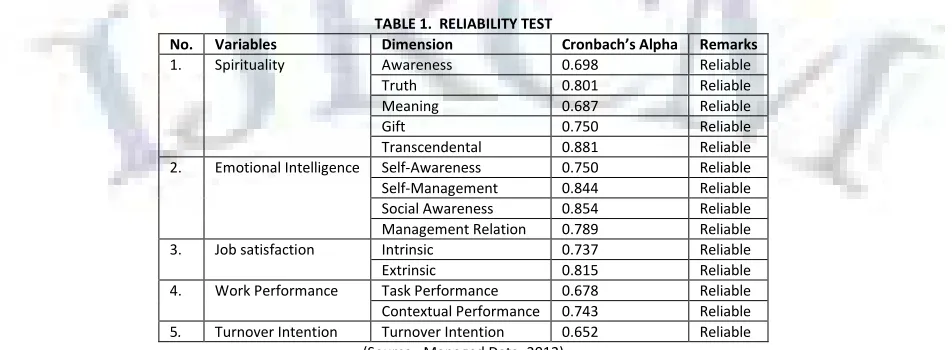
The distribution result of the respondents based on the demography included male (37, 5%) and female (62, 5%). Based on the age, the respondents were between 21-30 years old (50%), 31-40 years old (37, 5%) and above 40 years old (12, 5%). Based on the marital status, it includes the married ones (75%) and unmarried ones (25%). Based on work experience, it included those below 5 years (12, 5%), between 6-10 years (50%) and above 10 years (37, 5%). For the educational level, it was dominated by the undergraduates (38 %), Senior High School (25%), postgraduates (24%), and diploma (13%). For the employment status, 75% of them were permanent employees and 25% were the contract ones. Corrected Item-Total Correlation was used to test the construct validity in which each variable was with scores above 0, 3. The result of data management, correlation score in each item of questions was higher than 0, 3 that shows the validity of the research instruments. The reliability test in this research was measured using the Cronbach’s Alpha technique.
TABLE 1. RELIABILITY TEST
No. Variables Dimension Cronbach’s Alpha Remarks
1. Spirituality Awareness 0.698 Reliable
Truth 0.801 Reliable
Meaning 0.687 Reliable
Gift 0.750 Reliable
Transcendental 0.881 Reliable 2. Emotional Intelligence Self-Awareness 0.750 Reliable Self-Management 0.844 Reliable Social Awareness 0.854 Reliable Management Relation 0.789 Reliable 3. Job satisfaction Intrinsic 0.737 Reliable
Extrinsic 0.815 Reliable
4. Work Performance Task Performance 0.678 Reliable Contextual Performance 0.743 Reliable 5. Turnover Intention Turnover Intention 0.652 Reliable
(Source: Managed Data, 2012)
VOLUME NO.4(2014),ISSUE NO.01(JANUARY) ISSN2231-5756
INTERNATIONAL JOURNAL OF RESEARCH IN COMMERCE, IT & MANAGEMENT
showing that the employees in accepting themselves was related to all problems and limitations and found it difficult to integrate time in their life. Hence, it needs to be optimized.The measurement result for the mean value of emotional intelligence was at 3, 83. Self-control here had the highest mean value for the self-management dimension (4,30), indicating that the capability of employees in self-introspection and capability to be calm in positive thinking and stable in facing all situations was quite good. The lowest mean value was social awareness dimension in service orientation (3.30), showing that the employees in Syariah Bank realized about the objective of work competition and tried to be quite in togetherness of the teamwork when facing competition. The measurement result for the mean value of job satisfaction was at 3.99 with extrinsic satisfaction higher than the intrinsic one. The highest mean value was the extrinsic satisfaction dimension, e.g. organization policy (4.30), showing that the organization policies had been agreed with the regulation particularly in basis of Syariah organization. The lowest mean value was the extrinsic satisfaction dimension salary at 3, 70 reflecting that the acceptance of the employees to the salary was not in line with the number of finished works and needed a concern from the organization.
The measurement result for the mean value in work performance was 4,065 with the highest mean value at contextual performance dimension supporting the organization procedure at 4, 20. This indicates the capability of the employees in taking initiative in work problems based on the procedure of organization and in handling the task enthusiastically. Contrastively, the lowest mean value at the task performance dimension at task capability and communication was 4,00, showing a need for employees to improve and optimize the performance based on their desire, capability in coordination and sense of belonging in work quality. The measurement result for the mean value of turnover intention was 1, 87, showing a relatively low level of desire to quit from the organization related to the consideration of the employees to quit and possibility to find a new job and leave the organization.
The result of the outlier data evaluation showed no single observed data showing that the value of Mahalonobis d-squared was not more than the value of chi-square table (α=0.001; df=96) at 312,153. This comparison showed no any multivariate outlier indication in the collected research data. It means that the observed data was concentrated at the centroid points. Furthermore, the result of computerized AMOS program showed that the value of multivariate CR was at 1,174 from -2, 58 to 2, 58 based on the standards. This indicates a normal distribution of the data observed through the research indicators of multivariate data.
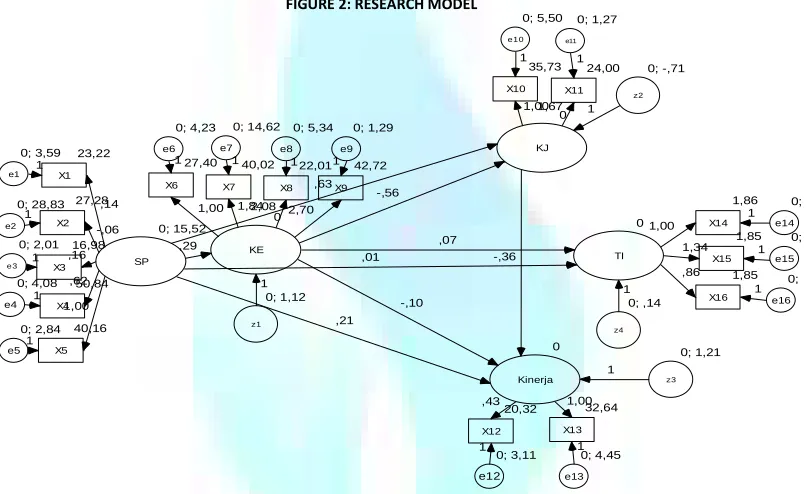
FIGURE 2: RESEARCH MODEL
SEM Model resulted in the goodness of fit. Subsequently, the index values were compared to the cut-off values recommended for each index. A good model had the index of Goodness of Fit suitable with the recommended cut-off.
TABLE 2: THE TESTING RESULT OF GOODNESS OF FIT OF SEM MODEL No. Goodness of Fit Index Testing Result Cut-off Value Remarks 1. Chi-square 312,153 Expected to be lower -
2. Probability 0,05 ≥ 0,05 Good
3. GFI 0,942 ≥ 0,90 Good
4. AGFI 0,971 ≥ 0,90 Good
5. TLI 0,959 ≥ 0,95 Good
6. CFI 0,971 ≥ 0,95 Good
7. RMSEA 0,149 ≤ 0,08 -
(Sources: Managed Data, 2012)
The model of suitability test, NCP (Non-Centrality Parameter) was used to measure the deviation level between the matrix covariance and fitted matrix covariance sample. The estimation model was 216,153 between the values of 136,160–250,463, thus still fulfilling the requirement though the value of NCP was considered higher. ECVI (Expected Cross Validation Index) was at 4,200, while ECVI saturated model was at 3,010 and ECVI independence model was at 75,593. The value of ECVI was lower than ECVI independence, thus the model is suitable to be replicated for the further research. The value of AIC was at 424,153 lower than the value of independence AIC at 7634,942. Hence, the model is fit. NFI (Normal Fit Index), a model, if considered fit, was when the value of NFI was higher than 0, 90, meanwhile, the result of the research was at 0,959. Hence, the model is fit. The model resulted in the value of IFI at 0,971 higher than the limit of cut-off at 0, 90 (Byrne, 1998), thus the model has a quite good level of fit. The value of RFI standardized between 0 – 1 with the value close to 1 indicates a fit model, while the result of testing the value RFI is at 0,942, thus the model has a good level of fit.
Hypothesis 1: Spirituality has a positive relationship with emotional intelligence, as shown from p-value lower than α-value (0,000< 0.05). Thus the hypothesis is accepted.
Hypothesis 2: Spirituality has a positive relationship with job satisfaction, as shown from p-value lower than α-value (0,001< 0.05). Hypothesis is accepted. Hypothesis 3: Spirituality has a positive relationship with work performance, as shown from p-value lower than α value (0,000<0.05). Thus, the hypothesis can be accepted.
Hypothesis 4: Spirituality has a negative relationship with turnover intention. The finding shows that spirituality has a positive relationship with turnover intention, as shown from p-value higher than α-value (0,220 > 0.05). The hypothesis can be accepted.
VOLUME NO.4(2014),ISSUE NO.01(JANUARY) ISSN2231-5756
INTERNATIONAL JOURNAL OF RESEARCH IN COMMERCE, IT & MANAGEMENT
Hypothesis 5: Emotional intelligence has a positive relationship with work performance. The finding indicates that emotional intelligence has a negative relationship with work performance as shown from p value higher than α value (0,714>0.05). The hypothesis cannot be accepted.Hypothesis 6: Emotional intelligence has a positive relationship with job satisfaction. The finding shows that the emotional intelligence has a negative relationship with job satisfaction as shown from p value higher than α value (0,102> 0.05). The hypothesis cannot be accepted.
Hypothesis 7: Emotional intelligence has a negative relationship with turnover intention, as shown from p-value higher than α-value (0,114>0.05). Thus, the hypothesis can be accepted.
Hypothesis 8: Job satisfaction has a positive relationship with work performance. The finding shows that the job satisfaction has a negative relationship with the work performance as shown from p-value higher than α-value (0,713>0.05). The hypothesis cannot be accepted.
The causality relationship between research variables either in the relation of exogenous variable, endogenous variable or in the relationship of mediation variable had a direct or indirect impact and overall impact. The relationship result shows that spirituality was correlated to the job satisfaction directly, indirectly or totally, reflecting the incapability of emotional intelligence to directly mediate spirituality to job satisfaction well. Here, spirituality was significantly correlated to the work performance but indirectly through the emotional intelligence – indicating the incapability of emotional intelligence to mediate the direct impact of spirituality to the work performance well.
The relationship of spirituality and turnover intention occurred directly and indirectly but the emotional intelligence could not mediate well the influence of spirituality to turnover intention. Emotional intelligence was correlated to the work performance and job satisfaction was able to directly mediate between emotional intelligence and work performance.
DISCUSSION
First, spirituality has a positive and significant correlation to emotional intelligence from t-value calculator = 5,654 higher than critical t = 1,961 with probability 0,000. Meanwhile, the estimation value for the correlation between spirituality and emotional intelligence is at 0,294 (0,000). Spirituality is a belief significantly influences, guides in decision making and someone behaviour; thus it is expected that as a universal phenomenon in personality it can cause employees emotional intelligence framed as inner awareness to reach the aspect of role and work, activity and effectiveness (Podaskoff et al., 2000). Tendency to the highest spirituality is gift, meaning of life, transcendence, awareness and truth. Those dimensions can influence and shape emotional intelligence of employees to be able to adjust themselves in their competence and social competence. Additionally, they can be helpful for the capability to show dedication in facing challenge, harmony between words and action to encourage other, support the chosen direction comprising personal commitment for solution of difficult life and business issues. The most dominant dimension here is transcendence (1,000) framed as high awareness, strong insight, integration, spiritual practices, giving guidance for other, compassion, and experience and life harmony. The research result is supported by Anderson (2006), Ayranci (2011), Podaskoff et al (2000) and Tee Suan Chin et al. (2011).
Secondly, spirituality has a positive and significant correlation to job satisfaction from the t-value calculator = 6,557 higher than the critical t = 1,961 with probability of 0,001, and the estimation value of correlation between spirituality and job satisfaction is 0,633 (0,001). The dominant dimension is extrinsic job satisfaction (0,779) framed as supervision, organization policy, salary, and interpersonal relationship between co-workers and superior. This result is supported by East (2005) mentioning a strong correlation between spirituality and job satisfaction. Yahyazadeh-Jeloudar and Lotfi-Goodarzi (2012) state that spirituality significantly will influence the job satisfaction that covers the work itself, attitude to supervisor, relationship with co-workers, work environment condition but not significant when being correlated to salary. Spirituality acts in controlling a clear achievement, brings an effect on and makes a short-term and long-term goal with the capability of achieving the goal, even in a very difficult condition, particularly in job satisfaction. One of the dimensions is framed as the meaning with its indicators: goal and organization service.
Thirdly, spirituality has a positive and significant correlation to work performance from the t-value calculator = 1,430 higher than critical t = 1,961 with the probability of 0,000. The estimation value for the correlation between spirituality and work performance is 0,210 (0,000). The dominant dimension is contextual performance (0,015) framed as regulation and organization procedure, extra work, and volunteerism in task activity, cooperation and support for organization procedure. Spirituality will impact the performance through the value of awareness, life essence, gift of love in the employees’ life and transcendence in helping other in handling any work matters in workplace. This perspective is supported by Lynton and Thogersen (2009) that spirituality in praying and productivity can improve performance and job satisfaction (Alexander et al., 1993).
Fourthly, spirituality has a positive but insignificant correlation to turnover intention from t-value calculator = 0,454 lower than critical t = 1,961 with the probability of 0,220, and the estimation value for the relationship between spirituality and work performance is 0,007 (0,220). The dominant dimension is the probability in finding a new job (0,035) as the employees attempt to find a new job from the current work at Syariah bank. This finding is contrast to what has been said by Chawla and Guda (2010) saying a strongly negative correlation between spirituality and turnover intention. The correlation between spirituality of employees and intention to move is still limited. Trott (1996) said that spirituality covering the community sense will positively be correlated to the cooperation and negatively correlated to rotation and absence.
Fifthly, emotional intelligence has a negative correlation to job satisfaction from t-value calculator = -3,697 lower than critical t = 1,961 with the probability of 0,716, and the estimation value for the relationship between emotional intelligence to job satisfaction is -0,564 (0,716). This finding, however, is not supported by Afolabi et al (2010), Fatima et al (2010), Carmeli (2003), Kafetosis and Tampektakis (2008). Most of researchers find a positive and significant influence of emotional intelligence to performance. It is only Bradberry (2006) supporting it. The dominant dimension is extrinsic satisfaction (-0,564) compared to the intrinsic satisfaction. In fact, the employees having emotional intelligence will find satisfaction and can influence the employee satisfaction and productivity entirely creating management efficiency and organization development (Patra, 2004).
Sixthly, emotional intelligence has a negative correlation to job satisfaction from t-value calculator (-0,455) lower than critical t (1,961) with the probability of 0,102, and the estimation value for the correlation between emotional intelligence and job satisfaction is -0,094 (0,102). The dominant dimension is contextual performance (0,105) compared to the task performance, showing that the capability to the aspect outside role is quite dominant in this organization. This finding is not supported by Ngah (2009), Chaudry and Usman (2011), O’Boyle et al (2010), Cote and Minners (2006), Afolabi et al (2010), Lopez (2006), Jayan (2006) and Carmeli (2003) finding the positive and significant influence of emotional intelligence to job satisfaction caused by emotional intelligence to performance creating a correlation between emotional intelligence and work achievement.
Seventhly, emotional intelligence has a positive correlation to turnover intention, from t-value calculator (1,494) lower value than critical t (1,961) with the probability of 0,114 and the estimation value between emotional intelligence to turnover intention is 0,066 (0,114). The dominant dimension is the probability to find a new job (0,088) as the employees attempt to find a new job from the current job. This finding is not in line with the ones by Trivellas et al. (2010), Jang and George (2011) and Fatima et al. (2010) and Carmeli (2003) finding a positive influence of emotional intelligence to turnover intention.
Eighthly, job satisfaction has a negative correlation to work performance from t value calculator (-1,242) that has a lower value compared to critical t (1,961) with the probability of 0,713. The estimation value for the correlation between job satisfaction and work performance is -0,357 (0,713). The dominant dimension to task performance is -0,154, showing that job satisfaction will be helpful for capability, efficiency and communication of employees in their organization. These findings are supported by Brown and Reterson (1993) saying that in the intrinsic value of work, job satisfaction is not consistent and has a weak correlation. However, this finding is not in line with the findings of Christen et al (2006) saying that the correlation between the job satisfaction and work achievement is for one-direction correlation causing job satisfaction to work achievement or vice versa (Law et al., 2001). Mutual relationship is that when satisfaction is extrinsic, it will address to work performance, but when job satisfaction is intrinsic, the performance will lead to the relationship to job satisfaction.
FINDINGS
VOLUME NO.4(2014),ISSUE NO.01(JANUARY) ISSN2231-5756
INTERNATIONAL JOURNAL OF RESEARCH IN COMMERCE, IT & MANAGEMENT
as shown from p-value lower than α-value (0,001<0.05). Hence, it can be accepted and dominant dimension to the extrinsic job satisfaction, (3) spirituality has a positive correlation of spirituality and work performance as shown from p-value lower than α-value (0,000<0.05), thus it can be accepted with contextual performance as the dominant dimension, (4) a positive correlation between spirituality and turnover intention, as shown from p-value higher than α-value (0,220>0.05), thus it cannot be accepted and dominant dimension is probability to find a new job.On the other side, (5) emotional intelligence has a negative correlation with work performance, as shown from p-value higher than α-value (0,714>0.05). Thus, it cannot be accepted and dominant dimension is contextual performance. (6) Emotional intelligence has a negative correlation with job satisfaction as shown from p-value higher than α-value (0,102>0.05), thus, it cannot be accepted and dominant dimension is extrinsic satisfaction and (7) a negative correlation between emotional intelligence and turnover intention, as shown from p-value higher than α-value (0,114>0.05), thus it cannot be accepted and dominant dimension is the probability of finding a new job and (8) a negative correlation between job satisfaction and work performance as shown from p-value higher than α value (0,713>0.05), thus it cannot be accepted and dominant dimension is task of capability, efficiency and communication of employees in their organization.
RECOMMENDATION
For the research appropriateness to the standard of statistics, it is essential to ensure the question indicators completeness in the questionnaires to avoid the respondents’ hesitation. Additionally, the number of the analyzed samples must be sufficient based on the requirements of the statistical analysis. For the practical implementation, it is necessary to give understanding for the employees about the spirituality role to improve the relationship to emotional intelligence, work satisfaction, and work performance for the capability of spirituality in controlling and managing work behaviour in organization.
CONCLUSIONS
The research results show the acceptance of three hypotheses, including (1) the positive relationship between spirituality and emotional intelligence with the dimension dominance of transcendence framed as high awareness, strong and integrated insight, spiritual practices, referrals for others, compassion, experience and grace and life harmony, (2) the positive relationship between spirituality and job satisfaction with the dominant dimension towards the extrinsic job satisfaction framed as supervision, organization policy, salary, interpersonal relationship between co-workers and employer and (3) the positive relationship between spirituality and work performance with the dominant dimension of contextual performance framed as regulation and procedure of organization, extra effort of employees, volunteerism in task, cooperation, and support for organizational procedures.
In contrast, 4 hypotheses are unaccepted including (1) a negative relationship between spirituality and turnover intention with the dominant dimension of the possibility to find a new job as the effort of the employees to find a new job from the current work in Syariah Bank, (2) negative relationship between emotional intelligence and work performance with the dominant dimension of comparison between contextual performance and task performance - indicating a capability to the aspect outside the quite dominant role in the organization, (3) negative relationship between emotional intelligence and job satisfaction with the dominant dimension in the comparison between extrinsic satisfaction and intrinsic one, (4) negative relationship between emotional intelligence and turnover intention with the dominant dimension of the possibility to find a new job as the employees attempt to find a new job from the current job in organization and (8) negative relationship between job satisfaction and work performance with the dominant dimension of task performance framed as task of capability, efficiency, and communication of employees in their organization.
SCOPE OF THE FUTURE STUDY
The scopes of this research are as follows: (1) it involves the research respondents that had many activities and limitation in bank. This, as a consequence, brought an effect on data gathering and data management process, (2) this research was conducted in Syariah bank in which, if it is conducted in conventional bank, it will create a different result and (3) to result in a relationship between independent variables and dependent ones in further research, a moderation variable as the one increasing the relationship of both is necessary.
REFERENCES
1. Afolabi, O.A., (2010), “Influence of Emotional Intelligence and Gender on Job Performance and Job Satisfaction among Nigerian Policemen”, Current Research Journal of Social Sciences, Vol. 3, pp. 147-154.
2. Alexander, C.N., Swanson, G.C., Rainforth, M.V., Carlisle, T.W., Todd, C.C., Oates, R.M., (1993), ”Effects of the transcendental meditation program on stress reduction, health, and employee development: A prospective study in two occupational settings”, Anxiety Stress Coping, Vol. 6, pp. 245-262.
3. Ali, Shah Taseema and Ellahi, Abida. (2012), “Workplace spirituality, emotional intelligence and job satisfaction: Pakistani manager in focus”, International Conference on Management (ICM 2 rd) Proceeding. 11-12 Juni 2012.
4. Amram, Y., and Dryer, C., (2008), ”The Integrated Spiritual Intelligence Scale (ISIS): Development and preliminary validation”, Paper presented at the 116th Annual (August 2008) Conference of the American Psychological Association, Boston, MA. from http://www.yosiamram.net/papers.
5. Anderson, A.L., (2001), “An exploration of the relationship of openness, emotional intelligence, and spirituality to universal-diverse orientation”, Unpublished doctoral dissertation, Oklahoma State University.
6. Antonio, Muhammad Syafii. (2001), “Bank Syariah: Dari Teori ke Praktek”, Gema Insani Press, Jakarta.
7. Ashmos, D.P., and D. Duchon, (2000). “Spirituality at work: A conceptualization and measure”, Journal of Management Inquiry, Vol. 9, No. 2, pp. 134-44. 8. Aydogdu, Sinem and Asikgil, Baris., (2011), “An empirical study of the relationship among job satisfaction, organizational commitment and turnover
intention”, International Review of Management and Marketing, Vol. 1, No. 3, pp. 43-53.
9. Ayranci, E., (2011), “Effects of Top Turkish Managers’ Emotional and Spiritual Intelligences on their Organizations’ Financial Performance”, Business Intelligence Journal, Vol. 4, No. 1.
10. Azimi. H, Turiman. S, Sidek, N, Rumaya. J, Abdul L; Abdullah, Jamilah M, Khiarul A; Mastor, M, and Hasnan. K., (2006), “The Religiosity and Personality Development Index: Implications for Nation Building”, Selangor: Institut Pengajian Komunti dan Keamanan.
11. Bolman, L.G., Deal, T., (2001), “Leading with soul: An uncommon journey of spirit”, San Francisco, Jossey-Bass.
12. Borman, W.C. and Motowidlo, S.J., (1993), “Expanding the Criterion Domain to Include Elements of Contextual Performance in N. Schmit and W.C. Borman (Eds.), Personnel Selection in Organisations , Jossey-Bass, San Francisco, C.A.
13. Borman, W.C., and Motowidlo, S.J., (1997), “Task performance and contextual performance: the meaning for personal selection research”, Human Performance, Vol. 10, No.2, pp. 199-209.
14. Bradberry, Travis, (2006), “Ability-versus skill-based assessment of emotional intelligence”, Psicotherma, Vol.18, pp. 59-66.
15. Brown, S.P., and Peterson, R.A., (1993), “Antecedents and consequences of salesperson job satisfaction: meta anaylisis and assessmentof casual effects”, Journal of Marketing Research. Vol. 30, No. 1, pp. 63-77.
16. Campbell, J.P, (1990), “Modeling the performance prediction problem in industrial and organizational psychology”, Palo Alto.
17. Carmeli, A. and Josman, Zvi E., (2006), “The relationship among emotional intelligence, task performance and organizational citizenship behaviors”, Human Performance, Vol. 19, No. 4, pp. 403-419.
18. Carmeli, A., (2003), “The relationship between EI and work attitudes, behavior and outcomes: An examination among senior managers”, Journal of Managerial Psycholog, Vol. 88, pp. 788-813.
VOLUME NO.4(2014),ISSUE NO.01(JANUARY) ISSN2231-5756
INTERNATIONAL JOURNAL OF RESEARCH IN COMMERCE, IT & MANAGEMENT
20. Chawla, V., and Guda, S. (2010). “Individual spirituality at work and its relationship with job satisfaction, propensity to leave and job commitment: Anexploratory study among sales professionals”. Journal of Human Values, Vol. 16, No. 2, pp. 157–167.
21. Cooper. R.K. and Sawaf, A. (1997), “Executive EQ: Emotional Intelligence in Leadership and Organizations”, Grosette/Putname, New York, NY.
22. Cote, S., and Miners, C.T.H., (2006). “Emotional intelligence, cognitive intelligence, and job performance”, Administrative Science Quarterly, Vol. 51, No.1, pp. 1-12.
23. Cranny, CJ., Smith, PC, and Stone, EF. (Eds.). (1992), “Job satisfaction: How people feel about their jobs and how it affects their performance”. New York: Lexington Books.
24. Fatima, Afsheen, Imran, Robia and Zaheer, Arshad. (2010), “Emotional intelligence and job satisfaction: mediated by transformatonal leadership”, World Applied Sciences Journal, Vol. 10, No. 6, pp. 612-620.
25. Ferdinand, Augusty, (2005), “Structural Equation Modeling dalam Penelitian Manajemen”, Ikatan Penerbit Univiversitas Diponegoro, Semarang. 26. Fry, L.W., (2003). “Toward a theory of spiritual leadership”, The Leadership Quarterly. Vol. 14, pp. 693-727.
27. Goleman, D., (2000), “Emotional intelligence: Issues and paradigm building”. In D. Goleman & C. Cherniss (Eds.), The emotionally intelligent workplace: How to select for, measure, and improve emotional intelligence in individuals, groups, and organizations. San Francisco: Jossey - Bass.
28. Guilford and Flurchter, (1973). “Fundamental Statistics in Psychology Education”. New York: McGraw Hill.
29. Haryoko, M. (2005), “Pembiayaan Syariah: Penerapan Bagi Hasil dan Resiko serta SDM yang Dibutuhkannya”. Makalah Seminar Keuangan Syariah: Prospek Pembiayaan Berbagi Hasil dan Resiko. Sasana Budaya Ganesha ITB, Bandung.
30. Hidayat, Agi Syarif, (2012), “Pengaruh Kompensasi dan Pengembangan Karier terhadap Komitmen Organisasi”, Tesis, Universitas Pendidikan Indonesia, Bandung
31. Hochwarter, W.A., Witt, L.A., Treadway, D.C., and Ferris, G.R., (2006), “The interaction of social skill and organizational support on job performance”, Journal of Applied Psychology, Vol. 91, No. 2, pp. 482- 489.
32. Hurias, J., Uggen, C., and McMorris. (2000), “Career jobs, survival jobs, and employee deviance: A social investment model of workplace miscontact”, Social Quarterly, Vol. 41, pp. 245-265.
33. Hutson, S., (2000), “Why Religion Matters; The Fate of the Human Spirit in an Age of Disbelief”. New York: Harper & Row.
34. Isen, A. and Baron, R., (1991), “Positive affect as a factor in organizational behavior”, In LL Cummings and BM Staw (Eds.), Research in Organizational Behaviour, pp. 1-53.
35. Islam, Talat., Rehman Khan, Saifur., Aamir, Muhammad and Ungku Ahmad, Ungku Noorul., (2012), “Turnover intentions: the influence of organizational learning culture and multi foci citizenship behaviors”, Middle East Journal of Scientific Research, Vol. 12, No. 5, pp. 650-661.
36. Jamal, M. (2007), “Job stress and job performance controversy revisited : an empirical examination in two countries”, International Journal of Stress Management. Vol. 14, No. 2, pp. 175 – 187.
37. Jang and George, (2011), “The relationship of emotional intelligence to job stress, affective commitment, and turnover intention among restaurant employees”, The Ohio State University, pp. 1-5.
38. Javanmard, Habibollah, (2012), “ The impact of spirituality on work performance”, Indian Journal of Science and Technology, Vol. 5, No. 1, pp. 1961-1966. 39. Jayan, Calicut, (2006), “Emotional competence, personality, and job attitudes as predictors of job performance”, Journal of The Indian Academy of Applied
Psychology. Vol. 32, No. 2, pp. 135–144.
40. Jon Springer, Gary, (2011), “A study of job motivation, satisfaction, and performance among Bank Employee”, Journal of Global Bussiness Issues, Vol. 5, No. 1, pp. 29 – 42.
41. Kafetsios, Kristantius, and Zampektois, (2008), “Emotional intelligence and job satisfaction: testing the mediating role of positive and negative affect at work”, Personality and Individu Different, Vol. 44, pp. 712-722.
42. King, S.M. (2007), “Religion, Spirituality, and The Workplace: Challenges for Public Administration”. Public Administration Review. Vol. 67, No. 1, pp.103-114.
43. Koenig, H.G., McCullough, M. and Larson, D.B., (2000), “Handbook of Religion and Health”, Oxford University Press, New York, NY.
44. Kulas, J.T., McInnerey, J.E., De Muth, R.F., and Jadwinski, V. (2007), “Employee satisfaction and theft: testing climate perceptions as a mediator”, The Journal of Psychology, Vol. 141, pp. 389-402.
45. Kumar, Naresh and Singh, Vandam., (2011), “Job satisfaction and its correlates”, IJRESS, Vol. 1, No. 2, pp. 11-24.
46. Kunde, J. (2000), “Corporate religion: Building a strong company through personality and corporate soul”. London, Pearson Education.
47. Law, K., Wong, C., and Song, L., (2004), “The construct and criterion validity of emotional intelligence and its potential utility for management studies”. Journal of Applied Psychology, Vol. 89, No. 3, pp. 483–496
48. Lee, T.W., and Mowday, R.T., (1987), “Leaving the organization: An empirical investigation of the Steers and Mowday (1981) model of turnover, “Academy of Management Journal, Vol. 30, No. 4, pp. 721–743.
49. Lopes, Paulo N. (2006), “Evidence that emotional intelligence is related to job performance and affect and attittude at work”, Psychotema, Vol. 18, pp. 132-138.
50. Lynton, N. and Thogersen, K. H. (2009), “Spiritual intelligence leadership in the china laboratory”. Journal of International Business Ethics, Vol. 2, No. 1. 51. Maqbool, Fouzia., Murtaza, Ghulam., and Rechman, Atiq-Ur., (2012), “Moderation role of organizational commitment between job satisfaction and
turnover intention”, European Journal of Scientific Research. Vol. 82, No. 4, pp. 564-571.
52. Martin, T.N., (1979), “A contextual model of employee turnover intention”. Academy of Management Journal, Vol. 22, No. 2, pp. 313–324.
53. Milliman, J., Czaplewski, A., and Ferguson, J., (2003), “Workplace spirituality and employee work attitudes”, Journal of Organizational Change Management. Vol. 16, No. 4, pp. 426-447.
54. Mobley, W.H. (1982), “Some unanswered questions in turnover with withdrawn research”, Academy of Management Review, Vol. 7, No. 1, pp. 111–116. 55. Mobley, W.H., (1978), “Intermediate linkages in the relationship between job satisfaction and employee turnover”, Journal of Applied Psychology, Vol. 62,
No. 2, pp. 237- 240.
56. Moore, J.E., (2000), “One road to turnover: An examination of work exhaustion in technology professionals”, MIS Quarterly, Vol. 24, No. 1, pp. 141–168. 57. Myers, L.L., and Tucker, M.L., (2005), “Increasing awareness of emotional intelligence in