*Corresponding author:Awadhesh Kumar ISSN: 0976-3031
Research Article
APPLICATION OF NANOTECHNOLOGY IN IMPROVING PERFORMANCE OF
CEMENTITIOUS COMPOSITES
Awadhesh Kumar and Ibadur Rahman
Department of Civil Engineering, Delhi Technological University, Delhi
DOI: http://dx.doi.org/10.24327/ijrsr.2017.0806.0410
The world of science has started to produce new materials and also to study their propertiesusing
nanotechnology. The use of nanotechnology has become wide spread in all branches of science and technology. In this study, the use of nano powders in cement mortar and concrete has been used and their performance has been evaluated. The influence of nano particles such as nano silica fume, nano flyash and fine grinded cement in cement mortar and concrete has been studied with reference to normal size particles of cement mortar and concrete. The morphology of nano particles was studied using Transmission Electron Microscopy (TEM) and Scanning Electron Microscope. Also, X-ray diffraction of all the mineral admixtures was studied. The results indicated that the addition of nano particles improves the properties of cement mortar and concrete.
INTRODUCTION
Nanotechnology is defined as the understanding, control and restructuring of matter on the order of nanometer level (i.e. less than 100 nm) to create materials of fundamentally new properties and functions. Nanotechnology encompasses two main approaches (i) the top down approach in which larger structures are reduced in size to the nanoscale while maintaining their original properties without atomic level control or deconstructed from larger structures into their smaller composite parts and (ii) the bottom up approach also called molecular nanotechnology or molecular manufacturing in which materials are engineered from atoms or molecular components through a process of assembly or self assembly. While most contemporary technologies rely on the top down approach but molecular technology holds great promise for breakthrough in materials and manufacturing.
Cementitious materials are typically characterised as quasi-brittle and susceptible to cracking. As concrete is loaded, initially short and discontinuous micro-cracks are created in a distributed manner. Later, these micro-cracks coalesce to form large macroscopic cracks known as macro-cracks. Fibres are incorporated into cementitious matrices to control cracking by bridging the cracks during loading and transferring the load. Recent research has led to significant improvement in the
mechanical properties of cement based materials. However, while microfibers delay the development of micro-cracks, they do not stop their initiation. But, the development of new nano size fibers has opened a new field for nano size reinforcement within concrete. The incorporation of fibres at the nanoscale allows them to control the cracking of matrix at nanoscale level and essentially create a new generation of crack free material.
Concrete performance is strongly dependent on nano size dimensions of solid materials such as C-S-H gel or voids such as gel porosity in the cement matrix and the transition zone at the interface of cement past with aggregate or steel reinforcement. Their properties are affected by nano size particles are strength, durability, shrinkage and steel bond. The word nano means anything of size 10-9 m, nano particles is a solid particle of size in the range of 1 to 100 nm. In the present work, nano size material i.e. nano silica was added to new super-plasticizer (poly carboxylic ether polymer based PCE Sky) to improve workability, strength and durability of high performance and self compacted concrete.
Research is in progress on investigation of changes in nanoscale properties with the addition of different nanofibers. The ultimate goal of this study is to develop nano-engineered material with improved properties and to investigate the changes in the nanostructure, fracture properties, transport
International Journal of
Recent Scientific
Research
International Journal of Recent Scientific Research
Vol. 8, Issue, 6, pp. 17719-17724, June, 2017
Copyright © Awadhesh Kumar and Ibadur Rahman, 2017, this is an open-access article distributed under the terms of the Creative Commons Attribution License, which permits unrestricted use, distribution and reproduction in any medium, provided the original work is properly cited.
DOI: 10.24327/IJRSR
CODEN: IJRSFP (USA)
Article History:
Received 15th March, 2017
Received in revised form 25th
April, 2017
Accepted 28th May, 2017
Published online 28th June, 2017
Key Words:
Nanotechnology, Scanning Electron Microscope, nano silica fume, nano flyash, dry and wet grinded cement.
properties and durability of cement based nano composites reinforced with highly dispersed nano-fibers so that findings of the study could have applications in highway structures, bridges, pavements, runways for airports and in general for all applications of conventional and high strength concrete as well as in manufacturing of precast elements for residential and commercial buildings.
LITERATURE REVIEW
Sobolev and Shah [1] used poly carboxylic ether polymer based PCE Sky super-plasticizer mixed with nano SiO2 to
improve workability and strength of high performance and self compacted concrete.
Sobolev and Ferrada [2] studied the application of Gaia super plasticizer containing nano-SiO2 particles at a dosage of 1.3%
by weight of cementitious materials and found that there is an increase in compressive strength of 100 to 150% at the ages of 7 and 28 days and this was dependent on water cement ratio.
Li et. al. [3] studied the properties of high volume flyash concrete incorporating nano SiO2 and found that the addition of
nano-SiO2 can activate flyash, leads to an increase of both short
term and long term strength, and acts as an accelerating additive, leading to more compact structure even at short curing times.
Sobolev [4] carried out study on nano materials and nanotechnology for high performance cement composites and found that major problem of nano-SiO2 application is strength
loss at later ages due to agglomeration of nano particles (30-100 nm) at the final drying stage of sol-gel method which can be solved using acrylic polymer based supper plasticizer called Gaia at a dosage of 1.3% by weight of cementitious materials and also found that high temperature treatment at 4000C or more, nano-SiO2 concrete affects the performance of these
additives and must be avoided.
Concrete, the most ubiquitous material in the world, is a nano-structured, multi-phase, composite material for ages over time. It is composed of an amorphous phase, nanometer to micrometer size crystals and bound water. The properties of concrete exist in, and the degradation mechanism occurs across, multiple length scale (nano to micro to macro) where properties of each scale derive from those of the next smaller scale [5].
The amorphous phase, calcium-silicate-hydrate (C-S-H) is the gel that holds concrete together and is itself a nano material. Viewed from the bottom up, concrete at the nano scale is a composite of molecular assemblage, surfaces (aggregates, fibers) and chemical bonds that interact through local chemical reactions, inter molecular forces and inter phase diffusion. Properties characterising this scale are molecular structure; surface function groups; and bond length, strength (energy) and density. The structure of the amorphous and crystalline phases and of the interphase boundaries originates from this scale. The properties and processes at the nanoscale define the interactions that occur between particles and phases at the microscale and the effects of working loads and the surrounding environment at the macroscale. Processes occurring at the nanoscale ultimately affect the engineering properties and performance of the bulk material [6-8].
The nano science and nano engineering sometimes called nano modification of concrete are terms that have come into common usage and describe two main avenues of application of nanotechnology in concrete research [9-10]. Nano science deals with the measurement and characterization of nano and micro scale structure of cement based materials to better understand how this structure affects macro scale properties and performance through the use of advanced characterization technique and atomistic or molecular level modelling. Nano engineering encompasses the techniques of manipulation of the structure at the nanometer scale to develop a new generation of tailored, multifunctional cementitious composites with superior mechanical performance and durability, potentially having a range of novel properties such as low electrical resistivity, self sensing capabilities, self cleaning, self healing, high ductility and self control of cracks. Concrete can be nano engineered by the incorporation of nano size building block or objects (e.g. nano particles) to control material behaviour and add novel properties or by grafting of molecules onto cement particles, cement phases, aggregates and additives (including nano size additives) to provide surface functionality, which can be adjusted to promote specific interfacial interactions.
Engineering concrete at the nanoscale can take place in one or more of three locations in the solid phases, in the liquid phase and at interfaces, including liquid-solid and solid-solid interfaces. While nano-engineering of cement based materials is seen as having tremendous potential, nonetheless several challenges need to be solved to realize its full potential, including the proper dispersion of the nano scale additives, scale up of laboratory results and implementation on larger scale, and a lowering of cost/ benefit ratio. The following summarises the effects of addition of nano particles and nano reinforcements to cement and recent developments in hybridization of hydrated cement phases. [9]
Nano size particles have a high specific surface, providing the potential for tremendous chemical reactivity. Most of the work to date has been done with nano-silica (Nano-SiO2),
nano-titanium oxide (Nano-TiO2) and there are few studies on
incorporating nano-iron (nano-Fe2O3), nano-alumina
(Nano-Al2O3) and nano-clay particles. The most significant issue for
all nano particles is that of effective dispersion.
Nano-silica has been found to improve concrete workability and strength to increase resistance to water penetration and to help/control leaching of calcium, which is closely associated with various types of concrete degradation. Nano-silica was shown to accelerate hydration reaction of both C3S and
ash-cement mortar as a result of large highly reactive surface of the nanoparticles. Nano-SiO2 was found to be more efficient in
enhancing strength than silica fume. Addition of 10% nano-SiO2 with dispersing agents was observed to increase the
compressive strength of cement mortar at 28 days by as much as 26% compared to 10% increase with addition of 15% silica fume. Even the addition of small amounts (0.25%) of nano-SiO2 increased the strength, improving 28 days compressive
strength by 10% and flexural strength by 25%. It was found that results obtained were depended on production route and conditions of synthesis of nano-SiO2 and dispersion of
nano-SiO2 in the paste plays an important role. Nano-SiO2 not only
Nano-TiO2 proven effective for self-cleaning of concrete and
provides additional benefit to clean the environment. Concrete containing TiO2 acts by triggering a photocatalytic degradation
of pollutants such as NOx, CO, chlorophenols and aldehydes
from vehicle and industrial emissions. Nano-TiO2 also
accelerates early age hydration of Portland cement, improve compressive and flexural strengths and enhances abrasion resistance of concrete. It was also found that ageing due to carbonation results in loss of catalytic efficiency [12-14].
A reduction in the amount of water needed can be achieved by organic cation exchange modification, where organic cation replace sodium or calcium in the interlayer, reducing the hydrophilicity. Chemical bonding of polyvinyl alcohol to exfoliated clay particles to create linked clay particles chain when incorporated in cement, were shown to improve the post failure properties of the material. Additionally non-modified, nanosize smectite clays were observed to act as nucleation agents for C-S-H and to modify the structure of C-S-H [11, 15].
Experimental Investigation
Materials
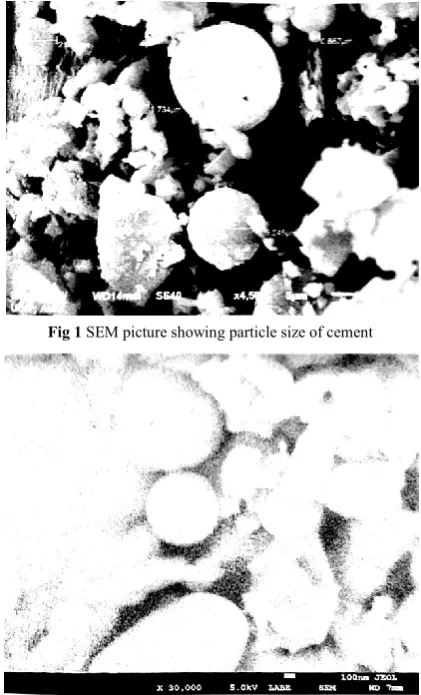
Construction materials namely cement, sand, coarse aggregate, silica fume, flyash and acetone were collected from various sources for use in the present study. Potable tap water was used in preparing the specimens and their curing. Samples of cement, flyash and silica fume were studied under Scanning Electron Microscope (SEM) and are shown in Figs. 1-3.
Conversion of constituent materials to nano scale was carried out with the help of Ball Mill Machine. This conversion can be done either by dry grinding or by wet grinding. Wet grinding was conducted for cement only, while other constituent materials including cement were dry-grinded. Acetone was used for wet grinding of cement in the ball mill. Cement, flyash and silica fume were converted into nano scale using ball mill machine and were again kept under SEM for determination of particle size to assure nano size of their particle size. Presence of nano size particles can be seen in Figs. 4-6 for cement, flyash and silica fume respectively.
Fig 1 SEM picture showing particle size of cement
Fig 2 SEM picture showing particle size of flyash
Fig 3 SEM picture showing particle size of silica fume
Fig 4 SEM picture showing particle size of fine cement
Cement
Ordinary Portland cement of 43 grade (i.e. Shree Ultra) was used in preparation of the specimens. Consistency, initial and final setting times of the cement were determined as 28.5%, 61 minutes and 294 minutes while for dry grinded cement were 30%, 58 minutes and 291 minutes and for wet grinded cement were 32%, 54 minutes and 290 minutes respectively.
Silica fume
Silica fume was collected from industry to use in the study. Average particle size, specific surface and density of silica fume were found as 6.09 x 10⁻⁸ m, 14 m2/g and 2.2 g/cc.
Flyash
Flyash was collected from thermal power plant, Panipat (Haryana) for preparing the specimens. Physical properties of flyash are given in Table 1.
Sand
Locally available Badarpur sand was used in the study. Sieve analysis test results of the same are given in Table 2.
Coarse Aggregate
Coarse aggregate of 10 mm down and 20mm down were used in the study.
Test Specimens
The ratio of cement and fine aggregate was taken as 1:3 (by weight) and water cement ratio of 0.4 – 0.5. 153 mortar cube specimens of 70.7 mm size were cast, cured under water and tested at different ages. The details of mix proportions and mix designations are given in Table 3. Due to space limitation in the table, cement, fine cement, sand, silica fume, nano silica fume, flyash, nano flyash and coarse aggregate are written in abbreviation form as C, FC, S, SF, NSF, Fl, NFl and CA respectively. M20 concrete specimens were also prepared and tested.
Test Results
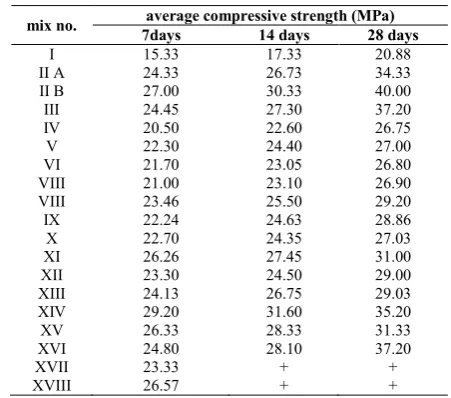
Before testing of specimens, they were taken out of curing tank about 20 minutes before, so that they could be tested for their compressive strength in saturated surface dry condition at 7days, 14 days and 28 days. Compressive strength test results of various mixes at different ages are given in Table 4.
DISCUSSION
Compressive Strength
Compressive strength of fine cement mixes (i.e. II A and II B) at 7, 14 and 21 days are more than the compressive strength of normal cement mix (i.e. I). Fine cement mix (wet grinded) (i.e. II B) gives higher strength than the fine cement mix (dry grinded) (II A) and normal cement mix (i.e. I). The percentage increase in compressive strength of wet grinded cement mix (i.e. II B) at 7, 14 and 28 days is 76%, 75% and 90% respectively than with normal cement mix (i.e. I), while percentage increase in dry grinded cement mix (I.e. II A) at the same age is 59%, 55% and 65% respectively than with normal cement mix (i.e. I). The reason for gain in strength of fine cement is due to fineness of cement which has larger surface area to come in contact with water means faster hydration. This reduces voids and increases strength, while a crack easily propagates through voids.
Replacement of cement by 10% silica fume gives more strength with fine cement mix (i.e. V) compared to normal cement mix (i.e. IV). Because finer cement hydrates faster due to its larger surface area and releases more free lime which reacts with silica fume and makes more supplementary
Fig 6 SEM picture showing particle size of nano silica fume
Table 1 Physical properties of flyash
name of property value
Colour grey
% passing on 45 μ sieve 90
Average size of particle 4.7 x 10⁻⁷ m
Maximum dry density 9.30 kN/m3
Optimum moisture content 27.5%
Specific gravity 2.02 at 270C
Specific surface 3060 cm2/g
Table 2 Sieve analysis test results of sand
sieve size (mm)
weight retained (g)
% of weight retained
cumulative % of
weight retained % passing
4.75 0 0.00 0.00 100
2.36 20 1.00 1.00 99.00
1.18 235 11.75 12.75 87.25
0.6 560 28.00 40.75 59.25
0.3 1102 55.10 95.85 4.15
0.15 83 4.15 100.00 0.00
Pan 0 0.00 - -
Fineness modulus =250.35/100 = 2.5035
Table 3 Details of mix proportions
mix no. proportion w/c
ratio ratio
I C: S 0.4 1: 3
II A FC: S 0.4 1: 3
II B FC (wet): S 0.5 1: 3
III C: FC(wet): S 0.5 0.5: 0.5: 3
IV C: SF: S 0.45 0.9: 0.1: 3
V FC: SF: S 0.45 0.9: 0.1: 3
VI C: FC: SF: S 0.45 0.45: 0.45: 0.1: 3
VII C: NSF: S 0.45 0.9: 0.1: 3
VIII FC: NSF: S 0.45 0.9: 0.1: 3
IX C: FC: NSF: S 0.45 0.45: 0.45: 0.1: 3
X C: Fl: S 0.45 0.9: 0.1: 3
XI FC: Fl : S 0.45 0.9: 0.1: 3
XII C: FC: Fl : S 0.45 0.45: 0.45: 0.1: 3
XIII C: NFl. : S 0.45 0.9: 0.1: 3
XIV FC: NFl : S 0.45 0.9: 0.1: 3
XV C: FC: NFl : S 0.45 0.45: 0.45: 0.1: 3
XVI FC: NSF : S 0.5 0.95: 0.05: 3
XVII C: S: CA 0.5 1: 1.5: 3.3
cementitious product, hence higher strength. From the comparison of strength of normal cement mixes (i.e. I and IV) it is found that the mix with 10% silica fume gives about 30% higher strength, while 10% silica fume mix fine cement mixes (i.e. V and II A) has reduced compressive strength by about 8.5% up to 14 days thereafter 21.35% at 28days, which is due to blocking of pores. On comparison of mixes II B and V, it is concluded that wet grinded fine cement mix gives strength higher than the dry grinded fine cement mix with 10% silica fume.
Replacement of cement with 10% nano silica fume, finer cement mix (i.e. VIII) gives more strength than with normal cement mix (i.e. VII). Fine cement mix with 10% nano silica fume (i.e. VII) shows more strength than normal and partial finer cement mixes (i.e. VIII and IX). There is 9% increase in strength of fine cement mix (i.e. VIII) with 10% nano silica fume compared with normal cement mix (i.e. VII) with 10% nano silica fume.
On comparing mixes with 10% replacement of cement by flyash, it is found that fine cement mix (i.e. XI) with 10% flyash gives highest strength than any other mix (i.e. X and XII) and partial fine cement and remaining normal cement mix (i.e. XII) gives intermediate strength. Comparison of normal cement mixes (i.e. I and X) show that 10% flyash mix has increased strength over without flyash mix by about 48.1%, 40.5% and 29.5% at 7, 14 and 28 days. While, on comparing fine cement mixes (i.e. II A and XI) it is found that 10% flyash mix has +7.9%, +2.6% and -9.7% at 7, 14 and 28 days respectively.
Replacement of 10% cement by nano flyash mixes (i.e. XIII, XIV and XV) gave better strength than 10% replacement of cement by flyash mixes (i.e. X,XI and XII). Also, 10% replacement of cement by nano flyash gave the best results with fine cement mix (i.e. XIV), smallest strength with normal cement mix (i.e. XIII) and intermediate values with partial fine cement mix (XV) at all ages. On comparison of these mixes (i.e. XIII to XV) with 10% replacement of cement with nano flyash, it is found that fine cement mix (i.e. XIV) gives strength about 18.1% to 21.2% higher strength than the normal cement mix (i.e. XIII). While comparing strength of mixes with 10%
replacement of cement with flyash (i.e. IX to XII) and nano flyash mixes (i.e. XIII to XV), it is found that nano flyash mixes gave 6.3% to 9.8% higher strength for normal cement mixes and 11.2% to 15.1% higher strength with fine cement mixes. But, on comparing strength of mixes with 10% replacement of cement with nano flyash (i.e. XIII to XV) and without replacement mixes i.e. I, II A and III), it is found that nano flyash mixes gave 39% to 57.4% higher strength for normal cement mixes and 2.5% to 20% higher strength with fine cement mixes.
On comparing strength of concrete mixes (i.e. XVI and XVII) at 7days, it is found that the mix (i.e. XVII) which is having 25% wet grinded fine cement has given higher strength than the mix with normal cement.
Microscopic Observation on Cement Mortar
From microscopic studies it seems that in case of normal cement, micro-pores are evident within the cement paste and the paste contact with the aggregate grains too, are not very dense.
But, in case of dry grinded nano size cement, the mix shows dense cement phase and good cement grain contact with aggregate particles. The dry grinded nano size cement particles at some places show rounded pores formed due to air trap in the mix.
The mix made up of wet grinded nano size cement and sand shows characteristics similar to dry grinded nano size cement and as such no differentiation could be made in magnifications of petrographic microscopy. The scanning electron microscope may be helpful in establishing the difference between the two.
CONCLUSIONS
1. The nano-fibers improve the compressive strength of cementitious composites by controlling cracks at the nano level of aggregate and mortar interfaces.
2. Photo micrographic study suggests that micro pores are evident within the normal cement paste and its contacts with the aggregate grains too, are not very dense.
3. Dry grinded nano size cement and wet grinded nano size cement mix with aggregate show similar characteristics of dense packing phase of grain to grain contact at the magnification level of petro-graphic microscopy.
4. The properties of cement matrix and concrete are improved by the use of nano powder, since nano particles fill the voids between cement grains and also consume a part of calcium hydroxide which is formed in addition to C-S-H gel on hydration of cement, which results in improvement of interface and strength.
5. The efficiency of nano particles such as nano-SiO2
and nano flyash depends on their morphology.
6. Addition of nano flyash/ nano-SiO2 along with fine
cement results in significant increase in compressive strength of a mix.
7. Maximum strength is gained by the mix which is having fine cement and nano flyash.
8. An increase of up to 90% has been observed for cube specimens using fine cement along with fine nano Table 4 Compressive strength test results
mix no. average compressive strength (MPa)
7days 14 days 28 days
I 15.33 17.33 20.88
II A 24.33 26.73 34.33
II B 27.00 30.33 40.00
III 24.45 27.30 37.20
IV 20.50 22.60 26.75
V 22.30 24.40 27.00
VI 21.70 23.05 26.80
VIII 21.00 23.10 26.90
VIII 23.46 25.50 29.20
IX 22.24 24.63 28.86
X 22.70 24.35 27.03
XI 26.26 27.45 31.00
XII 23.30 24.50 29.00
XIII 24.13 26.75 29.03
XIV 29.20 31.60 35.20
XV 26.33 28.33 31.33
XVI 24.80 28.10 37.20
XVII 23.33 + +
XVIII 26.57 + +
flyash as compared to the cube specimens with normal cement.
References
1. Sobolev K. and Shah S.P., “SP-254 Nanotechnology of concrete: recent developments and future perspectives”, Detroit, American Concrete Institute, 2008.
2. Sobolev K. and Ferrada G.M., “How nanotechnology can change the concrete world: part 2”, American Ceramic Society Bulletin, 2005, 84 (11), 16-19.
3. Li G.Y., Wang P.M. and Zhao X., “Pressure sensitive properties and micro-structure of carbon nanotube reinforced cement composites”, Cement Concrete Composites, 29(5), 2007, 377-382.
4. Sobolev K., “Mechano-chemical modification of cement with high volumes of blast furnace slag”, Cement Concrete Composites, 27(7-8), 2005, 848-853.
5. Sanchez F., Zhang L. And Ince C., “Multi scale performance and durability of carbon nanofiber/ cement composites”, In: Bittnar Z., Bartos P.J.M., NemeCek J., Smilauer V., Zeman J., “Nanotechnology in construction”, proceeding of the NICOM3 (3rd international symposium on nanotechnology in construction), Prague, Czech Republic, 2009, 345-350. 6. Garboczi E.J. and Bentz D.P., “Modeling of the
microstructure and transport properties”, Construction Building Materials, 10(5), 1996, 293-300.
7. Garboczi E.J. and Bentz D.P., “Multi-scale analytical/ numerical theory of the diffusivity of concrete”, Advanced Cement Based Materials, 8(2), 1998, 77-88. 8. Xi Y., William K and Frangopol DM, “Multi-scale
modelling of interactive diffusion processes in concrete”, J. of Engineering Mechanics, March 2000, 258-265.
9. Scrivener K.L. and Kirkpatrik R.J., “Innovation in use and research on cementitious materials”, Cement Concrete Research, 38(2), 2008, 128-136.
10. Raki L., Beaudoin J.J. and Alizadeh R., “Nanotechnology applications for sustainable cement-based products”, IN: Bittnar Z., Bartos P.J.M., NemCek J, Smilauer V and Zeman J. “Nanotechnology in Construction”, proceeding of the NICOM3 (3rd international symposium on nanotechnology in construction), Prague, Czech Republic, 2009, 119-124. 11. Lindgreen H, Geiker M, Kroyer H, Springer N and
Skibsted J., “Microstructure engineering of Portland cement paste and mortars through addition of ultrafine layer silicate”, Cement Concrete Composites, 30(8), 2008, 686-699.
12. Valee F., Rout B., Bonafous L., Gillout L., Pimpinelli N., Cassar L., et.al., “Cementitious materials for self-cleaning and dis-polluting facade surfaces”, IN: RILEM proceedings (2005), PRO 41 (RILEM international symposium on environment conscious materials and systems for sustainable development), 2004, 337-346. 13. Murata Y., Obara T. And Takeuchi K., “Air purifying
pavement: development of photo catalytic concrete blocks”, J. Advanced Oxidation Technology, 4(2), 1999, 227-230.
14. Lackhoff M., Prieto X., Nestle N., Dehn F. And Niessner R., “Photo catalytic activity of semiconductor-modified cement-influence of semiconductor type and cement ageing”, Applied Catalysis B: Environment, 43(3), 2003, 205-216.
15. Kroyer H., Lindgreen H., Jacobsen H.J. and skibsted J., “Hydration of Portland cement in the presence of clay minerals studied by 29Si and 27Al MAS NMR spectroscopy”, Advanced Cement Research, 15, 2003 103-112.