Please cite this article as: Z. Kalantari and M. S. Razzaghi, Predicting the buckling Capacity of Steel Cylindrical Shells with Rectangular Stringers under Axial Loading by using Artificial Neural Networks, International Journal of Engineering (IJE), TRANSACTIONS B: Applications Vol. 28, No. 8, (August 2015) 1154-1159
International Journal of Engineering
J o u r n a l H o m e p a g e : w w w . i j e . i r
Predicting the buckling Capacity of Steel Cylindrical Shells with Rectangular
Stringers under Axial Loading by using Artificial Neural Networks
Z. Kalantari, M. S. Razzaghi*
Department of Civil Engineering, Qazvin branch, Islamic Azad University, Iran
P A P E R I N F O
Paper history:
Received 12 May 2015
Received in revised form 10 July 2015 Accepted 30 July 2015
Keywords:
Buckling Cylindrical Shells Stiffener
Artificial Neural Networks
A B S T R A C T
A parametric study was carried out in order to investigate the buckling capacity of the vertically stiffened cylindrical shells. To this end, ANSYS software was used. Cylindrical steel shells with different yield stresses, diameter-to-thickness ratios (D/t) and number of stiffeners were modeled and their buckling capacities calculated by displacement control nonlinear static analysis. Radial basis function (RBF) neural networks were used to predict the buckling capacity of shells. Herein, 70 percent of the results of numerical analyses were used to train the neural network and the remainders to test and validate the results. Results of this study showed that RBF neural networks are useful tools to predict the buckling capacity of vertically stiffened cylindrical shells. It was also shown that buckling capacities of stiffened shells exponentially vary by distance of adjacent stiffeners (unstiffened length).
doi: 10.5829/idosi.ije.2015.28.08b.07
1. INTRODUCTION1
Buckling is one of the major failure modes of the thin walled cylindrical shells. Hence, there is a worldwide interest in investigating the buckling capacity of these types of structures. Cylindrical shells are one of the most common thin walled structures. The buckling capacity of cylindrical shells was investigated by Timoshenko in early 1900s. Since then the buckling of cylindrical shells has been investigated by several researchers [1]. Buckling of cylindrical shells depends on several parameters such as geometric specifications,
boundary conditions, inelastic behavior and
imperfections [1, 2]. Such parameters may cause shell buckling to occur in stresses below the classical buckling stress presented by Timoshenko [2]. Rotter and Teng [3] investigated the effects of weld depressions on buckling capacity of cylindrical shells. Arbocz and Bobcock [4] studied the effects of imperfections on buckling of cylindrical shells.
1 1*Corresponding Author’s Email: [email protected] (M. S.
Razzaghi)
Furthermore, several valuable studies on buckling of cylindrical shells are available [5-8].
Several techniques are used to increase the buckling capacity of cylindrical shells. The effects of vertical stiffeners (stringers) on buckling of cylindrical shells have been investigated by researchers all around the word [9-14]. Razzaghi and Karimi [10] showed that although the stringers increase the axial buckling capacity of cylindrical shells, they may decrease the buckling capacity of shells due to global shear.
impossible. On the other hand, calculating the inelastic buckling capacity of stiffened shells via solving nonlinear partial differential equations for various shells is dramatically difficult. Thus, there is a remarkable need to investigate the buckling capacity of such structures using a reliable simpler method. Artificial neural networks maybe a suitable approach for approximate solution of complex problems. It should be noted that although neural predicting techniques are usually simple for implementation, a deep attention is required to obtain reliable results. To this end, in this study nonlinear numerical analysis was used. Moreover, radial basis function (RBF) neural networks were used in order to predict the buckling capacity of vertically stiffened shells.
2. NUMERICAL ANALYSIS
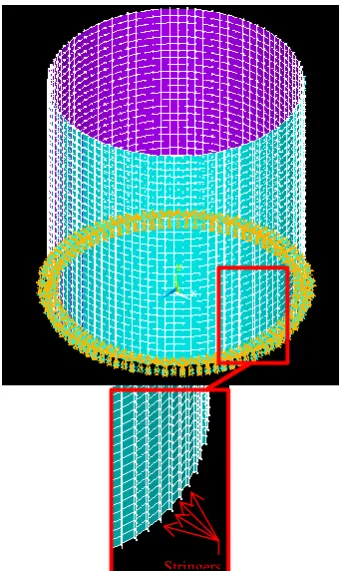
In order to calculate the inelastic buckling capacity of cylindrical steel shells with stringers, numerical analysis was used. To this end, ANSYS finite element software was used [23]. More than 160 cylindrical shells of various geometrical specifications and material properties were modeled (see Table 1). It should be noted that the cross section of all of the stringers were rectangular and their width was10 cm. Furthermore, the heights of all of the models were 15m. It is worth mentioning that all of the degrees of freedom were restrained at bottom and were released at top of all of the shells. Four node SHELL 181 elements having six degrees of freedom at each node were used to model cylindrical shells and stringers. The elements are capable of considering material nonlinearity and large deformation effects. Material nonlinearity of steel was accounted for based on Von Mises yield criterion. Kinematic hardening rule was used to define the material property in these elements. Bilinear stress-strain model were considered for cylindrical shell and
were plotted. The bifurcation point of the axial load-shortening graph of shell was considered as buckling load of a particular shell. It should be noted that the element tests and validation of models were carefully conducted according to techniques provided by Cook [24]. Several buckling modes may occur in stiffened shells (e.g. local buckling of shell, in-panel buckling of shell, global buckling and stringer buckling). In this study both in panel and global buckling mode of the shell were considered. In other words, local buckling modes of shell and/or stiffeners were not taken into account.
Results of numerical analyses revealed that the buckling capacity of a particular shell increases by decreasing the unstiffened length of the shell. The unstiffened length of the shell is defined as distance between the adjacent stiffeners and can be calculated as follows: (1), where d is an unstiffened length of the shell, D diameter the cylindrical shell and n the number of stringers. In unstiffened shells d is the perimeter of the cross section of the shell.
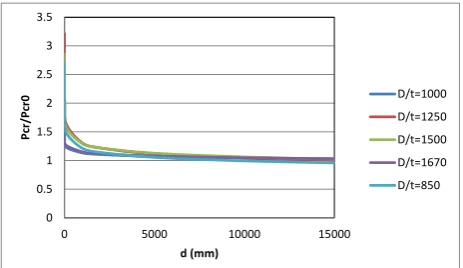
Variation of buckling capacity of shells with d is indicated in Figures 2-7. As indicated in Figures 2-7, the relation of dimensionless buckling capacities of shells (Pcr/Pcr0) and d can be expressed by a power function. Dimensionless buckling capacity of shell is defined as the ratio of the buckling capacity of a stiffened shell to that of the same unstiffened one. The above mentioned figures also show that the yield stress has low influence on buckling capacity of shells with large unstiffened lengths. This happens because the stiffened shells, especially those with large number of stiffeners, experience noticeable nonlinear behavior prior to buckling. The unstiffened length of the cylinders plays a role in buckling mode of the shells. In most of the shells with large numbers of stiffeners in-panel mode of buckling or combination of in-panel and stringer buckling took place; but, in other shells global buckling was the major failure mode.
TABLE 1. Specifications of the models
Item Diameter (m) Stringer thickness (mm) Shell thickness (mm) Yield stress (MPa) Number of stringers
1 10 1, 1.2, 2 1, 1.2, 2 250, 300, 370 0-4-8-16-32-64
2 15 1, 1.2, 2 1, 1.2, 2 250, 300, 370 0-4-8-16-32-64
Figure 1. FEM model of a stringer stiffened shell
Figure 2. Variation of dimensionless buckling capacity of shells with their unstiffened length (D/t = 750)
Figure 3. Variation of dimensionless buckling capacity of shells with their unstiffened length (D/t = 830)
Figure 4. Variation of dimensionless buckling capacity of shells with their unstiffened length (D/t = 1000)
Figure 5. Variation of dimensionless buckling capacity of shells with their unstiffened length (D/t = 1250)
Figure 6. Variation of dimensionless buckling capacity of shells with their unstiffened length (D/t =1500)
Figure 7. Variation of dimensionless buckling capacity of shells with their unstiffened length (D/t = 1670)
Figure 8. The effects of D/t on buckling capacity of stiffened shells
Variation of dimensionless buckling capacity of shells with unstiffened length for various D/t ratios and constant fy is shown in Figure 8. As indicated in Figure 8, there is not a meaningful relationship among the results of the buckling capacities stiffened shells and D/t (especially in shorter unstiffened lengths).
3. ARTIFICIAL NEURAL NETWORKS (ANN)
3. 1. Theoretical Background Artificial neural networks are simple computer model of the human brain. They are capable of mapping a relation between information in input and output layer. Several types of ANNs (e.g. Multi-layer perceptron, RBF, etc.) are available. Multi-layer perceptron (MLP) and Radial basis function (RBF) neural network are two of the most common neural networks which use to solve engineering problems. The MLP neural networks include a single input layer, one or more hidden layer(s) and an output layer. As indicated in Figure 2, each layer includes one or more artificial neuron(s). All neurons are fully connected to the neurons of the neighboring layer; but neurons within a same layer are not connected together. The RBF neural networks have simple structures with three distinct layers [25-28]. The information is collected by the first layer (input layer) and formulated the input vector. The second layer is a
hidden layer which performs a non-linear
transformation to the input vector. Finally, the third layer applies a linear transformation from hidden layer to the output space [25-28]. The jth output of a RBF neural network, yj(p), can be mathematically defined as
follows:
( ) ∑ ( ) (1)
where Ri(p) is the activity of node i which is the
Euclidean norm of the difference between the input vector and the node center:
where σi is a scalar width of the ith RBF unit.
3. 2. Network Architecture Radial Basis Function (RBF) networks have simple structure that includes a hidden layer with radial nonlinear functions and an output layer with linear transfer functions. They need to have more neurons compared to back propagation networks, but they have simpler training method than MLP networks [29]. Hence these networks usually have more efficiency when much training vectors are available.
In this study, RBF neural networks were used in order to predict the buckling capacity of stiffened cylindrical shells. To this end, 70% of the results of numerical analyses were selected to train the artificial neural networks. Various architectures were selected and examined. Generally, there is not a unique method to select the optimum architecture for neural networks [30]. In this study, the squared correlation coefficient (R2) and mean squared error (MSE) are the criteria for selecting the appropriate network. In other words, the neural network which had the least mean square error (MSE) and the maximum correlation factor (R2) were selected as the most suitable neural network. Thickness of shell and stiffeners, number of stiffeners, yield stress and the diameter of the shells were considered as input vectors and the dimensionless buckling capacity was considered as an output of the network.
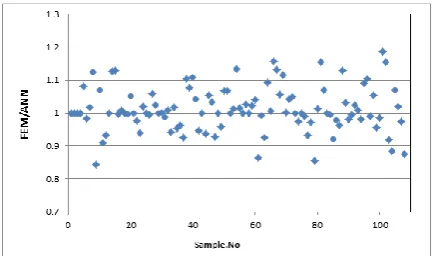
Figure 9 indicates the performance curve of the selected RBF network. It is shown that the selected network reaches the performance of 2.56x10⁻⁶ in 99 epochs which is a reasonable performance. Comparison of the prediction of the neural network with results of numerical analysis is shown in Figure 10. As shown in Figure 10, the RBF network has an acceptable potential to predict the buckling capacity of stiffened shells. In order to estimate the accuracy of the ANN predictions, the ratio of results of ANN to those estimated by numerical analysis were calculated for 108 samples (See Figure 11).
To this end, 108 new geometric-material
specifications were simulated by the selected neural network and simultaneously analyzed by FEM. Figure 11 indicates that the maximum error in ANN prediction is less than 20%. Furthermore in most of the cases (more than of 80% of the samples) the error is less than 10%.
0
0 5000 10000 15000
Figure 9. Performance curve of the selected RBF network
Figure 10. Neural predictions vs. results of FEM analyses
Figure 11. The accuracy of neural predictions in simulated shells
4. CONCLUDING REMARKS
A combination of nonlinear numerical analysis and artificial neural networks were implemented in order to estimate the buckling capacity of cylindrical stiffened shells. To this end, ANSYS software was used for nonlinear FEM analysis and RBF neural networks for neural prediction. Different structures of RBF networks were used and the best network was selected based on the minimized MSE and maximized R2.
Results of this study revealed that the relation of nonlinear buckling capacities of axially loaded cylindrical stiffened shells and their unstiffened length is approximately a power function. Results of the numerical analyses also revealed that yield stress has
low influence in buckling capacity of shells with large unstiffened lengths. It was also shown that RBF neural networks have a noticeable potential in accurate estimation of buckling capacity of stiffened shells. The maximum error in ANN prediction is less than 20%.
5. REFERENCES
1. Teng, J.-G. and Rotter, J.M., "Buckling of thin metal shells, CRC Press, (2006).
2. Hoff, N.J. and Rehfield, L.W., "Buckling of axially compressed circular cylindrical shells at stresses smaller than the classical critical value", Journal of Applied Mechanics, Vol. 32, No. 3, (1965), 542-546.
3. Rotter, J.M. and Teng, J.-G., "Elastic stability of cylindrical shells with weld depressions", Journal of Structural Engineering, Vol. 115, No. 5, (1989), 1244-1263.
4. Arbocz, J. and Babcock, C.D., "The effect of general imperfections on the buckling of cylindrical shells", Journal of Applied Mechanics, Vol. 36, No. 1, (1969), 28-38.
5. Mandal, P. and Calladine, C., "Buckling of thin cylindrical shells under axial compression", International Journal of Solids and Structures, Vol. 37, No. 33, (2000), 4509-4525. 6. Song, C., Teng, J. and Rotter, J., "Imperfection sensitivity of
thin elastic cylindrical shells subject to partial axial compression", International Journal of Solids and Structures, Vol. 41, No. 24, (2004), 7155-7180.
7. Harris, L.A., "The stability of thin-walled unstiffened circular cylinders under axial compression including the effects of internal pressure", Journal of the Aeronautical Sciences (Institute of the Aeronautical Sciences), Vol. 24, No. 8, (2012).
8. Rotter, J.M., Cai, M. and Holst, J.M.F., "Buckling of thin cylindrical shells under locally elevated compressive stresses",
Journal of Pressure Vessel Technology, Vol. 133, No. 1, (2011), 011204.
9. Teng, J.G., "Buckling of thin shells: Recent advances and trends", Applied Mechanics Reviews, Vol. 49, No. 4, (1996), 263-274.
10. M.S., R. and F., K., "Buckling of stiffened thin walled cylindrical tanks with shell imperfections due to global shear and seismic loads", Proceeding of 15th World Conference of Earthquake Engineering (15WCEE) Lisbon. Portugal, Vol. 4653, (2012).
11. Jones, N. and Papageorgiou, E., "Dynamic axial plastic buckling of stringer stiffened cylindrical shells", International Journal of Mechanical Sciences, Vol. 24, No. 1, (1982), 1-20.
12. Bushnell, D. and Bushnell, W.D., "Approximate method for the optimum design of ring and stringer stiffened cylindrical panels and shells with local, inter-ring, and general buckling modal imperfections", Computers & Structures, Vol. 59, No. 3, (1996), 489-527.
13. Yaffe, R. and Abramovich, H., "Dynamic buckling of cylindrical stringer stiffened shells", Computers & Structures, Vol. 81, No. 8, (2003), 1031-1039.
14. Andrianov, I., Verbonol, V. and Awrejcewicz, J., "Buckling analysis of discretely stringer-stiffened cylindrical shells",
International Journal of Mechanical Sciences, Vol. 48, No. 12, (2006), 1505-1515.
12, No. 4, (2012), 477-484.
19. Bilim, C., Atiş, C.D., Tanyildizi, H. and Karahan, O., "Predicting the compressive strength of ground granulated blast furnace slag concrete using artificial neural network", Advances in Engineering Software, Vol. 40, No. 5, (2009), 334-340. 20. Mata, J., "Interpretation of concrete dam behaviour with
artificial neural network and multiple linear regression models",
Engineering Structures, Vol. 33, No. 3, (2011), 903-910. 21. Razzaghi, M.S. and Mohebbi, A., "Predicting the seismic
performance of cylindrical steel tanks using artificial neural networks (ann)", Acta Polytechnica Hungarica, Vol. 8, No. 2, (2011).
22. Elshafey, A.A., Haddara, M.R. and Marzouk, H., "Damage detection in offshore structures using neural networks", Marine Structures, Vol. 23, No. 1, (2010), 131-145.
23. ANSYS (V. 5.45). Reference manuals (theoretical and element reference). SAS IP INC.
716, No. 1, (2005), 193-198.
27. Maier, H.R. and Dandy, G.C., "Neural networks for the prediction and forecasting of water resources variables: A review of modelling issues and applications", Environmental Modelling & Software, Vol. 15, No. 1, (2000), 101-124. 28. Moody, J. and Darken, C.J., "Fast learning in networks of
locally-tuned processing units", Neural Computation, Vol. 1, No. 2, (1989), 281-294.
29. Alejo, R., Garcia, V., Sotoca, J.M., Mollineda, R.A. and Sánchez, J.S., Improving the classification accuracy of rbf and mlp neural networks trained with imbalanced samples, in Intelligent data engineering and automated learning–ideal., Springer. (2006). 464-471.
30. Mukherjee, A. and Biswas, S.N., "Artificial neural networks in prediction of mechanical behavior of concrete at high temperature", Nuclear Engineering and Design, Vol. 178, No. 1, (1997), 1-11.
Predicting the buckling Capacity of Steel Cylindrical Shells with Rectangular
Stringers under Axial Loading by using Artificial Neural Networks
Z. Kalantari, M. S. Razzaghi
Department of Civil Engineering, Qazvin branch, Islamic Azad University, Iran
P A P E R I N F O
Paper history:
Received 12 May 2015
Received in revised form 10 July 2015 Accepted 30 July 2015
Keywords:
Buckling Cylindrical Shells Stiffener
Artificial Neural Networks
ديكچ ه
هتسوپ شنامک تیفرظ یسررب روظنم هب هناوتسا یاه
تخس اب یا هدننک نیا یارب .دیسر ماجنا هب کیرتماراپ تاعلاطم ،مئاق یاه
رازفا مرن زا روظنم
ANSYS
هتسوپ .دش هدافتسا ه
هناوتسا یا دادعت و رطق هب عافترا تبسن ،ندش یراج شنت اب یدلاوف یا
تخس هدننک یاه لدم نوگانوگ رییغت لرتنک اب یطخریغ یکیتاتسا لیلحت زا هدافتسا اب اهنآ شنامک تیفرظ و دندش یزاس
شیپ روظنم هب .دش هبساحم ناکم یبصع هکبش زا شنامک یروحم تیفرظ ینیب
RBF
روظنم نیا یارب .دش هدافتسا داتفه
لیلحت یجورخ جیاتن زا دصرد تحص و تست یارب یقبام و دندش هدافتسا هکبش شزومآ یارب یددع یاه
رانک جیاتن یجنس
یم ناشن شهوژپ نیا جیاتن .دندش هتشاذگ دهد
هک هکبش یبصع یاه
RBF
شیپ یارب بسانم یرازبا شنامک تیفرظ ینیب
هتسوپ هناوتسا یاه تخس اب یا .دنتسه مئاق هدننک نیا رب هولاع
، هتسوپ شنامک تیفرظ تارییغت هک دش هداد ناشن هلصاف اب اه
تخس هدننک یاه یم رییغت ییامن تروص هب )هدشن راهم لوط( رواجم .دنک