Investigation of potato peel-based bio-sorbent efficiency in reactive
dye removal: Artificial neural network modeling and genetic
algorithms optimization
Afshin Maleki Afshin MalekiAfshin Maleki Afshin Maleki1111
, , ,
, Hiua DaraeiHiua DaraeiHiua DaraeiHiua Daraei1111
, Farzaneh , Farzaneh , Farzaneh
, Farzaneh KhodaeiKhodaeiKhodaeiKhodaei1111
, Kolsum Bayazid , Kolsum Bayazid , Kolsum Bayazid
, Kolsum Bayazid----AghdamAghdamAghdamAghdam1111
,,,, Reza Rezaee
Reza RezaeeReza Rezaee
Reza Rezaee1111, Ali Naghizadeh, Ali Naghiz, Ali Naghiz, Ali Naghizadehadehadeh2222
1 Kurdistan Environmental Health Research Center, Kurdistan University of Medical Sciences, Sanandaj, Iran 2 Department of Environmental Health Engineering, School of Public Health, Birjand University of Medical Sciences, Birjand, Iran
Abstract Abstract Abstract Abstract
Over the last few years, a number of investigations have been conducted to explore the low cost sorbents for the decontamination of toxic materials. Undoubtedly, agricultural waste mass is presently one of the most challenging topics, which has been gaining attention during the past several decades. Wastes are very cheap and easily available material in production of sorbent. Therefore, the Reactive Red 198 (RR198) removal efficiency from aqueous solutions by potato peel powder based sorbent (PP) was examined in this study. The Taguchi method was used in combination with full factorial methods to design the experiments. Based on the design of experiment outputs, 18 experimental sets were designed and the experiments were done in accordance with the experimental design. The sorption handmade batch reactor consists of a 200 ml beaker, 100 RPM magnetic stirrer, and a sampling port. Then, the experimental data were collected under desired conditions. In each sample sorbent was separated using a centrifuge (3000 rpm and 5 minutes). Then, dye concentrations were determined based on Beer’s law and calibration plots using a UV-visible spectrophotometer. The wavelength resolution and the bandwidth were, respectively, 1 and 0.4 nm. The length of the optical path in glass cell was 1 cm. The maximum absorption wavelength was determined in each run to compensate the matrix effects. The results revealed that PP is effective for the sorption of RR198 from aqueous solutions. The maximum sorption of PP from RR198 solution was determined as 93 mg/g. Artificial neural network (ANN) model of dye removal efficiency (DR%) was developed based on the experimental data sets. The ANN model was strongly validated using statistical tests. The R2 and RMSE of the test set were 0.98 and 4.3, respectively. The results demonstrate that PP can be successfully used as sorbent for RR198 removal from aqueous solutions. The results revealed that experimental parameters strongly influence the DR% and different experimental conditions cause different DR% (from 0 to 93).
KEYWORDS: KEYWORDS: KEYWORDS:
KEYWORDS: Sorption, Potato Waste Powder, Design of Experiment, Artificial Neural Network, Genetic Algorithm, Dye Removal
Date of submission: Date of submission: Date of submission:
Date of submission: 10 Mar 2013, Date of acceptance:Date of acceptance: Date of acceptance:Date of acceptance:12 May 2013
Citation: Maleki A, Daraei H, Khodaei F, Bayazid-Aghdam K, Rezaee R, Naghizadeh A. Investigation of potato peel-based bio-sorbent efficiency in reactive dye removal: Artificial neural network modeling and genetic algorithms optimization. J Adv Environ Health Res 2013; 1(1): 21-8.
Introduction
1Water and wastewater pollutions like toxic or colorful organic materials (such as dyes,
Corresponding Author
Corresponding AuthorCorresponding Author Corresponding Author::::
Hiua Daraei
Email: [email protected]
pesticides, organic solvents, and etcetera), and toxic inorganic materials (especially heavy metals) have been a great concern in recent years. Conventional treatment techniques of water and wastewater include sorption, filtration, precipitation, flocculation, membrane technology, and advanced oxidation process. In
developing countries, like Iran, industries cannot afford to use conventional wastewater treatment, because they are not cost-effective. Therefore, the search for new efficient technologies capable of treating contaminated waste water in a cost effective manner is underway.1
Among the numerous treatment technologies developed for the removal of pollutions from water, sorption is receiving increasing attention. The sorbent used in the sorption processes are various materials, including activated carbon, obtained from agricultural byproducts and commercial activated carbons. However, the high cost of the activation process limits its use in wastewater treatment, particularly for developing countries.2
Over the last few years, a number of investigations have been conducted to explore low cost sorbents for the decontamination of toxic materials. Undoubtedly, agricultural waste mass is presently one of the most challenging topics, which has been gaining attention during the past several decades. Wastes are very cheap and easily available materials in the production of sorbent. Production of sorbent from different wastes not only achieves the removal of pollutants in harmless forms but also has environmental effects of reducing waste. In previous studies, different substances such as fruit and vegetable wastes, cone, leaves, and etcetera have been employed.3
Potato waste is disposed as a zero value waste in many countries as part of the production of French fries, crisps, puree, instant potatoes, and similar products. The management problem of potato wastes causes considerable concern for potato industries; thus, implying the need to identify an integrated and environmentally-friendly solution. However, potato waste can be used as sorbent to remove most pollutants in aqueous solutions. The produced waste ratio and composition depends on the procedure applied; steam, abrasion, or lye peeling. Potato waste is almost 15% to 40% of influent potatoes and it consists of 55% potato skins, 33% starch, and 12% inert material.4
A high quality model can be applied to the
process control. Applications of artificial neural network (ANN) and genetic algorithm have been successfully employed in environmental engineering for process modeling and optimization because of reliable, robust, and salient characteristics in capturing the non-linear relationships of variables in complex systems.5
ANN are parallel computational procedures consisting of highly interconnected processing element groups named neurons.6 Owing to their
inherent nature to model and learn complexities, ANNs have found wide applications in various areas of wastewater treatment.7-10 ANN has been
recently used for CR% (color removal) and energy consumption (EnC) modeling in electrocoagulation (EC).11, 12
Genetic algorithms (GA) are adaptive heuristic search algorithms based on the evolutionary ideas of natural selection and genetic. They belong to the larger class of evolutionary algorithms, which generate solutions to optimize problems by carrying out stochastic transformations inspired by natural evolution, such as inheritance, mutation, selection, and crossover.13-16
The present study had three objectives. First, to investigate the potential of PP as a sorbent in the removal of the model dye, Reactive Red 198 (RR198), from aqueous solutions. Second, DOE conducted studies to investigate the effects of five operational parameters: sorbent particle average size (Sz), initial pH (pH0), dose of
sorbent (Ds), initial dye concentration (C0), and
contact time (tc) on sorption efficiency. The third
objective was the application and assessment of ANN and GA for sorption system modeling and optimization.
Materials and Methods
RR198 was prepared from Alvan Sabet Co. (Iran). The chemical structure and some characteristics of this dye are shown in table 1. H2SO4 and NaOH
was used for calibration curve and experimental measurements.
Table 1. The chemical properties of RR198 Molecular
formula C27H18ClN7Na4O15S5
Molecular structure
Molecular
weight 968.21
CAS number 145017-98-7
Potato wastes were collected from the garbage of local restaurants of Kurdistan University of Medical Sciences. Raw potato peal was washed with hot water to remove adhering dirt. Then, degradation was done by washing thoroughly
with 1 M HCl solution and rinsing with distilled water several times. The degradation product was dried at 70ºC for 48 hours in order to gradually reduce the water content in the oven, crushed by a commercial mill, and sieved through two different sieve sizes with average size of 225 and 575 µm. The final product was stored in a sealed bottle for future application as sorbent.
The selected variables were Sz at two levels
(225 and 575 µm), pH0 at three levels (3, 7, and
11), C0 at three levels (10, 50, and 100 mgl−1), Ds
at three levels (1, 5, and 10 gl−1), and tS at five
levels (10, 30, 60, 90, and 150 min). A combined design of Taguchi for Sz, pH0, C0, Ds, and full
factorial methods for tc was used to design the
experiments (DOE) using Minitab 14 (Minitab Inc., State College, PA, USA). The Taguchi was designed based on L18 orthogonal array with 4
factors. The order of experiments was made random in order to avoid noise sources, which could take place during an experiment. In these 18 experiments, the five levels of tS were
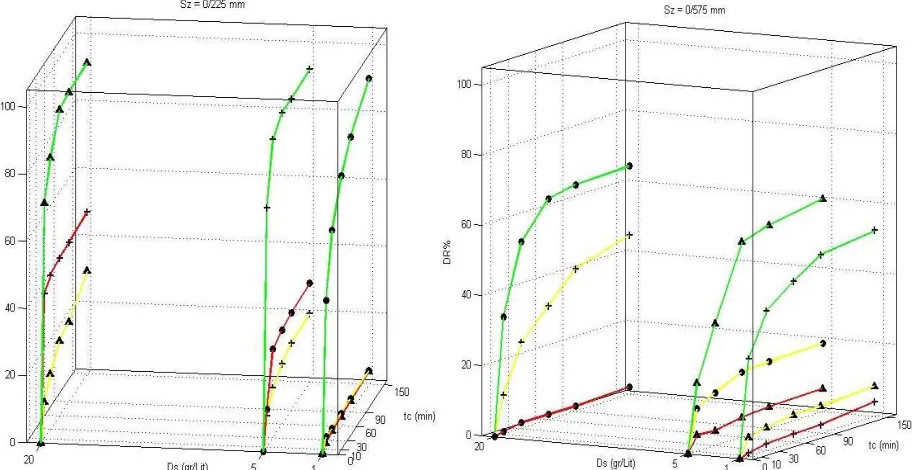
determined. All the selected experimental conditions can be seen in figure 1.17
To investigate the performance of synthetic wastewater containing DB41 using potato waste based sorbent in dye removal, DOE conducted sorption studies were carried out in batch experiments in a 200 ml beaker containing 100 ml DB41 and in room temperature as a function of Sz at two levels (225 and 575 µm), pH0 at three
levels (3, 7, and 11), C0 at three levels (10, 50, and
100 mgl−1), Ds at three levels (1, 5, and 10 gl−1),
and ts at five levels (10, 30, 60, 90, and 150 min).
In each sample sorbent was separated using a centrifuge (3000 rpm and 5 minutes). Then, dye concentrations were determined based on Beer’s law and calibration plots using a UV-visible spectrophotometer. The wavelength resolution and the bandwidth were, respectively, 1 and 0.4 nm. The length of the optical path in glass cell was 1 cm. The maximum absorption wavelength was determined in each run to compensate the matrix effects. The calibration plot was constructed in the range of each run concentration. The calibration plots usually provided a determination coefficient close to 99.9%. These data were used to calculate the sorption capacity of the sorbent. In most cases, an accurate dilution was necessary to obtain a measurable absorption. The percentage of dye uptake by the sorbent was computed using the equation:
% Sorption = (Ct-Ce)/Ct × 100
where C0 and Ct were the initial centrifuged
sample and final concentration of RR198 in the solution, respectively.
The 90 data of dye removal (DR%) together with corresponding experimental conditions were used as a data set. The five operational parameters were considered as inputs of models whilst the DR% was considered as dependent variable. Data set was randomly divided into three parts; 60% as a training set, 20% as a validation set, and 20% as testing set. The ANN models were constructed based on the same datasets for both DR%. The multiple linear regression (MLR) and ANN models were constructed as two most popular linear and nonlinear models for comparison. For the
used in this study, as it is very fast and can be employed quite easily. The number of hidden layers and nodes was determined via a trial and error procedure. GA toolbox in MATLAB (version 7) was used for generating the optimal solution for DR%. MATLAB functions using ANN model as the input were written for creating a fitness function for the optimization problem. The DR% component to be maximized was negated in the vector valued fitness function, since GA minimizes all the objectives. Experimental ranges were placed as bounds on the five inputs.18-21
Results and Discussion
Sorption process
Figure 2 shows all obtained data in 18 experiments. The effect of each operational parameter was illustrated in these figures, indicating that different levels of experimental parameters result in different DR%. In addition, it was found that PP is propitious for RR198 removal as sorbent.
SMLR models
The MLR models were developed for DR%. The model and related statistical characteristics are given in table 2.
Based on unbiased standardized coefficients presented in table 2, among linear parameters, Ds and tS have a positive effect, but C0, Sz, and
pH0 have negative effects on DR%. The most
important parameters were pH0 and Ds. Table 2
indicates that the MLR model does not have good predictability for DR% due to the complex mechanism of sorption process. It demonstrates new interest in using a more powerful modeling approach especially ANN model.
ANN modelling and GA Optimization
The ANN model was constructed for DR%. One hidden layer with 7 neurons was applied in the model. The tansig transfer function was selected for input and hidden layer, and purelin for output.18,19 Once the networks were trained by
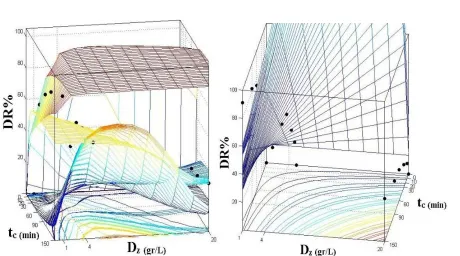
Figure 2. Sample plot of the artificial neural networks (ANN) (left) and multiple linear regression (MLR) (right) predicted values of dye removal (DR%) (colored surface) versus experimental data of DR% (black dot), for three sample conditions
Table 2. The MLR model and related statistical characteristics
Coeff. St. Coeff. P
Constant 63.14 9.91 < 0.01
Sz -0.04 0.01 0.02
pH0 -5.52 0.76 < 0.01
C0 -0.03 0.07 0.64
Ds 0.74 0.31 0.02
tS 0.20 0.05 < 0.01
Data set Train (64 data) Test (44 data)
R2 0.57 0.57
RMSE 19.3 18.6
Coeff.: Coefficients; St. Coeff.: Standardized coefficients;
Sz: Sorbent particle average size; pH0: Initial pH; Ds: Dose
of sorbent; C0: Initial dye concentration; RMSE: Root mean
square error
of each neuron and layer were saved in the ANN model. Then, they were used to estimate the test set. The (5:7:1) ANN were trained using 64 data of the train set for DR% models by the back propagation algorithm. The parameters of ANN models are presented in table 3.
Moreover, figure 2 shows the samples of ANN and MLR model predictions and their corresponding experimental results together.
Figure 2 and comparison of table 2 with table 4 clearly show that ANN model outperformed the MLR model. Therefore, ANN model was used as optimization function in GA. GA optimization
Table 3. Network weights and biases of the artificial neural networks (ANN) model
Neuron Input layer to hidden layer weights Hidden layer to output layer weights
Sz pH0 C0 Ds tS Bias Output Bias
n1 -1.445 1.395 1.167 -1.162 0.456 2.486 1.07
1.07
n2 -2.281 4.191 1.730 -0.976 -0.554 1.163 -0.84
n3 2.176 -0.673 1.859 -0.006 0.233 -0.323 1.84
n4 -1.644 -1.707 2.882 3.060 -2.604 -2.863 -0.5
n5 0.684 1.240 2.427 -1.179 0.435 1.162 -1
n6 -3.698 -0.161 0.391 2.762 0.375 -1.135 2.23
n7 -0.124 -0.236 0.278 0.133 -9.259 -9.778 -4.77
Table 4. Statistical characteristics of artificial neural networks (ANN) model of DR%
Data set Train Validation Test
R2 1 0.98 0.98
RMSE 0.8 3.8 4.3
RMSE: Root mean square error
process results in an optimal solution set with a set of decision variables. The input decision variables of the optimal solution (93.3% for DR%) were 396, 3.1, 66, 19.7, and 126 for Sz, pH0, C0, Ds,
and tS, respectively. Interpretation of table 2 and
optimum values was used to interpret and to discriminate effect of each parameter.
Effect of experimental parameters
The influence of Sz on DR% was investigated at
two levels of 225 and 575 µm. The results show that Sz clearly influences the DR% (Figure 1).
Furthermore, as presented in optimal values of empirical parameters, the optimum value of Sz is
396 µm. On the one hand, DR% further decreased Sz from 575 to 396 µg, because of a
more effective adsorption area for small sorbents. On the other hand, a decreasing in size from 396 µg to 225 µg of Sz caused the
decreasing of DR%. DR% might increase due to a more effective volume of absorption in small particles.
The pH0 of a suspension is an important
factor that can affect the DR% of RR198 by PP. Sorption efficiency increases, as the pH0 of the
solution is decreased from 11 to 3.1. As the pH0
of the solution decrease from 11 to 3.1, RR198 will get a natural or positive charge that might be more favorable as sorbent for PP. PP contains functional groups such as hydroxyl and carboxyl. These functional groups have a variety of structurally related pH dependent properties of generating appropriate atmosphere (positively and/or negatively charged sites) for attracting the cationic, natural, and anionic species of RR198.
The sorption behavior of RR198 on PP was investigated in the range of C0 (10-100 mg/l) at
three levels. As presented in optimal values of empirical parameters, the optimum value of
RR198 on PP increased with the increasing of C0 until C0 reached an optimal level (66 mg/l).
Later, an increase in concentration decreased the percentage binding. These observations can be explained by the fact that in medium concentrations, the ratio of sorptive surface area to the molecules available is high, thus, there is a greater chance of dye removal. When dye concentrations are increased, binding sites become more quickly saturated as the amount of mass concentration remains constant. However, it is important to see that the corresponding P-value of C0 presented in
table 2 statistically reveals that C0 is not
effective on DR%.
The Ds influence was investigated in the
range of 1-20 mg/l at three levels. As presented in optimal values of empirical parameters, the optimum value of Ds was 19.7 g/l. DR%
increased with the increasing of mass dosage from 1 to 19.7 g (near the maximum investigated range of Ds). This is due to the fact that
more sorbent has more capacity and binding sites for sorption.
The effect of tc on RR198 sorption on PP was
studied in 0-150 minutes at five levels. DR% increases with increasing tc then becomes stable
(Figure 1). The optimum value obtained by GA algorithm was 126 minutes that is in accordance with figure 1. This level off is due to the attainment of equilibrium between sorbate and sorbent at optimum tc or saturation of binding
sites at that time
.
Conclusion
sorption were studied. The results demonstrate that PP can successfully be used as sorbent for RR198 removal from aqueous solutions. The results revealed that experimental parameters strongly influence the DR% and different experimental conditions cause different DR% (from 0 to 93). The ANN modeling technique was successfully applied to model the process, and a reliable model was constructed and tested. The optimization of the process over the ANN model was done by GA algorithm. The obtained optimum values and experimental parameters effects were in accordance with previous studies and famous reported scientific theories.
Conflict of Interests
Authors have no conflict of interests.Acknowledgements
This work was financially supported by Kurdistan Environmental Health Research Center, Kurdistan University of Medical Sciences.
References
1. Robinson T, McMullan G, Marchant R, Nigam P. Remediation of dyes in textile effluent: a critical review on current treatment technologies with a proposed alternative. Bioresour Technol 2001; 77(3): 247-55. 2. Cheung C, Porter J, McKay G. Sorption kinetics for the
removal of copper and zinc from effluents using bone char. Separation and purification technology 2000; 19(1): 55-64.
3. Bell JP, Tsezos M. Removal of hazardous organic pollutants by biomass adsorption. Water Pollution Control Federation 1987; 59(4): 191-8.
4. Aman T, Kazi AA, Sabri MU, Bano Q. Potato peels as solid waste for the removal of heavy metal copper(II) from waste water/industrial effluent. Colloids Surf B Biointerfaces 2008; 63(1): 116-21.
5. Turan NG, Mesci B, Ozgonenel O. The use of artificial neural networks (ANN) for modeling of adsorption of Cu (II) from industrial leachate by pumice. Chemical Engineering Journal 2011; 171(3): 1091-7.
6. Hagan MT, Demuth HB, Beale MH. Neural network design. Kolkata, India: Vikas Publishing House; 2003. 7. Himmelblau DM. Applications of artificial neural
networks in chemical engineering. Korean Journal of Chemical Engineering 2000; 17(4): 373-92.
8. Ames A, Rogel-Hernandez E, Lin SW, Flores-Lَ◌pez LZ, Castro JR, Wakida FT, et al. Prediction of metal ion rejection in electro-cross-flow ultrafiltration using an artificial neural network. Desalination and Water Treatment 2011; 36(1): 105-18.
9. Saien J, Soleymani AR, Bayat H. Modeling fentonic advanced oxidation process decolorization of direct red 16 using artificial neural network technique. Desalination & Water Treatment 2012; 40(1-3): 174-82. 10.Singh G, Kandasamy J, Shon H, Cho J. Measuring
treatment effectiveness of urban wetland using hybrid water quality -- Artificial neural network (ANN) model. Desalination and Water Treatment 2011; 32(1-3): 284-90.
11.Kِ◌rbahti BK, Artut K, Geçgel C, Qzer A.
Electrochemical decolorization of textile dyes and removal of metal ions from textile dye and metal ion binary mixtures. Chemical Engineering Journal 2011; 173(3): 677-88.
12.Olmez-Hanci T, Kartal Z, Arslan-Alaton I. Electrocoagulation of commercial naphthalene sulfonates: process optimization and assessment of implementation potential. J Environ Manage 2012; 99: 44-51.
13.Tsutsui S, Goldberg DE. Search space boundary extension method in real-coded genetic algorithms. Information Sciences 2001; 133(1-4): 229-47.
14.Hasseine A, Kabouche A, Meniai AH, Korchi M. Salting effect of NaCl and KCl on the liquid―liquid
equilibria of water+ ethyl acetate+ ethanol system and interaction parameters estimation using the genetic algorithm. Desalination and Water Treatment 2011; 29(1-3): 47-55.
15.Sashi Kumar GN, Mahendra AK, Sanyal A, Gouthaman G. Genetic algorithm-based optimization of a multi-stage flash desalination plant. Desalination and Water Treatment 2009; 1(1-3): 88-106.
16.Tabesh M, Hoomehr S. Consumption management in water distribution systems by optimizing pressure reducing valves' settings using genetic algorithm. Desalination and Water Treatment 2009; 2(1-3): 95-100. 17.Ebrahimi R, Maleki A, Shahmoradi B, Daraei H,
Mahvi AH, Barati AH, et al. Elimination of arsenic contamination from water using chemically modified wheat straw. Desalination and Water Treatment 2013; 51(10-12): 2306-16.
18.Daraei H, Irandoust M, Ghasemi JB, Kurdian AR. QSPR probing of Na+ complexation with 15-crown-5 ethers derivatives using artificial neural network and multiple linear regression. Journal of Inclusion Phenomena and Macrocyclic Chemistry 2012; 72(3-4): 423-35.
20.Maleki A, Daraei H, Alaei L, Abasi L, Izadi A. Dye Removal Probing by Electrocoagulation Process: Modeling by MLR and ANN Methods. J Chem Soc Pak 2012; 34(15): 1056-69.