Journal of Theoretical and Applied Vibration and Acoustics 5(1) 69-84 (2019)
I S A V
Journal of Theoretical and Applied
Vibration and Acoustics
journal homepage: http://tava.isav.ir
Galloping and VIV control of square-section cylinder utilizing direct
opposing smart control force
Amir Hossein Rabiee *
School of Mechanical Engineering, Arak University of Technology, Arak, Iran
A R T I C L E I N F O A B S T R A C T
Article history: Received 20 April 2019
Received in revised form 18 May 2019
Accepted 22 June 2019
Available online 1 July 2019
An adaptive fuzzy sliding mode controller (AFSMC) is adopted to reduce the 2D flow-induced vibration of an elastically supported square-section cylinder, free to oscillate in stream-wise and transverse directions in both lock-in and galloping regions. The AFSMC strategy consists of a fuzzy logic inference system intended to follow a sliding-mode controller (SMC), and a robust control system designed to retrieve the variance between the sliding mode and fuzzy controllers. The sprung square cylinder first experiences vortex-induced vibrations with increasing Reynolds number, and then, after passing the critical flow velocity, it confronts high-amplitude and low-frequency vibrations of galloping owning to its sharp corners. A co-simulation platform is considered by linking the AFSMC system modeled in Matlab/Simulink to the plant model implemented in Fluent, aiming at the calculation of opposite control force needed for comprehensive annihilation of the cylinder motions. Based on the performed numerical simulations, it becomes clear that the utilized active control system has successfully mitigated the two-degree-of-freedom vibrations of a square cylinder in both the lock-in region and galloping zone. Here, the vibration amplitudes in the transverse and streamwise directions have decreased by 93% and 94%, for the lock-in region and 93% and 99%, for the galloping zone, respectively.
© 2019 Iranian Society of Acoustics and Vibration, All rights reserved. Keywords:
Galloping,
Flow-induced vibration,
Square-section cylinder, Intelligent controller,
Active controller.
1. Introduction
Fluid-solid interaction (FSI) is a stimulating engineering subject owing to its numerous applications ranging from pipelines used in different locations to various sections of power plants and heat exchangers[1, 2]. Two interesting phenomena categorized as flow-induced vibration (FIV) are vortex-induced vibration (VIV) and galloping. The former occurs due to the frequency synchronization of vortex-shedding frequency and structural natural frequency, leading to self-excited oscillations with potentially large amplitudes [3]. The latter, i.e. galloping,
* Corresponding author.
E-mail address:[email protected](A.H. Rabiee)
70 happens in non-circular cylinders when self-excited instabilities bring about oscillations with different amplitudes[4]. This phenomenon occurs in certain ranges of Reynolds (Re) number that are known to be higher than those of VIV. The cross-flow motion of a structure located in the galloping region yields aerodynamic loads that can augment oscillations [5]. When the flow velocity surpasses a critical galloping velocity, the magnitude of vibrations continues to rise with growing flow velocity. In other words, the criterion that shows the galloping phenomenon takes place is the occurrence of higher amplitude and lower frequency oscillations at higher flow velocities in comparison with lock-in condition for non-circular cylinders. A direct consequence of such vibrations in VIV and galloping is fatigue failure. Accordingly, one must consider different control strategies to alleviate these instabilities [6].
Passive control strategies are best suited for simple applications owing to their easier implementation and independency from an external power source [7]. Obviously, such methods may not be effective in special circumstances as the structural conditions or surrounding properties might change or a modification in the physical characteristics may become obligatory which is usually a challenging task. In contrast, active control methods benefit from actuators that apply energy to desired locations of the system so that the behavioral characteristics of the fluid-structure system could be adjusted[8]. Among such active systems, one can mention rotating cylinders, blowing/suction, acoustic excitation and direct opposing control force [9-12]. Bergers [13] arguably the first researcher who implemented a closed-loop control algorithm to mitigate vortex-shedding of a cylinder at low Re numbers. To reduce VIV in an elastic circular cylinder, Baz and Ro[14] utilized a velocity feedback controller that relied on flow measurements and electromagnetic actuators. A robust adaptive algorithm for a flexible cylinder was developed by Poh and Baz [15] that could effectively control and reduce low-amplitude VIV. The impacts of periodic vortex-induced excitations were greatly eliminated. Such excitations continuously act on flexible cylinders in the same conditions. To control FIV in FSI systems with limited disturbance, Carbonell et al.[16] proposed an algorithm with three different approaches. Micro-actuators of PZT type have also been used to empirically mitigate transverse VIV in multiple cylinders as in a study by Li et al.[17] In another study, Mehmood et al.[18] took advantage of various velocity feedback controllers to actively suppress VIV in a sprung cylinder with a circular cross-section in the synchronization regime. Another study relying on active control methods that sought to mitigate two-dimensional VIV was carried out by Hasheminejad et al.[19]. who used the opposite control force on a circular cylinder.
71 demonstrated that the vortex-shedding separation is affected by the twist in the cylinder surface, causing variations in the vortex-shedding frequency and vibration attenuation.
The above introduction shows that despite the large number of studies on the mitigation and control of vibrations due to vortex-shedding in circular cylinders, few studies have dealt with cylinders of square cross-section. Thus, the current study focuses on the topic of an active control strategy on a square cylinder with the aid of application of control forces that has proved to be one of the most appropriate methods for attenuation of FIV in circular cylinders. In this regard, the main novelties of current study are highlighted as follows: (1) Active FIV control of elastically mounted square-section cylinder using direct opposing control force; (2) Simultaneous VIV and galloping control of square-section cylinder; and (3) Application of intelligent model-free control strategy (adaptive fuzzy sliding mode controller) in active FIV control of square cylinder.
2. Formulation
2.1. Mathematical description of fluid and structure
The non-dimensional incompressible Navier-Stokes equations in their two-dimensional form are used to commence the numerical study. They are succinctly described as:
2 1 ( . ). Re . 0 u
u u u
u p , t , (1)
in whichp and are the pressure and density of the considered fluid, respectively, and u=(u
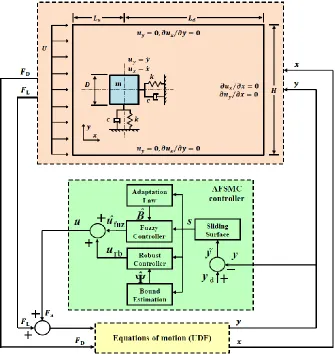
x /U, uy /U) denotes the non-dimensional velocity vector of flow where U is used to represent the free flow velocity. The oscillating moments and forces are the excitations required for the onset of motion of a rigid body placed in fluid. Here, the two-degree-of-freedom vibration of a rigid sprung cylinder with square cross-section upon which an outer control force via the intelligent control system is exerted is studied. Figure 1 displays a simplified view of the flow around the described cylinder installed on a two-degree-of-freedom elastic base. Along the x direction, the free stream flow causes variable forces, hence the rigid-body motion of the cylinder in both streamwise and transverse direction. An appropriate method for modeling the elastic cylinder is the simplified system of mass-damper-spring with stiffness values of kx=ky=k,and damping values of cx=cy =c. The corresponding motion equations are explained as:
D
( ) / ,
x F cxkx m
(2)
L a
( ) / ,
y F cykyF m
where m is the system mass per unit length, F D and FL are, respectively, the streamwise and transverse forces exerted on the cylinder from the flow and Fa is the transverse control force from the actuator (refer to Figure 1). Besides, x and y are, respectively, the in-line and cross-flow accelerations, x and y are, respectively, the in-line and cross-flow velocities, and x and y
72 Fig. 1. Representation of FIV on a cylinder with square cross-section along with the adaptive fuzzy sliding mode
control block diagram 2.2. Fluid and oscillator solvers
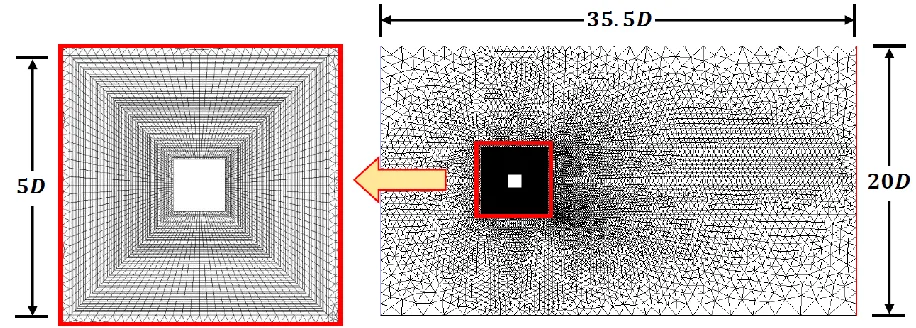
In this section, a summary of the utilized solvers for fluid and structure and their associated properties are discussed. To this aim, ANSYS Fluent combined with a user-defined function (UDF) is used to solve Equation (1) aided by an iteration method. The surrounding domain of the cylinder is a simple rectangle. As displayed in Figure 1, (L Lu, d) denotes the distances from the center of the cylinder to the boundaries of the upstream and downstream flows, H represents the size of the sidewise boundary and BD H/ is the blockage ratio. The obtained mesh for
0.05
73 condition for the surface boundary, i.e. (xn1,yn1)( ,u ux y), yields results concerning cylinder position, mesh structure and surface flow velocity in an iterative manner. Other assumptions including non-slip boundary conditions on the surface of cylinder, zero stress on horizontal boundaries and zero transverse velocity are important. Refs.[11, 26] provides a more detailed explanation of the flow-structure interaction procedure.
Fig. 2. Schematic of the computational domain 2.3. Controller design
The control of the cylinder understudy constitutes a complex FIV problem whose accurate model is significantly challenging to obtain due to nonlinearities, uncertainties, and variable parameters. This makes the derivation of controller design a cumbersome and even impractical task. Obviously, common control strategies that rely on the mathematical model of plants including sliding mode control (SMC) and ℋ2 / ℋ∞ robust control are not applicable here. A proper solution to tackle this issue is to use model-free or intelligent control methods based on heuristic algorithms.
The adaptive fuzzy sliding mode control (AFSMC) is based on fuzzy concepts and is an appropriate choice for the investigated problem. This method has also been used in various industrial areas [27, 28]. When designing the adaptive fuzzy sliding mode controller, one should consider the interaction between structure and fluid as the controller employs a transverse force Fa to modify this interaction. At its heart, a fuzzy logic control (FLC) algorithm simulates a perfect sliding mode controller, accompanied by a robust controller able to compensate the differences between the fuzzy system and the perfect controller via an adaptive tuning technique targeting FLC parameters and uncertainty bounds related to robust controller[29, 30].
To begin, a condensed inspection of the simple SMC as a method offering concurrent robustness and stability especially in nonlinear control systems is a must. To this end, an affine form of the coupled motion equations previously presented in Equation (2) is required as in:
( ) ( ) ,
x x
74 where the functions f( )x and g( )x are unknown at this stage, the control input is described by
a
[ ]
u F and the states are hidden in x as x[ , , , ]x x y yT with T denoting the vector transpose. Moreover, according to Figure 1, the tracking error is expressed as y t( )y td( )y t( ) where
d( )
y t is the preferred state trajectory while the final objective is limt y t( )0. In the presence of uncertainties, a description of the previous second-order system is best written as:
( ) ( ) ,
x x
y f g u d (4)
in which d (d f( )x g( )xu) signifies the bounded uncertainty parameter. Next, a description of the sliding surface ,as well as its derivate, should be given in the form:
,
s y
y(5)
d ,
s y y y
where is not known at this stage. Finally, SMC rule is described as:
eq rb,
u u u (6)
where ueq is the equivalent feedback controller defined as ueq g1( )x f( )x ydy and found through the use of Equation (3) and Equation (5) assuming s0. Also, urb defined as
1
rb sgn( )
u g s is necessary to be able to consider uncertainties.
Next, minimization of uncertainty bounds to eliminate chattering and to attain closed-loop stability is necessary. One should note that the ideal input for the controller, Equation (6), is not achievable as the required parameters are not known beforehand. To tackle this issue, ueq is estimated using an ideal controller *
u based on the concept of a Takagi-Saugeno fuzzy system
having a single input (shown by s), a single output (shown by ufuz) and nr fuzzy IF-THEN rules:
Rule r: IF
s
is rA THEN
fuz ,
r
u b (r1, ...,nr), (7)
where Ar is a fuzzy set based on a special membership function described by
2 [( )/ ]
( ) r r
r s c
A s e
in which cr and r are the corresponding center and width, and br
signifies a fuzzy singleton related to the output value of the r-th rule. Now, the fuzzy system output based on a well-known fuzzy interference method is expressed as:
T fuz( , ) ,
u s B B W (8)
where 1 T
[ ,..., ] b bnr
B and 1 T
[ ,..., ] w wnr
W with
1 1 ( ) ( )
r r r
n r
A r A
w s s indicating the
firing strength of the previous section of a fuzzy rule.
75
* * * *T
fuz( , ) ,
u u s B
B W
(9)where B* is the optimal parameter vector defined by B* argminB
B WT u*
and
is the sum of errors due to imperfect approximation and any other uncertainty ( ). Generally, B*and are not exactly known, hence the need for an estimation. Also, uˆfuz as a means of estimating the ideal controller is expressed as:
T
fuz ˆ ˆ
ˆ ( , )B B W,
u s (10)
quantity
B
ˆ
is an estimation of B*. At this point, one can propose a proper control law for the AFSMC system as in:fuz ˆ rb
ˆ ( , ) ( ),
B
u u s u s (11)
where urb takes care of the discrepancies between ideal and fuzzy controllers. Substituting Equation (15) in Equation (7) results in:
fuz ˆ rb
ˆ
( ) ( )[ ( , ) ( )].
x x B
y f g u s u s (12)
Additionally, by considering a set of approximation errors in the form ufuz u*uˆ ,fuz
* ˆ ,
B B B and
ˆ
in which ˆ is an estimation of uncertainty bound, and with the aidof Equations (9) and (10), one arrives at:
T
fuz B W ,
u (13)
It should be restated that .
The proposed design steps of AFSMC are listed as: a) Choosing a control input according to Equation (11)
b) Adaptively tuning the fuzzy parameter vector as explained by:
1
ˆ ( ) ,
B B s t W (14)
c) Determining a robust controller according to:
rb ˆ sgn[ ( )]sgn[ ( )],
u s t g t (15)
d) Approximating the uncertainty bound in an adaptive manner as in:
2
ˆ ( ) sgn[ ( ) ],
s t g t (16)
76
2.4. Fluent/Matlab Coupling, grid independency study, and validation
ANSYS Fluent and MATLAB/Simulink are used to implement the CFD and control models, respectively. An appropriate coupling and a concurrent simulation scheme are proposed between the two as in Figure 1 such that the controller recalls the outputs of the CFD model and attempts to control the cylinder vibrations. In particular, the communications of utilized data between Matlab/Simulink and ANSYS/Fluent are attained through a simple test file. The detailed procedure is as follows: (1) The ANSYS/Fluent solver calculates the pressure and velocity in the computational domain, (2) Fluid forces in the streamwise and transverse (F FD, L) directions are found, (3) The total force on the cylinder is obtained using the UDF, (4) The solution of motion equations is found using the Euler formula in the explicit form, (5) MATLAB reads the computed transverse displacements log, (6) The necessary force for displacement attenuation is found and saved by AFSMC, (7) The UDF reads the required control force as saved in a separate file from the last step, (8) Motion equations are solved once more according to the recalculated total force, (9) The procedure is repeated until the cross-flow displacements of cylinder are entirely eliminated.
It is essential to obtain the appropriate mesh size for precise flow computations. For this purpose, to examine the grid size independency, the general mesh arrangement is maintained, and consequently, the effect of the relative grid enhancement on the calculated mean drag and maximum lift coefficients associated with stationary square-section cylinder at Re=100 is investigated. Three different mesh grids of different sizes have been explored, as listed in Table 1, in which the level of improvement of the grids increasing for each case. According to computed force coefficients presented in Table 1, one can see the convergence of the calculated solution on gradually smaller mesh grids. Subsequently, the second grid (Case 2) with medium mesh grid quality appears to be the finest candidate intended for employment in the collaborative simulations hereafter. This selection approves that perfect compromise will be obtained between numerical precision and computing effort.
Table1. Effect of mesh grid improvement on the computed force coefficients of the elastically-mounted square-section cylinder
Total no. of cells No. of cells in the central block CLmax CD
Case 1 9100 3000 0.382 1.662
Case 2 20000 7000 0.339 1.607
Case 3 64500 9500 0.333 1.601
As an important step, the conducted simulations should be validated so as to check the reliability of the proposed method. The value of necessary quantities is taken as
*
10, 0, 0.05; / N N
77
3. Numerical results
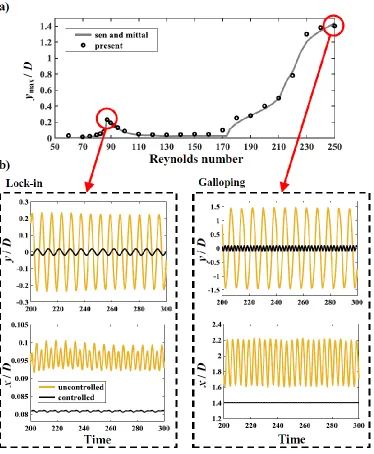
To study how VIV and galloping respond to the adaptive fuzzy sliding mode controller, the same parameters used in the previous section are employed.[31] Figure 2 displays the domain assuming H 20D and B = 0.05 for CFD analysis. The total number of grid cells reaches 20000 while those in the center grid count up to 7000. For the lock-in and galloping zones, Re numbers of Re87.5 and Re250 are considered, respectively. As discussed earlier, we seek to completely eliminate the cylinder vibration in the cross-flow direction, i.e. y td( )0 while AFSMC attempts to satisfy the relation limty t( )0. Other required parameters are taken as
3
, (cr,r) ( 10,3), (0,3), (10,3), Bˆ [ 0.5,0,0.5] and 0.1. Moreover, the learning rates are set to 1 =0.02 and 2=0.025.
Practical implementation concerns, including sensors, actuators ,and installation considerations, are not included in the main scope of the present study. However, a brief and simple explanation of the practical set up for considered FIV closed-loop control system is provided. The opposing control force should be attained by the utilization of electromagnetic actuator mounted inside the cylinder, to prevent flow distribution around the cylinder [14, 32]. The feedback signal (cylinder transverse displacement) can be achieved utilizing either a direct displacement sensor (laser displacement senor or LVDT) or a small accelerometer sensor mounted inside the surface of the square cylinder. To calculate cylinder position information, the accelerometer data can be integrated two times, and the output sent to the control system. Next, the control signal should be amplified and then drive the utilized actuator.
78 Fig. 3. (a) Representation of changes in the amplitude of cross-flow displacement at different Re numbers, (b) Outputs of the time evolution response related to the dimensionless displacements in the transverse and streamwise
directions in both lock-in and galloping regions.
79 directions has successfully approached zero. This was also identifiable in the black plots of the figure.
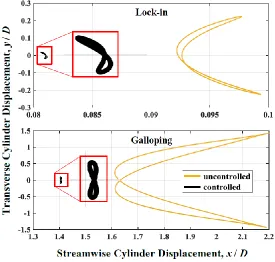
Fig. 4. Orbital trajectories of square-section cylinder for controlled and uncontrolled cases in both lock-in and galloping regions
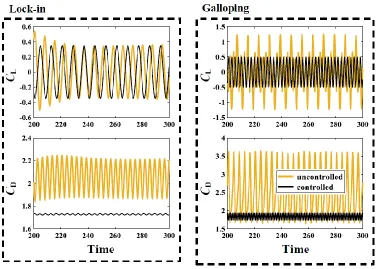
For both controlled and uncontrolled cases, the values of lift and drag coefficients in both studied regions are provided in the form of time evolution responses as in Figure 5. The amplitude of the lift coefficient on the cylinder in the lock-in region shows no reduction compared with the uncontrolled case. Also, the frequency change in the lift coefficient is clearly visible. On the contrary, the active controller has successfully decreased the magnitude of drag coefficient on the cylinder by 97%. At Re250 (galloping zone), the adaptive fuzzy sliding mode controller has decreased the amplitudes of drag and lift coefficients by 90% and 50%, respectively. The obtained results show that the active control system has not performed satisfactorily in reducing the amplitude of lift coefficient on the cylinder, particularly in the lock-in region. In contrast, the transverse displacement amplitude of cylinder for both studied regions has reduced by more than 90%. This indicates that the main reason behind the reduction in the cylinder transverse vibration is not the decrease in the magnitude of lift coefficient.
For both galloping and lock-in regions, the values of power spectral density (PSD) related to both controlled and uncontrolled cases can be seen in Figure 6 as a means of better assessment. The normalized values of vortex-shedding frequency in the lock-in region ( f fn1) related to
80 cylinder has considerably decreased after the interruption in frequency synchronization. A direct consequence of this phenomenon is a 93% decrease in the amplitude of transverse vibrations. Furthermore, the normalized vortex-shedding frequency in the galloping region, i.e. f fn0.87, has shifted up to f fn2.92 using the active controller. Consequently, the galloping oscillation frequency, which occurs in lower values than lock-in frequency, has risen and thus, the square cylinder exits this region due to the frequency change.
Fig. 5. Lift and drag coefficients in the form of time evolution responses for controlled and uncontrolled cases in both lock-in and galloping regions
81 formed toward the back of the square cylinder is similar to a stationary square cylinder, indicating the small amplitude of cylinder oscillations.
Fig. 6. PSD of cylinder transverse displacement for both controlled and uncontrolled cases
82
4. Conclusions
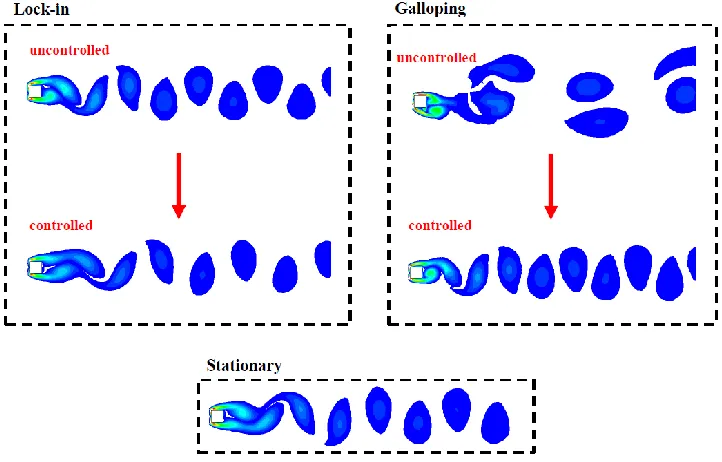
An adaptive fuzzy sliding mode control strategy is employed to annihilate the two-dimensional vortex-induced vibration and galloping of a sprung square-section cylinder at Reynolds numbers of Re87.5 and Re250. A co-simulation platform is considered by linking the AFSMC system modeled in Matlab/Simulink to the plant model implemented in Fluent, aiming at calculation of opposite control force needed for comprehensive suppuration of the cylinder motions. The most important observations are as follows. The sprung square cylinder first experiences vortex-induced vibrations with increasing Reynolds number, and then, after passing the critical flow velocity, it confronts high-amplitude and low-frequency vibrations of galloping owning to its sharp corners. First, for the lock-in region, the vibration amplitudes in the transverse and streamwise directions have decreased by 93% and 94%, respectively by utilization of an active control system. Moreover, for the galloping zone, the proposed controller has decreased the transverse and streamwise oscillations by as much as 93% and 99%, respectively. Also, the amplitude of the lift coefficient on the cylinder in the lock-in region shows no reduction compared with the uncontrolled case. At the galloping zone, the adaptive fuzzy sliding mode controller has decreased the amplitudes of lift coefficients only by 50%. The obtained results show that the active control system has not performed satisfactorily in reducing the amplitude of lift coefficient on the cylinder, particularly in the lock-in region. This indicates that the main reason behind the reduction in the cylinder transverse vibration is not the decrease in the magnitude of lift coefficient. On closer examination, it can be seen that the utilized controller reduces the normalized vortex-shedding frequency from f fn1 to f fn0.84. As a result, the transferred energy from the fluid flow to the square cylinder has considerably decreased after the interruption in frequency synchronization. Furthermore, the normalized vortex-shedding frequency in the galloping region, i.e. f fn0.87, has shifted up to f fn2.92 using the active controller. Consequently, the galloping oscillation frequency, which occurs in lower values than lock-in frequency, has risen and thus, the square cylinder exits this region due to the frequency change. Finally, it is observed that by employing an active control system, the general shape of vortices formed toward the back of the square cylinder is similar to a stationary square cylinder, indicating the small amplitude of cylinder oscillations.
References
[1] M. Keber, M. Wiercigroch, Dynamics of a vertical riser with weak structural nonlinearity excited by wakes, Journal of Sound and Vibration, 315 (2008) 685-699.
[2] V.D. Tandel, R.V. Patil, A Survey on vortex induced vibration of cross flow heat exchanger tubes, International Journal of Engineering Research and Technology, 3 (2014).
[3] N.A. Capell, D.W. Carlson, Y. Modarres-Sadeghi, Vortex-induced vibration of a single degree-of-freedom flexibly-mounted horizontal cylinder near the free surface, Journal of Sound and Vibration, 444 (2019) 161-175. [4] H. Jayatunga, B.T. Tan, J. Leontini, A study on the energy transfer of a square prism under fluid-elastic galloping, Journal of Fluids and Structures, 55 (2015) 384-397.
[5] S. Sen, S. Mittal, Free vibration of a square cylinder at low Reynolds numbers, Journal of Fluids and Structures, 27 (2011) 875-884.
[6] S.M. Hasheminejad, A.H. Rabiee, H. Bahrami, Active closed-loop vortex-induced vibration control of an elastically mounted circular cylinder at low Reynolds number using feedback rotary oscillations, Acta Mechanica, 229 (2018) 231-250.
83
[8] A.H. Rabiee, Regenerative semi-active vortex-induced vibration control of elastic circular cylinder considering the effects of capacitance value and control parameters, Journal of Mechanical Science and Technology, 32 (2018) 5583-5595.
[9] N. Fujisawa, G. Takeda, N. Ike, Phase-averaged characteristics of flow around a circular cylinder under acoustic excitation control, Journal of Fluids and Structures, 19 (2004) 159-170.
[10] W.-L. Chen, D.-B. Xin, F. Xu, H. Li, J.-P. Ou, H. Hu, Suppression of vortex-induced vibration of a circular cylinder using suction-based flow control, Journal of Fluids and Structures, 42 (2013) 25-39.
[11] S.M. Hasheminejad, A.H. Rabiee, M. Jarrahi, A. Markazi, Active vortex-induced vibration control of a circular cylinder at low Reynolds numbers using an adaptive fuzzy sliding mode controller, Journal of Fluids and Structures, 50 (2014) 49-65.
[12] J. Jiménez-González, F. Huera-Huarte, Vortex-induced vibrations of a circular cylinder with a pair of control rods of varying size, Journal of Sound and Vibration, 431 (2018) 163-176.
[13] E. Berger, Suppression of vortex shedding and turbulence behind oscillating cylinders, The Physics of Fluids, 10 (1967) 191-193.
[14] A. Baz, J. Ro, Active control of flow-induced vibrations of a flexible cylinder using direct velocity feedback, Journal of Sound and Vibration, 146 (1991) 33-45.
[15] S. Poh, A. Baz, A demonstration of adaptive least-mean-square control of small amplitude vortex-induced vibrations, Journal of fluids and structures, 10 (1996) 615-632.
[16] P. Carbonell, X. Wang, Z.P. Jiang, On the suppression of flow-induced vibration with a simple control algorithm, Communications in Nonlinear Science and Numerical Simulation, 8 (2003) 49-64.
[17] B.-Q. Li, Y. Liu, J.-R. Chu, Vortex-induced vibration control by micro actuator, Journal of mechanical science and technology, 21 (2007) 1408.
[18] A. Mehmood, A. Abdelkefi, I. Akhtar, A.H. Nayfeh, A. Nuhait, M.R. Hajj, Linear and nonlinear active feedback controls for vortex-induced vibrations of circular cylinders, Journal of Vibration and control, 20 (2014) 1137-1147.
[19] S.M. Hasheminejad, A.H. Rabiee, A. Markazi, Dual-Functional Electromagnetic Energy Harvesting and Vortex-Induced Vibration Control of an Elastically Mounted Circular Cylinder, Journal of Engineering Mechanics, 144 (2017) 04017184.
[20] M. Zhao, L. Cheng, T. Zhou, Numerical simulation of vortex-induced vibration of a square cylinder at a low Reynolds number, Physics of Fluids, 25 (2013) 023603.
[21] A.H. Dawi, R.A. Akkermans, Direct and integral noise computation of two square cylinders in tandem arrangement, Journal of Sound and Vibration, 436 (2018) 138-154.
[22] K. Venkatraman, S. Narayanan, Active control of flow-induced vibration, Journal of sound and vibration, 162 (1993) 43-55.
[23] L. Cheng, Y. Zhou, M. Zhang, Controlled vortex-induced vibration on a fix-supported flexible cylinder in cross-flow, Journal of sound and vibration, 292 (2006) 279-299.
[24] H. Dai, A. Abdelkefi, L. Wang, W. Liu, Control of cross-flow-induced vibrations of square cylinders using linear and nonlinear delayed feedbacks, Nonlinear Dynamics, 78 (2014) 907-919.
[25] C.-H. Wu, S. Ma, C.-W. Kang, T.-B. Lim, R.K. Jaiman, G. Weymouth, O. Tutty, Suppression of vortex-induced vibration of a square cylinder via continuous twisting at moderate Reynolds numbers, Journal of Wind Engineering and Industrial Aerodynamics, 177 (2018) 136-154.
[26] S.M. Hasheminejad, A.H. Rabiee, M. Jarrahi, Semi-active vortex induced vibration control of an elastic elliptical cylinder with energy regeneration capability, International Journal of Structural Stability and Dynamics, 17 (2017) 1750107.
[27] A.H. Rabiee, A.H. Markazi, Semi-active adaptive fuzzy sliding mode control of buildings under earthquake excitations, in: Proceedings of the 2nd World Congress on civil, structural, and environmental engineering, Barcelona, Spain, 2017.
[28] G. Susheelkumar, S. Murigendrappa, K. Gangadharan, Theoretical and experimental investigation of model-free adaptive fuzzy sliding mode control for MRE based adaptive tuned vibration absorber, Smart Materials and Structures, 28 (2019) 045017.
[29] A. Poursamad, A.H. Davaie-Markazi, Robust adaptive fuzzy control of unknown chaotic systems, Applied Soft Computing, 9 (2009) 970-976.
84
[31] S. Sen, S. .Mittal, Effect of mass ratio on free vibrations of a square cylinder at low Reynolds numbers, Journal of Fluids and Structures, 54 (2015) 661-678.