Evaluation the Efficacy of HBA Sperm- Hyaluronan
Binding Assay Method in Infertility Centers
Forouzan Absalan 1, 3 *, Sirous Rostami 2, Abdollah Zabihi 2
1. Department of Anatomical Science, Ahvaz Jundishapur University of Medical Sciences, Ahvaz, Iran. 2. Human Assisted Reproductive Center, Shiraz, Iran.
* Corresponding Author: Forouzan Absalan, Ph.D
Department of Anatomy, Medical Faculty, Ahvaz Jundishapur University of Medical Sciences, Ahvaz, Iran. Tel: +98 (61) 33332368
Introduction: The novel development of the (HBA) sperm- hyaluronan binding assay has now been routinely used in some laboratories worldwide to predict sperm maturity and functionality. The purpose of this study was to evaluate the correlation between HBA score and
histone deficiency, protamine content and DNA fragmentation.
Methods: During April- March 2012 patients who were enrolled at Shiraz- Human Assisted Reproductive Center were included in this study. Semen sample from 100 men were assessed during this study. Patients were divided into two groups, group A (%15≤HBA≤%55) n = 50 and group B (HBA≥ %55) n = 50. Sperm analysis carried out according to World Health Organization criteria. Histon efficiency, protamine content, and DNA integrity were assessed by Aniline blue, Chromomycine A3 staining and sperm chromatin dispersion test.
Results: The results show positive correlation between sperm concentration and motility with percentage HA-bounded sperms while a negative correlation with percentage abnormal
morphology. Histone deficiency assessed using Aniline blue staining show significant difference in group A 18.22±1.06 compared with group B 32.43± 2.90. Furthermore, the percentage HA-bounded sperm showed a significant negative correlation with protamine deficiency assessed by CMA3 staining spermatozoa (15.06± 0.88 in group A versus. 75.17± 2.37 in group B). The results also show a positive correlation between intact DNA with HA bound ability.
Conclusion: The results indicating that HBA had a high degree of selectivity for sperm with
histone efficiency, protamine quality, and high DNA integrity. These findings are important from the points of view of human sperm DNA integrity, sperm function, and the potential efficacy of HA-mediated sperm selection for human assisted reproduction techniques.
A B S T R A C T
Article info: Received: 15 Jul 2013 Accepted: 10 Oct 2013
Key Words:
(HBA) Sperm- Hyaluronan Binding Assay,
Aniline Blue Staining, Sperm Chromatin Dispersion Test,
Chromomycine A 3 Staining.
1. Introduction
uccessful fertility treatment is not only sperm competence as the ability to fertilize the oocytes but also defined as the capac-ity of sperm cells to establish a full-term pregnancy [1]. Poor predictive values of routine semen analysis for assisted reproduction techniques (ART) are not only because of a large variation of seminal parameters between ejaculates but also because of in-adequate quality controls for the semen analysis [2, 3]. Routine semen analysis only determines sperm count, motility, and morphology and it cannot detect many other aspects of sperm function such as nuclear matu-rity, DNA normality, and the ability of sperm to inter-act with oocytes [4-7].
Selection of spermatozoa based on their electronega-tive surface charge, apoptotic markers, membrane maturity (HB binding), and ultramorphology has been used to develop technical protocols for sperm isolation. The tests for the hyaluronan-binding ability (HBA) are simple and quick enough that the same semen sample test can be used for the insemination of oocytes [8]. This test has been developed as a commercial diagnos-tic kit for assessing sperm maturity and function [4-7].
HA is a polysaccharide which consists in extra cellular matrix of the cumulus oophorus; this test is based on previous reports demonstrating that HA-bound sper-matozoa are mature and devoid of cytoplasmic reten-tion, persistent histones, apoptotic markers, and DNA fragmentation [9]. In addition, a normal frequency of chromosomal aneuplodies [4], normal Tygerberg strict [10], and normal nucleus morphology criteria [3] have been correlated positively with HA-bound sperma-tozoa. The HBA has been proposed as a component of the standard analysis of semen in the diagnosis of suspected male infertility or to assist in clinical assign-ment of patients for treatassign-ment of either conventional IVF or ICSI [4]. However, published scientific data were inadequate to permit conclusions regarding ei-ther of these indications.
The test information sheet also does not provide ad-equate data to evaluate the diagnostic performance of the test [4]. The aim of this study was to determine the relationship between HBA score with the routine semen analysis results, DNA fragmentation (Halo sperm), Protamin deficiency (Chromomysin A3),
ex-cessive histones (Aniline blue), and potential efficacy of HA-mediated sperm selection in fertility centers.
2. Materials & Methods
This resolution epidemiologic study was performed during April- March 2012. Patients who were enrolled at Shiraz- Human Assisted Reproductive Center for routine IVF treatment were included in this study. All the participants were divided into two groups: patients with a %15≤HBA score ≤ %55 (group A) n = 50 and patients with HBA score ≥%55 (group B) n = 50. All patients participate in this study have admission.
2.1. Semen Analysis
Semen samples were obtained by masturbation after 2-5 days abstinence. The same ejaculated sperm was used for both IVF treatments and all sperm tests in this study. All the sperm tests were performed after liquefaction of the semen within 2 h. After complet-ing liquefaction, the semen were mixed with 2 or 3 equal of Hams F-10 medium supplemented with %10 human serum albumin, and then washed twice by centrifugation at 2000 Rpm for 10 min until sperms separated from semen. After getting the normal sper-mogram, the normal samples were selected according to World Health Organization guidelines [10], and sperm morphology was analyzed following the Kru-ger strict criteria [11]. Sperm count was performed in a Neuberger counting chamber. After immobiliz-ing, the morphology of cells with distilled water was evaluated by the Diffquick staining technique. Mo-tility was expressed as a percentage of rapid and/or progressive spermatozoa.
2.2. SCD Test
with unfixed sperm on a slide in a suspension like en-vironment. At 22°C in the dark to generate restricted single, DNA (ss DNA) motifs from DNA breaks were stranded. Then, the denaturation was stopped, and pro-teins were removed by transferring the slides to a tray with neutralizing and lysing solution (0.4 M Tris, 0.8 M DTT, 1% SDS, 2 M NaCl, 0.05 M Triplex) for 25 min at room temperature. Removal of nuclear proteins results in nucleoids with a central core and a peripheral halo of dispersed DNA loop.
Slides were thoroughly washed twice in water for 5 min, dehydrated in sequential 70%, 90% and 100% ethanol baths (2 min each), and air dried. At the end, the cells were stained with Wright and PBS (1:1) for 10 min. After air dried, the degree of DNA dispersion was assessed by bright field microscopy. A minimum of 200 spermatozoa were evaluated by 2 different ob-servers [12].
2.3. Sperm Hyaluronan Binding Assay
Commercial HBA kits were purchased from (Bio-coat, Int., 211 Witmer Road, Horsham, PA 19044, USA), and the HBA test was performed following the manufacturer’s instructions. Briefly, 10 µl of se-men (well mixed) was added to the center of the HBA chamber and the Cell-Vu grid cover slip was put on without entrapping air bubbles.
The cover slip provided a grade of 100 squares (0.1mm×0.1 mm) within a viewing circle. After incu-bation of the slide for 15 mi, unbound motile sperm and the bound motile sperm were counted in the same grade squares. For the HBA test, 400 motile sperm were counted. The percentage of hyaluronan- binding
sperm was calculated using the bound motile sperm di-vided by the sum of bound and unbound motile sperm counted in the same squares, and then multiplied by 100. Based on the percent of bound sperm, three bind-ing zones were established (excellent: > 90%; moder-ate: 60–90%; low: < 60%) and a recommendation was made to proceed with ICSI in the low binding group, while IUI could be attempted in those where the bind-ing was over 60% [13].
2.4. Indirect Assessment of Protamine Deficiency: Chromomycine A3 Staining
Proceeds semen samples were fixed in Carney’s solu-tion (Methanol: glacial acetic acid3: 1), at 4º C for 5 min. Smears were prepared and each slides were treated for 20 min with 100 µl of CMA3 solution (Sigma, USA) [0.25 mg ml-1 in McIlvaine buffer (7 ml citric acid 0.1 M +32.9 ml Na2HPO4×7H2O, 0.2 M, Ph 7.0, contain-ing 10 mM MgCl2). These slides were, then, rinsed in buffer and mounted with buffered glycerol (1:1). Mi-croscopic analysis of the slides was performed on an Olympus fluorescent microscope with the appropriate filter (460-470nm). On each slide, 200 spermatozoa were evaluated.
2.5. Aniline Blue Staining
After sperm preparation, 5 µl of the prepared sperma-tozoa were spread onto glass slides and allowed to dry. The smears were fixed in 3% buffered glutaraldehyde in 0.2 M phosphate buffer (pH=7.2) for 30 min. Then, the slides were stained with 5% aqueous aniline blue mixed with 4% acetic acid (pH=7.2) for 5 min. 200 sperm cells per slide were evaluated and the percent-age of unstained sperm heads was calculated.
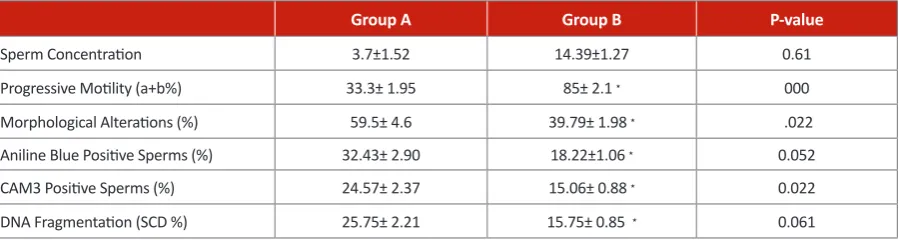
Group A Group B P-value
Sperm Concentration 3.7±1.52 14.39±1.27 0.61
Progressive Motility (a+b%) 33.3± 1.95 85± 2.1 ٭ 000
Morphological Alterations (%) 59.5± 4.6 39.79± 1.98 ٭ .022
Aniline Blue Positive Sperms (%) 32.43± 2.90 18.22±1.06 ٭ 0.052
CAM3 Positive Sperms (%) 24.57± 2.37 15.06± 0.88 ٭ 0.022
DNA Fragmentation (SCD %) 25.75± 2.21 15.75± 0.85 ٭ 0.061
A (18.22±1.06) compared to group B (32.43± 2.90). Furthermore, the percentage of HA-bounded sperm showed a negative significant correlation with prot-amine deficiency assessed by CMA3 staining sperma-tozoa (15.06± 0.88 in group A versus 24.75± 2.37 in group B). The results also show a positive correlation between DNA fragmentations with CMA3 positivity.
4. Discussion
Recently higher prevalence of male factor infertil-ity is the problem of young patients with multiple IVF failures that characterized by low fertilization rate in ART clinics. Data indicate that even if the best qual-ity spermatozoa are used, no more than 55% of the selected sperm have normal DNA [15, 16]. Sakkas et al. [17] observed that damaged sperm chromatin is not able to decondense, exchange protamines with his-tones, or replicate, which results in fertilization failure in high proportions. They suggested that the outcome of sperm penetration into an oocyte depends on the amount and type of DNA damage and the ability of the oocyte to repair this damage. The male pronucleus may be constituted, but DNA repair can cause a delay
with respect to the female pronucleus due to the repair activity [17]. Huszar et al developed and successfully applied a sperm-selection method based on binding ca-pacity of hyaluronan of the mature sperm with DNA integrity [6, 18, and 19]. The binding of the sperm to hyaluronic acid (HA) correlates with the followings: maturity of cell, lower degree of chromosomal an-euploidy, decrease of DNA fragmentation, increased chromatin integrity, normal head-morphology, and consequently improved fertility potential [7].
In this manner, our results demonstrated that hyal-uronic acid shows a high degree of selectivity for sperm with high DNA integrity, and so the HBA analy-sis also provides information even on the DNA integ-rity, leading to eliminate genetic examination in many cases. This selection also efficiently decreases the risk of transmission of numerical chromosomal abnormali-ties in offsprings [6, 20]. In addition, comparison with routine sperm preparation techniques, spermatozoa se-lected by HA binding resulted in significantly higher fertilization rates following ICSI [14[. In different stud-ies, HA-bound spermatozoa used for ICSI resulted in significantly higher embryo quality and cleavage rates 2.6. Statistical Analysis
The results were analyzed by performing ANOVA and Tukey's tests, with p ≤ 0.05 considered as statisti-cally significant. The mean and standard deviation (SD) was also calculated for each value.
3. Results
Table 1 show the correlation between different sperm parameters with the percentage of HA - bound sperms,
DNA fragmentation. Mean sperm concentration was 3.7± 1.27 and 14.39±1.27 for group A & B, respective-ly. Sperm motility (85± 2.1) and morphology altera-tions (59.5± 4.6) were found to be significantly lower in the group A (33.3± 1.95) compared with group B (39.79± 1.98), respectively (p ≤ 0.05). The results show positive correlation between sperm concentra-tion and motility with percentage HA-bounded sperms while a negative correlation with percentage abnormal morphology. Histone deficiency assessed using ani-line blue staining show significant difference in group
[15]. According to the percentage of sperm binding to hyaluronic acid, previous studies have determined the different potential fertility levels of men. Large and well-designed studies found that the pregnancy loss rate was significantly higher if the pre-procedure HA binding was below 65%, so the lower reference limit of hyaluronan binding is considered to be 65% [21]. In present study, we demonstrated that semen samples that have HBA score above the 35% showed increased chromatin integrity and better clinical parameters. In addition to cytoplasmic aspects, we have also inves-tigated chromatin structure in the sperm nucleus via aniline blue staining, which detects the persistence of histones that are not replaced with protamines, as nor-mally occurs in ejaculated sperms. The incidence of aniline blue stain sperm has been shown to correlates with abnormal sperm morphology delayed the conden-sation of DNA and diminished male fertility [22]. The distribution of mature and immature sperm, either by cytoplasmic retention or by chromatin maturity show similar patterns in two groups, providing further evi-dence for common spermiogenetic regulation. In ad-dition, bound-sperm shows no cytoplasmic retention and contains mature type chromatin. The results of the present study also revealed that spermatozoa select-ed by using HA procselect-edure had significantly rselect-educselect-ed amounts of protamine deficient spermatozoa. This in turn, reflected the fact that selected spermatozoa had reduced amount of excessive histone and possibly nor-mally compacted chromatin. In addition, spermatozoa selected by using HA procedure showed significantly lower levels of morphological anomalies when com-pared with neat semen. The present study confirms the notion that the sperm selection by HA provides a better approach to fertility potential.
Conclusion
The use of HBA test describe more precisely the male fertility potential as the previously used classic parameters and a potentially useful tool in the hands of andrologist in everyday andrological practice and before assisted reproductive techniques.
Acknowledgement
We highly appreciate Shiraz- Human Assisted Re-productive Center for their sincere technical assistant. There is no conflict of interest in this article
References
1. Sperm nucleus decondensation, hyaluronic acid binding and oocyte activation capacity: different markers of sperm imma-turity? Case reports. J Assist Reprod Genet. 2012; 29: 353-355.
2. Wyrobek AJ, Eskenazi B, Young S, Arnheim N, Tiemann-Boege I, Jabs BW, Glaser RL, Pearson FS, Evenson D. Ad-vancing age has differential effects on DNA damage, chro-matin integrity, gene mutations, and aneuploidies. Proc Natl Acad Sci USA. 2006; 103: 9601- 9606.
3. Cayli S, Jakab A, Ovari L, Delpiano E, Celik-Ozenci C, Sak-kas D, Ward D and Huszar G. Biochemical markers of sperm function: male fertility and sperm selection for ICSI. Reprod Biomed Online. 2003; 7: 462–468.
4. Cayli S, Sakkas D, Vigue L, Demir R, and Huszar G. Cellu-lar maturity and apoptosis in human sperm: creatine kinase, caspase-3 and Bcl-xl levels in mature and diminished matu-rity sperm. Mol Hum Reprod. 2004; 10: 365-372.
5. Ye H, Huang G, Gao Y, Liu D Y. Relationship between hu-man sperm- hyaluronan binding assay and fertilization rate in conventional in vitro fertilization. Hum Reprod. 2006; 21(6): 1545-1550.
6. Jakab A, Sakkas D, Delpiano E, Cayli S, Kovanci E, Ward D, Revelli A, Huszar G: Intracytoplasmic sperm injection: a novel selection method for sperm with normal frequency of chromosomal aneuploidies. Fertil Steril. 2005; 84: 1665-1673.
7. Huszar G, Ozenci CC, Cayli S, Zavaczki Z, Hansch E, Vigue L: Hyaluronic acid binding by human sperm indicates cellu-lar maturity, viability, and unreacted acrosomal status. Fertil Steril. 2003; 79(Suppl 3): 1616-1624.
8. Huszar G, Jakab A, Sakkas D, Ozenci CC, Caily S, Ozkavuk-cu S: Fertility testing and ISCI sperm selection by hyaluronic acid binding: clinical and genetic aspects. Reprod Biomed Online. 2007; 14: 650-663.
9. Huszar G, Ozenci CC, Cayli S et al. Hyaluronic acid binding by human sperm indicates cellular maturity, viability and unreacted acrosomal status. Fertile Steril. 2003; 79 (supple-mentary 3): 1616-24.
10. Midatlantic Diagnostics, Inc. HBA Sperm Hyaluronan Binding Assay Information sheet. http:// www.midatlantic-diagnostics.com/products/sperm/hba.htm
11. World Health Organization. Laboratory manual for the examination of human semen and sperm cervical mucus in-teraction. 4th ed. Cambridge: Cambridge University Press; 1999.
13. Fernandes JL, Muriel L, Rivero MT, Goyanes V, Vasquez R, Alvarez JG. The sperm chromatin dispersion test: a simple method for the determination of sperm DNA fragmentation. J Androl.2003; 24: 59–66.
14. Nasr-Esfahani MH, Razavi S, Vahdati AA, Fathi F, Tavalaee M: Evaluation of sperm selection procedure based on hyalu-ronic acid binding ability on ICSI outcome. J Assist Reprod Genet. 2008; 25: 197-203.
15. Parmegiani L, Cognigni GE, Bernardi S, Troilo E, Ciampa-glia W, Filicori M: "Physiologic ICSI": hyaluronic acid (HA) favors selection of spermatozoa without DNA fragmentation and with normal nucleus, resulting in improvement of em-bryo quality. Fertil Steril. 2010, 93: 598-604.
16. Simon L, Brunborg G, Stevenson M, Lutton D, Mcmanus J, Lewis SE. Clinical significance of sperm DNA damage in assisted reproduction outcome. Hum Reprod. 2010; 25: 1594-1608.
17. Sakkas D, Mariethoz E, St. John JC. Abnormal sperm pa-rameters in humans are indicative of an abortive apoptotic mechanism linked to the Fas-mediated pathway. Exp Cell Res. 1999; 251: 350-355
18. Huszar G, Ozenci CC, Jakab A, Vigue L. A double chember device for advanced sperm testing: semen analysis and an assay for sperm maturity by hialuronic acid (HA) binding. J Androl (Suppl.) 2002; 23(S1): 55.
19. Celik-Ozenci C, Jakab A, Kovacs T, Catalanotti J, Demir R, Bray-Ward P, and Ward D, Huszae G. Sperm selection for ICSI: shape properties do not predict the absence or presence of numerical chromosomal aberrations. Hum Reprod 2004; 9: 2052-2059.
20.Yagci A, Nurk W, Stronk J, Huszar G. Spermatozoa bound to solid state hyaluronic acid show chromatin structure with high DNA chain integrity: an acridine orange fluorescence study. J Androl. 2010; 31: 566-572.
21. Worrilow KC, Eid S, Woodhouse D, Perloe M, Smith S, Wit-myer J, Ivani K, Khoury C, Ball GD, Elliot T, Lieberman J. Use of hyaluronan in the selection of sperm for intracytoplasmic sperm injection (ICSI); significant improvement in clinical outcomes-multicenter, double blinded and randomized trial. Hum Reprod. 2012; 28: 306–314.