A Two-Phase Hybrid Heuristic Method for a Multi-Depot
Inventory-Routing Problem
Amir-Saeed Nikkhah Qamsari 1, Seyyed-Mahdi Hosseini-Motlagh2, Abbas Jokar 3
Received: 27. 10. 2016 Accepted: 25. 01. 2017
Abstract
In this study, a two phase hybrid heuristic approach was proposed to solve the multi-depot multi-vehicle inventory routing problem (MDMVIRP). Inventory routing problem (IRP) is one of the major issues in the supply chain networks that arise in the context of vendor managed systems (VMI) The MDMVIRP combines inventory management and routing decision. We are given on input a fleet of homogeneous vehicles, in which any of these vehicles have a capacity and a fixed cost. Also, a set of distribution centers with restricted capacities are responsible to serve the customer’s demands, which are known for distributer at beginning of each period. The problem consists of determining the delivery quantity to the customers at each period and the routes to be performed to satisfy the demand of the customers. The objective function of this problem is to minimize sum of the holding cost at distributer centers and the customers, and of the transportation costs associated to the preformed routes. In the proposed hybrid heuristic method, after a Construction phase (first phase) a modified variable neighborhood search algorithm (VNS), with distinct neighborhood structures, is used during the improvement phase (second phase). Moreover, we use simulated annealing (SA) concept to avoid that the solution remains in a local optimum for a given number of iterations. Computational results on benchmark instances that adopt from the literature of IRP indicate that the proposed algorithm is capable to find, within reasonable computing time, several solutions gained by the approaches that applied in the previous published studies.
Keywords: Inventory-routing problem, variable neighborhood search, two-phase heuristic
Corresponding author: [email protected]
1. MSc. Student, School of Industrial Engineering, Iran University of Science and Technology, Tehran, Iran
2. Assistant Professor, School of Industrial Engineering, Iran University of Science and Technology, Tehran, Iran
A Two-Phase Hybrid Heuristic Method for a Multi-Depot Inventory-Routing …
1.
Introduction
Collaboration between all supply chain partners is one of the most important strategies for obtaining competitive advantage. Vendor managed inventory (VMI) system deals with collaboration between a distributer and its customers [Hosseini-Motlagh et al. 2015]. Under VMI policy, the distributer decides on the order quantity and products delivery time to the
customers. Also the vendor takes the
responsibility for determining the inventory level of its customers to prevent any shortage. This approach is often defined as a win-win situation for the supplier and its customers in which suppliers can reduce total cost considerably including distribution and holding costs by integrating transportation decisions between different customers. In addition, retailers do not assign the resources to inventory control.
In the literature, the problem in which transportation and inventory management decisions are integrated simultaneously is called the inventory routing problem (IRP) that is classified in the context of VMI systems. Under this strategy, the vendor is free to decide on how much to deliver to its customers and when to visit each of them. In other words, the vendor guarantees that stock out cannot occur on its customers' side during the time horizon. In the last decade, IRP has received much attention in this research area. There are many applications for IRP in a wide variety of industries such as food distribution, perishable items[Saremi et al. 2015] [Majidi et al. 2015; Hosseini-Motlagh et al. 2017; Majidi et al. 2017], blood[Jokar and Motlagh, 2015; Cheraghi and Hosseini-Motlagh, 2017] and [Jokar and Hosseini Hosseini-Motlagh, 2015], waste organic oil, pharmaceutic Items [Riahi et al., 2013], fuel and automobile components.
One of the first studies on IRP was done by [Bell et al.1998]. Since then, several variants of IRP have been described in the literature, mainly depending on the number of depots (one or multiple), the number of vehicles to visit all
customers (one versus multiple), the nature of the demand function involved (deterministic or stochastic) and the length of the time horizon (finite versus infinite). See for more details [Anderson et al. 2010] and [Coelho et al. 2013].
In the field of exact methods, the first branch and cut algorithm was proposed by [Archetti et al. 2007] for the basic IRP (with a single depot and a single vehicle). Later, it was improved by [Solyalı and Süral, 2011] who used a stronger formulation and a heuristic method to obtain an initial upper bound for the branch and cut algorithm. [Coelho and Laporte, 2013] and [Adulyasak et. al, 2013] introduced an extension of the formulation in [Archetti et al. 2007] for multiple vehicles IRP and solved it by the branch-and-cut algorithm.
Amir-Saeed Nikkhah Qamsari, Seyyed-Mahdi Hosseini-Motlagh, Abbas Jokar
function of the inventory age. [Shabani and Nakhai,2016] introduced an efficient population-based simulated annealing algorithm (PBSA) for Periodic IRP with multiple products. They compared the computational results of the proposed algorithm with simulated annealing (SA) and genetic algorithm (GA).
Our Inventory routing problem literature review researches indicate the leakage of studies in which, the advantage of multiple distribution centers are considered.
[Soysal et al. 2016] proposed the multi-depot IRP for perishable products in the food logistics systems. However, they have only solved the problem with the limited number of customers and depots. In this paper, the IRP model with the advantage of considering multiple distribution centers is enhanced and an effective algorithm for solving the problem at the more reasonable time in the large scales is proposed consequently. Therefore, a multi-depot multi - vehicle IRP problem (MDMVIRP) in which customers' demands are known at the beginning of the time horizon is considered and Moreover, a two-phase heuristic method based on variable neighborhood Search and simulated annealing, which we refer as a two-phase VNS-SA is proposed in this article. Further parts of the paper is organized as
follows. Section two is devoted to the mathematical model. The heuristic algorithm is propsed in section 3 and Comprehensive computational results are presented in Section 4. Finally, conclusions and future research directions are provided in section 5.
2. Problem Description
A mixed-integer linear programming model for the multi-depot, multi-vehicle Inventory Routing problem is addressed in this section. As indicated in (Coelho et al. 2012), it is possible to modify this formulation in order to consider the multi-depot option. This problem is defined on a
graph 𝐺 = (𝑁, 𝐸) , where 𝑁 =
{1, … . |𝑛|, … , |𝑚 + 𝑛|} is composed of the vertex set 𝑁 in which the nodes {1,..,n} represent suppliers (depots) and the remaining nodes denote the retailers and 𝐸{(𝑖, 𝑗): 𝑖, 𝑗 ∈ 𝑁, 𝑖 ≠ 𝑗} is the set of arcs. Meanwhile, in the following we applied abbreviation 𝐸(𝑆) = {(𝑖, 𝑗) ∈ 𝐸: 𝑖 ∈
𝑆, 𝑗 ∈ 𝑆} in which the notation 𝑆 represents arbitrary node set. Moreover {𝑑1𝑑2} are an arbitrary subset of depot set. The storage capacity of all retailers is limited. Furthermore, the demand of all retailers is assumed to be known over all periods.
Sets
Retailers' set
𝑅
Set of depots
𝐷
Set of all points
(𝑅 ∪ 𝐷)
𝑁
Set of time periods
𝑇
Set of vehicles
𝐾
Parameters
Travel cost from retailer/depot
i
to retailer/depot
𝑗
𝑖 ∈ 𝑁, 𝑗 ∈ 𝑁
; satisfying triangular
inequality;
𝑐
𝑖𝑘+ 𝑐
𝑘𝑗≥ 𝑐
𝑖𝑗𝑐
𝑖𝑗Holding cost in period
𝑡
per unit for
𝑖 ∈ 𝑅
ℎ
𝒊𝒕Demand of retailer
𝑖
in period
𝑡
for
𝑡 ∈ 𝑇, 𝑖 ∈ 𝑅
𝑟
𝑖𝑡available product at depot
𝑖 ∈ 𝐷
in period
𝑇
𝑟́
𝑖𝑡Storage capacity of retailer
𝑖
A Two-Phase Hybrid Heuristic Method for a Multi-Depot Inventory-Routing …
Storage capacity of depot
𝑖
𝑈́
𝑖Vehicle capacity
𝑄
𝐼
𝑖.0initial inventory level of customer i
Variables
1 if vehicle
𝑘
along arc
(𝑖, 𝑗)
𝑖 ∈ 𝑁, 𝑗 ∈ 𝑁
and originating from depot
𝑑
and otherwise , 0
𝑦
𝒊𝑗𝑑𝑘𝑡1, if vehicle k originating from depot d visits point i in period t and otherwise,0
𝑧
𝑖𝑑𝑡𝑘Inventory amount of node (supplier or retailer) i in period t
𝐼
𝑖,𝑡The delivered amount to retailer i by vehicle k originating from depot d in period t
𝑞
𝑖𝑑𝑘𝑡inventory amount of depot d in period t
𝐼
𝑑𝑡́
𝑀𝑖𝑛 = ∑
𝑖∈𝑁∑𝑡∈𝑇ℎ𝑖𝑡𝐼𝑖𝑡∑𝑖,𝑗∈𝑅∑𝑡∈𝑇∑𝑑∈𝐷∑𝑘∈𝐾𝑐𝑖𝑗𝑦𝑖𝑗𝑑𝑘𝑡 (1)𝐼
𝑑𝑡́
=𝐼
𝑑,𝑡−1́
+ 𝑟́
𝑑𝑡−∑ ∑
𝑞𝑖𝑑 𝑘𝑡 𝑖∈𝑅́ 𝑘∈𝐾∀ 𝑡 ∈ 𝑇, ∀𝑑,
(2)
𝐼𝑖𝑡= 𝐼𝑖,𝑡−1− 𝑟𝑖𝑡+ ∑ ∑ 𝑞𝑖𝑑 𝑘𝑡 𝑑∈𝐷 𝑘∈𝐾
∀ 𝑖 ∈ 𝑅 , 𝑡 ∈ 𝑇,
(3)
𝐼𝑖𝑡≥ 0 ∀ 𝑖 ∈ 𝑁 , 𝑡 ∈ 𝑇 (4)
∑ 𝑞𝑖𝑑𝑘𝑡≥ 𝑈𝑖∑ 𝑧𝑖𝑡𝑘− 𝐼𝑖,𝑡−1 𝑘∈𝐾
𝑘∈𝐾
∀ 𝑖 ∈ 𝑅 , 𝑡 ∈ 𝑇
(5)
∑ ∑ 𝑞𝑖𝑑𝑘𝑡 𝑑∈𝐷
≤ 𝑈𝑖− 𝐼𝑖,𝑡−1 𝑘∈𝐾
∀ 𝑖 ∈ 𝑅, 𝑡 ∈ 𝑇
(6)
𝑞𝑖𝑑𝑡𝑘≤ 𝑈𝑖𝑧𝑖𝑑𝑡𝑘 ∀ 𝑖 ∈ 𝑅 , 𝑑 ∈ 𝐷, 𝑡 ∈ 𝑇 , 𝑘 ∈ 𝐾 (7)
∑ ∑ 𝑞𝑖𝑑𝑘𝑡 𝑑∈𝐷
≤ 𝑄𝑘 𝑖∈𝑁́
∀ 𝑡 ∈ 𝑇 , 𝑘 ∈ 𝐾
(8)
∑ ∑ ∑ 𝑦𝑖𝑗𝑑𝑘𝑡 𝑗∈𝑅 𝑑∈𝐷 𝑘∈𝐾
≤ 1 ∀ 𝑖 ∈ 𝑅, 𝑡 ∈ 𝑇
(9)
∑ 𝑦𝑖𝑗𝑑𝑘𝑡 𝑗:(𝑖,𝑗)∈𝐸
= 2𝑧𝑖𝑑𝑡𝑘 ∀ 𝑖 ∈ 𝑁 , 𝑑 ∈ 𝐷, 𝑡 ∈ 𝑇 , 𝑘 ∈ 𝐾
(10)
∑ 𝑦𝑖𝑗𝑘𝑡≤ ∑ 𝑧𝑖𝑑𝑡𝑘 𝑖∈𝑆
−
𝑗:(𝑖,𝑗)∈𝐸(𝑆)
𝑧𝑠𝑑𝑡𝑘 𝑠 ⊆ 𝑁́, 𝑠 ∈ 𝑆, 𝑘 ∈ 𝐾, 𝑡 ∈ 𝑇 (11)
𝑧𝑖𝑑𝑡𝑘∈ {0,1} ∀ 𝑖 ∈ 𝑁 , 𝑡 ∈ 𝑇 , 𝑑 ∈ 𝐷, 𝑘 ∈ 𝐾 (12)
∑ ∑ ∑ 𝑦𝑖𝑗𝑑𝑘𝑡 𝑖∈𝑅 𝑑∈𝐷 𝑘∈𝐾
≤ 1 ∀ 𝑗 ∈ 𝑅, 𝑡 ∈ 𝑇 (13)
𝑦𝑖𝑗𝑑𝑘𝑡 ∈ {0,1} {𝑖, 𝑗} ∈ 𝐸 𝑡 ∈ 𝑇 , 𝑑 ∈ 𝐷, 𝑘 ∈ 𝐾 (14)
𝑦𝑑1𝑗𝑑2𝑘𝑡 = 0 ∀ 𝑑 ∈ 𝐷 , 𝑡 ∈ 𝑇 , 𝑘 ∈ 𝐾 , ∀𝑗 ∈ 𝑁 (15)
𝑦𝑖𝑑1𝑑2𝑘𝑡 = 0 ∀ 𝑑 ∈ 𝐷 , 𝑡 ∈ 𝑇 , 𝑘 ∈ 𝐾 , ∀𝑗 ∈ 𝑁 (16)
Amir-Saeed Nikkhah Qamsari, Seyyed-Mahdi Hosseini-Motlagh, Abbas Jokar
In this model, the aim of the objective function (1) is to minimize the total cost including inventory and transportation costs. The inventory levels for both the suppliers and the retailers at the end of period 𝑡 are defined by constraints (2) and (3). Constraints (4) induce the absence of shortage at the suppliers and the retailers' sides. Constraints (5) and (6) ensure that if customer 𝑖 is visited in period𝑡, the delivered quantity does not exceed the customer's inventory capacity. Constraints (7) limit the available production in each depot. Constraints
(8) ensure that the demand amounts must not exceed the vehicle's capacities. Constraints (9) −
(11) are the routing constraints. Constraints
(12) − (14) define the type of decision variables. Constraints(15) and (16) institute that there is no arc from depots or customers to itself consequently using any type of vehicles. Constraints (17) ensure that at most one vehicle type originating from a given depot can meet customer𝑗.
3. Proposed Method: Two-phase
VNS-SA for the MDMVIRP
The variable neighborhood search (VNS) algorithm, as a meta-heuristic method, was developed by [Mladenović & Hansen, 1997]. The basic idea is to change neighborhood systematically within a local search algorithm. This implies that several neighborhoods are used to search for the solution improvement. In this paper, we propose a two-phase heuristic method based on VNS and SA algorithms to solve MDMVIRP, namely the two-phase VNS-SA method. As it can be seen in Algorithm 1, in the first phase, an initial solution is made through a constructive heuristic method. Then, the initial solution will be improved by modified VNS method. The two phases are described in the following
Algorithm 1. General structure of the proposed method 1 Start
2 Generate Initial solution (first phase) 3 Repeat (second phase)
4 Update 𝑇
5 Loop (VNS structure) 6 Set 𝑘 ← 1;
7 Generate a neighbor solution 𝑥̇ from the kth structure of 𝑥
8 Compute ∆= 𝑓(𝑥́) − 𝑓(𝑥) and generate r (random number between (0,1)) 9 If (∆< 0) 𝑜𝑟 (𝑒−∆⁄𝑇 > 𝑟) then (𝑥 ← 𝑥́), set 𝑘 ← 1; otherwise set 𝑘 ← 𝑘 +1; 10 End loop (until 𝑘 = 𝑘𝑚𝑎𝑥)
11 Loop (Local search structure) 12 Set 𝑙 ← 1;
13 Generate a neighbor solution 𝑥̇ from a random local search of 𝑥
14 Compute ∆= 𝑓(𝑥́) − 𝑓(𝑥) and generate r (random number between (0,1)) 15 If (∆< 0) 𝑜𝑟 (𝑒−∆⁄𝑇> 𝑟) then (𝑥 ← 𝑥́)
16 Set 𝑙 ← 𝑙 +1
17 End loop (until 𝑙 = 𝑙𝑚𝑎𝑥)
A Two-Phase Hybrid Heuristic Method for a Multi-Depot Inventory-Routing …
3.1. Phase 1: Construction of Initial
Solution (IS)
, this phase is divided into two steps, In order
to gain the IS. In the first step, a heuristic
method is performed to solve a capacitated
vehicle routing problem period by period. It
means that, in this step, inventory decisions
will not be taken into consideration. In the
second one, we propose a heuristic procedure
that can be used to improve the IS, which is
generated in the previous step, by considering
the inventory aspect of the problem. In the
heuristic procedure, in a certain period
𝑡
, a
visited retailer will be removed from the
route if it results in reducing the total cost. It
is important to note that the amounts of
quantity of the retailers' demands had to be
satisfied in the previous period. The
procedure is repeated until no more
improvement is possible.
Routing step:
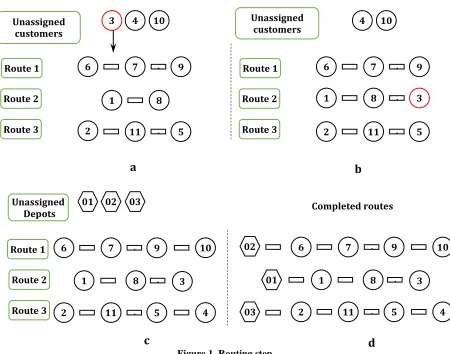
First of all, this step starts by building a
certain number of empty routes based on the
number of the available vehicles. Then,
unassigned customers are selected one by one
(
Fig. 1a
) and inserted into the feasible route
with lower cost (
Fig. 1b
). After that, each
route is assigned to the closest depot with
3 4 10
6 7 1 9
1 8
2 11 1 5
Unassigned customers
Route 1
Route 2
Route 3
4 10
6 7 1 9
2 11 1 5
Unassigned customers
Route 1
Route 2
Route 3
1 8 1 3
a
b
01 02 03
6 7 1 9
2 11 1 5
Unassigned Depots
Route 1
Route 2
Route 3
10
4 3
1 8 1 01
6 7 1 9
2 11 1 5
10
4 3
1 8 1
02
03
Completed routes
c
d
Amir-Saeed Nikkhah Qamsari, Seyyed-Mahdi Hosseini-Motlagh, Abbas Jokar
enough residual capacity (
Fig. 1c
and
Fig.
1d
)., the heuristic approach is repeated, For
each period.
3.2. Phase 2: Improvement Phase
The initial solution of the first phase is
improved by the proposed heuristic method.
In the second phase, our proposed scheme is
composed of two parts. At first, a modified
variable neighborhood search algorithm is
used to improve the solution by using a set of
neighborhood structures then, a local search
algorithm is used to escape from the local
optimality. In all over of this phase, the
new
neighborhood
solution
will be accepted after
being compared with the current solution.
This acceptance mechanism is based on the
simulated annealing acceptance criteria
.The
heuristic procedure details are described as
follow:
Modified Variable Neighborhood Search
The VNS begins with the initial solution and
tries to iteratively improve the current
solution and reach a better neighboring
solution by using several neighborhood
structures. In our implementation, the
neighborhood is started with a first
improvement strategy and the algorithm will
terminate if no better solution is found. We
use six different neighborhood structures
within the space of the solution. In this
section, we propose a new combination of
using these neighborhood structures in the
context of Inventory routing problem.
Meanwhile, we introduce 2 new structures
(
𝑬
5𝑎𝑛𝑑 𝑬
6)
which have not already applied
in the literature. Notably, these combinations
have not existed in the literature of inventory
routing problems.
Reposition Neighborhood (E
1)
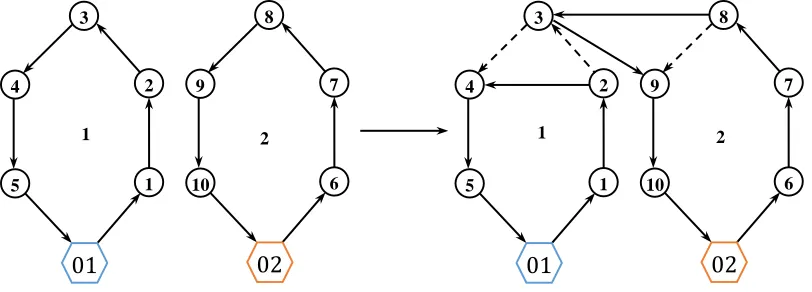
In this structure, to construct a neighbor of
the current solution, a customer is removed
from its route and inserted to a different
position in the same route or another route
planned at the same period. In Figure 2,
customer 3 is moved from the route (1) to
route (2) at the same
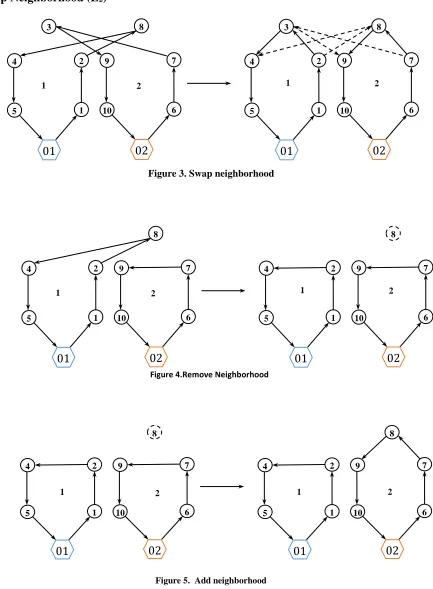
period. In this structure,
a neighbor of the current solution is obtained
by swapping a customer of one route by a
customer of another route at the same period.
For example, in Figure 3, customer 8 from the
route (2) is exchanged by customer 3 from the
route (1) at the same period.
A neighbor of the solution is gained by
removing a customer of a route. It means that
the demand of the removed customer is
delivered in the previous periods. Therefore,
the transportation cost will decrease and the
inventory costs will increase. For example, as
it is shown in Figure 4, customer 8 is removed
from the route (1).
1 2 1 2
4
3
2
5 1
01
9
8
7
10 6
02
4
3
2
5 1
01
9
8
7
10 6
02
A Two-Phase Hybrid Heuristic Method for a Multi-Depot Inventory-Routing …
Swap Neighborhood (E
2)
4
3
2
5 1
01
9
8
7
10 6
02
4
3
2
5 1
01
9
8
7
10 6
02
2 1
2 1
Figure 3. Swap neighborhood
4 2
5 1
01
9
8
7
10 6
02
4 2
5 1
01
9
8
7
10 6
02
2 1
2 1
Figure 4.Remove Neighborhood
4 2
5 1
01
9
8
7
10 6
02
4 2
5 1
01
9
8
7
10 6
02
2 1
2 1
Amir-Saeed Nikkhah Qamsari, Seyyed-Mahdi Hosseini-Motlagh, Abbas Jokar
Remove Neighborhood (E
3)
The difference between Drop neighborhood
and Remove neighborhood is that in the
latter, the demand of the customer which is
removed is satisfied in the nearest previous
period visited but in the first, the demand of
the customer which is removed is satisfied
exactly in the previous period.
Swap Periodic Neighborhood (E6)
A neighbor of a solution is obtained by
swapping two customers of two routes in
different periods. For example, in Figure 7,
customer 8 in route (2) and period 3 is
swapped by customer 3 in the route (1) and
period 2.
Local Search Algorithm
Since no further improvement occurs in the
previous section, it might have fallen into the
1 3
5 6
01
9
8
7
10 6
01
1 3
5 6
01
9
8
7
10 6
01
2 1
2 1
T=2 T=3 T=2 T=3
8
Figure 6. Drop neighborhood
3
1 3
5 6
01
9
8
7
10 6
02
1 3
5 6
01
9
3
7
10 6
02
2 1
2 1
T=2 T=3 T=2 T=3
8
A Two-Phase Hybrid Heuristic Method for a Multi-Depot Inventory-Routing …
local optimality. , some heuristic local search
methods are used for escaping this trap. Arc
exchange, Depot Exchange, and Partial
Route Drop are three heuristic method which
are used in this section. More details are
described as follows:
Arc Exchange
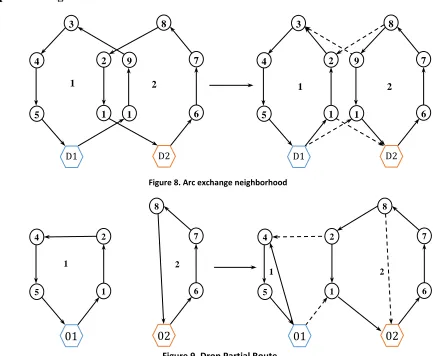
In this procedure, a neighbor of the current solution is obtained by exchanging an arc of one route by an arc of another route at the same period. For example, in Figure 8, the arc between customer 9 and customer 10 from the route (1) is exchanged by the arc between customer 1 and customer 2 from the route (2) at the same period
.
Depot Exchange
In this procedure, a neighbor of the current
solution is achieved by swapping the depot of
one route by the depot of another route at the
same period. Similarly, all possible exchange
modes are checked.
Drop Partial Route
In this heuristic procedure, a neighbor of the
solution is defined by removing partial
customers of a route and adding them to a
new position in another route at the same
period. For example, in Figure 9, customers 1
and 2 are removed from the route (1) and are
inserted into the route (2).
2 1
4 2
5 1
01
8
7
6
02
2 1
4 2
5 1
01
8
7
6
02
Figure 9. Drop Partial Route 4
3
2
5 1
D1
9
8
7
1 6
D2
4
3
2
5 1
D1
9
8
7
1 6
D2
Figure 8. Arc exchange neighborhood
2 1
Amir-Saeed Nikkhah Qamsari, Seyyed-Mahdi Hosseini-Motlagh, Abbas Jokar
4. Computational results
Our proposed algorithm was coded in
MATLAB
2014.b
and
computational
experiments were conducted on a platform
Intel Core i5 with 4 GB RAM and 3.4 GHz
processor. Detailed experimental tests were
presented for the introduced algorithm. Due
to randomness nature of our proposed
method, five independent replications were
run on each instance and the minimum
objective value among the five runs is
reported.
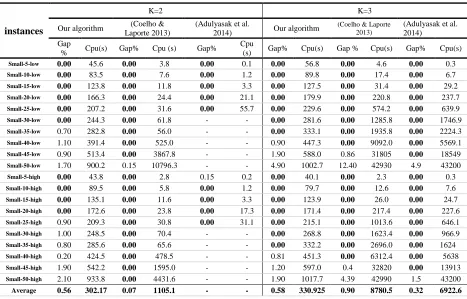
To evaluate the quality of our proposed
heuristic method, two benchmark datasets are
employed for the single-depot and
multi-vehicle case generated by Archetti et al.
[Archetti et al, 2007]and the obtained results
are compared with some available results in
the literature including Coelho & Laporte
[Coelho & Laporte, 2013] and Adulyasak et
al. [Adulyasak et al. 2014]. These data sets are
classified by the number of customers and the
planning horizon. In addition, they are divided
into two sets with respect to two levels of
inventory holding costs. It is included six time
periods with 30 customers, and three time
periods with 50 customers. These are
characterized small-n-p-low or small-n-p-high
in which n represent the number of customers,
p represents the number of periods and symbol
low/high is about two levels of inventory
holding costs. The solution results are reported
in Table 1 and Table 2. The first column
demonstrates the instance names. Then, , the
tables provide a gap of the best cost obtained
in five runs of each algorithm in comparison
with the best lower bound (LB) obtained by
Coelho et.al [Coelho et. al., 2012] and the
duration of the best run in seconds. For
example, the deviation of a method A to the
LB is computed as:
𝐺𝑎𝑝(%) = (𝐶𝑜𝑠𝑡(𝐴) − 𝐿𝐵 𝐿𝐵
⁄
) ∗ 100
Table 1. Computational results on the (Coelho & Laporte 2013)small instances set, p=3.
instances
K=2 K=3
Our algorithm Laporte 2013) (Coelho & (Adulyasak et al. 2014) Our algorithm (Coelho & Laporte 2013) (Adulyasak et al. 2014)
Gap
% Cpu(s) Gap% Cpu (s) Gap%
Cpu
(s) Gap% Cpu(s) Gap % Cpu(s) Gap% Cpu(s)
Small-5-low 0.00 45.6 0.00 3.8 0.00 0.1 0.00 56.8 0.00 4.6 0.00 0.3
Small-10-low 0.00 83.5 0.00 7.6 0.00 1.2 0.00 89.8 0.00 17.4 0.00 6.7
Small-15-low 0.00 123.8 0.00 11.8 0.00 3.3 0.00 127.5 0.00 31.4 0.00 29.2
Small-20-low 0.00 166.3 0.00 24.4 0.00 21.1 0.00 179.9 0.00 220.8 0.00 237.7 Small-25-low 0.00 207.2 0.00 31.6 0.00 55.7 0.00 229.6 0.00 574.2 0.00 639.9
Small-30-low 0.00 244.3 0.00 61.8 - - 0.00 281.6 0.00 1285.8 0.00 1746.9
Small-35-low 0.70 282.8 0.00 56.0 - - 0.00 333.1 0.00 1935.8 0.00 2224.3
Small-40-low 1.10 391.4 0.00 525.0 - - 0.90 447.3 0.00 9092.0 0.00 5569.1
Small-45-low 0.90 513.4 0.00 3867.8 - - 1.90 588.0 0.86 31805 0.00 18549
Small-50-low 1.70 900.2 0.15 10796.3 - - 4.90 1002.7 12.40 42930 4.9 43200
Small-5-high 0.00 43.8 0.00 2.8 0.15 0.2 0.00 40.1 0.00 2.3 0.00 0.3
Small-10-high 0.00 89.5 0.00 5.8 0.00 1.2 0.00 79.7 0.00 12.6 0.00 7.6
Small-15-high 0.00 135.1 0.00 11.6 0.00 3.3 0.00 123.9 0.00 26.0 0.00 24.7
Small-20-high 0.00 172.6 0.00 23.8 0.00 17.3 0.00 171.4 0.00 217.4 0.00 227.6 Small-25-high 0.90 209.3 0.00 30.8 0.00 31.1 0.00 215.1 0.00 1013.6 0.00 646.1
Small-30-high 1.00 248.5 0.00 70.4 - - 0.00 268.8 0.00 1623.4 0.00 966.9
Small-35-high 0.80 285.6 0.00 65.6 - - 0.00 332.2 0.00 2696.0 0.00 1624
Small-40-high 0.20 424.5 0.00 478.5 - - 0.81 451.3 0.00 6312.4 0.00 5638
Small-45-high 1.90 542.2 0.00 1595.0 - - 1.20 597.0 0.4 32820 0.00 13913
Small-50-high 2.10 933.8 0.00 4431.6 - - 1.90 1017.7 4.39 42990 1.5 43200
A Two-Phase Hybrid Heuristic Method for a Multi-Depot Inventory-Routing …
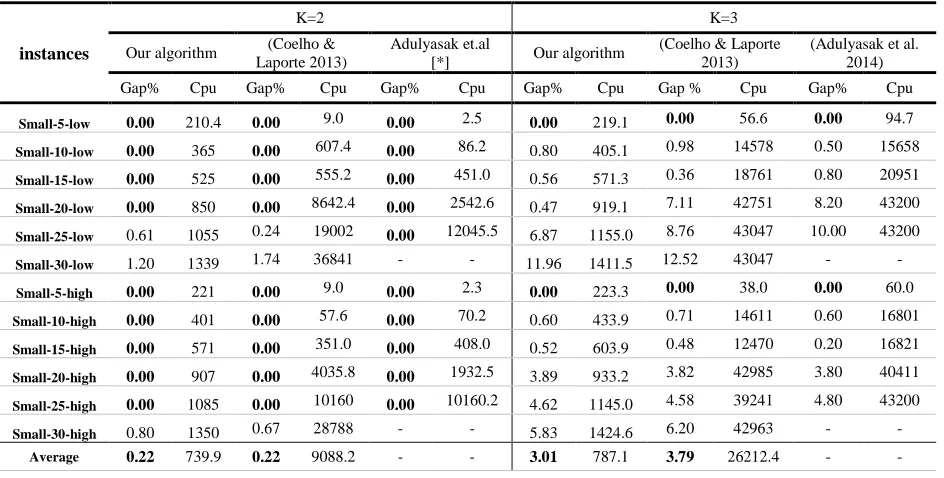
Table 2. Computational results on the (Coelho & Laporte 2013)small instances set, p=6.
instances
K=2 K=3
Our algorithm (Coelho & Laporte 2013)
Adulyasak et.al
[*] Our algorithm
(Coelho & Laporte 2013)
(Adulyasak et al. 2014)
Gap% Cpu Gap% Cpu Gap% Cpu Gap% Cpu Gap % Cpu Gap% Cpu
Small-5-low 0.00 210.4 0.00 9.0 0.00 2.5 0.00 219.1 0.00 56.6 0.00 94.7 Small-10-low 0.00 365 0.00 607.4 0.00 86.2 0.80 405.1 0.98 14578 0.50 15658 Small-15-low 0.00 525 0.00 555.2 0.00 451.0 0.56 571.3 0.36 18761 0.80 20951 Small-20-low 0.00 850 0.00 8642.4 0.00 2542.6 0.47 919.1 7.11 42751 8.20 43200 Small-25-low 0.61 1055 0.24 19002 0.00 12045.5 6.87 1155.0 8.76 43047 10.00 43200 Small-30-low 1.20 1339 1.74 36841 - - 11.96 1411.5 12.52 43047 - - Small-5-high 0.00 221 0.00 9.0 0.00 2.3 0.00 223.3 0.00 38.0 0.00 60.0 Small-10-high 0.00 401 0.00 57.6 0.00 70.2 0.60 433.9 0.71 14611 0.60 16801 Small-15-high 0.00 571 0.00 351.0 0.00 408.0 0.52 603.9 0.48 12470 0.20 16821 Small-20-high 0.00 907 0.00 4035.8 0.00 1932.5 3.89 933.2 3.82 42985 3.80 40411 Small-25-high 0.00 1085 0.00 10160 0.00 10160.2 4.62 1145.0 4.58 39241 4.80 43200 Small-30-high 0.80 1350 0.67 28788 - - 5.83 1424.6 6.20 42963 - -
Average 0.22 739.9 0.22 9088.2 - - 3.01 787.1 3.79 26212.4 - -
The first row shows the number of vehicles
for each instance. The last row displays the
average gap and the mean CPU time for each
algorithm. Numbers in boldface indicate
which methods give the same LB.
As it can be seen in Table 1, for k=2, the
average of gaps obtained by Coelho &
Laporte [Coelho & Laporte, 2013] is lower
than what is obtained in this study. But their
solution time's average is much more than the
proposed method. For k=3, the average of
gaps of the proposed method is lower than the
one obtained by Coelho et.al [Coelho et al.
2013] but is more than the average obtained
by Adulyasak et al.[ Adulyasak et al. 2014].
In Table 2, for k=2, the average of gaps
obtained by Coelho and Laporte [Coelho and
Laporte, 2013] appear to be the same as the
proposed method. However, solution time's
average obtained by these authors is much
more than the proposed method. For k=3, the
average of gaps of the proposed method is the
same as the one obtained by Coelho and
Laporte [Coelho and Laporte, 2013].
In the second set of the experiments, new
instances for the case with multiple depots
have been generated. In these sets of
instances, modifying the instances proposed
by Coelho et al.[Coelho et al, 2012] were
obligated. In order to solve the multiple
depots IRP, the same algorithm used in the
previous section was applied. Also a
simulated annealing algorithm was applied to
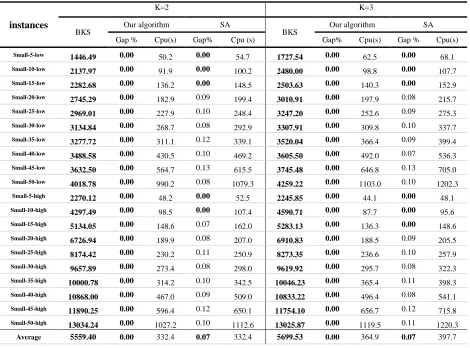
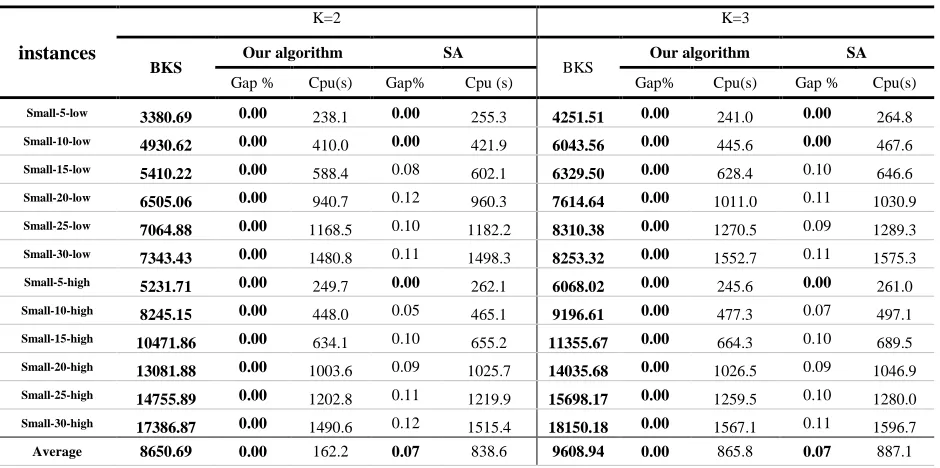
solve the multi-depot IRP. In Tables 3-4 the
comparison between our two-phase VNS-SA
algorithms with the proposed SA method is
provided. Note that "BKS" in the presented
tables represent the best-known solution
which has been founded in the current level
of problem.
Amir-Saeed Nikkhah Qamsari, Seyyed-Mahdi Hosseini-Motlagh, Abbas Jokar
planning horizons T=3 and 6 and the number
of vehicles K=2 and 3 are presented. In each
table, the average percentage gap is
demonstrated.
Comparing
the
results
obtained by the proposed method with SA
algorithm has quite interesting results.
Two-phase VNS-SA finds a better solution than
SA and the average gap for the two-phase
VNS-SA is obviously lower.
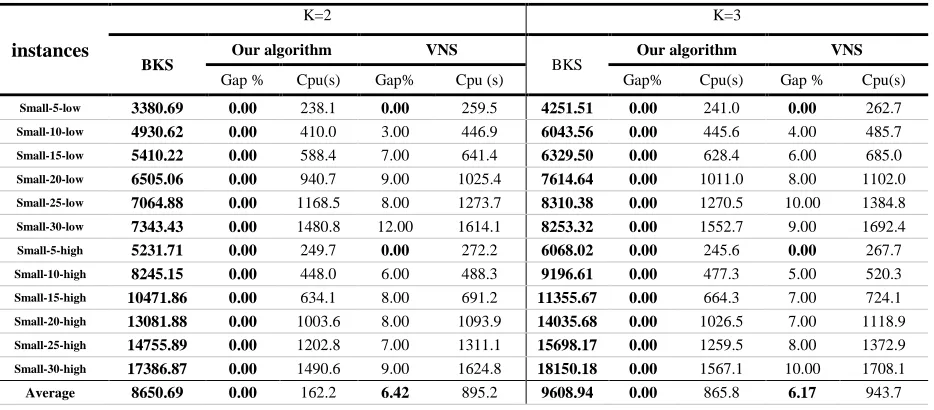
In Tables 5-6, it has been tried to reflect the
effect of a set of local searches used in the
proposed algorithm. For this purpose, a
comparison between solutions under the local
searches and without them for the
multi-depot IRP is provided. The average gap
between the two mentioned strategies in the
same tables is reported to One considerable
point is that the algorithm stops when the
solutions will not be improved by local
searches either. Therefore, the reported gap
describes
the
solution
improvement
percentage via local searches.
Table 3. Computational results on the small instances set for MDMVIRP, p=3.
instances
K=2 K=3
BKS Our algorithm SA BKS Our algorithm SA
Gap % Cpu(s) Gap% Cpu (s) Gap% Cpu(s) Gap % Cpu(s)
Small-5-low 1446.49 0.00 50.2 0.00 54.7 1727.54 0.00 62.5 0.00 68.1
Small-10-low 2137.97 0.00 91.9 0.00 100.2 2480.00 0.00 98.8 0.00 107.7
Small-15-low 2282.68 0.00 136.2 0.00 148.5 2503.63 0.00 140.3 0.00 152.9
Small-20-low 2745.29 0.00 182.9 0.09 199.4 3010.91 0.00 197.9 0.08 215.7
Small-25-low 2969.01 0.00 227.9 0.10 248.4 3247.20 0.00 252.6 0.09 275.3
Small-30-low 3134.84 0.00 268.7 0.08 292.9 3307.91 0.00 309.8 0.10 337.7
Small-35-low 3277.72 0.00 311.1 0.12 339.1 3520.04 0.00 366.4 0.09 399.4
Small-40-low 3488.58 0.00 430.5 0.10 469.2 3605.50 0.00 492.0 0.07 536.3
Small-45-low 3632.50 0.00 564.7 0.13 615.5 3745.48 0.00 646.8 0.13 705.0
Small-50-low 4018.78 0.00 990.2 0.08 1079.3 4259.22 0.00 1103.0 0.10 1202.3
Small-5-high 2270.12 0.00 48.2 0.00 52.5 2245.85 0.00 44.1 0.00 48.1
Small-10-high 4297.49 0.00 98.5 0.00 107.4 4590.71 0.00 87.7 0.00 95.6
Small-15-high 5134.05 0.00 148.6 0.07 162.0 5283.13 0.00 136.3 0.00 148.6
Small-20-high 6726.94 0.00 189.9 0.08 207.0 6910.83 0.00 188.5 0.09 205.5
Small-25-high 8174.42 0.00 230.2 0.11 250.9 8273.35 0.00 236.6 0.10 257.9
Small-30-high 9657.89 0.00 273.4 0.08 298.0 9619.92 0.00 295.7 0.08 322.3
Small-35-high 10000.78 0.00 314.2 0.10 342.5 10046.23 0.00 365.4 0.11 398.3
Small-40-high 10868.00 0.00 467.0 0.09 509.0 10833.22 0.00 496.4 0.08 541.1
Small-45-high 11890.25 0.00 596.4 0.12 650.1 11754.10 0.00 656.7 0.12 715.8
A Two-Phase Hybrid Heuristic Method for a Multi-Depot Inventory-Routing …
Table 4. Computational results on the small instances set for MDMVIRP, p=6.
instances
K=2 K=3
BKS Our algorithm SA BKS Our algorithm SA
Gap % Cpu(s) Gap% Cpu (s) Gap% Cpu(s) Gap % Cpu(s)
Small-5-low 3380.69 0.00 238.1 0.00 255.3 4251.51 0.00 241.0 0.00 264.8
Small-10-low 4930.62 0.00 410.0 0.00 421.9 6043.56 0.00 445.6 0.00 467.6
Small-15-low 5410.22 0.00 588.4 0.08 602.1 6329.50 0.00 628.4 0.10 646.6
Small-20-low 6505.06 0.00 940.7 0.12 960.3 7614.64 0.00 1011.0 0.11 1030.9
Small-25-low 7064.88 0.00 1168.5 0.10 1182.2 8310.38 0.00 1270.5 0.09 1289.3
Small-30-low 7343.43 0.00 1480.8 0.11 1498.3 8253.32 0.00 1552.7 0.11 1575.3
Small-5-high 5231.71 0.00 249.7 0.00 262.1 6068.02 0.00 245.6 0.00 261.0
Small-10-high 8245.15 0.00 448.0 0.05 465.1 9196.61 0.00 477.3 0.07 497.1
Small-15-high 10471.86 0.00 634.1 0.10 655.2 11355.67 0.00 664.3 0.10 689.5
Small-20-high 13081.88 0.00 1003.6 0.09 1025.7 14035.68 0.00 1026.5 0.09 1046.9 Small-25-high 14755.89 0.00 1202.8 0.11 1219.9 15698.17 0.00 1259.5 0.10 1280.0 Small-30-high 17386.87 0.00 1490.6 0.12 1515.4 18150.18 0.00 1567.1 0.11 1596.7 Average 8650.69 0.00 162.2 0.07 838.6 9608.94 0.00 865.8 0.07 887.1
5. Conclusions
A hybrid heuristic algorithm based on the
variable neighborhood search and the
simulated annealing algorithm is introduced
in this study. The proposed algorithm is
comprised of two phases. The first phase
generates an initial solution in which
inventory costs are ignored in step 1. In the
second phase the solution, which is initially
constructed in phase 1, is improved by
applying both a variable neighborhood search
and
a
local
search.
Six
different
neighborhood structures and 3 different local
searches for the proposed algorithm has been
used in this study. The computational tests
showed that this algorithm provides near
optimal solution in the more reasonable time
than the ones obtained by the existing
method. The applications of such proposed
model arise in a wide variety of industries
such as the distribution of blood products,
food distribution to supermarket chains,
delivery of waste organic oil and etc. there
are many issues which can enhance the
models usage in these research area,. Some of
the most significant issues are addressed as
follows:
Considering limited shelf life of
products in the model (perishability)
Transshipment between distribution
centers and customers
Developing the model by adding
pickup and delivery constraints which
leads to more realistic results.
Amir-Saeed Nikkhah Qamsari, Seyyed-Mahdi Hosseini-Motlagh, Abbas Jokar
Table 5. Computational results of the effect of local search on the results, p=3.
Table 6. Computational results of the effect of local search on the results, p=6.
instances
K=2 K=3
BKS Our algorithm VNS BKS Our algorithm VNS
Gap % Cpu(s) Gap% Cpu (s) Gap% Cpu(s) Gap % Cpu(s)
Small-5-low 3380.69 0.00 238.1 0.00 259.5 4251.51 0.00 241.0 0.00 262.7
Small-10-low 4930.62 0.00 410.0 3.00 446.9 6043.56 0.00 445.6 4.00 485.7
Small-15-low 5410.22 0.00 588.4 7.00 641.4 6329.50 0.00 628.4 6.00 685.0
Small-20-low 6505.06 0.00 940.7 9.00 1025.4 7614.64 0.00 1011.0 8.00 1102.0
Small-25-low 7064.88 0.00 1168.5 8.00 1273.7 8310.38 0.00 1270.5 10.00 1384.8
Small-30-low 7343.43 0.00 1480.8 12.00 1614.1 8253.32 0.00 1552.7 9.00 1692.4
Small-5-high 5231.71 0.00 249.7 0.00 272.2 6068.02 0.00 245.6 0.00 267.7
Small-10-high 8245.15 0.00 448.0 6.00 488.3 9196.61 0.00 477.3 5.00 520.3
Small-15-high 10471.86 0.00 634.1 8.00 691.2 11355.67 0.00 664.3 7.00 724.1
Small-20-high 13081.88 0.00 1003.6 8.00 1093.9 14035.68 0.00 1026.5 7.00 1118.9 Small-25-high 14755.89 0.00 1202.8 7.00 1311.1 15698.17 0.00 1259.5 8.00 1372.9 Small-30-high 17386.87 0.00 1490.6 9.00 1624.8 18150.18 0.00 1567.1 10.00 1708.1 Average 8650.69 0.00 162.2 6.42 895.2 9608.94 0.00 865.8 6.17 943.7 instances
K=2 K=3
BKS Our algorithm VNS BKS Our algorithm VNS
Gap % Cpu(s) Gap% Cpu (s) Gap% Cpu(s) Gap % Cpu(s)
Small-5-low 1446.49 0.00 50.2 0.00 57.7 1727.54 0.00 62.5 0.00 73.1
Small-10-low 2137.97 0.00 91.9 0.00 105.7 2480.00 0.00 98.8 0.00 115.6
Small-15-low 2282.68 0.00 136.2 4.00 156.6 2503.63 0.00 140.3 3.00 164.2
Small-20-low 2745.29 0.00 182.9 3.00 210.3 3010.91 0.00 197.9 4.00 231.5
Small-25-low 2969.01 0.00 227.9 8.00 262.1 3247.20 0.00 252.6 6.00 295.5
Small-30-low 3134.84 0.00 268.7 6.00 309.0 3307.91 0.00 309.8 6.00 362.5
Small-35-low 3277.72 0.00 311.1 9.00 357.8 3520.04 0.00 366.4 9.00 428.7
Small-40-low 3488.58 0.00 430.5 8.00 495.1 3605.50 0.00 492.0 6.00 575.6
Small-45-low 3632.50 0.00 564.7 9.00 649.4 3745.48 0.00 646.8 7.00 756.8
Small-50-low 4018.78 0.00 990.2 6.00 1138.7 4259.22 0.00 1103.0 8.00 1290.5
Small-5-high 2270.12 0.00 48.2 0.00 55.4 2245.85 0.00 44.1 0.00 51.6
Small-10-high 4297.49 0.00 98.5 3.00 113.3 4590.71 0.00 87.7 0.00 102.6
Small-15-high 5134.05 0.00 148.6 4.00 170.9 5283.13 0.00 136.3 4.00 159.5
Small-20-high 6726.94 0.00 189.9 6.00 218.4 6910.83 0.00 188.5 3.00 220.5
Small-25-high 8174.42 0.00 230.2 7.00 264.7 8273.35 0.00 236.6 8.00 276.8
Small-30-high 9657.89 0.00 273.4 8.00 314.4 9619.92 0.00 295.7 8.00 346.0
Small-35-high 10000.78 0.00 314.2 6.00 361.3 10046.23 0.00 365.4 9.00 427.5
Small-40-high 10868.00 0.00 467.0 7.00 537.1 10833.22 0.00 496.4 8.00 580.8
Small-45-high 11890.25 0.00 596.4 8.00 685.9 11754.10 0.00 656.7 9.00 768.3
A Two-Phase Hybrid Heuristic Method for a Multi-Depot Inventory-Routing …
6
.
References
-Adulyasak, Y., Cordeau, J. F. and Jans, R.
(2013) "Formulations and branch-and-cut algorithms for multivehicle production and inventory routing problems", INFORMS Journal on Computing, Vol.26, No.1, pp.103-120.
-Andersson, H., Hoff, A., Christiansen, M., Hasle, G. and Løkketangen, A. (2010) "Industrial aspects and literature survey:
Combined inventory management and
routing", Computers and Operations Research, Vol.37, No.9, pp.1515–1536. Available at: http://dx.doi.org/10.1016/j.
-Archetti, C., Bertazzi, L., Laporte, G. and Speranza, M. G. (2007) "A branch-and-cut algorithm for a vendor-managed inventory-routing problem", Transportation Science, Vol.41, No.3, pp.382–391. Available at: http://pubsonline.informs.org/doi/abs/10.128 7/trsc.1060.0188.
-Archetti, C., Bertazzi, L. and Speranza, M. G. (2012) "A hybrid heuristic for an inventory routing problem". , INFORMS Journal on
Computing, Vol.24, No.1, pp.101–116.
-Bell, W.J., Dalberto, L. M., Fisher, M.L., Greenfield, A.J., Jaikumar, R., Kedia, P., Mack, R.G. and Prutzman, P.J. (1983). "Improving the distribution of industrial gases with an on-line computerized routing and scheduling optimizer", Interfaces, Vol.13, No.6, pp.4–23.
-Cheraghi, S. and Hosseini-Motlagh, S.-M. (2017) " Optimal Blood Transportation in Disaster Relief Considering Facility Disruption and Route Reliability under Uncertainty", International Journal of Transportation Engineering, Vol. 4, No. 3, pp.225-254.
-Coelho, L.C., Cordeau, J.F. and Laporte, G. (2012) "Consistency in multi-vehicle inventory-routing", Transportation Research Part C: Emerging Technologies, Vol.24,
pp.270–287. Available at:
http://dx.doi.org/10.1016/j.trc.2012.03.007.
-Coelho, L.C. and Laporte, G. (2013) "The exact solution of several classes of inventory-routing problems", Computers and Operations Research, Vol.40,No.2, pp.558–
565. Available at:
http://dx.doi.org/10.1016/j.cor.2012.08.012.
-Cordeau, J. F., Laganà, D., Musmanno, R., and Vocaturo, F. (2014) " A decomposition-based heuristic for the multiple-product inventory-routing problem", Computers and Operations Research, Vol.55, pp.153–166.
Available at: htt
p://dx.doi.org/10.1016/j.cor.2014.06.007.
-Hosseini-Motlagh, S.-M., Ahadpour, P. and Haeri, A. (2015) "Proposing an approach to calculate headway intervals to improve bus fleet scheduling using a data mining algorithm", Journal of Industrial and Systems Engineering, Vol.8, No.4, pp.72–86.
Hosseini-Motlagh, S. M., Majidi, S., Yaghoubi, S., & Jokar, A. (2017) "Fuzzy green vehicle routing problem with simultaneous pickup-delivery and time windows". RAIRO-Operations Research.
Available at:
https://doi.org/10.1051/ro/2017007
-Huang, S.-H. and Lin, P.-C. (2010) "A modified ant colony optimization algorithm for multi-item inventory routing problems with demand uncertainty", Transportation
Research Part E: Logistics and
Transportation Review, Vol.46, No.5,
pp.598–611. Available at:
http://dx.doi.org/10.1016/j.tre.2010.01.006.
-Jokar, A. and Hosseini-Motlagh, S.-M. (2015) "Impact of capacity of mobile units on blood supply chain performance: Results from a robust analysis", International Journal of Hospital Research, Vol.4, No.3, pp.101– 105.
Amir-Saeed Nikkhah Qamsari, Seyyed-Mahdi Hosseini-Motlagh, Abbas Jokar
Journal of Management and Sustainability, Vol.2, No.2, pp.219.
-Liu, S. C. and Lee, S. B. (2003) "A two-phase heuristic method for the multi-depot location routing problem taking inventory control decisions into consideration",
International Journal of Advanced
Manufacturing Technology, Vol.22, No.(11– 12), pp. 941–950.
-Majidi, S., Hosseini-Motlagh, S.-M., Yaghubi,S., Jokar, A. (2015). "An adaptive large neighborhood search heuristic for the green vehicle routing problem with simultaneously pickup and delivery and hard time windows", Journal Of Industrial Engeeniring Research in Production Systems, Vol.3, No.6, pp.149–165.
-Majidi, S., Hosseini-Motlagh, S.-M., Ignatius, J. (2017). "Adaptive Large Neighborhood Search heuristic for Pollution Routing Problem with simultaneous pickup and delivery", Soft Computing, Available at: 10.1007/s00500-017-2535-5
-Mirzaei, S. and Seifi, A. (2015). "Considering lost sale in inventory routing problems for perishable goods", Computers and Industrial Engineering, Vol.87 (May),
pp.213–227. Available at:
http://dx.doi.org/10.1016/j.cie.2015.05.010.
-Mirzapour Al-e-hashem, S.M.J. and Rekik, Y. (2014) "Multi-product multi-period
inventory routing problem with a
transshipment option: a green approach", International Journal of Production Economics, Vol.157, pp.80–88.
-Mladenović, N. and Hansen, P. (1997) "Variable neighborhood search", Computers & Operations Research, Vol.24, No.11, pp.1097–1100.
-Park, Y.-B., Yoo, J.-S. and Park, H.-S. (2016) "A genetic algorithm for the vendor-managed inventory routing problem with lost sales", Expert Systems with Applications, Vol.53, pp.149–159.
-Poorjafari, V., Long Yue, W., and Holyoak, N. (2016) "A novel method for measuring the quality of temporal integration in public transport systems", International Journal of Transportation Engineereing , Vol.4, No.1, pp.53-59.
-Riahi N., Hosseini-Motlagh, S.-M., Teimourpour, B., (2013) " Three-phase Hybrid Times Series Modeling Framework for Improved Hospital Inventory Demand Forecast", International Journal of Hospital Research Vol. 2, No. 3, pp.130-138
-Saremi, S., Hosseini-Motlagh, S.-M.,S. and Sadjadi, S.J. (2016) "A reschedule design for disrupted liner ships considering ports demand and CO2 emissions : the case study of islamic republic of Iran shipping lines (IRISL)", Journal of Industrial and Systems Engineering, Vol.9, No.1, pp.126–148.
-Shaabani, H. and Kamalabadi, I. N. (2016) "An efficient population-based simulated annealing algorithm for the multi-product multi-retailer perishable inventory routing problem", Computers and Industrial Engineering, Vol.99, pp.189–201. Available at:
http://dx.doi.org/10.1016/j.cie.2016.07.022.
-Solyali, Ǒguz and Süral, H. (2011) "A branch-and-cut algorithm using a strong formulation and an a priori tour-based heuristic for an inventory-routing problem", Transportation Science,Vol.45, No.3, pp.335–345.