Considering Alternate Futures to Classify Of-Task
Behavior as Emotion Self-Regulation: A
Supervised Learning Approach
JENNIFER L. SABOURIN, JONATHAN P. ROWE, BRADFORD W. MOTT, AND JAMES C. LESTER
________________________________________________________________________
Over the past decade, there has been growing interest in real-time assessment of student engagement and motivation during interactions with educational software. Detecting symptoms of disengagement, such as off-task behavior, has shown considerable promise for understanding students’ motivational characteristics during learning. In this paper, we investigate the affective role of off-task behavior by analyzing data from student interactions with CRYSTAL ISLAND,a narrative-centered learning environment for middle school microbiology. We observe that off-task behavior is associated with reduced student learning, but preliminary analyses of students’ affective transitions suggest that off-task behavior may also serve a productive role for some students coping with negative affective states such as frustration. Empirical findings imply that some students may use off-task behavior as a strategy for self-regulating negative emotional states during learning.
Based on these observations, we introduce a supervised machine learning procedure for detecting whether students’ off-task behaviors are cases of emotion self-regulation. The method proceeds in three stages. During the first stage, a dynamic Bayesian network (DBN) is trained to model the valence of students’ emotion self-reports using collected data from interactions with the learning environment. In the second stage, a novel simulation process uses the DBN to generate alternate futures by modeling students’ affective trajectories as if they had engaged in fewer off-task behaviors than they did during their actual learning interactions. The alternate futures are compared to students’ actual traces to produce labels denoting whether students’ off-task behaviors are cases of emotion self-regulation. In the final stage, the generated emotion self-regulation labels are predicted using off-the-shelf classifiers and features that can be computed in run-time settings. Results suggest that this approach shows promise for identifying cases of off-task behavior that are emotion self-regulation. Analyses of the first two phases suggest that trained DBN models are capable of accurately modeling relationships between students’ off-task behaviors and self-reported emotional valence in CRYSTAL ISLAND. Additionally, the proposed simulation process produces emotion self-regulation labels with high levels of reliability. Preliminary analyses indicate that support vector machines, bagged trees, and random forests show promise for predicting the generated emotion self-regulation labels, but room for improvement remains. The findings underscore the methodological potential of considering alternate futures when modeling students’ emotion self-regulation processes in narrative-centered learning environments.
________________________________________________________________________
1. INTRODUCTION
[VanLehn, 2006; VanLehn, 2011]. These efforts have led to significant improvements in educational software’s effectiveness, and in some cases intelligent tutoring systems have produced learning gains comparable to human tutors [Bloom, 1984]. However, as with any educational tool, student learning is dependent on how effectively the software is used. Even advanced educational software will not help students who fail to use it properly because they are disengaged.
Students demonstrate a broad range of learning behaviors when interacting with intelligent tutoring systems [Aleven, McLaren, Roll, & Koedinger, 2006; Beal, Mitra, & Cohen, 2007; Bunt & Conati, 2003; Graesser, Person, & Magliano, 1995]. In particular, there has been growing interest in how student motivation affects learning and problem solving. This line of research has raised important questions about how and why students disengage from educational software, as well as the cognitive impacts of disengagement [Baker, Corbett, Koedinger, & Wagner, 2004; Beal, Qu, & Lee, 2006; Muldner, Burleson, Van de Sand, & VanLehn, 2010]. Disengagement can take a variety of forms, including hint abuse [Aroyo et al., 2007; Beal et al., 2006], off-task conversation [Baker, 2007] and gaming the system [Baker et al., 2004a]. In general, students who abuse or disengage from an intelligent tutoring system learn less effectively than students who do not disengage [Baker et al., 2004; Cocea, Hershkovitz, & Baker, 2009; Gong, Beck, Heffernan, & Forbes-Summers, 2010]. Consequently, a growing body of research has investigated techniques for automatically detecting and preventing harmful learning behaviors such as gaming the system [Baker, Corbett, Roll, & Koedinger, 2008; Beal et al., 2006; Beal et al., 2007; Cetintas, Luo, Xin, Hord, & Zhang, 2009].
Furthermore, some types of off-task behavior have been observed to be more harmful than others [Baker et al., 2004a].
These observations highlight the importance of distinguishing between off-task behavior that is associated with positive affective and learning outcomes and off-task behavior that is unproductive. By employing models that distinguish between unproductive off-task behavior and productive off-task behavior, intelligent tutoring systems can utilize pedagogical strategies that appropriately respond to student disengagement and hypothetically yield both improved affective and learning outcomes.
We investigate the affective role of off-task behavior by analyzing data from student interactions with CRYSTAL ISLAND,a narrative-centered learning environment for middle school microbiology. We find that off-task behavior has an overall detrimental effect on student learning, but observations of students’ affective transitions suggest that off-task behavior may serve a productive role for some students coping with negative affective states such as frustration. In some cases, we find preliminary evidence that students use off-task behavior as a strategy for self-regulating their emotional states during learning.
Findings indicate that this novel procedure shows promise for identifying cases of off-task behavior involving emotion self-regulation. An empirical analysis of the procedure’s first phase demonstrates that DBNs can accurately and reliably predict the valence of students’ emotion self-reports using data from the CRYSTAL ISLAND learning environment. Furthermore, we observe that the alternate future simulation process produces reliable labels denoting whether students’ off-task behaviors are cases of emotion self-regulation. A preliminary investigation of the procedure’s third stage suggests that support vector machines, bagged trees, and random forests have potential for improving the precision of emotion self-regulation detectors with modest tradeoffs in recall, but room for improvement remains. The results provide initial support for the proposed method of identifying off-task behaviors as cases of emotion self-regulation. The findings also highlight the potential of continued investigation into educational data mining methods that employ alternate futures.
The paper is organized as follows. Section 2 describes related work investigating off-task behavior in intelligent tutoring systems. Section 3 discusses background on narrative-centered learning environments, as well as issues related to off-task behavior in these environments. Section 4 describes CRYSTAL ISLAND, a narrative-centered learning environment for middle school microbiology. Sections 5 and 6 describe a study that was conducted with middle school students using CRYSTAL ISLAND, as well as initial findings investigating off-task behavior and student affect in the environment. Section 7 describes the modeling procedure that was used to generate labels denoting whether off-task behaviors were unproductive or cases of emotion self-regulation. Section 8 reports empirical findings about using the proposed method to identify cases of emotion self-regulation. Section 9 discusses the findings, as well as limitations of the work. Section 10 concludes the paper with a description of future directions.
2. OFF-TASK BEHAVIOR IN INTELLIGENT TUTORING SYSTEMS
outcomes. However, a series of studies found that only gaming the system correlated negatively with learning outcomes among the off-task behaviors listed above [Baker et al., 2004a; Cocea et al., 2009]. Additionally, analyses have suggested that type of off-task behavior is more useful for predicting learning than total time spent off task. Cocea et al. [2009] compared gaming the system behaviors against other off-task behaviors. They found that the two categories had different impacts on learning, including learning specific concepts as well as overall learning on a subject. Their findings were reproduced by Gong et al. [2010]. Further work has indicated that the harmful impacts of gaming the system may not be universal [Baker et al., 2008a]. There is evidence that some students are able to game the system without negatively impacting their learning gains. However, it remains unclear what factors distinguish these students from others.
These observations have coincided with several efforts to devise models for detecting and responding to off-task behaviors in intelligent tutoring systems. For example, work by Beal et al. [2007] examined hidden Markov models (HMMs) for classifying student engagement levels. They distinguish between four categories of students: sustained-high engagement, sustained-medium engagement, increasing engagement, and sustained-low/decreasing engagement. These clusters imply that students experience different types of engagement patterns during their learning interactions. Additional analyses suggested that the sustained-low/decreasing engagement cluster was associated with low-achievement students, corroborating other findings regarding off-task behavior.
behaviors in other students. Rather than modify the design of an entire tutoring system, individual cases of harmful gaming behavior can be addressed directly by employing accurate and reliable detection models. Scooter the Tutor detects harmful gaming the system behaviors and intervenes with supplementary learning activities and messages of displeasure [Baker et al., 2006]. Scooter the Tutor was compared to a baseline system without adaptive gaming interventions, and a marginal reduction in the frequency of gaming behaviors was observed among students who interacted with Scooter the Tutor. Despite this reduction in gaming, there was no significant impact on student learning gains.
Recent work has examined emotional components of off-task behavior. Baker et al. [2010; 2011] and Rodrigo et al., [2007] have investigated affect and off-task behavior in several computer-based learning environments. Observers noted whether students were in one of seven emotional states: boredom, confusion, frustration, engaged concentration, surprise, delight and neutral. The study found that students were most likely to be bored, confused, or frustrated while performing gaming the system behaviors. Additionally, boredom and confusion were significant predictors of students’ future gaming behavior. This same line of research has begun to investigate whether off-task behavior is an effective strategy for regulating specific negative affective states in intelligent tutoring systems. Baker et al. [2011] found evidence that off-task behavior may reduce subsequent levels of boredom. These findings, combined with evidence that some types of off-task behavior are harmful for learning and some types are not harmful [2004a; 2008a], suggest that off-task behavior may not be as universally detrimental to learning as was previously believed.
levels of boredom. These findings, combined with evidence that some types of off-task behavior are harmful for learning and some types are not harmful [Baker, 2004a; Baker et al., 2008a], suggest that off-task behavior may not be as universally detrimental to learning as was previously believed.
3 NARRATIVE-CENTERED LEARNING
Off-task behavior has been the subject of growing attention in traditional intelligent tutoring systems, but less is known about off-task behavior in narrative-centered learning environments. Narrative-centered learning environments are a class of game-based learning environments that embed subject matter and problem solving within interactive story scenarios [Aylett, Louchart, Dias, Paiva, & Vala, 2005; Marsella, Johnson, & Labore, 2000; Rowe, Shores, Mott, & Lester, 2011]. This approach aims to foster student engagement and capitalize on individuals’ inherent abilities to interpret, recall, and reason about narrative structures [Bruner, 1990; Mandler & Johnson, 1988; O’Neill & Riedl, 2011]. Narrative-centered learning environments have been observed to yield positive learning, problem solving, and engagement outcomes [Hickey, Ingram-Goble, & Jameson, 2009; Ketelhut, 2007; Rowe et al., 2011].
While narrative-centered learning environments offer several attractive qualities, they must be carefully designed to avoid narrative elements that detract from learning. Narrative-centered learning environments often provide rich interactive environments, realistic physics, and engaging characters, but these same features can introduce seductive details [Rowe, McQuiggan, Robison, & Lester, 2009; Harp & Mayer, 1998].
For example, students may allocate extraneous attention to characters and objects in the world, limiting cognitive resources available for learning. Alternatively, students may spend excessive time manipulating objects to explore physics simulations that underlie gameplay. In the latter case, object manipulation may not contribute to the problem-solving task, and thus the behaviors can be considered off task. In this manner, off-task behavior in narrative-centered learning environments differs from off-task behavior in traditional intelligent tutoring systems. Unlike task conversation and inactivity, off-task behavior in narrative-centered learning environments appears superficially similar to engaged behavior; the student is interacting with the virtual environment, but not focusing on the primary learning task. For these reasons, off-task behavior in narrative-centered learning environments is challenging for instructors to detect. This observation underscores the importance of software-based solutions for detection and intervention.
4 CRYSTAL ISLAND
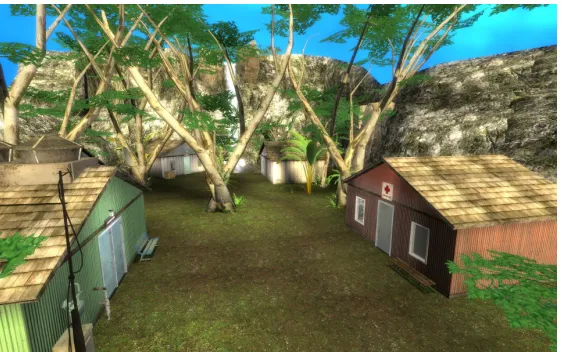
To illustrate the behavior of CRYSTAL ISLAND, consider the following situation. Suppose a student has been interacting with the virtual characters in the story world and learning about infectious diseases. In the course of having members of the research team become ill, she has learned that a pathogen is an agent that causes disease in its host and can be transmitted from one organism to another. As the student concludes her introduction to infectious diseases, she uncovers a clue while speaking with a sick patient that suggests the illness may be coming from food items the sick scientists recently ate. Some of the island’s characters are able to help identify food items and symptoms that are relevant to the scenario, while others are able to provide helpful microbiology information. The student discovers through a series of tests that a container of unpasteurized milk in the dining hall is contaminated with bacteria. By combining this information with her knowledge about the characters’ symptoms, the student deduces that the team is suffering from an E. coli outbreak. The student reports her findings back to the camp nurse, and they discuss a plan for treatment.
5 CORPUS COLLECTION
As part of an investigation of narrative-centered learning, a study was conducted with 450 eighth grade students from two North Carolina middle schools. Students interacted with the CRYSTAL ISLAND narrative-centered learning environment. After removing instances of incomplete data, the final corpus included data from 400 students. Of these, there were 194 male and 206 female participants. The average age of the students was 13.5 years (SD = 0.62). At the time of the study, the students had not yet completed the microbiology curriculum in their classes.
5.1 METHOD
Emotion Regulation Questionnaire [Gernefski & Kraati, 2006] which measures the extent to which each of nine common strategies are used by an individual. Students also completed a researcher-generated curriculum test to assess their domain content knowledge prior to interacting with CRYSTAL ISLAND.
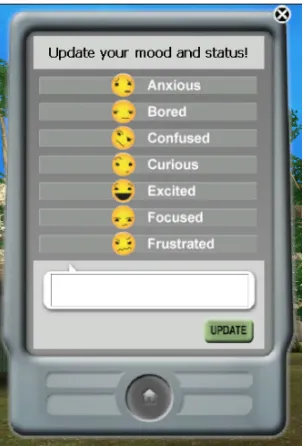
During the study, students interacted with CRYSTAL ISLAND for 55 minutes or until they completed the mystery. During their interaction they received an in-game prompt asking them to report on their emotional state at regular seven-minute intervals (Figure 2). This prompt was described to students as an “experimental social network” that was being pilot tested on CRYSTAL ISLAND. Students selected from one of seven emotional states: anxious, bored, confused, curious, excited, focused, and frustrated. They were also asked to type a short “status update.” There was no actual cross-student communication enabled by this interface.
Immediately after completing their interaction with CRYSTAL ISLAND, students were given a post-interaction curriculum test with questions identical to the pre-test. They also completed several questionnaires related to their interest and understanding of the CRYSTAL ISLAND mystery. These additional measures were not used in the current investigation.
5.2 IDENTIFYING OFF-TASK BEHAVIOR
CRYSTAL ISLAND provides an open environment, believable characters, and a mystery narrative. Some of the elements that populate the narrative world are primarily aesthetic, and they are not essential for completing the science problem-solving task. For this work, off-task behavior is defined as any activity in the environment that does not contribute toward completing the science mystery. These behaviors are distinguished by identifying non-essential locations in the virtual world and unproductive interactions with objects.
There are several locations that are tangential to the learning task, including a number of outdoor areas and a waterfall. Students are considered to be off-task if they spend an excessive amount of time (e.g., four minutes without entering a building) in any of these locations. We also consider the player character’s z-coordinate, or vertical position, in detecting off-task behavior. During the study researchers observed a common off-task behavior involving climbing trees and stacked crates in order to reach the roofs of buildings. Students are considered off-task if their z-coordinates exceed the maximum height that can be reached without climbing in the virtual environment. Non-critical objects in the virtual environment include cacti, crates, medicine bottles, buckets, and trash bins. No virtual characters refer to these objects at any point in the mystery. Any interaction with these objects is considered off-task. Additionally, if a student brings a task-related object (e.g., a contaminated egg) to an unassociated location (e.g., the living quarters) this is considered to be off-task as well.
6 EXPLORATORY ANALYSIS OF OFF-TASK BEHAVIOR AND EMOTION In order to assess student learning, paired t-tests were conducted. The tests compared student’s pretest (M = 6.6, SD = 2.3) and posttest (M = 8.6, SD = 3.4) scores, and they indicated that students’ learning gains from using CRYSTAL ISLAND were statistically significant, t(399) = 12.5, p < 0.0001. Based on the definition of off-task behavior described previously, the proportion of time that each student spent off-task was calculated. On average, students spent 5.1% (SD = 5.16) of their time engaged in off-task behavior, with a range of 0% to 63.2%.
An initial examination of off-task behavior was conducted using students from only the first school (N = 260). Results resembled findings reported from other investigations of off-task behavior in alternate intelligent tutoring systems [Baker et al., 2010]. Off-task behavior was found to negatively correlate with students’ normalized learning gains, r(258) = -0.18, p = 0.004. There was no evidence that low prior-knowledge students engaged in more off-task behavior, as the correlation between time off-task and pre-test score was not statistically significant, r(258) = -0.08, p = 0.21. This result contrasted with a previous investigation of off-task behavior using an earlier version of the CRYSTAL ISLAND learning environment [Rowe et al., 2009].
The results also highlighted evidence that off-task behavior may have a significant affective component. In particular, total time off-task was negatively correlated with curiosity r(258) = -0.12, p = 0.04 and frustration, r(258) = -0.13, p = 0.04. This result was surprising given prior work that demonstrated frustration as a trigger for off-task behavior [Baker et al., 2010]. The finding prompted an examination of whether off-task behavior helps alleviate frustration in the CRYSTAL ISLAND environment.
Equation 1.L-value calculation
To examine whether off-task behavior alleviates frustration or other negative learning emotions, we defined student states as follows: the current state is comprised of the student’s emotion self-report at time tn and whether or not the student went off-task between time tn and tn+1. The next state is comprised of the student’s emotion self-report at time tn+1. The likelihood of transitioning between these two states was calculated using the L statistic described above.
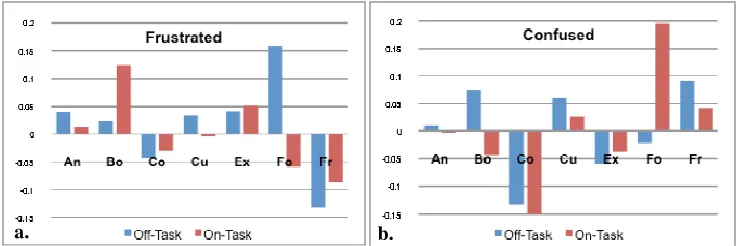
The analysis revealed that students who reported frustration at time tn and subsequently went off-task were most likely to report feeling focused seven minutes later at tn+1 (Figure 3a). These observations are consistent with a hypothesis that off-task behavior helps to alleviate frustration. The finding lends support to the premise that some students use off-task behavior as a way to productively cope with negative affect. A possible explanation for the finding is that students employ emotion self-regulation strategies by taking breaks from challenging tasks, exploring the virtual environment, and returning “refreshed” at later times to re-engage in problem-solving activities. Students who did not go off-task after reporting frustration did not appear to reap this same benefit. Frustrated students who stayed on-task were most likely to report boredom at the next self-report (Figure 3a). An emotion transition from frustration to boredom may indicate that a student has disengaged from problem solving altogether.
Fig. 3. Graph of transition likelihoods from (a) frustration and (b) confusion based on off-task behavior.
The hypothesis that students use off-task behavior as a productive strategy for regulating negative affect was not supported when examining affect transitions from the state of confusion (Figure 3b). Confused students who remained on-task were most likely to report focus at the next self-report, but confused students who went off-task were most likely to report boredom. An affect transition from confusion to boredom may signify a student reaching an impasse and giving up. These observations also suggest that students who persevered through confusion achieved positive affective benefits for doing so. A notable distinction between the frustration transitions and the confusion transitions is that frustration is generally considered harmful for learning, but confusion is considered productive for learning despite its negative valence [Baker et al., 2010].
These findings indicate that off-task behavior is not universally effective for self-regulating negative affect, but the findings also imply that some students may experience emotional benefits from off-task behavior under particular circumstances (e.g., when experiencing frustration). A promising direction for future investigation is exploring whether students’ individual differences impact the relationships between off-task behavior and emotion transitions. In a follow up investigation that compared students with above-median learning gains and below-median learning gains, the high-learning students tended to transition from frustration to focus after going off-task. On the other hand, students in the low-learning group were no more likely than chance to transition from frustration to focus whether they went off-task or remained on-task. While these findings were not statistically significant, the observations raise questions about whether students’ individual differences—in prior knowledge, problem-solving ability, personality, self-regulation ability—may affect whether an intelligent tutor should recommend that a student “take a break” from problem solving by going off-task in CRYSTAL ISLAND.
to generate hypothetical affective trajectories, or alternate futures, which play a central role in generating labels to annotate off-task behaviors. The labels identify whether each interval of off-task behavior is self-regulatory (i.e., increases emotional valence) or unproductive (i.e., decreases emotional valence or has no impact). During the third stage, supervised machine learning techniques are used to induce predictive models of emotion self-regulation using only features available in run-time settings. The resulting models can be used by an intelligent tutoring system to guide pedagogical decisions about intervening in students’ off-task behaviors.
7.1 BAYESIAN MODELING OF OFF-TASK BEHAVIOR AND AFFECT
Bayesian networks have been used to model several aspects of intelligent tutoring systems, including models of student learning [Baker, Corbett, & Aleven, 2008; Corbett & Anderson, 1994], affect [Sabourin et al., 2011b; Conati & Maclaren, 2009], and hinting [Gertner, Conati, & VanLehn, 1998]. Bayesian networks provide a concise graphical representation for reasoning under uncertainty as they explicitly encode relationships between random variables in terms of conditional probability distributions. Bayesian networks are comprised of two primary components: a network structure that encodes the variables and conditional independence relationships among them, and conditional probability distributions that concisely encode the joint probability distribution over all of the model’s variables. Network structures and conditional probability distributions can be machine learned using a variety of algorithms [Alpaydin, 2004], or they can be authored by hand.
7.2 CONSIDERING ALTERNATE FUTURES
Distinguishing between off-task behaviors that are unproductive and off-task behaviors that are self-regulatory poses notable challenges. In particular, a transition between two emotional states cannot be automatically attributed to the off-task behaviors that occur between emotion self-reports; a range of factors impact student emotions. However, if comparisons can be drawn between two sequences that differ only in their patterns of off-task behavior, changes in emotion self-reports can be attributed to the off-off-task behavior. In order to perform such a comparison, we use the dynamic Bayesian network from the procedure’s first stage to simulate students’ affective trajectories as if they had performed fewer off-task behaviors than in reality. This approach involves simulating alternate futures after each emotion self-report in order to determine whether off-task behavior directly impacted the student’s affect transition. In effect, the dynamic Bayesian network is used to generate virtual emotion data to conduct a simulated experiment.
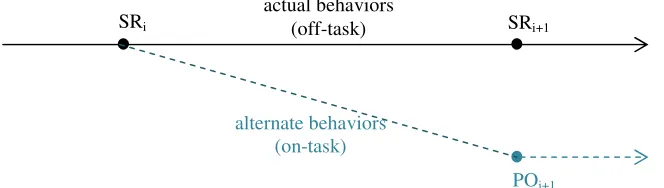
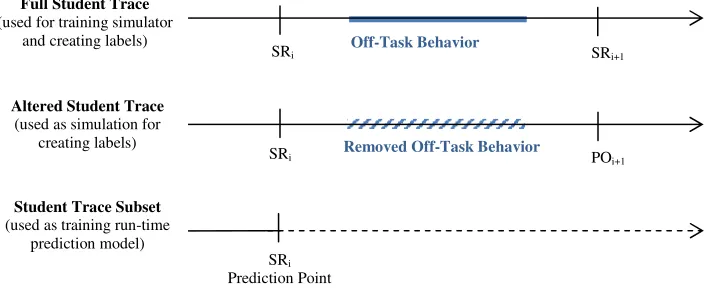
Consider the following example: a student is midway through interacting with CRYSTAL ISLAND. She reports confusion at one self-report (SRi) and at the next opportunity (SRi+1) she reports feeling focused. In the interval between SRi and SRi+1 she engaged in off-task behavior. With just this information, one cannot determine whether the off-task behavior caused the positive transition into a focused state. However, suppose that the student’s trace data is altered by removing all instances of off-task behavior that occurred between time SRi and SRi+1.The altered data is next provided to the dynamic Bayesian network from the procedure’s first stage. The DBN provides a prediction about what the student’s affective state might have been at the next time step (POi+1)if she had not gone off-task (Figure 4). If the model predicts a positive state such as focused or curious, one could conclude that the off-task behavior did not cause the positive change
SRi SRi+1
POi+1 actual behaviors
(off-task)
alternate behaviors (on-task)
in emotion. On the other hand, if the model predicts that the student would feel frustrated if she had not gone off-task, then one has obtained evidence that the off-task behavior brought about the positive affect transition. This latter observation identifies a possible case of emotion self-regulation, and a case where intervention by an intelligent tutor may be undesirable. This comparison can be used to label the interval’s off-task behavior as self-regulatory or unproductive depending on the outcome.
7.3 REAL-TIME PREDICTION
While consideration of alternate futures provides evidence about self-regulation of negative emotion, it is not a technique that can be used at run-time. The technique cannot be directly used at run-time because it involves comparisons of students’ emotional states after they have already gone off-task. An intelligent tutoring system requires models that can determine whether an off-task behavior will likely be a case of emotion self-regulation before the off-task behavior or self report occur. This type of predictive model provides the ability to decide whether to intervene or remain idle at the onset of off-task behavior.
In order to obtain such a model, we employ supervised machine learning techniques to predict labels generated during the procedure’s second stage. The learned model is restricted to using predictor features that can be calculated during run-time (Figure 5). This approach is similar to work on contextual guess and slip, which uses information from future practice opportunities to generate class labels for training runtime models
SRi
SRi+1
POi+1
SRi
Off-Task Behavior
Removed Off-Task Behavior
SRi
Prediction Point Full Student Trace
(used for training simulator and creating labels)
Altered Student Trace (used as simulation for
creating labels)
Student Trace Subset (used as training run-time
prediction model)
[Baker et al., 2008b]. A notable distinction with the current work is that contextual guess and slip models employ a Bayesian analysis procedure to generate data labels, whereas the current approach uses machine learned dynamic Bayesian networks and alternate future simulations to generate the data labels.
8 FINDINGS
The corpus described in Section 5 was used to examine the proposed procedure for modeling off-task behavior as emotion self-regulation. This section reports findings from empirical investigations of each of the three stages: (1) developing a dynamic Bayesian network to accurately predict students’ affective states, (2) generating possible alternate futures to distinguish cases of unproductive and self-regulatory off-task behavior, and (3) training models that predict whether off-task behaviors are self-regulatory or unproductive at run-time. We report significant findings for the first two stages, as well as preliminary results for the third stage. These findings underscore the potential of using alternate futures to investigate emotion self-regulation in intelligent tutoring systems.
8.1 PREDICTING STUDENT AFFECT
The CRYSTAL ISLAND corpus includes a total of 2,886 emotion self-reports from 400 students. Student reports spanned the full range of available emotion choices. Focused (23.1%) was the most frequently reported emotion. Following were reports of curiosity (19.1%), confusion (16.2%), frustration (15.7%), excitement (13.1%), boredom (8.4%) and anxiety (4.5%). Overall, emotions with positive valence (focused, curious, and excited) accounted for 55.3% of emotion self-reports.
The corpus was randomly split into two equal-sized data sets, DS1 and DS2. Equal numbers of students from each school were included in each data set. The first data set, DS1, was designated for training models and generating labels during the procedure. The second data set, DS2,was designated for validation and assessing the reliability of the generated self-regulation labels.
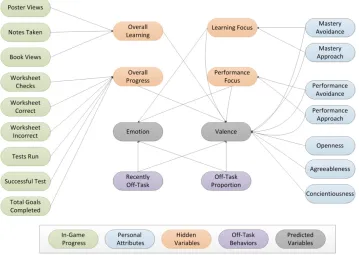
During the procedure’s first stage, a dynamic Bayesian network structure was handcrafted that included variables related to three main sources: student personal traits, in-game progress, and off-task behaviors.
measures of goal orientation: mastery avoidance, mastery approach, performance avoidance, and performance approach. Goal orientation describes how students approach learning tasks, and it has been shown to significantly impact student emotions during learning [Dweck & Leggett, 1988; Elliot & Pekrun, 2007]. Three personality features expected to have close relations to affective dispositions were also included: openness, agreeableness, and conscientiousness. In particular these traits relate to how individuals approach novel situations (e.g., learning tasks) and react to feedback (e.g., a student is told they have given an incorrect answer). The questionnaires were scored according to their individual scoring instructions. The resulting ordinal values were used to create an even ternary split of students on each attribute (Low, Medium, High). The resulting discretized labels were used to train the model.
• In-Game Progress. These attributes were calculated from students’ log data, and they summarized student actions in CRYSTAL ISLAND up until the time of particular emotion self-reports. The attributes characterized important actions taken, such as TestsRun, BooksViewed, and GoalsCompleted. They also included features quantifying student progress on problem-solving milestones, such as SuccessfulTest and WorksheetChecks. Most of these attributes were split into equal ternary groups (High, Medium, and Low) resulting in three discrete values for each variable. The TestsRun and WorksheetChecks attributes had four possible values: High, Medium, Low and Zero. The High, Medium, and Low values represented an even ternary split of students who performed the actions at least once, and the Zero value represented students who did not perform the action at all. The SuccessfulTest feature was binary, indicating whether a student performed a laboratory test that turned out positive.
In addition to observable states, each time slice of the dynamic Bayesian network included four hidden states. Two of these states represented summaries of student progress in CRYSTAL ISLAND in terms of learning progress and goal completion. The other two hidden states characterized students’ achievement goals during learning. The network’s structure was based on prior work examining Bayesian prediction of student affect [Sabourin et al., 2011b]. A single time slice from the network is shown in Figure 6. Temporal relationships were also added between temporally adjacent emotion and valence nodes. A high-level illustration of the dynamic Bayesian network depicts the temporal connections in Figure 7.
The dynamic Bayesian network was created using the GeNIe modeling environment developed by the Decision Systems Laboratory of the University of Pittsburgh (http://dsl.sis.pitt.edu). After hand-crafting the structure of the dynamic Bayesian network, the parameters were learned using the EM algorithm provided by GeNIe. The model was evaluated using 10-fold cross-validation. In this technique, a model’s parameters are trained using data from 90% of the student corpus. The predictive accuracy of the model is then evaluated on the remaining 10% of the corpus. This
approach is designed to provide an accurate measure of how well a trained model will extend to future, unseen populations. The evaluation of the DBN showed that it was able to predict emotion labels with 34.7% accuracy and emotional valence with 80.6% accuracy. This performance offers statistically significant (p < 0.001) improvement over the most-frequent baseline measures, which for DS1 are 22.8% for emotion and 54.4% for valence.
While the accuracy of emotion label prediction is significantly better than baseline, it is likely too low for practical use in guiding interventions. However, the 80.6% accuracy rate for valence prediction could be used in a tutorial setting. As a result, we decided to focus on emotion valence for the remainder of the investigation.
8.2 CONSIDERING ALTERNATE FUTURES
In order to distinguish between cases where students should be permitted to go off-task and cases where students should be discouraged from going off-task, we compared students’ actual affective outcomes (as indicated by self-report SRi) with predicted affective outcomes (POi). Predicted outcomes were based on alternate futures, which were hypothetical scenarios where students performed fewer off-task behaviors than they did in reality. The comparisons indicated whether off-task behaviors may have been
responsible for changes in student emotions. The comparison results were also proxies for modeling the consequences of intervening in unproductive off-task behavior.
When creating alternate futures for a student, only off-task behaviors occurring between the affective state being predicted (SRi+1) and the previous self-report (SRi) are modified. The procedure assumes that an “optimal” tutorial intervention delivered during this interval would reduce or eliminate off-task behavior; the data is altered accordingly. Since reductions in off-task behavior can fall into several possible levels, we consider multiple possible futures for each student.
The two features that represent off-task behavior are discrete. One binary feature measures whether or not the student went off task since the last self report. The other feature has five possible values representing the discretized proportion of time spent off task. When reducing or eliminating the amount of off-task behavior in a student’s data, we consider every possible reduction in off-task behavior level. For example, if a student spends a large amount of time off-task and has a value in the fourth bucket for proportion off-task, we simulate scenarios where her off-task behavior is reduced to the third, second, and first buckets. The binary feature is correspondingly adjusted to account for possible elimination of off-task behavior.
The modified data is input to the dynamic Bayesian network to generate a predicted affective valence for the student’s next emotion self report. The predicted emotional valence is then compared with the actual emotional valence. If the predicted valence is lower than the actual valence, the transition (and associated off-task behavior) reflects evidence of self-regulation. This represents a case where intervening in off-task behavior may actually do more harm than good. If the predicted valence is higher or equal to the actual valence, the off-task behavior is considered unproductive from an affective standpoint.
If the second model’s labels, which were generated using a separate corpus than the first model, were highly similar to those produced by the first model, then we consider the emotion self-regulation labels to be reliable. This validation process seeks to avoid biased labels that are closely related to the particular corpus and model used to generate them. When the two sets of labels were compared, the models agreed 88.2% of the time, with a kappa value of .64. This represents a reasonable level of reliability, suggesting that the labels appear to reflect a real phenomenon: off-task behavior as emotion self-regulation.
8.3 PREDICTING SELF-REGULATION LABELS
In order to train models for predicting the labels at run-time, off-the-shelf supervised machine learning techniques were employed. Supervised learning techniques require a single set of “gold standard” labels that classify each observation. In order to generate one set of labels, the predictions from the two models were consolidated. In nearly all cases there was agreement between the two models and possible futures. In cases where the two models or possible futures did not agree, the most frequent label was selected. In the very small minority (<1%) of cases where neither label occurred more frequently, we labeled the off-task behavior interval as unproductive. This choice was a conservative approach motivated by the observation that off-task behavior is generally associated with decreased learning. On this basis, it is likely preferable to err on the side of intervention in cases of uncertainty. After consolidating the labels, 19.5% of off-task behavior cases were labeled as self-regulatory.
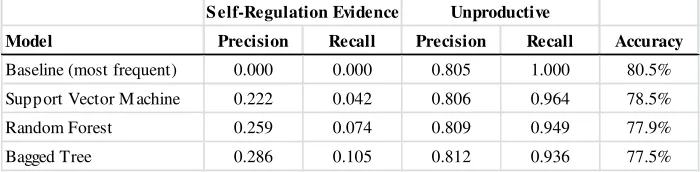
maintaining a high recall of the unproductive class. The accuracy, precision and recall of each trained model are shown in Table 1. The models were compared to a baseline model that predicted the most frequent label: unproductive off-task behavior.
While several models offered improvements in precision for recognizing self-regulation, none of the models achieved greater overall accuracy than the baseline model. Among the trained models, support vector machines achieved the greatest accuracy, and all three techniques observed improvements in precision at detecting self-regulation. While these findings do demonstrate that supervised learning techniques can achieve modest improvements in precision with small reductions in recall, considerable room for improvement remains. Several directions exist for improving the performance of these predictive models to a level that could be used in an intelligent tutoring system. A natural next step includes considering a broader pool of predictor features when training the classifiers. In particular, students’ log data is amenable to producing a diverse range of metrics that characterize students’ problem solving behaviors in the CRYSTAL ISLAND environment. While the current set of features have proven effective for predicting emotional valence in dynamic Bayesian networks, alternate features may need to be considered to obtain accurate predictive models for the procedure’s third stage. The current investigation also did not explore automated techniques for feature selection, which offer potential to narrow down the most promising predictors from a pool of candidates. Ensemble learning techniques are another promising approach, as they combine the predictive strengths of multiple models.
9 DISCUSSION
Results from investigating the first two stages of the procedure for modeling off-task behavior as emotion self-regulation are especially encouraging. Theoretically grounded Table 1. Trained classifiers and performance metrics, ordered by recall on no-evidence
class
Model Precision Recall Precision Recall Accuracy
Baseline (most frequent) 0.000 0.000 0.805 1.000 80.5%
Supp ort Vector M achine 0.222 0.042 0.806 0.964 78.5%
Random Forest 0.259 0.074 0.809 0.949 77.9%
Bagged Tree 0.286 0.105 0.812 0.936 77.5%
dynamic Bayesian networks predicted students’ emotional valence in CRYSTAL ISLAND with high levels of accuracy. Furthermore, the proposed method for obtaining emotion self-regulation labels based on alternate futures produced reliable results. These findings support the promise of empirical approaches for identifying off-task behaviors that are cases of emotion self-regulation. A preliminary analysis of the procedure’s third stage yielded modest results, but several directions for continued investigation remain. The analysis did reveal that improvements in identifying self-regulatory off-task behavior can be obtained with small reductions in recall of unproductive off-task behavior. In addition to explorations of additional classification techniques and predictor features, other evaluation metrics may be considered to identify models with acceptable trade-offs. Potential directions for future work include selecting models based on different evaluation metrics, as well as incorporating the models into run-time systems in order to assess resulting student outcomes in the learning environment. As these models improve, it will become increasingly important to identify what level of predictive accuracy and recall is necessary to satisfy the pedagogical requirements of runtime systems; the current predictive accuracies are too low for operational tutoring systems, as they underperform a majority class baseline. Furthermore, it remains to be seen which predictive performance metrics should be optimized in order to yield affect-sensitive intelligent tutors with the strongest positive impact on student learning.
In this work, we have operated under the assumption that off-task behavior is generally unproductive for learning, and it should be discouraged unless strong evidence exists to the contrary. However, it is possible that tutorial interventions may be harmful in settings like narrative-centered learning environments because they interrupt typical gameplay sequences and student flow. Consideration of alternate off-task behavior intervention strategies may help to guide further development in this area.
10 CONCLUSION
This work examined the relationships between student affect and off-task behavior in narrative-centered learning environments. We reported empirical results that suggest off-task behavior is associated with positive affect transitions from the emotional state of frustration, but the opposite is true for off-task behavior occurring after self-reported confusion. The findings suggested that off-task behavior may be an effective emotion self-regulation strategy under some circumstances. However, an aggregate association between off-task behavior and decreased learning implied that principled approaches for distinguishing between unproductive off-task behavior and self-regulatory off-task behavior are needed.
We proposed a novel supervised machine learning procedure for classifying off-task behaviors that are cases of emotion self-regulation. During the first stage, dynamic Bayesian networks are trained to predict student emotion self-reports from trace data. We found that a theoretically grounded DBN was capable of predicting emotional valence with high accuracy, and it predicted emotional states at levels significantly better than a baseline approach.
The DBN was used to generate alternate futures that simulated students’ affective trajectories as if they had performed fewer off-task behaviors than in reality. The alternate futures were compared to students’ actual affective trajectories in order to generate labels indicating whether off-task behaviors were cases of emotion self-regulation. In a validation process involving a second DBN trained from a distinct data set, the labels were found to be highly reliable. The two DBN models produced labels with high levels of agreement between one another. During the procedure’s third stage, off-the-shelf classification models were trained to predict the labels using features that would be available in run-time settings. Support vector machines, bagged trees, and random forests achieved a promising balance between precision in detecting self-regulatory off-task behavior and recall in detecting unproductive off-task behavior, but considerable room for improvement remained. The overall findings underscore the methodological potential of using empirically generated alternate futures for analyzing students’ emotion self-regulation processes.
self-regulation labels. If significant improvements in predictive accuracy can be obtained, we intend to incorporate the models into the CRYSTAL ISLAND learning environment in order to assess their ability to guide interventions for off-task behavior, shape students’ affective states, and yield improved student learning outcomes.
ACKNOWLEDGEMENTS
REFERENCES
ALEVEN, V., MCLAREN, B.M., ROLL, I., and KOEDINGER, K.R. 2006. Toward meta-cognitive tutoring: A model of help-seeking with a cognitive tutor. Internaitonal Journal of Artificial Intelligence in Education, 16, 101-128.
ALPAYDIN, E. 2004. Introduction to Machine Learning, MIT Press.
ARROYO, I., FERGUSON, K., JOHNS, J., DRAGON, T., MEHERANIAN, H., FISHER, D., BARTO, A., MAHADEVAN, S., and WOOLF, B.P. 2007. Repairing disengagement with non-invasive interventions. Proceedings of the 13th International Conference on Artificial Intelligence in Education, 195-202.
BAKER, R.S. 2007. Modeling and understanding students’ off-task behavior in intelligent tutoring systems, Proceedings of the SIGCHI Conference on Human Factors in Computing Systems, 1059-1068.
BAKER, R.S., CORBETT, A.T., and ALEVEN, V. 2008. More accurate student modeling through contextual estimation of slip and guess probabilities in Bayesian knowledge tracing. Proceedings of the Ninth International Conference on Intelligent Tutoring Systems, 406-415.
BAKER, R.S., CORBETT, K.R., KOEDINGER, K.R., EVENSON, S., ROLL, I., WAGNER, A., NAIM, M., ... BECK, J. 2006. Adapting to when students game an intelligent tutoring system, Proceedings of the 8th International Conference on Intelligent Tutoring Systems, 392-401.
BAKER, R.S., CORBETT, A.T., KOEDINGER, K.R., and WAGNER, A. 2004. Off-task behavior in the cognitive tutor classroom: When students game the system. Proceedings of the SIGCHI Conference on Human Factors in Computing Systems, 383-390.
BAKER, R.S., CORBETT, A.T., ROLL, I., and KOEDINGER, K.R. 2008. Developing a generalizable detector of when students game the system. User Modeling and User-Adapted Interaction, 18, 287-314.
BAKER, R.S., D’MELLO, S.K., RODRIGO, S.K., and GRAESSER, A.C. 2010. Better to be frustrated than bored: The incidence, persistence, and impact of learners’ cognitive-affective states during interactions with three different computer-based learning
environments. International Journal of Human-Computer Studies, 68, 223-241.
BAKER, R.S., MOORE, G., WAGNER, A., KALKA, J., SALVI, A., KARABINOS, M., ASHE, C., and YARON, D. 2011. The dynamics between student affect and behavior occurring outside of educational software. Proceedings of the 4th International Conference on Affective Computing and Intelligent Interaction, 14-24.
BEAL, C.R., MITRA, S., and COHEN, P.R. 2007. Modeling learning patterns of students with a tutoring system using Hidden Markov Models. In Proceedings of the 13th International Conference of Artificial Intelligence in Education, 238-245.
BEAL, C.R., QU, L., and LEE, H. 2006. Classifying learner engagement through integration of multiple data sources. Proceedings of the National Conference on Artificial Intelligence, 2-8.
BLOOM, B.S. 1984. The 2 sigma problem: The search for methods of group instruction as effective as one-to-one tutoring. Educational Researcher, 13, 4-16.
BRUNER, J.S., 1990. Acts of Meaning, Cambridge, MA: Harvard University Press. BUNT, A. and CONATI, C. 2003. Probabilistic student modeling to improve exploratory behavior. User Modeling and User-Adapted Interaction, 13, 269-309.
COCEA, M., HERSHKOVITZ, A., and BAKER, R.S. 2009. The impact of off-task and gaming behaviors on learning: Immediate or aggregate. Proceedings of the 14th
International Conference on Artificial Intelligence in Education, 507-514. CONATI, C. and MACLAREN, H. 2009. Empirically building and evaluating a
probabilistic model of user affect. User Modeling and User-Adapted Interaction, 19, 267-303.
CORBETT, A.T. AND ANDERSON, J.R. 1994. Knowledge tracing: Modeling the Acquisition of Procedural Knowledge. User Modeling and User-Adapted Interaction, 4, 253-278.
D’MELLO, S., TAYLOR, R.S., and GRAESSER, A.C. 2007. Monitoring affective trajectories during complex learning. Proceedings of the 29th Annual Meeting of the Cognitive Science Society, 203-208.
DWECK, C.S. and LEGGET, E.L. A social-cognitive approach to motivation and personality. Psychological Review, 95, 256-273.
ELLIOT, A. and MCGREGOR, H.A. 2001. A 2 x 2 achievement goal framework, Journal of Personality and Social Psychology, 80, 501-519.
ELLIOT, A. and PEKRUN, R. 2007. Emotion in the hierarchical model of approach-avoidance achievement motivation. Emotion in Education, P. SCHUTZ and R. PEKRUN, eds., London: Elsevier, 57-74.
GERNEFSKI, N. and KRAATI, V. 2006. Cognitive Emotion Regulation Questionaire: Development of a short 18-item version. Personality and Individual Differences, 41, 1045-1053.
GERTNER, A., CONATI, C., and VANLEHN, K. 1998. Procedural help in Andes: Generating hints using a Bayesian network student model. Proceedings of the 15th National Conference on Artificial Intelligence.
GONG, Y., BECK, J., HEFFERNAN, N., and FORBES-SUMMERS, E. 2010. The fine-grained impact of gaming on learning. Proceedings of the 10th International Conference on Intelligent Tutoring Systems, 194-203.
GRAESSER, A.C., PERSON, N.K., MAGLIANO, J.P. Collaborative dialogue patterns in naturalistic one-to-one tutoring, Applied Cognitive Psychology, 9, 495-522.
HARP, S. and MAYER, R.E. 1998. How seductive details do their damage: Atheory of cognitive interest in science learning. Journal of Educational Psychology, 90, 414-434. HALL, M., FRANK, E., HOLMES, G., PFAHRINGER, B., REUTEMANN, P., and WITTEN, I. The WEKA data minig software: An update. SIGKDD Explorations, 11, 2009.
HICKEY, D.T., INGRAM-GOBLE, A.A., and JAMESON, E.M. 2009. Designing assessments and assessing designs in virtual educational environments. Journal of Science Education and Technology, 18, 187-208.
KETELHUT, D.J. The impact of student self-efficacy on scientific inquiry skills: An exploratory investigation in River City, a multi-user virtual environment. Journal of Science Education and Technology, 6, 99-111.
MANDLER, J. and JOHNSON, N. 1988. Remeberance of things parsed: Story structure and recall. Journal of Cognitive Psychology, 9, 111-151.
MARSELLA, S.C., JOHNSON, W.L., and LABORE, C.M. 2000. Interactive
pedagogical drama. Proceedings of the 5th International Conference on Intelligent Virtual Agents, 305-315.
MEYER, D. and TURNER, J. 2006. Reconceptualizing emotion and motivation to learn in classroom contexts, Educational Psychology Review, 18, 377-390.
MULDNER, K., BURLESON, B., VAN DE SAND, B., and VANLEHN, K. 2010. An analysis of gaming behaviors in an intelligent tutoring system. Proceedings of the 10th International Conference on Intelligent Tutoring Systems, 184-193.
MURRAY, R.C. and VANLEHN, K. Effects of dissuading unnecessary help requests while providing proactive help, Proceedings of the 12th International Conference on Artificial Intelligence in Education, 887-889.
O’NEILL, B. and RIEDL, M.O. 2011. Toward a computational framework of suspense and dramatic arc. Proceedings of the 4th International Conference on Affective Computing and Intelligent Interaction, 256-263.
RODRIGO, M., BAKER, R.S., LAGUD, M., LIM, S., MACAPANPAN, A., PASCUA, S., SANTILLANO, J., ...VIEHLAND, N. Affect and usage choices in simulation problem-solving environments, Proceedings of the 13th International Conference on Artificial Intelligence in Education, 145-152.
ROWE, J.P., MCQUIGGAN, S.W., ROBISON, J.L., and LESTER, J.C. 2009. Off-task behavior in narrative-centered learning environments. Proceedings of the 14th
International Conference on Artificial Intelligence and Education, 99-106. ROWE, J.P., SHORES, L.R., MOTT, B.W., and LESTER, J.C. 2011. Integrating learning, problem solving, and engagement in narrative-centered learning environments, International Journal of Artificial Intelligence in Education, 21, 115-133.
SABOURIN, J.L., MOTT, B.W., and LESTER, J.C. 2011. Modeling learner affect with theoretically grounded dynamic Bayesian networks. Proceedings of the 4th International Conference on Affective Computing and Intelligent Interaction, 286-295.
SABOURIN, J.L., ROWE, J.P., MOTT, B.W., and LESTER, J.C. 2011. When off-task in on-task: The affective role of off-task behavior in narrative-centered learning
environments. Proceedings of the 15th International Conference on Artificial Intelligence and Education, 534-536.
VANLEHN, K. 2011. The relative effectiveness of human tutoring, intelligent tutoring systems, and other tutoring systems. Educational Psychologist, 46, 197-221.