Journal of Computing and Security
A Novel Block Cipher Algorithm with Feistel-Like Structure
Mahmood Deypir
a,∗, Yosef Pourebrahim
baShahid Sattari University of Science & Technology, Tehran, Iran. bIslamic Azad University, Meshkin Shahr Branch, Meshkin Shahr, Iran.
A R T I C L E I N F O.
Article history:
Received:20 September 2015
Revised:09 April 2016
Accepted:03 October 2016
Published Online:25 January 2017
Keywords:
Cryptography, Cryptanalysis, Practical Security, Provable Security, Cipher Algorithm.
A B S T R A C T
Block ciphers have wide applications for hardware and software implementations. In this paper, a new block cipher algorithm with provable security is proposed. The whole structure of the algorithm is novel and has a good encryption and decryption performance. Additionally, it has good security with few number of rounds. The structure of the proposed algorithm consists of 4-rounds Feistel-Like which uses 3-rounds Feistel type functions. Moreover, a new method for MDS (Maximal Distance Separable) Matrix construction is proposed and used in the round function as a linear layer. Furthermore, some considerations in S-Boxes of the algorithm lead to obtaining better algebraic expression than AES S-boxes. The Algorithm has a high margin of security against various cryptanalysis methods due to using specific functions in its round functions. Our theoretical evaluations show that the devised cipher algorithm has provable security against attacks based on linear and differential cryptanalysis and it is robust against differential, truncated differential, boomerang, and integral cryptanalysis in terms of practical security.
c
2016 JComSec. All rights reserved.
1
Introduction
Block cipher algorithms are used in a large number of secure communication systems for several different purposes including confidentiality, message integrity, pseudo-random generation, etc. In cryptography, a block cipher is a deterministic algorithm working on fixed-length groups of bits, named blocks, with an unvarying transformation which is specified by a sym-metric key. Block ciphers are important components in the design of many cryptographic protocols and are widely exploited to implement the encryption of bulk data. Recently, lightweight block cipher algorithms have attracted a great deal of interest due to their application in hardware and software systems. LED ∗ Corresponding author.
Email addresses:[email protected](M. Deypir),
[email protected](Y. Pourebrahim)
ISSN: 2322-4460 c2016 JComSec. All rights reserved.
[1], Speck, and Simon [2] are examples of block cipher algorithms. A Goal behind designing such algorithms is a hardware or software implementation with low energy consumption. Therefore, these algorithms can be embedded in devices like a sensor network and an RFID [1].
differential attack [4] and linear attack [5] are known as the best attacks for analyzing these types of algo-rithms. Therefore, the necessity of designing robust block based algorithms against these attacks is re-vealed. Since the introduction of differential and linear cryptanalysis, a great deal of effort has been made for designing robust block based algorithms against these cryptanalysis. In this way, one of the key points is prov-able security against these attacks. In order to prove the security of a block cipher structure against these attacks, an upper bound for most attacks of these types must be determined. In this paper, a new cipher algorithm is proposed which is suitable for software implementation and is robust against the well-known attacks. Moreover, it has provable security against differential and linear cryptanalysis.
The organization of this paper is as follows. In the next section, some related works are reviewed. In Section 3, the structure of the proposed cipher algorithm is introduced. In Section 4, the security of the algorithm is analyzed. Subsequently, statistical analysis is presented in Section 5. Finally, Section 6 concludes the paper.
2
Related Works
There are a large number of researches regarding the design and analysis of block ciphers in the last three decades which led to a significant progress. An exam-ple of a lightweight cryptographic algorithm proposed in the literature is KLEIN [6]. This algorithm has some potential weaknesses since it does not present provable security [7]. In most cases, the security of block based algorithms is evaluated by analyzing their resistance against well-known attacks. Designing block ciphers with provable and practical security against popular attacks such as differential and linear cryptanalysis is an interesting research area due to the importance of security in critical systems. The first sample of a block cipher having provable security against differential and linear cryptanalysis has been proposed by Nyberg et al. [8, 9]. Matsui introduced an approach for design-ing block ciphers with provable security against the above-mentioned attacks [10]. This approach that was based on principles presented in [8, 9], reduced the size of substitution box by using an iterative structure for the round function. Thereafter, this approach was used in some block ciphers [11, 12]. In 1997, a group of Japanese researchers discussed the provable security against differential and linear cryptanalysis of gener-alized Feistel ciphers with multiple functions [13]. In 2000, a group of Korean cryptography researchers, il-lustrated provable security against differential and lin-ear cryptanalysis for a structure substitution and per-mutation graph [14]. As an example of a newer
struc-ture of block cipher having provable security against the above types of attacks, the pseudo RC6 structure introduced in 2006 can be mentioned [15]. There are other researches regarding cryptanalysis and provable security in the literature [16, 17] in which security is the most important thing.
In [16] seven new block cipher structures, including Feistel-variant structure, were introduced and evalu-ated. It was shown that these structures have prov-able security against differential cryptanalysis attack and upper bounds for average differential probabilities over at least 5 rounds were obtained. Moreover, under the assumption that all of the used components are bi-jective, these structures are provably resistant against linear cryptanalysis. Upper bounds for maximum dif-ferential and linear probabilities of an SMS4-like block cipher in order to evaluate practical security against differential and linear cryptanalysis were investigated in [18]. This block cipher which employs a special kind of unbalanced Feistel structure has been accepted as the Chinese National Standard for securing Wireless
Local Area Networks. Classification, security, and effi-ciency of Generalized Feistel Networks (GFNs) were investigated in [19]. Generally, any combination of several keyed non-linear functions using XOR opera-tions and permutaopera-tions in an invertible manner can be named GFN. More precisely, such a combination of functions can be regarded as a GFN only when the rounds are connected by a rotation of one line instead of a generic line permutation. Simpira [20] has been proposed as a Generalized Feistel Structure (GFS) with an F-function that contains two rounds of AES. The analysis performed by designers of this structure is based on two basic bounds including full bit diffu-sion, and a minimum number of active S-boxes. The number of rounds for each variant was selected as three times the number of rounds required to prove full bit diffusion and a minimum number of 25 (differentially or linearly) active S-boxes. In SAC 2013 Berger et al. [21] devised a unified variation of GFNs based on a matrix representation and used it to further study the diffusion properties of GFNs. They also extended this matrix representation and introduced a broader class of Feistel networks called Extended Generalized Feistel Networks (EGFNs). Differential cryptanalysis of this structure was investigated in [22].
3
The Proposed Cipher Algorithm
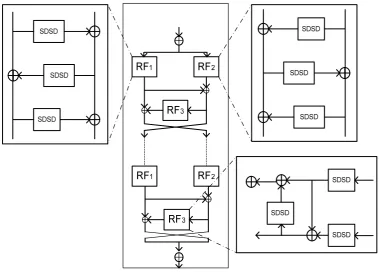
Figure 1. The Proposed Cipher Algorithm
and exploited in the structure. Although it is similar to the Feistel structure, our approach to employ the structure and its round functions are designed so that cryptanalysis can be performed using various types of cryptanalysis attacks. Therefore, the block cipher algorithm introduced in this paper is a Feistel-like al-gorithm and it benefits from some advantages of the SPN structure. In this algorithm, the block size and the key sizes are 128 bits and 256 bits, respectively. The algorithm has a completely straightforward imple-mentation since it is implemented based on selection table. On the other hand, it has a smaller number of loops with respect to other algorithms. Therefore, the algorithm is semi-lightweight and thus, it is more suit-able for software applications but it is not an ideal choice for hardware implementation since providing provable security requires considerable hardware re-sources. The structures of encryption and decryption of the algorithm are described in the following sections. 3.1 The Cipher Structure
The encryption block diagram is partly shown in Fig-ure 1. This figFig-ure shows two rounds of the algorithm. This figure illustrates how SDSD (Substitution Diffu-sion Substitution DiffuDiffu-sion) functions are exploited in the first, second, and third round functions (RFs). The size of the input block is 128 bits which is organized as four 32-bit words denoted bym[i], i= 0,1,2,3 where
m[0] is the most significant word (32 bits of the
left-Figure 2. SDSD Round function
hand side of the 128-bit block). For encryption, the input text is added to 128-bit key in modulo 2.
The number of rounds is equal to 4 and each round has three functions namelyRFi, i= 1,2,3. The round
functions (RFs) are Feistel with three rounds using SDSD (Substitution Diffusion Substitution Diffusion) function. The structure of round function is depicted in Figure 2.
composed of three RFi functions, there are bits of
subkeys in each round.
3.2 SDSD Round Function
The input for SDSD function is 32 bits of text and 64 bits of round subkey. The input is fed into four S-boxes, in 4-byte format. The output is entered into the diffusion layer after performing XOR operation with the least significant 32 bits of the subkey of the round. The diffusion layer is a MDS (Maximal Distance Separable) matrix. The output of this layer is entered into 4 S-boxes in the form of 4 separate bytes after performing XOR operation with 32 most significant bits of the round subkey. Subsequently, the result is moved again through the diffusion layer and produces 32 bits of output.
4
The Principles of the Algorithm
The overall structure of the proposed algorithm is designed to provide provable security against linear and differential cryptanalysis. Moreover, it must be se-cure against the other attacks like the boomerang and the integral attacks. Furthermore, it must be suitable for software implementation and can be embedded in other systems.
4.1 Round Function
To prove the upper bound for differential probability and linear mask, it is required to determine the dif-ferential and linear probability of the round function. Therefore, in the proposed algorithm, a three-round simple Feistel is used whose provable linear and dif-ferential probability can be expressed.
4.2 SDSD Function
To reduce the differential and linear probabilities of the structure, the differential and linear probabilities of RFi functions must be as small as possible. For
this purpose, an SDS (Substitution Diffusion Sub-stitution) structure can be used. The advantage of this structure is its provable linear and differential security. In this structure, the linear and differential probabilities are the least, especially when appropri-ate substitution functions and diffusion layers with the highest branching factor are used. However, SDS structure does not have suitable software implemen-tation. Therefore, here, the SDSD structure is used in which each SD function is implemented as a lookup table. For an implementation based on a lookup ta-ble, the SDSD requires smaller memory rather than the SDS structure. In fact, the SDSD can be imple-mented using one lookup table but the SDS requires
two lookup tables,i.e., one for SD and the another one for S. Moreover, using the SDSD structure in the proposed cipher leads to achieving acceptable secu-rity (at least in terms of linear and differential) in a smaller number of rounds. Therefore, it has better resistance against cryptanalysis with respect to the SDS structure.
4.3 The Linear Layer and the Round Func-tion
Provable high security for the SDS based structure is achieved when it uses an MDS-type linear layer in the SDS round function. Therefore, in this algorithm, regarding the implementation consideration and the above-mentioned reason, a novel method for construct-ing MDS matrices is proposed and used. In this pro-posed approach, for creating ann×nmatrix, firstly, a closed set underXORoperation with distinct mem-bers is produced. For example, ifn = 4, this set is equal to{0, α, β, α⊕β}in whichα, βare distinct non-zero members. Subsequently, each of{x0, . . . , xn−1}
is assigned to one member of the above set and the value of ∆ is computed so that it does not belong to the set ofxi . Finally, the values of yi =xi⊕∆
are computed andB = (bij) matrix is produced so
thatbij = λ(x1
i+yi) . In this matrix, λhas two
pos-sible values according to existing circumstances. For the self-inverse matrix, we chooseλ=⊕n−k=011
yk ,
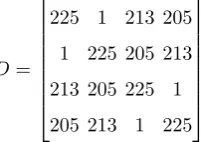
oth-erwise, we chooseλ= 1 . Since the structure of the algorithm is Feistel-Like, the self-inverse matrix is not required. According to this approach, a large number of MDS matrices can be produced. An example with initial polynomial ofx8+x4+x2+ 1 is as follows:
D=
225 1 213 205 1 225 205 213 213 205 225 1 205 213 1 225
(1)
For implementing SD function in a table format, 4 kilobytes of memory is required for storing two S-boxes. Compared to AES, the above MDS matrix has a higher cost. In fact, AES is faster in encryption step because its elements have smaller hamming weights. However, for decryption, it is slower compared to encryption step since the used inverse matrix has elements containing larger hamming weights. Here, the aim is to use new elements in the proposed cipher and to propose a self-inverse matrix construction process.
4.4 Substitution Box
integral, etc., as well as providing provable security, two new substitution functions are used in the SDSD round function. S-boxes of the algorithm are similar to those in the AES algorithm. However, using the proposed approach described in the paper, the number of terms is much larger than those in AES. Therefore, the devised algorithm becomes more robust against algebraic attacks. Mathematical relations between input and output of S-boxes are according to the following equations:
Sbox1(x) =[A×((x+ 128)⊕99)−1]⊕59 (2)
Sbox2(x) =[B×(((B×x) + 192)⊕74)−1]⊕135 (3) In these equations the Boolean functions A and B are defined as follows:
A=
1 1 0 0 0 0 0 0 0 1 1 0 0 0 0 0 0 0 1 1 0 0 0 0 0 0 0 1 1 0 0 0 0 0 0 0 1 1 0 0 0 0 0 0 0 1 1 0 0 0 0 0 0 0 1 1 0 0 0 0 0 0 0 1 B =
0 1 1 1 1 1 1 0 1 0 1 1 0 1 1 1 1 1 0 1 1 0 1 1 1 1 1 0 1 1 0 1 1 1 0 1 1 1 0 0 1 1 1 0 0 1 1 0 0 1 1 1 0 0 1 1 1 0 1 1 1 0 0 1 (4) The S-box1 and S-box2 are selected with the follow-ing properties. 1) They don’t have fixed and reversed points. 2) They have at least 112 non-linearity de-grees. 3) They have at most 4 differential values in the approximate differential matrix. 4) Their biases in linear approximation are at most 16. 5) They have the maximum number (255 terms) of coefficients in the algebraic expression (the AES S-boxes have 9 terms [23]). 6) Their maximum algebraic degree is equal to 7. 4.5 Subkey Generation Algorithm
The number of subkeys used in the algorithm is large. Therefore, using ordinary subkey generation of block based ciphers is not affordable regarding security and run-time factors and can lead to having a correlation among the keys.
One of the approaches to avoid correlation among generated subkeys is using the well-known secure stream ciphers to produce the subkeys. This approach has some advantages including rapid subkey ation while all bits of the main key affect all gener-ated subkeys. Therefore, in the proposed algorithm, SNOW3G stream cipher algorithm is used to design the subkey generation method. The SNOW3G is based
on SNOW2 and is widely analyzed from a security per-spective and it has not any known security breach [24– 26].
4.6 Implementation Issues
Since each SD function has a 32-bit input, for its implementation, the input is considered asa4a3a2a1
in whicha1anda2are the least significant and the
most significant eight bits of the input, respectively. The input must firstly pass through the S-boxes. The obtained result can be represented as:
S2(a4)S1(a3)S2(a2)S1(a1) (5)
The resulting 32 bits then pass through MDS ma-trix. For this purpose, a multiplication in Galois field
GF(28) must be carried out as:
x4 x3 x2 x1
=hS2(a4) S1(a3) S2(a2) S1(a1)
i •
A B C D
B C D A
C D A B
D A B C
(6) The resulting values can be formulated as:
x4 =S2(a4)•A⊕S1(a3)•B⊕S2(a2)•C⊕S1(a1)•D
x3 =S2(a4)•B⊕S1(a3)•C⊕S2(a2)•D⊕S1(a1)•A
x2 =S2(a4)•C⊕S1(a3)•D⊕S2(a2)•A⊕S1(a1)•B
x2 =S2(a4)•D⊕S1(a3)•A⊕S2(a2)•B⊕S1(a1)•C
It is obvious that for obtaining the output of SD function, four lookup operations on the lookup table, 12 XORs, and 16 multiplications in Galois field are required which lead to a heavy computation. In order to enhance the implementation for faster computation, four lookup tables can be constructed using S-boxes, each of which contains 256 units of 32-bit elements as:
L4 =S2•A|S2•B|S2•C|S2•D
L3 =S1•B|S1•C|S1•D|S1•A
L2 =S2•C|S2•D|S2•A|S2•B
L1 =S1•D|S1•A|S1•B|S1•C
In the above equations, “|” symbol is used for better representation and separation of bytes. Using these lookup tables, the output of each SD function is ob-tained as:
X=x4x3x2x1 =L4(a4)⊕L3(a3)⊕L2(a2)⊕L1(a1)
5
Practical
and
Provable
Security
against Well-known Cryptanalysis
Supposewh(a) as hamming weight of “a” which shows
the number of non-zero elements. Elements can be bits or components fromGF(2m). Therefore branch number is defined according to Equation (8) [14]:
β(D) = min
a6=0(wh(a) +wh(D(a))) (8)
In this equationβshows a measurement of the worst case of diffusion. Since a cryptanalysis searches to find the worst states, the branching factor is a suitable measure for diffusion characteristic. In equation 5, if ‘a’ shows the input difference as a linear layer, then the output difference is in the form of ‘D(a)’. Therefore, the branching factorβdis the least number of active
S-boxes in the form of differential in two rounds of SPN. Similarly,β1is the least number of active S-boxes in
two rounds. A differentially active S-box is defined as an S-box given a non-zero input difference. On the other hand, a linearly active S-box is an S-box given a non-zero output mask value [27].
Diffusion layer matrix used in the algorithm is MDS (Maximum Distance Separable) type since it has not any square sub-matrix with zero determinants. The above discussions can be summarized using the fol-lowing theorems. The results of these theorems are used for various cryptanalysis of the algorithm. Theorem 1. For eachn×nMDS matrix, linear and differential branching factor is equal ton+ 1[14]. This theorem states that, if MDS matrices are used as a linear layer in the SPN structure, the number of active S-boxes will be maximized.
Theorem 2. ifβd andβl are the numbers of active
S-boxes in two rounds of SPN (one round SDS), in the forms of differential and linear, respectively, then the probabilities of differential characteristicpand linear characteristicqare as follows [14]:
p≤pβd
s , q≤q βl
s (9)
wherepsandqsare the Maximum Differential
Probabil-ity (MDP) and Maximum Linear ProbabilProbabil-ity (MLP) of an S-box, respectively. This theorem is used in practical security evaluation of the algorithm. In this evaluation, only the number of active S-boxes is required to obtain the probability of differential or linear characteristics.
Theorem 3. ifβd andβl are the numbers of active
S-boxes in two rounds of SPN (one round SDS), in the form of differential and linear, respectively, then the probabilities of differential pand linearq are as follows:
p≤pβd−1
s , q≤q βl−1
s (10)
This theorem is used for computing provable security in which obtaining differential or linear probability values which are equal to the summation of probabilities for
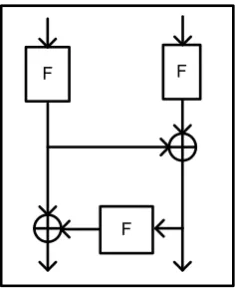
Figure 3. Feistel-Like Structure
differential or linear characteristics are desirable.
Theorem 4. For the structure depicted in Figure 3 with bijective round functionF, the provable differen-tial and linear probabilitiespandqare [16]:
p≤p2F, q≤qF2 (11)
5.1 Practical Security
In each round of the algorithm, at least two round functions (RFi) are active for each input element. For
each active round function, at least two active SDS functions are created. Consequently, for each round of the algorithm, there exist at least four active SDS functions. For each active SDS function, at least five substitution functions (S-box) are activated due to using MDS diffusion layer. Therefore, in each round, twenty active substitution functions are created which will produce practical linear and differential security from the following order by applying Theorems 1 and 2:
p≤p2RFi = (p2SDS)2= ((p5Sbox)2)2
= (2−6)5×2×2= 2−120 (12)
q≤q2RFi = (q
2
SDS)2= ((q5Sbox)2)2
= (2−6)5×2×2= 2−120 (13) For the resistance of the algorithm against differen-tial and linear cryptanalysis, the probabilities of dif-ferential and linear characteristics must be less than 2−128. To provide this condition, the number of rounds
must be large enough to have twenty two active S-boxes. One and a half rounds are enough to reach this number. For this number of rounds, there are thirty active S-boxes. Therefore, the probability of differen-tial and linear characteristics of 1.5 rounds is equal to 2−6×30= 2−180<2−128. In fact, before the end of the
5.2 The New Approach of Practical Security
In this approach, instead of counting the active S-boxes, the active functions that have provable security are counted. In the proposed algorithm, in each round, there exist at least two active round functions. Based on Theorems 3 and 4, each active round function is three rounds Feistel with SDS round function having provable linear and differential security as follows:
p < p2SDS = (p4Sbox)2= (2−6)4×2= 2−48 (14)
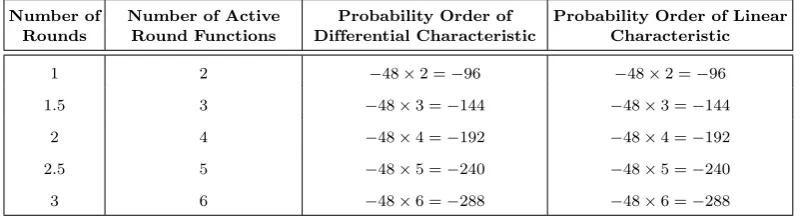
q < q2SDS = (qSbox4 )2= (2−6)4×2= 2−48 (15) For computing the above probabilities, previously mentioned theorems are used. Therefore, practical security is presented in Table 1.
5.3 Provable Security
According to the theorems described in the previous section, one round of the algorithm has the following provable security:
p≤p2F, q≤q2F (16)
pF and qF are obtained regarding Feistel round
function with three loops having probabilitiespF ≤
p2
SDS,qF ≤qSDS2 . Therefore, provable differential and
linear securities are equal to:
p≤p2SDS = (p4Sbox)2= (2−6)4×2= 2−48 (17)
q≤q2SDS = (q4Sbox)2= (2−6)4×2= 2−48 (18)
The above probabilities are computed assuming that the linear and differential probabilities of S-boxes are at most 2−6. In fact, for the S-boxes used in this
algorithm there is only one characteristic with 2−6
probability and there are 126 characteristics with 2−7
probabilities in the differential characteristic distribu-tion table. As a result, the differential probabilities can be smaller than the value used in Equation (19). Theorem 5. For SDS with X−1 type substitution
layer of sizem×mand diffusion layer with branching factor ofβd, the maximum differential probability is
computed as [28]:
max( max
1≤u≤2m−1
2m−1
X
j=1
DPSbox(u→j)Bd) (19)
According to the above theorem, maximum differen-tial probability of SDS function used in the algorithm is equal to:
pSDS = 2(1−m)(βd−1)−2(1−m)βd+1+ 2(2−m)βd
= 2−28−2−34+ 2−30= 2−27.696 (20) On the other hand, the differential probability for
RFi function is:
pF ≤p2SDS= 2
−55.39 (21)
Therefore, the security of one round of the algorithm is in order of:
p≤p2F = 2−110.78 (22) The linear probability can also be computed by this method and using a linear characteristic table.
qSDS = 2−26.477 (23)
q≤(q2F)2= 2−26.477×4= 2−105.91 (24) 5.4 Security of the Algorithm Against
Boomerang Cryptanalysis
In this section, the security of the algorithm against the boomerang cryptanalysis is evaluated and it is shown that the proposed algorithm with more than two rounds is secured against this attack. The boomerang cryptanalysis is a stronger type of differential attack. It is an adaptively chosen plaintext-ciphertext attack which was suggested by Wagner in 1999. This attack is based on the two characteristics of the short differ-ential which are exploited in a quad structure. The main idea of this attack is to use two high probability short differentials instead of one differential and nu-merous rounds with lower probability. The complexity of this cryptanalysis is (p1p2)−2 in whichp1andp2
are differential probabilities of forward and returning paths. Suppose thatnis the block length of the algo-rithm. Based on this assumption, the boomerang is effective, provided that (p1p2)−2<2n[17].
The security ofr+ 1 rounds of a block algorithm is not smaller than its security forrrounds. Therefore, if we prove the security of the algorithm for the least number of rounds, which is two, it can be also true for a higher number of rounds.
For applying the boomerang cryptanalysis to two rounds of the algorithm, we decompose the algorithm intor1rounds andr2rounds components wherer1+
r2 = 2. In Table 2, all probable states forr1,r2and
the corresponding probabilitiesp1andp2 are listed.
In the last column, for each state, the upper bound of the boomerang complexity is noted.
As can be seen in Table2, for all possible states, the upper bound of the boomerang complexity is greater than 2128. Therefore, it can be concluded that using
Table 1. The Order of Practical Security Based on the New Approach for Different Rounds of the Algorithm
Number of Rounds
Number of Active Round Functions
Probability Order of Differential Characteristic
Probability Order of Linear Characteristic
1 2 −48×2 =−96 −48×2 =−96
1.5 3 −48×3 =−144 −48×3 =−144
2 4 −48×4 =−192 −48×4 =−192
2.5 5 −48×5 =−240 −48×5 =−240
3 6 −48×6 =−288 −48×6 =−288
Table 2. Probable States for Applying Boomerang Cryptanalysis Against Two Rounds of the Proposed Algorithm
State r1 r2 p1 p2 Upper Bound of Attack Complexity (p1p2)−2
1 1 1 2−96 2−96 2384
2 1.5 0.5 2−144 2−48 2384
3 1.5 1.5 2−48 2−144 2384
5.5 Security Against Impossible Differential Attack
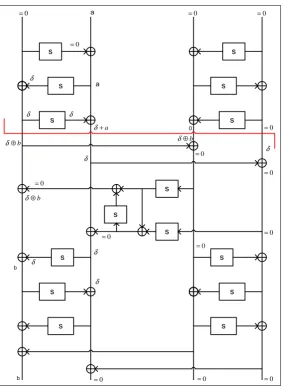
Among the cryptanalyses that we have performed on the cipher algorithm, the impossible differential attack based on truncated differential techniques [29] has the best results. Based on this attack, a two-round im-possible differential characteristic is achieved for the algorithm. Figure 4 shows the two-round impossible differential characteristic and corresponding differen-tials. The used symbols in this figure are as follows:
• “0” is 32 bits of zero values
• “δ” is 32 bits of non-zero values
• “a” and “b”are two 32 bits of optionally deter-mined non-zero values
• “?” is 32 bits undetermined value
According to Figure 4, the input difference is equal to ∆x = (0, a,0,0) and the output difference after two rounds is equal to ∆y= (b,0,0,0). We denote the probability of mapping ∆xto ∆yafter two rounds as
DP2r(∆x→∆y). This probability is equal to zero:
DP2r(∆x→∆y) = 0 (25) According to Figure 4, this characteristic is obtained using meet in the middle approach and has two parts,
i.e.forward and backward, and reach a contradiction at half of the first round (which is the input of the next one and a half rounds) as:
• According to the figure in forward part, if the difference of the input of the structure is equal to ∆x= (0, a,0,0), the output difference after the first half of round becomes ∆x= (δ, δ+a,0,0).
• Similarly, the backward part forces that if the difference of the output for the second round is
equal to ∆y= (b,0,0,0), the input difference of the remaining 1.5 rounds becomes ∆y = (δ+
b, δ, δ+b, δ) and this is in contradiction to the previous state.
From the fact that impossible differential charac-teristic is obtained for two rounds and the algorithm consists of three rounds, it can be concluded that the algorithm is robust against impossible differential at-tack.
5.6 The Security Against Integral Cryptanal-ysis
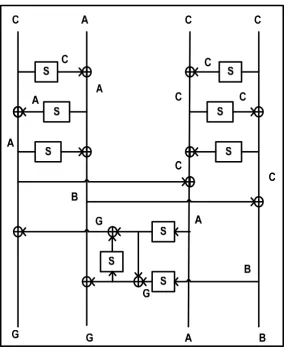
The square or integral attack was originally proposed as a dedicated attack on square block cipher algorithm [30]. In this section, the results of integral cryptanalysis based on 32-bit ports on the proposed algorithm are illustrated. Using reversible property of the round function, one round integral characteristic is obtained for the algorithm. In Figure 5, one round integral differentiator as well as the status of each 32-bit port is shown. The symbols used in this figure are as follows [31]:
• “C” is an inactive 32-bit port (with a 32-bit con-stant value)
• “A” is an active 32-bit port (with all probable 32-bit values)
• “B” is a balanced bit port (with all 232 32-bit values that the results of performing XOR operation on them is equal to a 32-bit zero value).
• “G” is a garbled 32-bit port (not inactive, not active and not balanced).
s
s
s
s s
s
s s
s
s
s s
s s
s
0
= =0 =0
0
=
0
=
0
= =0
0
=
b b
0
=
0
=
0
=
0
=
0
=
0
a
a
0
=
δ δ δ
b ⊕ δ b ⊕
δ
δ
b ⊕ δ
δ δ
δ δ
a + δ
Figure 4. Two-round Impossible Differential Specification
Table 3. The Impact of XOR Operation in Integral Attack
XOR G B A C
C G B A C
A G B B A
B G G B B
G G G G G
According to Figure 5, the attacker starts with (C, A, C, C) input. That is, the second port (from the left-hand side) gets all of the probable 32-bit values and the values of the other ports are kept constant. In this situation, according to the figure, the output of the first round will be (G, G, A, B). That is, from the right-hand side, the first port is balanced; the second port is active; the third and the fourth ports are garbled. Using this differentiator, at most two rounds of this algorithm can be attacked by guessing some sub keys.
Since the best integral differentiator was obtained
for one round and the algorithm consists of three rounds, it is expected that the algorithm is secure enough against the integral cryptanalysis.
5.7 Truncated Differential Attack
For applying truncated differential cryptanalysis on block ciphers, the following definitions are used [32, 33].
Definition 1. χofGF(2)4→GF(2) transformation
is defined as:
χ(x) = (
0 if x= 0
1 if x6= 0 (26)
χ(x1, x2, x3, x4) = (χ(x1), χ(x2), χ(x3), χ(x4)) (27)
Definition 2. δx ∈ GF(2)4 and δy ∈ GF(2)4 are
Figure 5. Applying Integral Cryptanalysis on One Round of the Proposed Algorithm
δx= (δx1, δx2, δx3, δx4), δxi∈GF(2) (28)
δy= (δy1, δy2, δy3, δy4), δyi∈GF(2) (29)
δxi=χ(∆xi), ∆xi∈GF(2)8 (30)
δyi=χ(∆yi), ∆yi∈GF(2)8 (31)
Definition 3. The probability of the byte character-istic of functionF is defined as:
p= P r
x∈GF(2)32[χ(F(x))⊕F(x⊕∆x)) =δy
|χ(δx) =δx] (32)
In the above relation, it is assumed that the out-put difference of uniform distribution for each inout-put difference is not equal to zero. Therefore, byte charac-teristicδxgoes toδywith probability ofp.
Theorem 6. Ifδx= (0,0,0,0)then δy= (0,0,0,0)
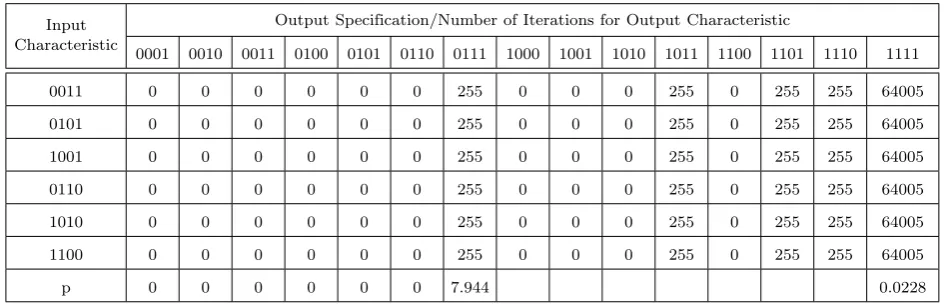
with probability of 1, otherwise the probability is com-puted using the complete search of all byte characteris-tics of SDSD function. Table 4 show the byte charac-teristics for SD function.
For example, if the input characteristic is (0011), then 255 output characteristics equal to (0111) are created. Therefore, the probability of occurring this
characteristic in the output is computed as follows:
P r(0011→0111) = 255 255×255 = 2
−7.994 (33)
Similarly, the probability of the output characteris-tic (1111) for the input characterischaracteris-tic (0011) is com-puted as follows:
P r(0011→1111) = 64005 255×255 = 2
−0.0228 (34)
Since the branching factor of the diffusion layer is the most probable value (βd= 5), therefore, for each
input byte characteristic with hamming weight equal to 1, a characteristic with hamming weight of 4 (1111) is produced in the output with probability of 1.
Table 4. Byte Specification of Two Inputs SD Function
Input Characteristic
Output Specification/Number of Iterations for Output Characteristic
0001 0010 0011 0100 0101 0110 0111 1000 1001 1010 1011 1100 1101 1110 1111
0011 0 0 0 0 0 0 255 0 0 0 255 0 255 255 64005
0101 0 0 0 0 0 0 255 0 0 0 255 0 255 255 64005
1001 0 0 0 0 0 0 255 0 0 0 255 0 255 255 64005
0110 0 0 0 0 0 0 255 0 0 0 255 0 255 255 64005
1010 0 0 0 0 0 0 255 0 0 0 255 0 255 255 64005
1100 0 0 0 0 0 0 255 0 0 0 255 0 255 255 64005
p 0 0 0 0 0 0 7.944 0.0228
Table 5. Byte Specification of Three Inputs SD Function
Input Characteristic
Hamming Weight of Output Specification/Number of Iterations for Characteristic
0001 0010 0011 0100 0101 0110 0111 1000 1001 1010 1011 1100 1101 1110 1111 0111 0 0 255 0 255 255 64005 0 255 255 64005 255 64005 64005 16323825 1011 0 0 255 0 255 255 64005 0 255 255 64005 255 64005 64005 16323825 1101 0 0 255 0 255 255 64005 0 255 255 64005 255 64005 64005 16323825 1110 0 0 255 0 255 255 64005 0 255 255 64005 255 64005 64005 16323825
p 15.98 8.01 0.0225
P r(1111→wh(1)) = 255 2554 = 2
−23.98 (35)
P r(1111→wh(2)) = 64005 2554 = 2
−16.01 (36)
P r(1111→wh(3)) = 16323825 2554 = 2
−8.01 (37)
P r(1111→wh(4)) = 1−
3
X
i=1
P r(1111→wh(i))
= 2−0.0056 (38)
5.7.1 Evaluating Truncated Differential At-tack Against the Algorithm
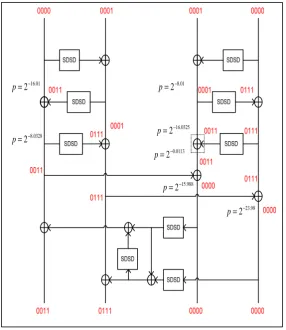
For evaluation, two-byte characteristics are used in the input. In Figure 6, the approach for propagating this characteristic within one round is depicted. Addi-tionally, the probability of occurring each byte char-acteristic after passing through the SDSD function can be inferred from the figure. It is useful to note that, each input characteristic after passing through two SDS functions, produces the output. For example, (0001) characteristic after passing through SD func-tion produces (1111) characteristic with probability of 1 and, subsequently, the produced characteristic gener-ates (1111) characteristic with probability of 2−0.0056. Consequently, the total probability is equal to:
P r[(0001)→(1111)→(1111)] = 1×2−0.0056 = 2−0.0056 (39) The probability of the characteristic depicted in Figure 6 is also:
P r([0000000100010000]→[0011011100000000])∼= 2−23.9−15.988−16.3−8.01−16.01−8.03∼= 2−88.238 (40)
The probability of failure is:
P r([0000000100010000]6=→[0011011100000000])
= 2−8×11= 2−88 (41)
0325 . 16 2− =
p
01 . 8 2− =
p
0113 . 0 2− =
p
988 . 15 2− =
p
98 . 23 2− =
p
01 . 16 2− =
p
0328 . 8 2− =
p
Figure 6. Truncated Differential Diffusion
6
Conclusion and Discussion
In this study, a new cryptographic algorithm is pro-posed which has practical and provable security and can be used in different applications for telecommu-nication. In order to trust the algorithm and it’s re-sistance to different types of attacks, it was analyzed against various cryptanalyses. The algorithm struc-ture is Feistel-Like in which Feistel functions were used in each round. The non-linear function used in its round functions is SDSD (Substitution Diffusion Substitution Diffusion) in which the substitution func-tions are quite novel. On the other hand, it has an overall new structure with respect to other block-based algorithms. In order to enhance the speed of encryption and decryption using the lowest number of rounds, MDS (Maximal Distance Separable) matrices are used which have suitable software implementation. In the proposed cipher algorithm and corresponding cryptanalysis, four rounds of executions are enough. However, adding another round to the algorithm to obtain better security does not significantly degrade the performance due to using special functions in its round structure. To decrease the runtime, the struc-ture of the proposed cipher is selected so that it can be implemented using well-known parallel
process-ing approaches. It was shown that usprocess-ing SDSD struc-ture in round functions produces appropriate security against various attacks such as truncated differential cryptanalysis. Moreover, the proposed algorithm has both practical and provable security against other well-known cryptanalyses. In order to reduce the com-plexity of the algorithm for hardware implementation, it is possible to use smaller substitution functions. In this case, it is required to use more rounds. However, the proposed algorithm is not completely lightweight since it has linear and differential cryptanalysis which requires specific components in its round functions.
References
[1] Jian Guo, Thomas Peyrin, Axel Poschmann, and Matt Robshaw. The LED Block Cipher, pages 326–341. Springer Berlin Heidelberg, Berlin, Hei-delberg, 2011. ISBN 978-3-642-23951-9. doi: 10. 1007/978-3-642-23951-9 22. URL http://dx. doi.org/10.1007/978-3-642-23951-9_22. [2] Ray Beaulieu, Douglas Shors, Jason Smith,
De-sign Automation Conference, DAC ’15, pages 175:1–175:6, New York, NY, USA, 2015. ACM. ISBN 978-1-4503-3520-1. doi: 10.1145/2744769. 2747946. URLhttp://doi.acm.org/10.1145/ 2744769.2747946.
[3] Farzaneh Abed, Eik List, Stefan Lucks, and Jakob Wenzel. Differential Cryptanalysis of Round-Reduced Simon and Speck, pages 525– 545. Springer Berlin Heidelberg, Berlin, Heidel-berg, 2015. ISBN 978-3-662-46706-0. doi: 10. 1007/978-3-662-46706-0 27. URL http://dx. doi.org/10.1007/978-3-662-46706-0_27. [4] Eli Biham and Adi Shamir. Differential
crypt-analysis of des-like cryptosystems. Journal of Cryptology, 4(1):3–72, 1991. ISSN 1432-1378.
doi: 10.1007/BF00630563. URLhttp://dx.doi. org/10.1007/BF00630563.
[5] Mitsuru Matsui. Linear Cryptanalysis Method for DES Cipher, pages 386–397. Springer Berlin Heidelberg, Berlin, Heidelberg, 1994. ISBN 978-3-540-48285-7. doi: 10.1007/ 3-540-48285-7 33. URL http://dx.doi.org/ 10.1007/3-540-48285-7_33.
[6] Zheng Gong, Svetla Nikova, and Yee Wei Law.
KLEIN: A New Family of Lightweight Block Ciphers, pages 1–18. Springer Berlin Heidelberg,
Berlin, Heidelberg, 2012. ISBN 978-3-642-25286-0. doi: 1978-3-642-25286-0.1007/978-3-642-25286-0 1. URLhttp: //dx.doi.org/10.1007/978-3-642-25286-0_ 1.
[7] Jean-Philippe Aumasson, Mar´ıa Naya-Plasencia, and Markku-Juhani O. Saarinen. Practi-cal Attack on 8 Rounds of the Lightweight Block Cipher KLEIN, pages 134–145. Springer Berlin Heidelberg, Berlin, Heidelberg, 2011. ISBN 978-3-642-25578-6. doi: 10.1007/ 978-3-642-25578-6 11. URL http://dx.doi. org/10.1007/978-3-642-25578-6_11.
[8] Kaisa Nyberg. Linear approximation of block ciphers, pages 439–444. Springer Berlin Heidel-berg, Berlin, HeidelHeidel-berg, 1995. ISBN 978-3-540-44717-7. doi: 10.1007/BFb0053460. URLhttp: //dx.doi.org/10.1007/BFb0053460.
[9] Kaisa Nyberg and Lars Ramkilde Knudsen. Prov-able Security Against Differential Cryptanaly-sis, pages 566–574. Springer Berlin Heidelberg, Berlin, Heidelberg, 1993. ISBN 978-3-540-48071-6. doi: 10.1007/3-540-48071-4 41. URL http: //dx.doi.org/10.1007/3-540-48071-4_41. [10] Mitsuru Matsui. New structure of block
ci-phers with provable security against differen-tial and linear cryptanalysis, pages 205–218. Springer Berlin Heidelberg, Berlin, Heidelberg, 1996. ISBN 978-3-540-49652-6. doi: 10.1007/ 3-540-60865-6 54. URL http://dx.doi.org/ 10.1007/3-540-60865-6_54.
[11] Mitsuru Matsui.New block encryption algorithm MISTY, pages 54–68. Springer Berlin Heidelberg, Berlin, Heidelberg, 1997. ISBN 978-3-540-69243-0. doi: 1978-3-540-69243-0.1007/BFb0052334. URL http://dx. doi.org/10.1007/BFb0052334.
[12] Ju-Sung Kang, Sang-Uk Shin, Dowon Hong, and Okyeon Yi. Provable Security of KASUMI and 3GPP Encryption Mode f8, pages 255–271. Springer Berlin Heidelberg, Berlin, Heidelberg, 2001. ISBN 978-3-540-45682-7. doi: 10.1007/ 3-540-45682-1 16. URL http://dx.doi.org/ 10.1007/3-540-45682-1_16.
[13] Yasuyoshi Kaneko, Fumihiko Sano, and Kouichi Sakurai. On provable security against differen-tial and linear cryptanalysis in generalized feistel ciphers with multiple random functions. In Pro-ceedings of SAC, volume 97, pages 185–199, 1997. [14] Seokhie Hong, Sangjin Lee, Jongin Lim, Jaechul
Sung, Donghyeon Cheon, and Inho Cho.Provable Security against Differential and Linear Crypt-analysis for the SPN Structure, pages 273–283. Springer Berlin Heidelberg, Berlin, Heidelberg, 2001. ISBN 978-3-540-44706-1. doi: 10.1007/ 3-540-44706-7 19. URL http://dx.doi.org/ 10.1007/3-540-44706-7_19.
[15] Changhoon Lee, Jongsung Kim, Jaechul Sung, Seokhie Hong, and Sangjin Lee. Provable Secu-rity for an RC6-like Structure and a MISTY-FO-like Structure Against Differential Cryptanaly-sis, pages 446–455. Springer Berlin Heidelberg, Berlin, Heidelberg, 2006. ISBN 978-3-540-34076-8. doi: 10.1007/11751595 4978-3-540-34076-8. URL http://dx. doi.org/10.1007/11751595_48.
[16] KIM Jongsung, LEE Changhoon, SUNG Jaechul, HONG Seokhie, LEE Sangjin, and LIM Jongin. Seven new block cipher structures with provable security against differential cryptanalysis. IE-ICE Transactions on Fundamentals of Electron-ics, Communications and Computer Sciences, 91 (10):3047–3058, 2008.
[17] Jorge NAKAHARA J´unior.Cryptanalysis and de-sign of block ciphers. PhD thesis, Katholieke Uni-versiteit Leuven, June 2003. URLhttp://www. bybin.narod.ru/nakahara/phd-thesis.pdf. [18] Qiu-Yan Wang, Bin Zhang, and Chen-Hui Jin.
Practical security against differential and linear cryptanalysis for sms4-like cipher. Journal of Networks, 8(8):1689–1693, 2013.
[19] Andrey Bogdanov and Kyoji Shibutani. General-ized feistel networks revisited.Designs, Codes and Cryptography, 66(1):75–97, 2013. ISSN 1573-7586. doi: 10.1007/s10623-012-9660-z. URL http:// dx.doi.org/10.1007/s10623-012-9660-z. [20] Shay Gueron and Nicky Mouha. Simpira v2: A
Re-port 2016/122, 2016. URLhttp://eprint.iacr. org/2016/122.
[21] Thierry P. Berger, Marine Minier, and Ga¨el Thomas. Extended Generalized Feistel Net-works Using Matrix Representation, pages 289– 305. Springer Berlin Heidelberg, Berlin, Heidel-berg, 2014. ISBN 978-3-662-43414-7. doi: 10. 1007/978-3-662-43414-7 15. URL http://dx. doi.org/10.1007/978-3-662-43414-7_15. [22] Lei Zhang and Wenling Wu.
Differen-tial analysis of the extended generalized feis-tel networks. Information Processing Let-ters, 114(12):723 – 727, 2014. ISSN 0020-0190. doi: http://dx.doi.org/10.1016/j.ipl.2014. 07.001. URLhttp://www.sciencedirect.com/ science/article/pii/S0020019014001318. [23] Jingmei Liu, Baodian Wei, Xiangguo Cheng, and
Xinmei Wang. An aes s-box to increase com-plexity and cryptographic analysis. In19th In-ternational Conference on Advanced Information Networking and Applications (AINA’05) Volume 1 (AINA papers), volume 1, pages 724–728 vol.1,
March 2005. doi: 10.1109/AINA.2005.84. [24] Philip Hawkes and Gregory G. Rose.
Guess-and-Determine Attacks on SNOW, pages 37–46. Springer Berlin Heidelberg, Berlin, Heidelberg, 2003. ISBN 978-3-540-36492-4. doi: 10.1007/ 3-540-36492-7 4. URLhttp://dx.doi.org/10. 1007/3-540-36492-7_4.
[25] Dai Watanabe, Alex Biryukov, and Christophe De Canni`ere. A Distinguishing Attack of SNOW2.0 with Linear Masking Method, pages 222–233. Springer Berlin Heidelberg, Berlin, Hei-delberg, 2004. ISBN 978-3-540-24654-1. doi: 10. 1007/978-3-540-24654-1 16. URL http://dx. doi.org/10.1007/978-3-540-24654-1_16. [26] Olivier Billet and Henri Gilbert. Resistance
of SNOW 2.0 Against Algebraic Attacks, pages 19–28. Springer Berlin Heidelberg, Berlin, Hei-delberg, 2005. ISBN 978-3-540-30574-3. doi: 10.1007/978-3-540-30574-3 3. URLhttp://dx. doi.org/10.1007/978-3-540-30574-3_3. [27] Masayuki Kanda, Youichi Takashima, Tsutomu
Matsumoto, Kazumaro Aoki, and Kazuo Ohta.
A Strategy for Constructing Fast Round Func-tions with Practical Security Against Differen-tial and Linear Cryptanalysis, pages 264–279. Springer Berlin Heidelberg, Berlin, Heidelberg, 1999. ISBN 978-3-540-48892-7. doi: 10.1007/ 3-540-48892-8 21. URL http://dx.doi.org/ 10.1007/3-540-48892-8_21.
[28] Sangwoo Park, Soo Hak Sung, Sangjin Lee, and Jongin Lim. Improving the Upper Bound on the Maximum Differential and the Maximum Linear Hull Probability for SPN Structures and AES, pages 247–260.
Springer Berlin Heidelberg, Berlin, Heidelberg, 2003. ISBN 978-3-540-39887-5. doi: 10.1007/ 978-3-540-39887-5 19. URL http://dx.doi. org/10.1007/978-3-540-39887-5_19.
[29] Jongsung Kim, Seokhie Hong, Jaechul Sung, Sangjin Lee, Jongin Lim, and Soohak Sung.
Impossible Differential Cryptanalysis for Block Cipher Structures, pages 82–96. Springer Berlin Heidelberg, Berlin, Heidelberg, 2003. ISBN 978-3-540-24582-7. doi: 10.1007/ 978-3-540-24582-7 6. URL http://dx.doi. org/10.1007/978-3-540-24582-7_6.
[30] Lars Knudsen and David Wagner. Inte-gral Cryptanalysis, pages 112–127. Springer Berlin Heidelberg, Berlin, Heidelberg, 2002. ISBN 978-3-540-45661-2. doi: 10.1007/ 3-540-45661-9 9. URLhttp://dx.doi.org/10. 1007/3-540-45661-9_9.
[31] Yongjin Yeom. Integral cryptanalysis and higher order differential attack. Trends in Mathematics (ICMS), 8(1):101–118, 2005.
[32] Lars R. Knudsen. Truncated and higher or-der differentials, pages 196–211. Springer Berlin Heidelberg, Berlin, Heidelberg, 1995. ISBN 978-3-540-47809-6. doi: 10.1007/ 3-540-60590-8 16. URL http://dx.doi.org/ 10.1007/3-540-60590-8_16.
[33] Shiho Moriai, Makoto Sugita, Kazumaro Aoki, and Masayuki Kanda. Security of E2 against Truncated Differential Cryptanalysis, pages 106– 117. Springer Berlin Heidelberg, Berlin, Hei-delberg, 2000. ISBN 978-3-540-46513-3. doi: 10.1007/3-540-46513-8 8. URLhttp://dx.doi. org/10.1007/3-540-46513-8_8.
Mahmood Deypirreceived his Ph.D. de-gree in 2011 and M.Sc dede-gree in 2006 both from Shiraz University. He is currently as-sistant professor at Computer and Informa-tion Technology department at Shahid Sattari University of Science and Technology. His re-search interests include Data Mining and Cy-ber space Security. He has published a num-ber of papers in ISI journals and international conferences.