ISSN: 2333-6048 (Print), 2333-6056 (Online) Copyright © The Author(s). 2014. All Rights Reserved. Published by American Research Institute for Policy Development DOI: 10.15640/jmpp.v2n3a5 URL: http://dx.doi.org/10.15640/jmpp.v2n3a5
Competing Values Enhanced Knowledge Chain Activities in a New Conceptual Mode
Amir Hossein Dastaviz 1 & Majid Jamshidy2
Abstract
The main purpose of this paper is to propose a conceptual model for better knowledge management activities’ performance. This model applies the dominant values in the organisation and facilitates or contributes to knowledge management (KM) activities adoption. For this purpose, the competing values model status should be assessed with both dimensions, control and internal or external tendency, which shows the structure and environments of the organisation. Hence, the extent of control and environmental tendencies produce specific values in the organisation which in terms has the capability to promote and enhance particular knowledge management activities. This may lead to initiating the knowledge chain cycle in the organisation. The model has been developed by integrating knowledge chain model and competing value model. This unique model of knowledge management and values of organisation will enrich the knowledge management practices’ in a wide range of industries and firms. In addition, it opens new insights for other researchers and practitioners to develop the organizational competing values as well as knowledge management activities.
Keywords: Knowledge Chain Activities, Knowledge Management Activities, Competing Values
Introduction
The role of initiative factors in knowledge management practice is the main issue in modern business. These factors can lead to knowledge management success or failure in the business activities. Organisational values as a knowledge management enabler has a significant role in performing knowledge management activities (KMA).
1 Institute of Graduate Studies, University of Malaya, Kuala Lumpur, 59200, Malaysia.(Corresponding Author)
These knowledge management enablers, including identification of the competing values framework, can promote knowledge management activities performance, and thus, organizational performance. Identifying and facilitating these factors is the key point in knowledge management practices. Although, some researchers consider the competing values framework as an organisational culture, here in this article, regards to original framework which referred to organisational effectiveness, these competing values come from organisational design, control and structure, which in turn, produce values in the organisation.
Any organization that likes to perform knowledge management practice needs to evaluate organisational values to see how much the produced values are supportive or restrictive for knowledge management practice. In the literature organisational culture and knowledge management activities were studied widely, for example, the influence of organizational culture on knowledge management practices studied by (Alavi et al., 2006). Besides, David et al. (2000) studied the effect of culture on knowledge management practices and Balthazard and Cooke (2004) investigated the relationship between organizational culture and knowledge management success.
Competing Value Framework
It is clear that, in the knowledge management, organisational tendency to openness has capability in facilitating more knowledge management practice circle in the organization. However, there is no constant rule for knowledge practices which mentioned that if the organization is more open there would be better trigger knowledge management practice than the organization with hierarchical structure. Each organization may enhance its knowledge management activities by own way toward knowledge management practice, whether by hierarchical structure or by flexible structure and values. Each competing values are able to trigger the particular knowledge management activities in knowledge chain.
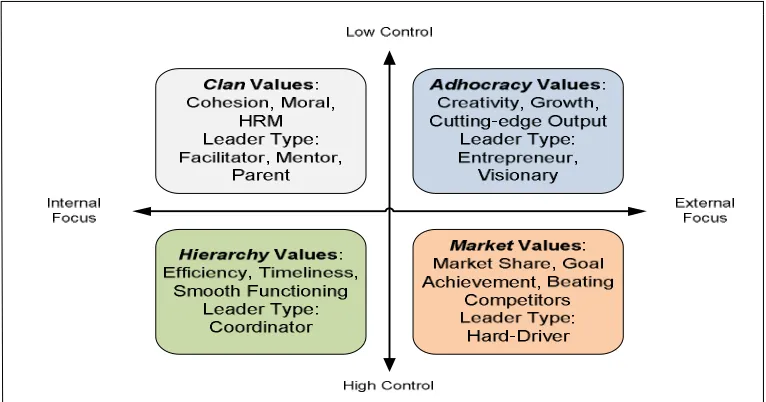
The clan, situated in the upper left quadrant, illustrates the human relationship perspective. It is actually seen as low control and internal resource tendencies which leads to beliefs, values and creed, highlighted internal values. In clan culture, the emphasis is on sharing information between personnel, team work, easy and fast communication, coordination in team work, interpersonal human relationships, as well as participative decision making process (Cameron & Freeman, 1991).
The adhocracy (up right quadrant), known as open system of view, is truly seen as a value, emphasising the external environment of the organisation, such as natural and organic emphasis. Flexibility is another identification of the adhocracy culture (Cameron & Freeman, 1991). The particular focus in this kind of values is with innovations, creativity, transformation change, progress, entrepreneurship, gaining outsiders support, and in addition, resource acquisition (Cameron & Freeman, 1991).
The market (lower right part), known as the goal perspective. Also, this value identified by standard values for highly predictable and more concerned with controlling external factors (Hamilton & Biggart, 1988). These characteristic emphasises competitiveness, quick responses, conclusiveness tendency, and productivity manner, goal clearness, getting through barriers and obstacles, and goal attainments (Abolafia, 1990).
Fig. 1: Competing Values Framework
Knowledge Chain Model
The term ‘knowledge chain’ is still comparatively new in the field of knowledge management, compared with other more established terms, such as ‘knowledge management system’ (Mintzberg, 1990) or ‘knowledge creation’ (Coyle, 1977). This concept, however, has not fully been applied in different industries, thereby creating a gap in service firms to assess this model.
Among the various definitions of KCM, this study adapted Holsapple’s definition. Knowledge Chain Model (KCM) defines as nine essential activities that a knowledge-driven firm is able to perform in ways that yield competitive advantage and better performance (Holsapple & Joshi, 2001). These critical activities come from knowledge management ontology of phenomena, which was collaboratively designed with a wide range of international KM experts (Holsapple & Joshi, 2002). This model like Porter’s value chain model is a basic tool used in diagnosing, recognizing and enhancing competitive advantage of the firms.
The identification of each KMA is crucial to understand and formulate organisation's strategy for competitive advantage, and consequently, the performance of the firms. These activities of KC may happen simultaneously, for example, acquisition activities and selection occur simultaneously in the firm, orderly like management activities which may happen consequently or parallel in latitude, and sometimes in loops of combining various patterns in the course of organisational operations. In this case, recognizing the triggers of each knowledge management activity contribute to knowledge management performance.
Each firm is embedded with complicated knowledge enablers or initiators which are difficult to obtain and mimic, so the capability to manage these knowledge enablers are irreplaceable by other firms.
Primary Activities of Knowledge Chain
The knowledge chain model is grounded on a KM ontology, which was collectively developed by an international panel of KM scholars and practitioners (Joshi, 1998). The object of the KCM includes five primary activities or organisational activities (OA) of KCM, which is responsible of organisation’s knowledge processors in order to accomplish these activities for manipulating knowledge assets for better knowledge spine in the firm. These five activities are distinguished in KM ontology as the five generic KM activities. These are necessitated within KCM, which are acquiring, selecting, generating, assimilating, and emitting knowledge.
Knowledge Acquisition: Knowledge acquisition is delineated as gaining or
adapting knowledge from outside of an organisation (Kuhn, 2000). This happens in two common ways direct or indirect (Darroch, 2003). Competing values of the organisation can support knowledge acquisition based on the tendency of external organisational values, which drives market and competition, adhocracy (Giberson et al., 2009).
Selection: Knowledge selection is defined as the selection of a required
These two activities, although differing in implementation, greatly complement each other. Since clan and hierarchy values come from insiders, these can contribute tremendously to knowledge selection in an organisation.
Knowledge Generation: Knowledge generation is defined as making or producing
knowledge by excavation or derivation from existing knowledge sources in the organisation(Amidon & Macnamara, 2003). Within this scope, some activities include acquisition of knowledge from external and internal sources.
Knowledge Assimilation: Knowledge assimilation is defined as group activities
that alter the status of the organisational knowledge resource by internally distributing, sorting, selecting and generalising knowledge (Liebowitz et al., 2002). The process of knowledge assimilation leads to the inflow of knowledge from these activities into the organisation, and will, in turn, influence its state of knowledge. Sub-activities of knowledge assimilation include evaluation, testing and filtering of needed knowledge. It is broadly divided into two main groups, publishing, and interaction (Liebowitz, 2004).
Knowledge Emission: Knowledge emission is defined as captured knowledge in
the form of these ways are transmitted to the extend organisational environment through this process. In other word, embedding or implementing knowledge into the outflow of an organisation for external released or distributed (Joshi, 1998). Knowledge emission has two main categories, the first one being published, while the other is interaction, both having formal and informal forms (Bose, 2003).
Secondary Activities of Knowledge Chain
New business environments regard KM as an essential factor to ensure competitiveness. The knowledge chain model was recently developed as a first step in understanding the link between KCM and organisational performance. On previous stage, the primary KM activities of knowledge chain model were explored. Here, the secondary activities or management activities of KCM, which including leadership, coordination, control and measurement, were studied in brief.
Leadership: Leadership (Clyde & Kiku, 2005) has been recognized as one of the
The definition of leadership in knowledge chain and the organisation is generally different. Knowledge Leadership (KL) in an organisation functions as an accelerator to knowledge workers, whereas leadership in an organisation refers to someone who arranges the goals and direction of an organisation in order to enable it function as a single entity (Mehta, 2012).
Coordination: Knowledge coordination is defined as the act of managing the
dependencies between KMA in order to determine its proper processes (Eisenhart, 2001). In this context, it means ensuring that available resources perform adequately at allocated times and places. The coordination activity is divided by structuring and security efforts.
Control: Knowledge control definition is the continuity and ensuring that
knowledge resources and processors are available in good quality (O'dell, 2000). Controlling is a significant issue in KA because of the value of knowledge return from knowledge resource quality. Another aspect of knowledge control is protection (O'dell et al., 2000). It involves less devolution, clearance exposure and clearance limitation. There are two main groups of tasks in knowledge control, controls and process governance (Puga & Trefler, 2002).
Measurement: Knowledge measurement is defined as the evaluation or
assessment of the values of knowledge that is applied during the course of knowledge resource, process and deployment by quantitative and qualitative methods for performance assessment or benchmarking (Mclaughlin, 2007). It also involves evaluating value added processes, assessment of KM operational activities, and analysing the impact of an OA of KC on its overall KM performance (Holsapple & Singh, 2001). There are two groups of activities for knowledge measurement, determining/developing measurement and applying measurement (Hanley & Malafsky, 2004).
Integration
Organizational values is a prerequisite factor in building and reinforcing knowledge management practices or activities in the organizations. In this way there is no theoretical framework that comprehensively explains which kinds of values of the organization have more effects on knowledge management activities in organizations. In this paper, we develop an evaluation framework for Knowledge chain competing values (KCCV) which composed knowledge management activities and competing value model as an indicator of competing values and knowledge chain. The framework rested on the theoretical foundations, underlying competing values model and knowledge chain model, which lead to identifying key management and organisational activities of knowledge chain model and required supporting embedded values in the organisation. Then it can be used to form a benchmark for evolving knowledge chain activities in organizations to perform the best course of activities in knowledge management practices based on the competing value framework.
Theoretically, both frameworks, competing values and knowledge chain, are following resource based view. These two frameworks have capabilities to enhance competitive advantage in the organisation. Moreover, there are some other empirical research confirm the relation between competing values and knowledge chain model (Ruppel & Harrington, 2001). In addition, both the frameworks endeavour to capture the dynamic processes linked with internal operations and the organizational interactions with the external environment. The comparison between the characteristics of the four quadrants of the ‘‘competing values framework’’ and the various components of the ‘‘knowledge chain model clearly shows that both frameworks have conceptual similarities
Fig. 2: Clan and Knowledge Chain Model
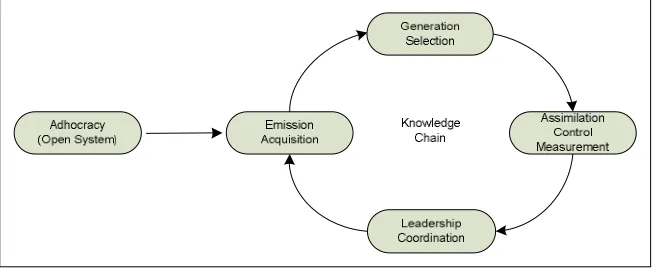
The adhocracy values or open systems model involves a flexibility/external focus in which readiness and adaptability are utilised in order to achieve growth, resource acquisition and external support. This model has also been referred to as a ‘developmental culture’ because it is associated with innovative leaders with vision who also maintain a focus on the external environment (Clayton et al., 2008). These organisations are dynamic and entrepreneurial, their leaders are risk-takers, and organizational rewards are linked to individual initiative (Jones & Redman, 2000). This kind of value prepares the appropriate environment for knowledge emission and acquisition. The external tendencies lead to more acquisition.
Fig. 3: Adhocracy and Knowledge Chain Model
This model of organisational culture is referred to as a rational culture because of its emphasis on outcomes and goal fulfilment (Denison (1990). Organisations of this type are production oriented, managers organise employees in the pursuit of designated goals and objectives, and rewards are linked to outcomes (Parker & Bradley, 2000). More control in the organisation in order to select a specific knowledge for particular market completion is another reason for supporting this model.
Fig. 4: Maeket and Knowledge Chain Model
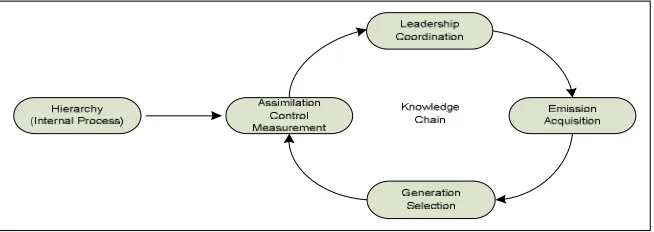
The hierarchy values or internal process model involves a control/internal focus in which information management and communication are utilised in order to achieve stability and control. This model has also been referred to as a ‘hierarchical value’ because it involves the enforcement of rules, conformity, and attention to technical matters (Denison & Spreitzer, 1991). The internal process model most clearly reflects the traditional theoretical model of bureaucracy and public administration that relies on formal rules and procedures as control mechanisms (Parker & Bradley, 2000)
Conclusion
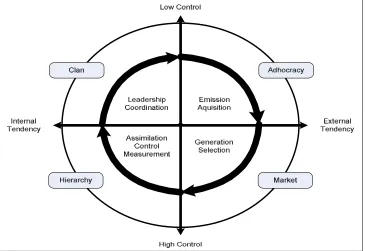
The following diagram shows the combination of the steps explained previously. Based on knowledge chain model, each knowledge chain activity can initiate knowledge chain cycle and the priority of staring is not the matter of knowledge cycle in this framework. Therefore, confirming the dominate values of the organisation makes the starting point of the knowledge chain model clear. With this diagram, each organisation is able to implement the knowledge chain model.
Fig. 6: Knowledge Chain Competing Value (KCCV)
In hierarchal organizations people should follow the organizational structure for their communication and knowledge practice, therefore it may have some delay or rigid in their communication. Knowledge activities need fast and easy communication, whereas people are ready and have facility to exchange or tracts their experience and knowledge with each other, if there is any delay or permission for their communication. Therefore, their knowledge practice or activities face with failure and barrier.
As it has been mentioned before, the CVF has been used in a number of studies to investigate organisational culture (Cameron & Quinn, 2011). The CVF examines the competing demands within organisations between their internal and external environments on the one hand and between control and flexibility on the other (Parker & Bradley, 2000). These conflicting demands constitute the two axes of the competing values model. Organisations with an internal focus emphasise integration, information management and communication, whereas organizations with an external focus emphasise growth, resource acquisition and interaction with the external environment. On the second dimension of conflicting demands, organisations with a focus on control emphasise stability and cohesion while organisations with a focus on flexibility emphasise adaptability and spontaneity. Combined, these two dimensions of the competing values map out four major ‘types’ of organisational culture revealed in theoretical analyses of organisations (Parker & Bradley, 2000).
References
Abolafia, M. Y. (1990). Constructing market culture: ambiguity and change on Wall Street (Vol. 90): Johnson Graduate School of Management, Cornell University.
Alavi, M., Kayworth, T. R., & Leidner, D. E. (2006). An empirical examination of the influence of organizational culture on knowledge management practices. Journal of Management Information Systems, 22(3), 191-224.
Amidon, D., & Macnamara, D. (2003). The 7 C’s of knowledge leadership: Innovating our future. Handbook on knowledge management, 1, 539-551.
Bose, R. (2003). Knowledge management-enabled health care management systems: capabilities, infrastructure, and decision-support. Expert systems with applications, 24(1), 59-71.
Cameron, K. S., & Freeman, S. J. (1991). Cultural congruence, strength, and type: Relationships to effectiveness. Research in organizational change and development, 5(1), 23-58.
Chen, C.-J., & Huang, J.-W. (2007). How organizational climate and structure affect knowledge management—The social interaction perspective. International Journal of Information Management, 27(2), 104-118.
Clayton, B., Fisher, T., Harris, R., Bateman, A., & Brown, M. (2008). Structures and Cultures: A Review of the Literature. Support Document 2. National Centre for Vocational Education Research (NCVER).
Clyde, H., & Kiku, J. (2005). Exploring secondary activities of the knowledge chain. Knowledge and Process Management, 12(1), 3.
Coyle, R. G. C., R.G. (1977). Management system dynamics (Vol. 6): Wiley New York. Darroch, J. (2003). Developing a measure of knowledge management behaviors and practices.
Journal of Knowledge Management, 7(5), 41-54.
Denison, D. R. (1990). Corporate culture and organizational effectiveness: Wiley New York. Denison, D. R., & Spreitzer, G. M. (1991). Organizational culture and organizational
development: A competing values approach. Research in organizational change and development, 5(1), 1-21.
Eisenhart, M. (2001). Washington’s need to know. Knowledge Management Magazine, 4(1). Giberson, T. R., Resick, C. J., Dickson, M. W., Mitchelson, J. K., Randall, K. R., & Clark, M.
A. (2009). Leadership and organizational culture: Linking CEO characteristics to cultural values. Journal of Business and Psychology, 24(2), 123-137.
Hamilton, G. G., & Biggart, N. W. (1988). Market, culture, and authority: A comparative analysis of management and organization in the Far East. American journal of Sociology, 52-94.
Hanley, S., & Malafsky, G. (2004). A guide for measuring the value of KM investments. Handbook on knowledge management, 2, 369-389.
Holsapple, C. W., & Joshi, K. D. (2001). Organizational knowledge resources. Decision Support Systems, 31(1), 39-54.
Holsapple, C. W., & Joshi, K. D. (2002). Knowledge manipulation activities: results of a Delphi study. Information & Management, 39(6), 477-490.
Holsapple, C. W., & Singh, M. (2001). The knowledge chain model: activities for competitiveness. Expert Systems with Applications, 20(1), 77-98.
Jennex, M. E., & Olfman, L. (2002). Organizational memory/knowledge effects on productivity, a longitudinal study.
Jones, K. R., & Redman, R. W. (2000). Organizational culture and work redesign: experiences in three organizations. Journal of Nursing Administration, 30(12), 604-610.
Joshi, K. (1998). An investigation of knowledge management characteristics: synthesis, delphi study, analysis. Unpublished doctoral dissertation, Carol M. Gatton College of Business and Economics, University of Kentucky, Lexington.
Kuhn, D. (2000). Strategies of knowledge acquisition: Wiley-Blackwell.
Liebowitz, J. (2004). Linking Knowledge Management With Human Capital Strategy Development. John Hopkins University. IACIS Volume V(1).
Liebowitz, S. J., Margolis, S., & Lewin, P. (2002). The economics of QWERTY: history, theory, and policy: NYU Press.
Mclaughlin, S. (2007). Identifying knowledge transfer barriers within a complex supply chain organization
Mehta, A. (2012). Knowledge Entrepreneurship: An Innovative Integrated Process of Organizational Learning, Learning Organization & Knowledge Management for Indian SMEs. Learning Organization & Knowledge Management for Indian SMEs. Mickelson, J. S., & Campbell, J. H. (1975). Information behavior: Groups with varying levels
of interpersonal acquaintance. Organizational Behavior and Human Performance, 13(2), 193-205.
Mintzberg, H. (1990). The design school: reconsidering the basic premises of strategic management. Strategic management journal, 11(3), 171-195.
O'dell, C. (2000). Stages of implementation: a guide for your journey to knowledge management best practices: Amer Productivity Center.
O'dell, C., Elliott, S., & Hubert, C. (2000). Knowledge management: a guide for your journey to best-practice processes: Amer Productivity Center.
Parker, R., & Bradley, L. (2000). Organisational culture in the public sector: evidence from six organisations. International Journal of Public Sector Management, 13(2), 125-141. Puga, D., & Trefler, D. (2002). Knowledge creation and control in organizations: National
Bureau of Economic Research.
Quinn, R. E., & Rohrbaugh, J. (1981). A competing values approach to organizational effectiveness. Public Productivity Review, 122-140.
Ruppel, C. P., & Harrington, S. J. (2001). Sharing knowledge through intranets: a study of organizational culture and intranet implementation. Professional Communication, IEEE Transactions on, 44(1), 37-52.