Short communication
Effects of starch or fermented fiber based diets on performance, growth status,
rumen fermentation and some blood metabolites in Holstein bull calves
M. Kazemi-Bonchenari*, M. Khodaei-Motlagh, H. A. Ghasemi and I. Hajkhodadadi
Department of Animal Science, Faculty of Agriculture and Natural Resources, Arak University, 38156-8-8349, Arak, Iran.
* Corresponding author, E-mail address: [email protected]
Abstract Starch (SS) and fermented fiber (FFS), as energy sources were included in Holstein bull calf diets to evaluate their growth performance, rumen fermentation pattern and concentration of insulin and selected blood metabolites. Fourteen Holstein bull calves (BW=94.5±2.1 kg; age 87±9 d) were allocated to treatments (n=7 calves per treatment) and the study lasted 10 weeks. The diets were based on barley grain and corn silage in SS and FFS treatments, respectively. Dry matter intake was decreased (P < 0.05) in SS compared to FFS treatment (7.83 vs. 8.21 kg/d), with SS treatment causing a lower feed conversion ratio (FCR). Growth indices (body length, withers height and heart girth) did not differ between two treatments (P > 0.05). Fecal score was more watery (= 3.1) in SS compared to FFS (= 2.4) treatment (P < 0.05). The SS diet increased propionate concentration but FFS increased acetate concentration in the rumen fluid. Blood glucose was increased, but beta-hy-droxybutyrate (BHB) decreased in SS fed calves. Insulin concentration was greater by 2.1 µIU ml-1 in SS compared to FFS fed calves. Results showed that although the high starch diet decreased the feed intake and caused feces to contain more water, it improved energy status of the calves via de-creasing BHB, inde-creasing propionate concentration and improving glucose concentrations. The SS-based diet showed greater efficiency compared to FFS in bull calves.
Keywords: Holstein bull calves, blood metabolites, energy source, insulin Received: 13 Aug. 2015, accepted: 11 Dec. 2016, published online: 08 Jun. 2017
Introduction
High energy diets in growing animal should be supplied through concentrates to meet the requirements for fast growth rates (Robinson and Kennelly, 1989; Allen, 2009). High-concentrate diets, which are mostly based on starch, are rapidly fermented in the rumen, leading to high concentrations of volatile fatty acids (VFA) in the ruminal fluid and relatively low ruminal pH (Beauche-min et al., 2001). Barley grain, which is one of the main feedstuffs in growing and finishing feedlot cattle nutri-tion, is highly degradable in the rumen and often causes production of excess fermentation acids, decreasing the ruminal pH (McCarthy et al., 1989; Robinson and Ken-nelly, 1989; Nocek and Tamminga, 1991). Although carbohydrate fermentation in the rumen is desirable in providing energy for microbial growth and production of microbial protein, yet the fermentability of the diet must be limited to prevent excessive production of VFA. Inadequate effective fiber or excessive fermenta-bilityofthe dietcandecreaseruminalpH,feed intake,
20
creased NDF fermentability resulted in higher feed in-take in dairy cows consuming diets with the same level of NDF (Oba and Allen, 1999). Among the fermented fiber sources, corn silage is an important source of di-gestible effective fiber and can be an economical source of energy for ruminants (Allen, 2009). Insulin concen-tration which has been shown to have effect on meat deposition in feedlot cattle (Kimball et al., 1994) might also be influenced by carbohydrate sources in the diet (Lemosquet et al., 1997; Sano et al., 1999). Because corn silage and grains are commonly used in beef cattle diets as energy suppliers (Burken, 2014), more research is needed to evaluate and compare how these carbohy-drate sources can affect animal health and productivity. In the present study, the effect of a starch source (SS; rolled barely grain) versus fermented fiber source (FFS; corn silage) on the performance, rumen fermentation pattern, concentration of energy status indicators (glu-cose, NEFA and BHB) and plasma insulin concentra-tion in Holstein bull calves was invesstigated.
Materials and methods
Animals, treatments and management
Fourteen Holstein bull calves (BW 94.5±2.1 kg, 87±9 days old) were assigned to a completely randomized de-sign receiving either of two dietary carbohydrate sources [7 animals per treatment; rolled barley grain ba-
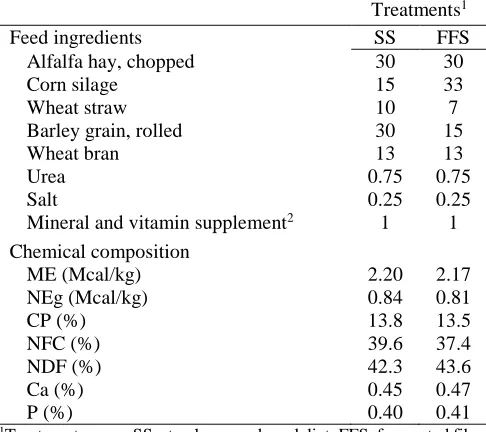
Table 1. Feed ingredients and chemical composition of the experimental diets (% of DM)
Treatments1
Feed ingredients SS FFS
Alfalfa hay, chopped 30 30
Corn silage 15 33
Wheat straw 10 7
Barley grain, rolled 30 15
Wheat bran 13 13
Urea 0.75 0.75
Salt 0.25 0.25
Mineral and vitamin supplement2 1 1 Chemical composition
ME (Mcal/kg) 2.20 2.17
NEg (Mcal/kg) 0.84 0.81
CP (%) 13.8 13.5
NFC (%) 39.6 37.4
NDF (%) 42.3 43.6
Ca (%) 0.45 0.47
P (%) 0.40 0.41
1Treatments were; SS, starch source based diet; FFS, fermented fiber
source based diet
2Contained per kilogram of supplement: 200,000 IU of vitamin A,
75,000 IU of vitamin D, 2.500 IU of vitamin E, 2g of Mn, 160 g of Ca, 7.2 g of Zn, 60 g of P, 21 g of Mg, 20 g of Na, 1.75 g of Fe, 20 mg of Co, 1 g of Cu, 100 mg of I, and 3 mg of Se.
sed diet (SS) vs. corn silage based diet (FFS)]. The feed ingredients are listed in Table 1. The animals were kept in individual stanchions and had free access to water. The study lasted 10 weeks, with the first week as the adaptation period and 9 weeks for data collection. Orts were collected and weights recorded once daily at 07:30 h and the feeding rate was adjusted daily to yield orts of about 5-10% of intake. The animals were cared for in accordance with the practices outlined in the Guide for the Care and Use of Agricultural Animals in Agricul-tural Research and Teaching (FASS, 1999).
Experimental procedures and chemical analyses
21 morning meal on day 30 of the experiment. Ruminal
fluid samples were squeezed through a four-layer cheesecloth and pH was measured immediately using a portable pH meter with a combination electrode. Rumi-nal fluid (8-mL aliquots) was preserved with 0.2 mL of 50% sulfuric acid and stored at -20°C for VFA analysis. The VFA analysis was carried out by using gas chroma-tography (Varian 3700; Varian Specialties Ltd., Brock-ville, Ontario, Canada) with a 15 m (0.53 mm i.e.) fused silica column (DBFFAP column; J and W Scientific, Folsom, CA).
Statistical analysis
Data were analyzed using PROC Mixed (SAS, 2000). The following model was used for variables which there were repeated measurements over time:
Yijk = µ + Ci + Tj + Zk + ZTjk + εijk; where Yijk is the dependent variable, µ is the overall mean, Ci is the effect of calf i, Tj is the effect of treatment j, Zk is the effect of sampling time k, ZTjk is the interaction between time k and treatment j and εijk is the residual error. All terms were considered fixed except for Ci and εijk which was considered as random effects. Differences between least square means were considered significant at P < 0.05 and differences were considered to indicate a trend to-ward significance at 0.05 < P < 0.10.
Results
Feed intake, daily gain and feed efficiency
Dry matter intake (Table 2) was greater in FFS
compar-Table 2. Least square means for the intake and feed conver-sion ratio in Holstein male calves fed starch based (SS) or fer-mented fiber (FFS) based diets
Treatments1
SE P-value SS FFS
Dry matter intake (kg d-1) 7.83 8.21 5.6 0.03 Daily gain (kg d-1) 1.18 1.09 0.3 0.07 Feed conversion ratio (FCR) 6.64 7.53 0.07 0.05
ed to SS-fed calves and average daily gain was tended to be different (P = 0.07). The mean FCR was 7.5 and 6.6 for FFS and SS treatments, respectively (P < 0. 05). Although feed intake was greater in FFS group, better FCR was achieved in SS treatment, showing better feed efficiency in starch-based diets.
Growth rate, health parameters, rumen
fermentation, and plasma metabolites
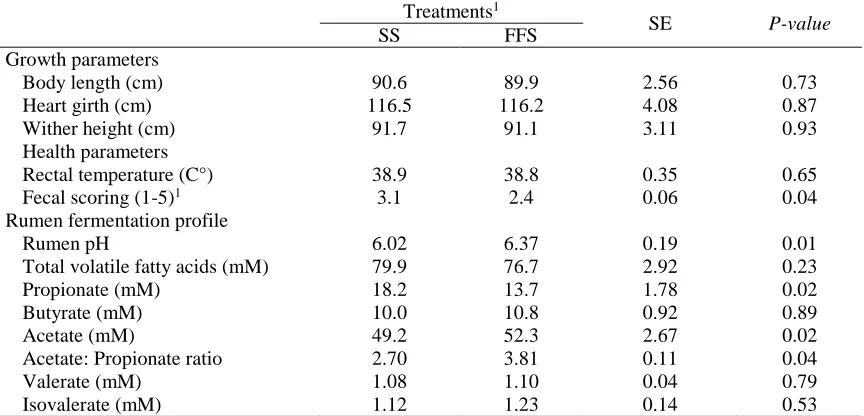
Growth indices (body length, withers height and heart girth) did not differ by feeding different experimental diets (Table 3). Rectal temperature was not statistically different between treatments (P >0.05). The starch-fed animals produced feces of lower consistency (fecal score = 3.1) compared to the calves fed the fermented fiber diet (fecal score = 2.4) (P < 0.05). Total VFA pro-duction did not differ between experimental diets. Ace-tate was increased in FFS, propionate was increased in SS diet (P < 0.05) and the ratio of acetate to propionate was increased in FFS vs. SS fed group. No difference for branched-chain volatile fatty acids, i.e. valerate and iso-valericacids,were found between treatments (Table
Table 3. Least square means for growth parameters, health indicators and rumen fermentation profile in Holstein male calves fed starch (SS) based versus fermented fiber (FFS) based diets
Treatments1
SE P-value
SS FFS
Growth parameters
Body length (cm) 90.6 89.9 2.56 0.73
Heart girth (cm) 116.5 116.2 4.08 0.87
Wither height (cm) 91.7 91.1 3.11 0.93
Health parameters
Rectal temperature (C°) 38.9 38.8 0.35 0.65
Fecal scoring (1-5)1 3.1 2.4 0.06 0.04
Rumen fermentation profile
Rumen pH 6.02 6.37 0.19 0.01
Total volatile fatty acids (mM) 79.9 76.7 2.92 0.23
Propionate (mM) 18.2 13.7 1.78 0.02
Butyrate (mM) 10.0 10.8 0.92 0.89
Acetate (mM) 49.2 52.3 2.67 0.02
Acetate: Propionate ratio 2.70 3.81 0.11 0.04
Valerate (mM) 1.08 1.10 0.04 0.79
Isovalerate (mM) 1.12 1.23 0.14 0.53
1Fecal scoring was scales 1-5 as follow; scale: 1 = normal; 2 = soft to loose; 3 = loose to watery; 4 = watery, mucous and
22
Table 4. Least square means for blood metabolites and insu-lin concentrations in calves fed starch based (SS) or fer-mented fiber (FFS) based diets
Treatments1
SE P-value SS FFS
Glucose (mg dL-1) 86.21 73.57 1.26 0.01 NEFA (mmol L-1) 0.64 0.67 0.09 0.68 BHB (mmol L-1) 0.66 0.78 0.05 0.03 Insulin (µIU mL-1) 28.2 26.1 0.87 0.02
3). The ruminal pH was higher in FFS compared to SS treatment (P < 0.05). Plasma glucose and insulin con-centrations were higher but BHB levels were lower in SS compared to FFS treatment (Table 4). Plasma NEFA levels were not affected by the diets (Table 4).
Discussion
A starch based diet was compared with a fermented fi-ber based diet in growing bull calves. The SS diet re-sulted in lower DMI compared to the FFS based diet. The high starch diets are rapidly fermented in the rumen, leading to high concentrations of VFA in the ruminal fluid which has potential to reduce the ruminal pH (Beauchemin et al., 2001). Barley grain is rapidly mented in the rumen. Higher ruminal carbohydrate fer-mentation rates often result in DMI reduction (McCar-thy et al., 1989; Aldrich et al., 1993; Mitzner et al., 1994), mostly due to high concentration of propionate in animal fed high levels of barley which is called with hypophagic effect and to lowered ruminal pH (Allen et al., 2009). Ruminal pH also was lower in SS calves which might be related to more substrate being present for microbial digestion (Oliveira et al., 1993; Plascencia et al., 1996).
Although feed intake was lower in SS calves com-pared to FFS based diet, feed efficiency was better, sug-gesting that starch based diets has the potential to im-prove weight gain and consequently feed efficiency, probably as a result of VFA profile produced in the ru-men (Beever, 1993). In this study, propionate concen-tration was higher in SS calves compared with the higher acetate concentration in FFS-fed animals. In con-tradiction to our results, Popova et al. (2011) reported that high fiber diet increased acetate level in the feedlot bulls without affecting the propionate concentration. This might be related to the level of carbohydrate fed to animals in these studies. In the present study, the carbo-hydrate source did not affect the total VFA production. It may be suggested that FFS could produce the same amount of VFA in comparison to SS; but the individual VFA were different between the diets.
Plasmaglucoseconcentrationwas higher by 17% in
SS compared with FFS diet, mainly as a result of higher propionate availability for gluconeogenesis. Corn silage fed to the calves in the present study is a rich source of FNDF. The fermented fiber source based diet increased plasma BHB and reduced glucose concentration. Rumi-nal butyrate concentration is mostly related to the fiber content of the diet (Silveira et al., 2007). Most of the acetate and all the propionate are transported to the liver, but a proportion of butyrate is converted to β-hydroxy-butyrate in the ruminal epithelium (Rogers and Davis, 1982). Plasma insulin concentration was higher in SS calves. Typically ruminants obtain most of their glucose (43 to 77%) through hepatic gluconeogenesis, primarily from propionate (Amaral et al., 1990). Duodenal infu-sion of glucose increased basal plasma concentrations of glucose and insulin (Lemosquet et al., 1997); there-fore, higher blood glucose concentration in SS calves may be a cause of higher plasma insulin secretion in these animals. Propionate appears to be more potent than glucose in stimulating insulin secretion (Brock-man, 1978); therefore, it seems that in addition to the stimulatory effect of glucose, the effects of VFA pattern also need to be considered. Higher DMI in FFS calves did not compensate for lower glucogenic precursor and subsequently glucose concentration. Probably greater concentration of BHB in fermented fiber based diet neg-atively affected insulin secretion. Therefore, higher feed intake may not result in higher blood glucose and insulin concentrations in ruminants and probably VFA pattern produced in the rumen may contribute to the energy sta-tus of the animal.
Conclusions
The high fermentable fiber improved the fecal score, but the lower feed efficiency and plasma glucose concentra-tion suggested lower efficiency compared to high starch diets in growing Holstein bull calves. Further research is needed to evaluate the effects of starch and fermenta-ble fiber supplied by various feedstuffs.
Acknowledgments
The authors are grateful to Arak University for financial supports of the present study. The authors also acknowledge Dr. A. Tajik for his comments in revising the manuscript.
References
23 Allen, M.S., 1997. Relationship between fermentation acid
production in the rumen and the requirement for physically effective fiber. Journal of Dairy Science 80, 1447-1462.
Allen, M.S., Bradford, B.J., Oba, M., 2009. Board invited re-view: The hepatic oxidation theory of the control of feed intake and its application to ruminants. Journal of Animal Science, 87, 3317-34.
Amaral, D.M., Veenhuizen, J.J., Drackley, J.K., 1990. Metab-olism of propionate, glucose, and carbon dioxide as affected by exogenous glucose in dairy cows at energy equilibrium. Journal of Dairy Science 73, 1244-1254.
Association of Official Agricultural Chemists, 1995. Official Methods of Analysis, 16th ed. Association of Official Ana-lytical Chemists, Arlington, VA, USA.
Baker, M.J., Hogue, D.E., Thonney, M.L., 2009. Effect of type and length of dietary fiber on growth, efficiency and carcass characteristics of feedlot cattle. Proceedings of the Cornell Nutrition Conference, Ithaca, NY, 99-110.
Beauchemin, K.A., Yang, W.Z., Rode, L.M., 2001. Effects of barley grain processing on the site and extent of digestion of beef feedlot finishing diets. Journal of Animal Science 79, 1925–1936.
Beever, D.E., 1993. Rumen function. In: Forbes, J.M., France, J., (Eds.), Quantitative Aspects of Ruminant Diges-tion and Metabolism. CAB InternaDiges-tional, Wallingford, UK, pp. 187-215.
Brockman, R.P., 1978. Roles of glucagon and insulin in the regulation of metabolism in ruminants – “A review” Cana-dian Veterinary Journal 19, 55-62.
Burken, D.B., 2014. New approaches to corn silage use in beef cattle finishing diets. Dissertation. University of Ne-braska.
FASS, 1999. Guide for the Care and Use of Agricultural An-imals in Agricultural Research and Teaching, “1st Revised Ed. Federation of Animal Science Societies”. Savoy, IL, USA.
Gandra, J.R., Freitas, Jr, J.E, Barletta, A.R.V., Maturana, Filho, M., Gimenes, L.U., Vilela, F.G., Baruselli, P.S., Renno, F.P., 2011. Productive performance, nutrient diges-tion and metabolism of Holstein (Bos taurus) and Nellore (Bos indicus) cattle and Mediterranean buffaloes (Bubalis bubalis) fed with corn silage based diets. Livestock Science 140, 283-291.
Hogue, D.E., 1994. Further observations on feeding highly productive sheep. Proceedings of the Cornell Nutrition Conference, Ithaca, NY, USA.
Kimball, S.R., Vary, T.C., Jefferson, L.S., 1994. Regulation of protein synthesis by insulin. Annual Reviews of Physiol-ogy 56, 321–348.
Lemosquet, S., Rideau, N., Rulquin, H., 1997. Effects of a duodenal glucose infusion on the relationship between plasma concentrations of glucose and insulin in dairy cows. Journal of Dairy Science 80, 2854–2865.
Lesmeister, K.E., Heinrichs, A.J., 2005. Effects of adding ex-tra molasses to a texturized calf starter on rumen develop-ment, growth characteristics, and blood parameters in neo-natal dairy calves. Journal of Dairy Science 88, 411–418.
McCarthy, R.D., Klusmeyer, T.H., Vicini, J.L., 1989. Effects of source of protein and carbohydrates on ruminal fermen-tation and passage of nutrients to the small intestine of lac-tating cows. Journal of Dairy Science 72, 2002–2016.
Mitzner, K.C., Owen, F.G., Grant, R.J., 1994. Comparison of sorghum and corn grains in early and mid-lactation diets for dairy cows. Journal of Dairy Science 77, 1044–1051.
Nocek, J.E., Tamminga, S., 1991. Site of digestion of starch in the gastrointestinal tract of dairy cows and its effect on milk yield and composition. Journal of Dairy Science 74, 3598–3629.
Oba, M., Allen, M.S., 1999. Evaluation of the importance of the digestibility of neutral detergent fiber from forage: ef-fects on dry matter intake and milk yield of dairy cows. Journal of Dairy Science 82, 589-596.
Oliveira, J.S., Huber, J.T., Ben-Ghedalia, D., 1993. Influence of sorghum grain processing on performance of lactating dairy cows. Journal of Dairy Science 76, 575-581.
Owens, F.N., Secrist, D.S., Hill, W.J., 1998. Acidosis in cat-tle: A review. Journal of Animal Science 76, 275–286.
Plascencia, A., Zinn, R.A., 1996. Influence of flake density on the feeding value of steam-processed corn in diets for lactating cows. Journal of Animal Science 74, 310-316.
Popova, M., Martin, C., Eugene, M., Mailon, M.M., Doreau, M., Morgavi, D.P., 2011. Effect of fiber- and starch-rich fin-ishing diets on methanogenic Archaea diversity and activity in the rumen of feedlot bulls. Animal Feed Science and Technology 166 and 167, 113– 121.
Robinson, P.H., Kennelly, J.J., 1989. Influence of ammoniat-ing of high moisture barley on its in situ rumen degradation and influence on rumen fermentation in dairy cows. Cana-dian Journal of Animal Science 68, 839–851.
Rogers, J.A., Davis, C.L., 1982. Rumen volatile fatty acid production and nutrient utilization in steers fed a diet sup-plemented with sodium bicarbonate and monensin. Journal of Dairy Science 65, 944-952.
Sano, H., Takebayashi, A., Kodama, Y., 1999. Effects of feed restriction and cold exposure on glucose metabolism in re-sponse to feeding and insulin in sheep. Journal of Animal Science 77, 2564-2573.
24
Schotthofer, M.A., Thonney, M.L., Hogue, D.E., 2007. Effect of level of fermentable NDF on feed intake and production of lactating ewes. Journal of Animal Science 85 Suppl. 1:180 (Abstr.).
Silveira, C., Oba, M., Yang, W.Z., 2007.Selection of barley grain affects ruminal fermentation, starch digestibility, and productivity of lactating dairy cows. Journal of Dairy Sci-ence 90, 2860–2869.
Van Soest, P.J., Roberts, J.B., Lewis, B.A., 1991. Methods of dietary fiber, neutral detergent fiber and non-starch polysac-charides in relation to animal nutrition. Journal of Dairy Science 74, 3583–3597.
Communicating editor: Omid Dayani
هریج رثا
هیاپرب یاه
هبمکش ریمخت ،دشر ییاراک رب هدشریمخت فایلا ای هتساشن ی
یخرب و یا
تیلوباتم
هلاسوگ رد ینوخ یاه
نیاتشله رن یاه
.م
نب یمظاک
یرانچ
*
.ح ،قلطم ییادخ .م ،
ع
.
یمساق
.ا و
جاح
یدادادخ
کارا هاگشناد یزرواشک هدکشناد ،یماد مولع هورگ ،
کارا .ناریا ،
*
:کینورتکلا تسپ ،لوئسم هدنسیون
-m
هدیکچ
( هتساشن رثا
SS
) ( هدش ریمخت فایلا و
FFS
) هب هریج رد یژرنا توافتم عبنم ود ناونع هلاسوگ ی
نیاتشله رن یاه
هبمکش ریمخت دنور ،دشر درکلمع رب هجنسارف یخرب و نیلوسنا تظلغ و یا
نیدب .تفرگ رارق یسررب دروم ینوخ یاه م
،روظن
14 نزو نیگنایم اب( نیاتشله رن هلاسوگ سأر 1 / 2 ± 5 / 94 نس و مرگولیک 9
± 87 رامیت ود بلاق رد هتفه هد تدم هب )زور
اب رامیت ره( یشیامزآ 7
هریج .دنتفرگ ررق هدافتسا دروم )رارکت یشیامزآ یاهرامیت رد ییاذغ یاه
SS و FFS هب رب بیترت هیاپ رامیت رد کشخ هدام فرصم .دش هیهت ،هدش ولیس ترذ و هدز کطلغ وج هناد ی
SS هب نعم روط ی ( یراد 05 / 0 P< رد )
رامیت اب هسیاقم
FFS
( تفای شهاک 83 / 7 لباقم رد 21 / 8 رد ییاذغ لیدبت بیرض ندوب رت نییاپ دوجواب .)زور رد مرگولیک
هورگ
SS
اب هسیاقم رد
FFS ( 05 / 0 P<
رامیت ود نیب )هاگودج زا عافترا و ندرگ رود ،ندب لوط( دشر یاه هصخاش ،)
( دوب هباشم 05
/ 0
P>
رصم هورگ .) هتساشن یژرنا عبنم هدننک ف
یکبآ عوفدم یاراد یا ( یرت
1 / 3 هورگ اب هسیاقم رد )=
FFS ( 4 / 2 ( دندوب) 05 / 0 P<
هریج فرصم )
SS
هریج و تانویپورپ تظلغ شیازفا ببس
FFS
رد تاتسا تظلغ شیازفا ببس
نازیم و رتشیب یا هتساشن عبنم هدننک تفایرد رامیت رد نوخ زکولگ تظلغ .دش هبمکش عیام وب یسکوردیهاتب
زا رتمک تاریت
( دوب هدش ریمخت فایلا هدننک فرصم هورگ 05
/ 0
P<
نازیم هب نیلوسنا تظلغ .) 1
/ 2 یلیم ره رد یللملا نیب دحاو ورکیم رتیل
داد ناشن هعلاطم نیا زا لصاح جیاتن .تفای شیازفا هدش ریمخت فایلا اب هسیاقم رد یا هتساشن عبنم هدننک تفایرد رامیت رد ب هک هتساشن یژرنا عبنم هدننک تفایرد هورگ رد عوفدم تبوطر نازیم شیازفا و یفرصم کشخ هدام نازیم شهاک دوجو ا ا
،ی
یژرنا تیعضو دوبهب هنیمز رد یبسانم تیلباق یاراد هدش ریمخت فایلا عبنم اب هسیاقم رد یا هتساشن یژرنا عبنم زا هدافتسا وب یسکوردیهاتب نازیم شهاک هطساو هب ناویح دوبهب هب رجنم هجیتن رد و هدوب زکولگ و تانویپورپ تظلغ شیازفا و تاریت
هلاسوگ رد کاروخ فرصم ییاراک هریج اب هسیاقم رد نیاتشله رن یاه
هیاپ رب یاه یم ،هدش ریمخت فایلا ی