Available Online at www.aextj.com
Agricultural Extension Journal 2019; 3(2):91-95 RESEARCH ARTICLE
Comparative Study of Feeding Different Levels of Black Cumin (
Nigella sativa
) on
Growth Performance of COBB-500 Broilers
Hem Raj Dhakal1, Meghraj Tiwari2
1Sheep and Goat Research Program, Guthichaur, Jumla, Nepal, 2Animal Nutrition Division, Khumaltar, Lalitpur, Nepal
Received: 31-01-2019; Revised: 01-03-2019; Accepted: 21-04-2019 ABSTRACT
The present work was aimed to determine the comparative effect of feeding different levels of black cumin on growth, feed consumption, and feed efficiency of COBB-500 broiler. Three hundred and twenty, days-old straight run COBB-500 chicks from a lot of the same hatch were brooded in an electrically operated battery brooder for a period of 7 days, where pre-experimental diet was offered. On the 8th day, chicks having uniform body weight were randomly allocated into four dietary treatments with four replications (20 chicks in each). The isoproteinous and isocaloric formulated standard starter (1–10 days), grower (11–20 days), and finisher (21–42 days) diets were supplemented with different levels of black cumin of T1 – control, T2 – 0.25% black cumin, T3 – 0.5% black cumin, and T4 – 0.75% black cumin, respectively. The chicks were offered ad libitum treatment diets and clean drinking water. The desired data were recorded weekly, which included live weight, weight gain, feed consumption, and feed efficiency of broiler birds. The obtained data were subjected to statistical analysis under completely randomized design as per the methods of MSTAT. Final live weight of the birds was found highly significant (P < 0.01) for all treatment groups. Highest final weight gain (2244.59 g) was found in birds fed ration supplemented with 0.5% black cumin. Daily live weight of the birds was also found highly significant (P < 0.01) for all treatment groups. Highest daily live weight gain (60.27 g) was found in birds fed ration supplemented with 0.5% black cumin. Supplementation of black cumin in the broiler rations did not exhibit any significant effect (P > 0.05) on the total feed consumption. Feed conversion ratio was found significantly different (P < 0.01) for all treatment groups. It is, therefore, concluded that inclusion of black cumin in the broiler rations could be economical and efficient production of broilers.
Key words: Broiler and feed efficiency, Nigella sativa, COBB-500 broilers INTRODUCTION
Poultry keeping has been an important source of income to many households of Nepal. There is growing awareness of nutritive value of meat and eggs among people. Poultry products (meat and eggs) are a good source of food with high biological value. Therefore, poultry keeping is becoming an important business enterprise in both the urban and rural areas of Nepal. Chicken contributes about 14.5% of total meat production in
Address for correspondence:
Hem Raj Dhakal,
E-mail: [email protected]
the country and 98.5% of the total egg production (MoAD-2013/14).
In poultry farming, feeding is one of the key factors that determine successful productions. Increase in the production cost of meat is mainly due to the increasing cost of broiler feed which constituted around 70–75%.[1-6]
In the past, the major growth promoters added to the feed of broilers were antibiotics. However, due to their residues and subsequent occurrence of antibiotic-resistant bacteria, there is great interest in developing natural alternatives to antibiotic growth promoters. Recent biological trials of certain herbal formulations in India as growth promoters have shown encouraging results and some of the reports have demonstrated improvement with respect to weight gain, feed efficiency, lowered mortality, increased immunity, and increased livability in poultry birds. Furthermore, these herbal growth promoters have shown to exert therapeutic effects against liver damage due to feed contaminants like afflation. Various herbal products are being used as growth promoters in the poultry rations like garlic black cumin. Such herbal products have not yet been reported to contain cross-resistance to pathogens and residual effect in tissues. Nigella sativa (black seed or black cumin) is a small aromatic black seed which contains the essential fatty acid (linoleic acid) which is important for obtaining maximum body weight.[7-9]
Therefore, this experiment was designed to study the effect of different levels of black cumin (N. sativa) on growth performance of COBB-500 broiler.[10]
MATERIALS AND METHODS Experimental site and design
This study was carried out at Rameshwor Poultry Farm, Kawasoti-6, Nawalparasi, from March 1, 2014, to April 12, 2014. Day-old COBB-500 broiler chicks were group brooded using an electric battery brooder for 7 days and were fed on pre-experimental standard starter ration. A total of 320, 7-day-old chicks were allocated randomly to four different treatments with 80 chicks in each treatment. The experiment was designed in a completely randomized design with four replicates of each treatment. Each replication had 20 birds. The chicks were vaccinated with Litchi heart killed vaccine by subcutaneous injection (0.2 ml/chick) at the back of neck at the age of the 3rd day. The
new castle disease (ND) vaccine was a modified live vaccine consisting of F1 strain of ND virus for the initial vaccination against ND. This vaccine was given to chicks by ocular route (one drop/ chick) at the age of the 7th day. For revaccination against ND, the modified live Lasota ND virus vaccine was given in drinking water at the age of the 25th days. The infectious bursal disease (IBD) vaccine was a modified live vaccine containing intermediate form of IBD virus strain Georgia for both initial vaccinations at the age of the 14th day by eye drop method (1 drop/bird) and booster dose in drinking water at the age of the 21st day.
Experimental diet and shed management Broilers were fed isoproteinous and isocaloric formulated broiler standard starter, grower, and finisher diets (basal ration) supplemented with three different levels of black cumin. The dietary treatments were as follows:
• T1 (control) = basal ration
• T2 = basal ration + 0.25% black cumin • T3 = basal ration + 0.5% black cumin, and • T4 = basal ration + 0.75% black cumin.
Black cumin was grounded and mixed in the basal ration on weight basis in the desired proportion to make different treatment diets.
The broiler birds were raised up to the 6th week of
age. The experimental birds were fed (ad libitum) an experimental ration with different levels of black cumin. The experimental units were kept on a deep litter system in separate pens. The pens were thoroughly cleaned, whitewashed, and disinfected before putting the experimental chick into these. All the birds were provided similar management conditions such as floor space, temperature, relative humidity, ventilation, and light.
Observation and management
(2) liver, (3) gizzard, and (4) abdominal fat. After evisceration, relative weights (g) [(weight of organ/live body weight) ×100] of various internal organs such as liver, heart, gizzard, and abdominal fat of the slaughtered bird were recorded.
Data analysis
The data thus collected regarding dressing percentage and relative weights of heart, gizzard, liver, and abdominal fat were subjected to the analysis of variance technique in completely randomized design.[19] The differences in the
treatment means were compared by the Duncan’s multiple range test using computer program MSTAT-C basic version 1.3 (1975).
RESULTS AND DISCUSSION Body weight gain
The weight gain trend of experimental birds is given in Table 1 and Figure 1.
Table 1 showed that mean weekly cumulative live body weight was significantly (P < 0.05) different among different treatments from the 3rd week to 6th week. The result showed that final live weight of the birds was found highly significant (P < 0.01) for all treatment groups. Highest final weight (2244.59 g) was found in birds fed ration supplemented with 0.5% black cumin followed by ration supplemented with 0.75% black cumin (2218.33 g) and ration supplemented with 0.25% black cumin (2204.03 g) and the lowest final weight (2179.54 g) was found in broiler fed ration without black cumin (control group). Similarly, average daily gain of the birds was also found highly significant (P < 0.01) for all treatment groups. Highest average daily gain (60.27 g) was found in birds fed ration supplemented with 0.5% black cumin which was followed by ration supplemented with 0.75% black cumin (59.52 g) and ration supplemented with 0.25% black cumin (59.11 g) and the lowest average daily gain (58.41 g) was found in broiler fed ration without black cumin (T1).
Table 1: Weekly cumulative live weight of Cobb-500
Treatment Weekly cumulative live weight, g Average daily gain, g
Initial 2nd week 3rd week 4th week 5th week 6th week
T1 135.03 300.14 557.08b 985.14c 1525.14b 2179.54c 58.41c
T2 135.03 299.17 553.06b 1007.08ab 1539.17b 2204.03bc 59.11bc
T3 135.03 304.17 583.6a 1023.06a 1549.03b 2244.59ab 60.27ab
T4 135.03 299.58 558.06b 994.17bc 1541.11b 2218.33bc 59.52bc
F-value 08.58 40.71* 71.11** 34.83* 52.38* 52.38**
Probability >0.05 <0.05 <0.01 <0.05 <0.01 <0.01
CV, % 1.03 1.59 1.10 1.21 1.18 1.26
SEM 0.66 2.7 4.05 5.36 8.62 0.25
LSD (P<0.05) 15.65 19.32 32.57 45.88 1.31
Means in a column with different superscript differ significantly by DMRT (P<0.05), Where, BC: Black cumin, CV: Coefficient of variation, SEM: Standard error of mean, LSD: Least significant difference, *, **significant at 0.05 and 0.01 probability levels, respectively
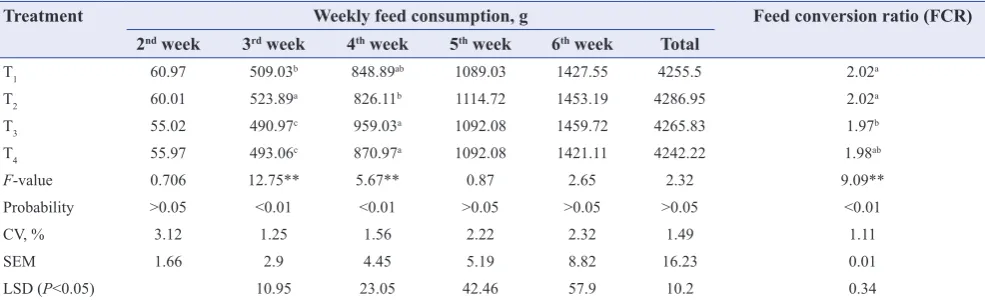
Table 2: Weekly feed consumption, total feed consumption, and FCR of Cobb-500 broilers
Treatment Weekly feed consumption, g Feed conversion ratio (FCR)
2nd week 3rd week 4th week 5th week 6th week Total
T1 60.97 509.03b 848.89ab 1089.03 1427.55 4255.5 2.02a
T2 60.01 523.89a 826.11b 1114.72 1453.19 4286.95 2.02a
T3 55.02 490.97c 959.03a 1092.08 1459.72 4265.83 1.97b
T4 55.97 493.06c 870.97a 1092.08 1421.11 4242.22 1.98ab
F-value 0.706 12.75** 5.67** 0.87 2.65 2.32 9.09**
Probability >0.05 <0.01 <0.01 >0.05 >0.05 >0.05 <0.01
CV, % 3.12 1.25 1.56 2.22 2.32 1.49 1.11
SEM 1.66 2.9 4.45 5.19 8.82 16.23 0.01
LSD (P<0.05) 10.95 23.05 42.46 57.9 10.2 0.34
Feed consumption
The feed consumption trend of experimental bird is given in Table 2 and Figure 2.
Table 2 showed that the mean weekly feed consumption was found statistically similar (P > 0.05) in the 2nd, 5th, and 6th weeks. However,
in the 3rd and 4th weeks, it was found significantly
different (P < 0.05). Statistically analyzed data revealed that the supplementation of black cumin in the broiler rations did not exhibit any significant effect (P > 0.05) on the total feed consumption of the birds of various treatment groups.
The data showed that feed conversion ratio (FCR) was found significantly different (p<0.01) for all treatment groups [Table 1]. Highest FCR (2.02) was found in birds fed ration supplemented with 0.25% black cumin. Similar FCR (2.02) was found in the case of control group which was followed by broilers fed ration supplemented with 0.75% black cumin (1.98) and the lowest FCR (1.97) was found in broilers fed ration supplemented with 0.5% black cumin. It concluded that the birds using ration supplemented with different levels of black cumin utilized their feed significantly (P < 0.05) more efficiently among the treatment groups.
These results are in close agreement with the findings of Kumar et al. (2010), Mahmood et al. (2009), Songsang et al. (2008), and Ahmad (2005). Mahmood et al. (2009) reported that the supplementation of garlic and black cumin in the broiler ration significantly (P < 0.05) improved the weight gain, live weight, and the FCR. Ahmad (2005) reported higher weight gain in broilers fed rations supplemented with black cumin. Siddig and Abdelati (2001) reported higher weight gain in broilers fed ration containing black cumin. The improvement in weight gain using black cumin in rations might be due to the ethyl ether extracts of N. sativa which inhibits the growth of intestinal bacteria such as Staphylococcus aureus and Escherichia coli as reported by Hanafy and Hatam (1991).[11-18] It contains the essential fatty
acid linoleic acid which is important for obtaining maximum body weight (Al-Jassir, 1992).
CONCLUSION
From the results of this experiment, it can be suggested that broiler diet can be successfully supplemented with 0.5% black cumin as a growth promoter for better growth performance, feed
Figure 2: Cumulative feed consumption of experimental birds
efficiency, and profitability without any adverse effect on growth performance of COBB-500 broiler production.
ACKNOWLEDGMENT
The authors would like to express their sincere thanks to RamesworAryal (owner of the poultry farm) for providing space and experimental birds for experiment conduction.
REFERENCES
1. Ahmad S. Comparative Efficiency of Garlic, Turmeric and Black Cumin as Growth Promoter in Broiler. Thesis, Department Poultry Sciences University of Agriculture. Faisalabad, Pakistan; 2005.
2. Agriculture Perspective Plan. National Planning Commission Secretariat, Singh Darbar. Kathmandu, Nepal: National Planning Commission; 1995.
3. Bhurtel, RB, Shah KP. Poultry Development in Nepal Constraints and Potentials. Nepal: Published by Winrock International Research Report Series No.45; 2000. p. 16.
4. Esmail SH. Black Cumin and Garlic Powder in Poultry Diets Source; 2012. Available from: http://www. worldpoultry.net/Broilers/Nutrition/2012/9/Black-cumin-&-garlicpowder-inpoultry-diets-WP010881W. [Last accessed on 2017 Dec 02].
5. Gardzielewska J, Pudyszak K, Majewska T, Jakubowska M, Pomianowski J. Effect of plant-supplemented feeding on fresh and frozen storage quality of broiler chicken meat. Electron J Pol Agric Univ 2003;6:12. Available from: http://www.ejpau. media. pl/series/volume6/issue2/animal/art-12.html. [Last accessed on 2004 Jan 15]
6. Ghosh TK. Efficiency of liver herbal product on counteracting aflatoxin on broiler birds. Indian Poult Rev 1992;32:33-4.
7. Guler T, Dalkilic OB, Ertas N, Ciftci M. The effect
of dietary black cumin seeds (Nigella Sativa L.) on
the performance of broilers. Asian Aust J Anim Sci 2006;19:425-30.
8. Hanafy MS, Hatem ME. Studies on the antimicrobial
activity of Nigella sativa seed (black cumin).
J Ethnopharmacol 1991;34:275-8.
9. Ihsan K. Effect of Different Levels of Black cumin
(N. sativa) Seeds on the Performance of Broilers.
Thesis, Department of Poultry Sciences, University of Agriculture. Faisalabad, Pakistan; 2003.
10. Kumar S, Sharadamma KC, Radhakrishna PM.
Effects of garlic active based growth promoter on
growth performance and specific pathogenic intestinal microbial counts of broiler chicks. Int J Poult Sci 2010;9:244-6.
11. Lee KW, Evarts H, Beynen AC. Essential oils in broiler nutrition. Int J Poult Sci 2004;3:738-52.
12. Mahmood S, Hassan MM, Alam M, Ahmad F.
Comparative efficacy of Nigella sativa and
Allium sativum as growth promoters in broilers. Int J Agric Biol 2009;11:775-8.
13. Meraj IC. Effect of Garlic and Neem Leaves Supplementation on the Performance of Broiler Chickens. Thesis, Department of Poultry Sciences, University of Agriculture. Faisalabad, Pakistan; 1998. 14. Ministry of Agricultural Development. Ministry of
Agriculture and Cooperative, Statistical Information on Nepalese Agriculture, 2008/09. Nepal; 2009.
15. MSTAT-C. Basic version 1.3. Michigan State University, USA; 1975.
16. Panda B, Mohapatra SC. Poultry Production. Vol. 10. New Delhi: Indian Council of Agricultural Research; 1989. p. 190.
17. Al-Jassir MS. Chemical composition and microflora of
black cumin (Nigella sativa L.) seeds growing in Saudi Arabia. Food Chem 1992;45:241-5.
18. Siddig RM, Abdelati K. Effect of Dietary Vitamin A
and N. Sativa on broiler chicks’ Performance. In:
Proceedings of the 10th Conference of the Association
of Institutions for Tropical Veterinary Medicine. Livestock. Copenhagen, Denmark: Community and Environment; 2001.
19. Songsang A, Suwanpugdee A, Onthong U, Sompong R,
Pimpontong P, Chotipun S, et al. Effect of Garlic
(Allium sativum) Supplementation in Diets of Broilers