Practices, Challenges and Implications of Teaching
and Assessment of Cognitive Skills in Higher
Education
Malik Ghulam Behlol* Wasyl Cajkler**
Abstract
The key research questions of the study were to check understanding, practices and challenges in teaching and assessment of higher order thinking skills to students enrolled in pre-service teacher education program. Sequential mixed method design was applied to collect quantitative and qualitative data with the help of structured questionnaire scale and semi-structured interview. Descriptive statistics were applied by calculating percentages and means; and thematic analysis was carried out by open coding, axial coding, analytical coding and selective coding. Quantitative and qualitative data was integrated to draw findings and conclusions of the study. The major conclusions of the study are that faculty in UK conceptualise Cognitive Skills (CS) as processing information, constructing understanding, application of knowledge, problem solving and thinking activity. They also incorporate CSs in teaching problem solving and reflective learning practices in which learners retrieve, generate, organise, and validate information. They assess CSs by open book examination, moderation of assignments, matching and comparing against Teacher Education Standards, and also provide effective feedback. However, faculty do not focus on ‘construction of theory’ and linking theory to practice in teaching and assessment.
Keywords: cognitive skills, teaching, assessment, implications.
*
Assistant Professor, Fatima Jinnah Women University Rawalpindi. Email: [email protected]
Introduction
embedded in the curriculum and instruction and also includes CSs (Martone & Sireci, 2009 ; Arem, 2006; Azzam, 2009; Barahal, 2008; Martone & Sireci, 2009).
Cognitive-Constructivist Viewpoint about Teaching and
Assessment
Developments in the field of cognitive science has brought substantive changes in the assessment practices.Traditional paper and pencil tests are increasingly seen as misaligned with active learning approaches (Sweller; 2009; Wenglinsky, 2004). The learner centered, dynamic, and activity based learning approaches have led to an alternative set of assessment practices which are different from traditional paper and pencil approaches for assessing student outcomes (Anderson, 1998; Shepard, 2000). Instead of testing memory and recall knowledge, we need to prepare and train teachers to test the higher order thinking skills of the students. Cognitive, Constructive and Social constructive theories have reconceptualised classroom learning that has significant influence on Curriculum, Learning, and Assessment. Cognitive theory emphasizes that existing knowledge structures and beliefs work to enable or impede new learning. Intelligent thought involves self-monitoring and awareness to construct and adjust new learning to solve problems instead of just accumulation of information. School learning should be authentic and connected to the real life situation that makes it more interesting and motivating for students. In addition to the development of cognitive abilities, classroom expectations and social norms should foster the development of important dispositions, such as students' willingness to persist in trying to solve difficult problems. According to Shepard (2000):
Content of assessment should match subject matter standards to improve the content and form of assessments. It may instantiate what it means to know and learn in each of the disciplines. It requires a broader range of assessment tools to address learning goals and processes that directly connect assessment to ongoing instruction. The reforms needed to devise more open-ended performance tasks to ensure that students are able to reason critically, to solve complex problems, and to apply their knowledge in real-world contexts. In addition, if instructional goals include developing students' metacognitive abilities, fostering important dispositions, and socializing students into the discourse and practices of academic disciplines, then it is essential that classroom routines and corresponding assessments reflect these goals as well. It means expanding the scope of data gathering to include observations, clinical interviews, reflective journals, projects, demonstrations, collections of student work, and students' self-evaluations, and systematic analysis of the available evidence by the teacher (Shepard, 2000).
Research Questions
Following three research questions set for the study
i. How do education faculty conceptualise and understand meanings of cognitive skills?
ii. How do education faculty practice teaching and assessment of cognitive skills?
iii. What are the major challenges to practice teaching and assessment of cognitive skills?
Methodology of the Study
there are different ways of inquiry to search answers of the research questions by using both qualitative and quantitative approaches.
Design of the Study
Sequential mixed method design was applied to conduct this study in two phases. The first phase was quantitative and the second phase was qualitative. The researcher collected data of first phase through questionnaire which was in numeric form. On the basis of quantitative data, an interview protocol was designed to crosscheck the findings of quantitative analysis. Consequently, qualitative and quantitative methods both were used to explore the answer of the research questions. All research questions were answered in both phases. In the first phase, awareness and understanding, practices in teaching and assessment, feedback, problems and challenges were answered through the four categories of questionnaire. In the second phase, interview protocol was designed to cross check the quantitative findings. The decision to take interviews of teachers after analyzing the quantitative data was made pragmatically on the basis of the contradictive quantitative results. The sources of triangulation in the study were the quantitative and qualitative responses of university teachers. According to Cohen and Manion(2008) triangulation is a technique that gives a balanced picture of human behavior in an unbiased and objective way.
Population and Sample of the Study
In the second phase, five faculty members were selected for interview applying criterion sampling technique. Only those faculty members who mostly disagreed with the statements of questionnaire were selected in order to cross check the data.
Research Instruments
Structured Questionnaire and semi-structured interview were used to collect the data of study. These instruments were developed by the research team and validated by the renowned experts of the University of Leicester and The Open University of Melton Kenes, UK. Instruments were also pilot tested before administration. Questionnaire consisted on four categories: demographic information, understanding, teaching and assessment of CSs. In qualitative approaches, interviews are considered as the most common tool for collection of data (Andrew & Halcomb, 2009). Semi-structured interview was used to get in-depth information on particular issues (Holloway & Wheeler, 2010). Pilot testing is useful to enhance the practical application, reliability and validity of the research instrument(Cohen, Manion & Morrison, 2007). Best method to pilot test the instrument is to consult it with people included in population but not in the sample to anticipate the concerning issues (Walliman, 2011). Internal consistency of the instruments was checked through the Cronbach Alpha. Reliability statistics showed that total number of items was fifty-one and value of Cronbach Alpha was .89. As Gay suggested that the value of Alpha i.e. 0.75 is acceptable and more than .80 of it is highly significant (Gay, 2000). The consistency of the qualitative data was checked by interrater reliability.
Data Collection and Analysis
from both sides. The coding matched well except for some minor differences. Approximately 90% yielded consistency in the coding differences were removed through discussions. Findings of quantitative and qualitative data were integrated to draw findings and conclusions of the study. Related ethical considerations were fully observed to conduct this study, and prior approval from the ethical committee of the UoL was obtained.
Data Analysis
Table 1
Demographic Variables (n=10)
Academic
qualification n= 10 Professional Qualification n=10 Experience (Year) n=10 Year teaching n=10 Role n=10 BA(hon),
B.Ed.
1 6-10 2 1-5 4 Lecturer 7
BSC(hons) 1 PGCE 9 11-15 2 6-10 4 Associate
professor 3
BSC,MSC 2 HE
fellowship
1 16-20 4 20-25 1
BSC,M.Ed 2 21-25 2 40 years 1
MA 2
Phd 2
Table 2
Section A: Understanding of Cognitive Skills
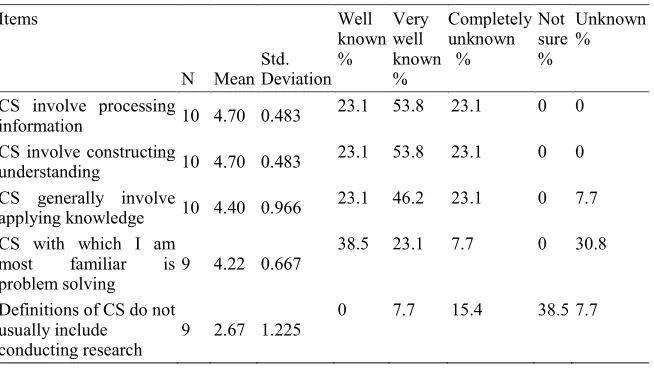
Items
N Mean Std. Deviation Well known % Very well known % Completely unknown % Not sure % Unknown %
CS involve processing
information 10 4.70 0.483
23.1 53.8 23.1 0 0
CS involve constructing
understanding 10 4.70 0.483
23.1 53.8 23.1 0 0
CS generally involve
applying knowledge 10 4.40 0.966
23.1 46.2 23.1 0 7.7
CS with which I am
most familiar is
problem solving
9 4.22 0.667
38.5 23.1 7.7 0 30.8
Definitions of CS do not usually include conducting research
9 2.67 1.225
0 7.7 15.4 38.5 7.7
Table (2) shows that faculty of education understand meanings of the components of CSs that involves processing information with mean (4.70), constructing understanding with mean (4.70), applying knowledge with mean (4.40), familiar about problem solving with mean (4.22), conducting research with mean (2.67). Highest mean score (4.70) also shows that 23.1% faculty are well known that CS involves constructing understanding. Lowest mean score (2.67) depicted that faculty do not involve CSs for conducting research. Only 7.7% faculty are very well known that CSs usually include conducting research however 38.5% are not sure about this concept.
Table 3
Teaching of Cognitive Skills
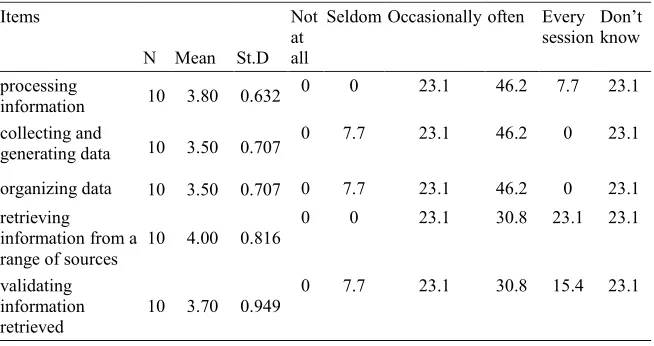
Items
N Mean St.D Not at all
Seldom Occasionally often Every session
Don’t know
processing
information 10 3.80 0.632
0 0 23.1 46.2 7.7 23.1
collecting and
generating data 10 3.50 0.707
0 7.7 23.1 46.2 0 23.1
organizing data 10 3.50 0.707 0 7.7 23.1 46.2 0 23.1
retrieving information from a range of sources
10 4.00 0.816
0 0 23.1 30.8 23.1 23.1
validating information retrieved
10 3.70 0.949
0 7.7 23.1 30.8 15.4 23.1
Table 4
Providing opportunities to students to construct understanding and practice of cognitive skills
Items
N Mean SD
Never Seldom Occasionally often Always Don’t know
analysing (e.g. teacher talk, problems in the classroom)
10 4.20 0.919
0 7.7 0 38.5 30.8 23.1
synthesizing 10 3.80 0.919 0 7.7 15.4 38.5 15.4 23.1
Reasoning 10 4.20 0.632 0 0 7.7 46.2 23.1 23.1
Table 5
Conducting research is a requirement to assess students’ skills
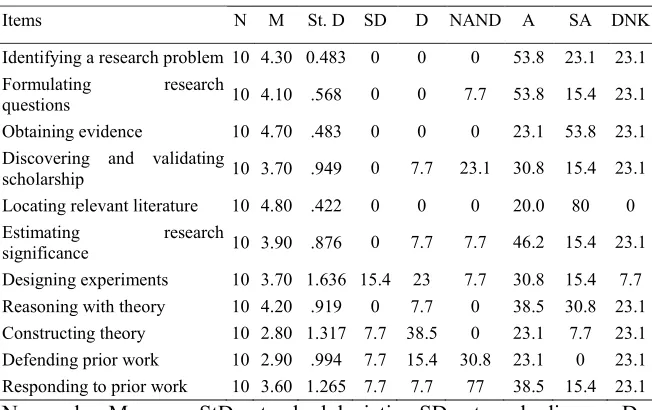
Items N M St. D SD D NAND A SA DNK
Identifying a research problem 10 4.30 0.483 0 0 0 53.8 23.1 23.1
Formulating research
questions 10 4.10 .568 0 0 7.7 53.8 15.4 23.1
Obtaining evidence 10 4.70 .483 0 0 0 23.1 53.8 23.1
Discovering and validating
scholarship 10 3.70 .949 0 7.7 23.1 30.8 15.4 23.1
Locating relevant literature 10 4.80 .422 0 0 0 20.0 80 0
Estimating research
significance 10 3.90 .876 0 7.7 7.7 46.2 15.4 23.1
Designing experiments 10 3.70 1.636 15.4 23 7.7 30.8 15.4 7.7
Reasoning with theory 10 4.20 .919 0 7.7 0 38.5 30.8 23.1
Constructing theory 10 2.80 1.317 7.7 38.5 0 23.1 7.7 23.1
Defending prior work 10 2.90 .994 7.7 15.4 30.8 23.1 0 23.1
Responding to prior work 10 3.60 1.265 7.7 7.7 77 38.5 15.4 23.1
N= number M= mean StD= standard deviation SD= strongly disagree D= disagree NAND=neither agree nor disagree A= agree SA= strongly agree DNK= do not know CS= cognitive skills
Table (6) reveals mean scores and percentages of faculty responses towards ‘conducting research is a requirement to assess students’ CSs. Mean score about ‘identifying research problem’ was (4.30) with 53.8 % agree, 23.1% strongly agree and 23.1% do not know about it. Mean score about ‘obtaining evidence’ was (4.70) with 23.1 % agree, 53.8 % strongly agree and 23.1% do not know about it. Mean score about ‘discovering and validating scholarship’ was (3.70) with 30.8 % agree, 15.4% strongly agree and 23.1% do not know about it. Highest mean score (4.80) calculated towards ‘locating relevant literature’ with 80% faculty strongly agree and 20% agree to the statement. Followed by high mean score (4.70) towards ‘obtaining evidence’ where 53.8% strongly agree while 23.1% agree to the statement. Mean score (4.30) identified towards ‘identifying a research problem’ where 53.8% agree with and 23.1% strongly agree.
Table 6
Solving problems, a significant part of teaching
Table (7) reveals views of teachers about ‘solving problem’ as a significance part of teaching. Highest mean score (4.50) was found about ‘identifying pedagogical problems’ with 38.5% faculty strongly agree and 38.5% agree to the statement. Mean score (4.40) identified towards ‘creating solutions’ and ‘finding ways of improving solutions’ with 38.5% faculty strongly agree and 30.8% agree to the statement. However, 40% strongly agree and 60 % agree towards ‘finding ways of improving solutions’. Mean score (4.20) showed that 61.5% faculty agree to the statement of ‘structuring the problem’ and 15.1% strongly agree.
Table 7
Cognitive skills in teacher education program
Items N M St.D SD D NAND A SA DNK
Know how to assess CS in pre-service teacher education programs.
10 3.80 0.422 0 0 15.4 61.5 0 23
My colleagues help me to construct tests to assess CS.
10 3.10 1.197 7.7 15.4 23.1 23.1 7.7 23
Pre-service teacher education prepared me to teach CSs effectively
10 3.00 1.563 15.4 15.4 15.4 23.1 0 7.7
Pre-service teacher education prepared me to assess CS effectively
10 2.70 1.494 15.4 23.1 23.1 7.7 7.7 23
N= number M= mean SD= standard deviation SD= strongly disagree D= disagree NAND=neither agree nor disagree A= agree SA= strongly agree DNK= do not know CS= cognitive skills
Items N M St. D SD D NAND A SA DNK
Identifying pedagogic problems 10 4.50 0.527 0 0 0 38.5 38.5 23.1
Structuring the problem 10 4.20 0.422 0 0 0 61.5 15.4 23.1
Creating solutions 10 4.40 0.699 0 0 7.7 30.8 38.5 23.1
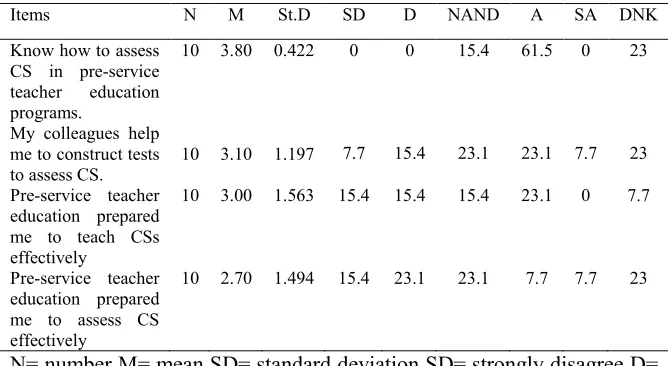
Section G of the scale comprises of four sections. First section is analysed and presented in table 8. Mean score (3.80) showed that faculty ‘know how to assess CSs in pre-service teacher education programs’ where 61.5% faculty agree to the statement. Mean score (3.10) calculated towards ‘my colleagues help me to construct tests to assess CSs’ with 23.1% faculty agree and 7.7% strongly agree to the statement. Mean score (3) identified towards ‘Pre-service teacher education prepared me to teach CSs effectively’ however lowest mean score (2.70) identified towards ‘Pre-service teacher education prepared me to assess CS effectively’ with 23.1% disagree and 15.4% strongly disagree to the statement. 23% faculty do not know and 15% neither agree nor disagree about ‘how to assess CSs in pre-service teacher education’ and ‘help of colleagues to construct test on CSs’.
Table 8
Practising Teaching of Cognitive Skills
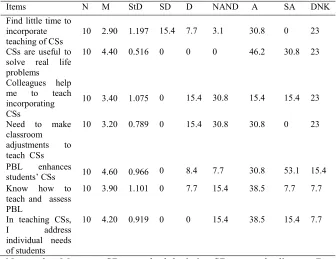
N= number M= mean SD= standard deviation SD= strongly disagree D= disagree NAND=neither agree nor disagree A= agree SA= strongly agree DNK= do not know PBL= problem based learning
Items N M StD SD D NAND A SA DNK
Find little time to incorporate teaching of CSs
10 2.90 1.197 15.4 7.7 3.1 30.8 0 23
CSs are useful to solve real life problems
10 4.40 0.516 0 0 0 46.2 30.8 23
Colleagues help
me to teach
incorporating CSs
10 3.40 1.075 0 15.4 30.8 15.4 15.4 23
Need to make classroom
adjustments to
teach CSs
10 3.20 0.789 0 15.4 30.8 30.8 0 23
PBL enhances
students’ CSs 10 4.60 0.966 0 8.4 7.7 30.8 53.1 15.4
Know how to
teach and assess PBL
10 3.90 1.101 0 7.7 15.4 38.5 7.7 7.7
In teaching CSs,
I address
individual needs of students
Table (9) presents faculty responses toward ‘teaching of CSs’. Highest mean score (4.60) identified on the statement that ‘PBL enhances students CSs’ with 30.8% agree and 23.1% strongly agree to the statement. Followed by mean score (4.40) on the statement that ‘CSs are useful to solve real life problems’ with 46.2% agree and 30.8% strongly agree to the statement. Mean score on ‘CSs useful to solve real problem, colleague helps me to teach CSs, need to make classroom adjustment to teach CSs, know how to teach and asses PBL, address individual needs of students’ was found above the average mean scores (4.40, 3.40, 3.20, 3.90, 4.20)
Table 9
Cognitive skills and assessment
Items N M StD SD DA NAND A SA DNK
Competent enough to construct tests incorporating CSs
10 3.10 1.287 0 7.7 23.1 7.7 30.8 7.7
Balance LO and
HO CSs in
designing teaching
10 4.00 0.943 0 0 23.1 38.5 7.7 7.7
Balance LO and
HO CSs in
designing assessments
10 4.00 0.943 0 0 23.1 38.5 7.7 7.7
Apply different
techniques to assess the learning of CSs.
10 3.70 0.483 0 0 23.1 53.8 0 23.1
Have difficulties to incorporate assessment of CSs
10 3.00 0.667 0 15.4 46.2 15.4 0 23
Test rubrics help to
assess CSs
objectively
10 3.00 1.563 15.4 15.4 15.4 23.1 23 7.7
Consult with my
students to set
criteria for the
assessment of
CSs.
10 2.10 0.738 15.4 38.5 23.1 0 0 23
Assess performance of students writing of journals
10 3.60 1.506 15.4 0 7.7 30.8 23.1 23
Prefer to use open
ended tasks for
assessment of CSs
10 3.90 0.876 0 7.7 7.7 46.2 15.4 23
Always try to align
teaching and
assessment
10 4.30 0.675 0 0 7.7 38.5 30.8 23
Consider the
affective state of
students in
assessing CSs.
10 3.80 1.135 0 7.7 23.1 30.8 7.7 7.7
Use assessment
results to modify teaching practices
10 4.50 0.527 0 0 0 38.5 38.5 23
My teaching
activities guides the assessment of CSs
10 4.20 1.229 0 0 30.8 15.4 15.4 15.4
Often study
researches on the assessment of CSs.
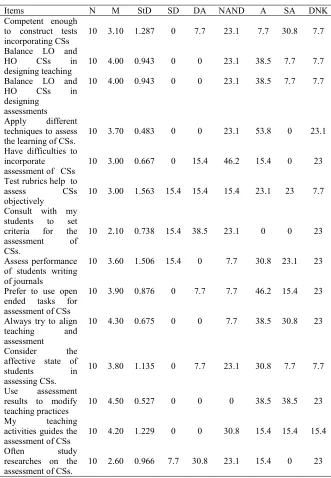
Table (10) depicts faculty views towards use of CSs in assessment. High mean score (4.50) identified towards ‘Use assessment results to modify teaching practices’ with 38.5% faculty agree and strongly agree to the statement. It is followed by mean score (4.30), where 38.5% faculty agree and 30.8% strongly agree to the statement that they ‘always try to align teaching and assessment’.
Responses of the faculty on the item ‘Competent enough to construct tests incorporating CSs, Balance LO and HO CSs in designing teaching, Balance LO and HO CSs in designing assessments, Apply different techniques to assess the learning of CSs, Have difficulties to incorporate assessment of CSs, Test rubrics help to assess CSs objectively, Assess performance of students writing of journals, Prefer to use open ended tasks for assessment of CSs, Consider the affective state of students in assessing CSs, teaching activities guides the assessment of CSs’ were found above average (3.10, 4.00, 4.00, 3.70, 3.00, 3.00, 3.60, 3.90, 3.80, 4.20).
15.4% of the faculty disagree and 46.2% neither agree nor disagree on the statement ‘Have difficulties to incorporate assessment of CSs. 38.5 of the faculty disagree and 23.1 neither agree nor disagree on the statement ‘Consult with my students to set criteria for the assessment of CSs’.
Table 10
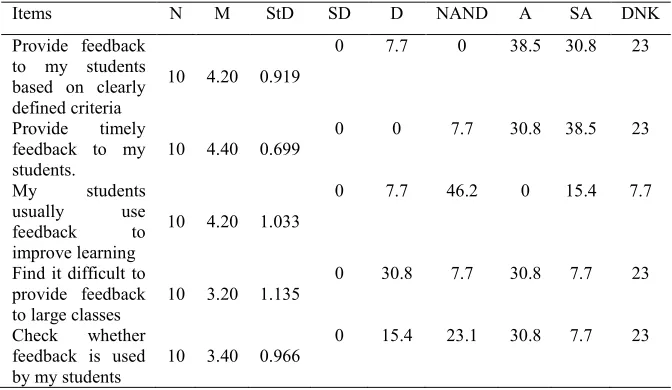
Cognitive Skills and Feedback to Students
Items N M StD SD D NAND A SA DNK
Provide feedback to my students based on clearly defined criteria
10 4.20 0.919
0 7.7 0 38.5 30.8 23
Provide timely
feedback to my students.
10 4.40 0.699
0 0 7.7 30.8 38.5 23
My students
usually use
feedback to
improve learning
10 4.20 1.033
0 7.7 46.2 0 15.4 7.7
Find it difficult to provide feedback to large classes
10 3.20 1.135
0 30.8 7.7 30.8 7.7 23
Check whether
feedback is used by my students
10 3.40 0.966
0 15.4 23.1 30.8 7.7 23
Table (11) presents details about utilization of CSs and feedback provided to students. Mean score (4.40) identified towards ‘Provide timely feedback to my students’ with 38.5% faculty strongly agree and 30.8% agree to the statement. Mean score (4.20) identified towards ‘Provide feedback to my students based on clearly defined criteria’ and ‘my students usually use feedback to improve learning’. 38.5% faculty agree and 30.8% strongly agree to the statement that ‘they provide feedback to students based on criteria and 15.4% strongly agree that their students usually use feedback to improve learning.
Mean score (3.40) calculated towards the statement that ‘check whether feedback is used by my students’ with 30.8% agree and 15.4% faculty disagree to the statement.
Low level of mean score (3.20) calculated towards the statement that ‘Find it difficult to provide feedback to large classes’ with 30.8% faculty disagree to the statement.
Qualitative Data Analysis
Demographics of the Study Participants
Five participants (four females and one male) participated in the study for the collection of qualitative data. Minimum level of the qualification of the participants was master and maximum was P.hD. Minimum experience of teaching was 6 years and the maximum duration of teaching experience was 20 years. Thematic analysis was conducted to analyse the qualitative data. Following main themes and sub themes emerged from the data.
Main themes Sub Themes
Background and experience Qualification/Specialization
Reason to join the profession
Meaning and understanding of CSs Understanding
Conceptualisation
Teaching of cognitive skills Methods of teaching
Collaboration with the colleges
Assessment of cognitive skills Criteria for assessment
Ways and methods of assessment
Grading the assignments
Reviewing assignments
Provision of feed back Written feedback
Oral feedback
Challenges in teaching and
assessment of CSs
Differences in backgrounds and context
Suggestions to promote teaching and assessment of cognitive skills
Application of theory
Careful planning
Teachers awareness and training
Detailed description of qualitative data is as under:
Background and Experiences
years teaching at primary school alongside taking classes at university. P4 worked for 14 years in University. P5 worked for 6 years at Secondary School to teach Mathematics before joining University. Three out of five participants have educational background in Educational Psychology, one in Geography and one in Mathematics.
Reason for Joining Teacher Education P1 viewed, he joined teaching profession because of inclination and interest of research in pedagogy of Geography. P2 highlighted that she opted in teaching profession because of her previous experiences and work as Teacher Assistant. P3 told that her father and mother were also teachers, and they motivated her to opt for this profession. P5 stated that she joined this profession because of her interest and enjoyment to work and teach adults.
Meaning and understanding of Cognitive Skills
This theme interprets meaning, understanding and definition of CSs in the light of the views of participants. All of the participants have understanding of CSs and they defined it in different ways. According to P1, “it is a very broad area, to do something with the brain, remembering, analysing and interpreting things to solve problems”. He further elaborated, it includes critical thinking, reflective thinking creativity and analytical thinking, using knowledge etc. Prior information is very important to practice higher order CSs to solve problems. He differentiated between the metacognition and critical thinking skills by stating that metacognition is more about understanding or reflecting whereas critical thinking is about actually taking information and evaluating their strengthen and weaknesses in different situations and contexts. P2 defined CSs as learning, attaining information, concentration, analytical skills, problem solving and making connection with the learned knowledge. According to P3, it includes learning and processing information. P4 elaborated that CSs mean to “do something with thinking, thinking about thinking, problem solving, and organizational skills”.
Teaching of Cognitive Skills
Methods of teaching P1 shared that “setting focus of learning, teaching them basic information first and then asking students to apply knowledge to solve problems is the right approach to teach CSs”. He further added that engaging students through critical thinking is the best way to teach CSs. He added that it is “providing resources (soft, paper), matter and events, deciding about the quantity of data, how to work on the information, and then framing questions and exercises to conduct learning of CSs”. P2 stated that assessment comes at every stage and it starts from very beginning when a child enters in the schools. She added, “We get to know about the interests of children through assessment and we also know what they know before deciding what will be the next step. “Posing problem, providing opportunities of reflection, teacher confidence play a very important role in teaching of CSs”. P3 shared that she does not teach students only for knowledge and understanding but also educate them how to learn. She further elaborated that she prefers to become model for them and uses questioning to create higher order thinking and analysing information rather than just hearing.
Collaboration with the colleagues According to P1 and P2, they conduct informal dialogues with their colleagues to comprehend teaching problems in reference to CSs. P3 shared that they discuss and share teaching challenges with their colleagues to address them effective, logical and practical way. P5 viewed, they conduct formal and informal meetings to share teaching and assessment challenges, and also conduct one to one corridor discussion. P4 stated that these learning conversation in formal and informal setting help to address daily problems and challenges in teaching of higher order thinking skills. These discussions also help to engage students in critical discussion.
Assessment of Cognitive Skills
Participants shared their views on assessment of CSs, and they are explained under the following sub themes:
assessment by the faculty. Students are not allowed to challenge the academic judgement given by the faculty. A student below 40% is considered fail. Furthermore, they assess students’ observational skills and try to develop a sense of educational theory by critically analysing it. She highlighted that they assess the abilities and skills of the prospective teachers to work in different environment and dealing with students that have different backgrounds. P2 stated that “we also check how students interpret literature, apply it to promote theory and practice in teaching”.
Ways and Methods of Assessment According to P1, “assessment of CSs is more appropriate through writing report, project presentation, review of literature, problem solving tasks, reflective journals, research projects, and reflective assignments instead of formal tests. P2 elaborated that “It is not testing; I look upon how they respond to a question, process data, infer insight to solve problem or respond to situation. She also viewed that careful curriculum planning, structuring pattern of thinking and provision of basic skills of the subject also play an important role in teaching and assessment of CSs. P3 shared her views in these words “I have common sense and experience to assess them on assessment tasks and check them on individual basis. We observe them in classroom, evaluate assignment organisation, critical analyses to and draw findings and conclusions. P4 shared her experience in these lines “Somehow, we teach them to promote CSs by confidence building, observing, reflecting, critically analysing and problem solving ways.
Reviewing Assignments Participants also highlighted that the students’ assignments were reviewed after the evaluation of subject teacher. Teachers who review the assignments called moderator. According to P2, Faculty fully cooperate in the review process and provide genuine input about the missing points and suggestions to support the students in learning and finalising their grades. P4 expressed that “students who get below 40% marks in assignment, then, it is reviewed by the other faculty members to declare the repetition or promotion decision. They give their opinion and if someone failed the assignment, other colleagues check and put their comments and we make a decision”. Students are not allowed to challenge academic judgement of the teachers.
Provision of Feedback
Feedback is very essential part of teaching and learning process. Themes and sub-themes emerged from the participants’ views are as under:
Written feedback All the participants elaborated that they provide feedback in written form on the assignments/projects, and also provide oral Feedback about teaching, classroom management, research and assessment activities by identifying their strengths and weaknesses. P2 stated that detailed Feedback written on the hard copies by posing questions, suggesting helping material, practical tips to enhance learning of the prospective teachers to learn the art of profession. P3 viewed that Feedback sheet is handed over to students consisting on the blocks about writing styles, structuring and organisation, identifying gaps, critical analysis, and suggestions for improvement. P4 stated that Feedback is on the pattern of ‘scaffolding learning’ to help students to enhance their learning. Oral Feedback, according to P5 is provided after the observation of lesson, student teacher meeting to share achievements and problems to enhance the confidence of students.
to be covered by the students. According to P5, coversheet on the assignment attached by the student also explains how and to what extent feedback has been utilised by the student. In case of major observation, student has been asked to repeat the assignment.
Challenges in Teaching and Assessment of Cognitive Skills
Every society has challenges and obstacles in various fields to achieve the targets. Same is in the field of teacher education i.e. these challenges are of academic, pedagogical, research, management, relationship and linking theory to practice nature.
Differences in backgrounds and context The majority of the participants’ highlighted that variety in background of the prospective teachers joining teacher education program is major challenge. They viewed that it is difficult for them to teach students with the background other than the social sciences. For instance, P2 stated that writing competencies, literature review, Science background, report writing skills are the major issues and challenges. P3 highlighted on the same issue in these words, “Every student is individual and has specific contextual background, temperaments that is required to be comprehended and addressed for the preparation of professionals. According to P1, to orientate students to conduct critical analysis is one of the major problems, and also to engage them to think and draw conclusions or solve problems by collecting, generating, processing, analysing, and interpreting information. Students are not tuned to do so as far as their learning in previous grades. It is also very challenging to connect theory to practice in learning the art of teaching profession.
Suggestions for the Improvement
The study participants shared some suggestion to improve the practices about teaching and assessment of CSs in higher education. These suggestions are discussed under the following sub themes.
Application of theory P3 and P5 stressed over the practical application of the theory. By identifying the gaps between theory and practice, they suggested developing connections between theory and practice is also one of the major challenges in teaching and assessment of cognitive skills.
Session on cognitive skills P4 suggested to conduct a session on CSs and said, “Perhaps it would be useful as part of professional development. P5 also talked about the articulation and application of Bloom taxonomy.
Discussion
Quantitative and qualitative data triangulated and discussed under the headings of understanding of CSs, teaching of CSs, assessment of CSs and feedback practices.
It is revealed from quantitative data analysis that faculty thinks that CSs involve processing information, constructing understanding, application of knowledge and problem solving. These findings are corroborated with qualitative data analysis where all of the faculty members were of the view that CSs are related to remembering, processing information, thinking, analysing, interpreting, problem solving, reflecting and then it goes with understanding. Prior information is also important to conduct these processes. However, it is identified through quantitative and verified from the qualitative analysis that faculty thinks that CSs do not include ‘conducting research’ a component of CSs. It is also revealed that metacognition is more about understanding or reflecting whereas critical thinking is about actually taking information and evaluating their strengthen and weaknesses in different situations and contexts.
to teach CSs. Faculty was of the view that they prefer higher order thinking skills and analyze information. These findings are corroborated to cognitive theory that established that existing knowledge structures and beliefs work to support or impede new learning. Intelligent thought involves self-monitoring and awareness about when and how to use skills that promote expertise in coherent way of thinking and representing problems, not just as an accumulation of information. Critical thinking to CSs may enhance teaching and conceptual development for not only solution of problems rather may lead to innovation and creativity. Teachers are required to be competent enough to pose questions and engage students to reflect, analyse and induct and deduct conclusions. Cognitivists, Constructivists and Social constructivist theorists also agree that learning is active, intentional and intelligent activity to construct meaning in contrast to behaviorist mechanical approach of stimulus response connection. Although faculty agreed to the incorporation of CSs into teaching, however, they find little time to adjust it in classroom teaching.
It is concluded that they assess CSs in ‘locating relevant literature’ and ‘obtaining evidence’ that helps and guides to modify teaching practices. It was also revealed that the faculty is competent enough to construct tests that promote balanced assessment of lower order and higher order CSs. However, faculty do not focus on ‘construction of theory’ and linking theory to practice in teaching and assessment. And they also do not consult with their students to set criteria for assessment. Qualitative data contradicted quantitative data and revealed that they assess students’ observational skills and try to develop a sense of educational theory. Majority of the respondents agreed that they know how to assess CSs in teacher education program, however, they disagreed that pre-service teacher education program prepared them enough to assess CSs effectively.
minimum standards. Cognitive psychologists also recommend that open book examination, reflective journal, project assignments are more useful instead of traditional paper and pencil tests for active and meaningful learning. The learner centered, dynamic, and activity based learning and assessment approaches are more effective for the assessment of cognitive and higher order thinking skills(Shepard, 2000).
It is identified from quantitative data that faculty provide timely feedback to students based on clearly defined criteria’, and students usually use feedback to improve learning. Qualitative data also highlighted same opinions of faculty that they provide feedback to their students in written form as writing notes, strengths and weaknesses and targets for the next assignment. Contradictory views were found through qualitative data analysis about whether the students worked on the given feedback or not. Two of them told that they require a written report from the students and three of them viewed that they check the feedback incorporation in the next assignment instead of written report. They also viewed that feedback is provided on clearly defined criteria and students usually use it to improve learning.
Different academic backgrounds of the prospective teachers joining teacher education program was considered major challenge followed by writing competencies, analysing and reflective skills, collecting, organising and generating data for problem solving. Curriculum planning, building professional competencies are suggested to be enhanced for teaching and assessment of CSs. Linking theory to practice is an important to enhance teaching skills of the prospective teachers.
Recommendations
Following are the recommendations
Reforms are needed to devise more open-ended performance tasks to ensure that students are able to reason critically, to solve complex problems, and to apply their knowledge in real-world contexts. It means expanding the scope of data gathering to include observations, clinical interviews, reflective journals, projects, and demonstrations, collections of student work, and students' self-evaluations, and systematic analysis of the available evidence by the teacher.
Existing practices of high stake testing required to be replaced by dynamic, on-going and self-assessment practices. Teachers try their level best to raise the scores of students to meet political demands and satisfy the parents in reference to getting admission for attractive and high paying professions. These tests have a corrupting influence on students’ learning and leads to the de-skilling and de-professionalization of teachers.
Feedback for the learner may lead to self-correction and improvement. Only reporting of right and wrong answers to the learner, and the end-of-study test may not be enough. Observation feedback forms, as well as training in lesson analysis, will provide evaluation tools for supporting (and assessing) classroom practice.
References
Anderson, L. W., & Krathwohl, D. R. (Eds.). (2001). A taxonomy for learning, teaching, and assessing: A revision of Bloom’s Taxonomy of Educational Objectives. New York: Longman.
Andrew, S & Halcomb, E. J (2009). Mixed Methods Research for Nursing and the Health Sciences. Chichester, West Sussex Blackwell Publishing Ltd
Arem, G. (2006). Using student assessments in archery to increase higher-order thinking and student success. Strategies, 19(4), 34–38. Azzam, A. M. (2009). Why creativity now? A conversation with Sir Ken
Robinson. Educational Leadership, 67(1), 22-26.
Barahal, S. L. (2008). Thinking about thinking. Phi Delta Kappan, 90(4), 298–302.
Bashir, M. (2002). A study of examination system of Pakistan and development of a model for twenty first century (Doctoral dissertation, PMAS-Arid Agriculture University, Rawalpindi).
Biggs, J. (1996). Enhancing teaching through constructive alignment. Higher Education, 32(3), 347-364.
Brookhart, S.M. (2010). Assess higher order thinking skills in your classroom. ASCD, Alexandira, Virginia:
Cohen, L., Manion, L., & Morrison, K. (2013). Research methods in education. Routledge
Creswell, J. W. & Clark, V. L. P. (2007).Designing and Conducting Mixed Methods Research’ Sage Publications Ltd, USA.
Davis, D., Beyerlein, S.W. Leise, C., & Apple, D. K. (2005). Cognitive Domain, Faculty Development Series, Washington: Pacific Crest Foundation.
Gay, L. R. (2000). Educational Research. 5th ed. Merrill Publishing Company
Iqbal, B., Anwer, M. (2014). An exploratory study of assessment practices at B.ED (Hons) 4 years program. Unpublished research, USAID, Islamabad:
Martone, A., & Sireci, S. G. (2009). Evaluating alignment between curriculum, assessment, and instruction. Review of Educational Research, 79(4), 13-32.
Naeemullah, K., Muhammad, I. H., Muhammad, S., Uddin, M. N., & Shafqat, H. (2010). The managerial behavior of secondary school heads in Punjab (Pakistan). Educational Research and Reviews, 5(4), 186.
Patton, M. Q. (2002) Qualitative Research and Evaluation Methods. (3rd Edition) Thousand Oaks, CA: SAGE.
Shepard, L. A. (2000). Measuring achievement: What does it mean to test for robust understanding! Princeton, NJ: Policy Information Center, Educational Testing Service. Shepard, L. A. (2000). The Role of Assessment in a Learning Culture. Teaching and Learning, 229-253.
Sweller, J. (2009). Cognitive bases of human creativity. Educational Psychology Review,21(1), 11–19.
Vygotsky, L. S. (1978). Mind in society: The development of higher psychological processes. Cambridge, MA: Harvard University Press. Walliman, N. (2011) Your Research Project: Designing and planning
your work, ThousandOaks, CA: Sage Publications Ltd.
Wenglinsky, H. (2004). Facts or critical thinking skills? What NAEP results say. Educational Leadership, 62(1), 32–35.