127 International Journal of Transportation Engineering,
Vol.4/ No.2/ Autumn 2016
Estimating the Capacity of the Basic Freeway Section Using
Headway Method in Developing Countries (Case Study: Iran)
Soheil Sohrabi1, Khosrow Ovaici2, Mina Ghanbarikarekani3
Received: 24.11.2015 Accepted: 16.07.2016
Abstract:
Although there are remarkable differences in drivers’ behavior as well as vehicles characteristics, road capacity esti-mation methods in developing countries are same as developed ones. So, the discrepancy between the theoretical and practical values of capacity is inevitable. Although, capacity estimation methods can be classified based on numerous parameters, in developing countries, the availability of data is a remarkable factor to choose the appropriate method. Headway method is one of the most popular methods which is used to estimate capacity of basic freeways section regarding to the lack of available data in developing countries such as Iran. According to headway method theory, the distribution function of headways needs to be estimated in order to find the capacity of a road facility. However, in previous studies the mean of observed headway is used for capacity estimation.
The data applied in this study have been collected from Iran. Modelling had accomplished in 2 steps: 1) Filtering the input data that are related to following vehicles and just before queue. 2) Statistical modelling using the Minitab 16 software. Evaluating models by three parameters (applicability, validity and reasonability), it was proven that the log -normal distribution functions, is the best fit to observed data. According to results, the capacity of the basic freeway section is 12% less than the values proposed by HCM, which are the current bases for traffic studies in developing countries such as Iran.
Keywords:
Capacity, headway, following vehicle, follower vehicleCorresponding author E-mail: [email protected]
128
International Journal of Transportation Engineering, Vol.4/ No.2/ Autumn 2016
1. Introduction
Roadway Capacity estimation is one of the major as-pects in traffic engineering and many studies have been conducted around this subject. Typically capacity esti-mation is based on analysis of significant data bases or is in accordance with theoretical algorithms and Physics laws while some methods are based on simulation re-sults [Roess, Prassas and McShane, 2004]. The capacity and other flow characteristics depend heavily on driver behavior. Although, there are significant differences in drivers’ behavior and vehicles characteristics in devel-oping countries comparing with developed ones, HCM which is developed in United States is used directly for capacity studies around the world [Ashutosh, Senathip-athi and Madhu, 2013]. Consequently, the results are almost unreal in practice and may cause unprofitable constructions. On the other hand, lack of required infra-structures in developing countries leads to insufficient data availability in traffic studies.
According to the aforementioned explanations, in this study, the capacity of freeway for a developing country, Iran, will be estimated in order to investigate possible differences with the HCM proposed values. Differ-ent methods have been proposed for capacity estima-tion like headway methods, maximum observed flow method, probabilistic methods and etc. Considering all aspects such as data requirement, location choice and observation period that are more meaningful in devel-oping countries, time headway method is selected. Es -timating the capacity, on the basis of the models related to headway, is carried out by assuming constant vehicle attitudes. These models are able to estimate the capac-ity of only one lane. Indeed, the assumption of models related to headway, are the separate functions of lane in multi-lane roads. The headway models can be used for one lane in both stable and unstable flow. [Minderhoud, Botma and Bovy, 1996]
According to inverse relation of headway and flow rate, the maximum flow rate, in other words “capacity”, can be estimated using accepted headway of drivers’ in a traffic flow. In this study, drivers’ headway of follower vehicles and before queue is applied. In this case, the abnormal behavior of Iranian drivers in a congested flow will be eliminated. Followers’ vehicles are found by the well-known General Motors’ following model.
In order to estimate the capacity, the headway should be introduced as a deterministic value with the capa-bility of describing the drivers’ behavior. Although in previous studies in Iran the mean headway have been utilized, in this study the estimated distribution function of headways is used for finding the exclusive value of headway [Abtahi, Tamanaiee and Kermanshahi, 2011]. Finding the distribution function of headway is the vital part of this study, where eight well-known distribution functions in traffic studies are fitted to drivers’ headway data of Iran freeways and the best model is introduced. Distribution functions are validated using three param-eters_ applicability, validity and reasonability.
2. Literature Review
The headway attitudes were discussed in 1960s. Green-berg has found a connection between the microscopic traffic flow theory and the lognormal follower head -way distribution [Greenberg, 1966]. Branston 1976 and Buckley 1968 presented the models based on headway. These models are based on following drivers’ data at the time of perceiving the capacity level, and the com-patibility of the hypothesis and the observed data had been proven [Branston, 1976; Buckley, 1968].
Mei and Bullen presented different distribution func-tions for time headways measured on a four-lane high-way. According to their results, the lognormal distribu-tion with a shift of 0.3 or 0.4 seconds was the best fit for the time headways in high traffic volumes [Mei and Bullen, 1993]. Sadeghhosseini in 2002 investigated the time headways at flow rates varying from 140 to 1704 vehicles per hour per lane on a highway and suggest-ed the lognormal distribution [Sadeghhosseini, 2002]. Arasan and Koshy in 2003 determined the negative exponential distribution for headways distribution of urban arterial in India [Arasan and Koshy, 2003]. Bham and Ancha in 2006 analyzed the time headway of driv-ers in a basic freeway section and recommended the lognormal distribution for vehicles’ headway [Bham and Ancha, 2006].
129 International Journal of Transportation Engineering,
Vol.4/ No.2/ Autumn 2016 ent traffic lanes are the same [Zwahlen, Oner and Sura
-varam, 2007].
In addition to what has been mentioned, the empiri-cal models are other forms of headway models. These models are introduced by cumulative distribution func-tions. Some studies, which were focused on estimating mode, the median and the coefficient of variation have been conducted, that Buckley research in 1968 has been the most reputed one. Also, Breiman et al. in 1977 and Griffiths & Hunt in 1991 have carried out some re -search in this field [Breiman et al., 1977; Griffiths & Hunt, 1991].
It should be considered that the discrepancy between distribution functions and results in different countries and also variety of the proposed models are problems of the presented models. The reason of the mentioned problem is that the drivers’ behavior is completely dif-ferent and their sensitivity impacts on time headway. Also, statistical characteristics of the models have not been presented comprehensively. In empirical models, determining the statistical characteristics of models is complicated and they cannot be generalized. In addi-tion to what is expressed, Luttinen in 1996 investigated these models and demonstrated that the disadvantages of the headway models are interpreting of small data [Luttinen, 1996].
Although, the distribution function is used to model the drivers’ behavior for choosing the time headway in traffic flow, in Iran, capacity is estimated by the mean value of observed headways. [Abtahi, Tamanaiee and Kermanshahi, 2011]
3. Data Collection
In this study 2 types of data, macroscopic and micro-scopic data, are utilized. Macromicro-scopic parameters are mean speed, mean headway and flow, and in the form of microscopic parameters, vehicles speed, vehicle ac-celeration rate have been collected. The data related to macroscopic parameters are collected from the detec-tors which are available in Iran’s freeways. Collected data are available in form of mean headway of 5-minute intervals. According to current limitations in available data in Iran, the microscopic parameters have been col-lected by video-recording and image processing. Selected sections are base sections according to
high-way capacity manual (HCM) definition [TRB 2010] with 3-lanes and 120 km/hr speed limits. According to Base section definition of freeways, there is no access to studying sections. In Iran heavy vehicles are not al-lowed to use freeway facilities.
The total time needed for surveying the macroscopic parameters is considered one year in working days, and the time of surveying the microscopic parameters is 2-hour intervals in morning and evening in working days as well. The users of freeway in working days are commuters which are familiar to the road. All the data were provided in ordinary weather condition and dry pavement conditions.
According to the presented explanations, 3 sections have been selected, and related data will be used in this study.
4. Methodology
The following equations are bases for capacity estima-tion using headway models.
4
n h
hm p
(1)
m h
q 1
(Vehicle per second)
(2)
In these equations
:
ph
= The time headway between vehicle P and its next vehicle (sec)
m
h
= The mean headway of all the vehicles
q
= The vehicles’ flow rate
n
= The number of vehicles passing the section during time t
As it is obvious from the above equation, capacity i.e. the maximum flows that can
reasonably be estimated by reciprocal of the minimum headway. It would be possible to estimate
the minimum mean headway and the capacity, if the headway distribution of vehicles is
determined as a mathematics model.
In addition,
the vehicles’ headway depends on flow
characteristics. According to
Branston 1976 and Buckley 1968 hypotheses, vehicles at the capacity level cannot maneuver, so
they are following
[Branston, 1976; Buckley, 1968]
. In other words, headway distribution
function at the capacity level, are equal to the following
vehicles’
headway. This hypothesis has
been considered in most of headway models and this study. At the same time, according to
investigations in Iran as a developing country
, the drivers’
behavior is remarkably different in
period of time before queuing. In other word, the headway is significantly small at the time of
queue. Consequently, in this study, the data related to queue, will be eliminated as a new
hypothesis.
4.1
Following Vehicles
The car-following theories represent how vehicles follow others in an uninterrupted flow
and are known as the most common parameters fo
r driver’s
behavior definition. According to
these models, vehicles are categorized in two groups which are following and free. The following
vehicles cannot maneuver or change their direction, and their behavior depend on head vehicles
named
“
leader
”
. However, free vehicles can maneuver and move freely. Different models have
been introduced in this field up to now. According to limited available data in General Motors
Models have been chosen. [Tom and Krishna Rao, 2004]
General Motors presents the car-following definition regarding
two assumptions: 1)
The
higher speed the more distance, 2) Heeding to safe [Tom and Krishna Rao, 2004]
. The maximum
following time can be estimated by using the equations which have been presented by General
Motors. The equation 3
can be presented as:
[Tom and Krishna Rao, 2004]
t n v safe x t
n
x 1 1
(3)
Differentiating the above equation with respect to time,
t n a t
n v t n
v 1 1
(4)
In this equation:
t n x 1
= The distance between the (n+1) vehicle and previous vehicle in t
thsecond
(meters)
safe x
= Safe space distance in t
thsecond (meters)
(1)
4
n h
hm p
(1)
m h
q 1
(Vehicle per second)
(2)
In these equations
:
ph
= The time headway between vehicle P and its next vehicle (sec)
m
h
= The mean headway of all the vehicles
q
= The vehicles’ flow rate
n
= The number of vehicles passing the section during time t
As it is obvious from the above equation, capacity i.e. the maximum flows that can
reasonably be estimated by reciprocal of the minimum headway. It would be possible to estimate
the minimum mean headway and the capacity, if the headway distribution of vehicles is
determined as a mathematics model.
In addition,
the vehicles’ headway depends on flow
characteristics. According to
Branston 1976 and Buckley 1968 hypotheses, vehicles at the capacity level cannot maneuver, so
they are following
[Branston, 1976; Buckley, 1968]
. In other words, headway distribution
function at the capacity level, are equal to the following
vehicles’
headway. This hypothesis has
been considered in most of headway models and this study. At the same time, according to
investigations in Iran as a developing country
, the drivers’
behavior is remarkably different in
period of time before queuing. In other word, the headway is significantly small at the time of
queue. Consequently, in this study, the data related to queue, will be eliminated as a new
hypothesis.
4.1
Following Vehicles
The car-following theories represent how vehicles follow others in an uninterrupted flow
and are known as the most common parameters fo
r driver’s
behavior definition. According to
these models, vehicles are categorized in two groups which are following and free. The following
vehicles cannot maneuver or change their direction, and their behavior depend on head vehicles
named
“
leader
”
. However, free vehicles can maneuver and move freely. Different models have
been introduced in this field up to now. According to limited available data in General Motors
Models have been chosen. [Tom and Krishna Rao, 2004]
General Motors presents the car-following definition regarding
two assumptions: 1)
The
higher speed the more distance, 2) Heeding to safe [Tom and Krishna Rao, 2004]
. The maximum
following time can be estimated by using the equations which have been presented by General
Motors. The equation 3
can be presented as:
[Tom and Krishna Rao, 2004]
t n v safe x t
n
x 1 1
(3)
Differentiating the above equation with respect to time,
t n a t
n v t n
v 1 1
(4)
In this equation:
t n x 1
= The distance between the (n+1) vehicle and previous vehicle in t
thsecond
(meters)
safe x
= Safe space distance in t
thsecond (meters)
(Vehicle per second) (2)
In these equations:
hp = The time headway between vehicle P and its next
vehicle (sec)
hm = The mean headway of all the vehicles
q = The vehicles’ flow rate
n = The number of vehicles passing the section during time t
As it is obvious from the above equation, capacity i.e. the maximum flows that can reasonably be estimated by reciprocal of the minimum headway. It would be possible to estimate the minimum mean headway and the capacity, if the headway distribution of vehicles is determined as a mathematics model.
130
International Journal of Transportation Engineering, Vol.4/ No.2/ Autumn 2016
in most of headway models and this study. At the same time, according to investigations in Iran as a developing country, the drivers’ behavior is remarkably different in period of time before queuing. In other word, the head-way is significantly small at the time of queue. Conse -quently, in this study, the data related to queue, will be eliminated as a new hypothesis.
4.1 Following Vehicles
The car-following theories represent how vehicles fol-low others in an uninterrupted ffol-low and are known as the most common parameters for driver’s behavior defi -nition. According to these models, vehicles are catego-rized in two groups which are following and free. The following vehicles cannot maneuver or change their direction, and their behavior depend on head vehicles named “leader”. However, free vehicles can maneuver and move freely. Different models have been introduced in this field up to now. According to limited available data in General Motors Models have been chosen. [Tom and Krishna Rao, 2004]
General Motors presents the car-following definition regarding two assumptions: 1) The higher speed the more distance, 2) Heeding to safe [Tom and Krishna Rao, 2004]. The maximum following time can be esti -mated by using the equations which have been present-ed by General Motors. The equation 3 can be presentpresent-ed as: [Tom and Krishna Rao, 2004]
4
n h
hm p
(1)
m h
q 1
(Vehicle per second)
(2)
In these equations
:
ph
= The time headway between vehicle P and its next vehicle (sec)
m
h
= The mean headway of all the vehicles
q
= The vehicles’ flow rate
n
= The number of vehicles passing the section during time t
As it is obvious from the above equation, capacity i.e. the maximum flows that can
reasonably be estimated by reciprocal of the minimum headway. It would be possible to estimate
the minimum mean headway and the capacity, if the headway distribution of vehicles is
determined as a mathematics model.
In addition,
the vehicles’ headway depends on flow
characteristics. According to
Branston 1976 and Buckley 1968 hypotheses, vehicles at the capacity level cannot maneuver, so
they are following
[Branston, 1976; Buckley, 1968]
. In other words, headway distribution
function at the capacity level, are equal to the following
vehicles’
headway. This hypothesis has
been considered in most of headway models and this study. At the same time, according to
investigations in Iran as a developing country
, the drivers’
behavior is remarkably different in
period of time before queuing. In other word, the headway is significantly small at the time of
queue. Consequently, in this study, the data related to queue, will be eliminated as a new
hypothesis.
4.1
Following Vehicles
The car-following theories represent how vehicles follow others in an uninterrupted flow
and are known as the most common parameters fo
r driver’s
behavior definition. According to
these models, vehicles are categorized in two groups which are following and free. The following
vehicles cannot maneuver or change their direction, and their behavior depend on head vehicles
named
“
leader
”
. However, free vehicles can maneuver and move freely. Different models have
been introduced in this field up to now. According to limited available data in General Motors
Models have been chosen. [Tom and Krishna Rao, 2004]
General Motors presents the car-following definition regarding
two assumptions: 1)
The
higher speed the more distance, 2) Heeding to safe [Tom and Krishna Rao, 2004]
. The maximum
following time can be estimated by using the equations which have been presented by General
Motors. The equation 3
can be presented as:
[Tom and Krishna Rao, 2004]
t n v safe x t n
x 1 1
(3)
Differentiating the above equation with respect to time,
t n a t n v t n
v 1 1
(4)
In this equation:
t n x 1
= The distance between the (n+1) vehicle and previous vehicle in t
thsecond
(meters)
safe x
= Safe space distance in t
thsecond (meters)
(3)
Differentiating the above equation with respect to time,
4
n h
hm p
(1)
m h
q 1
(Vehicle per second)
(2)
In these equations
:
ph
= The time headway between vehicle P and its next vehicle (sec)
m
h
= The mean headway of all the vehicles
q
= The vehicles’ flow rate
n
= The number of vehicles passing the section during time t
As it is obvious from the above equation, capacity i.e. the maximum flows that can
reasonably be estimated by reciprocal of the minimum headway. It would be possible to estimate
the minimum mean headway and the capacity, if the headway distribution of vehicles is
determined as a mathematics model.
In addition,
the vehicles’ headway depends on flow
characteristics. According to
Branston 1976 and Buckley 1968 hypotheses, vehicles at the capacity level cannot maneuver, so
they are following
[Branston, 1976; Buckley, 1968]
. In other words, headway distribution
function at the capacity level, are equal to the following
vehicles’
headway. This hypothesis has
been considered in most of headway models and this study. At the same time, according to
investigations in Iran as a developing country
, the drivers’
behavior is remarkably different in
period of time before queuing. In other word, the headway is significantly small at the time of
queue. Consequently, in this study, the data related to queue, will be eliminated as a new
hypothesis.
4.1
Following Vehicles
The car-following theories represent how vehicles follow others in an uninterrupted flow
and are known as the most common parameters fo
r driver’s
behavior definition. According to
these models, vehicles are categorized in two groups which are following and free. The following
vehicles cannot maneuver or change their direction, and their behavior depend on head vehicles
named
“
leader
”
. However, free vehicles can maneuver and move freely. Different models have
been introduced in this field up to now. According to limited available data in General Motors
Models have been chosen. [Tom and Krishna Rao, 2004]
General Motors presents the car-following definition regarding
two assumptions: 1)
The
higher speed the more distance, 2) Heeding to safe [Tom and Krishna Rao, 2004]
. The maximum
following time can be estimated by using the equations which have been presented by General
Motors. The equation 3
can be presented as:
[Tom and Krishna Rao, 2004]
t n v safe x t n
x 1 1
(3)
Differentiating the above equation with respect to time,
t n a t n v t n
v 1 1
(4)
In this equation:
t n x 1
= The distance between the (n+1) vehicle and previous vehicle in t
thsecond
(meters)
safe x
= Safe space distance in t
thsecond (meters)
(4)
In this equation:
4
n
h
hm p (1)
m
h
q 1 (Vehicle per second) (2)
In these equations:
p
h = The time headway between vehicle P and its next vehicle (sec)
m
h = The mean headway of all the vehicles q = The vehicles’ flow rate
n = The number of vehicles passing the section during time t
As it is obvious from the above equation, capacity i.e. the maximum flows that can reasonably be estimated by reciprocal of the minimum headway. It would be possible to estimate the minimum mean headway and the capacity, if the headway distribution of vehicles is determined as a mathematics model.
In addition, the vehicles’ headway depends on flow characteristics. According to Branston 1976 and Buckley 1968 hypotheses, vehicles at the capacity level cannot maneuver, so they are following [Branston, 1976; Buckley, 1968]. In other words, headway distribution function at the capacity level, are equal to the following vehicles’ headway. This hypothesis has been considered in most of headway models and this study. At the same time, according to investigations in Iran as a developing country, the drivers’ behavior is remarkably different in period of time before queuing. In other word, the headway is significantly small at the time of queue. Consequently, in this study, the data related to queue, will be eliminated as a new hypothesis.
4.1Following Vehicles
The car-following theories represent how vehicles follow others in an uninterrupted flow and are known as the most common parameters for driver’s behavior definition. According to these models, vehicles are categorized in two groups which are following and free. The following vehicles cannot maneuver or change their direction, and their behavior depend on head vehicles named “leader”. However, free vehicles can maneuver and move freely. Different models have been introduced in this field up to now. According to limited available data in General Motors Models have been chosen. [Tom and Krishna Rao, 2004]
General Motors presents the car-following definition regarding two assumptions: 1) The higher speed the more distance, 2) Heeding to safe [Tom and Krishna Rao, 2004]. The maximum following time can be estimated by using the equations which have been presented by General Motors. The equation 3 can be presented as: [Tom and Krishna Rao, 2004]
t n v safe x t n
x 1 1
(3)
Differentiating the above equation with respect to time,
t n a t n v t n
v 1 1 (4)
In this equation: t
n
x 1
= The distance between the (n+1) vehicle and previous vehicle in tth second (meters)
safe x
= Safe space distance in tth second (meters)
= The distance between the (n+1) vehicle and previous vehicle in tth second (meters)
4
n h h pm (1)
m
h
q 1 (Vehicle per second) (2)
In these equations:
p
h = The time headway between vehicle P and its next vehicle (sec)
m
h = The mean headway of all the vehicles q = The vehicles’ flow rate
n = The number of vehicles passing the section during time t
As it is obvious from the above equation, capacity i.e. the maximum flows that can reasonably be estimated by reciprocal of the minimum headway. It would be possible to estimate the minimum mean headway and the capacity, if the headway distribution of vehicles is determined as a mathematics model.
In addition, the vehicles’ headway depends on flow characteristics. According to Branston 1976 and Buckley 1968 hypotheses, vehicles at the capacity level cannot maneuver, so they are following [Branston, 1976; Buckley, 1968]. In other words, headway distribution function at the capacity level, are equal to the following vehicles’ headway. This hypothesis has been considered in most of headway models and this study. At the same time, according to investigations in Iran as a developing country, the drivers’ behavior is remarkably different in period of time before queuing. In other word, the headway is significantly small at the time of queue. Consequently, in this study, the data related to queue, will be eliminated as a new hypothesis.
4.1Following Vehicles
The car-following theories represent how vehicles follow others in an uninterrupted flow and are known as the most common parameters for driver’s behavior definition. According to these models, vehicles are categorized in two groups which are following and free. The following vehicles cannot maneuver or change their direction, and their behavior depend on head vehicles named “leader”. However, free vehicles can maneuver and move freely. Different models have been introduced in this field up to now. According to limited available data in General Motors Models have been chosen. [Tom and Krishna Rao, 2004]
General Motors presents the car-following definition regarding two assumptions: 1) The higher speed the more distance, 2) Heeding to safe [Tom and Krishna Rao, 2004]. The maximum following time can be estimated by using the equations which have been presented by General Motors. The equation 3 can be presented as: [Tom and Krishna Rao, 2004]
t n v safe x t n
x 1 1
(3)
Differentiating the above equation with respect to time,
t n a t n v t n
v 1 1 (4)
In this equation: t
n
x 1
= The distance between the (n+1) vehicle and previous vehicle in tth second (meters)
safe x
= Safe space distance in tth second (meters)
= Safe space distance in tth second (meters)
4
n
h
hm p (1)
m
h
q 1 (Vehicle per second) (2)
In these equations:
p
h = The time headway between vehicle P and its next vehicle (sec)
m
h = The mean headway of all the vehicles q = The vehicles’ flow rate
n = The number of vehicles passing the section during time t
As it is obvious from the above equation, capacity i.e. the maximum flows that can reasonably be estimated by reciprocal of the minimum headway. It would be possible to estimate the minimum mean headway and the capacity, if the headway distribution of vehicles is determined as a mathematics model.
In addition, the vehicles’ headway depends on flow characteristics. According to Branston 1976 and Buckley 1968 hypotheses, vehicles at the capacity level cannot maneuver, so they are following [Branston, 1976; Buckley, 1968]. In other words, headway distribution function at the capacity level, are equal to the following vehicles’ headway. This hypothesis has been considered in most of headway models and this study. At the same time, according to investigations in Iran as a developing country, the drivers’ behavior is remarkably different in period of time before queuing. In other word, the headway is significantly small at the time of queue. Consequently, in this study, the data related to queue, will be eliminated as a new hypothesis.
4.1Following Vehicles
The car-following theories represent how vehicles follow others in an uninterrupted flow and are known as the most common parameters for driver’s behavior definition. According to these models, vehicles are categorized in two groups which are following and free. The following vehicles cannot maneuver or change their direction, and their behavior depend on head vehicles named “leader”. However, free vehicles can maneuver and move freely. Different models have been introduced in this field up to now. According to limited available data in General Motors Models have been chosen. [Tom and Krishna Rao, 2004]
General Motors presents the car-following definition regarding two assumptions: 1) The higher speed the more distance, 2) Heeding to safe [Tom and Krishna Rao, 2004]. The maximum following time can be estimated by using the equations which have been presented by General Motors. The equation 3 can be presented as: [Tom and Krishna Rao, 2004]
t n v safe x t n
x 1 1
(3)
Differentiating the above equation with respect to time,
t n a t n v t n
v 1 1 (4)
In this equation: t
n
x 1
= The distance between the (n+1) vehicle and previous vehicle in tth second (meters)
safe x
= Safe space distance in tth second (meters)
= (n+1) vehicle’s speed in tth second (meters per
second)
5
t n
v 1= (n+1) vehicle’s speed in tth second (meters per second)
= Driver’s sensitivity coefficient (seconds) t
n
a 1= (n+1) vehicle’s acceleration rate in tth second (meters per second squared) The decision distance of the following vehicle will be considered as the desired distance if the speed of the leader vehicle is reduced. Therefore, the following time distance can be estimated by equation 5.
Tsafe f
T (5)
In this equation:
f
T =The desired time distance (seconds)
safe
T =The safe time distance (seconds)
The safe time distance in equation 5 is the reaction time. Thus, the desired time distance can be estimated by calculating the sensitivity coefficient of driver. The sensitivity coefficient of driver will be counted by equation 4 and using collected microscopic data. Vehicles with greater headway than estimated desired time distance are assumed as free vehicles.
4.2Queuing
Since the vehicles headway at the capacity level has been considered, and there is remarkable discrepancy between drivers’ behavior before and after queuing, the data related to queue have to be eliminated. In order to recognizing and eliminating the relevant data, the speed-flow diagram is used. Indeed, speed-flow drop i.e. breakdown, and its relevant speed is the best factor for the queue recognition [Chung, Rudjanakanoknad and Cassidy, 2007; Dowling et al., 1997]. The speed-flow curves have been suggested for the sake of finding the speed corresponded to breakdown [Maerivoet and De Moor, 2008].
4.3Mathematical Modelling
The hypothesis of statistical modelling is based on accidental input data with no trend [Luttinen 1996]. Three tests suggested for determining data trend are: 1) Weighted sign test, 2) Kendall rank correlation test and 3) exponential ordered scores test. In order to trend data, correlation tests are utilized. The pair data are compared in this test [Stuart and Ord 1991]. Because of the complicated calculations, statistical software is used. It has to be considered that, generally, traffic data has a specific trend [Luttinen, 1996].
The model parameters are estimated after investigating the data trend. The model parameters estimation is the most vital step in statistical modelling. These parameters can be estimated by several methods. The most well- known methods of model parameters analysis are Moments method, Maximum likelihood and Chi-square. The most common method of parameter estimation is Maximum likelihood [Luttinen, 1996].
5. Modeling Procedure
The headway data modeling is conducted in two steps which are: preparing and filtering the input data and statistical modelling. In first step, the input data for the follower vehicles before the queuing have filtered using the following time criteria and related speed of flow drop.
In second step, the statistical models, related to vehicles’ headway for each freeways lane have been estimated.
5.1First step: Preparing Input Data = Driver’s sensitivity coefficient (seconds)
5
t n
v 1= (n+1) vehicle’s speed in tth second (meters per second)
= Driver’s sensitivity coefficient (seconds) t
n
a 1= (n+1) vehicle’s acceleration rate in tth second (meters per second squared) The decision distance of the following vehicle will be considered as the desired distance if the speed of the leader vehicle is reduced. Therefore, the following time distance can be estimated by equation 5.
Tsafe f
T (5)
In this equation:
f
T =The desired time distance (seconds)
safe
T =The safe time distance (seconds) The safe time distance in equation 5 is the reaction time. Thus, the desired time distance can be estimated by calculating the sensitivity coefficient of driver. The sensitivity coefficient of driver will be counted by equation 4 and using collected microscopic data. Vehicles with greater headway than estimated desired time distance are assumed as free vehicles.
4.2Queuing
Since the vehicles headway at the capacity level has been considered, and there is remarkable discrepancy between drivers’ behavior before and after queuing, the data related to queue have to be eliminated. In order to recognizing and eliminating the relevant data, the speed-flow diagram is used. Indeed, speed-flow drop i.e. breakdown, and its relevant speed is the best factor for the queue recognition [Chung, Rudjanakanoknad and Cassidy, 2007; Dowling et al., 1997]. The speed-flow curves have been suggested for the sake of finding the speed corresponded to breakdown [Maerivoet and De Moor, 2008].
4.3Mathematical Modelling
The hypothesis of statistical modelling is based on accidental input data with no trend [Luttinen 1996]. Three tests suggested for determining data trend are: 1) Weighted sign test, 2) Kendall rank correlation test and 3) exponential ordered scores test. In order to trend data, correlation tests are utilized. The pair data are compared in this test [Stuart and Ord 1991]. Because of the complicated calculations, statistical software is used. It has to be considered that, generally, traffic data has a specific trend [Luttinen, 1996].
The model parameters are estimated after investigating the data trend. The model parameters estimation is the most vital step in statistical modelling. These parameters can be estimated by several methods. The most well- known methods of model parameters analysis are Moments method, Maximum likelihood and Chi-square. The most common method of parameter estimation is Maximum likelihood [Luttinen, 1996].
5. Modeling Procedure
The headway data modeling is conducted in two steps which are: preparing and filtering the input data and statistical modelling. In first step, the input data for the follower vehicles before the queuing have filtered using the following time criteria and related speed of flow drop.
In second step, the statistical models, related to vehicles’ headway for each freeways lane have been estimated.
5.1First step: Preparing Input Data
= (n+1) vehicle’s acceleration rate in tth second
(meters per second squared)
The decision distance of the following vehicle will be considered as the desired distance if the speed of the
leader vehicle is reduced. Therefore, the following time distance can be estimated by equation 5.
5
t n
v 1= (n+1) vehicle’s speed in tth second (meters per second)
= Driver’s sensitivity coefficient (seconds) t
n
a 1= (n+1) vehicle’s acceleration rate in tth second (meters per second squared) The decision distance of the following vehicle will be considered as the desired distance if the speed of the leader vehicle is reduced. Therefore, the following time distance can be estimated by equation 5.
Tsafe f
T (5)
In this equation:
f
T =The desired time distance (seconds)
safe
T =The safe time distance (seconds)
The safe time distance in equation 5 is the reaction time. Thus, the desired time distance can be estimated by calculating the sensitivity coefficient of driver. The sensitivity coefficient of driver will be counted by equation 4 and using collected microscopic data. Vehicles with greater headway than estimated desired time distance are assumed as free vehicles.
4.2Queuing
Since the vehicles headway at the capacity level has been considered, and there is remarkable discrepancy between drivers’ behavior before and after queuing, the data related to queue have to be eliminated. In order to recognizing and eliminating the relevant data, the speed-flow diagram is used. Indeed, speed-flow drop i.e. breakdown, and its relevant speed is the best factor for the queue recognition [Chung, Rudjanakanoknad and Cassidy, 2007; Dowling et al., 1997]. The speed-flow curves have been suggested for the sake of finding the speed corresponded to breakdown [Maerivoet and De Moor, 2008].
4.3Mathematical Modelling
The hypothesis of statistical modelling is based on accidental input data with no trend [Luttinen 1996]. Three tests suggested for determining data trend are: 1) Weighted sign test, 2) Kendall rank correlation test and 3) exponential ordered scores test. In order to trend data, correlation tests are utilized. The pair data are compared in this test [Stuart and Ord 1991]. Because of the complicated calculations, statistical software is used. It has to be considered that, generally, traffic data has a specific trend [Luttinen, 1996].
The model parameters are estimated after investigating the data trend. The model parameters estimation is the most vital step in statistical modelling. These parameters can be estimated by several methods. The most well- known methods of model parameters analysis are Moments method, Maximum likelihood and Chi-square. The most common method of parameter estimation is Maximum likelihood [Luttinen, 1996].
5. Modeling Procedure
The headway data modeling is conducted in two steps which are: preparing and filtering the input data and statistical modelling. In first step, the input data for the follower vehicles before the queuing have filtered using the following time criteria and related speed of flow drop.
In second step, the statistical models, related to vehicles’ headway for each freeways lane have been estimated.
5.1First step: Preparing Input Data
(5)
In this equation:
Tf = The desired time distance (seconds)
Tsafe =The safe time distance (seconds)
The safe time distance in equation 5 is the reaction time. Thus, the desired time distance can be estimated by calculating the sensitivity coefficient of driver. The sensitivity coefficient of driver will be counted by equa -tion 4 and using collected microscopic data. Vehicles with greater headway than estimated desired time dis-tance are assumed as free vehicles.
4.2 Queuing
Since the vehicles headway at the capacity level has been considered, and there is remarkable discrepancy between drivers’ behavior before and after queuing, the data related to queue have to be eliminated. In or-der to recognizing and eliminating the relevant data, the speed-flow diagram is used. Indeed, flow drop i.e. breakdown, and its relevant speed is the best factor for the queue recognition [Chung, Rudjanakanoknad and Cassidy, 2007; Dowling et al., 1997]. The speed-flow curves have been suggested for the sake of finding the speed corresponded to breakdown [Maerivoet and De Moor, 2008].
4.3 Mathematical Modelling
The hypothesis of statistical modelling is based on accidental input data with no trend [Luttinen 1996]. Three tests suggested for determining data trend are: 1) Weighted sign test, 2) Kendall rank correlation test and 3) exponential ordered scores test. In order to trend data, correlation tests are utilized. The pair data are compared in this test [Stuart and Ord 1991]. Because of the complicated calculations, statistical software is used. It has to be considered that, generally, traffic data has a specific trend [Luttinen, 1996].
The model parameters are estimated after investigating the data trend. The model parameters estimation is the most vital step in statistical modelling. These param-eters can be estimated by several methods. The most well- known methods of model parameters analysis are Moments method, Maximum likelihood and
131 International Journal of Transportation Engineering,
Vol.4/ No.2/ Autumn 2016
square. The most common method of parameter estima-tion is Maximum likelihood [Luttinen, 1996].
5. Modeling Procedure
The headway data modeling is conducted in two steps which are: preparing and filtering the input data and statistical modelling. In first step, the input data for the follower vehicles before the queuing have filtered us -ing the follow-ing time criteria and related speed of flow drop. In second step, the statistical models, related to vehicles’ headway for each freeways lane have been estimated.
5.1 First Step: Preparing Input Data
Filtering Free Vehicles
Drivers’ reaction time in Iran has been investigated by Sohrabi et al. in Hamedan Medical University. This study has been carried out on 46 individuals (including 10 females and 36 males) and has been complemented on each volunteer using a simulator machine for one hour. The sample contains includes drivers with driv-ing license who drive both professionally and unprofes-sionally. Also, includes variety of age, gender and driv-ing experience. The drivers’ reaction has been recorded has been analyzed by SPSS software in next step. Re -sults have demonstrated that the mean reaction time of decelerating is 1320 milliseconds. Also, the time of releasing the accelerator has been estimated 559
mil-liseconds [Sohrabi et al., 2013].
If the driver’s reaction time is considered as the sum of perception, decision and action time [Elefteriadou 2014], the sum of releasing accelerator pedal and pushing on the decelerating pedal will be equal to the driver’s reaction time. Consequently, the driver’s reac-tion time in Iran has been determined 1879 millisec-onds.
The equation 5 is used to estimate the driver’s sensi-tivity coefficient. vt
n, vtn+1 and atn+1 have been collected
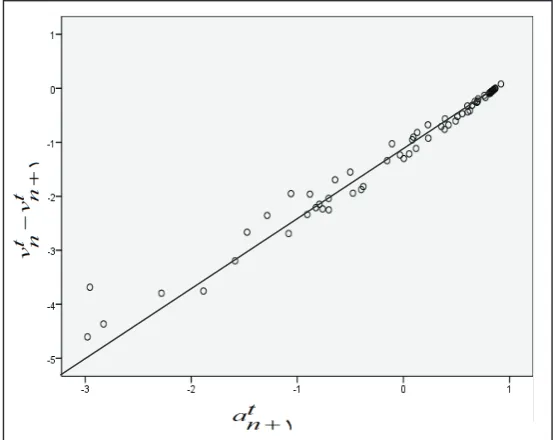
and analyzed as microscopic data which is discussed before. In next step, the sensitivity coefficient has been estimated using regression model. Modelling process has been done using SPSS. The linear regres-sion model with zero constant value has been applied and result is shown in equation 6 and Figure 1.
6
Filtering Free Vehicles
Drivers’ reaction time in Iran has been investigated by Sohrabi et al. in Hamedan Medical University. This study has been carried out on 46 individuals (including 10 females and 36 males) and has been complemented on each volunteer using a simulator machine for one hour. The sample contains includes drivers with driving license who drive both professionally and unprofessionally. Also, includes variety of age, gender and driving experience. The drivers’
reaction has been recorded has been analyzed by SPSS software in next step. Results have demonstrated that the mean reaction time of decelerating is 1320 milliseconds. Also, the time of releasing the accelerator has been estimated 559 milliseconds [Sohrabi et al., 2013].
If the driver’s reaction time is considered as the sum of perception, decision and action time [Elefteriadou 2014], the sum of releasing accelerator pedal and pushing on the decelerating pedal will be equal to the driver’s reaction time. Consequently, the driver’s reaction time in Iran
has been determined 1879 milliseconds.
The equation 5 is used to estimate the driver’s sensitivity coefficient. vtn,vnt1andatn1
have been collected and analyzed as microscopic data which is discussed before. In next step, the sensitivity coefficient has been estimated using regression model. Modelling process has been done using SPSS. The linear regression model with zero constant value has been applied and result is shown in equation 6 and Figure 1.
t n a t
n v t n
v 11.646 1 (6)
Figure 1.The Equation of Estimated Regression in order to Determining the Driver’s Sensitivity Coefficient
According to outputs, the corrected R2 has been determined 0.933. Also, as is presented is Table 1, related P-values of model and independent variable are zero, which means, the model and independent variable are significant with 95% confidence.
Table 1. Results of model statistical tests
Model Independent Variable Independent
Variable Coefficient
Corrected R2 P-Value Model (F) P-Value
0.933 0.00 0.00 1.646
(6) According to outputs, the corrected R2 has been deter-mined 0.933. Also, as is presented is Table 1, related P-values of model and independent variable are zero, which means, the model and independent variable are significant with 95% confidence.
As it was mentioned, the desired time distance is sum of the reaction time and driver’s sensitivity coefficient. Therefore, this value is determined as 3.525, which is meant the vehicles that have time headway less than 3.525 are follower vehicles and the others are free ones. Free vehicles have been eliminated for data base.
6
Filtering Free
Vehicles
Drivers’ reaction time in Iran has been investigated by Sohrabi et al.
in Hamedan Medical
University. This study has been carried out
on 46 individuals (including 10 females and 36
males) and has been complemented on each volunteer using a simulator machine for one hour.
The sample contains includes drivers with driving license who drive both professionally and
unprofessionally. Also, includes variety of age, gender and driving
experience
. The
drivers’
reaction has been recorded has been analyzed
by SPSS software in next step.
Results have
demonstrated that the mean reaction time of decelerating is 1320 milliseconds. Also, the time of
releasing the accelerator has been estimated 559 milliseconds [Sohrabi et al., 2013].
If the driver’s reaction time
is considered as the sum of perception, decision and action
time [
Elefteriadou
2014], the sum of releasing accelerator pedal and pushing on the decelerating
pedal
will be equal to the driver’s reaction time. Consequently, the driver’s reaction time in Iran
has been determined 1879 milliseconds.
The equation 5 is used to estimate
the driver’s sensitiv
ity coefficient.
vtn,
vnt 1and
atn1have been collected and analyzed as microscopic data which is discussed before
. In next step,
the sensitivity coefficient has been estimated using regression model. Modelling process has
been done using SPSS. The linear regression model with zero constant value has been applied
and result is shown in equation 6 and Figure 1.
t n a t
n v t n
v 11.646 1
(6)
Figure 1.The Equation of Estimated Regression in order to Determining the Driver’s Sensitivity Coefficient
According to outputs, the corrected R
2has been determined 0.933. Also, as is presented
is Table 1, related P-values of model and independent variable are zero, which means, the model
and independent variable are significant with 95% confidence.
Table 1. Results of model statistical tests
Model Independent Variable Independent
Variable Coefficient
Corrected R2 P-Value Model (F) P-Value
0.933 0.00 0.00 1.646
132
International Journal of Transportation Engineering, Vol.4/ No.2/ Autumn 2016
Table 1. Results of model statistical tests
Filtering queue data
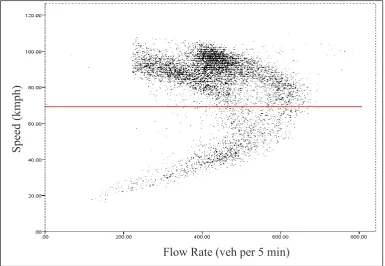
Speed and flow data of the study section are fitted for 5- minute periods as shown in Figure 2. The data is collected for one year period of study section (almost 100,000 observations) and each point represents an ob-servation.
As it is depicted, flow drop have been occurred in flow speed 68 kilometers per hour, where the data density is re-duced. In consequence, the data with mean speed more than 68 kilometers per hour have been utilized in this study.
5.2 Second Step: Modelling
In this step, the filtered data have been extracted accord -ing to maximum vehicles’ headway and minimum ve -hicles’ mean speed, and modelling has been conducted by statistical software, Minitab16. The trendless feature of data has been examined using correlation method as mentioned before. Finally, modelling has been carried out for each lane and the entire section and model’s parameters have estimated. (Table 2 to 5) Eight
well-known distribution functions in traffic studies are uti -lized to find the best fitted model of observed headway.
6. Evaluation Models
In order to find the best distribution function, models have been evaluated by three criteria and the best model has been presented.
6.1 Applicability
The applicable model should have not only simple structure and definition, but also specific statistical at -titudes. In addition, this model can be reviewed and the model parameters can be estimated. Therefore, the well-known statistical models in this study are consid-ered and experimental models are not investigated. According to the conducted studies up to now, in this study 4 models are investigated. These 4 models are: 1- Normal distribution function and exponential distri -bution function
2- Lognormal distribution function and 3-parameter 6
Filtering Free
Vehicles
Drivers’ reaction time in Iran has been investigated by Sohrabi et al.
in Hamedan Medical
University. This study has been carried out
on 46 individuals (including 10 females and 36
males) and has been complemented on each volunteer using a simulator machine for one hour.
The sample contains includes drivers with driving license who drive both professionally and
unprofessionally. Also, includes variety of age, gender and driving
experience
. The
drivers’
reaction has been recorded has been analyzed
by SPSS software in next step.
Results have
demonstrated that the mean reaction time of decelerating is 1320 milliseconds. Also, the time of
releasing the accelerator has been estimated 559 milliseconds [Sohrabi et al., 2013].
If the driver’s reaction time
is considered as the sum of perception, decision and action
time [
Elefteriadou
2014], the sum of releasing accelerator pedal and pushing on the decelerating
pedal
will be equal to the driver’s reaction time. Consequently, the driver’s reaction time in Iran
has been determined 1879 milliseconds.
The equation 5 is used to estimate
the driver’s sensitiv
ity coefficient.
vnt,
vnt 1and
atn1have been collected and analyzed as microscopic data which is discussed before
. In next step,
the sensitivity coefficient has been estimated using regression model. Modelling process has
been done using SPSS. The linear regression model with zero constant value has been applied
and result is shown in equation 6 and Figure 1.
t n a t
n v t n
v 11.646 1
(6)
Figure 1.The Equation of Estimated Regression in order to Determining the Driver’s Sensitivity Coefficient
According to outputs, the corrected R
2has been determined 0.933. Also, as is presented
is Table 1, related P-values of model and independent variable are zero, which means, the model
and independent variable are significant with 95% confidence.
Table 1. Results of model statistical tests
Model Independent Variable Independent
Variable Coefficient
Corrected R2 P-Value Model (F) P-Value
0.933 0.00 0.00 1.646
7
As it was mentioned, the desired time distance
is sum of the reaction time and driver’s
sensitivity coefficient. Therefore, this value is determined as 3.525, which is meant the vehicles
that have time headway less than 3.525 are follower vehicles and the others are free ones. Free
vehicles have been eliminated for data base.
Filtering queue data
Speed and flow data of the study section are fitted for 5- minute periods as shown in
Figure 2. The data is collected for one year period of study section (almost 100,000 observations)
and each point represents an observation.
Figure 2. Flow-speed diagram of study section
As it is depicted, flow drop have been occurred in flow speed 68 kilometers per hour,
where the data density is reduced. In consequence, the data with mean speed more than 68
kilometers per hour have been utilized in this study.
5.2
Second Step: Modelling
In this step, the filtered data
have been extracted according to maximum vehicles’
headway and minimum vehicles’ mean speed, and
modelling has been conducted by statistical
software, Minitab16. The trendless feature of data has
been examined using correlation method
as mentioned before. Finally, modelling has been carried out for each lane and the entire section
and model’s parameters have estimated. (Table 2 to 5) Eight well
-known distribution functions
in traffic studies are utilized to find the best fitted model of observed headway.
Spe
ed (kmph)
Flow Rate (veh per 5 min)
Figure 2. Flow-speed diagram of study section
133 International Journal of Transportation Engineering,
Vol.4/ No.2/ Autumn 2016
Table 2. Parameters of the headway model for first lane data
Table 3. Parameters of the headway model for second lane data
Table 4. Parameters of the headway model for third lane data
8
Table 2. Parameters of the headway model for first lane data
Parameters Model Threshold Scale Shape Location NA 0.146 11.067 NA Gamma 0.928 0.368 1.881 NA
3- parameter Gamma
NA 0.549 NA 1.620 Normal NA 1.620 NA NA Exponential NA 0.289 0.437 NA Lognormal 0.217 0.316 0.049 NA
3- parameter Lognormal
NA 1.810 2.928 NA Weibull 0.935 0.752 1.354 NA
3- parameter Weibull
NA = Not available.
Table 3. Parameters of the headway model for second lane data
Parameters Model Threshold Scale Shape Location NA 0.193 10.236 NA Gamma 0.835 0.360 3.184 NA
3- parameter Gamma
NA 0.670 NA 1.979 Normal NA 1.979 NA NA Exponential NA 0.307 0.633 NA Lognormal 0.461 0.392 0.229 NA
3- parameter Lognormal
NA 2.212 2.997 NA Weibull 0.875 1.245 1.754 NA
3- parameter Weibull
NA = Not available.
Table 4. Parameters of the headway model for third lane data
Parameters Model Threshold Scale Shape Location NA 0.228 1196315 NA Gamma -7.450 0.056 181.804 NA
3- parameter Gamma
NA 0.744 NA 2.732 Normal NA 2.732 NA NA Exponential NA 0.302 0.963 NA Lognormal 0.697 0.575 0.478 NA
3- parameter Lognormal
NA 3.012 4.373 NA Weibull -3.077 6.132 9.493 NA
3- parameter Weibull
NA = Not available.
8
Table 2. Parameters of the headway model for first lane data
Parameters Model Threshold Scale Shape Location NA 0.146 11.067 NA Gamma 0.928 0.368 1.881 NA
3- parameter Gamma
NA 0.549 NA 1.620 Normal NA 1.620 NA NA Exponential NA 0.289 0.437 NA Lognormal 0.217 0.316 0.049 NA
3- parameter Lognormal
NA 1.810 2.928 NA Weibull 0.935 0.752 1.354 NA
3- parameter Weibull
NA = Not available.
Table 3. Parameters of the headway model for second lane data
Parameters Model Threshold Scale Shape Location NA 0.193 10.236 NA Gamma 0.835 0.360 3.184 NA
3- parameter Gamma
NA 0.670 NA 1.979 Normal NA 1.979 NA NA Exponential NA 0.307 0.633 NA Lognormal 0.461 0.392 0.229 NA
3- parameter Lognormal
NA 2.212 2.997 NA Weibull 0.875 1.245 1.754 NA
3- parameter Weibull
NA = Not available.
Table 4. Parameters of the headway model for third lane data
Parameters Model Threshold Scale Shape Location NA 0.228 1196315 NA Gamma -7.450 0.056 181.804 NA
3- parameter Gamma
NA 0.744 NA 2.732 Normal NA 2.732 NA NA Exponential NA 0.302 0.963 NA Lognormal 0.697 0.575 0.478 NA
3- parameter Lognormal
NA 3.012 4.373 NA Weibull -3.077 6.132 9.493 NA
3- parameter Weibull
NA = Not available.
8
Table 2. Parameters of the headway model for first lane data
Parameters Model Threshold Scale Shape Location NA 0.146 11.067 NA Gamma 0.928 0.368 1.881 NA
3- parameter Gamma
NA 0.549 NA 1.620 Normal NA 1.620 NA NA Exponential NA 0.289 0.437 NA Lognormal 0.217 0.316 0.049 NA
3- parameter Lognormal
NA 1.810 2.928 NA Weibull 0.935 0.752 1.354 NA
3- parameter Weibull
NA = Not available.
Table 3. Parameters of the headway model for second lane data
Parameters Model Threshold Scale Shape Location NA 0.193 10.236 NA Gamma 0.835 0.360 3.184 NA
3- parameter Gamma
NA 0.670 NA 1.979 Normal NA 1.979 NA NA Exponential NA 0.307 0.633 NA Lognormal 0.461 0.392 0.229 NA
3- parameter Lognormal
NA 2.212 2.997 NA Weibull 0.875 1.245 1.754 NA
3- parameter Weibull
NA = Not available.
Table 4. Parameters of the headway model for third lane data
Parameters Model Threshold Scale Shape Location NA 0.228 1196315 NA Gamma -7.450 0.056 181.804 NA
3- parameter Gamma
NA 0.744 NA 2.732 Normal NA 2.732 NA NA Exponential NA 0.302 0.963 NA Lognormal 0.697 0.575 0.478 NA
3- parameter Lognormal
NA 3.012 4.373 NA Weibull -3.077 6.132 9.493 NA
3- parameter Weibull
NA = Not available.
134
International Journal of Transportation Engineering, Vol.4/ No.2/ Autumn 2016
lognormal distribution function
3- Weibull distribution function and 3-parameter weibull distribution function
4- Gamma distribution function and 3-parameter gam-ma distribution function
6.2 Validity
In modelling, validating models is the most prominent step. In this study, the models’ goodness of fit is investigat -ed and the best model will be determin-ed. The goodness of fit tests can be applied in order to investigating the hypoth -esis of equality in observed data distribution with specific distribution. The zero hypothesis of this test (H0) depicts the equality of fitted distribution function on observed data and the reputed distribution function. The contrast hypoth-esis (HA) illustrates the difference of the models.
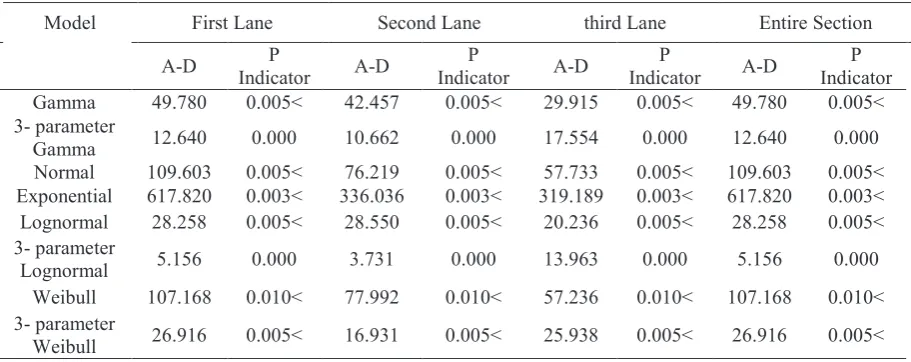
In order to testing the goodness of fit, several tests have been proposed: Chi- Square test, Kolmogorov- Smirnov and Anderson & Darling tests are widely used in statisti-cal studies. Although all the methods have equal hypoth-eses, it has been demonstrated that Anderson & Darling test (A-D) will have better results concerning to headway data essence. In this method, the maximum value will be estimated as the difference of model and observed data distribution function. This discrepancy is belonged to middle part of function and the discrepancies are slight in beginning and ending part of the function. These discrep-ancies are weighted according to the location in function which each point has specific weight [Luttinen 1996]. In this study, the A-D method will be applied in order to calculating the model goodness of fit. Table 6, presented the goodness of fit of estimated models.
Table 5. Parameters of the Headway Model for the EntireSection
9
Table 5. Parameters of the Headway Model for the EntireSection
Parameters Model
Threshold Scale
Shape Location
NA 0.187
9.644 NA
Gamma
0.874 0.391
2.368 NA
3- parameter Gamma
NA 0.638
NA 1.800
Normal
NA 1.800
NA NA
Exponential
NA 0.314
0.535 NA
Lognormal
0.352 0.342
-0.122 NA
3- parameter Lognormal
NA 2.016
2.859 NA
Weibull
0.877 1.033
1.556 NA
3- parameter Weibull
NA = Not available.
6.
Evaluation Models
In order to find the best distribution function, models have been evaluated by three
criteria and the best model has been presented.
6.1
Applicability
The applicable model should have not only simple structure and definition, but also
specific statistical attitudes. In addition, this model can be reviewed and the model parameters
can be estimated. Therefore, the well-known statistical models in this study are considered and
experimental models are not investigated.
According to the conducted studies up to now, in this study 4 models are investigated.
These 4 models are:
1- Normal distribution function and
exponential
distribution function
2- Lognormal distribution function and 3-parameter lognormal distribution function
3- Weibull distribution function and 3-parameter weibull distribution function
4- Gamma distribution function and 3-parameter gamma distribution function
6.2
Validity
In modelling, validating models is the most
prominent step. In this study, the models’
goodness of fit is investigated and the best model will be determined. The goodness of fit tests
can be applied in order to investigating the hypothesis of equality in observed data distribution
with specific distribution. The zero hypothesis of this test (H
0) depicts the equality of fitted
distribution function on observed data and the reputed distribution function. The contrast
hypothesis (H
A) illustrates the difference of the models.
In order to testing the goodness of fit, several tests have been proposed
: Chi
- Square test,
Kolmogorov- Smirnov and Anderson & Darling tests are widely used in statistical studies.
Although all the methods have equal hypotheses, it has been demonstrated that Anderson &
Darling test (A-D) will have better results concerning to headway data essence. In this method,
the maximum value will be estimated as the
difference of model and observed data distribution
function. This discrepancy is belonged to middle part of function and the discrepancies are slight
in beginning and ending part of the function. These discrepancies are weighted according to the
location in function which each point has specific weight [Luttinen 1996]. In this study, the
A-D method will be applied in order to calculating the model goodness of fit. Table 6, presented
the goodness of fit of estimated models.
10
Table 6. The Goodness of Fit of Headway Models
Entire Section third Lane
Second Lane First Lane
Model
P Indicator A-D
P Indicator A-D
P Indicator A-D
P Indicator A-D
0.005> 49.780
0.005> 29.915
0.005> 42.457
0.005> 49.780
Gamma
0.000 12.640
0.000 17.554
0.000 10.662
0.000 12.640
3- parameter Gamma
0.005> 109.603
0.005> 57.733
0.005> 76.219
0.005> 109.603
Normal
0.003> 617.820
0.003> 319.189
0.003> 336.036
0.003> 617.820
Exponential
0.005> 28.258
0.005> 20.236
0.005> 28.550
0.005> 28.258
Lognormal
0.000 5.156
0.000 13.963
0.000 3.731
0.000 5.156
3- parameter Lognormal
0.010> 107.168
0.010> 57.236
0.010> 77.992
0.010> 107.168
Weibull
0.005> 26.916
0.005> 25.938
0.005> 16.931
0.005> 26.916
3- parameter Weibull
As it is obvious, the 3-parameter gamma and 3-parameter lognormal present acceptable
results with 95% confidence level. Indeed, the zero hypotheses is not rejected in these models.
Comparing the A-D value of these two models demonstrates that the 3-parameter lognormal can
present more compatible results than other data.
6.3
Reasonability
Concerning to statistical data characteristics and traffic flow theory, the obtained model
should be compatible to users’
behavior. The last step of headway modelling is investigating the
models with the purpose of
compatibility to drivers’
behavior. As discussed before, both log
normal and gamma distribution have been used in previous traffic studies which satisfies the
reasonability criteria.
7.
Conclusion
In this study, using headway method, capacity of the basic freeway section was
determined. Therefore, headway distribution functions estimated for each freeway lanes. The
essential data of the Iran’s freeways
were collected and the
filtered according to 2 assumptions:
1) the following vehicles, and 2) before queuing. Finally, modelling for function determination
was done by mathematics methods and the models were analyzed
on basis of 3 factors: 1)
Applicability, 2) Validity, and 3) Reasonability. At last, the lognormal model is introduced as
the best distribution function of the headway data for first, second, third lanes and the entire
section.
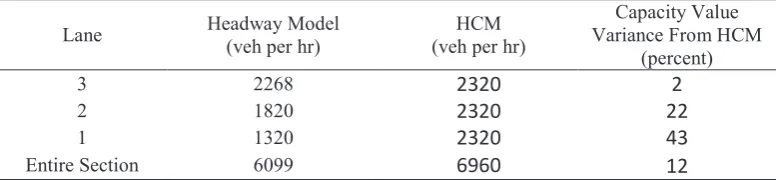
According to the relation of headway and flow rate, the capacity values have been
estimated for each lane and the entire section for a 3-lane freeway basic section as. On the other
hand, the capacity proposed value of HCM under basic section condition and considering the
ratio of buses, is depicted in Table 7.
Table 7. Capacity of Each Lane and the Entire Section for a 3-Lane Freeway basic Section
Lane Headway Model (veh per hr) (ve