Pedagogical knowledge base in ELT:
A conceptual framework
Ramin Akbari
Assistant Professor, Tarbiat Modares University Babak Dadvand1
PhD Candidate, Tarbiat Modares University Reza Ghafar Samar
Associate Professor, Tarbiat Modares University Gholam Reza Kiany
Associate professor
,
Tarbiat Modares UniversityReceived on February 25, 2012 Accepted on June 5, 2012
Abstract
Drawing on language teacher cognition research and using a mix-method research design, the present study tried to offer a conceptual framework for the pedagogical knowledge base in English Language Teaching (ELT). The aim was to see what categories of knowledge Iranian English language teachers use in their teaching. Stimulated recall interviews were used with 6 practicing EFL teachers to map out the categories and units of pedagogical knowledge that they drew upon in their teaching practices. At the same time, semi-structured interviews were carried out with 10 Subject Matter Experts (SMEs) and 10
1 Corresponding author at Tarbiat Modares University
TELL, Vol. 6, No. 2
Pedagogical knowledge base in ELT 50
experienced EFL teachers to probe into their judgments and opinions regarding the important domains of pedagogical knowledge for English language teachers. Overall, the findings pointed to a 7 component model of pedagogical knowledge in ELT. The components of this tentative model included Knowledge of Language, Knowledge of Teaching, Knowledge of Learning, Knowledge of Classroom Management, Knowledge of Students, Knowledge of Culture, and Knowledge of Context. The implications of these findings for teacher education programs are discussed at the end.
Keywords: mixed-method research design, pedagogical knowledge base, stimulated recall interviews, teacher cognition.
1. Introduction
The last two decades have been years of growing complexity and sophistication for L2 teacher preparation and development research; there are now numerous books and papers dealing with different aspects of teacher education, and teacher growth is addressed from professional, cognitive, social, as well as contextual perspectives (Tsui, 2003; Richards & Farrell, 2005; Tedick, 2004; Johnson, 2000; Woods, 1996; Richards & Lockhart, 1994).
Teachers’ agency and mentality, or what later on came to be known as teachers’ mental lives (Walberg, 1977) was totally ignored since teachers were supposed to enter the teaching profession with a tabula rasa and through a training program the required teaching skills and habits were to be mastered. In such a context, there was no room for teachers’ mentality due to the common perception that “teachers’ internal mental world was assumed to be minimally sophisticated” (Freeman, 2002, p. 5).
Fortunately the profession has outgrown such simplistic interpretations of teaching and behaviorist conceptions of instruction have been replaced by cognitive/social views of teaching (Johnson, 2006). In this new conceptualization , teaching is a complicated activity in which “teachers are active, thinking decision-makers who make instructional choices by drawing on complex, practically-oriented, personalized, and context-sensitive networks of knowledge, thoughts, and beliefs” (Borg, 2003, p. 81). The way teachers teach is not only affected by the training they have received, it is also as a result of their hidden pedagogies, or their personal philosophy of what teaching is all about (Denscombe, 1982) as well as their years of learning as students, what Lortie has termed apprenticeship of observation (1975). It is now an established fact that any teaching context and any teaching decision is the result of interaction among received, personal, experiential, and local types knowledge (Mann, 2005, p. 106) teachers draw upon as they negotiate their instructional lives in their classrooms.
TELL, Vol. 6, No. 2
Pedagogical knowledge base in ELT 52
view more faithful to the practice of teaching. Teacher education programs would also benefit from research on teacher cognition for designing and implementing policies for the preparation of prospective teachers.
2. Literature Review
The term teacher cognition refers to “the unobservable cognitive dimension of teaching- what teachers know, believe and think” (Borg, 2003, p. 81). In other words, teacher cognition encompasses all the aspects which are related to the mental lives of teachers, elements which affect teachers’ conception of teaching, and the impact of all these on the way teachers teach and justifications they provide for their teaching decisions.
In fact, interest in teachers’ mental lives and cognition started with the investigation of the decisions teachers made in their classes (Shavelson & Stern, 1981). Reducing the complexity of teachers’ cognition to decision making was part of the continuation of behaviorist conceptions of teaching since this strategy “created an easy, almost quasi-behavioral, unit of analysis that could be applied across multiple classroom settings, content areas, and levels of teacher expertise” (Freeman, 2002, p. 5). Research that addressed teachers’ mental lives in a serious, comprehensive way started mostly during 1990s, and in language teaching, after 1996 (Borg, 2003).
pedagogic content knowledge (Shulman, 1987), local knowledge (Allwright, 2003), and pedagogical knowledge base (VanPatten, 1997).
Teacher cognition has been investigated from different perspective in L2 teacher preparation. Among the aspects of teachers’ pedagogic knowledge, teachers’ knowledge of grammar and instructional decisions related to grammar teaching have been addressed by Borg (1998; 1999) and Andrews (1994; 1997; 1999), while Burns (1992) and Tsui (1996) deal with teachers’ beliefs and their approach to teaching L2 writing. Bartels (1999) investigated the kinds of skills and linguistic knowledge teachers relied on in implementing their lesson plans in the class, a topic which is also addressed from a different perspective by Baily (1996). Teachers’ beliefs and changes in teachers’ conceptions of teaching have been the topic of research in Collie Graden (1996), Cabaroglu and Roberts (2000), and Smith (1996).
Of particular interest to the present study, however, are the studies done on teachers’ pedagogical knowledge base (Gatbonton, 2000, 2008; Mullock, 2006). Pedagogic knowledge base is defined by Mullock as the “accumulated knowledge about the act of teaching, including goals, procedures, and strategies that form the basis for what teachers do in classroom” (p.48). In this line of research, attempts are made to discover the thought processes teachers go through as they assist their students in mastering formal/communicative features of the L2.
TELL, Vol. 6, No. 2
Pedagogical knowledge base in ELT 54
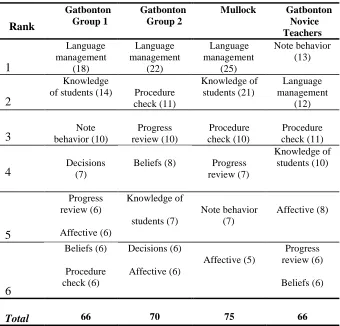
dealt with the input students were exposed to as well as their output. Language Management was followed by Knowledge of Students. Other important thought categories teachers reported using frequently were Procedure Check, Progress Review, Beliefs, Note Student Reaction and Behavior, and Decisions (see Appendix A for the Categories of pedagogical knowledge, their definition and sample instances). Gatbonton’s study, however, has a number of methodological defects that make her categories imprecise in terms of definition and limited in terms of application to similar contexts.
As Mullock (2006) points out, “there are doubts regarding the ecological validity” (p. 50) of Gatbonton’s study since her classes were formed only for research proposes. Another factor threatening the internal validity of the study is the use of course books at pre-publication stage with which the participating teachers had little experience and familiarity. There are also complications in the way certain terms were defined; for example, the category of Language Management is defined in a broad, imprecise way that can include all aspects of input and output (Mullock, 2006). In addition, the construct of experience is left unaddressed since to show the effect of experience, one needs a comparison group of inexperienced teachers to determine what kind of qualitative/quantitative differences can be attributed to experience per se.
Examining the pedagogical knowledge base of four language teachers, Mullock (2006) replicated Gatbonton’s study. She points out:
Mullock did not change the overall design of the study since it was supposed to be a replication of Gatbonton’s. However, the respondents who participated in Mullock’s research came from four intact classes and represented different real life teaching contexts, teaching general, business, or advanced English for Cambridge Advanced Certificate courses. The results of her study were to a large extent similar to those of Gatbonton, with some slight differences. Mullock also found Language Management to be the main category. Knowledge of Students also ranked second in Mullock’s study, which is much higher than the one reported by Gatbonton. Procedure Check, Progress Review, and Note Student Reaction and Behavior were the other categories that ranked high in Mullock’s study and show differences in terms of order and value with those of Gatbonton.
TELL, Vol. 6, No. 2
Pedagogical knowledge base in ELT 56
Table 1: The top categories of pedagogical knowledge with their ranking and frequency (in %) in Gatbonton and Mullock studies
3. The Present Study
The present study was carried out to examine the pedagogical knowledge base of EFL teachers in Iran. The aim was to see what domains of knowledge Iranian English language teachers draw upon in their daily classroom teaching. More specifically, the following research question was raised in this study:
R Rank Gatbonton Group 1 Gatbonton Group 2
Mullock Gatbonton
Novice Teachers 1 1 1 Language management (18) Language management (22) Language management (25) Note behavior (13) 2 2 Knowledge
of students (14) Procedure check (11) Knowledge of students (21) Language management (12) 3
3 behavior (10) Note
Progress review (10) Procedure check (10) Procedure check (11) 4
4 Decisions (7)
Beliefs (8) Progress review (7) Knowledge of students (10) 5 5 Progress review (6) Affective (6) Knowledge of students (7) Note behavior (7) Affective (8) 6 6 Beliefs (6) Procedure check (6) Decisions (6) Affective (6) Affective (5) Progress review (6) Beliefs (6) T
What categories of pedagogical knowledge do EFL teachers in Iran use in their teaching?
4. Method
Using a multi-method research design (Maxcy, 2003), the present study approached its aim through data triangulation using three sources of data and two methods of data collection. First, we identified the categories of pedagogical knowledge and their ranking/frequency for six EFL teachers using stimulated recall technique. Then, semi-structured interviews were carried out with ten experienced EFL teachers; the purpose was to see what domains of pedagogical knowledge these teachers considered necessary for EFL practitioners. Ten semi-structured interviews were also conducted with Subject Matter Experts (SMEs) to further probe into their expert judgments and opinions with regards to what they considered necessary knowledge for EFL teachers. Having juxtaposed the gathered data from the above sources, we finally proposed a tentative model of pedagogical knowledge in ELT.
4.1 Participants
EFL Teachers: The first group of participants in this study
consisted of six EFL teachers teaching general English courses in three private language institutes in Tehran. Of these six participants, five were male and one female with teaching experience ranging from two to three years. In addition, all the participants had BA degrees in English and had undergone Teacher Training Courses (TTC) in the institutes where they worked.
Experienced EFL Teachers: Ten experienced EFL teachers
TELL, Vol. 6, No. 2
Pedagogical knowledge base in ELT 58
English course books to students of different ages at different proficiency levels.
Subject Matter Experts (SMEs): Ten SMEs, 6 males and 4
females with 4 to 11 years of teaching experience, also took part in this study. These were domain experts whose main responsibility was training English language teachers and supervising the practicum. With their expertise in methodology and practicum in ELT, the SMEs helped the researchers to identify the domains of pedagogical knowledge that EFL teachers need.
4.2 Data Collection
In order to triangulate its findings, the present study used a mixed-method research design using two different data collection mixed-methods: Stimulated Recall Technique and Semi-Structured Interviews.
4.2.1 Stimulated Recall Technique
According to Meijer et al. (2002) stimulated recall technique, a substitute to ‘think aloud’ procedure, is the most appropriate data collection approach for examining teachers’ interactive cognitions. It entails videotaping a class session taught by the target teachers and a follow-up recollection interview in which each teacher verbalizes the thoughts he/she was engaged in while teaching. In fact, since teachers cannot simultaneously teach and verbalize their pedagogical thoughts, they re-live the classroom situation and retrieve their thoughts at the moment of their practice by watching a video tape of their own instruction. However, it is important to bear in mind that no single data collection method can depict the entire pedagogical knowledge repertoire of teachers involved during their practices. “What stimulated recall can provide us with is an
Several measures were taken to enhance the reliability and validity of the elicited stimulated recall data in this study. First, since the passage of time may hinder the teacher from remembering the exact thoughts involved in his/her teaching process (Gass & Mackey, 2000), efforts were made to keep at minimum the time lapse between the video-tapings and the recall interviews. This interval ranged between half an hour to about two hours and a half for the teachers of this study. Second, the participants were familiarized with the purposes of stimulated recall protocol and its procedure before conducting the interviews. By so doing, the researchers were able to diminish the likely effects of teachers’ undue reading into their pedagogic behaviors (Meijer et al., 2002). Finally, in order to control the ‘camera effect’ on the teachers’ and students’ typical class conduct, the main video-taping phase started in the third session after having kept the camera off on the tripod in the rear of the class for two sessions. The video-taping was also carried out with the camera recording in the absence of the researchers so that their presence does not affect the class performance of both the teachers and students.
4.2.2. Semi-Structured Interviews
In addition to stimulated recall technique, we also carried out semi-structured interviews with 10 experienced EFL teachers and SMEs. We used semi-structured interviews to probe into the judgments and opinions of these participants and highlight the domains of pedagogical knowledge that they considered necessary for EFL teachers (see Appendices B and C for the interview questions).
4.3 Data Analysis
TELL, Vol. 6, No. 2
Pedagogical knowledge base in ELT 60
4.3.1 Stimulated Recall Data
The analysis of the stimulated recall data was carried out by one of the researchers experienced in conceptual content-analysis. First, the verbal recollection data was transcribed. Then, the transcribed interviews were segmented into independent units each with a distinct pedagogical theme, technically referred to as pedagogical thought units. These thought units, then, were organized into
pedagogical thought categories, an umbrella term for the thought units with similar pedagogic purpose. The following extract from teacher A is an example of how the segmentation and labeling were carried out on the transcripts:
(1) We are approaching the end of the class. (2) Students are bored (3) so I use L1 and translate the word. … (4) After a while, one of the students eagerly volunteered to come to the board (5) and I guided her through the activity.
As it can be observed, the above transcribed piece of verbal recollection is broken down into five separate chunks, or thought units, (numbered from 1 to 5) each expressing a particular pedagogical concern. These chunks were then examined to sort out the thought unit they belonged to. Then, based on the underlying theme the units expressed, they were classified under their relevant categories. For example, in the above quote, sentence number 1 represents the teacher’s concern for time and hence is a thought unit dealing with Time Check, a thought unit which belongs to the category of Classroom Management. The second utterance marks the teacher’s attention to the students’ feelings and is an instance of
Finally, the last utterance is a thought unit pertaining to the teacher’s conduct of class activities and is representative of the pedagogical thought unit called Procedure Check, which belongs to the category of Knowledge of Language Teaching.
However, the analyses were not always as straightforward as the above extract depicts. In fact, there were many utterances which could not be identified with any thought unit/category or they were not simply the teachers’ reflection on their class performance. For this reason, only those reflections with direct pedagogical significance were included in the analyses and irrelevant comments, e.g. thoughts occurring during the interview or stimulated by the researcher’s given clues, were discarded. The following example taken from Teacher B is an instance of a thought which did not correspond to any particular pedagogical thought unit or category:
Well, I used to grow beard for the past nine months and because of a passport photo I had to shave; a new face for the students.
At the same time, to check the inter-rater reliability of the content analysis phase, i.e. segmentation and labeling, a second party, a colleague familiar with the research analytic scheme, was asked to reexamine twenty percent of all the transcribed data, a procedure believed to lead to more reliable results (Gass & Mackey, 2000). The results of this second round of content analysis showed 93% of consistency between the researchers’ analyses and those of the outside examiner. Besides, this second rater was systematically consulted with throughout the project when the segmented thought units could fit into multiple categories. The purpose was to achieve higher analytic objectivity by building consensus as to which category/unit could better represent the pedagogical purpose behind a particular thought.
TELL, Vol. 6, No. 2
Pedagogical knowledge base in ELT 62
provided us with a measure for estimating: a) the average number of reported pedagogical thoughts per minute and b) the frequency of each reported thought unit/category. At the same time, in order to examine whether there was any significant frequency difference among the participants in terms of the number of thoughts they produced, Chi-Square Analysis – a non-parametric test of relationship in frequency data – was carried out on the data.
4.3.2 Semi-Structured Interview Data
Conceptual content analysis, “a systematic, replicable technique for compressing many words of text into fewer content categories based on explicit rules of coding” (Stemler, 2001), was used to analyze the semi-structured interviews. Having transcribed the interviews with both SMEs and experienced EFL teachers, the candidates’ responses were systematically inspected for identifying their textual-thematic characteristics. This qualitative analysis technique helped us unearth the trends and patterns built into the participants’ responses to different interview questions.
5. Results
5.1 The Categories of Pedagogical Knowledge: Stimulated Recall Data
of the pedagogical thoughts each teacher had produced, and the frequency of each category across the participants. Table 2 shows the categories and units of pedagogical knowledge and their frequency/ranking for the six EFL teachers in this study.
Table 2: The categories and units of pedagogical knowledge along with their ranking and frequency (in %) extracted from the stimulated recall
interviews
Pedagogical Knowledge
Categories
Pedagogical Thought Units
Teachers A-F
A B C D E F Average
Knowledge of Language
Language
skills/components 42 40 30 32 34 38 36
Knowledge of
Language Teaching
Procedure check 8 9 12 11 7 13 10
Feedback 6 8 7 5 8 4 6
Group/pair work 2 2 3 1 2 2 2
Lesson plan 1 1 1 1 1 1 1
Curriculum 1 0 0 2 1 2 1
Materials 1 1 1 2 0 1 1
Knowledge of
Language Learning
Learning problem 5 8 6 7 7 9 7
Learning progress 5 7 9 7 8 6 7
Comprehensibility 2 1 1 4 3 1 2
Knowledge of
Classroom Management
Note behavior and reaction
12 7 10 11 8 6 9
Time check 5 5 3 7 6 4 5
Knowledge of Students
Students and their characteristics
3 6 4 5 7 5 5
Affective 6 5 3 7 6 3 5
Students’ language level
3 1 4 3 2 5 3
Total 228 239 231 252 245 258 1453
TELL, Vol. 6, No. 2
Pedagogical knowledge base in ELT 64
5.2 The Categories of Pedagogical Knowledge: Semi-Structured Interview Data
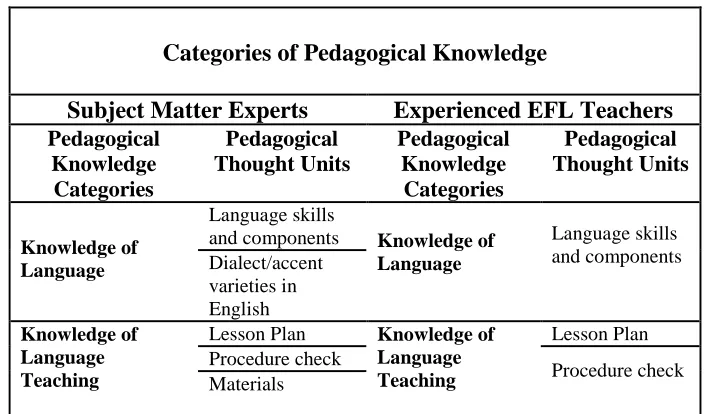
The semi-structured interviews with the SMEs pointed to 7 categories of pedagogical knowledge that EFL teachers need for their teachings. These categories include Knowledge of Language, Knowledge of Language Teaching, Knowledge of Language Learning, Knowledge of Classroom Management, Knowledge of Students, Knowledge of Culture, and Knowledge of Context. As for the experienced EFL teachers, 6 categories of pedagogical knowledge emerged from the semi-structured interviews including Knowledge of Language, Knowledge of Language Teaching, Knowledge of Language Learning, Knowledge of Classroom Management, Knowledge of Students, and Knowledge of Culture. Table 3 summarizes the categories and units of pedagogical knowledge for both SMEs and experienced EFL teachers.
Table 3: The categories and units of pedagogical knowledge extracted from the semi-structured interviews with SMEs and experienced EFL
teachers
Categories of Pedagogical Knowledge
Subject Matter Experts Experienced EFL Teachers Pedagogical
Knowledge Categories
Pedagogical Thought Units
Pedagogical Knowledge
Categories
Pedagogical Thought Units
Knowledge of Language
Language skills
and components Knowledge of Language
Language skills and components Dialect/accent
varieties in English
Knowledge of Language Teaching
Lesson Plan Knowledge of Language Teaching
Lesson Plan Procedure check
Knowledge of Language Learning
Learning progress Knowledge of Language Learning
Learning progress Learning problem Learning problem
Knowledge of Classroom Management
Time check Knowledge of Classroom Management Time check Note behavior and Reaction Note behavior and Reaction Knowledge of Students
Students and their characteristics Knowledge of Students Students and their characteristics
Affective Affective
Knowledge of Culture Target language culture Knowledge of Culture Target language culture Cultural differences Cultural differences Knowledge of Context Knowledge of local setting (social, cultural, political, ideological) Knowledge of underlying values
6. Discussion
By and large, the results of the stimulated recall and semi-structured interviews confirmed the existence of a relatively homogeneous body of pedagogical knowledge in ELT. This similarity showed itself in the way the categories of pedagogical knowledge and their constituent thought units overlapped across the groups of participants (see Table 2 and Table 3). Most of the emerged pedagogical knowledge categories and units had equal representation in the data gathered from both the EFL teachers and SMEs. We interpret this convergence of the results as evidence for the validity of the classification of pedagogical knowledge in ELT into distinct thought categories and units.
semi-TELL, Vol. 6, No. 2
Pedagogical knowledge base in ELT 66
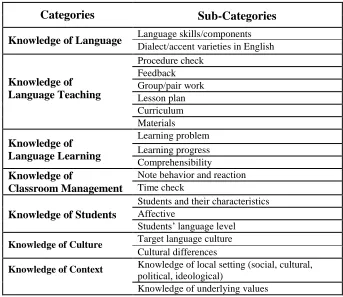
structured interviews confirmed a seven-component model of pedagogical knowledge in ELT. Knowledge of Context and Knowledge of Culture only emerged from the semi-structured interviews. The absence of these two categories from the practice of our 6 EFL teachers could be due to factors like their relatively low teaching experience (around two years) or the gulf between their
theoretical and practical knowledge of pedagogy (Woods and Cakir, 2011). In addition, Knowledge of Context was only mentioned by the SMEs. This knowledge was not among the categories of pedagogical knowledge mentioned by the experienced EFL teachers. This difference could be an indication of the mismatch between what SMEs regard as important for teaching and what teachers themselves deem relevant to their pedagogy.
Table 4: The categories and sub-categories of pedagogical knowledge extracted from the stimulated recall interviews and semi-structured
interviews
Categories Sub-Categories
Knowledge of Language Language skills/components
Dialect/accent varieties in English
Knowledge of Language Teaching
Procedure check Feedback Group/pair work Lesson plan Curriculum Materials
Knowledge of Language Learning
Learning problem Learning progress Comprehensibility
Knowledge of
Classroom Management
Note behavior and reaction Time check
Knowledge of Students
Students and their characteristics Affective
Students’ language level
Knowledge of Culture Target language culture
Cultural differences
Knowledge of Context Knowledge of local setting (social, cultural,
political, ideological)
Knowledge of underlying values
7. Conclusion
TELL, Vol. 6, No. 2
Pedagogical knowledge base in ELT 68
model included Knowledge of Language, Knowledge of Teaching, Knowledge of Learning, Knowledge of Classroom Management, Knowledge of Students, Knowledge of Culture, and Knowledge of Context.
However, caution should be exercised when interpreting the findings of this study. It should be born in mind that teaching is a highly complex and situated activity and teachers develop their knowledge of pedagogy over time and in response to their academic/professional experiences. Thus, the framework of pedagogical knowledge developed in this study should only be treated tentatively. Still more replication studies with larger groups of teachers in more diverse teaching contexts may be needed to confirm its validity and accuracy. The need for further confirmatory research is crucial especially with regards to the classification of teachers’ knowledge into categories and units. Until more research corroborates these findings, the identified categories and units of pedagogical knowledge in ELT “should be interpreted as providing only a tentative understanding of pedagogical knowledge” (Gatbonton, 2008, p. 176).
References
Allwright, D. (2003). A brief guide to exploratory practice.
Language Teaching Research, 7(2), 109-112.
Andrews, S. (1994). The grammatical knowledge/awareness of native-speaker EFL teachers: What the trainers say. In M. Bygate, A. Tonkyn, & E. Williams (Eds.), Grammar and the language teacher (pp. 69-89). London: Prentice Hall International.
Andrews, S. (1997). Metalinguistic knowledge and teacher explanation. Language Awareness, 6(2), 147-61.
Andrews, S. (1999). ‘All these like little name things’: A comparative study of language teachers’ explicit knowledge of grammar and grammatical terminology. Language Awareness, 8(3), 143-59.
Bailey, K. M. (1996). The best laid plans: teachers’ inclass decisions to depart from their lesson plans. In K.M. Bailey & D. Nunan (Eds.), Voices From the Language (pp. 15–40). Cambridge: Cambridge UniversityPress.
Bartels, N. (1999). How teachers use their knowledge of English. In Trappes-Lomax, H. & McGrath, I. (eds.), Theory in Language Teacher Education (pp. 46-56). London: Prentice Hall.
Borg, S. (1998). Talking about grammar in the foreign language classroom. Language Awareness, 7(4), 159-75.
Borg, S. (1999). Studying teacher cognition in second language grammar teaching. System, 27(1), 19-31.
Borg, S. (2003). Teacher cognition in language teaching: A review of research on what language teachers think, know, believe, and do. Language Teaching, 36(2), 81-109
Burns, A. (1992). Teacher beliefs and their influence on classroom practice. Prospect, 7(3), 56-66.
Cabaroglu, N. & Roberts, J. (2000). Development in student teachers’ pre-existing beliefs during a 1-Year PGCE program. System, 28(3), 387-402.
TELL, Vol. 6, No. 2
Pedagogical knowledge base in ELT 70
Cochran, F. K., DeRuiter, A. J. & King, A. R. (1993). Pedagogical content knowing: an integrative model for teacher preparation. Journal of Teacher Education, 44(4), 263-272. Collie Graden, E. (1996). How language teachers’ beliefs about
reading are mediated by their beliefs about students.
Foreign Language Annals, 29(3), 387-395.
Denscombe, M. (1982). The hidden pedagogy and its implications for teacher training: An ecological analysis. British Journal of Sociology of Education, 3(1), 249-265.
Feryok, A. (2010). Language teacher cognition: Complex dynamic systems? System, 38(2), 272-279.
Freeman, D. (2002). The hidden side of the work: Teacher knowledge and learning to teach. Language Teaching, 35(1), 1-13.
Gass, S. M., & Mackey, A. (2000). Stimulated recall methodology in second language acquisition. Mahwah, NJ:Erlbaum. Gatbonton, E. (2000). Investigating experienced ESL teachers’
pedagogical knowledge. The Canadian Modern Language Review,56(4), 16-29.
Gatbonton, E. (2008). Looking beyond teachers’ classroom behavior: Novice and experienced ESL teachers’ pedagogical knowledge. Language Teaching Research, 12(2), 161-182.
Grossman, P. (1990). The making of a teacher. New York: Teachers College Press
Halliday, J. (1998). Techncisim, reflective practice and authenticity in teacher education. Teaching and teacher education. 14(6),597-605.
Johnson, K. E. (ed.) (2000). Teacher education. Alexandria, VA: Teachers of English to Speakers of Other Languages (TESOL).
Johnson, K. E. (2006). The sociocultural turn and its challenges for second language teacher education. TESOL Quarterly, 40(1), 235-257
Lortie, D. (1975). School teacher: A sociological study. Chicago: University of Chicago Press.
Mann, S. (2005). The language teacher’s development. Language Teaching , 38(3), 103-118.
Maxcy, S. J. (2003). Pragmatic threads in mixed methods research in the social sciences: The search for multiple modes of inquiry and the end of the philosophy of formalism. In Tashakkori, A. & Teddlie, C. (eds.): Handbook of Mixed Methods in Social And Behavioral Research. Thousand Oaks, CA: Sage.
Meijer, P.C., Verloop, N., & Beijaard, D. (2002). Examining teachers’ interactive cognitions using insights from research on teachers’ practical knowledge. In C. Sugrue & C. Day (Eds.). Developing teachers and teaching practice (pp.162-178). London, RoutledgeFalmer.
Mullock, B. (2006). The pedagogical knowledge base of four TESOL teachers. Modern Language Journal, 90(1), 48-66. Richards, J. & Farrell, T. (2005). Professional development for
language teachers: Strategies for teacher learning. Cambridge: Cambridge University Press.
Richards, J. & Lockhart, C. (1994). Reflective teaching in second language teaching classrooms. Cambridge: Cambridge University Press.
Shavelson, R., & Stern, P. (1981). Research on teachers’ pedagogical thoughts, judgments, decisions, and behaviors.
Review of Educational Research, 5(4), 455-498.
Shulman, L. S. (1987). Knowledge and teaching: Foundations of the new reform. Harvard Educational Review, 57(1), 1-22. Smith, D. B. (1996). Teacher decision making in the adult ESL
classroom. In D. Freeman & J.C. Richards (Eds.), Teacher learning in language teaching (pp. 197-216). Cambridge: Cambridge University Press.
Stemler, Steve (2001). An overview of content analysis. Practical Assessment, Research & Evaluation, 7(17). http://PAREonline.net/getvn.asp?v=7&n=17.
TELL, Vol. 6, No. 2
Pedagogical knowledge base in ELT 72
Tsui, A. B. M. (1996). Learning how to teach ESL writing. In D. Freeman, & J.C. Richards (Eds.), Teacher learning in language teaching (pp. 97-119). Cambridge: Cambridge University Press.
Tsui, A. B. M. (2003). Understanding expertise in teaching. Cambridge: Cambridge University Press.
VanPatten, B. (1997). How language teaching is constructed: Introduction to the special issue. Modern Language Journal, 18(1), 1-5.
Van Driel, H. J., Veal, R. W. & Janssen, M. J. J. F. (2001). Pedagogical content knowledge: an integrative component within the knowledge base for teaching. Teaching and Teacher Education,17(8), 979-986.
Walberg, H. (1977). Decision and perception: New constructs for research on teaching effects. Cambridge Journal of Education, 7(1), 12-20.
Wallace, M. (1991). Training foreign language teachers: A reflective approach. Cambridge: Cambridge University Press.
Woods, D. (1996). Teacher cognition in language teaching. Cambridge: Cambridge University Press.
Woods, D. & Cakir, H. (2011). Two dimensions of teacher knowledge: The case of communicative language teaching.
System, 39(3), 381-390.
Appendix A
Categories of pedagogical knowledge, their definition and sample utterances
Categories Definition Samples
Utterances Language
Management
Things to do with the management of language input and students’ output (e.g., provide language, model utterances, elicit language from students).
Procedure Check Things to do with ensuring that the lesson proceeds smoothly from start to finish (e.g., starting the lesson, giving, explaining, and demonstrating procedures).
This is a quick review for remembering [the previous grammatical point].
Noting Behavior Teachers’ comments on what they
observe students do and how they react (e.g., they move around or do not want to work with someone).
I am checking their attention at the same time.
Progress Review Ensuring that the students are involved in the lesson, are doing the things they are supposed to do, and are on task
(e.g., check if students are on task, note success in doing the task).
Everyone is engaged in the activity . . .
Affective Remarks on teachers’ feelings and
reactions about the students, establishing and maintaining rapport (e.g., the teacher wanted students to feel relaxed).
Again this [a joke by the teacher] may help to light up the atmosphere.
Knowledge of Students
Everything that has to do with comments on what teachers know about the students (e.g., I know students’ abilities, personalities, attitudes, interests and feelings).
She [a student who has just read the text] is very sensitive to my comments.
Self-Reflection Teachers’ revelations about her or
himself (e.g., likes, preferences, attitudes, hobbies, style of teaching, and strategies in dealing with the students).
I’m not a deductive type teacher in matters of grammar!
Time Check Remarks on anything to do with timing of activities or tasks (e.g., wanted to give the students enough time, or did not have enough time).
I look down at my watch to see if we still have time [for a role-play].
Comprehensibility Comments on whether students understood lessons, ideas, tasks, whether teacher understood the students’ output
(e.g., students did not understand,
TELL, Vol. 6, No. 2
Pedagogical knowledge base in ELT 74
had trouble understanding).
Group/Pair Work Anything to do with group/pair work (e.g., organizing students into groups, teacher intervention in groups).
I want to pair him [a weak student] with someone more active.
Appendix B
Open-ended pedagogical knowledge interview questions [SMEs version]
Introduction to the Interview
The aim of this study is to develop an instrument for evaluating the pedagogical knowledge base of teachers of English as a foreign language. Pedagogical knowledge is defined as the accumulated personal, practical and theoretical knowledge that teachers have developed over years of practice. It is this cognitive knowledge that is behind EFL teachers’ classroom behaviors.
To clarify different aspects of the concept of pedagogical knowledge, we have decided to interview domain experts and applied linguists as well as teacher educators; we intend to ask for their professional opinion as to what constitutes the knowledge of pedagogy for EFL teachers. More specifically, we are looking for those categories of domain-specific knowledge that guides EFL teachers’ classroom actions. If you have no question, we can proceed with the interview.
Warm up:
- Name and age:
- Degree and major: - Experience:
- Field(s) of specialization and university courses taught:
Main Questions
1. How do you define teaching (what is teaching)?
2. Do you think teaching is an art people are born with or an expertise they gradually develop? Please explain.
3. Do you consider teaching behavioral or cognitive in nature? Please explain.
4. How do you define quality teaching? Who would be an effective teacher from your point of view?
5. What knowledge is necessary for effective teaching IN GENERAL (domain-general knowledge)? Please be specific. 6. Where do you think teachers acquire their pedagogical knowledge from (Where does knowledge of how to teach come from)? Please be specific about each source of teaching knowledge. 7. What knowledge is necessary for effective FOREIGN LANGUAGE teaching (domain-specific knowledge)? OR what knowledge is unique to English language teaching profession? Please be specific.
TELL, Vol. 6, No. 2
Pedagogical knowledge base in ELT 76
Appendix C
Open-ended pedagogical knowledge interview questions [experienced EFL teachers’ version]
Introduction to the Interview
The aim of this study is to develop an instrument for evaluating the pedagogical knowledge base of teachers of English as a foreign language. Pedagogical knowledge is defined as the accumulated personal, practical and theoretical knowledge that teachers have developed over years of practice. It is this cognitive knowledge that is behind EFL teachers’ classroom behaviors.
To clarify different aspects of the concept of pedagogical knowledge, we have decided to interview experienced EFL teachers; we intend to ask their opinion as to what constitutes their knowledge of pedagogy. More specifically, we are looking for those categories of domain-specific knowledge that guides EFL teachers’ classroom actions. If you have no question, we can proceed with the interview.
Warm up:
Would you please introduce yourself? - Name and age:
- Degree and major: - Teaching experience:
- Past/present schools/institutions: - Age and level of students: Main Questions
2. Do you think teaching is an art people are born with or an expertise they gradually develop? Please explain.
3. Do you consider YOUR teaching practices behavioural or cognitive in nature? Please explain.
4. How do you define quality teaching? Who would be an effective/ideal teacher from your point of view? OR What kind of features/qualities/knowledge would make him/her an ideal practitioner?
5. What knowledge is necessary for effective teaching IN GENERAL (domain-general knowledge)? Please be specific. 6. Where have you acquired your pedagogical knowledge from (Where does your knowledge of how to teach come from)? Please be specific about each source of teaching knowledge.
7. What knowledge is necessary for effective FOREIGN LANGUAGE teaching (domain-specific knowledge)? OR what knowledge is unique to English language teaching profession? Please be specific.