Effect of solar light on the decrease of microbial contamination in
facultative stabilization pond
Ali Almasi1, Mitra Mohammadi2,, Rohallah Shokri3, Majid Hashemi4, Nemat Bahmani5,6
1. Department of Environmental Health Engineering, School of Public Health, Social Development and Health Promotion Research Center, Kermanshah University of Medical Sciences, Kermanshah, Iran
2. Department of Environmental Health Engineering, School of Public Health, Kermanshah University of Medical Sciences, Kermanshah, Iran
3. Abadan School of Medical Sciences, Abadan, Iran
4. Ph.D. of environmental Health Engineering, Kerman University of Medical Sciences, Kerman, Iran 5. Student Research Committee, Kermanshah University of Medical Sciences, Kermanshah, Iran 6. Department of environment protection, Kermanshah, Iran
Date of submission:05 Nov 2017,Date of acceptance:08 Apr 2018
ABSTRACT
One of the indexes of stabilization pond is the presence of coliform bacteria in water and wastewater. This study aimed to determine the effect of solar light on coliform variations in stabilization pond. In this experimental study, the effect of light, pH (<7, 7.1–8, 8.1–9), and temperature (10 ºC and 30 ºC) on facultative stabilization pond was studied for six months. The sampling was accomplished weekly. Coliform colonies were measured using the nine tube fermentation method. The coliform deterioration constant was calculated using the Maraise model. The data were analyzed using SPSS version 20. The effect of light on coliform deterioration constant was negative. Also, low pH increased the coliform death. No significant statistical difference was seen at 10 ºC and 30 ºC (P < 0.05).Low temperature cannot be adherence for facultative stabilization pond. Regarding the positive effect of temperature on the coliform death, use of facultative stabilization pond in a warm climate is suggested.
Keywords:Stabilization pond, Fecal coliform, Microbial pollution
Introduction
Wastewater is one of the major sources of chemical and microbial contamination of water, especially in developing countries. Therefore, its treatment is necessary to remove pollutants. Pathogenic viruses, bacteria, unicellular forms, and worms are found in urban raw sewage.1One
of the main goals of domestic wastewater treatment is to reduce the number of pathogens to the extent that the risk of transmission of sewage-related diseases is substantially reduced.2 A stabilization pond is part of the
natural process of sewage treatment that is of high importance in developing countries, especially in the tropical regions. Stabilization pond is cheaper in terms of cost of construction and operation than other processes. The ease of
Mitra Mohammadi
Citation: Almasi A, Mohammadi M, Shokri R, Hashemi M,
operation and lack of requirement of electrical and mechanical equipment and skilled operators are the advantages of this process compared with the other wastewater treatment processes.3
One of the benefits of the stabilization pond is the reduction of pathogens in the wastewater. Temperature, solar radiation, food shortages, predator organisms, and toxic substances are among the factors that influence the efficiency of the pond. Improving hydraulic performance of ponds increases the removal of pollutants such as pathogens.4Coliforms are considered as
non-35 ºC.5These facultative anaerobic bacteria are
mainly Escherichia coli, Klebsiella pneumoniae, Enterobacter cloacae, and Enterobacter aerogenes. The reliability of coliform count as an indicator of the presence of pathogens in water is dependent on the resistance of the pathogenic coliforms.6 The
mortality rate for the pathogens is higher than the total coliforms that live outside the intestines. Therefore, if pathogenic bacteria are present in an aqueous solution, their number decreases relative to the coliform bacteria. Therefore, disinfection of treated sewage is essential. Disinfection is carried out mainly by physical, chemical, thermal, and irradiation methods. An economical method to disinfect the effluent of stabilization ponds is to use sunlight.7
Curtis et al. conducted a study regarding the effect of sunlight on fecal coliforms in ponds. The results showed that light could only have an impact on the fecal coliforms if complemented by high dissolved oxygen (DO) concentrations.8
Giannakis et al. investigated the environmental considerations of solar disinfection of wastewater and the subsequent bacterial (re)growth. Intermittent illumination unevenly prolonged the required exposure time and highlighted the need for extended illumination times when unstable weather conditions are expected.9A study of the removal ofE. coliand enterococci from maturation pond and kinetic modeling under sunlight conditions was conducted by Ouali et al. The results showed that light has an important role in the disinfection process in maturation ponds.10
Disinfection of water with the help of sunlight is a simple, sustainable, non-specific, and low-cost chemical method for microbial treatment.11For
this reason, in this study, the factors that influence and control the growth and survival of microorganisms, including radiant light, were selected as the basis of the study. Also, this is the first such study conducted in Iran.
Materials and Methods
In this experimental study conducted in 2015 in Kermanshah University of Medical Sciences, the characteristics of Kermanshah's wastewater treatment system, which fed the
established pond, which included BOD5, COD,
TKN, pH, and COD/BOD5were determined, as
described in Table 1. The facultative stabilization pond was constructed in a cubed rectangular shape (1 m L× 0.5 m W× 1.5 m H) from plexiglass with a batch flow. The entrance to the wastewater was 20 cm below the pond.
Table 1. The characteristics of Kermanshah's treatment system
Parameters Mean ± SD COD (mg/L) 514 ± 69 BOD5(mg/L) 327 ± 83 TKN (mg/L) 8±0.96
pH 6.8-8
COD/BOD5 0.56
The required sludge was obtained from the returned activated sludge of the Kermanshah wastewater treatment plant and transferred to the laboratory of the Kermanshah University of Medical Sciences in polyethylene containers. Then, the activated sludge was thickened and kept at refrigeration temperature (2 ºC–4 ºC) until the test was performed. The sampling time was 24 hours for 5 days. The studied variables included hydraulic retention time, temperature, and pH. Sunlight without barrier was used to determine the effect of the presence of light on the static mortality of bacteria. The pond was completely covered with two layers of black nylon when there was a need for dark conditions. Phosphate disodium hydrogen phosphate buffer (K2HPO4) was used to adjust
the pH and prevent sudden pH changes. By adding sulfuric acid and normal NaOH, the pH was adjusted to the range of ≤7, 7.1–8, and 8.1– 9. The sampling was carried out during two seasons, summer with an average temperature of 30 ºC ± 4 ºC and winter with an average temperature of 10 ºC ± 3 ºC. The presence and absence of light and pH in a total of 27 treatments were investigated for the establishment of the temperatures during summer and winter. Based on the standard methods for water and wastewater, nine tubular fermentation was selected as the main method for counting the fecal coliforms.12To determine
the static mortality rate, equation (1) was used.13
Ne
Ni
=
1
Where,
K = constant coefficient of total mortality in the outlet of the pond (in terms of number in 100 mL); Ni = total coliforms in the inflow, CFU/mL; Ne = total coliforms in the outflow, CFU/mL; Ө = time in days.
Temperature is an early factor in the mortality of bacteria, and there is a relationship between the reduction of coefficient K and heat.5
kT=k20CT-20 (2)
Where,
K20= decomposition coefficient at 20 ºC;
C = constant coefficient;
T = average water temperature, ºC.
SPSS software version 20 was used for the data analysis. The Excel 2013 software was used to draw the charts.
Results and Discussion
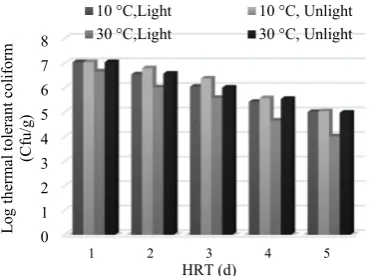
The results of the microbial experiments performed using the Most Probable Number method are presented in Figures 1–3. In general, the greatest reduction in the number of coliforms was observed at pH 8–9.1>7>7.1–8, respectively.
Fig. 1. Changes in thermophilic coliform in FAS under different conditions (pH < 7)
Fig. 2. Changes in thermophilic coliform in FAS under different conditions (pH = 7.1–8)
Fig. 3. Changes in thermophilic coliform in FAS under different conditions (pH = 8.1–9)
At pH < 7, the highest amount of coliforms in the microbial samples was observed in exposed light at 30 ºC followed by a temperature of 30 ºC in darkness. Other microbial samples at the same pH had equal values and the least total coliforms as determined using the independent sample t-test; this difference was significant (p < 0.05).
In the microbial samples with a pH of 7.1– 8, the highest number of coliforms was found in the sample exposed to light at a temperature of 30 ºC followed by that to light at 10 ºC. In the microbial samples with a pH of 8.1–9, the minimum reduction in the total coliform content was related to dark treatment and temperature of 30 ºC, with a slight difference in the amount of total coliforms in the three microbial samples. Based on the experiments carried out over 5 days at all pH values, the highest reduction was observed in the microbial sample exposed to radiation and temperature of 30 ºC, and the lowest decrease was observed in response to light exposure and temperature of 10 ºC (p = 0.01). According to Bolton et al.14 irrespective
of the wavelength of the sunlight, the effect of DO and pH on the inactivation rates were dependent on the bacteria. Bolton et al. considered that the inactivation ofE. coliin the wastewater stabilization ponds was due to the sunlight interacting with photosensitizers, high pH, DO, predation, and sedimentation in the presence of suspended solids.15 In Table 2, the
mortality constants (K) obtained from the treatments were compared with the highest K value related to the 4 days retention time; the K value decreased during the 5 days. In the
0 2 4 6 8
1 2 3 4 5
Lo g th erm al to le ra nt co lif orm (Cf u/ g) HRT (d)
10 ºC,Light 10 ºC, Unlight 30 ºC,Light 30 ºC, Unlight
0 1 2 3 4 5 6 7 8
1 2 3 4 5
Lo g th er m al to le ra nt c ol ifo rm (C fu /g ) HRT (d)
10 °C,Light 10 °C, Unlight 30 °C,Light 30 °C, Unlight
0 2 4 6 8
1 2 3 4 5
Lo g og th erm al to le ra nt co lif orm (Cf u/ m l) HRT(d)
microbial samples with a pH less than 7, the highest K values were obtained for the microbial samples at 10 ºC and darkness. At the same pH, two microbial samples were exposed to light at 10 ºC and 30 ºC. In the pH range of 7.1–8, the highest K values were observed at temperatures of up to 30 ºC and in dark conditions. In the pH range of 8.1–9, the highest K values were observed on light exposure at 30 ºC, and the lowest K value was observed at 10 ºC and under dark conditions (p < 0.05). As shown in Table 2, the highest value of this coefficient (K = 0.1403) was observed at pH < 7, 10 ºC, and in the absence of light, but the lowest value (K = 0.396%) was observed in the absence of light, pH 8.1, and 10 ºC temperature. To obtain an equation for K, the data on the amount of K
under different conditions in relation to light, pH, and temperature were analyzed using SPSS software, and the following equation was obtained.
K=0.07 + 0.07 pH+0.22 T − 0.09 L (3)
Where,
T = temperature (ºC) L = visible light
According to Ouali et al., the decay rate measured under light conditions ranged from 0.047 to 1.81 h−1and 0.058 to 1.66 h−1forE. coli
and enterococci, respectively. The comparison between the kinetic coefficients obtained in dark and UV conditions shows that sunlight is a major factor in the inactivation of bacteria in the maturation pond.10
Table 2. The values of kinetic coefficients under different conditions in facultative stabilization pond
Temperature (ºC) pH<7 PH= 7.1-8 pH=8.1- 9
Light Darkness Light Darkness Light Darkness 10 ± 3 0.113 0.14 0.046 0.039 0.137 0.091 30 ± 4 0.113 0.111 0.064 0.097 0.154 0.119
The results showed that pH and temperature had the maximum effect on the reduction of total coliforms, and the effect of light was very small. The sample exposed to light radiation at 30 ºC had the lowest total number of coliforms in comparison with the other three treatments, which seems to have had an effect on the mortality of microorganism at this pH more than the others. According to a review by Dias et al., temperature is considered the most important environmental variable influencing coliform and E. coli disinfection.16
Also, it seems that at pH 8.1–9, the alkaline pH overcomes other factors and has the greatest effect on the mortality of the thermophilic coliforms. The data were compared for a period of 3 to 4 days at pH below 7, and it was observed that in the presence of radiation and a temperature of 30 ºC, the coliform reduction was the lowest whereas in the pH range of 7.1– 8, the highest number of coliforms was observed on light exposure at temperatures of 10 ºC and 30 ºC. Therefore, light appears to be responsible for the survival of the coliforms which indicates
the suitability of the sewage pH for the growth of thermal tolerant coliforms. At the end of 3 days, the highest coliform count was observed at pH 8.1–9, 10 ºC, and presence of light. The coliform counts were approximately equal in rest of the treatment conditions. Over 5 days, a three log decrease in the coliforms was seen. On the fifth day, there was some growth that could be due to the adaptation of the coliforms to the environment. It follows from the results that in all treatments, the death of the coliforms mostly occurred on the third and fourth day. It should be noted that in climates with high temperature changes overnight, the wastewater heat capacity is used for the treatment and prevention of the cessation of bioactivity.11 Comparing the K
hence, alkaline pH is more effective, and a neutral pH (7.1–8) would lead to the survival of the coliforms.17,18The results of this study are in
contradiction with that of the study by Doosti et al.19They found that sunlight could significantly
reduce the number of coliforms. The results of the study by Mahvi et al. showed that during contact of 6 hours and temperature of 19 ºC, the number of coliforms in drinking water could be reduced by 97.9%, which is in contrast to the current study findings.20Equation (3) shows that
the effect of light on the thermal coliform mortality is expressed negatively, proving the above results regarding the effect of light on the coliform survival. The results are in agreement with that of the study by Sperling et al. who reported that the Kb in facultative initial stabilization pond is 0.1–1 d-1 and, for
facultative secondary stabilization pond, is 0.1– 0.7.21 The effect of temperature and pH on the
mortality of the coliforms in the equation (3) is positive, and the effect of each of them is according to the coefficients of that factor in this equation.
Conclusion
The effect of solar light on the decrease of microbial contamination in facultative stabilization pond was investigated. The study showed that until 4 days, the number of coliforms decreased by two to three logs without any specific process. The wastewater standards could be met with the transfer of wastewater from the pond to a maturation pond. The results showed that pH and temperature had the greatest effect on the reduction of the total coliforms, and the effect of light was very minimal. Although the cold weather in winter does not prevent the use of stabilization ponds, the use of facultative ponds can be considered as an option in tropical areas due to the effect of temperature on the mortality rate of coliforms.
Acknowledgment
We would like to specially thank Professor Ali Almasi executive and his colleagues from "Social development and Health Promotion Research Center", Kermanshah University of
Medical Sciences, for facilitating and providing us with invaluable guidance in performing and sharing the use of the possibility of their research center.
References
1. Derayat J, Almasi A, Sharafi K, Meskini H. A comparison of the efficiency of natural wastewater treatment plants in removal of protozoan cysts and parasitic eggs. water & wastewater 2013;24(2):11-18.
2. Almasi A, Mousavi A, Mohammadi M, Azemnia S, Godini K, Zarei A, et al. Efficiency of integrated ultrasonic and anaerobic digestion of oil refinery wastewater sludge. Glob NEST J 2016;18(4):771-7.
3. Almasi A, Dargahi A, Amrane A, Fazlzadeh M, Mahmoudi M, Hashemian A. Effect of the retention time and the phenol concentration the stabilization pond efficiency in the treatment of oil refinery wastewater. Fresenius Environ Bull 2014;23(10a):2541-8.
4. Almasi A, Pescod M. Wastewater treatment mechanisms in anoxic stabilization ponds. Water Sci Technol 1996;33(7):125-32.
5. Almasi A, Rezaei M, Meskini H. Compatibility Rate of Three Laboratory Methods for Enumerating Thermo-tolerant Coliforms in Water Resources. water & wastewater 2009;20(2):75-9.
6. Guber A, Yakirevich A, Sadeghi A, Pachepsky Y, Shelton D. Uncertainty evaluation of coliform bacteria removal from vegetated filter strip under overland flow condition. J Environ Qual 2009;38(4):1636-44.
7. Devi R, Alemayehu E, Singh V, Kumar A, Mengistie E. Removal of fluoride, arsenic and coliform bacteria by modified homemade filter media from drinking water. Bioresour Technol 2008;99(7):2269-74.
8. Curtis T, Mara DD, Silva SA. The effect of sunlight on faecal coliforms in ponds: implications for research and design. Water Sci Technol 1992;26(7-8):1729-38.
9. Giannakis S, Darakas E, Escalas-Cañellas A, Pulgarin C. Environmental considerations on solar disinfection of wastewater and the subsequent bacterial (re) growth. Photochem Photobiol Sci 2015;14(3):618-25.
11. Ubomba-Jaswa E, Navntoft C, Polo-Lopez MI, Fernandez-Ibáñez P, McGuigan KG. Solar disinfection of drinking water (SODIS): an investigation of the effect of UV-A dose on inactivation efficiency. Photochem Photobiol Sci 2009;8(5):587-95.
12. Rice E, Bridgewater L. Standard methods for the examination of water and wastewater. Washington, D.C.: American Public Health Association; 2012.
13. Polprasert C, Bhattarai KK. Dispersion model for waste stabilization ponds. J Environ Eng 1985;111(1):45-59
14. Bolton NF, Cromar NJ, Hallsworth P, Fallowfield HJ. A review of the factors affecting sunlight inactivation of micro-organisms in waste stabilisation ponds: preliminary results for enterococci. Water Science and Technology 2010:61(4):885-90.
15. Kuglarz M, Karakashev D, Angelidaki I. Microwave and thermal pretreatment as methods for increasing the biogas potential of secondary sludge from municipal wastewater treatment plants. Bioresour Technol 2013;134:290-7. 16. Dias DFC, Passos RG, Von Sperling M. A review
of bacterial indicator disinfection mechanisms in waste stabilisation ponds. Rev Environ Sci Bio/Technol 2017;16(3):517-39.
17. Lydakis-Simantiris N, Riga D, Katsivela E, Mantzavinos D, Xekoukoulotakis NP. Disinfection of spring water and secondary treated municipal wastewater by TiO2
photocatalysis. Desalination 2010;250(1):351-5. 18. Gupta SK, Ansari FA, Shriwastav A, Sahoo NK,
Rawat I, Bux F. Dual role of Chlorella sorokiniana and Scenedesmus obliquus for comprehensive wastewater treatment and biomass production for biofuels. J Clean Prod 2016;255:115-24.
19. Doosti Z, Teimoori M, Jamali HA. disinfection of polluted water by solar light (TiO2Yes/ No) in
summer and autumn, 2011. Journal of Edrak 2013;8(30):24-8.
20. Mahvi AH, Vaezi F, Alimohammadi M, MehrabiTavana A. Use of solar light for water disinfection in suburb regions. J Mil Med 2006;7(4):331-6.