Please cite this article as: A. Q. A. Rashid, Z. Harun, M. Z. Yunos, A. Ahma, R. A. R. Ahmad, F. H. Azhar, The Coating Effect of PANI/Silver on Performance of Polysulfone Membrane Toward Protein Separation, International Journal of Engineering (IJE), IJE TRANSACTIONS B: Application, Vol. 31, No. 8, (August 2018) 1406-1412
International Journal of Engineering
J o u r n a l H o m e p a g e : w w w . i j e . i rThe Coating Effect of PANI/Silver on Performance of Polysulfone Membrane Toward
Protein Separation
A. Q. A. Rashidb, Z. Harun*a,b, M. Z. Yunosa,b, A. Ahmab, R. A. R. Ahmadb, F. H. Azharb
a Departmentof Materials and Design Engineering, Faculty of Mechanical and Manufacturing Engineering, Universiti Tun Hussein Onn Malaysia,
86400 Parit Raja, Johor, Malaysia
b Advanced Materials and Manufacturing Centre (AMMC), Faculty of Mechanical and Manufacturing Engineering, Universiti Tun Hussein Onn
Malaysia, 86400 Parit Raja, Batu Pahat, Johor Darul Takzim, Malaysia
P A P E R I N F O
Paper history:
Received 15 December 2017
Received in revised form 26 March 2018 Accepted 26 March 2018
Keywords: Deposite PANI Silver Nitrate BSA Protein
A B S T R A C T
The effects of different coating time of PANI/Silver into polysulfone (PSf) membrane surface were investigated according to the morphology, contact angle, surface roughness and BSA, pepsin and trypsin rejection. The membrane was prepared by employing the pressure deposition method toward phase inversion membrane. Thus, PANI particles were forced to adhere on membrane surface by pressure driven force. The duration of coated time was taken from 30 mins up to120 mins. However, due to smooth surface of PSf, PANI particle was able to bounce back from the PSf surface. Furthermore, the presence of PANI/Ag were also hard to distinguished on the membrane surface. Clear observation was noticed with the changed of the membrane surface from smooth surface until rougher surface. EDS result using SEM data proved the presence of PANI and PANI/Ag on the surface membrane. The hydrophilicity of membrane was proved with decreasing of contact angle test from 75⁰ to 40⁰ for duration time from 0 min until 120 min for membrane coated with PANI. Meanwhile membrane coated with PANI/Ag also show a reduction from 75⁰ to 50⁰. The result was in line with membrane surface roughness which is increased up to 79% after coating with PANI while 90% after coating with PANI/Ag after under effect of 120 min. Higher surface roughness had influenced membrane rejection performance toward BSA. For water rejection test, PSf membrane showed the rejection of 100%, 60.42% and 50% for BSA, pepsin and trypsin. After coating membrane for 30 min, 100%, 90.21% and 77.23% was obtained for PANI-coated and 100%, 92.30% and 80.30% after coating with PANI/Ag. For duration of 120 min, the result shows that coated membrane able to reject 100% BSA, for pepsin and trypsin it shows 96.15% and 87.98% while membrane coated with PANI/Ag, it shows 100% BSA and up to 98.41% and 90.60% pepsin and trypsin protein. In the end, study of membrane performance was improved with presence of PANI and silver on the protein separation process by using deposition method.
doi: 10.5829/ije.2018.31.08b.32
1. INTRODUCTION1
According to a report by newspaper “The Star”, most of the main river water in Malaysia has turned out to be polluted [1]. This report was in line with some other researcher that reported the water in the main river in Malaysia is not all clean and some were polluted [2, 3]. Although our watershed still remains secured, this issue can become serious due to the fact that water was essential either for human or animal life. In order to improve water quality especially for drinking water, all
*Corresponding Author Email: [email protected](Z. Harun)
element in the water mixture to go through the membrane freely without any resistance while preventing the other elements to pass through the membrane.
Polysulfone (PSf) is one of the most common materials that has been used as a membrane. PSf has the ability to sustain high temperature up to 190 ºC, high resistance to chemical and low production cost that make this material among popular in water treatment industry [6]. However, PSf has low hydrophilicity which resulted in a fouling problem. Fouling can be defined as deposition of a particle on membrane surface and pores. The particle mentioned is normally hydrophobic substances which tend to interact with membrane hydrophobic surface and eventually block the membrane pores. As the membrane pore is blocked, water unable to penetrate the membrane, hence membrane performance will be declined.
In order to reduce membrane fouling, a lot of researchers has made modification on membrane surface. This is due to the fact that the main attribute to fouling is the attraction of hydrophobic particle on the membrane surface [7, 9]. The membrane surface modifications can be conducted either by combining or blending with the hydrophilic nano particle, grafting or surface coating with hydrophilic materials [10, 11, 12]. Coating hydrophilic material on the membrane surface was reported to able protect membrane surface and reduce membrane hydrophobicity.
Polyaniline (PANI) is a hydrophilic polymer that is used as coating material on the membrane [13]. A lot of researches have focused on blending properties of PANI in a polymer membrane. Although the result was promising, there are concerns arise especially on the miscibility of PANI in polymer dope solution. It was reported that PANI was unable to be diluted due to strong chemical resistance on the solvent. Consequently, mixing PANI in polymer solution will produce a poor dispersion of PANI in the membrane. Thus, the alternative way are to coat membrane surface with PANI. However, coating PANI on membrane surface does not solve the biofouling problem. Compared to normal fouling, biofouling involved attachments of bacteria on membrane surface. The bacteria tend to accumulate on membrane pores and produce protein layer on the top of membrane surface. To overcome this problem, addition of antibacterial agents such as silver, zinc oxide or titanium dioxide is expected to be able to reduce biofouling problem. Silver is a common antibacterial agent that widely used in medical, others and able to attack several types of bacteria [14]. Silver is also among the materials that is mostly used in membrane because it is less toxic to human body cells and has excellent antibacterial properties. Thus, in this study, the effect of coating PANI and silver on PSf membrane was investigated. The prepared membranes were characterized with respect to its morphology, fouling properties. The objective for this paper are to
investigate the effect of coating time on Polyaniline (PANI) / Silver (Ag) on PSf membrane surface using BSA solution as foulant.
2. MATERIALS METHOD
2. 1. Materials The materials used in this study include polyaniline (PANI), silver nitrate (AgNO3), Polyethylene Glycols (PEG), Bovine Serum Albumin Fraction V (BSA), pepsin, trypsin and N-methyl-2-pyrrolidone (MNP) were purchased and used to produce membrane PANI/Ag.
2. 2. Manufacturing Membrane PANI And PANI/Ag Membranes were prepared by immersion phase inversion method. Firstly, the polymer solution was prepared by dissolving NMP along with PSf. By mechanical stirrer, the solution was stirred for 4 hours. The solution was stirred at a temperature of 80oC at the speed of 500 rpm. Vigorous stir was carried out at room temperature to prepare PSf pristine membrane. By completing the stirring process, the dope solution was poured into the bottle. Before casting, the solution was sonicated for about 15 minutes using an ultrasonic device (KQ-100VDE, China). This is to ensure that the dope solution was dispersed well and the bubbles formed during the stirring process was eliminated. Then, the membrane was casted using casting knife with 150 µm gap between casting solution and knife. Then, the dope was immersed into a water bath to solidify the dope solution and form a membrane. Next, the membrane was immediately proceeds to be coated with PANI and Ag.
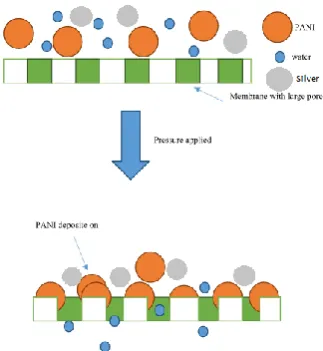
The coating process was done by employing the pressure deposition method using ultrafiltration permeate machine. The concept of coating deposition is shown in Figure 1. Figure 1 shows that PANI and silver was acting as foulant and deposited on the membrane after pressure been applied. Theoretically, the deposition depends on time PANI and silver deposited on the membrane surface. The design of experiment was focused on the effect of time chemical additive deposited on the membrane surface. The reaction of deposition area depends on the time coating. The time was started from 30 min to 120 min.
2. 3. Characterization of PANI And PANI/Ag Membrane A Hitachi S-4800 field-emission scanning electron microscope (SEM, Japan) was used to study the microscopic structures of various membranes. The microscope has an energy dispersive X-ray spectrograph (EDX) detector.
Figure 1. Schematic diagram using deposition method
When studying the inner structure of a membrane, a cross-section was obtained by fracturing the membrane using liquid nitrogen. The sample was cut in 3 cm x 1 cm for this test.
VCA Optima contact angle machine was used to investigate hydrophilicity of the membrane. Wettability studies are defined as the measurement of contact angle as a primary data, which indicated the degree of wetting when the solid and liquid interact. Hydrophobic will occure when Contact angle 90 degrees and above while hydrophilic occure less than 90 degrees. The membrane was cut into 5 cm x 2 cm size. To measure the degree of contact angle, 2 μ L of water was carefully injected on to the membrane surface. After the water drop to the tip of the needle, the position of the moving plate was adjusted to fit with the scale in the screen monitor.
The membrane specimen was cut into the size of 2 cm x 2 cm and placed on to scanner tube was prepared. AFM was used to measure membrane surface roughness and the type of machine used is E-100 Park system. The value of average surface roughness was then recorded.
Rejection test for AgNO3/PANI/PSf membrane was tested using Pepsin, Trypsin, and BSA. The sample was cut in round shape and place it in the permeate machine. The solution for 3 type protein was added with 1 litter distilled water. The liquid will permeate though the membrane by driven pressure. After finish the permeate, the sample of water permeate was taken and store in the container. Each sample was taken to measure the rejected using UV – vis spectrophotometer.
3. RESULTS AND DISCUSSION
3. 1. Characterization Properties Of PANI And PANI/Ag Membrane SEM images of PSf, PANI and PANI/Ag microspheres are shown in Figure 2. As can be seen from the Figure 2(a) the membrane has no additive on
the surface. Figure 2(b) shows the membrane coating with PANI on the surface. The white and small particles on the Figure 2(b) show the presence of PANI element on the membrane surface. Figure 2(c) also show the presence of PANI/Ag with the existence of smaller particles on top of membrane surface both coated membrane show the formation of thin layers of non-homogenous structure with rougher surface area. This result is in line with previous research that showed the non-homogenous surface was formed on the membrane after several cycles of depostion technique [15].
Further information on the elemental composition of the coated samples can be determines by EDX analysis. Figure 3 also shows the EDX spectrum of membrane not only PSf but with additive PANI and Ag. The EDX results in Figure 3(a) confirmed the presence of only oxygen, O, carbon, C and sulphur, S elements in the membrane. This proven the membrane are not coated with other chemical. The spectrum Figure 3 (b) shows that membrane coated with PANI consist of O, C, S and nitrogen, N elements. The present of nitrogen element where possessed by PANI are able to detect at 0.4 KeV [16].
The result also shows that the PANI tend to agglomerate and form a cake layer on the top membrane surface.
Figure 2. SEM images of (a) PSf (b) PSf / PANI and (c)
This is because of strong interaction between PANI and membrane surface and no anti – agglomeration agent was added to prevent such phenomena happen. The distribution peak of silver, Ag in membrane was confirmed by the EDX elemental mapping as shown in Figure 3(c). The EDX elemental mapping clearly shows the peak of Ag eventhough slightly low in concentration revealed that the membrane was sucessfully coated using deposited method.
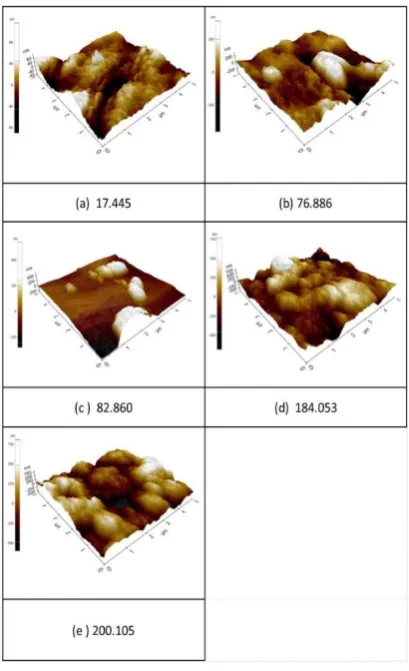
AFM test was conducted to inspect the effect of the additive on the surface roughness for all the coated membrane. The surface roughness, Ra parameters of the membranes were calculated using XE software Figure 4 shows the surface roughness of membrane that prepared in this area study. The result clearly showed the roughness on membrane increased as coating time increases for both coating materials. This is due to the presence of PANI and silver particles on the membrane surface.
As coating time increases, the surface roughness of
Figure 3. EDX result for (a) PSf (b) PSf / PANI and (c)
PSf/PANI/Ag membrane.
the membrane also increases due to increment of the PANI and PANI/silver particles. As compared with membrane coating with PANI only, the membrane coating using PANI/silver shows higher surface roughness. This might be due to the presence of different particles geometry between silver and PANI increased the membrane surface roughness. According to Mollahosseini et al. [15], the presence of silver able to transform the membrane surface became rougher due to the incompatibility of silver with polymeric membrane. Thus, as coating time increased, the amount of silver on membrane surface will increase and this will attribute to higher surface roughness.
The contact angle measurement was used to investigate the adhesion properties of PANI with water on the membrane surface. Figure 5 show the resulting effect of PSf membrane coated with PANI based on different coating times. As shown in Figure 5, the pristine membrane possesses high contact angle as compared to coated membrane.
Figure 4. SEM images of surface roughness of the
Figure 5. Result of water contact angle on PSf membrane coated with PANI
The hydrophilicity of the membrane depends on the lowest possible angle of water as attched to the membrane surface. It was shown in that figure, as coating time increases, the contact angle of the membrane with water also increased. This result might occur due to hydrophilic properties of PANI on top of membrane surface promoted the reduction of contact angle. Furthermore, similar result was observed by Razali et al. [10], which found that PANI tend to reduce membrane contact angle value as its changed the surface of the membrane to become more hydrophilic. Another possibility was due to high surface roughness due to the accumulation of PANI on the membrane surface and provides cake layer formation with non-uniform roughness. Hence, the contact angle of water was affected and water tend to diffuse in the membrane.
The effect of PANI/Ag coated on PSf on the contact angle was depicted in Figure 6. As shown in this figure the contact angle of the membrane was reduced as the coating time increases. However, the result shows that contact angle of the membrane coated with PANI / Ag slightly higher as compared with a membrane coated with PANI only. The result implies that addition of silver decreased hydrophilicity properties of the membrane, although silver was known as hydrophilic materials [17].
Figure 6. Result of water contact angle on PSf membrane
coated with PANI/Ag
This may be due to the surface properties of solid silver particles which is quite shiny and reflected, that make water to penetrate or adhere on the surface. These results indicates that PANI was more hydrophilic as compared to silver. Thus, the addition of silver has not enhanced the hydrophilicity of membrane.
3. 2. Performance of the Membrane Additive Toward 3 Type Protein The influence of coating time for PANI and PANI/Ag particles on the rejection performance of the membrane is shown in Table 1. As shown in this table, the rejection percentage of the membrane were increased as coating time increases. The result showed that membrane can completely reject BSA. This result might be due to the prepared membrane has a smaller pore size as compared to BSA. The table also shows that coated membrane able to reject pepsin 40 and 30% for trypsin as to compared with the pristine membrane. This may be due to the pore size of the membrane was reduced as the coating is applied on the membrane surface. This result was in line with Arthanareeswaran et al. [18], research stated that BSA was rejected more than Pepsin and Trypsin due to the effect of additive that able to reduce pore size.
TABLE 1. Percentage rejected of the membrane against
Pepsin, Trypsin, and BSA solution
4. CONCLUSION
noticed in membrane coated with PANI / Ag compared to membrane coated with PANI only. Similar pattern was also observed in hydrohilicity as increased coating particles, hydrophilicty also increased for both coated membrane. This indirectly influence the membrane performance. All of the results regarding the permeation showed that coated membrane with PANI and PANI/Ag was able to enhance the improve the rejection toward protein solution which recorded the 100% BSA and up to 98.4% and 90% for pepsin and trypsin protein rejection.
Lastly, it was found that the membrane performance was improved with presence of PANI and silver on the protein separation process by deposition method.
5. ACKNOWLEDGEMENT
The authors would like to thank the Advance Manufacturing and Material Centre (AMMC), Department of Materials and Design Engineering, Faculty of Mechanical and Manufacturing Engineering, Universiti Tun Hussein Onn Malaysia for funding this research under TRGS grant Vot no. T001 and FRGS vot check also Ministry of Higher Education (MOHE), Malaysia.
6. REFERENCES
1. The Star 'Selangor rivers polluted'. 12 October 2012. Malaysian Newspaper,
https://www.thestar.com.my/news/nation/2012/10/12/selangor-rivers-polluted/
2. N. H. Ab Razak, S. M. Praveena, A. Z. Aris, and Z. Hashim, “Quality of Kelantan drinking water and knowledge, attitude and practice among the population of Pasir Mas, Malaysia,” Public Health, Vol. 131, (2015), 103–111.
3. S. A. Kadhum, M. Y. Ishak, S. Z. Zulkifli, and R. binti Hashim, “Evaluation of the status and distributions of heavy metal pollution in surface sediments of the Langat River Basin in Selangor Malaysia,” Marine Pollution Bulletin, Vol. 101, No. 1, (2015), 391–396.
4. S. T. Forczek, M. Pavlík, J. Holík, L. Rederer, and M. Ferenčík, “The natural chlorine cycle - Formation of carcinogenic and greenhouse gas compound chloroform in drinking water reservoirs,” Chemosphere, Vol. 157, 1–30, (2016).
5. S. Mandal, S. Natarajan, A. Tamilselvi, and S. Mayadevi, “Photocatalytic and antimicrobial activities of zinc ferrite nanoparticles synthesized through soft chemical route: A magnetically recyclable catalyst for water/wastewater treatment,”. Journal of Environmental Chemical Engineering, Vol. 4, No. 3, (2016), 2706–2712.
6. L. Y. Ng, A. W. Mohammad, C. P. Leo, and N. Hilal, “Polymeric membranes incorporated with metal/metal oxide nanoparticles: A comprehensive review,” Desalination, Vol. 308, (2013), 15–33. 7. S. Jiang, Y. Li, and B. P. Ladewig, “A review of reverse osmosis
membrane fouling and control strategies,” Sci. Total Environment, Vol. 595, (2017), 567–583.
8. M. T. Khan, M. Busch, V. G. Molina, A. H. Emwas, C. Aubry, and J. P. Croue, “How different is the composition of the fouling layer of wastewater reuse and seawater desalination RO membranes?,” Water Research, Vol. 59, (2014), 271–282. 9. R. A. Al-Juboori and T. Yusaf, “Biofouling in RO system:
Mechanisms, monitoring and controlling,” Desalination, vol. 302, (2012), 1–23.
10. N. F. Razali, A. W. Mohammad, and N. Hilal, “Effects of polyaniline nanoparticles in polyethersulfone ultrafiltration membranes: Fouling behaviours by different types of foulant,”
Journal of Industrial Engineering Chemistry, Vol. 20, No. 5, (2014), 3134–3140.
11. G. Kang and Y. Cao, “Development of antifouling reverse osmosis membranes for water treatment: A review.,” Water Research, Vol. 46, No. 3, (2012), 584–600.
12. I. Sawada, R. Fachrul, T. Ito, Y. Ohmukai, T. Maruyama, and H. Matsuyama, “Development of a hydrophilic polymer membrane containing silver nanoparticles with both organic antifouling and antibacterial properties,” Journal of Membrane Science, Vol. 387–388, No. 1, (2012), 1–6.
13. M. R. Tokala, B. Padya, P. K. Jain, and C. H. Shilpa Chakra, “Preparation and characterization of graphene nano-platelets integrated polyaniline based conducting nanocomposites,”
Superlattices Microstructures, Vol. 82, (2015), 287–292. 14. L. Huang, S. Zhao, Z. Wang, J. Wu, J. Wang, and S. Wang, “In
situ immobilization of silver nanoparticles for improving permeability, antifouling and anti-bacterial properties of ultrafiltration membrane,” Journal of Membrane Science, Vol. 499, (2016), 269–281.
15. A. Mollahosseini, A. Rahimpour, M. Jahamshahi, M. Peyravi, and M. Khavarpour, “The effect of silver nanoparticle size on performance and antibacteriality of polysulfone ultrafiltration membrane,” Desalination, Vol. 306, (2012), 41–50.
16. I. Arshadnia, M. Movahedi, and N. Rasouli, “SnFe2 O4 /SnO2
/PANI magnetically separable photocatalyst for decolorization of two dye mixture in aqueous solution,” Surfaces and Interfaces, Vol. 8, No. July 2016, (2017), 91–96.
17. X. Chen, Z. Wang, S. Bi, K. Li, R. Du, C. Wu, and L. Chen, “Combining catalysis and separation on a PVDF/Ag composite membrane allows timely separation of products during reaction process,” Chemical Engineering Journal, Vol. 295, (2016), 518–529.
18. G. Arthanareeswaran, T. K. Sriyamuna Devi, and D. Mohan, “Development, characterization and separation performance of organic-inorganic membranes. Part II. Effect of additives,”
The Coating Effect of PANI/Silver on Performance of Polysulfone Membrane Toward
Protein Separation
A. Q. A. Rashidb, Z. Haruna,b, M. Z. Yunosa,b, A. Ahmab, R. A. R. Ahmadb, F. H. Azharb
a Departmentof Materials and Design Engineering, Faculty of Mechanical and Manufacturing Engineering, Universiti Tun Hussein Onn Malaysia,
86400 Parit Raja, Johor, Malaysia
b Advanced Materials and Manufacturing Centre (AMMC), Faculty of Mechanical and Manufacturing Engineering, Universiti Tun Hussein Onn
Malaysia, 86400 Parit Raja, Batu Pahat, Johor Darul Takzim, Malaysia
P A P E R I N F O
Paper history:
Received 15 December 2017
Received in revised form 26 March 2018 Accepted 26 March 2018
Keywords: Deposite PANI Silver Nitrate BSA Protein هديكچ
فلتخم ششوپ نامز تارثا PANI
یلپ یاشغ حطس هب هرقن / ( نوفلوس
PSf حطس یربز ،سامت هیواز ،یژولوفروم ساسا رب )
و BSA یرگلابرغ ءاشغ تمس هب راشف بوسر شور زا هدافتسا اب اشغ .تفرگ رارق یسررب دروم نیسپرتیت شوارت و نیسپپ ،
تارذ ،نیاربانب .دش هیهت زاف PANI
ر رب دندش روبجم ششوپ نامز تدم .دنریگ رارق راشف تحت راشف یورین اب اشغ حطس یو
زا هدش هداد
30
ات هقیقد
120
فاص حطس هب هجوت اب ،لاح نیا اب .دش ظاحل هقیقد PSf
تارذ ، PANI زا تشگزاب هب رداق
حطس PSf روضح ،نیا رب هولاع .دندوب
PANI/Ag
رییغت هب هجوت اب فافش تادهاشم .دوب زیامتم اشغ حطس یور رب زین
جیاتن .دش هدهاشم فافش حطس ات فاص حطس زا اشغ حطس EDS
هداد زا هدافتسا اب SEM
روضح ، PANI و
PANI/Ag
تقد اب سامت هیواز شهاک اب اشغ ندوب لیفوردیه .داد ناشن حطس یاشغ رد ار
75
ات
40
نامز تدم یارب هجرد زا
0
ات
120
اب هدش هداد ششوپ یاشغ یارب هقیقد PANI
اب هدش هداد ششوپ یاشغ ،نمض رد .دش تابثا
PANI/Ag
شهاک زین
زا ار
75
هب
50⁰
اب ششوپ زا دعب هک اشغ حطس یربز اب هک دوب نیا هجیتن .دهد یم ناشن PANI
ات دبای یم شیازفا
79
٪ و
90٪
اب ششوپ زا سپ
PANI/Ag
رثا زا سپ
120
هنومنزیر یاشغ درکلمع رب رتلااب حطس یربز .دبای یم شیازفا هقیقد
ات BSA اشغ ،بآ یریگدر نومزآ یارب .تسا هتشاذگ ریثأت PSf در ، 100 ٪ ، 60.42 ٪ و 50 ٪ یارب BSA نیسپیرت و نیسپپ ،
تدم هب اشغ نداد ششوپ زا سپ .داد ناشن ار
30 ،هقیقد 100 ٪ ، 90.21 ٪ و 77.23 ٪ ششوپ یارب PANI و 100 ٪ ، 92.30٪ و 80.30 ٪ اب ششوپ زا سپ
PANI/Ag
تدم یارب .دمآ تسدب
120
یاشغ هک دهد یم ناشن جیاتن ،هقیقد
در هب رداق هدش هداد ششوپ
100
٪ BSA دهد یم ناشن ار نآ نیسپیرت و نیسپپ یارب ،
96.15
٪ و
87.98
٪ هک یلاح رد
اب هدش هداد ششوپ یاشغ
PANI/Ag
هد یم ناشن نآ ، د 100 ٪ BSA ات و 98.41 ٪ و 90.60
و نیسپپ نیئتورپ دصرد
روضح اب اشغ درکلمع یسررب ،نایاپ رد .نیسپرت PANI
بوسر شور زا هدافتسا اب نیئتورپ یزاسادج دنیآرف یور رب هرقن و
.دیدرگ ماجنا یهد