A Solvent Free and Efficient Knoevenagel Condensation;
Using Solid Mixed Metal Oxide Fe
2O
3/SnO
2as
Heterogeneous Catalyst
Potu. Ramchander and Battu Satyanarayana
Department of Chemistry, University College of Science, Osmania University, Hyderabad-500 007, Telangana, INDIA.
email: [email protected]
.
(Received on: March 8, Accepted: March 13, 2017)
ABSTRACT
An eco-friendly convenient and economic method for Knoevenagel condensation of aromatic aldehydes with active methylene compounds usingFe2O3/
SnO2 as heterogeneous catalyst under a solvent free condition at room temperature
within short reaction time, high yields and easy separation by simple filtration. The catalyst was reused for further reaction without loss catalytic activity. Catalyst has been prepared by wet impregnation method using aqueous condition and catalyst was characterized by XRD, SEM, EDX, FTIR and UV-DRS.
Keywords: Solvent free, Fe2O3/SnO2, Heterogenous catalyst, eco-friendly.
INTRODUCTION
Carbon–carbon bond formation is very important reaction in organic synthesis, Knoevenagel condensation has been extensively investigated in view of it significance. The Knoevenagel condensation has been carried out between aldehydes with active methylene compounds has been commonly employed in the synthesis of numerous fine chemicals,1
therapeutic drugs,2 natural products3 and functional polymers.4In general, this type of
condensation is performed in presence of number of acid–base reagents or catalysts such as ethylene diamine,5 dimethyl amino pyridine6, potassium fluoride mixture7, surfactants8, ionic
liquids9, modified silica10, anionic resins,11 alkaline earth oxides12, calcined hydrotalcites13,
aluminophosphate oxinitrides 14, alkali cation exchanged X and Y zeolites 15-17 and so. On have
made to perform the Knoevenagel condensation in green conditions. The growth of heterogeneous catalysts and how they affect specific reactions in chemical synthesis has turn into a major area of research. The prospective advantages of these materials over homogeneous systems, in terms of their easy recovery and reusability, could potentially allow for the progress of environmentally benign chemical reactions in both industrial and academic settings. We investigated the application of the Fe2O3/SnO2, as a catalyst for Knoevenagel
condensation. This new reusable heterogeneous catalyst performed well and showed a high level of catalytic activity in the Knoevenagel condensation.
EXPERIMENTAL
Chemistry
Catalyst preparation
Dissolve 50 grams of SnCl2 2H2O in distilled water add 0.1M (NH4OH) white
precipitate is formed filtrate the compound using Buchner funnel wash with methanol-free from chloride ions then dried the compound in oven 12 hours at 150oC then pulverisation of
the compound taken 25 grams of Sn(OH)4dissolve in distilled water then add water dissolved
Fe(NO3)39H2O to that compound then heating on water bath dry precipitate was formed then
pulverising the compound and dried in oven overnight at 150oC further calculations at 650oC
for 4 hours.
Catalyst characterization
The powder X-ray diffraction patterns were recorded on PAN alytical B.V Lelyweg 17602 EA Almelo the Netherlands instrument by using nickel-filtered Cu, Kα radiation and scintillation counter detector. The scattered intensity data were recorded from 2θ values scanning range from 10 to 80 by scanning at a scan speed of 2.000 (deg/min), sampling pitch 0.0200 deg and preset time 60 (sec). Debey-Scherrer equation is used to calculate the average crystalline size of the particle. Scanning Electron Microscope (SEM) investigations performed on ZEISS Evo 18 Oxford inca x-act Penta FET Precision. The FT-IR spectrum of the catalyst was recorded on a SHIMADZU model: A21005002961 spectrometer at ambient conditions. Self-supporting KBr pellets containing the catalyst samples were used to scan the spectra.UV-DRS spectra were recorded SHIMADZU UV-3600 for sample preparation using BaSO4. The 1H NMR spectra were recorded at 400 MHz of Bruker Ultrashield (Avance-III) Nano Bay
spectrometers using TMS as an internal standard.
General procedure for knoevenagel condensation
A mixture of aldehyde (1mmol), and malononitrile (1.2mmol) and the catalyst 5wt% Fe2O3/SnO2 (30 mg) was taken in a 50ml round bottom flask. This reaction mixture was stirred
reactions. The solvent of the filtrate was evaporated under reduced pressure and the crude product purified by recrystallization from ethanol. The products obtained were identified by IR, 1H NMR.
Model reaction
(1. a-o) (3. a-o)
Scheme-1
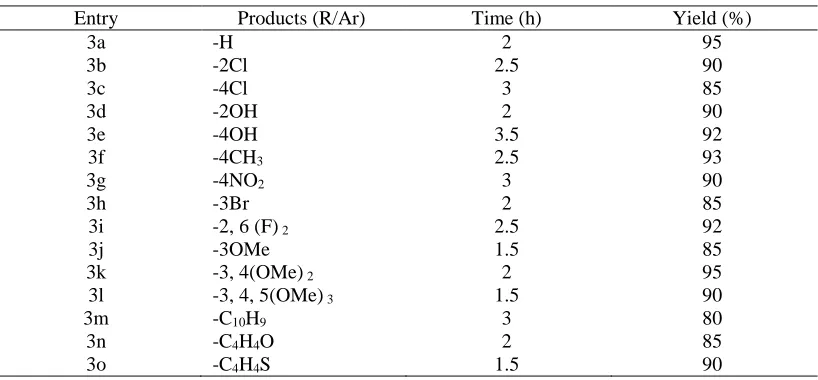
Table 1. Knoevenagel condensation analogues
Entry Products (R/Ar) Time (h) Yield (%)
3a -H 2 95
3b -2Cl 2.5 90
3c -4Cl 3 85
3d -2OH 2 90
3e -4OH 3.5 92
3f -4CH3 2.5 93
3g -4NO2 3 90
3h -3Br 2 85
3i -2, 6 (F) 2 2.5 92
3j -3OMe 1.5 85
3k -3, 4(OMe) 2 2 95
3l -3, 4, 5(OMe) 3 1.5 90
3m -C10H9 3 80
3n -C4H4O 2 85
3o -C4H4S 1.5 90
RESULTS AND DISCUSSION
The powder X-ray diffraction patterns of SnO2 and Fe, promoted SnO2 samples
calcined at 650K are presented in Fig.1. All the diffraction peaks coincide with tetragonal phase (JCPDS card 41-1445). In this figure, three intense peaks appeared at 2θ values at 26, 33, and 510. Can be associated with (110) (101) (211) planes respectively indicating the
tetragonal phase of Fe, promoted SnO2. The average particle size was calculated using the
Scherrer equation D = 0.9λ/β cosθ where D is the average crystalline size, λ is X-ray wavelength, β is FWHM of the diffraction lines and θ is the diffraction angle. Calculation
using the equation shows the average crystalline size for pure SnO2 and Fe, promoted SnO2 is
0.30 µm. There is no difference in the particle size for a supported and unsupported sample, but the activities in knoevenagel condensation were different. Pure SnO2 was totally inactive
whereas Fe, promoted SnO2 is found be active.
Fig.1. XRD Spectra of SnO2 and Fe2O3/SnO2
SEM analysis was carried out to investigate the morphology of the samples. Fig.2 shows SEM images of SnO2 and Fe, promoted SnO2 catalyst (a and b). As can be seen from
the micrograph, there is no much difference in SEM photographs of SnO2 and Fe, promoted
SnO2 catalyst except a small change in the structure of SnO2, due to incorporating of Fe. It is
clearly seen the particles are uniformly distributed all over the surface and observed to be spherical in shape. These results are in agreement with that of XRD results having a tetragonal phase with same crystallite size. Higher activity for iron promoted SnO2 catalyst is due to
uniform distribution of particles all over the SnO2. The average crystalline size of the particles
was observed to be same in both the samples from SEM photographs.
Figure 3. shows EDX spectrum of (a) pure SnO2 and (b) Fe2O3/SnO2 is shown. Pure
SnO2 exhibits peaks corresponding to Sn and O, no impurity is observed whereas Fe2O3/SnO2
exhibits peaks corresponding to Fe, Sn, and O indicating incorporation of Fe into SnO2. The
amount of Fe, doped shown in the EDX result is close to that we required stoichiometric ratio 5wt%.
Fig.3. EDX Images of SnO2 and Fe2O3/SnO2
Figure 4. Shows the FTIR spectra of SnO2 nanoparticles. The small absorption peak
at 2989cm-1 is attributed to OH groups of adsorbed water bound at SnO
2 surface while the peak
at 1217cm-1 is due to C-H stretching mode. The peak at 1737 cm-1 may also be related to
bending vibrations of water molecule trapped in SnO2 sample The characteristic band Peak
concluded that because of calculations, condensation of hydroxyl groups of Sn(OH)4 leads to
a crystallized sample.
In order to analyze the changes in the optical properties caused by supporting Fe2O3
doped on SnO2, the samples were analyzed by UV–VIS diffuse reflectance spectroscopic
technique and the results are displayed in Fig. 5. As can be seen, the absorption peak of SnO2
lies in the range of visible region. The absorption band of pure SnO2 is at 300 nm, and the
calculated band gap value is 4.13 eV. The band gap of the sample can be estimated by using the formula: Eg=1240/λ, where Eg is the band gap energy and λ is the wavelength of the absorption edge. A red shift was observed for the Fe2O3 /SnO2, It is due to the incorporation of
Fe2O3.The band gap of supported Fe2O3 /SnO2 shows red shift when compared to pure SnO2,
that is the absorption edge shifted from 300 to 310 nm and the band gap energy calculated is 4.00 eV. This shift toward lower energy in the sample is due to the contribution of Fe2O3.
Fig: 5.UV- DRS SPECTRA of SnO2 andFe2O3/SnO2
Spectral data: 1HNMR & FTIR
1. 2-Benzylidenemalononitrile (3a): 1H NMR (400 MHz, CDCl3, ppm): δ= 7.92 (d, 2H),
7.79 (s, 1H), 7.64 (d, 1H), 7.54 (s, 2H). IR (KBr, cm_1): 3798, 3690, 3394, 2930, 1205, 671.
2.2-(2-Chlorobenzylidene)malononitrile (3b):1H NMR (400 MHz, CDCl3, ppm): δ=7.47(d
2H), 7.55 (d, 1H), 7.28 (d, 1H), 7..37 (s, 1H): IR (KBr, cm1): 3051, 2928, 2227, 1587, 1439,
1371, 1288, 1212, 1129, 1045, 959, 755, 700.
3.2-(4-Chlorobenzylidene)malononitrile (3c): 1H NMR (400 MHz, CDCl3, ppm): δ= 7.88
(d, 2H), 7.74 (s, 1H), 7.55(d, 2H). IR (KBr, cm_1): 3084, 3047, 2225, 1595, 1527, 1355, 1215,
952.
4.2-(2-Hydroxybenzylidene)malononitrile (3d): 1H NMR (400 MHz, CDCl3 ppm). δ=
6.80-7.50 (m, 4H), 7.80 (s, 1H), 5.20 (br s, 1H). IR (KBr, cm_1): 3364, 3184, 2916, 2197, 1219,
752.
5.2-(4-Hydroxybenzylidene)malononitrile (3e):
1
H NMR (400 MHz, CDCl3 ppm). δ= 2.40
2838, 2230, 1712, 1674, 1605, 1590, 1510, 1459, 1367, 1278, 1218, 1161, 1105, 1049, 962, 835, 731.
6.2-(4-Methylbenzylidene)malononitrile (3f): 1H NMR(400 MHz, CDCl3, ppm): δ= 2.50 (s
3H),7.33 (d, 2H), 7.72 (s, 1H) 7.81 (d, 2H): IR (KBr,cm-1 ): 2920,2217,1722, 1595, 1514,
1368, 1268, 1209, 1187, 1092, 1021, 969, 896, 848, 816, 757.
7.2-(4-Nitrobenzylidene)malononitrile (3g):1H NMR (400 MHz, CDCl3, ppm): δ= 8.38 (d,
2H), 8.07-8.04 (d, 2H), 7.87 (s, 1H); IR (KBr, cm_1): 3032, 2227, 1597, 1589, 1579, 1411,
1263, 1024, 692.
8.2-(3-Bromobenzylidene)malononitrile (3h): 1H NMR (400 MHz, CDCl3, ppm): δ=
7.30-7.50 (m, 3H), 7.40 (s,1H), 7.60 (s, 1H). IR (KBr, cm_1): 3801, 3051, 2922, 2294, 1566, 1199,
675.
9. 2-(2, 6-Difluorobenzylidene)malononitrile (3i):1H NMR(400 MHz, CDCl3, ppm): δ=
6.80- 7.20 (m, 3H), 8.00 (s, 1H). IR (KBr, cm_1): 3825, 3067, 2941, 2592, 2222, 852, 717.
10. 2-(3-Methoxybenzylidene) malononitrile (3j): 1H NMR (400 MHz, CDCl3, ppm): δ=
6.80- 7.60 (m, 3H), 7.70 (s, 1H), 3.50 (s, 3H), IR (KBr, cm_1): 3087, 2937, 2226, 1514, 1271,
771.
11. 2-(3, 4-Dimethoxybenzylidene) malononitrile (3k):1H NMR(400 MHz, CDCl3, ppm):
δ= 6.80 (d, 2H), 7.10 (d, 1H), 3.50 (s, 6H), 7.50 (s, 1H). IR (KBr, cm_1): 2937, 2214, 1485,
1257, 1014, 829.
12. 2-(3, 4, 5-Trimethoxybenzylidene) malononitrile (3l): 1H NMR(400 MHz, CDCl3,
ppm): δ= 6.50 (s, 1H), 6.60 (s, 1H), 3.60 (s, 9H), 7.60 (s, 1H). IR (KBr, cm_1): 2933, 2214,
1570, 1460, 1124, 991, 632.
13. 2-(Naphthalen-1-ylmethylene)malononitrile (3m): 1H NMR(400 MHz, CDCl3, ppm):
δ= 7.50 - 8.00 (m, 4H), 7.60 – 7.90 (m, 3H), 7.90 (s, 1H).IR (KBr,cm_1): 3798, 3028, 2216,
1737, 1554, 1224, 757.
14. 2-(Furan-2-ylmethylene)malononitrile (3n): 1H NMR (400 MHz, CDCl
3). δ = 6.70
(d, 1H), 7.45 (d, 1H), 7.56 (d, 1H), 7.80 (s, 1H) IR (KBr, cm_1): 3124, 3041, 2922, 2231, 1606,
1529, 1456, 1394, 1296;
15.2-(Thiophen-2-ylmethylene)malononitrile (3o): 1H NMR (400 MHz, CDCl
3, ppm):
δ= 7.85 (d, 1H), 7.78 (d 1H), 7.26 (d, 1H), 7.80 (s, 1H) IR (KBr, cm_1): 2981,2935, 2274,
2158, 1645, 1448, 1184.
CONCLUSION
In conclusion, we have demonstrated Fe2O3/SnO2 heterogeneous solid acid catalyst
ACKNOWLEDGEMENT
The author PRC (UGC-SRF) thanks to University Grants Commission (UGC) for financial support of this work.
REFERENCES
1. Freeman, F. Propertiesand reactions of ylidenemalononitriles. Chem.Rev.80(4), 329-350 (1980).
2. Kraus, G. A., & Krolski, M. E. Synthesis of a precursor to quassimarin. J. Org. Chem. 51 (17), 3347 (1986).
3. Tietze, L. F., & Rackelmann, N. Domino reactions in the synthesis of heterocyclic natural products and analogs. Pure Appl. Chem.76 (11), 1967-1983 (2004).
4. Liang, F.,Pu,Y. J., Kurata, T., Kido, J., & Nishide, H. Synthesis and electroluminescent property of poly (p-phenylenevinylene)s bearingtriarylamine pendants. Polymer, 46(11), 3767-3775 (2005).
5. Kraus, G. A., & Krolski, M. E. Synthesis of a precursor to quassimarin. J. Org. Chem 51(17), 3347 (1986).
6. Tietze, L. F., & Rackelmann, N. Domino reactions in the synthesis of heterocyclic natural products and analogs. Pure Appl.Chem. 76(11), 1967-1983 (2004).
7. Augustine, J. K., Naik, Y. A., Mandal, A. B., Chowdappa, N., & Praveen, V. B. Gem-Dibromomethylarenes: A convenient Substitute for Noncommercial Aldehydes in the Knoevenagel− Doebner Reaction for the Synthesis of α, β-Unsaturated Carboxylic Acids.
J. Org. Chem 72(25), 9854-9856 (2007).
8. Mukhopadhyay, C., & Datta, A. A simple, efficient and green procedure for the Knoevenagel condensation of aldehydes with N-methylpiperazine at room temperature under solvent-free conditions. Synth. Commun. 38(13), 2103-2112 (2008).
9. Ranu, B. C., & Jana, R. Ionic Liquid as Catalyst and Reaction Medium–A Simple, Efficient and Green Procedure for Knoevenagel Condensation of Aliphatic and Aromatic Carbonyl Compounds Using a Task‐Specific Basic Ionic Liquid. Eur. J. Org. Chem. 2006(16), 3767-3770 (2006).
10. Forsyth, S. A., Fröhlich, U., Goodrich, P., Gunaratne, H. N., Hardacre, C., McKeown, A., & Seddon, K. R. Functionalised ionic liquids: synthesis of ionic liquids with tethered basic groups and their use in Heck and Knoevenagel reactions. New J. Chem. 34(4), 723-731 (2010).
11. Choudary, B. M., Kantam, M. L., Neeraja, V., Rao, K. K., Figueras, F., & Delmotte, L. Layered double hydroxide fluoride: a novel solid base catalyst for C–C bond formation. Green Chem.3 (5), 257-260 (2001).
13. Lee, A., Michrowska, A., Sulzer‐Mosse, S., & List, B. The catalytic asymmetric Knoevenagel condensation. Angew. Chem. Int. Ed. 50(7), 1707-1710 (2011).
14. Rahmati, A., & Vakili, K. L-Histidine and L-arginine promote Knoevenagel reaction in water. Amino Acids, 39(3), 911-916 (2010).
15. Dandia, A., Parewa, V., Jain, A. K., & Rathore, K. S. Step-economic, efficient, ZnS nanoparticle-catalyzed synthesis of spirooxindole derivatives in aqueous medium via Knoevenagel condensation followed by Michael addition. Green chem. 13(8), 2135-2145 (2011).
16. Leelavathi, P., & Kumar, S. R. Niobium (V) chloride catalyzed Knoevenagel condensation: An efficient protocol for the preparation of electrophilic alkenes. J. Mol.
Catal. A: Chem. 240(1), 99-102 (2005).
17. Fildes, D., Caignaert, V., Villemin, D., & Jaffrès, P. A. Potassium exchanged zirconium hydrogen phosphate Zr(O3POK)2: a heterogeneous basic catalyst for Knoevenagel